
Depop vs Shopify: Which Is Better for Sellers in 2026?
A side-by-side comparison of fees, traffic, features, and what real sellers think — plus how to use both together with FLUF Connect.



- Choose Depop if: you want instant access to 7 million fashion-obsessed buyers without spending a penny on marketing. Depop is a marketplace — list your items and buyers find you through search, feeds, and social discovery.
- Choose Shopify if: you want to build your own brand, own your customer relationships, and control every aspect of your store — from design to checkout to email marketing. Shopify is a platform — you build the store and drive the traffic yourself.
- Fees: Depop charges zero commission (UK/US) with 2.9% + £0.30 payment processing per sale. Shopify charges £19–259/month subscription plus 2% + 25p payment processing — no per-sale commission.
- Traffic: This is the critical difference. Depop has 7 million built-in buyers actively browsing. Shopify has zero — every visitor to your store must come from your own marketing efforts (social media, SEO, paid ads).
- Best strategy: Use both — sell on Depop for instant reach, build a Shopify store for long-term brand equity. FLUF Connect syncs both automatically.
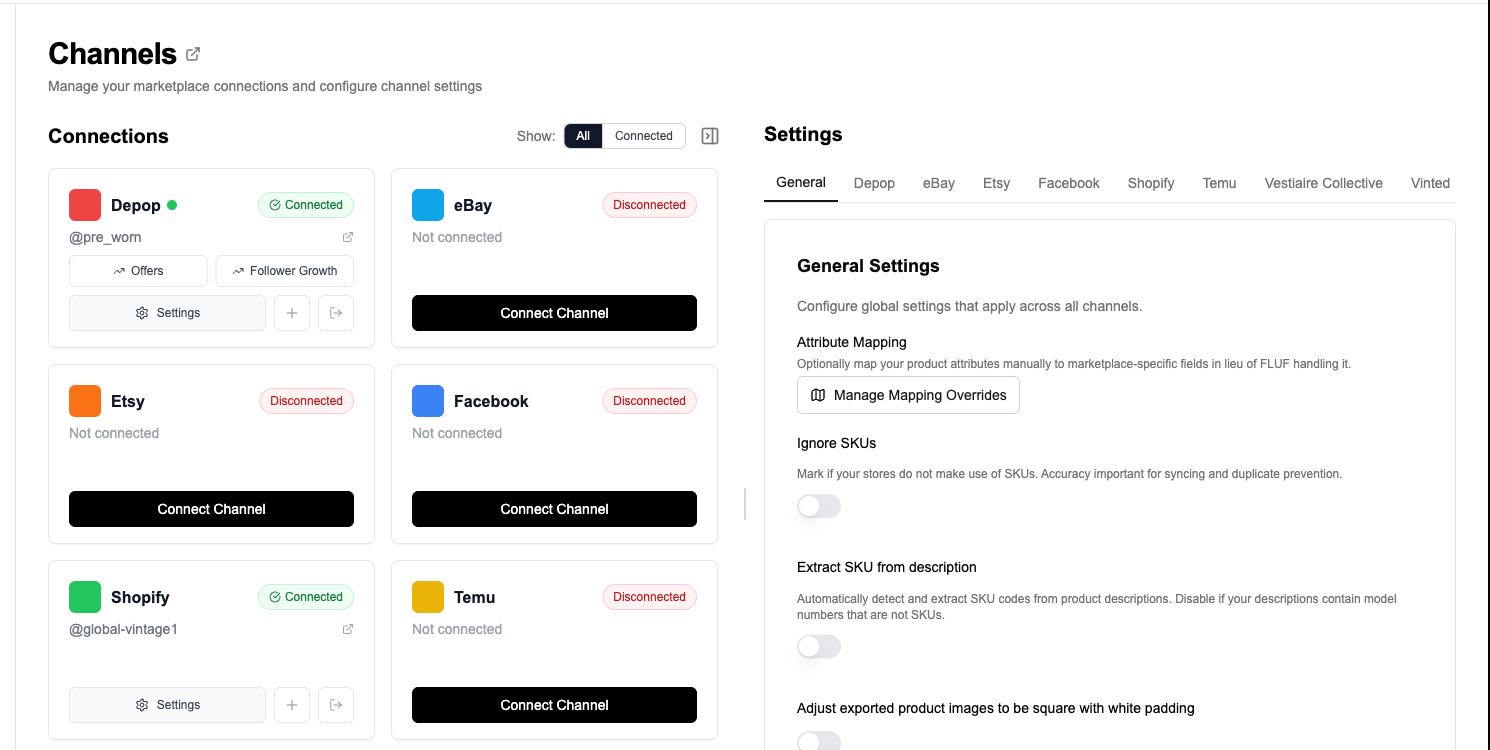
Depop vs Shopify at a Glance
Depop and Shopify are fundamentally different types of selling platforms, and understanding that difference is the key to choosing between them. Depop is a marketplace — it has built-in buyers who browse and search for items. Shopify is a platform — it gives you the tools to build your own online store, but brings zero buyers. You drive all the traffic yourself.
Think of it like this: Depop is a stall in a busy market where thousands of shoppers walk past every day. Shopify is your own shop on a quiet street — beautifully designed, fully yours, but you need to put up signs and run advertising to get anyone through the door.
Depop was founded in 2011 in London as a social marketplace for second-hand fashion. With 7 million active buyers (90% under 34), it’s where Gen Z shops for vintage, streetwear, and one-of-a-kind pieces. Depop is being acquired by eBay for $1.2 billion (expected Q2 2026), having been owned by Etsy since 2021.
Shopify was founded in 2006 in Ottawa, Canada, and is now one of the world’s largest e-commerce platforms. Over 5.5 million stores run on Shopify across 175+ countries, collectively generating $292 billion in GMV in 2024. Shopify powers everything from one-person vintage shops to global brands like Gymshark and Allbirds.
| Depop | Shopify | |
|---|---|---|
| Type | Marketplace (built-in buyers) | E-commerce platform (build your own store) |
| Founded | 2011 | 2006 |
| Headquarters | London, UK | Ottawa, Canada |
| Active buyers / stores | 7 million buyers | 5.5 million+ stores (no buyer count — each store has its own audience) |
| Built-in traffic | Yes — browse, search, feeds, explore page | No — seller drives all traffic |
| Best for | Second-hand fashion, vintage, streetwear | Any product — new, used, digital, services |
| Seller fees | Zero commission (UK/US). Processing: 2.9% + £0.30 | Subscription: £19–259/month. Processing: 2% + 25p (Basic) |
| Brand control | Minimal — profile page within Depop | Complete — your own domain, design, branding |
| Customer data ownership | No — Depop owns the buyer relationship | Yes — full customer data, email lists, analytics |
For a deeper look at each platform individually, see our full guides: How to Sell on Depop and How to Sell on Shopify.
Depop vs Shopify: Feature-by-Feature Comparison
Depop gives you marketplace infrastructure — search, discovery, payments, and buyer protection — in exchange for operating within its ecosystem. Shopify gives you complete control over every aspect of your business — but you build everything yourself.
| Feature | Depop | Shopify |
|---|---|---|
| Product discovery | Built-in — search, explore feed, hashtags | None — you must drive traffic via SEO, social media, ads |
| Shop branding | Minimal — profile photo, bio, banner | Complete — custom domain, themes, logos, branded checkout |
| Customer data | No access to buyer emails or data | Full ownership — email lists, purchase history, analytics |
| Email marketing | Not available | Built-in (Shopify Email) + integrations (Klaviyo, Mailchimp) |
| Payment processing | Depop Payments (Stripe) — no choice | Shopify Payments or 100+ third-party gateways |
| Offer/haggle system | Yes — Make an Offer | No (unless you add an app) |
| Social features | Likes, follows, feed, community | None built-in — integrate with Instagram, TikTok, etc. |
| SEO control | Limited — hashtags, descriptions | Full — meta titles, descriptions, URLs, blog, sitemap |
| Product variations | No — one item per listing | Yes — sizes, colours, materials per product |
| Digital products | No | Yes — downloads, courses, subscriptions |
| Discount codes | No built-in tools | Yes — automatic discounts, codes, bundles, free shipping thresholds |
| Shipping integration | Depop Shipping (Evri UK, USPS US) | Shopify Shipping (discounted rates from Royal Mail, DPD, Evri, UPS, and more) |
| Analytics | Basic — views, likes | Advanced — traffic sources, conversion rates, customer lifetime value, sales reports |
| Mobile app | Core selling experience | Shopify mobile app for store management |
| Third-party apps | None | 8,000+ apps in Shopify App Store |
The trade-off is clear: Depop gives you buyers. Shopify gives you a business. Depop handles discovery, payments, and trust — but you’re a seller within their ecosystem, not a brand. Shopify lets you build a real brand with customer relationships, email marketing, and full analytics — but every single customer must be acquired through your own efforts.
Listing and Store Experience: Depop vs Shopify
Listing on Depop takes under a minute. Building a Shopify store takes days to weeks. But that comparison isn’t quite fair — they’re solving different problems.
On Depop, you list individual items for a marketplace audience. Upload photos, write a description with hashtags, set a price, choose shipping. The listing goes live to millions of potential buyers immediately. No design work, no domain setup, no marketing strategy needed. For someone selling 10 vintage jackets from their wardrobe, this is perfect.
On Shopify, you build an entire online store. Choose a theme, customise your design, set up your domain, create product pages, configure shipping rates, write an About page, set up payment processing, and plan how you’ll drive traffic. The initial setup is significantly more work — but the result is a professional online shop that you fully own and control. For someone building a vintage clothing brand, this is essential.
Ongoing effort also differs dramatically:
- Depop rewards constant activity — listing new items, refreshing old listings, liking and following, responding to messages. The algorithm favours active sellers. Stop listing for a week and your visibility drops.
- Shopify rewards marketing investment — SEO, social media content, email campaigns, paid advertising. Your store stays visible regardless of listing frequency, but traffic dries up if you stop marketing.
The sweet spot for most growing sellers: list on Depop for immediate sales while building a Shopify store for long-term brand value. FLUF Connect keeps products in sync across both.
Fees and Costs: How Much Do Depop and Shopify Actually Cost?
Depop and Shopify have completely different cost structures. Depop has no upfront costs — you only pay when you sell. Shopify charges a monthly subscription whether you sell or not. Which is cheaper depends entirely on your sales volume.
Depop Fees (UK)
Since March 2024, Depop charges zero seller commission in the UK. The only cost is payment processing: 2.9% + £0.30 per sale. No listing fees, no subscription, no monthly costs. You pay nothing until you make a sale. Optional Depop Boost costs 12% of the sale price if you choose to use it.
Shopify Costs (UK)
Shopify charges a monthly subscription plus payment processing per sale:
| Plan | Monthly Cost | Card Rate (Shopify Payments) | Third-Party Gateway Surcharge |
|---|---|---|---|
| Basic | £19/month (annual) / £24 monthly | 2% + 25p | 2% |
| Shopify (Grow) | £49/month (annual) / £69 monthly | 1.7% + 25p | 1% |
| Advanced | £259/month (annual) / £349 monthly | 1.5% + 25p | 0.6% |
| Plus | From $2,300/month | Custom rates | Custom |
There’s no per-sale commission on Shopify — just the subscription and payment processing. You keep more of each sale, but you pay the subscription even in months when you sell nothing.
| Fee Type | Depop (UK) | Shopify Basic (UK) |
|---|---|---|
| Monthly subscription | £0 | £19/month (annual billing) |
| Listing fee | Free — unlimited | Free — unlimited |
| Commission / transaction fee | Zero | Zero |
| Payment processing | 2.9% + £0.30 | 2% + 25p (Shopify Payments) |
| Promoted listings | Boost: 12% of sale (optional) | N/A (run your own ads externally) |
- Depop: Processing £1.17 (2.9% + £0.30) = You keep £28.83
- Shopify Basic: Processing £0.85 (2% + 25p) = You keep £29.15 (but pay £19/month subscription)
- 10 sales/month at £30 avg: Depop = £11.70 total fees. Shopify Basic = £27.50 (£19 sub + £8.50 processing). Depop is cheaper.
- 50 sales/month at £30 avg: Depop = £58.50 total fees. Shopify Basic = £61.50 (£19 sub + £42.50 processing). Roughly equal.
- 200 sales/month at £30 avg: Depop = £234 total fees. Shopify Basic = £189 (£19 sub + £170 processing). Shopify is cheaper.
The break-even point is around 50 sales per month. Below that, Depop’s zero-subscription model is cheaper. Above that, Shopify’s lower per-transaction rate plus fixed subscription becomes more cost-effective. But this calculation misses the biggest cost difference: marketing. On Depop, buyers find you for free. On Shopify, you must pay for advertising, invest in SEO, or build a social media presence — all of which cost time and money that doesn’t appear in the fee comparison.
Payout Comparison
| Depop | Shopify | |
|---|---|---|
| Payout method | Bank transfer (via Stripe) | Bank transfer (Shopify Payments) |
| Payout schedule | 10 working days after sale, or 2 days after delivery | Daily, weekly, or monthly (you choose). Typically 2–5 business days |
| New seller holds | 10-day default hold | May hold funds for new stores (varies) |
| Minimum payout | No minimum | No minimum |
Shopify pays faster and more predictably. You can set up daily payouts from day one, though new stores may experience temporary holds. For detailed cost breakdowns, see our full guides on selling on Depop and selling on Shopify.
Audience and Traffic: The Critical Difference
This is the single most important difference between Depop and Shopify — and the one most comparison articles understate. Depop brings you buyers. Shopify does not.
On Depop, 7 million active buyers are already browsing. They’re searching for vintage Nike, scrolling the explore feed for outfit inspiration, and following sellers whose style they like. Your listing appears in their search results the moment you publish it. You don’t need a marketing budget, an Instagram following, or SEO knowledge. The marketplace does the work of connecting buyers with your items.
On Shopify, your store launches to an audience of zero. You can build the most beautiful vintage clothing store on the internet, but nobody will visit unless you actively drive traffic. That means investing in at least one (ideally several) of:
- Social media — Instagram, TikTok, Pinterest (hours per week of content creation)
- Paid advertising — Meta Ads, Google Ads, TikTok Ads (£5–50+/day)
- SEO — blog content, product descriptions, technical optimisation (months to see results)
- Email marketing — building a subscriber list and sending campaigns (ongoing effort)
- Influencer partnerships — gifting or paying for promotion (variable cost)
The customer acquisition cost on Shopify is real and significant. A typical cost-per-purchase via paid ads for fashion e-commerce ranges from £10–30. On Depop, that acquisition cost is effectively £0 — the marketplace brings the buyer to you.
| Depop | Shopify | |
|---|---|---|
| Built-in buyers | 7 million active, browsing daily | Zero — you bring every visitor |
| Customer acquisition cost | £0 (marketplace handles discovery) | £10–30+ per purchase (via ads) |
| Time to first sale | Hours to days (if priced well) | Weeks to months (after store build + marketing) |
| Buyer demographics | Gen Z (16–26), fashion-focused | Whoever your marketing targets |
| Customer ownership | No — Depop owns the relationship | Yes — full email lists, purchase data, retargeting |
| Repeat customers | Limited — buyers follow sellers but discovery is algorithmic | Strong — email marketing, loyalty programmes, retargeting ads |
The long-term play: Depop is faster to start but you’re always dependent on the algorithm. Shopify is slower to build but creates an asset you own — a customer base, a brand, and a store that doesn’t disappear if a marketplace changes its rules. The smartest sellers use Depop for immediate cash flow while building a Shopify store for long-term value.
Shipping: Depop vs Shopify
Both platforms offer integrated shipping, but Shopify’s shipping infrastructure is significantly more powerful — reflecting its position as a platform built for scaling businesses.
| Depop | Shopify | |
|---|---|---|
| Integrated shipping labels | Depop Shipping (Evri UK, USPS US) | Shopify Shipping (Royal Mail, Evri, DPD, UPS, FedEx, and more) |
| Discounted rates | Standard carrier rates | Up to 88% discounted rates (carrier-negotiated) |
| Shipping profiles | Simple — per-listing | Advanced — weight-based, zone-based, calculated rates |
| International shipping | Seller arranges own labels | Built-in with customs forms, duties, and tax calculation |
| Fulfilment options | Self-ship only | Self-ship, Shopify Fulfilment Network, third-party 3PLs |
| Free shipping thresholds | Seller manually offers free shipping | Automated — “Free shipping on orders over £X” |
Shopify’s discounted shipping rates and fulfilment network integration are a major advantage for volume sellers. If you’re shipping dozens of parcels daily, Shopify’s carrier-negotiated rates can save hundreds per month compared to standard retail postage rates. For sellers on multiple platforms, FLUF Connect’s inventory sync centralises all orders in Shopify for unified fulfilment — ship from one place, tracking syncs back to every marketplace automatically.
What Real Sellers Say About Depop vs Shopify
The marketplace-vs-own-store debate is one of the most common discussions among growing resellers and small fashion brands. The consensus is nuanced — and almost always lands on “use both.”
Sellers who outgrew marketplaces
“There’s a huge amount of distraction on Etsy. It’s more like strolling through a crafts fair rather than intentionally driving up to a brick-and-mortar store.”
— Loran Polder, Old World Kitchen (migrated from Etsy to Shopify), Shopify Blog
“It builds a lot more trust with customers, especially those I don’t know… there’s a lot of people who don’t want to Venmo a stranger.”
— Michaela Reardon, West of Vintage (moved from Instagram DMs to Shopify), Racket MN
Brands using Depop alongside their own store
“Our main site is really clean; we have to appeal to a broader audience, including moms shopping for their daughters. But Depop is meme-driven, it’s about rave culture, it’s nostalgic and ’90s.”
— Lisa Bubbers, CMO of Studs (uses both Depop and own site), Glossy
The Shopify reality check
The Shopify Community forums are full of sellers who underestimated the traffic challenge:
“I launched my Shopify store expecting slow but steady growth, but I’m dealing with almost zero traffic. I’m 10k in debt and don’t know how to make ads or run ads. I’m completely lost.”
— RaionLifestyle, Shopify Community
This is the most common topic on Shopify’s forums — “no traffic, no sales.” The biggest mistake sellers make is launching a Shopify store instead of marketplaces rather than in addition to them. The winning strategy, repeated across every seller community: start on marketplaces for immediate sales, then add your own store once you have an audience to bring with you.
Why sellers add Shopify to Depop
Growing sellers add a Shopify store when they hit Depop’s limitations: no email marketing (you can’t re-engage past buyers), no brand control (your “shop” is a profile within Depop’s ecosystem), algorithm dependency (visibility requires constant activity), and the narrow audience (Gen Z fashion only). Shopify solves all of these — but requires significant marketing investment.
Why sellers keep Depop alongside Shopify
Almost nobody abandons Depop entirely after starting a Shopify store. Depop’s zero customer acquisition cost is too valuable. Even established Shopify stores use Depop as a discovery channel — new customers find them on Depop, and the best sellers convert those buyers into direct Shopify customers over time. As one seller on the Shopify Community put it: “We use FLUF Connect… it’s a bit of a super power for Depop especially — with automatic offer management and boosting.”
How to Choose Between Depop and Shopify
The choice between Depop and Shopify isn’t really “which one” — it’s “which one first” and “when do I add the other.” Here’s a framework based on where you are in your selling journey.
- Are just starting out and want sales without upfront investment
- Sell second-hand fashion, vintage, or streetwear
- Don’t have a social media following or marketing budget
- Want to validate your products with real buyers before investing in a store
- Prefer mobile-first, quick listing over store-building
- Are ready to build a brand — not just sell items
- Want to own your customer relationships and email lists
- Have a marketing strategy (social media, SEO, ads) to drive traffic
- Sell new or handmade items alongside vintage/secondhand
- Want centralised order management across multiple marketplaces
For casual sellers clearing a wardrobe or selling part-time: Depop only. The zero upfront cost and built-in audience mean you can start earning immediately. A Shopify store would be an unnecessary expense.
For growing sellers doing 50+ sales per month: Add Shopify. At this volume, the subscription pays for itself through lower per-transaction fees, and you start building the brand equity and customer data that enable long-term growth.
For brands and businesses: Shopify is your home base. Depop (plus eBay, Vinted, and other marketplaces) are your sales channels. FLUF Connect keeps everything in sync from one dashboard.
Why Not Both? Use Depop and Shopify Together
The most successful resellers and fashion brands don’t choose between Depop and Shopify — they use them together as complementary parts of the same strategy. Depop is the discovery channel that brings new customers. Shopify is the brand home where those customers become repeat buyers.
Here’s how the strategy works in practice:
- List on Depop for instant exposure to 7 million fashion buyers
- Build a Shopify store as your branded home base
- Use FLUF Connect to sync inventory between both — plus eBay, Vinted, and Facebook Marketplace
- Convert Depop buyers to direct Shopify customers over time (include your URL in packages, build an email list)
- Centralise fulfilment — all marketplace orders flow into Shopify for unified shipping
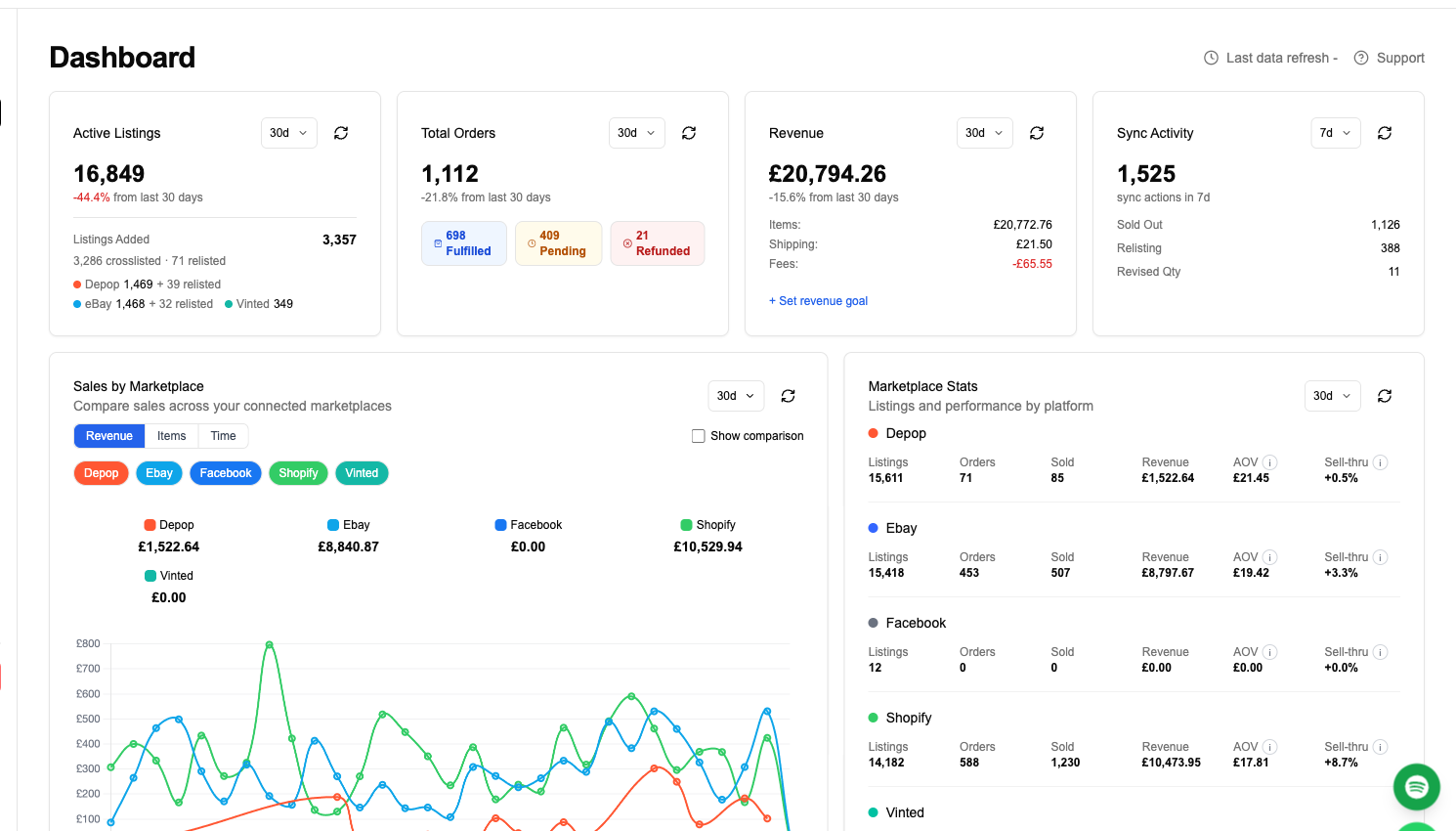
This is exactly what FLUF Connect was built for. Shopify sits at the centre as your product catalogue and order hub. Every marketplace — Depop, eBay, Vinted, Facebook — syncs with Shopify automatically. When a vintage jacket sells on Depop, the order appears in Shopify, inventory updates everywhere, and you ship from one place.
| FLUF Connect Feature | Depop | Shopify |
|---|---|---|
| Crosslisting | Yes | Yes (product catalogue source) |
| Inventory sync | Yes | Yes (native integration) |
| Auto-relisting | Yes | N/A (not a marketplace) |
| Offer management | Yes | N/A |
| Order sync | Yes (via Shopify) | Native — all orders centralised |
| Bulk operations | Yes | Yes |
Shopify is FLUF Connect’s anchor channel — the hub that connects to every marketplace. Depop gets full automation: crosslisting, auto-relisting, offer management, and inventory sync — all included free. Competitors like List Perfectly and Vendoo charge extra for these features.
Free for 30 days, no credit card required. Then from £19/month with 500 free crosslistings on the Growth plan.
Frequently Asked Questions
It depends on your stage. Depop is better for getting started — 7 million fashion-focused buyers find your items through search and social feeds, with zero upfront costs. Shopify is better for building a brand — you get your own website, customer email lists, and full control. Most successful vintage sellers use both: Depop for discovery and Shopify for brand building. FLUF Connect syncs inventory between them automatically.
It depends on volume. Depop charges 2.9% + £0.30 per sale with no subscription. Shopify Basic costs £19/month plus 2% + 25p per sale. Below ~50 sales per month, Depop is cheaper. Above that, Shopify becomes more cost-effective per transaction. But Shopify requires marketing spend to drive traffic, which Depop does not.
Yes — and it is the recommended strategy for growing sellers. Use Depop for instant access to fashion buyers and Shopify as your branded home base. FLUF Connect syncs products and inventory between both platforms automatically, so when an item sells on either platform it is removed everywhere.
No. This is the biggest difference. Depop has 7 million active buyers browsing daily — your listings appear in their search results automatically. Shopify brings zero buyers. Every visitor must come from your own marketing: social media, paid ads, SEO, or email campaigns. You build a better store on Shopify, but you must drive all the traffic yourself.
For sellers doing fewer than 50 sales per month, Shopify is usually not worth the £19/month subscription — Depop, eBay, and Vinted are cheaper and bring built-in buyers. Once you pass 50+ monthly sales and want to build a brand, Shopify becomes valuable for customer ownership, email marketing, and centralised order management.
Yes. FLUF Connect treats Shopify as the central hub and syncs with Depop (and eBay, Vinted, Etsy, Facebook Marketplace). Products, inventory, and orders all stay in sync. Depop gets full automation including auto-relisting and offer management, while Shopify centralises all orders for unified fulfilment.
A marketplace like Depop has built-in buyers — millions of people already browsing and searching for products. You list items and they find you. Shopify is a platform to build your own online store — no built-in buyers, but full brand control, customer data ownership, and the ability to sell anything. Most growing sellers use marketplaces for discovery and Shopify for brand building.
Usually the answer is add Shopify alongside Depop rather than replacing it. Depop's zero customer acquisition cost is too valuable to give up. Add Shopify when you want to build a brand, own customer relationships, and create a direct sales channel. Keep Depop as a discovery and sales channel. FLUF Connect makes running both effortless.
The main traffic sources for Shopify stores are: social media marketing (Instagram, TikTok, Pinterest), paid advertising (Meta Ads, Google Ads), search engine optimisation (blogging, product page SEO), email marketing to past customers, and influencer partnerships. Most successful Shopify stores use a combination of these. Budget £5-50+ per day for paid ads when starting out.
Yes. Shopify has no restrictions on selling pre-owned, vintage, or second-hand items. Many resellers use Shopify as their own branded storefront for curated vintage collections. Unlike marketplaces, you control the entire shopping experience — branding, layout, checkout, and customer communication.
Start Crosslisting for Free Today
500 free crosslistings. No credit card. Set up in under 10 minutes.