
Depop vs Vinted: Which Is Better for Sellers in 2026?
A side-by-side breakdown of fees, audience, listing experience, shipping, and what real sellers think — so you can choose the right platform (or sell on both).



- Choose Depop if: you sell vintage, Y2K, streetwear, or designer fashion and want a social, curated marketplace where buyers pay premium prices.
- Choose Vinted if: you sell everyday clothing, kids’ items, or homeware and want zero seller fees with a massive European buyer base.
- Fees: Depop charges 2.9% + £0.30 payment processing on a £30 sale (you keep ~£28.83). Vinted charges sellers nothing — the buyer pays a ~5% protection fee.
- Audience: Depop has 7 million active buyers (mostly under 34). Vinted has 75+ million monthly active users across 26 markets.
- Shipping: Vinted provides integrated labels with the buyer choosing and paying for shipping. Depop offers optional prepaid labels or self-arranged shipping.
- Best strategy: Sell on both — list trendy items at higher prices on Depop, everyday items on Vinted, and let inventory sync handle the rest. Cross-list free with FLUF Connect.
Depop vs Vinted at a Glance
Depop and Vinted are both second-hand fashion marketplaces, but they serve different audiences and operate on very different business models. Depop is a social, trend-driven platform favoured by Gen Z for vintage, streetwear, and curated fashion. Vinted is a fee-free marketplace built for everyday wardrobe clearouts, popular across Europe with a far broader user base.
Depop launched in London in 2011 as a social shopping app inspired by Instagram. It was acquired by Etsy in 2021, and in February 2026, eBay announced a $1.2 billion deal to acquire Depop from Etsy, expected to close in Q2 2026. Vinted was founded in Vilnius, Lithuania in 2008, and has grown into Europe’s largest second-hand fashion platform — reaching 75+ million monthly active users and surpassing €10 billion in GMV in 2025.
| Depop | Vinted | |
|---|---|---|
| Founded | 2011 (London) | 2008 (Vilnius, Lithuania) |
| Headquarters | London, UK | Vilnius, Lithuania |
| Active buyers | 7 million (Q4 2025) | 75+ million monthly active users |
| Registered users | 56.3 million | 100+ million |
| Top markets | US (58%), UK (23%), Australia (9%) | France, UK, Germany, Netherlands, Spain |
| Markets available | ~6 core markets | 26+ countries |
| Best for | Vintage, Y2K, streetwear, designer | Everyday fashion, kids’ clothes, homeware |
| Seller fees | 2.9% + £0.30 payment processing | None (buyer pays protection fee) |
| Business model | Payment processing fees + boosted listings | Buyer protection fees + promoted listings |
| Mobile app | iOS & Android (mobile-first design) | iOS & Android (strong mobile experience) |
Depop vs Vinted: Feature-by-Feature Comparison
Both platforms offer the core functionality you need to sell second-hand items, but they differ significantly in social features, seller tools, and how they handle disputes. Depop leans heavily into social commerce — likes, follows, and shop curation matter. Vinted is more transactional — list it, price it right, and the search algorithm does the work.
| Feature | Depop | Vinted |
|---|---|---|
| Fixed-price listings | Yes | Yes |
| Auction listings | No | No |
| Offer/haggle system | Yes (Make Offer button) | Yes (Make Offer + counter-offers) |
| Built-in messaging | Yes | Yes |
| Social features (likes, follows) | Strong — Instagram-style feed, follower count matters | Basic — favourites and follows exist but less prominent |
| Seller analytics | Basic (views, likes, sales) | Basic (views, favourites) |
| Promoted/boosted listings | Yes — 12% fee (UK), pay-on-sale only | Yes — Item Bump (~£0.75–£5), Closet Spotlight (~£6.95/7 days) |
| Integrated shipping labels | Yes (UK: from £2.99) | Yes (buyer selects and pays) |
| Buyer protection | Depop Protection — 30-day claim window | Buyer Protection — 2-day claim window after delivery |
| Return policy | 30 days for not-as-described | 2 days for not-as-described (14 days from Pro sellers) |
| Seller verification | Phone + ID (Stripe KYC) | ID at payout threshold (Mangopay KYC) |
| Business/Pro accounts | No formal tier — registered businesses must comply with consumer law | Yes — Vinted Pro (free, EU consumer protections apply) |
| Vacation mode | No | Yes |
| International selling | Limited cross-border | Cross-border within EU + UK-US pilot |
| Categories beyond fashion | Limited — mostly fashion, some beauty and accessories | Broader — fashion, kids, homeware, electronics, books |
The biggest structural difference: Depop’s social model rewards sellers who invest in their brand, photography, and community. Vinted’s search-driven model rewards competitive pricing and accurate categorisation. If you enjoy curating a shop aesthetic, Depop is more rewarding. If you just want items to sell quickly with minimal effort, Vinted is more efficient.
Listing Experience: Depop vs Vinted
Creating a listing on Vinted takes roughly 2–3 minutes. Depop takes slightly longer if you want your listings to stand out, because the platform rewards styled, high-quality photos and detailed descriptions that read like social media captions.
Photos
Depop allows up to 8 images per listing. The platform’s visual culture favours lifestyle shots — items worn, styled, or shot in natural light with personality. Flat-lay photos work too, but the most successful Depop sellers create a recognisable visual identity. Vinted allows up to 20 images, but the aesthetic bar is lower. Clear, well-lit photos on a plain background are perfectly fine. Buyers on Vinted care more about condition accuracy than visual branding.
Titles and descriptions
On Depop, the first sentence of your description becomes your listing title in search results — so lead with brand, item type, and key details. Descriptions can be longer and more editorial, almost like an Instagram caption. Depop’s algorithm weighs keyword relevance heavily, so include specific terms buyers search for (brand, colour, size, style, era).
On Vinted, titles and descriptions are more straightforward. The platform’s structured fields (brand, size, colour, condition) do much of the heavy lifting for search. Descriptions should be factual and thorough — noting any flaws, measurements, and material — but they don’t need personality.
Which is easier for beginners?
Vinted is easier to start on. The structured listing form guides you through every field, and items sell without requiring professional photography or a curated shop profile. On Depop, new sellers often struggle to get visibility without first building followers and investing in their shop’s visual identity.
Fees Compared: How Much Do Depop and Vinted Actually Cost?
Vinted charges sellers nothing — no listing fees, no commission, no payment processing fees. The buyer pays a “Buyer Protection Fee” of approximately 5% + £0.70 on each purchase. Depop removed its 10% seller commission for UK and US sellers in 2024, but still charges payment processing fees of 2.9% + £0.30 on the total transaction amount (item price + shipping + tax).
| Fee Type | Depop (UK) | Vinted |
|---|---|---|
| Listing fee | Free | Free |
| Seller commission | None (removed 2024 for UK/US) | None |
| Payment processing | 2.9% + £0.30 per transaction | None to seller |
| Buyer protection fee | Up to 5% + £1.00 (paid by buyer) | 5% + £0.70 (paid by buyer) |
| Boosted/promoted listings | 12% of sale price (optional, pay-on-sale) | Item Bump: ~£0.75–£5 (optional, pay upfront) |
| Subscription tiers | None | None |
- Depop: £30.00 item price − £1.17 processing fee (2.9% + £0.30) = You keep £28.83
- Vinted: £30.00 item price − £0.00 seller fees = You keep £30.00
On paper, Vinted wins on fees every time. But there’s a nuance: because Vinted buyers pay the protection fee on top of the item price, they tend to offer less. A £30 item on Vinted costs the buyer ~£32.20 after fees, which means buyers frequently haggle harder. On Depop, the buyer sees £30 and that’s closer to what they pay (plus optional shipping). Some sellers find they net similar amounts on both platforms because Depop buyers accept higher prices.
Payout speed
| Depop | Vinted | |
|---|---|---|
| Payout method | Direct to bank account | Vinted Wallet → bank transfer |
| When funds are available | 2 working days after delivery, or 10 days after sale | After buyer confirms receipt (or auto-confirmed after 2 days) |
| Bank transfer time | Instant or 1–2 days | 2–5 business days after withdrawal |
| New seller holds | 10 working day hold | No extended holds |
| Minimum payout | None | None |
Vinted’s wallet system means your money lands in-app quickly, but getting it to your bank takes an extra step. Depop pays directly to your bank. For established sellers, Depop’s 2-day payout after delivery is slightly faster end-to-end. For new sellers, Depop’s 10-day hold is frustrating — Vinted has no equivalent.
Hidden costs to watch for
Depop: Payment processing is calculated on the total transaction amount, not just the item price. If the buyer pays £5 shipping, you’re paying 2.9% on that too. Boosted listings at 12% add up fast — and the fee applies to the full sale price including self-arranged shipping costs. Outside the UK and US, the old 10% seller commission still applies (e.g. Australia).
Vinted: No hidden seller fees, but the indirect cost is real. Buyer Protection fees mean buyers see a higher total price, which puts downward pressure on what they’re willing to pay. Promoted listings (Item Bump, Closet Spotlight) are paid upfront regardless of whether the item sells — unlike Depop’s pay-on-sale model.
Audience and Demand: Who’s Buying on Depop vs Vinted?
Depop’s buyer base is younger and trend-driven — nearly 90% of active buyers are under 34. They’re shopping for specific aesthetics: Y2K, vintage, streetwear, cottagecore, and designer pieces. Vinted’s audience is broader in both age and intent — from parents buying kids’ clothes to adults clearing wardrobes to bargain hunters across every category.
| Depop | Vinted | |
|---|---|---|
| Primary age group | 16–34 (nearly 90%) | Broader range, strong 18–45 |
| Top markets | US, UK, Australia | France, UK, Germany, Netherlands, Spain |
| Active buyers/users | 7 million (Q4 2025) | 75+ million monthly active users |
| UK users | ~13 million registered (1 in 3 Gen Z/Millennials) | 17 million (Feb 2026) |
| Best-selling categories | Vintage fashion, streetwear, Y2K, designer | Everyday fashion, kids’ clothes, homeware, electronics |
| Buyer behaviour | Browsing for aesthetic, willing to pay premiums | Searching for bargains, expects low prices |
| Average sale price | Higher (trend and brand premiums) | Lower (value and volume driven) |
In practical terms: a vintage Levi’s 501 jacket might sell for £60–£80 on Depop to a buyer who values the specific wash and era. The same jacket on Vinted might sell for £35–£50 to a buyer who just wants a denim jacket at a good price. Different audiences, different price points — which is exactly why selling on both makes sense.
Category strengths
Depop excels for: vintage and Y2K fashion, streetwear (Supreme, Palace, Nike collaborations), designer/luxury (Gucci, Louis Vuitton), one-of-a-kind and handmade pieces, and anything where curation and branding add value.
Vinted excels for: everyday high-street brands (Zara, H&M, Next), children’s clothing (a category barely present on Depop), homeware and soft furnishings, electronics and books, and bulk wardrobe clearouts where speed matters more than maximising price.
Growth trajectory
Both platforms are growing. Depop’s active buyers grew 37.7% year-on-year in Q4 2025, with US buyer spending up 60.2%. Vinted surpassed €10 billion in GMV in 2025 and grew revenue to €813 million — up significantly from the prior year, with net profit of €76.7 million. Vinted is expanding into new European markets (Croatia, Greece, Ireland launched in 2024) and piloting UK-to-US cross-border selling. Depop’s upcoming acquisition by eBay could accelerate its reach but may also change its character.
Shipping: Depop vs Vinted
Shipping is one of the starkest differences between the two platforms. On Vinted, the buyer chooses and pays for shipping at checkout — the seller just drops the parcel at the specified carrier point using a provided label or QR code. On Depop, sellers have more control (and more responsibility) — you can use Depop’s prepaid shipping labels or arrange your own carrier and set your own shipping price.
| Depop | Vinted | |
|---|---|---|
| Integrated shipping labels | Yes — “Ship with Depop” (from £2.99 UK) | Yes — buyer selects carrier at checkout |
| Who pays shipping | Seller sets price (can offer free shipping) | Buyer pays (seller can offer free shipping, cost deducted from earnings) |
| Carrier options (UK) | Depop Shipping (single option) or self-arranged | Evri, Yodel, InPost, Royal Mail — buyer chooses |
| International shipping | Self-arranged only | Built-in cross-border within EU + UK-US pilot |
| Ship-by deadline | 5 days (auto-cancel after 10) | 5 business days (auto-cancel) |
| Tracking required | Yes (strongly recommended) | Yes (built into integrated labels) |
| Return shipping | Depop covers up to £20 for eligible returns | Vinted provides prepaid return label |
Vinted’s shipping model is simpler for sellers — you never need to calculate shipping costs or negotiate with buyers about it. The buyer sees the total cost upfront and chooses their preferred carrier. This eliminates one of the most common friction points in second-hand selling. Depop’s model gives sellers more flexibility but requires more decisions.
For international sellers, Vinted has a clear advantage with built-in cross-border shipping across 26+ European markets. Depop’s international shipping is self-arranged, which adds complexity and cost.
What Real Sellers Say About Depop vs Vinted
The most revealing insights come from sellers who’ve used both platforms. We reviewed dozens of seller testimonials, forum discussions, and interviews to find the patterns.
On Vinted’s speed of sales
“Within a day or so of adding my first batch of items I had sold quite a few pieces — items that had been on Depop for months at the same prices with the same descriptions.”
On ease of use
“I think I prefer Vinted at the minute, just because it’s a lot easier to deal with postage and shipping and stuff — the buyer always pays for whichever kind of shipping they want.”
— Fern, 21, reseller (Refinery29)
On Depop’s identity crisis
“I think Depop has just kind of lost its magic, lost its spark.”
— Amy, 23, sells on both platforms (Refinery29)
On selling everyday items
“It’s been so much easier to sell ‘normal’ items on Vinted. I don’t want to see a Nike T-shirt being repurposed into a boned corset and sold for 50 quid.”
— Amy, 23 (Refinery29)
On the argument for using both
The sellers who do best tend to use both platforms strategically. Vintage and trend-driven pieces go on Depop at premium prices. Everyday items and wardrobe clearouts go on Vinted for faster turnover. If something doesn’t sell on Depop within a few weeks, crosslist it to Vinted at a slightly lower price. Sellers listing on 3+ marketplaces consistently report significantly higher sell-through rates than those using a single platform.
The common frustrations
Depop sellers complain about: payment processing fees eating into margins, dispute resolution that favours buyers even when flaws were disclosed, and boosted listing fees climbing to 12%. Vinted sellers complain about: aggressive lowball offers, customer service that can be slow to respond, and the 2-day dispute window creating pressure on buyers to check items quickly. Both platforms have vocal critics — no marketplace is perfect.
How to Choose Between Depop and Vinted
The right platform depends on what you’re selling, who you’re selling to, and how much time you want to invest. There’s no universal answer — but here’s a clear framework.
- Sell vintage, Y2K, streetwear, or designer fashion
- Want to build a recognised brand and following
- Enjoy creating styled, editorial-quality photos
- Are willing to invest time in building a community
- Prioritise higher per-item prices over speed of sale
- Sell everyday fashion, kids’ clothes, or homeware
- Want zero seller fees and simple shipping
- Prefer quick listings without needing professional photos
- Value speed of sale over maximum price per item
- Sell across European markets or want cross-border reach
For casual sellers clearing out a wardrobe, Vinted is the easier starting point — no fees, no need for aesthetic photos, and items tend to sell faster at accessible prices.
For serious resellers building a business, the answer is almost always both. Depop and Vinted serve different buyer pools, and the same item can command different prices on each platform. Limiting yourself to one means leaving money on the table.
Which leads to the obvious question: how do you manage inventory across both without overselling?
Why Not Both? Sell on Depop and Vinted at the Same Time
The smartest resellers don’t choose between Depop and Vinted — they sell on both and let automation handle the complexity. Items listed on multiple platforms sell significantly faster than those on a single marketplace, because you’re reaching entirely different buyer pools with different spending habits.
The challenge with selling on both manually is real: when an item sells on Depop, you need to immediately remove it from Vinted (and vice versa) to avoid overselling. With hundreds of listings, this becomes a full-time job.
FLUF Connect solves this. It’s a crosslisting and automation platform that connects Depop, Vinted, eBay, Shopify, and more — with automatic inventory sync, so when an item sells on one platform, it’s removed from the others instantly.
How it works
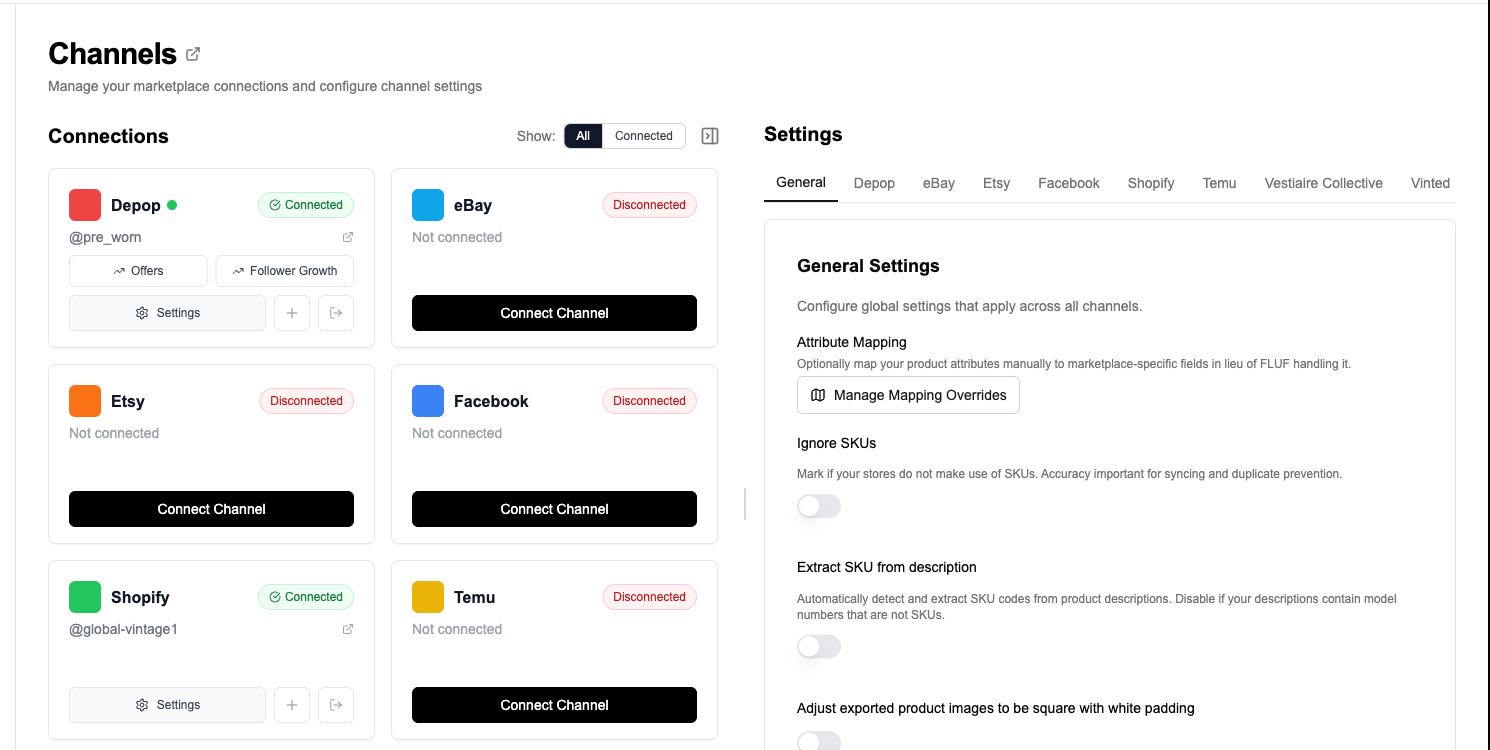
- Connect your accounts — Link your Depop and Vinted accounts (plus any other marketplaces you sell on) in under 2 minutes.
- Select products to crosslist — Choose individual items or use bulk operations to crosslist hundreds at once. Set up auto-crosslisting rules to automatically list new products on both platforms.
- Sell and sync automatically — When an item sells on Depop, FLUF removes it from Vinted. Prices and stock levels stay in sync. You ship from one place.
| FLUF Connect Feature | Depop | Vinted |
|---|---|---|
| Crosslisting | Yes — to/from all channels | Yes — to/from all channels |
| Inventory sync | Yes — real-time | Yes — real-time |
| Auto-relisting | Yes — smart strategies by age, price, category | Yes — smart strategies by age, price, category |
| Offer management | Yes — automated offers to likers | Yes — automated offers to likers |
| Order sync | Yes (via Shopify) | Yes (direct) |
| Bulk operations | Yes — find & replace, bulk pricing, bulk crosslist | Yes — find & replace, bulk pricing, bulk crosslist |
Both Depop and Vinted get full automation support in FLUF Connect — including relisting and offer management, which are included free on every plan. Most competitors either don’t support Vinted at all or charge extra for automation features.
Pricing: Free 30-day trial with full access. After that, plans start at £19/month for 500 products, with 500 free crosslistings on every plan. No credit card required to start. See full pricing.
Frequently Asked Questions
It depends on what you are selling. Depop is better for vintage, streetwear, and designer fashion where buyers pay premium prices. Vinted is better for everyday clothing, high-street brands, and kids items where speed of sale matters more than maximising price. Many successful sellers use both.
Vinted has no seller fees at all. Depop charges 2.9% + £0.30 per sale in payment processing. On a £30 sale, you keep the full £30 on Vinted versus £28.83 on Depop.
Yes, and many sellers do. The main challenge is keeping inventory in sync. Crosslisting tools like FLUF Connect automate this with real-time inventory sync.
Vinted is generally easier for beginners. The listing process is more structured, photos dont need to be professionally styled, there are no seller fees, and the buyer handles shipping selection.
Vinted has significantly more users — 75+ million monthly active users across 26 countries, compared to Depops 7 million active buyers. However, Depops buyers tend to have higher purchase intent for niche fashion categories.
Yes. FLUF Connect supports automatic crosslisting between Depop and Vinted, including inventory sync, auto-relisting, and offer management on both platforms.
Depop pays directly to your bank account within 2 working days of delivery confirmation. Vinted pays into a Vinted Wallet after the buyer confirms receipt, then bank withdrawal takes an additional 2-5 business days.
Yes. The two platforms have different audiences and price points. Using both maximises your reach and sell-through rate.
Depop is generally better for vintage fashion. Its audience actively seeks curated vintage pieces and will pay premiums for specific eras, brands, and styles. Vinted buyers tend to value practical affordability over vintage rarity.
Start Crosslisting for Free Today
500 free crosslistings. No credit card. Set up in under 10 minutes.