
eBay vs Vestiaire Collective: Which Is Better for Selling Designer Fashion in 2026?
A side-by-side comparison of fees, authentication, audience, and what real sellers think — so you can choose the right platform for designer fashion (or sell on both).



- Choose eBay if: you sell a wide range of items including designer fashion, want the largest buyer pool (135 million active buyers), and prefer faster payouts with lower fees on high-value items.
- Choose Vestiaire Collective if: you sell exclusively luxury/designer fashion, want professional authentication to build buyer trust, and are willing to pay higher fees for an audience that pays premium prices.
- Fees: eBay charges ~13–15% total (final value fee + processing). Vestiaire charges 12% + 3% processing (15% total), though lower-priced items under £100 can see effective rates of 20–25%.
- Authentication: Vestiaire authenticates items via expert physical inspection — the core trust signal. eBay offers Authenticity Guarantee on sneakers, watches ($2,000+), and handbags ($500+), but it’s category-limited.
- Audience: eBay has 135 million active buyers across all categories. Vestiaire has 23 million registered members specifically shopping for luxury fashion.
- Best strategy: List luxury items on both — Vestiaire for premium prices and authentication trust, eBay for broader reach and faster sales. Sync inventory with FLUF Connect.
eBay vs Vestiaire Collective at a Glance
eBay and Vestiaire Collective both sell designer fashion, but they serve fundamentally different markets. eBay is a general marketplace with 135 million active buyers across every category — fashion is one of many. Vestiaire Collective is a curated luxury fashion marketplace where every item is from a recognised designer brand, and high-value items are physically authenticated before reaching the buyer.
eBay launched in 1995 and has grown into the world’s largest online auction and fixed-price marketplace. It sells everything from electronics to cars, but fashion is a significant category with dedicated authentication programmes for sneakers, watches, and handbags. Vestiaire Collective launched in Paris in 2009 as a peer-to-peer marketplace exclusively for pre-owned luxury fashion, and has grown to 23 million registered members across 70+ countries, with an average transaction price of around $400–$500.
| eBay | Vestiaire Collective | |
|---|---|---|
| Type | General marketplace (all categories) | Curated luxury fashion marketplace |
| Founded | 1995 (San Jose, California) | 2009 (Paris, France) |
| Active buyers | 135 million | 23 million registered members |
| Countries | 190+ | 70+ |
| Top markets | US, UK, Germany, Australia | France, UK, US, Italy, Germany |
| Best for | Everything — electronics, fashion, collectibles, vehicles | Luxury fashion only — bags, clothing, shoes, accessories |
| Average transaction | Varies widely (£10–£1,000+) | ~£350–£500 |
| Authentication | Category-limited (sneakers, watches £2,000+, bags £500+) | Physical authentication on qualifying items |
| Seller fees | ~13–15% (final value + processing) | 12% + 3% processing (15% total) |
| Fast fashion allowed | Yes | No — banned since 2023 |
eBay vs Vestiaire Collective: Feature-by-Feature Comparison
eBay offers more seller tools, listing formats, and flexibility. Vestiaire offers a more curated experience with authentication as its cornerstone — fewer features, but a laser-focused luxury buyer base.
| Feature | eBay | Vestiaire Collective |
|---|---|---|
| Listing formats | Auction + fixed price + “Best Offer” | Fixed price + “Make an Offer” |
| Item authentication | Limited categories (sneakers, watches, bags, jewellery) | Core feature — expert physical inspection |
| Buyer protection | eBay Money Back Guarantee (30 days) | Authentication-backed; no change-of-mind returns from individuals |
| Seller analytics | Comprehensive (Seller Hub, Terapeak) | Basic (views, offers, sales) |
| Promoted listings | Yes — Standard (2–20%, pay-on-sale) and Advanced (CPC) | Yes — “Boost” feature |
| Store subscriptions | Yes — Starter (£4.95/mo) to Enterprise (£2,999.95/yr) | No subscription tiers |
| International shipping | Global Shipping Program (190+ countries) | Authenticated Shipping (via Vestiaire hub) |
| Seller ratings | Detailed feedback + seller levels (Top Rated, Star Seller) | Basic ratings |
| Return policy | Seller sets terms (eBay override for INAD) | No returns from individual sellers; 14 days from Pro sellers |
| Customer data ownership | Partial — buyer details for shipping | No — Vestiaire controls the relationship |
| Categories | Everything — no restrictions | Luxury fashion only — recognised brands, no fast fashion |
| Listing duration | Up to 30 days (Good ‘Til Cancelled available) | No expiry — listed until sold or removed |
Authentication: The Key Difference
Authentication is what sets Vestiaire Collective apart from every general marketplace — and it’s the single biggest factor in choosing between these platforms for luxury items. It affects buyer trust, sale prices, disputes, and the overall selling experience.
Vestiaire Collective’s authentication
Vestiaire employs a team of authentication experts across hubs in the US, UK, France, Hong Kong, and Singapore. When a high-value item sells, the seller ships it to a Vestiaire hub where experts conduct a multi-point physical inspection: materials, stitching, typography, serial numbers, hardware engravings, labels, and even sensory checks (smell and feel of leather). They use specialised equipment including UV lamps, magnifying glasses, and precious metal testing devices, supplemented by AI and machine learning. The buyer receives an Authentication & Quality Control Report. In 2025, Vestiaire blocked nearly $120 million worth of counterfeit items.
The practical impact for sellers: authenticated items sell for more because buyers trust the platform’s verification. You’re less likely to face post-sale disputes because the item has already been inspected. The trade-off is time — authentication adds 2–3 business days to delivery, and in rare cases, genuine items are rejected without detailed explanation.
eBay’s Authenticity Guarantee
eBay offers authentication for specific categories: sneakers (eligible models auto-enrolled), watches (£2,000+, optional from £500), handbags (£500+, optional from £200), and select jewellery. Items ship to an eBay authentication centre for physical inspection before reaching the buyer. For qualifying categories, authentication is free above the threshold — a significant advantage over Vestiaire, where the buyer pays ~£15 per authenticated item.
The limitation: eBay’s authentication only covers select high-value categories. A £300 designer dress, a £150 silk scarf, or a £400 pair of designer sunglasses get no authentication on eBay. On Vestiaire, the buyer can request authentication on virtually any item.
What this means for sellers
If you’re selling a Chanel handbag for £2,000+, both platforms offer authentication and the choice comes down to audience, fees, and speed. If you’re selling a £200 Gucci belt or a £350 designer dress, only Vestiaire offers the authentication trust signal that justifies premium pricing. For non-luxury items or items below authentication thresholds, eBay is the practical choice — Vestiaire won’t list them.
Fees Compared: How Much Do eBay and Vestiaire Collective Actually Cost?
Both platforms take a meaningful cut of each sale, but the fee structures differ significantly — especially at different price points. eBay’s fees are straightforward with tiered rates for high-value items. Vestiaire’s fees decrease as item price increases, making it more competitive at higher price points.
| Fee Type | eBay (no store) | Vestiaire Collective |
|---|---|---|
| Listing fee | Free (first 250/month), then £0.35 | Free |
| Selling commission | 12.8–15% final value fee (varies by category) | 12% (items £100–£40,000) |
| Payment processing | Included in final value fee | 3% (minimum £3) |
| Per-order fee | £0.30 (≤£10) or £0.40 (>£10) | None |
| Authentication cost (seller) | Free (qualifying categories) | Free (buyer pays ~£15) |
| Promoted listings | 2–20% (optional, pay-on-sale) | Available (variable) |
- £200 designer belt: eBay ~£170 (15% fee) vs Vestiaire ~£167 (12% + 3% processing). Roughly equal.
- £500 designer bag: eBay ~£425 (15%) vs Vestiaire ~£425 (15%). Equal on fees — but Vestiaire’s authentication may command a higher sale price.
- £1,000 designer bag: eBay ~£850 (15%) vs Vestiaire ~£850 (15%). Equal — authentication tips Vestiaire.
- £2,500 designer bag: eBay ~£2,175 (13% — reduced rate over £2,000 for bags) vs Vestiaire ~£2,125 (15%). eBay slightly cheaper, but Vestiaire buyers may pay more.
The fee difference is surprisingly small between the two platforms for most luxury items. Where fees diverge:
- Under £100: Vestiaire’s minimum fees make it expensive (effective rate 20%+). eBay is significantly cheaper for lower-priced items.
- £100–£2,000: Both platforms take roughly 15%. Vestiaire’s authentication may justify a higher selling price, offsetting the fee parity.
- Over £2,000: eBay’s reduced rates for handbags, watches, and jewellery kick in (9%/7% above certain thresholds). Vestiaire stays at 15%. eBay becomes cheaper on fees — but the question is whether you’ll get the same price.
Payout speed
| eBay | Vestiaire Collective | |
|---|---|---|
| Payout method | Bank account, debit card, Payoneer | Bank account, PayPal, Venmo |
| Payout schedule | Daily, weekly, biweekly, or monthly (seller chooses) | 72 hours after delivery (direct) or next day after authentication approval |
| Bank processing | 1–3 business days (instant via debit card) | Up to 5 business days |
| Time from sale to cash | ~3–7 days (standard shipping + payout) | ~7–14 days (authentication adds time) |
eBay pays faster. Vestiaire’s authentication process adds days to the timeline — the item ships to a hub, gets inspected, then ships to the buyer, and only then does payout processing begin. For sellers who need cash quickly, this delay matters.
Audience and Pricing Power: Who’s Buying on eBay vs Vestiaire?
eBay has 135 million active buyers across every category, but most aren’t specifically looking for luxury fashion. Vestiaire has a smaller but laser-focused audience of luxury shoppers willing to pay premium prices for authenticated designer items.
| eBay | Vestiaire Collective | |
|---|---|---|
| Active buyers | 135 million | 23 million registered members |
| Buyer intent | Bargain-hunting across all categories | Luxury shopping with authentication trust |
| Average transaction | Varies widely | ~£350–£500 |
| Price negotiation | Aggressive — buyers expect discounts | Present but less aggressive — buyers accept premium pricing |
| Counterfeit concern | High — buyers are sceptical, may lowball | Low — authentication removes doubt |
| International reach | 190+ countries | 70+ countries (Europe-heavy) |
The pricing power difference is the crucial factor. eBay buyers are trained to expect deals — they filter by “lowest price + shipping” and make low offers. Luxury items on eBay often sell below their true market value because buyers factor in authenticity risk. On Vestiaire, the authentication stamp removes that risk, so buyers pay closer to asking price. Multiple sellers report that the same bag sells for 10–20% more on Vestiaire than eBay, despite similar fee rates.
As one seller on Mumsnet put it: “The commission is high but as things seem to be set at higher prices than eBay it works out better — designer items sometimes don’t always sell well on eBay for some reason.”
Selling Experience: eBay vs Vestiaire Collective
Returns and disputes — where eBay hurts
eBay’s buyer protection is notoriously aggressive. Any buyer can file an “Item Not As Described” (INAD) claim, even on accurately listed items, and eBay almost always sides with the buyer. For luxury sellers, this creates a serious risk: a buyer can receive a genuine designer bag, claim it’s fake, and get a full refund — sometimes returning a different (fake) item. The eBay seller community is full of horror stories about INAD scams on high-value fashion items.
Vestiaire’s authentication largely eliminates this problem. Because the item is physically inspected at a Vestiaire hub before reaching the buyer, post-sale authenticity disputes are rare. Individual sellers don’t need to accept change-of-mind returns either — once an authenticated item is delivered, the sale is final (the buyer can relist it, but that’s on them). This post-authentication finality is a major draw for luxury sellers.
Listing and discovery
eBay gives you comprehensive listing tools — 12 images, detailed item specifics, HTML descriptions, and the Terapeak research tool for pricing. Discovery depends on the Cassini algorithm, which rewards keyword relevance, competitive pricing, free shipping, and seller metrics. Competition is fierce across millions of listings.
Vestiaire’s listing process is simpler — upload photos, select brand and category, describe condition, set price. The platform uses AI-powered image search and visual similarity to surface items. Because the marketplace is curated (luxury only, no fast fashion), your listing competes with fewer items in a more focused context.
What Real Sellers Say About eBay vs Vestiaire Collective
On Vestiaire’s pricing advantage
“The commission is high but as things seem to be set at higher prices than eBay it works out better — designer items sometimes don’t always sell well on eBay for some reason.”
On authentication as a trust signal
“Vestiaire? Their commission is higher than Vinted but they offer physical authentication (at additional cost to the buyer) so it’s likely more trusted than Vinted and eBay.”
On eBay’s INAD risk
“Don’t sell anything on eBay you can’t afford to lose. Saying ‘no returns’ is merely a deterrent and nothing more — any buyer can claim ‘item not as described’ for any reason, even if it’s a lie, and get a full refund.”
On Vestiaire’s customer service
“I’ve used Vestiaire a few times, no issues getting my money but customer service is crap.”
On eBay’s practical advantages
“I’ve sold on eBay for years and have rarely had problems. You get the odd chancer who will try to claim that the item wasn’t received, but it’s not a problem as long as you have tracking and proof of delivery.”
The common frustrations
eBay sellers of luxury items complain about: INAD scam buyers, aggressive price negotiation, counterfeit scepticism depressing prices, and the 2026 Promoted Listings attribution change increasing ad costs. Vestiaire sellers complain about: poor customer service, authentication occasionally rejecting genuine items without explanation, and the 15% total fee on mid-range items.
How to Choose Between eBay and Vestiaire Collective
The right platform depends on what you’re selling, its value, and how much you value authentication protection versus speed and reach.
- Sell a mix of items beyond just luxury fashion
- Want the largest possible buyer pool (135 million active buyers)
- Sell sneakers, watches, or bags in eBay’s Authenticity Guarantee categories
- Need faster payouts and quicker time-to-sale
- Sell items under £100 where Vestiaire’s fees are disproportionately high
- Sell exclusively luxury/designer fashion and accessories
- Want authentication protection on every sale to justify premium pricing
- Prefer fewer post-sale disputes (authenticated items are final sale)
- Sell items in the £500+ range where Vestiaire’s pricing power offsets its fees
- Target European luxury buyers (Vestiaire’s strongest market)
The price point rule of thumb: below £200, eBay is almost always better (lower fees, bigger audience, Vestiaire’s minimum fees bite). Between £200 and £2,000, it’s a toss-up — Vestiaire’s authentication may get you a higher sale price, offsetting similar fees. Above £2,000, eBay’s reduced category rates make it cheaper on fees, but Vestiaire’s authentication and luxury audience may still net you more overall.
The best approach for serious luxury resellers? List on both and let the market decide.
Why Not Both? Sell on eBay and Vestiaire Collective at the Same Time
Listing luxury items on both platforms simultaneously doubles your exposure. eBay’s 135 million buyers include bargain hunters who might bite at a competitive price. Vestiaire’s luxury-focused audience might pay full asking price with authentication confidence. The item sells wherever a buyer bites first.
The operational challenge is inventory: when a bag sells on Vestiaire, you need to remove it from eBay immediately to avoid selling the same item twice. With multiple listings across platforms, this becomes complex fast.
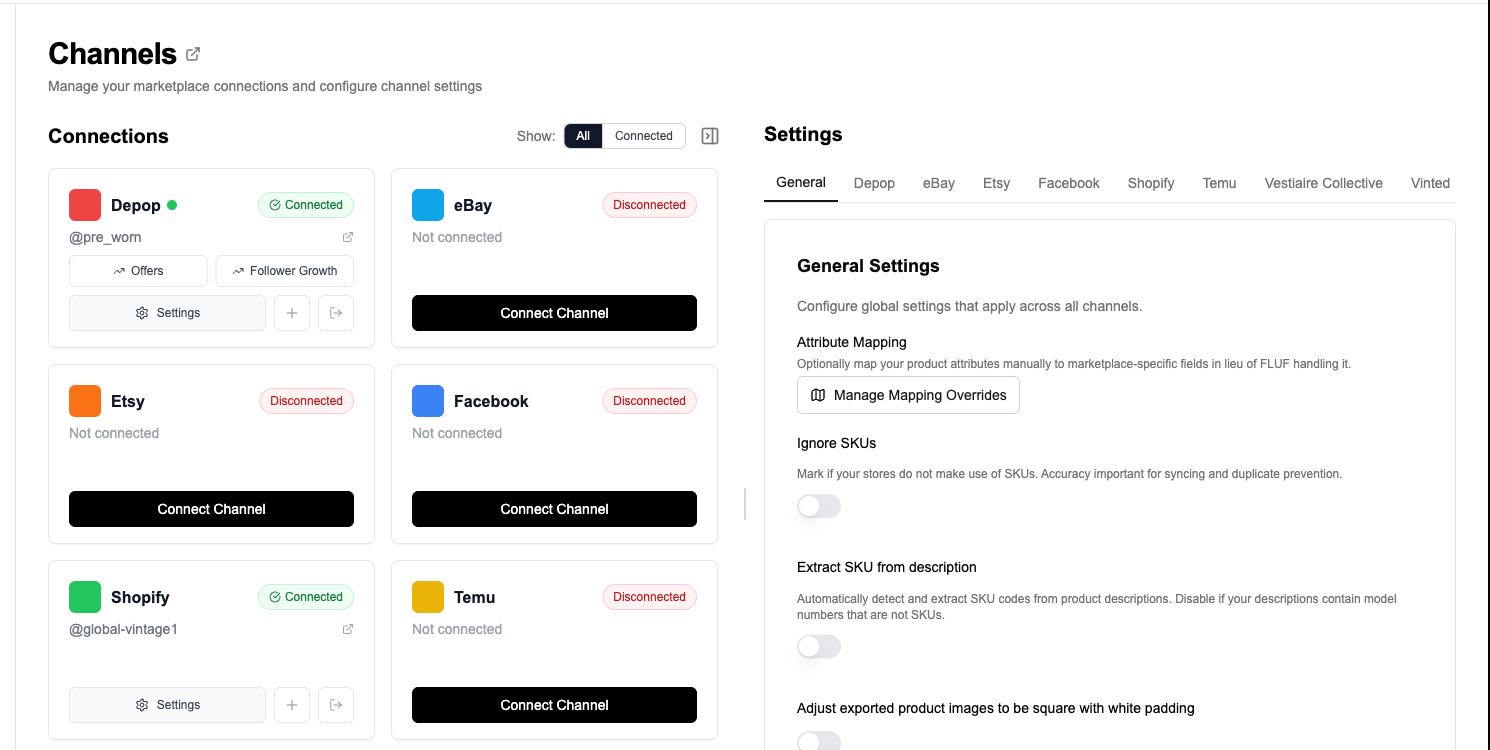
FLUF Connect manages this automatically. It connects eBay, Vestiaire Collective, and 7 other marketplaces — including Depop, Vinted, Shopify, and Facebook Marketplace — with real-time inventory sync. When an item sells anywhere, it’s removed everywhere else.
How it works
- Connect your accounts — Link eBay and Vestiaire Collective (plus any other channels) in minutes.
- Crosslist your products — Move listings between platforms individually or in bulk. Set auto-crosslisting rules to push new inventory to all connected channels automatically.
- Sync automatically — When an item sells on Vestiaire, FLUF removes it from eBay and every other channel. No double-selling.
| FLUF Connect Feature | eBay | Vestiaire Collective |
|---|---|---|
| Crosslisting | Yes — to/from all channels | Yes — to/from all channels |
| Inventory sync | Yes — real-time | Yes — real-time |
| Auto-relisting | Yes — smart strategies | No |
| Offer management | Yes — automated offers | No |
| Order sync | Yes (via Shopify) | Yes |
| Bulk operations | Yes — find & replace, bulk pricing | Yes |
eBay gets full automation support including relisting and offer management — both included free. Vestiaire Collective gets crosslisting, inventory sync, order sync, and bulk operations. Most crosslisting competitors don’t support Vestiaire at all.
Pricing: Plans start at £19/month for 500 products. See full pricing.
Try FLUF Connect — Sell on eBay and Vestiaire Collective Together
New crosslisting guides (May 2026)
- Already sell on Vestiaire Collective? Crosslist to eBay rather than choose between them. Crosslist from Vestiaire Collective to eBay
Frequently Asked Questions
For bags over £500, both are strong. Vestiaire authentication builds trust and commands higher prices. eBay offers larger audience and free Authenticity Guarantee on bags over £500. Many sellers list on both.
Fees are similar around 15% total in the £200-£2000 range. Below £100, eBay is cheaper. Above £2000, eBay reduced rates for bags and watches make it cheaper on fees.
Not automatically. Authentication is required for international orders and items above certain thresholds. For domestic orders below the threshold, the buyer can choose whether to pay for authentication.
eBay carries higher dispute risk. Any buyer can file Item Not As Described claims and eBay typically favours buyers. Authenticity Guarantee on sneakers, watches, and bags reduces this risk.
Yes. Many luxury resellers list on both to maximise exposure. FLUF Connect automates inventory sync so when an item sells on one platform it is removed from the other.
eBay is faster with daily payouts and instant debit card transfers. Vestiaire authentication adds 7-14 days from sale to bank.
Yes. FLUF Connect supports crosslisting between eBay and Vestiaire Collective with real-time inventory sync across both plus 7 other marketplaces.
eBay accepts virtually any product. Vestiaire only accepts luxury designer fashion - bags, clothing, shoes, jewellery, watches, and accessories from recognised brands. Fast fashion was banned in 2023.
Both are strong for watches. eBay offers free authentication on watches over £2000 with reduced fees. Vestiaire offers authentication with a focused luxury audience. For watches over £2000, eBay is slightly more cost-effective.