
How to Sell Pok\xc3\xa9mon Cards on Whatnot — The Complete Guide for 2026
The highest-volume TCG on Whatnot. Modern sets, vintage WOTC, Japanese cards, grading strategy, booster break formats, sourcing, and how to cross-list.



Key Takeaways
- Pokémon is the highest-volume TCG on Whatnot — the single most searched-for trading card game on the platform, within a global Pokémon TCG market worth roughly $2 billion in annual card sales and growing.
- Whatnot fees are lower than eBay or TCGPlayer — 8% commission + 2.9% + $0.30 processing (~11% effective). Commission cap at $1,500 means 0% on the overage for high-value cards. A PSA 10 Umbreon ex SIR at $1,050 costs ~$116 in Whatnot fees vs ~$139 on eBay.
- Modern and vintage both sell strong — Prismatic Evolutions and Ascended Heroes (the largest English set ever at 290+ cards) dominate modern demand. Vintage WOTC sealed product appreciates 15–25% annually. Japanese cards are a fast-growing niche.
- Booster box breaks are the signature format — opening sealed product live on camera is Whatnot’s core entertainment loop for Pokémon. ETB openings, singles auctions, and sealed BINs round out the show toolkit.
- Grading matters above $75 raw value — PSA 10 = 2–5x raw price for modern cards, 5–10x for vintage. CGC is closing the gap and expected to reach parity by 2027.
- Cross-list with FLUF Connect — sync your Pokémon card inventory with eBay and Shopify so a live-show pull never oversells on another channel. Get started free.
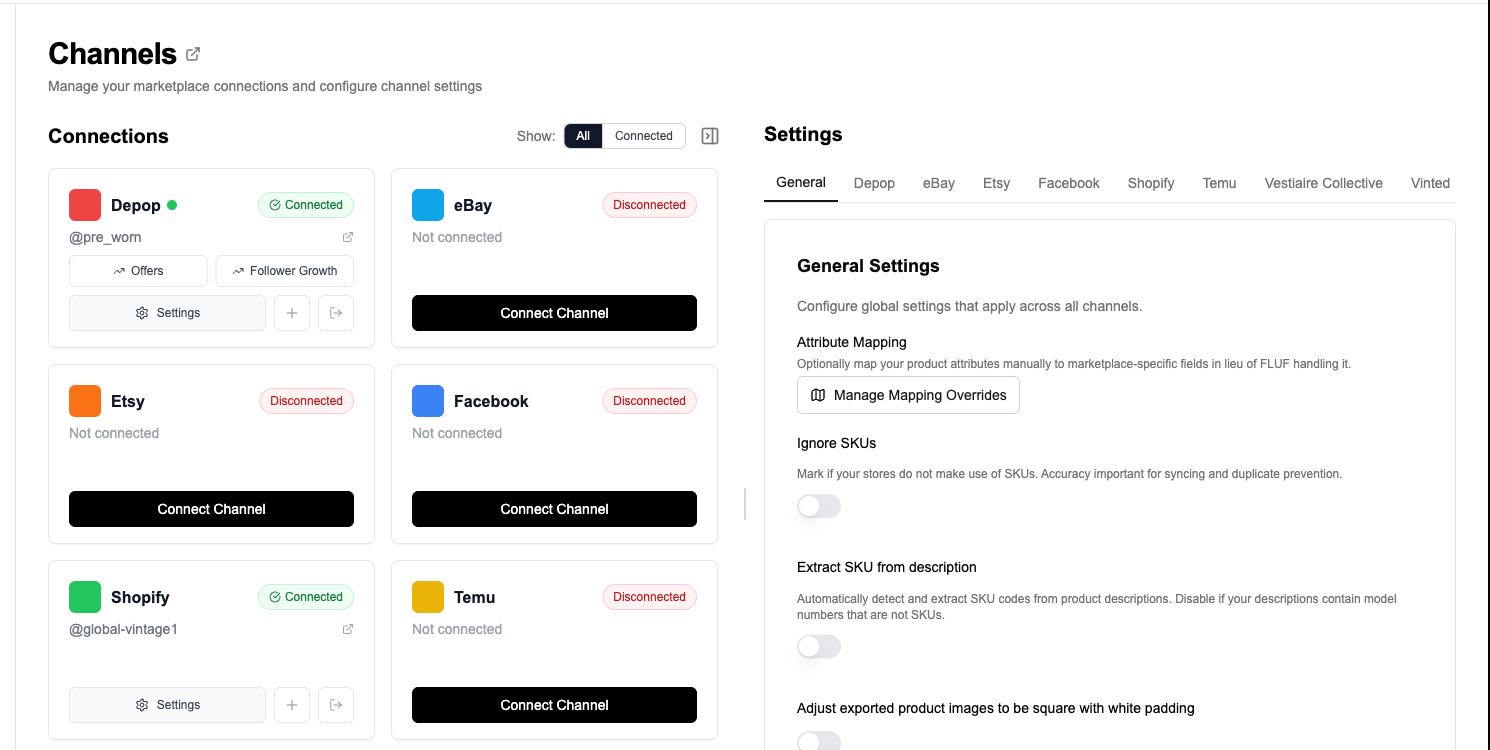
Table of Contents
- Why Sell Pokémon Cards on Whatnot?
- The Pokémon Card Market in 2026
- Modern Sets: What Is Selling Now
- Vintage WOTC and Japanese Cards
- Show Formats for Pokémon Sellers
- Grading: PSA vs CGC vs BGS for Pokémon
- Pricing Strategy and Auction Dynamics
- Where to Source Pokémon Card Inventory
- Presentation Tips for Pokémon Cards
- Common Mistakes Pokémon Card Sellers Make
- Cross-List with FLUF Connect
- FAQ
Why Sell Pokémon Cards on Whatnot?
Pokémon is the highest-volume single trading card game on Whatnot, and for good reason: the live booster break format is a perfect match for the Pokémon TCG’s chase-card excitement. When a Umbreon ex Special Illustration Rare from Prismatic Evolutions is pulled live on camera — and the chat erupts — the resulting auction captures a price premium that no static listing can replicate. Pokémon cards have appreciated 3,821% since 2004 (compared to the S&P 500’s 483% over the same period), and the Pokémon TCG generates roughly $2 billion in annual card sales globally.
Whatnot’s advantage for Pokémon sellers is the combination of speed, engagement, and community. A two-hour booster-break show can move 200+ packs of sealed product. A singles night can auction 100+ individual cards. Buyers spend 80+ minutes per day in the app and return to the same sellers weekly. One Pokémon seller on Whatnot noted that “making moving bulk Pokémon cards easy with quick setup, low fees, fast payouts, and engaged buyers” was the platform’s core appeal.
The fee structure reinforces this: Whatnot’s ~11% effective rate undercuts eBay (~13.25%) and TCGPlayer (12–15%). On high-value graded Pokémon cards above $1,500, the commission cap means you pay 0% commission on the overage — a meaningful saving on chase cards like PSA 10 vintage Charizards or Umbreon SIRs.
The Pokémon Card Market in 2026
The Pokémon TCG accounts for approximately 12% of the total trading card games market, with roughly $2 billion in annual card sales. The market is healthy but bifurcated — top-end chase cards and vintage sealed product are appreciating, while common modern cards face oversupply and declining margins.
The big picture
- Vintage sealed products: 15–25% appreciation expected throughout 2026. WOTC-era (1999–2003) sealed packs and boxes are treated as collectible assets, not trading cards.
- Modern chase cards: top cards (SIRs, alt arts) holding value or appreciating. Mid-tier rarity cards facing 20–30% price adjustments as print runs increase.
- Japanese cards: continued strong growth, particularly for cards without English equivalents. Lower print runs = higher scarcity. Growing collector interest in Japanese art variants.
- Historical context: Pokémon cards have appreciated 3,821% since 2004 — consistently outperforming traditional investments over two decades.
Modern Sets: What Is Selling Now
These are the sets driving the most Whatnot activity and price action as of early 2026.
| Set | Key Chase Cards | Price Range | Notes |
|---|---|---|---|
| Ascended Heroes (Jan 2026) | Mega Gengar SIR (~$1,231 raw), Mega Charizard Y (~$880), Mega Dragonite SIR (~$697–1,000 PSA 10), Team Rocket’s Mewtwo (~$550) | Chase cards $550–1,250 | 290+ cards — largest English set ever. Strong price floors establishing from day one. Art quality is driving premiums over character popularity. |
| Prismatic Evolutions | Umbreon ex SIR ($1,020–1,050 raw) | Sealed boxes $155–175 (above $140 MSRP) | Eeveelution SIRs appreciating 100–200% annually. Sealed product still above MSRP months after release. Allocation-only — demand vastly exceeds supply. |
| Surging Sparks | Pikachu ex SIR ($271) | Booster boxes $250–300 (up from $140 MSRP) | 50–100% ROI potential in 3–6 months for sealed product. Pikachu chase card driving demand. |
What this means for Whatnot sellers
Sealed product from these sets is the highest-demand inventory for booster breaks. Prismatic Evolutions boxes at $155–175 produce breaks that generate $200–400+ in total revenue (depending on pulls) — strong margins for sellers who source near MSRP. Ascended Heroes is the current flagship release, and first-wave sealed product will command premiums for months. Sourcing these sets at wholesale or MSRP is the key profitability lever.
Vintage WOTC and Japanese Cards
Vintage Pokémon cards — particularly first edition WOTC-era (1999–2003) — are the blue-chip assets of the Pokémon collecting world. On Whatnot, vintage pack openings are among the highest-engagement shows, with individual vintage packs costing $500–850+ and drawing audiences who want to witness the pull in real time.
Key vintage price data (Q1 2026)
- 1st Edition PSA 9+ cards: returning 15–25% annually long-term. The “gold standard” holding value through market volatility.
- Pikachu Illustrator: the most valuable Pokémon card in existence. Six-figure+ territory.
- 1st Edition Charizard (Base Set): PSA 10 remains a collector benchmark in the $300,000–500,000 range.
- Umbreon VMAX Alt Art (Evolving Skies): dropped $300+, fell below $2,000 for the first time — represents corrections in 2020–2022 era “modern vintage.”
- TAG TEAM cards (Sun & Moon era): renewed interest. Mewtwo & Mew GX pushed over $280 after a December 2025 buyout.
Japanese cards
Japanese Pokémon cards are a fast-growing niche on Whatnot. Lower print runs create genuine scarcity, Japanese-exclusive promos command premiums, and the art quality on Japanese prints is consistently rated higher by collectors. For Whatnot sellers, Japanese product offers two advantages: margin (wholesale pricing from Japanese distributors is often cheaper per unit) and audience appeal (the live reveal of a Japanese art variant that does not exist in English drives enormous engagement).
Show Formats for Pokémon Sellers
| Format | How It Works | Best For |
|---|---|---|
| Booster Box Breaks | Open an entire sealed booster box live. Buyers purchase packs, spots, or the entire rip. The drama of watching pulls in real time is the core entertainment. | The signature Whatnot Pokémon format. Works for every set. |
| ETB Openings | Open Elite Trainer Boxes live. Lower entry cost than full box breaks but still entertaining. | Lower-capital sellers. Good entry format for new streamers. |
| Singles Auctions | Individual cards (raw or graded) auctioned live. 15–60 seconds per card. Show front, back, corners, grade. | High-value singles, PSA 10 chase cards, vintage raw cards. |
| Sealed Product BINs | Sell sealed booster boxes, ETBs, tins at or above retail as Buy It Now items during or between shows. | Prismatic Evolutions (still above MSRP), allocated sets, Japanese product. |
| Vintage Pack Openings | Open WOTC-era packs ($500–850+ per pack) live on camera. Extremely high engagement but requires significant capital. | High-audience shows. The drama of a vintage pull is unmatched entertainment. |
| Mystery / Repack Lots | Curated mystery bundles. Requires pre-approval since Nov 2025. Full checklist must be disclosed. | Moving mid-tier inventory at volume. Higher regulatory burden post-policy change. |
Grading: PSA vs CGC vs BGS for Pokémon
Grading is a critical part of the Pokémon card value chain on Whatnot. A raw chase card worth $200 can sell for $600–1,000 as a PSA 10. Understanding which grading company to use — and when to grade — is the difference between a profitable card and a costly one.
| Company | Market Share | PSA 10 Price Premium | Best For |
|---|---|---|---|
| PSA | 70%+ | Benchmark | Resale value. Gold standard. Most recognised slab on Whatnot. PSA 10 = 2–5x raw value for modern, 5–10x for vintage. |
| CGC | ~25% (growing) | 72–85% of PSA 10 (gap narrowing to 5–10% for modern) | Budget-friendly grading. Faster turnaround. Expected to reach PSA parity by 2027. |
| BGS/Beckett | Declining | BGS 9.5 ≈ PSA 10. Black Label: 3–5x PSA 10. | Sub-grade transparency. Black Label chase on modern chase cards. |
When to grade for Whatnot
- Only grade cards worth $75–100+ raw — the grading fee ($20–50 depending on tier and turnaround) needs to be justified by the uplift
- PSA 10 = 2–5x raw for modern cards: a $200 raw Umbreon SIR becomes $600–1,000 as PSA 10
- PSA 9 = only 30–50% of PSA 10 value: the cliff between 9 and 10 is severe. Only submit cards you are confident will gem
- Population matters: cards with fewer than 100 PSA 10s in the pop report command the highest premiums
- CGC for volume grading: if you are grading 50+ modern cards, CGC’s lower cost and faster turnaround often make more sense than PSA for mid-value cards
Caution: A December 2025 PSA inconsistency issue — where roughly 30 identical modern cards submitted returned mostly PSA 9 — caused 10–20% price drops on modern Pokémon PSA slabs. The long-term impact is still developing. Factor this into your pricing and grading decisions.
Pricing Strategy and Auction Dynamics
Sealed product breaks
Price break spots based on the set’s expected value. For a Prismatic Evolutions booster box sourced at $155, selling 36 packs at $5–8 each produces $180–288 in revenue before fees. If a chase Eeveelution SIR hits, the auction for that individual card can add $200–1,000+ on top. The maths works at scale.
Singles auctions
Start at $1 for cards worth $20–75. For cards above $75, starting at $5–15 is acceptable. For graded cards above $200, start at $25–50. Never start at market price — the auction format requires headroom for bidding momentum.
Whatnot vs eBay pricing
Desirable Pokémon cards routinely sell for 20–60% above eBay sold comps during well-attended Whatnot shows, driven by competitive FOMO bidding. The flip side: on slow shows with 5–10 viewers, the same card can sell at $1. Always check eBay sold listings (filter by “recently sold”) for a floor expectation before going live. If your audience is still small, expect to sell at or below eBay comps until you build a following.
Segment projections for 2026
- Vintage sealed: 15–25% appreciation expected
- Modern chase cards (SIRs, alt arts): stable to up for top-end; mid-tier down 20–30%
- Japanese exclusives: continued strong growth
- Common modern singles: flat to down. Move at volume if at all.
Where to Source Pokémon Card Inventory
| Source | Best For | Notes |
|---|---|---|
| Authorised distributors | Sealed product at wholesale ($70–90/box vs $100–120 retail) | Requires retailer relationship and minimum order volumes. Critical for allocated sets like Prismatic Evolutions. |
| UK wholesale (Plus Marketing, Muddleit, Invicta TCG, PokUK) | UK-based sellers sourcing English and Japanese product | Plus Marketing is the leading UK Pokémon distributor. Business registration typically required. |
| Japanese distributors | Japanese-exclusive cards and sealed product | Often cheaper per unit than English product. Import from Japan or via UK importers. |
| Retail (Costco, Target, Walmart, GAME) | MSRP-priced sealed product for above-MSRP resale | Highly competitive. Prismatic Evolutions restocks at Costco caused physical altercations due to overwhelming demand. |
| Card shows / conventions | Bulk singles, raw cards for grading, collections | Negotiate bulk deals with dealers clearing inventory. |
| eBay / Mercari lots | Undervalued lots for resale or grading candidates | Buy raw cards below comp, grade to PSA 10, sell on Whatnot at 3–5x. |
| Other Whatnot sellers | Bulk commons/uncommons from breakers | Breakers offload bulk between shows at low per-card prices. |
The sourcing advantage is everything. A Pokémon seller who reached 1,000 sales in 100 days on Whatnot reported zero profit — because without distributor access, sourcing at retail or above retail eliminated every margin. The sellers making six and seven figures have wholesale relationships that let them break product profitably even on $1 starting bids.
Presentation Tips for Pokémon Cards
- Holo/foil lighting: avoid direct ring light reflection. Use diffused overhead lighting angled from above and slightly to the side. The holographic pattern is the whole appeal — if glare obscures it, buyers will not bid confidently.
- Slow card reveals: when pulling from a pack, build the moment. Show the pack, peel it open slowly, fan out the cards. Save the rare slot for last. This is entertainment — the pacing drives engagement and retention.
- Close-up for condition: for raw singles, show all four corners, the surface under angled light (reveals whitening and scratches), and the back centering. For graded slabs, hold still at camera level and tilt gently to show the label and card surface.
- Know your sets: call out the set name, card number, rarity tier, and any relevant context. “This is a Special Illustration Rare from Ascended Heroes, Mega Gengar, trending at $1,200 raw on eBay” — that kind of detail drives bids.
- Dark background mat: black or charcoal. Pokémon playmats work well and reinforce the category aesthetic.
- Penny sleeves + top loaders on camera: watching you handle cards carefully builds trust. Sloppy handling = lower bids.
Common Mistakes Pokémon Card Sellers Make on Whatnot
- Sourcing at retail and expecting margins — if you buy booster boxes at $120 retail and sell 36 packs at $3 each after $1 starts, you lost money before fees. Wholesale sourcing or above-MSRP sealed products are the only paths to consistent profit.
- Excessive $1 auctions and giveaways — generosity builds goodwill but destroys margins. Track the dollar value of giveaways per show and cap it at a budget you have set in advance.
- Not knowing the grading landscape — sending mid-value cards to PSA when CGC is faster and cheaper for the same market acceptance. Or grading $30 raw cards where the PSA fee alone eats the margin.
- Poor pack-opening pacing — ripping through packs at speed kills the entertainment value. Every pack should be a mini-event with commentary, anticipation, and chat interaction.
- Listing mystery/repack products without approval — since November 2025, all repack sellers must be pre-approved. Listing without approval risks suspension.
- Not tracking cost basis per box — a booster box break looks great on revenue ($250 total) until you subtract the box cost ($155), fees (~$28), shipping ($5 per buyer × 10 buyers = $50), and giveaways ($30). Actual profit: $0–15. Track everything.
- Ignoring Japanese product — Japanese Pokémon cards are one of the fastest-growing niches on Whatnot with less seller competition. Missing this segment leaves money on the table.
- Running shows at the same time as bigger sellers — check the Whatnot schedule before going live. If a major Pokémon breaker with 500 followers is running at the same time, your viewers will be watching them instead.
Cross-List with FLUF Connect
If you sell Pokémon cards on both Whatnot and eBay (and you should), inventory sync is non-negotiable. A PSA 10 Umbreon SIR sells for $1,050 on your live Whatnot show at 8pm. At 8:03pm, the same card sells on eBay. You now owe two buyers the same card.
FLUF Connect prevents this by automatically delisting items from eBay, Shopify, and every other connected channel the moment a sale happens on Whatnot — and vice versa. For Pokémon card sellers running high-value singles across multiple platforms, this is the difference between a smooth operation and a refund headache.
| FLUF Connect Feature | What It Does for Pokémon Sellers |
|---|---|
| Crosslisting | Push your Pokémon inventory to Whatnot, eBay, Shopify from one dashboard |
| Inventory sync | Whatnot sale = instant delist from eBay. eBay sale = instant delist from Whatnot. |
| Auto-relisting | Automatically relist unsold cards on eBay between Whatnot shows |
| Order sync | All orders from every channel in one dashboard for fulfilment |
| Bulk operations | Adjust pricing across hundreds of cards when market values shift |
To get started, create a free FLUF Connect account. unlimited listings on the £9/month Starter plan — see the pricing page for plans beyond that.
Selling Pokémon cards on Whatnot and eBay? FLUF Connect syncs your inventory in real time — a live-show sale never oversells on another platform.
Frequently Asked Questions
What Pokémon sets sell best on Whatnot in 2026?
Prismatic Evolutions (Umbreon ex SIR at $1,020+), Ascended Heroes (Mega Gengar SIR at $1,231, the largest English set ever), and Surging Sparks (Pikachu ex SIR at $271). Vintage WOTC sealed product consistently commands premium prices.
Should I grade my Pokémon cards before selling on Whatnot?
Grade cards worth $75+ raw. PSA 10 = 2–5x raw value for modern, 5–10x for vintage. CGC is a budget-friendly alternative with a narrowing price gap. Do not grade commons or mid-value cards where the fee eliminates the premium.
What fees does Whatnot charge for Pokémon cards?
8% commission + 2.9% + $0.30 processing (~11% effective). On cards above $1,500, you pay 0% commission on the overage. No listing fees, no monthly subscription. Lower than eBay and TCGPlayer.
Is it profitable to break Pokémon booster boxes on Whatnot?
Yes, if you source at wholesale. A Prismatic Evolutions box sourced at $155 produces $200–400+ in total break revenue depending on pulls, plus the individual auction of any chase cards pulled. The maths breaks down at retail pricing unless the set is above MSRP.
Are Japanese Pokémon cards popular on Whatnot?
Yes and growing fast. Japanese cards offer lower print runs, higher scarcity, and unique art variants that do not exist in English. They are one of the fastest-growing niches on the platform with less seller competition.
How do I source Pokémon product for Whatnot in the UK?
Plus Marketing is the leading UK Pokémon distributor. Other options include Muddleit, Invicta TCG, PokUK, and MaxOnCards. Business registration is typically required. Retail sourcing from GAME and supermarkets is possible but competitive and margin-thin.
Can I sync my Pokémon card listings across Whatnot and eBay?
Yes. FLUF Connect supports both with real-time inventory sync. Sell on Whatnot, auto-delist from eBay.
Explore more: Trading Cards | Sports Cards | Sneakers | Funko Pops | Vintage Clothing. Or read the full How to Sell on Whatnot guide.
Frequently Asked Questions
Prismatic Evolutions with Umbreon ex SIR at $1,020+, Ascended Heroes the largest English set ever, and Surging Sparks with Pikachu ex SIR at $271. Vintage WOTC sealed product commands premium prices.
Grade cards worth $75+ raw. PSA 10 equals 2-5x raw value for modern, 5-10x for vintage. CGC is budget-friendly with a narrowing price gap. Do not grade commons where the fee eats the premium.
8% commission plus 2.9% plus $0.30 processing, roughly 11% effective. On cards above $1,500 you pay 0% commission on the overage. Lower than eBay and TCGPlayer.
Yes if you source at wholesale. A Prismatic Evolutions box at $155 produces $200-400+ in break revenue depending on pulls plus individual chase card auctions. Margins break down at retail pricing.
Yes and growing fast. Japanese cards offer lower print runs, higher scarcity, and unique art variants. They are one of the fastest-growing niches on the platform.
Plus Marketing is the leading UK Pokemon distributor. Also Muddleit, Invicta TCG, PokUK, and MaxOnCards. Business registration typically required. Retail from GAME is possible but competitive.
Yes. FLUF Connect supports both with real-time inventory sync. Sell on Whatnot, auto-delist from eBay.