
How to Sell Trading Cards on Whatnot — The Complete Guide for 2026
Pokémon, Magic, Yu-Gi-Oh, One Piece, Lorcana — every major TCG on the largest live-auction platform. Fees, show formats, grading, sourcing, and how to cross-list.



Key Takeaways
- Whatnot is the #1 platform for live TCG sales — the platform’s second-largest category in the US, with 15,000+ live TCG shows active at any given time and a global trading card games market worth $9.2 billion in 2026.
- Lower fees than eBay or TCGPlayer — Whatnot charges 8% commission + 2.9% + $0.30 processing (~11% effective). eBay takes ~13.25% FVF on collectibles. TCGPlayer takes 12–15%. On high-value singles above $1,500, Whatnot’s commission cap means you pay 0% commission on the overage.
- Every major TCG sells on Whatnot — Pokémon, Magic: The Gathering, Yu-Gi-Oh, One Piece, Disney Lorcana, Flesh and Blood, Weiss Schwarz. Each game has a dedicated community of live breakers and singles auctioneers.
- Multiple show formats — booster box breaks, PYT (Pick Your Team), random team breaks, singles auctions, sealed product BINs, rip-and-ship, mystery packs. The format you choose depends on your inventory and audience.
- Cross-list with FLUF Connect — sync your TCG inventory with eBay, Shopify, and other channels so a live-show sale instantly delists everywhere else. Get started in minutes.
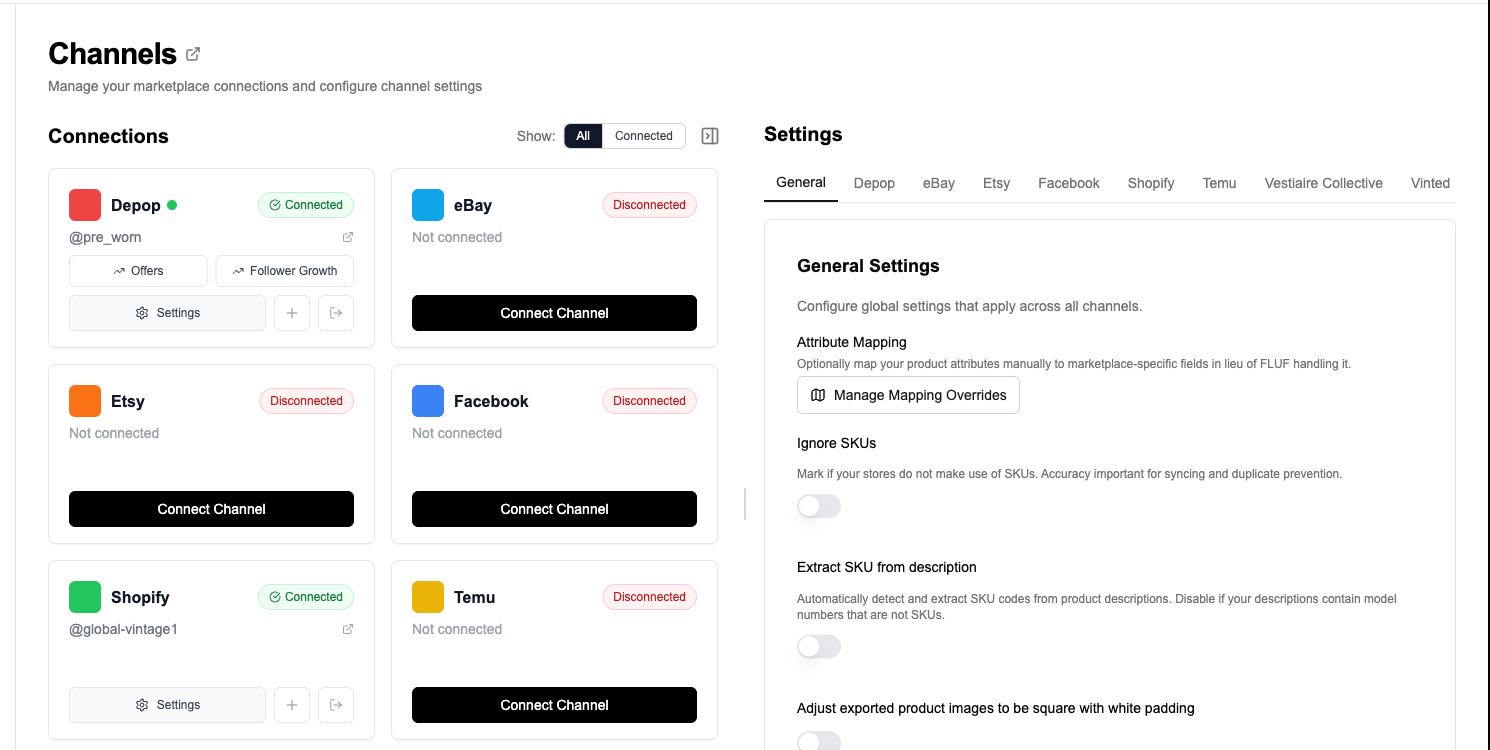
Table of Contents
- Why Sell Trading Cards on Whatnot?
- Whatnot Fees for Trading Card Sellers
- Show Formats That Work for TCG
- Guide by Game: Which TCGs Sell Best
- Pricing Strategy and Auction Dynamics
- Grading: PSA, CGC, BGS and Their Role on Whatnot
- Where to Source TCG Inventory
- Presentation and Camera Tips for Cards
- Common Mistakes TCG Sellers Make
- Whatnot Card Policies You Must Know
- Whatnot vs eBay vs TCGPlayer for Cards
- Cross-List Your TCG Inventory with FLUF Connect
- FAQ
Why Sell Trading Cards on Whatnot?
Whatnot was built for card sellers. The platform’s very first livestream featured its founder selling $5,000 worth of Funko Pops and cards in a few hours, and trading cards have been the platform’s bread and butter ever since. In 2025, TCG was Whatnot’s second-largest category in the US (behind sports cards), with over 15,000 live shows running at any given time. The global trading card games market is worth an estimated $9.2 billion in 2026 and growing at 6.9% annually — projected to reach $16.9 billion by 2035.
Speed that static platforms cannot match
A well-run Whatnot stream can sell 100–300+ cards in a single 2–3 hour show. On eBay or TCGPlayer, the same inventory might take weeks or months to trickle out through search-driven sales. The live auction format compresses the sales cycle from “list and wait” to “show and sold.” For sellers with high-volume inventory — booster boxes, bulk singles, rotating collections — this speed is transformational.
Auction dynamics that push prices above static comps
When two bidders want the same card during a live show, the price goes up. Community-reported data suggests desirable cards routinely sell for 20–60% above eBay sold comparables during well-attended shows. A chase Pokémon pull revealed live on camera, with the chat going wild, can land well above what the same card would fetch in a static eBay listing. The caveat: on slow shows with small audiences, the same card might sell for $1. The live format amplifies highs and lows.
Community and repeat buyers
Whatnot buyers spend an average of 80+ minutes per day in the app. They follow specific sellers, return for every scheduled show, and build relationships through live chat. For TCG sellers, this means a core audience of 20–50 loyal buyers can sustain a full-time business. One Boca Raton trading card shop grew from ~$40,000/month in-store to $1.5–3 million/month after adding Whatnot live commerce and now employs 39 people.
Lower fees than the competition
Whatnot’s effective fee rate of ~11% undercuts eBay (~13.25% for collectibles) and TCGPlayer (12–15%). On high-value singles, Whatnot’s commission cap (0% commission above $1,500 in trading card categories) creates even larger savings. More detail in the fees section below.
Whatnot Fees for Trading Card Sellers
| Fee | Rate | Notes |
|---|---|---|
| Seller commission | 8% of sale price | Applied to the item price (not shipping) |
| Payment processing | 2.9% + $0.30 per order | Applied to total including shipping |
| Listing fee | $0 | Unlimited listings, no insertion fees |
| High-value commission cap | 0% commission above $1,500 | Applies to Trading Cards (all sub-categories), Comics/Anime, Toys, Sports Singles |
| Effective take rate | ~11% | On a typical $30 sale |
- Commission: 8% × $100 = $8.00
- Processing: 2.9% × $105 + $0.30 = $3.35
- Total fees: $11.35 (~11.4%). You keep: $88.65.
- Same card on eBay: 13.25% × $105 = $13.91. You keep: $86.09. Whatnot saves you $2.56.
- Same card on TCGPlayer (12%): $12.60. You keep: $87.40.
The $1,500 commission cap
For Trading Cards (including Pokémon, MTG, Yu-Gi-Oh, One Piece, and all other TCG sub-categories), Whatnot charges 0% commission on the portion of a single order above $1,500. You still pay the 2.9% + $0.30 processing on the full amount. On a $5,000 graded card, your commission is capped at $120 (8% × $1,500) instead of $400 (8% × $5,000) — saving you $280 on a single transaction. eBay would charge approximately $660 on the same sale.
Note: Whatnot describes this cap as a promotional offer. Verify current availability before relying on it for high-value pricing decisions.
Show Formats That Work for TCG
Choosing the right show format is the single most important decision a TCG seller makes on Whatnot. Each format serves different inventory types, audience preferences, and revenue goals.
Booster Box Breaks
The signature Whatnot TCG format. You open an entire sealed booster box live on camera, and buyers purchase packs, spots, or teams before the rip. The entertainment value of watching pulls in real time — and the collective reaction when a chase card hits — drives engagement that no static platform can replicate. This works for every TCG: Pokémon booster boxes, MTG draft and collector boosters, Yu-Gi-Oh cases, One Piece boxes, and Lorcana boosters.
PYT (Pick Your Team) and Random Team Breaks
Originally a sports card format, PYT has crossed into TCG. Buyers purchase a “team” or a slot, and cards are allocated based on the randomiser or a predetermined rule. PYT works best for TCGs with clear sub-categories (e.g., by energy type in Pokémon, by colour in MTG, by archetype in Yu-Gi-Oh). Random team breaks assign slots via a live randomiser wheel, adding a gambling-adjacent excitement layer.
Singles Auctions
Individual cards auctioned live with detailed descriptions. The seller shows front, back, corners, and edges on camera. Graded slabs are held to the camera and rotated slowly. This format works for high-value singles where the buyer needs to see condition. Typical auction duration: 15–60 seconds per card. $1 starting bids are the norm; competitive bidding handles the rest.
Rip and Ship (Personal Box Breaks)
A buyer purchases a full sealed product (a booster box, ETB, or case), and you open it live on camera while they watch. Everything pulled goes to the buyer. This format works for buyers who want the pack-opening experience but trust the seller to handle it. All product from a card break must be opened in the same show — you cannot split a break across multiple streams.
Flash Sales and BINs
Fixed-price items during or between streams. Use these for sealed product at market rate, bulk lots of commons/uncommons, and items that do not lend themselves to auctions. Many sellers pin Buy It Now items alongside their live auctions for passive purchases during the show.
Mystery / Repack Lots
Curated mystery bundles where buyers get a random allocation. Since November 2025, all sellers of repacks must be pre-approved by Whatnot and listed on the “Identified Product List.” This was introduced to combat scam repacks and ensure quality. If you sell mystery products, read Whatnot’s Professionally Sealed Surprise Products policy carefully before listing.
Guide by Game: Which TCGs Sell Best on Whatnot
| Game | Whatnot Strength | Best Formats | Key Products / Sets (2026) |
|---|---|---|---|
| Pokémon | Dominant — highest search volume of any single TCG on Whatnot | Booster box breaks, ETB openings, singles (raw + graded), sealed BINs | Prismatic Evolutions, Ascended Heroes (Jan 2026), Surging Sparks. Vintage WOTC sealed at massive premiums. |
| Magic: The Gathering | Strong — most established competitive secondary market | Draft/collector booster breaks, singles auctions for staples, sealed BINs | Avatar set (Q4 2025 top seller), Modern Horizons, Commander precons |
| Yu-Gi-Oh | Solid — loyal competitive player base | Case breaks, singles for competitive play, sealed product | 2025 Mega-Pack, Legendary Modern Decks 2026. Losing ground to One Piece in sales volume. |
| One Piece TCG | Fastest-growing — officially outsold Yu-Gi-Oh in late 2025 | Booster box breaks (high chase card appeal), singles auctions | The Best Vol. 2, Carrying On His Will. Strong community growth. |
| Disney Lorcana | Growing — broader audience appeal beyond traditional TCG collectors | Booster box breaks (Enchanted Rare chase at ~1:100 packs), singles | Enchanted Rares sell for hundreds to thousands. Disney fan crossover drives unique demand. |
| Flesh and Blood | Niche but passionate | Singles auctions, sealed product for competitive players | Dedicated competitive community. Less Whatnot activity but growing. |
| Weiss Schwarz | Niche — anime-driven TCG | Singles auctions, box breaks for anime fans | Smaller buyer pool but less seller competition. |
For a dedicated deep-dive into Pokémon specifically (the highest-volume single TCG on Whatnot), see our Sell Pokémon Cards on Whatnot guide. For sports cards (Whatnot’s #1 category), see Sell Sports Cards on Whatnot.
Pricing Strategy and Auction Dynamics
Pricing on Whatnot requires a completely different mindset from eBay or TCGPlayer. You are not setting a fixed price and waiting — you are setting a starting bid and trusting the market to determine the final price in real time. Getting this right is the difference between a profitable show and a loss.
The $1 start philosophy
Most successful TCG sellers on Whatnot start auctions at $1. This feels terrifying — your $50 card could sell for $1 if nobody bids. But the psychology works: low starts attract immediate bids, bids attract more bids, and competitive bidding routinely pushes prices to or above market value. Starting at $25 on the same card often results in zero bids and no sale, because buyers browse Whatnot looking for auction excitement, not for fixed-price shopping.
When cards sell above market on Whatnot
- Pulled live on camera — a chase card revealed during a booster break generates instant FOMO and emotional bidding
- High show attendance — 100+ concurrent viewers create competitive pressure. 5 viewers means no competition and $1 final prices
- Rare or trending cards — limited-edition cards, new set releases, and trending players/characters benefit most from the auction format
- Strong seller following — established sellers with loyal audiences command higher final prices because their viewers trust the product and enjoy the show
When cards sell below market
- Low attendance shows — new sellers with small audiences often sell below eBay comps. Building viewership takes weeks to months of consistent streaming
- Common / bulk cards — the live format does not add value to cards that are readily available elsewhere at fixed prices
- Over-saturated categories — if 50 other sellers are running Pokémon breaks at the same time, your share of the viewer pool drops
Always check eBay sold comps
Before listing any card on Whatnot, check the eBay sold listings for recent comparable sales. This gives you a floor expectation. If a card sells consistently at $40 on eBay, and your Whatnot show averages 20 viewers, you should expect $25–$50 depending on the night. If the same card sells for $200 and you have 200 viewers, the live format can push it to $250+. Know your comps before you go live.
Grading: PSA, CGC, BGS and Their Role on Whatnot
Graded cards sell better on Whatnot than raw cards for anything valued above ~$50, because the grade provides instant trust during a live auction where buyers cannot physically inspect the card. The grading company matters — PSA dominates the market, CGC is closing the gap, and BGS occupies a niche premium position.
| Grading Company | Market Share | Price Premium vs CGC | Best For |
|---|---|---|---|
| PSA | 70%+ | Benchmark (15–20% above CGC for modern cards) | Resale value. Gold standard for secondary market. Most recognisable slab. |
| CGC | ~25% (growing fast) | 72–85% of PSA 10 price (gap narrowing) | Budget-friendly grading. Expected to reach PSA parity by 2027 for modern cards. |
| BGS/Beckett | Declining | BGS 9.5 ≈ PSA 10 | Black Label (all sub-grade 10s): commands 3–5x PSA 10 price on chase cards. |
When to grade for Whatnot
- Only grade cards worth $75–100+ raw — the grading cost needs to be justified by the price uplift
- Target PSA 10 candidates — a PSA 10 sells for 2–5x raw value on modern cards, 5–10x on vintage
- PSA 9 = only 30–50% of PSA 10 value, so the drop-off is severe. Only submit cards you are confident will gem
- Cards with fewer than 100 PSA 10s in the population report are the best candidates — scarcity drives the premium
Note: A December 2025 PSA grading inconsistency issue (where ~30 identical modern cards submitted returned mostly PSA 9) caused 10–20% price drops on modern PSA slabs. The long-term impact is still developing. Sellers should be aware that grading confidence has been shaken in some collector circles.
Where to Source TCG Inventory
Sourcing is the single biggest determinant of profitability for TCG sellers on Whatnot. The sellers who make six or seven figures have one thing in common: they source at wholesale or below.
| Source | Cost | Best For | Difficulty |
|---|---|---|---|
| Authorised distributors | $70–90 per booster box (wholesale) | Sealed product at maximum margin | Hard — requires retailer relationship and minimum order volumes |
| UK wholesale (Plus Marketing, Muddleit, Invicta TCG) | Wholesale pricing | UK-based sellers sourcing Pokémon, MTG, Lorcana | Moderate — need business registration |
| Card shows / conventions | Below retail for bulk | Bulk singles, collections, networking with dealers | Moderate — travel and negotiation required |
| eBay / Mercari lots | Variable | Undervalued lots for resale; arbitrage opportunities | Easy — but margins are thinner |
| Retail (Target, Walmart, Costco) | MSRP | Allocated sets (e.g., Prismatic Evolutions) for above-MSRP resale | Easy but competitive — demand regularly exceeds supply |
| Other Whatnot sellers | Below retail | Bulk commons/uncommons from breakers offloading | Easy — buy during other sellers’ shows |
| Liquidation wholesalers | Below wholesale | Overstock lots at deep discounts | Easy — variable quality |
The golden rule: never sell inventory you cannot source profitably. A Whatnot seller who reached 1,000 sales in 100 days reported zero profit because sourcing costs and generous $1 auctions ate every margin. Know your cost basis on every card and every box before you go live.
Presentation and Camera Tips for Cards
The way you present cards on camera directly affects how much they sell for. Whatnot buyers are making purchasing decisions based on a live video feed — if they cannot see the card clearly, they will not bid confidently.
Lighting
Standard ring lights can cause harsh reflections on holo and foil cards, making them hard to see. Use overhead diffused lighting or angle your light source from above and slightly to the side to minimise glare. Test your setup with a holo card before going live — if you can see the artwork clearly through the camera, your lighting works.
Card handling
Handle cards slowly and deliberately. Show the front, pause for 3–5 seconds, then rotate to show the back. For raw cards, show all four corners close-up. For graded slabs, hold them still at camera level and tilt gently to show the grade label and surface. Never touch raw card surfaces with bare fingers during a show — use gloves or hold by the edges in a penny sleeve.
Camera setup
A top-down camera angle works best for cards laid flat on a surface (mat or stand). Some sellers use a second camera or phone mount angled at face level for chat interaction. The card camera should be close enough that buyers can read set numbers, grading labels, and condition details without squinting.
Background
Use a solid-colour mat (black or dark grey works best for most cards) to isolate the card and reduce visual noise. Some sellers use branded mats or category-specific backdrops (Pokémon playmats, MTG life counter mats) to reinforce their niche.
Knowledge on camera
Buyers pay more from sellers who clearly know what they are selling. Call out the set name, card number, rarity, condition details, and any relevant market context (“this just came out of the new Ascended Heroes set, only available for two weeks”). Sellers who show expertise command higher final prices than sellers who hold cards up silently.
Common Mistakes TCG Sellers Make on Whatnot
- Starting prices too high — $1 starts drive bidding momentum. Starting at $15–25 kills the auction energy and results in zero bids. Trust the market.
- Poor lighting for holo/foil cards — ring light reflections obscure the very detail buyers want to see. Angle your light from above to avoid direct reflection on the card surface.
- Bad card handling — touching raw card faces, flashing cards too quickly, not showing backs and corners. Slow, deliberate presentation builds trust and bids.
- Not knowing grading details — selling PSA/BGS/CGC slabs without understanding the difference between a 9 and a 10, or not knowing which grading companies hold resale value.
- Shipping cards poorly — penny sleeve + top loader + team bag + cardboard sandwich is the minimum. Damaged arrivals destroy your ratings and generate returns.
- Over-generous discounting — excessive giveaways and $1 auctions on valuable cards destroy margins. One seller reported zero profit after 1,000 sales from being too generous.
- No market research — failing to check eBay sold listings before pricing. Know your comps.
- Ignoring community building — Whatnot is a relationship platform. Treating shows as purely transactional (hold card up, sell, next) instead of engaging the chat produces lower prices and fewer repeat buyers.
- Inconsistent schedule — audiences need predictability. “Every Tuesday and Thursday at 7pm” builds a following. Random sporadic shows do not.
- Not tracking finances — live selling moves fast. Without tracking cost basis, shipping costs, fees, and revenue per show, you will not realise you are losing money until it is too late.
Whatnot Card Policies You Must Know
Whatnot has specific policies for card breaks and sealed products. Violating these can result in suspension or permanent ban. Read the full policies before running your first show.
Card Breaks Policy
- Every buyer must receive at minimum one card per break purchase
- For hit drafts, only auction as many spots as there are guaranteed cards
- All product from a break must be opened in the same live show — no multi-stream breaks
- Break rules (what counts as “base,” how bulk is distributed) must be shared in Show Notes or item listings
- Non-card memorabilia (jerseys, helmets) cannot be included in breaks
- Unfilled breaks must be cancelled and refunded, or product carried forward unopened
Professionally Sealed Surprise Products (Nov 2025)
- All sellers of repacks/mystery packs must be pre-approved and on the “Identified Product List”
- Manufacturers must apply and may undergo third-party audit
- Sellers cannot have non-public knowledge about pack contents
- If sealed products are opened for buyers (rip-and-ship), contents must be revealed live on camera in full visibility
Counterfeit Policy
- Counterfeit cards are strictly prohibited — listing, selling, or giving away
- Sellers are responsible for ensuring and proving authenticity
- Buyers must submit counterfeit claims within 7 days of delivery or 30 days of purchase (whichever is earlier)
- Sellers cannot offer grading services on Whatnot (can only sell already-graded cards)
Whatnot vs eBay vs TCGPlayer for Cards
| Factor | Whatnot | eBay | TCGPlayer |
|---|---|---|---|
| Format | Live auctions + BIN | Static auctions (1–10 days) + BIN | Static BIN listings |
| Effective fees | ~11% | ~13.25% | 12–15% |
| High-value cap | 0% commission above $1,500 | 3% FVF above £5,000 | No cap |
| Buyer base | Community-driven, entertainment-first | Search-driven, 135M global buyers | Search-driven, TCG-specialist |
| Speed of sale | Seconds (live auction) | Days to weeks | Days to weeks |
| Price realisation | Variable (auction heat vs floor risk) | Market-rate, predictable | Market-rate, competitive pricing |
| Best for | Sealed product breaks, volume sales, community building | Individual singles, rare items, global reach | Competitive singles pricing, NM-specific grading |
| Authentication | Seller-responsible | Authenticity Guarantee on cards $250+ | Condition-based system (NM, LP, etc.) |
The smart play is multi-channel. Use Whatnot for sealed product breaks and volume singles where the live format adds value. Use eBay for rare high-value singles that need a global search audience. Use TCGPlayer for competitive singles pricing. And use FLUF Connect to sync inventory across all three so a sale on one channel instantly delists everywhere else.
For a detailed Whatnot-vs-eBay comparison across all categories, read our Whatnot vs eBay guide.
Cross-List Your TCG Inventory with FLUF Connect
Running Whatnot alongside eBay or Shopify without inventory sync is a guaranteed path to overselling. You auction a card live on Whatnot at 8pm while the same card sells on eBay at 8:02pm. Now you have two sales and one card. FLUF Connect eliminates this by syncing your inventory across Whatnot, eBay, Shopify, Depop, Vinted, and Facebook Marketplace.
| FLUF Connect Feature | What It Does for TCG Sellers |
|---|---|
| Crosslisting | Push your card inventory to Whatnot, eBay, Shopify, and more from a single dashboard |
| Inventory sync | Live-show sale on Whatnot instantly delists from eBay and every other channel |
| Auto-relisting | Automatically relist unsold cards on eBay/Depop to maintain visibility between shows |
| Order sync | View all orders from every channel in one dashboard for fulfilment and accounting |
| Bulk operations | Edit pricing across hundreds of listings simultaneously when market prices shift |
To get started, create a free FLUF Connect account and connect your selling channels. You get unlimited listings on the £9/month Starter plan — see the pricing page for plans beyond that.
Selling cards on Whatnot and eBay? FLUF Connect syncs your inventory in real time so a live-show sale never oversells on another channel.
Frequently Asked Questions
How much does it cost to sell trading cards on Whatnot?
Whatnot charges 8% commission + 2.9% + $0.30 processing per order (~11% effective). No listing fees, no monthly subscription. On high-value cards above $1,500 in TCG categories, the commission cap means 0% commission on the overage. This is lower than eBay (~13.25%) and TCGPlayer (12–15%).
What trading card games sell best on Whatnot?
Pokémon is the highest-volume single TCG. Magic: The Gathering, Yu-Gi-Oh, One Piece (the fastest-growing), Disney Lorcana, Flesh and Blood, and Weiss Schwarz all have active communities. Sports cards are Whatnot’s overall #1 category — see our sports cards guide.
Do I need to go live to sell cards on Whatnot?
Whatnot supports off-stream Marketplace listings, but the live show is where the vast majority of card sales happen. The format is the entire value proposition — if you are not willing to go live, eBay or TCGPlayer is a better fit.
How should I ship trading cards sold on Whatnot?
Penny sleeve + top loader + team bag + cardboard sandwich is the minimum for raw cards. Graded slabs should ship in bubble wrap inside a rigid mailer or small box. Whatnot provides the shipping label (USPS in US, Royal Mail in UK) — your job is to pack securely and drop off promptly.
Is it profitable to sell trading cards on Whatnot?
It can be extremely profitable — Whatnot reports 500+ sellers have crossed $1 million in lifetime sales. However, profitability depends on sourcing costs, audience size, and show frequency. Sellers who source at wholesale and stream consistently make strong margins. Sellers who source at retail and give away too much through $1 auctions can end up at zero profit even after hundreds of sales.
Can I sell graded cards on Whatnot?
Yes. PSA, CGC, and BGS graded slabs are among the highest-value items sold on the platform. Graded cards sell better than raw for items above ~$50 because the grade provides instant trust. Sellers cannot offer grading services on Whatnot — only sell already-graded cards.
Can I crosslist my card inventory to eBay and TCGPlayer?
Yes. FLUF Connect supports Whatnot alongside eBay and Shopify with synced inventory. When a card sells on one channel, it automatically delists from every other connected platform.
Explore more Whatnot category guides: Sports Cards | Pokémon Cards | Sneakers | Funko Pops | Vintage Clothing. Or read the full How to Sell on Whatnot guide.
Frequently Asked Questions
Whatnot charges 8% commission plus 2.9% plus $0.30 processing per order, roughly 11% effective. No listing fees, no subscription. On cards above $1,500, the commission cap means 0% on the overage. Lower than eBay at 13.25% and TCGPlayer at 12-15%.
Pokemon is the highest-volume single TCG. Magic: The Gathering, Yu-Gi-Oh, One Piece (fastest-growing), Disney Lorcana, Flesh and Blood, and Weiss Schwarz all have active communities. Sports cards are Whatnot overall number one category.
Whatnot supports off-stream Marketplace listings, but the live show is where the vast majority of card sales happen. If you are not willing to go live, eBay or TCGPlayer is a better fit.
Penny sleeve plus top loader plus team bag plus cardboard sandwich is the minimum for raw cards. Graded slabs need bubble wrap inside a rigid mailer or small box. Whatnot provides the shipping label. Your job is to pack securely and drop off promptly.
It can be extremely profitable. Whatnot reports 500+ sellers have crossed $1 million in lifetime sales. Profitability depends on sourcing costs, audience size, and show frequency. Wholesale sourcing and consistent streaming produce the best margins.
Yes. PSA, CGC, and BGS graded slabs are among the highest-value items on the platform. Graded cards sell better than raw for items above roughly $50 because the grade provides instant trust during live auctions.
Yes. FLUF Connect supports Whatnot alongside eBay and Shopify with synced inventory. When a card sells on one channel, it automatically delists from every other connected platform.