
Depop vs eBay: Which Is Better for Sellers in 2026?
A side-by-side comparison of fees, audience, features, shipping, and what real sellers think — plus how to sell on both automatically.



- Choose Depop if: you sell trend-driven fashion, streetwear, or Y2K styles and want to reach a young, engaged audience through a social, mobile-first experience.
- Choose eBay if: you sell across many categories (electronics, collectibles, designer fashion, homeware), want access to 134 million buyers worldwide, and value auction listings and mature seller tools.
- Fees: Depop charges no selling fee but takes 2.9% + £0.30 payment processing — you keep £28.83 on a £30 sale. eBay private sellers pay £0 in fees — you keep the full £30.
- Audience: Depop has 7 million active buyers, 90% under 34. eBay has 134 million active buyers across 190+ markets.
- Big news: eBay is acquiring Depop from Etsy for $1.2 billion (expected Q2 2026). Both platforms will remain separate for now.
- Best strategy: Sell on both — items cross-listed to multiple platforms sell significantly faster. Cross-list free with FLUF Connect.
Depop vs eBay at a Glance
Depop and eBay are two of the most popular platforms for reselling in the UK, but they serve fundamentally different audiences. Depop is a social, mobile-first marketplace built around fashion — its 7 million active buyers are overwhelmingly under 34 and browse for unique, trend-driven pieces. eBay is a global marketplace where you can sell virtually anything to 134 million active buyers across 190+ countries, from vintage clothing to electronics and collectibles.
Depop was founded in 2011 in London by Simon Beckerman, originally as a social shopping app inspired by his magazine PIG. It quickly became the go-to platform for Gen Z fashion resellers, blending Instagram-style aesthetics with peer-to-peer selling. Etsy acquired Depop in 2021 for $1.625 billion, and in February 2026, eBay announced it would acquire Depop for $1.2 billion — a deal expected to close in Q2 2026.
eBay was founded in 1995 in San Jose, California, by Pierre Omidyar. Originally an auction site, it has evolved over three decades into one of the world’s largest online marketplaces, hosting billions of live listings across every imaginable category. Its strength lies in sheer scale: if there is a buyer for what you are selling, they are almost certainly on eBay.
| Depop | eBay | |
|---|---|---|
| Founded | 2011 | 1995 |
| Headquarters | London, UK | San Jose, California |
| Active buyers | 7 million | 134 million |
| Markets | US, UK, Australia (primary) | 190+ countries |
| Top markets | US (~56% of revenue), UK, Australia | US, UK, Germany, Australia |
| Best for | Fashion, streetwear, Y2K, vintage clothing | Everything — electronics, collectibles, fashion, homeware |
| Seller fees (UK) | £0 selling fee + 2.9% + £0.30 processing | £0 for private sellers. Business: 8–15% + 30–40p |
| Free listings | Unlimited | Up to 1,000 per month |
| Mobile app | Yes — mobile-first, Instagram-style design | Yes — functional but complex |
For a deeper look at each platform individually, see our full guides: How to Sell on Depop and How to Sell on eBay.
Depop vs eBay: Feature-by-Feature Comparison
eBay offers a broader set of seller tools and listing formats, reflecting its maturity as a 30-year-old marketplace that serves every product category. Depop keeps things deliberately simple and social, prioritising a fast, visual listing experience over feature depth. The table below compares every major seller-facing feature.
| Feature | Depop | eBay |
|---|---|---|
| Auction listings | No — fixed price only | Yes — with reserve prices |
| Fixed-price listings | Yes | Yes |
| Built-in messaging | Yes — WhatsApp-style chat | Yes — email-style messaging |
| Offer/haggle system | Yes — Make an Offer (non-binding) | Yes — Best Offer (binding once accepted) |
| Seller analytics | Basic — views and likes | Detailed — Seller Hub with traffic reports, conversion data |
| Promoted listings | Yes — Boosted Listings (12% in UK) | Yes — Standard (1–20%) and Advanced (CPC) |
| Integrated shipping labels | Yes — Evri (UK), USPS (US) | Yes — Royal Mail, Evri, and more |
| Buyer protection | Yes — Depop Protection | Yes — eBay Money Back Guarantee |
| Social features (likes, follows) | Strong — likes, follows, social feed | Limited — watchers and followers |
| Seller verification | ID verification + Top Seller (blue tick) | ID verification + Top Rated Seller status |
| Business accounts | No formal tiers | Yes — Store subscriptions from £27/month |
| International selling | Limited — seller arranges own shipping | Yes — Global Shipping Programme |
| Multi-quantity listings | No — one item per listing | Yes — stock quantity per listing |
| Authenticity programme | No | Yes — mandatory for luxury items above thresholds |
The most significant difference is eBay’s offer system being binding versus Depop’s non-binding offers. On eBay, when a buyer submits a Best Offer and the seller accepts, the buyer is committed to purchase. On Depop, offers are non-binding — one analysis found sellers accepting multiple offers on a single item with zero completed transactions. This difference matters considerably for sellers managing active inventory across platforms.
Listing Experience: Depop vs eBay
Depop is the faster, simpler platform to list on — most sellers can photograph an item and have it live in under two minutes using the mobile app. eBay offers more control and visibility options, but the listing process takes longer and has a steeper learning curve.
On Depop, you upload up to 20 photos (with video support), select a category, enter the brand, size, colour, and condition, write a description, and set a price. The app guides you through each step with tap-to-select fields. There are no complex item specifics, no shipping configurations to set up (Depop handles labels through Evri in the UK), and no listing format decisions. Depop also offers AI-powered photo editing through its Photoroom integration, which can remove backgrounds and enhance images automatically.
On eBay, you get up to 24 photos, a comprehensive item specifics system (brand, model, material, and dozens of category-specific attributes), a choice between auction and fixed-price formats, configurable shipping options per listing, and promotional tools like subtitles, bold text, and promoted listings. eBay also supports product identifiers (UPC, EAN, ISBN) which help your items appear in product-based search results. The listing form is more complex, but each field helps the Cassini search algorithm match your item with the right buyer.
Photography expectations differ significantly. Depop buyers expect lifestyle-style photos — flat lays on clean backgrounds, items worn or styled, close-ups of labels and details. The aesthetic is Instagram-influenced and curated. eBay buyers, particularly in electronics and collectibles, prefer clear product photos showing every angle and any imperfections. For clothing on eBay, a mix of flat lay and mannequin/worn shots tends to perform best.
Time to list: expect 1–2 minutes per item on Depop, and 3–5 minutes on eBay (longer for items with many specifics). When listing hundreds of items, this difference compounds quickly — which is why sellers turn to bulk crosslisting tools like FLUF Connect to list once and push to both platforms simultaneously.
Fees Compared: How Much Do Depop and eBay Actually Cost?
Depop and eBay have taken very different approaches to seller fees. Depop removed its selling commission in July 2024 but still charges payment processing on every sale. eBay went further for private sellers — eliminating all fees entirely in October 2024. For business sellers, however, eBay’s fee structure is significantly more complex and expensive.
Fee Breakdown
| Fee Type | Depop | eBay (Private Sellers) | eBay (Business Sellers) |
|---|---|---|---|
| Listing fee | Free — unlimited | Free — up to 1,000/month | Free — up to 1,000/month (more with Store) |
| Selling / final value fee | £0 (removed July 2024) | £0 | 8–15% depending on category |
| Payment processing | 2.9% + £0.30 per transaction | £0 — included | Included in final value fee |
| Per-order fee | None | None | £0.30 (under £10) / £0.40 (over £10) |
| Regulatory operating fee | None | None | 0.35% + VAT (~0.42%) |
| Promoted listings | 12% (Boosted Listings, UK) | 1–20% (optional) | 1–20% (optional) |
| Store subscription | N/A | N/A | From £27/month (Basic) |
Important context for Depop fees: while Depop removed its 10% selling fee, payment processing of 2.9% + £0.30 still applies to every transaction. Buyers also pay a marketplace fee of up to 5% + £1, which does not come from the seller but can affect pricing strategy since it increases the total cost to buyers. Depop’s Boosted Listings fee also increased from 8% to 12% in the UK in March 2026.
- Depop: Selling fee £0.00 + Processing fee £1.17 (2.9% + £0.30) = You keep £28.83
- eBay (private seller): No fees = You keep £30.00
- eBay (business seller, clothing): FVF £3.57 (11.9%) + Per-order £0.40 + Regulatory £0.13 = You keep £25.90
Payouts: How Quickly You Get Your Money
| Depop | eBay | |
|---|---|---|
| Payout method | Bank transfer (via Stripe) | Bank transfer or debit card |
| Payout schedule | 2–3 working days after delivery confirmed, or up to 10 days after sale | Within 2 business days (daily, weekly, or monthly options) |
| On-demand payouts | No | Yes — within 30 minutes to debit card |
| New seller holds | Up to 10 working days | Up to 21 days (first 90 days) |
| PayPal option | No — phased out | No — Managed Payments only |
eBay pays out faster for established sellers, with daily payouts available and on-demand transfers to a debit card. Depop ties payouts to delivery confirmation, which means your money arrives only after the tracking shows delivered — or after a 10-day waiting period if tracking is unclear. For sellers with high volume, eBay’s flexible payout scheduling is a meaningful cash flow advantage.
Hidden Costs to Watch For
On Depop: the buyer-side marketplace fee (up to 5% + £1) can make your items look more expensive than the same listing on eBay, where buyers see no additional fees. This means you may need to price slightly lower on Depop to remain competitive, effectively cutting into your take-home. If you use Boosted Listings, the 12% fee in the UK is steep — and a class action was filed over how these buyer fees are disclosed at checkout.
On eBay: business sellers face a complex fee stack that varies by category. The Promoted Listings Standard attribution window was broadened in January 2026, meaning you pay the ad fee on any purchase within 30 days of a click — even if the buyer found your listing organically later. Below Standard seller performance can add a 6% surcharge, and high item-not-as-described rates add another 5%.
Audience and Demand: Who Is Buying on Depop vs eBay?
Depop and eBay attract fundamentally different buyer demographics, which is precisely why selling on both platforms is so effective — the overlap is minimal, meaning you reach almost entirely separate pools of potential buyers.
| Depop | eBay | |
|---|---|---|
| Primary age group | 16–34 (90% of buyers under 34) | 25–54 (broadest age distribution) |
| Top markets | US, UK, Australia | US, UK, Germany, Australia |
| Estimated active buyers | 7 million | 134 million |
| Annual GMV | ~$1 billion (2025) | ~$75 billion (2025) |
| Best-selling categories | Streetwear, Y2K fashion, vintage clothing, handmade items | Electronics (16.4%), clothing, collectibles, home & garden |
| Buyer behaviour | Browse-led, social, impulse purchases | Search-led, intent-driven, comparison shopping |
Depop’s audience skews young, fashion-forward, and social. Buyers browse Depop like a social media feed — scrolling through curated shops, following sellers whose style they admire, and making impulse purchases on trend pieces. The platform’s strength is in fashion subcategories that resonate with Gen Z: Y2K, vintage sportswear, streetwear, and indie brands. Growth has been strong, with active buyers up 37.7% year-on-year in 2025.
eBay’s audience is vastly larger, older, and more diverse. Buyers come to eBay with specific purchase intent — searching for a particular product, brand, or model rather than browsing. This search-driven behaviour means eBay is the stronger platform for categories like electronics (eBay’s top category at 16.4% of sales), collectibles, rare items, and anything with broad international appeal. A Y2K Dior piece that sits on Depop might sell fast on eBay to a serious buyer willing to pay a premium.
Category guidance: Depop wins for trend-driven fashion, ASOS/Topshop/New Look high-street brands, and curated vintage with a lifestyle aesthetic. eBay wins for designer fashion, electronics, books, collectibles, plus-size clothing, formal wear, and everyday basics. As one seller put it, eBay does better with “the more mid-range brands” like M&S and Next, while Depop is where the edgier, trendier pieces thrive.
Shipping: Depop vs eBay
Both platforms offer integrated shipping labels in the UK, but the options, flexibility, and international capabilities differ considerably. eBay gives sellers more choice and a global reach advantage, while Depop keeps shipping simple with a single carrier integration.
| Depop | eBay | |
|---|---|---|
| Integrated shipping labels (UK) | Yes — Evri only | Yes — Royal Mail, Evri, DPD, Parcelforce |
| Who pays shipping | Buyer pays, or seller offers free shipping | Buyer pays, or seller offers free shipping |
| UK shipping cost (small item) | From £2.99 (under 1kg via Evri) | Varies by carrier — typically £3–5 |
| Free shipping option | Yes — seller absorbs cost | Yes — seller absorbs cost |
| International shipping | No integrated labels — seller arranges own | Yes — Global Shipping Programme to 100+ countries |
| Return shipping | Buyer pays unless item not as described | Varies — seller sets return policy |
| Tracking required | Strongly recommended (affects payout speed) | Required for Money Back Guarantee protection |
eBay’s Global Shipping Programme is a significant advantage for sellers wanting to reach international buyers without the complexity of customs forms and overseas postage rates. You ship to a UK hub, and eBay handles the rest — customs, duties, and international delivery to over 100 countries. Depop offers no equivalent; international sellers must arrange and pay for their own cross-border shipping, which puts them at a disadvantage for reaching global buyers.
Depop’s Evri-only UK shipping is straightforward — prepaid labels with tracking, drop-off at Evri points — but some sellers find Evri’s delivery reliability frustrating, particularly for higher-value items. eBay’s carrier choice lets sellers select the service level that matches the item’s value, from budget Evri parcels to tracked Royal Mail Special Delivery.
What Real Sellers Say About Depop vs eBay
The best comparison data comes from sellers who have used both platforms. Here is what they actually say — the good, the bad, and the nuanced — sourced from seller forums, Reddit, and review sites.
“I’ve been selling on eBay since 2008 and Depop since 2014. I recommend eBay.”
“I was on Depop for a while to sell unwanted clothing, but they just weren’t moving. I’ve had better luck with eBay and Vinted.”
“Depop has more of a community feel — if you like a person’s vibe, you can follow them to see more of their listings. If you have a strong following and fanbase, Depop might be better.”
“The most successful clothing resellers often use both platforms. They list their trendy, niche items on Depop to capture the youth market while using eBay for their broader inventory to reach a larger, more diverse audience.”
— Reeva.ai
Common themes from sellers who use both:
- Depop’s strengths: quicker listing process, stronger community engagement, better for trendy fashion, younger buyer base that pays fair prices for curated pieces.
- Depop’s frustrations: non-binding offers that waste time, slow customer service, algorithm changes that can bury small sellers, and payout delays tied to delivery tracking.
- eBay’s strengths: massive buyer reach, faster payouts, better seller analytics, more professional tools, and higher prices on rare or niche items.
- eBay’s frustrations: buyer-favoured dispute resolution (“eBay ALWAYS takes the buyer side”), complex fee structures for business sellers, and a less personal selling experience.
- The consensus: diversify. Resellers who list on at least three marketplaces see significantly higher sales compared to single-platform sellers.
How to Choose Between Depop and eBay
The right platform depends on what you sell, who you are selling to, and how much time you want to spend on each listing. Here is a practical decision framework based on seller type and product category.
- Sell trend-driven fashion, streetwear, Y2K styles, or indie brands
- Want a fast, mobile-first listing experience with minimal fields
- Have a personal style or brand aesthetic that attracts followers
- Sell primarily to younger buyers (under 34) in the UK, US, or Australia
- Prefer a social selling experience with community engagement
- Sell across multiple categories — electronics, collectibles, homeware, books, and fashion
- Want access to 134 million buyers in 190+ countries
- Sell designer, archival, or rare items where buyers pay premium prices
- Need auction listings, multi-quantity listings, or detailed item specifics
- Value faster payouts, mature seller tools, and international shipping support
For casual sellers clearing out a wardrobe, Depop’s simplicity and zero selling fee make it the easier starting point — though eBay’s zero private seller fees now make it equally cost-effective. For scaling resellers managing hundreds of items, eBay’s seller tools, analytics, and buyer scale become essential. For established businesses, eBay Store subscriptions provide reduced fees and advanced tools, while Depop’s lack of business tiers limits growth options.
But the honest answer is: the smartest sellers do not choose just one. The buyers on Depop and eBay barely overlap — listing on both means reaching almost entirely separate audiences, which is the fastest way to increase your sell-through rate.
Why Not Both? Sell on Depop and eBay at the Same Time
Limiting yourself to a single marketplace means leaving money on the table. Depop’s 7 million young, fashion-focused buyers and eBay’s 134 million global buyers are almost entirely different audiences — a vintage Nike jacket that sits for weeks on eBay might sell in hours on Depop, and vice versa. Multi-platform sellers consistently report higher total revenue than single-platform sellers.
The challenge with selling on both is the operational overhead. Listing the same items manually on two platforms doubles your workload. If something sells on Depop, you need to immediately remove it from eBay to avoid overselling. Keeping prices, descriptions, and photos consistent across platforms requires constant attention.
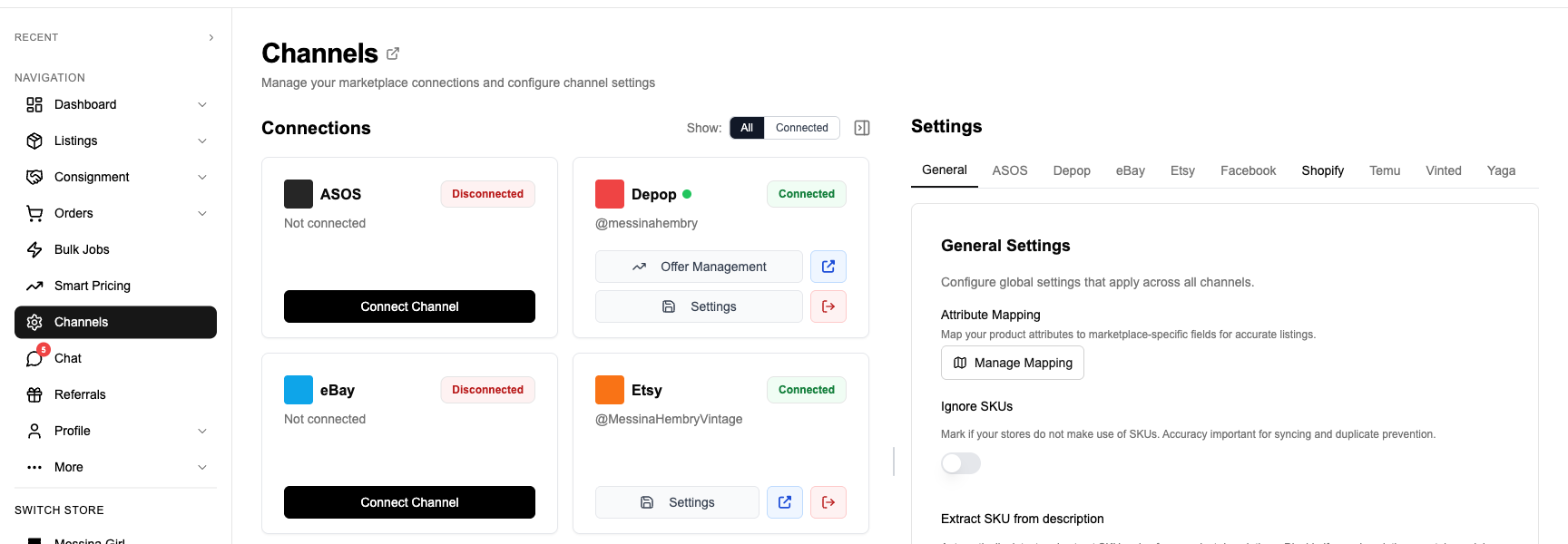
This is exactly what FLUF Connect automates. List your products once, crosslist to Depop, eBay, and seven other marketplaces in a few clicks, and FLUF handles the rest — real-time inventory sync, automatic removal when items sell, and automated relisting to keep your listings fresh.
How It Works
- Connect your accounts — Link your Depop and eBay accounts to FLUF Connect in seconds.
- Import or create listings — Pull in your existing inventory from either platform, or create new listings directly in FLUF.
- Crosslist to both platforms — Select products and push them to Depop and eBay simultaneously. FLUF adapts titles, descriptions, and categories to each platform’s requirements.
- Automatic sync — When an item sells on Depop, FLUF removes it from eBay (and vice versa). Prices stay consistent, inventory stays accurate.
| FLUF Connect Feature | Depop | eBay |
|---|---|---|
| Crosslisting | Yes | Yes |
| Inventory sync | Yes | Yes |
| Auto-relisting | Yes | Yes |
| Offer management | Yes | Yes |
| Order sync | Yes (via Shopify) | Yes (via Shopify) |
| Bulk operations | Yes | Yes |
Both Depop and eBay have full feature support in FLUF Connect — including automated relisting and offer management, which are included free with every plan. Most competitors charge £30–50+ per month for these features alone.
Free for 30 days, no credit card required. Then from £19/month for up to 500 products.
Frequently Asked Questions: Depop vs eBay
What does the eBay acquisition of Depop mean for sellers?
eBay announced in February 2026 that it is acquiring Depop from Etsy for $1.2 billion, with the deal expected to close in Q2 2026. Depop will retain its brand and London headquarters. Sellers can expect potential benefits like shared logistics and eBay’s Authenticity Guarantee programme, but both platforms are expected to remain separate marketplaces with distinct audiences and experiences. For now, selling on both remains the best strategy.
Is Depop or eBay better for selling clothes?
Both are excellent for clothing, but they attract very different buyers. Depop is best for trend-driven fashion, streetwear, and Y2K styles — its audience is overwhelmingly under 34. eBay reaches a far larger audience across all age groups and typically achieves higher prices on designer, vintage, and rare items. Many clothing sellers use both platforms to maximise sales — cross-listing free with FLUF Connect.
Which has lower fees, Depop or eBay?
For UK and US private sellers, eBay is cheaper — private sellers pay zero fees on most categories. Depop removed its 10% selling fee in July 2024 but still charges 2.9% + £0.30 payment processing on every sale. On a £30 sale, you keep £30 on eBay versus £28.83 on Depop. For business sellers, eBay charges 8–15% final value fees while Depop’s processing fee stays the same.
Can I sell on Depop and eBay at the same time?
Yes. Many sellers list on both platforms to reach different buyer demographics. The main challenge is managing inventory — if an item sells on one platform, you need to remove it from the other to avoid overselling. FLUF Connect automates this with real-time inventory sync and automatic removal when items sell.
Which is easier for beginners, Depop or eBay?
Depop is generally easier for beginners. The mobile-first app lets you photograph an item and list it in under two minutes. eBay has a steeper learning curve with more listing options and fee structures, but this flexibility becomes an advantage as you scale.
Does Depop or eBay have more buyers?
eBay has significantly more buyers — around 134 million active buyers across 190+ markets. Depop has 7 million active buyers, but they are highly engaged and fashion-focused. For clothing sellers targeting younger buyers, Depop’s concentrated audience can be just as effective.
Can I crosslist between Depop and eBay automatically?
Yes. FLUF Connect lets you crosslist products between Depop and eBay (and seven other marketplaces) automatically. List on one platform, crosslist to the other, and inventory syncs in real time. Auto-relisting, offer management, and bulk operations are all included free.
Which platform pays out faster, Depop or eBay?
eBay pays out faster. With eBay Managed Payments, funds are typically available within 2 business days. On Depop, payouts take 2–3 working days after the buyer’s tracking shows delivered, or up to 10 working days after the sale date.
Depop vs eBay for selling vintage clothing?
Both platforms are strong for vintage, but different types perform better on each. Depop excels at trend-driven vintage — Y2K, 90s sportswear, and pieces that fit current fashion cycles. eBay is better for rare, collectible, or archival vintage where buyers are willing to pay premium prices. Listing on both with FLUF Connect gives you the best of both worlds.
Is it worth selling on both Depop and eBay?
Yes. Sellers who list on multiple platforms consistently report faster sales and higher total revenue. Depop and eBay complement each other perfectly — almost zero audience overlap means every listing reaches an entirely new pool of buyers. Using both platforms together is the fastest way to increase your sell-through rate.
Related Guides
- How to Sell on Depop — our complete Depop seller guide
- How to Sell on eBay — our complete eBay seller guide
- Cross-List Depop to eBay — step-by-step crosslisting guide
- Auto-Relist Your Listings — keep listings fresh automatically
- Depop vs Vinted — another popular comparison
- FLUF Connect vs List Perfectly — crosslisting tool comparison
Frequently Asked Questions
Start Crosslisting for Free Today
500 free crosslistings. No credit card. Set up in under 10 minutes.