
Depop vs Etsy: Which Is Better for Sellers in 2026?
A side-by-side comparison of fees, audience, features, shipping, and what real sellers think — plus how to sell on both automatically.



- Choose Depop if: you sell second-hand fashion, vintage clothing, or streetwear to Gen Z and millennial buyers, and want a mobile-first, social selling experience with zero seller commission.
- Choose Etsy if: you sell handmade goods, craft supplies, personalised gifts, or vintage items (20+ years old) and want a mature marketplace with powerful SEO, shop branding tools, and 87 million active buyers.
- Fees: Depop charges zero seller commission in the UK and US (since 2024) — you only pay payment processing (2.9% + £0.30). Etsy charges a 6.5% transaction fee + £0.16 listing fee + 4% + £0.20 payment processing. On a £30 sale, you keep ~£29.13 on Depop vs ~£26.55 on Etsy.
- Audience: Depop has 7 million active buyers (90% under 34). Etsy has approximately 87 million active buyers across all age groups, skewing older millennial.
- Vintage overlap: Both platforms are strong for vintage — Depop for trend-driven vintage fashion, Etsy for curated collectible vintage across all categories.
- Best strategy: Sell on both — Depop and Etsy reach completely different buyer demographics. Cross-list free with FLUF Connect.
Depop vs Etsy at a Glance
Depop and Etsy occupy different corners of the online marketplace world, but they share one important overlap: vintage sellers. Depop is a mobile-first social marketplace built around second-hand fashion, streetwear, and trend-driven vintage — with an audience that’s overwhelmingly Gen Z. Etsy is a global marketplace for handmade goods, craft supplies, and curated vintage items (defined as 20+ years old), attracting a broader, older demographic with higher average spending.
Depop was founded in 2011 in London by Simon Beckerman. It grew rapidly among younger sellers and buyers who wanted a more social, Instagram-like selling experience. Etsy acquired Depop in June 2021 for $1.625 billion. In February 2026, Etsy announced it would sell Depop to eBay for $1.2 billion — a move that signals both platforms are heading in different strategic directions. Depop reported approximately $1 billion in annual gross merchandise sales in 2025, with 60% year-on-year growth in the US market alone.
Etsy was founded in 2005 in Brooklyn, New York, and is publicly traded on NASDAQ (ETSY). It has grown into one of the world’s largest marketplaces for unique, handcrafted, and vintage goods. With approximately 87 million active buyers and $11.9 billion in annual GMS (2025), Etsy’s scale dwarfs Depop — but its audience wants fundamentally different things.
| Depop | Etsy | |
|---|---|---|
| Founded | 2011 | 2005 |
| Headquarters | London, UK | Brooklyn, New York |
| Active buyers | 7 million | ~87 million |
| Markets | 150+ countries | 190+ countries |
| Top markets | UK, US, Australia | US, UK, Canada, Germany, Australia |
| Best for | Second-hand fashion, streetwear, vintage clothing, Y2K | Handmade goods, craft supplies, vintage (20+ years), personalised gifts |
| Seller fees | Zero commission (UK/US). Processing: 2.9% + £0.30 | 6.5% transaction + £0.16 listing + ~4% processing |
| Free listings | Unlimited | None — £0.16 per listing (lasts 4 months) |
| Mobile app | Mobile-first — the primary selling experience | Available but desktop-optimised |
For a deeper look at Depop individually, see our full guide: How to Sell on Depop.
Depop vs Etsy: Feature-by-Feature Comparison
Depop and Etsy are built for different types of sellers, and their feature sets reflect this. Depop prioritises speed, social engagement, and mobile simplicity. Etsy prioritises shop branding, SEO discoverability, and business management tools. The table below compares every major seller-facing feature.
| Feature | Depop | Etsy |
|---|---|---|
| Listing format | Fixed price only | Fixed price (no auctions) |
| Built-in messaging | Yes — in-app chat (Instagram-style) | Yes — Conversations (email-style) |
| Offer/haggle system | Yes — Make an Offer (central to the culture) | Yes — Make an Offer (optional per listing) |
| Seller analytics | Basic — views, likes, sell-through | Advanced — Shop Manager with traffic sources, conversion, revenue reports |
| Promoted listings | Yes — Depop Boost (UK 12%, US/AU 8% of sale price) | Yes — Etsy Ads (from £0.80/day, CPC model) |
| Shop branding | Minimal — profile photo, bio, banner | Extensive — shop banner, logo, about section, policies, custom sections |
| SEO tools | Limited — hashtags and descriptions | Strong — title tags, tags (13 per listing), categories, attributes |
| Integrated shipping labels | Yes — Depop Shipping (Royal Mail, USPS) | Yes — Etsy Shipping Labels (Royal Mail, USPS, FedEx, and more) |
| Buyer protection | Yes — Depop Protection (purchase protection) | Yes — Etsy Purchase Protection |
| Social features | Strong — likes, follows, feed, explore page | Limited — favourites and reviews |
| Business accounts | No formal tiers | Yes — Etsy Plus (£8/month for advanced tools) |
| International selling | Yes — global by default | Yes — with calculated international shipping |
| Handmade items | Allowed but not the focus | Core category — the platform’s identity |
| Digital downloads | No | Yes — digital products are a major category |
| Multi-quantity listings | No — one item per listing | Yes — inventory quantities and variations |
| Promo codes / sales | No built-in tools | Yes — coupon codes, sales events, targeted offers |
The standout difference: Etsy is built for brand-building and long-term shop growth, with tools that reward patient sellers who invest in SEO, photography, and shop curation. Depop is built for speed and social momentum — success comes from frequent listing, active engagement, and staying on-trend. Etsy sellers build shops; Depop sellers build followings.
Listing Experience: Depop vs Etsy
Depop is the faster platform to list on — photograph, describe, price, post, all from your phone in under a minute. Etsy’s listing process takes longer but gives sellers far more control over discoverability and how their shop presents to buyers.
On Depop, listing is designed to feel like posting on social media. Take or upload up to 4 photos (video also supported), write a description using hashtags for discoverability, select a category, set a price, and choose your shipping option. The entire process happens in the mobile app and is optimised for speed. Depop’s algorithm rewards frequent listing activity, so sellers are incentivised to post regularly rather than spend time perfecting each listing.
On Etsy, you get up to 10 photos plus a video per listing. The listing form includes a title (optimised for search with up to 140 characters), up to 13 tags for SEO, detailed category selection with attributes (colour, material, occasion, style), shipping profiles, processing times, and return policies. Etsy also supports product variations (size, colour, personalisation options) within a single listing — essential for handmade sellers who offer custom work.
Photography expectations are distinctly different. Depop buyers respond to curated, styled photography — items worn or modelled, flat lays with props, natural lighting, a distinctive aesthetic that feels personal. The best Depop sellers treat their page like a visual portfolio. Etsy buyers prefer clean, professional product photography — white or neutral backgrounds, multiple angles, close-ups of details and craftsmanship, and lifestyle shots showing the item in context. Etsy’s search algorithm also favours listings with more photos.
Time to list: Under 1 minute per item on Depop. 3–8 minutes on Etsy (more for handmade items with variations). At scale, this gap matters — bulk crosslisting with FLUF Connect eliminates the duplication.
Fees Compared: How Much Do Depop and Etsy Actually Cost?
Depop and Etsy take very different approaches to fees. Depop removed seller commissions entirely in 2024 (UK and US), while Etsy layers multiple fees that can add up significantly. This is one of the most important differences between the two platforms and one of the top reasons sellers consider switching — or selling on both.
Depop Fees (UK)
Since March 2024, Depop charges zero seller commission in the UK. No listing fees, no transaction fees, no final value fees. The only mandatory cost is payment processing: 2.9% + £0.30 per sale (via Depop Payments / Stripe). Optional Depop Boost costs 12% of the sale price — but it’s entirely opt-in.
Etsy Fees (UK)
Etsy’s fee structure has multiple layers that sellers need to understand:
- Listing fee: £0.16 per listing (auto-renews every 4 months or upon sale)
- Transaction fee: 6.5% of the sale price (including shipping)
- Payment processing: 4% + £0.20 per sale (via Etsy Payments)
- Regulatory operating fee: 0.32% in the UK (varies by country)
- Optional Etsy Ads: CPC model, budget from £0.80/day
- Optional Etsy Plus: £8/month for advanced shop tools
- Offsite Ads fee: 15% on sales from Etsy’s offsite advertising (12% for shops earning $10,000+/year). This is mandatory for shops earning over $10,000/year — you cannot opt out.
| Fee Type | Depop (UK) | Etsy (UK) |
|---|---|---|
| Listing fee | Free — unlimited | £0.16 per listing (renews every 4 months) |
| Transaction / commission | Zero (since March 2024) | 6.5% of total sale price (including shipping) |
| Payment processing | 2.9% + £0.30 | 4% + £0.20 |
| Offsite ads fee | N/A | 15% on offsite ad sales (mandatory above $10K/year) |
| Promoted listing cost | Boost: 12% of sale (optional) | Etsy Ads: CPC from £0.80/day (optional) |
| Monthly subscription | None | Etsy Plus: £8/month (optional) |
- Depop: Processing fee £1.17 (2.9% + £0.30) = You keep £28.83
- Etsy: Listing £0.16 + Transaction £1.95 (6.5%) + Processing £1.40 (4% + £0.20) = You keep £26.49
- Depop: Processing fee £3.20 (2.9% + £0.30) = You keep £96.80
- Etsy: Listing £0.16 + Transaction £6.50 (6.5%) + Processing £4.20 (4% + £0.20) = You keep £89.14
The gap widens at higher price points. On a £100 sale, you keep £7.66 more on Depop than Etsy. For a seller doing £2,000/month in sales, that’s roughly £150/month more in your pocket on Depop — over £1,800/year. This fee advantage is Depop’s most powerful competitive lever against Etsy.
The Etsy Offsite Ads trap: If your Etsy shop earns over $10,000/year, Etsy automatically enrols you in Offsite Ads and takes a 15% cut on any sale attributed to their advertising (12% for larger shops). You cannot opt out. This surprises many growing sellers and can significantly eat into margins on individual sales.
Payout Comparison
| Depop | Etsy | |
|---|---|---|
| Payout method | Bank transfer (via Stripe) | Bank transfer (via Etsy Payments) |
| Payout schedule | 10 working days after sale, or 2 working days after marked delivered (whichever is sooner) | Weekly (Monday deposits) or daily for eligible shops |
| New seller holds | 10-day default hold for new sellers | Reserve system — may hold % of earnings for new shops (14–20 day hold) |
| Minimum payout | No minimum | No minimum |
Etsy is often faster for established sellers — daily deposits can put money in your account the next business day. Depop’s default 10-working-day hold can feel slow, though it drops to 2 days after delivery confirmation for sellers with good track records. For more detail, see our full guide to selling on Depop.
Audience and Demand: Who’s Buying on Depop vs Etsy?
Depop and Etsy serve almost entirely different buyer demographics, which is exactly what makes selling on both so powerful — there’s very little audience overlap.
Depop’s audience is young and fashion-obsessed. Over 90% of active users are under 34, with the core demographic being 16–24 year-olds. Buyers come to Depop browsing for style inspiration as much as shopping — scrolling feeds, following sellers whose aesthetic they admire, and making impulse purchases on pieces that catch their eye. The most-searched categories are vintage, Y2K fashion, streetwear, and one-of-a-kind pieces. With 7 million active buyers across 150+ countries, Depop is the marketplace where Gen Z shops for fashion.
Etsy’s audience is broader and higher-spending. The core demographic is 25–44 year-old women, many shopping for gifts, home decor, weddings, and personalised items. Etsy buyers tend to search for specific items rather than browse — they come with intent. Wedding-related categories are among Etsy’s biggest sellers, alongside jewellery, home and living, and craft supplies. With approximately 87 million active buyers across 190+ countries, Etsy’s scale is enormous — over 12x Depop’s buyer base.
| Depop | Etsy | |
|---|---|---|
| Primary age group | 16–26 (Gen Z) | 25–44 (Millennials) |
| Top markets | UK, US, Australia | US, UK, Canada, Germany, Australia |
| Estimated active buyers | 7 million | ~87 million |
| Average order value | Lower — typically £10–30 | Higher — typically £20–60+ |
| Best-selling categories | Vintage fashion, streetwear, Y2K, accessories | Handmade jewellery, home decor, wedding items, personalised gifts, craft supplies |
| Buyer behaviour | Browse-driven, social, impulse | Search-driven, intent-based, gift-buying |
The Vintage Overlap
Vintage is the one category where Depop and Etsy directly compete — and where selling on both makes the most sense. But the type of vintage that sells differs:
| Vintage Type | Better on Depop | Better on Etsy | Both |
|---|---|---|---|
| Y2K fashion (2000s) | ✓ | ||
| Vintage band tees | ✓ | ||
| 90s streetwear | ✓ | ||
| 70s/80s fashion | ✓ (Depop for wearable, Etsy for collectible) | ||
| Vintage jewellery | ✓ (higher prices) | ||
| Vintage homeware / decor | ✓ | ||
| Designer vintage (Chanel, Gucci) | ✓ (Etsy for higher prices, Depop for faster sales) | ||
| Vintage accessories (bags, scarves) | ✓ |
For vintage sellers, crosslisting between Depop and Etsy means reaching both Gen Z bargain hunters and older buyers willing to pay premium prices for the same item — maximising both speed and value.
Shipping: Depop vs Etsy
Both platforms offer integrated shipping, but the experience and flexibility differ significantly. Depop keeps it simple and mobile-friendly. Etsy gives sellers granular control over shipping profiles, calculated costs, and international options.
| Depop | Etsy | |
|---|---|---|
| Integrated shipping labels | Yes — Depop Shipping (Royal Mail UK, USPS US) | Yes — Etsy Shipping Labels (Royal Mail, USPS, FedEx, UPS, and more) |
| Who pays shipping | Configurable — buyer or seller (free shipping) | Configurable — buyer or seller (free shipping boosts ranking) |
| Free shipping option | Yes — seller absorbs cost | Yes — with free shipping guarantee programme (boosts priority placement) |
| International shipping | Yes — global by default, buyer pays international postage | Yes — calculated international rates, customs forms supported |
| Shipping profiles | Simple — per-listing or default | Advanced — reusable profiles with weight-based calculated shipping |
| Tracking required | Recommended | Strongly recommended (affects star seller status) |
Etsy’s shipping is more powerful for volume sellers. You can create reusable shipping profiles, set processing times, offer calculated shipping based on item weight, and manage international rates per region. Etsy’s free shipping guarantee — offering free domestic shipping on orders of £28+ — gives listings priority placement in search results.
Depop’s shipping is simpler. Select your carrier when listing, print the label when it sells, drop it off. For sellers shipping a handful of items per week from their phone, this simplicity is perfect. For sellers managing hundreds of orders, Etsy’s profiles and multi-platform tools are more efficient.
What Real Sellers Say About Depop vs Etsy
The Depop vs Etsy debate splits along a clear line: sellers who thrive on social engagement lean toward Depop, while sellers who prefer building a searchable, branded shop lean toward Etsy. We found real sellers — with names, not anonymous — sharing their experiences.
Sellers who chose Depop
“Depop is a better demographic for me. Etsy’s fees add up quickly.”
— Abby Moon (@satansflowerchild), handmade resin jewellery seller ($5,000/month), Craft Industry Alliance
“If you know how to use SEO, you can be seen more on Etsy, but it kind of sucks for people like me who want to sell items but don’t really understand it, and then our stuff gets pushed to the bottom. I wasn’t selling enough and I kept losing money.”
— Carissa Hawkes, reworked clothing seller, Modern Retail
Sellers who chose Etsy
“If you are a patient brand-builder with an eye for photography and writing, choose Etsy. If you are a fast-moving social media native who loves creating content, choose Depop.”
— Seller guide, Thrive on Etsy
“You will only sell things that appeal to a young audience on Depop — ie Topshop rather than Boden.”
— 2ndAugust (former Depop top seller), Mumsnet
The honest frustrations
Etsy sellers frequently complain about stacking fees that consume 15–20% of a sale. The mandatory Offsite Ads programme (above $10,000/year in sales) is a particular sore point. Many also report frustration with the platform being flooded by mass-produced goods:
“Today it seems like 95% of it is drop-shipped goods. If I wanted that, I’d go to AliExpress.”
— pnathan, Hacker News
Depop sellers cite the lowball offer culture as exhausting — constant offers at a fraction of the listing price are the norm. The platform’s algorithm also demands constant activity (listing, liking, following) to maintain visibility, and the recent Boost fee increase from 8% to 12% in the UK frustrated many sellers:
“When I opened my Etsy account, the moment I saw the amount of fees they had, I just automatically thought, ‘This isn’t worth it.’ But because my friends make handmade crafts, they don’t know where else to post them.”
— Kiara Mendez, former Etsy seller, Modern Retail
The emerging consensus: Depop and Etsy are complementary, not competitive. They serve different audiences and reward different seller strengths. The sellers who do best list on both — vintage fashion on Depop for quick Gen Z sales, the same items repositioned on Etsy for higher prices from older buyers. The challenge is managing both without doubling your workload. That’s where crosslisting automation comes in.
How to Choose Between Depop and Etsy
The right platform depends on what you sell, who you’re selling to, and how you prefer to work. Here’s a clear framework — though for vintage sellers especially, the answer is almost always “use both.”
- Sell second-hand fashion, streetwear, or vintage clothing
- Want zero seller commission — keep more of every sale
- Prefer listing from your phone in under a minute
- Enjoy social selling — engaging with buyers, building a following
- Target Gen Z and younger millennial buyers
- Sell handmade goods, personalised items, or craft supplies
- Want powerful SEO tools to be found in search
- Prefer building a branded shop with a professional storefront
- Sell digital downloads or items with multiple variations
- Target older millennials, gift buyers, and wedding shoppers
For vintage sellers: Both. Depop’s Gen Z audience will snap up trend-driven vintage fashion quickly, while Etsy’s older audience will pay more for curated, collectible vintage across all categories. Same inventory, different positioning, different prices.
For handmade sellers: Etsy is the primary platform — it’s built for you, with the tools, audience, and search infrastructure to support handmade businesses. Depop can work as a secondary channel for fashion-adjacent handmade items (jewellery, accessories, customised clothing).
For resellers: Depop is likely your primary channel for fashion, with lower fees and a faster-moving audience. Etsy works for vintage (20+ years old) items but doesn’t allow general resale of modern second-hand goods.
Why Not Both? Sell on Depop and Etsy at the Same Time
Depop and Etsy have almost zero buyer overlap — a 19-year-old scrolling Depop for Y2K jeans and a 35-year-old searching Etsy for a vintage gold necklace are two completely different people. If your inventory appeals to both audiences (vintage fashion, handmade accessories, curated vintage), listing on both platforms means reaching buyers you’d otherwise miss entirely.
The challenge with managing both manually: different listing formats, different photo expectations, different SEO strategies, and the constant risk of overselling if an item sells on one platform before you can remove it from the other. This is where automation makes the difference.
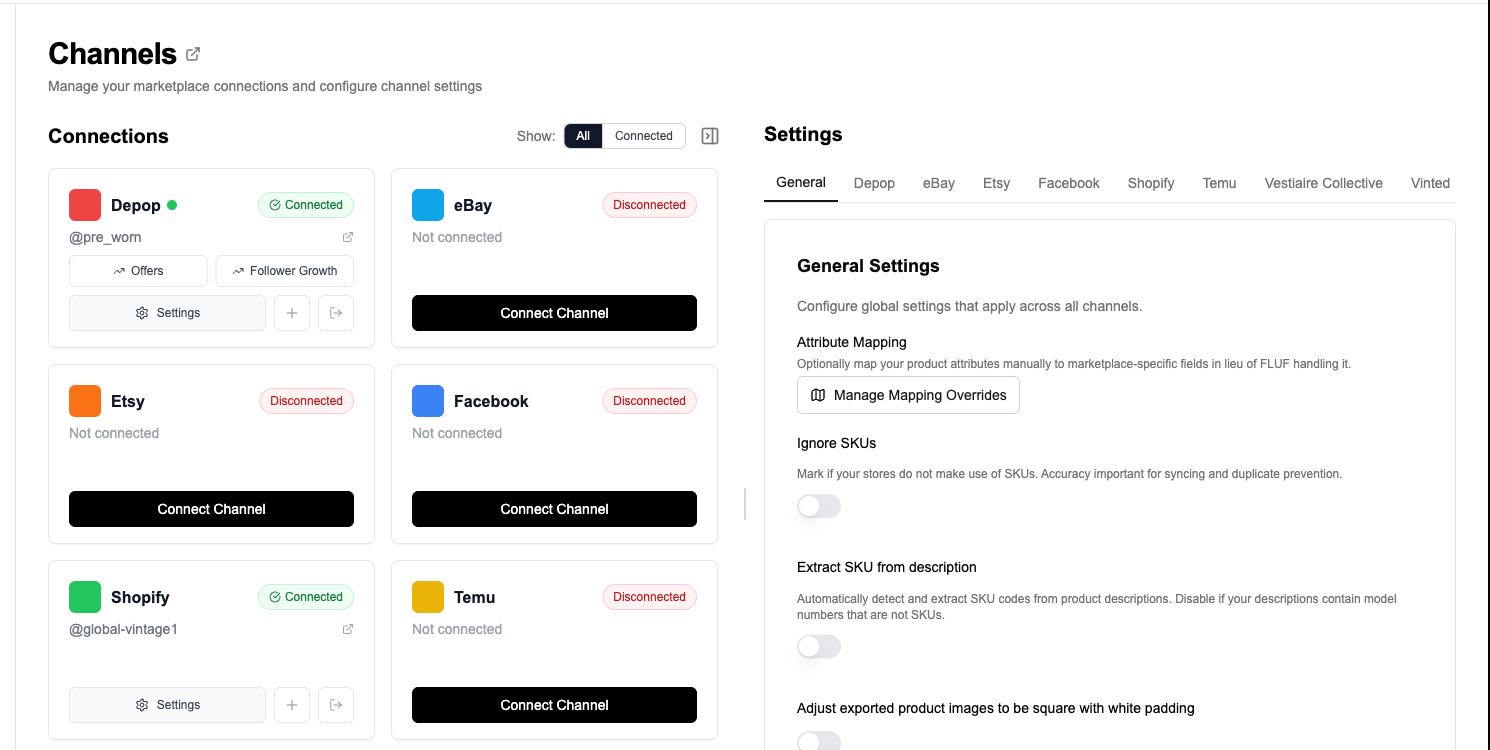
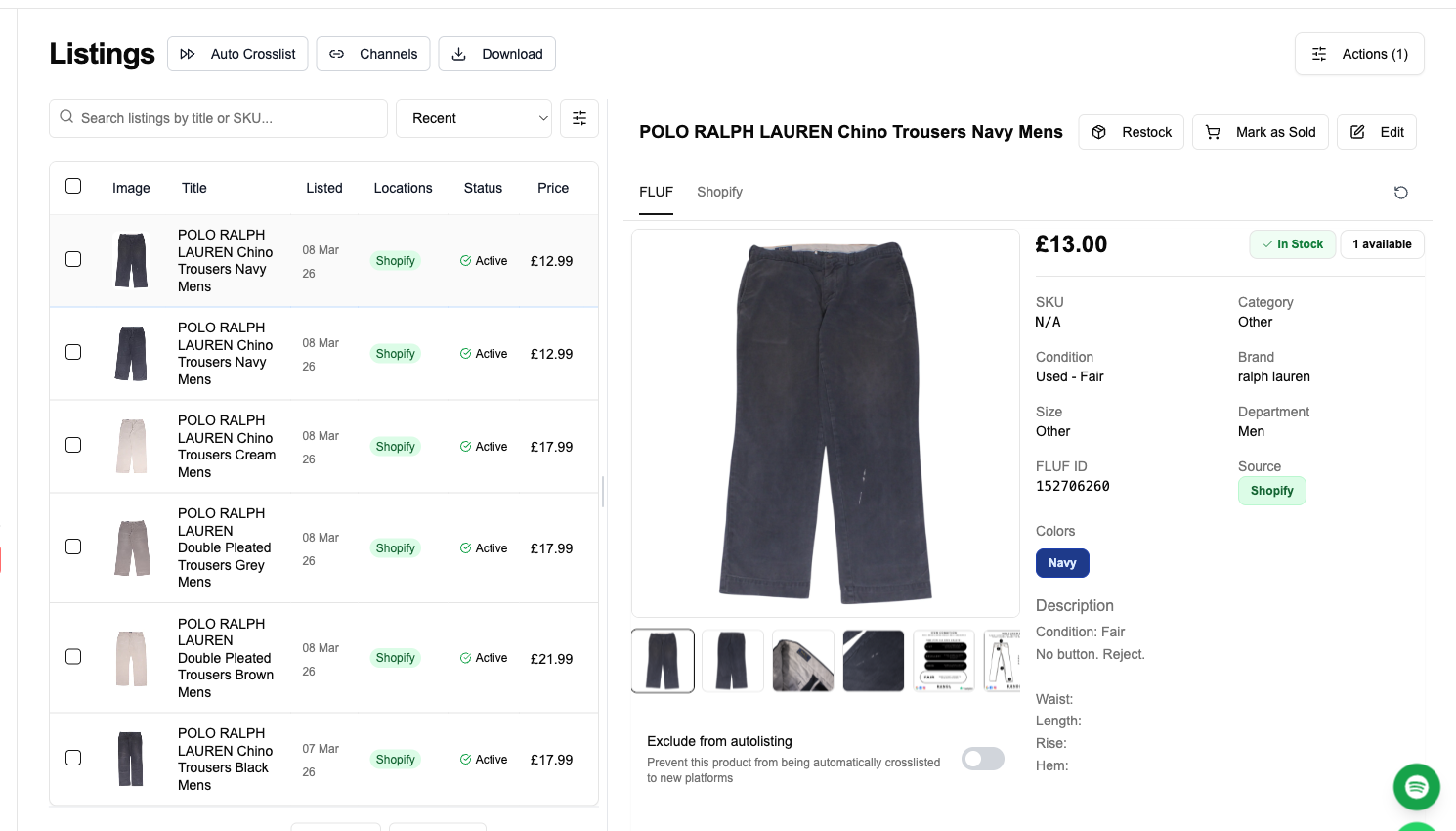
FLUF Connect lets you list on one platform and crosslist to the other automatically. When a vintage jacket sells on Depop, it’s removed from Etsy within minutes. No double-listing, no overselling, no duplicated effort.
How it works
- Connect your accounts — Link your Depop and Etsy accounts to FLUF Connect in a few clicks.
- Crosslist your inventory — Select items individually, in bulk, or set auto-crosslisting rules to handle new listings automatically.
- Let FLUF handle the rest — Real-time inventory sync, automatic relisting on Depop, offer management, and order sync keep everything in perfect sync.
| FLUF Connect Feature | Depop | Etsy |
|---|---|---|
| Crosslisting | Yes | Yes |
| Inventory sync | Yes | Yes |
| Auto-relisting | Yes | No |
| Offer management | Yes | No |
| Order sync | Yes (via Shopify) | Yes (via Shopify) |
| Bulk operations | Yes | Yes |
Depop gets full automation support including auto-relisting and offer management — both included free. Etsy gets crosslisting, inventory sync, and order sync. Most competitors like List Perfectly charge extra for relisting and offer management that FLUF Connect includes at no additional cost.
Free for 30 days, no credit card required. Then from £19/month with 500 free crosslistings on the Growth plan.
Frequently Asked Questions
Both platforms are excellent for vintage, but they attract different buyers. Depop is better for trend-driven vintage fashion (Y2K, 90s streetwear, vintage band tees) aimed at Gen Z buyers who want unique everyday pieces. Etsy is better for curated collectible vintage — jewellery, homeware, designer pieces — where buyers expect higher quality and pay premium prices. Many vintage sellers list on both with FLUF Connect to reach both audiences.
Depop has significantly lower fees. Depop charges zero seller commission in the UK and US (since 2024) — you only pay payment processing of 2.9% + £0.30. Etsy charges a 6.5% transaction fee plus a £0.16 listing fee plus 4% + £0.20 payment processing. On a £30 sale, you keep about £28.83 on Depop versus £26.49 on Etsy.
Yes, and it is one of the most effective strategies for vintage sellers. Depop and Etsy have almost no buyer overlap — Depop reaches Gen Z fashion buyers while Etsy reaches older millennials shopping for gifts, home decor, and curated vintage. FLUF Connect lets you crosslist between both platforms with automatic inventory sync so you never oversell.
Depop is easier to start on. Listing takes under a minute from your phone, there are no upfront costs (no listing fees), and the social interface is intuitive for anyone familiar with Instagram. Etsy has a steeper learning curve — you need to understand SEO, tags, shipping profiles, and fee structures — but its tools are more powerful for building a long-term business.
Etsy has far more active buyers — approximately 90 million compared to Depop's 7 million. However, the audiences are very different. Depop's 7 million buyers are highly engaged Gen Z fashion shoppers, while Etsy's broader audience spans all ages and categories. For second-hand fashion specifically, Depop's focused audience can be more valuable than Etsy's larger but more dispersed one.
Yes. FLUF Connect supports both Depop and Etsy crosslisting with automatic inventory sync. List on one platform, crosslist to the other, and when an item sells on either platform it is automatically removed from the other. Depop also gets auto-relisting and offer management included free.
Yes, handmade items are allowed on Depop, though the platform is primarily known for second-hand fashion. If you make handmade jewellery, customised clothing, or fashion accessories, Depop can work well — especially if your aesthetic appeals to Gen Z buyers. For a wider handmade audience with more shop branding tools, Etsy is the stronger platform.
For vintage sellers, absolutely. Depop and Etsy reach completely different buyer demographics with almost no overlap. The same vintage jacket could sell quickly at £20 to a Gen Z buyer on Depop, or at £35 to an older buyer on Etsy who values the curation. Selling on both platforms maximises exposure and revenue — crosslisting tools like FLUF Connect make managing both effortless.
On Depop: vintage fashion, Y2K clothing, streetwear, band tees, and one-of-a-kind accessories. On Etsy: handmade jewellery, personalised gifts, wedding items, home decor, craft supplies, digital downloads, and curated vintage (20+ years old) across all categories. The overlap is vintage fashion, where both platforms perform well for different audiences.
Depop was acquired by Etsy in June 2021 for $1.625 billion. In February 2026, Etsy announced it would sell Depop to eBay for $1.2 billion, with the deal expected to close in Q2 2026. This means Depop will soon be part of the eBay ecosystem, while Etsy refocuses on handmade and craft.
Start Crosslisting for Free Today
500 free crosslistings. No credit card. Set up in under 10 minutes.