
How to Sell on Etsy — The Complete Guide for 2026
Everything you need to know about fees, listing strategy, SEO, shipping, and growing your Etsy business — plus how to cross-list automatically.



TL;DR — Selling on Etsy in 2026
- 86.5 million active buyers across 200+ countries — one of the largest built-in audiences for handmade, vintage, and craft supplies.
- Fees add up fast: $0.20 listing fee + 6.5% transaction fee + 3–4% payment processing. Offsite ads can push total fees to 25%+ on some sales.
- What you can sell: handmade items (made or designed by you), vintage (20+ years old), and craft supplies. Mass-produced goods are prohibited.
- Best for: jewellery makers, vintage sellers, home décor creators, digital product sellers, and craft supply shops with a unique or personalised angle.
- Biggest advantage: Etsy’s brand trust and built-in search traffic mean buyers come to you — no need to build an audience from scratch.
- Cross-list to sell faster: Use FLUF Connect to list your Etsy products on Depop, eBay, Vinted, and Shopify simultaneously — with inventory sync to prevent overselling.
What Is Etsy?
Etsy is an online marketplace built specifically for handmade goods, vintage items, and craft supplies. Founded in 2005 in Brooklyn, New York, it has grown from a small community of artisans into one of the world’s largest e-commerce platforms — with 86.5 million active buyers spending nearly $12 billion a year on the platform.
Unlike general marketplaces such as eBay or Amazon, Etsy positions itself as a destination for unique, creative, and one-of-a-kind products. That positioning gives sellers a significant advantage: buyers arrive on Etsy already looking for something special. They expect handmade jewellery, vintage clothing, personalised gifts, and artisan home décor — not mass-produced goods from factories.
Etsy operates in over 40 countries and ships to 200+ destinations worldwide. Approximately 40–45% of its gross merchandise sales come from international transactions, making it genuinely global. The platform handles payments through Etsy Payments (its integrated payment processing system), offers discounted shipping labels, and provides built-in advertising tools to help sellers reach more buyers.
In early 2026, Etsy underwent a leadership change with Kruti Patel Goyal replacing long-time CEO Josh Silverman. The company also announced it would sell Depop to eBay for $1.2 billion — a deal expected to close in Q2 2026. These shifts signal a renewed focus on Etsy’s core marketplace rather than its portfolio of acquired brands.
The platform enforces strict rules about what can be sold. Every listing must fall into one of three categories: handmade (made or designed by the seller), vintage (at least 20 years old), or craft supplies and tools. Sellers who use production partners must disclose them. As of June 2025, Etsy tightened its “Creativity Standards” further — items made with computerised tools like laser cutters or 3D printers must use the seller’s original design, and purchased templates no longer qualify as handmade.
| Detail | Info |
|---|---|
| Founded | 2005, Brooklyn, New York |
| Active buyers | 86.5 million |
| Active sellers | 5.6 million |
| Gross merchandise sales (FY2025) | ~$11.9 billion |
| Active listings | 100+ million |
| Seller countries | 40+ |
| Buyer countries | 200+ |
| International GMS | ~40–45% |
| Categories allowed | Handmade, vintage (20+ years), craft supplies |
| CEO | Kruti Patel Goyal (Jan 2026) |
| Take rate | ~24.5% |
For sellers who want to reach Etsy’s massive audience while also listing on other platforms, crosslisting tools like FLUF Connect make it straightforward to manage inventory across Etsy, Depop, eBay, Vinted, and Shopify from a single dashboard.
Why Sell on Etsy in 2026?
With millions of active sellers and an increasingly complex fee structure, you might wonder whether Etsy is still worth it. The honest answer: for the right products and the right strategy, absolutely. Here’s why.
A Built-In Audience of 86.5 Million Buyers
The single biggest advantage of selling on Etsy is that you don’t need to drive your own traffic. Etsy spends hundreds of millions on advertising every year — Google Shopping ads, social media campaigns, TV spots — and that investment brings buyers to the platform. When someone searches “personalised birthday gift” on Google, Etsy listings consistently appear in the top results. That kind of organic visibility is extraordinarily difficult (and expensive) to replicate on your own website.
Brand Trust and Purchase Intent
Etsy has cultivated a reputation as the place to buy unique, thoughtful, and handmade goods. Buyers on Etsy aren’t window-shopping the way they might on Instagram or TikTok — they arrive with purchase intent. The platform’s review system, buyer protection policies, and curated feel create a level of trust that helps newer sellers convert visitors into customers faster than they would on a standalone Shopify store.
Global Reach from Day One
Etsy handles currency conversion, international payment processing, and even offers discounted international shipping labels. Roughly 40–45% of all sales on Etsy cross borders. If you’re a UK seller, your vintage finds can reach buyers in the US, Australia, and across Europe without you needing to set up separate storefronts or payment gateways for each country.
The Vintage Market Opportunity
While most people associate Etsy with handmade goods, the vintage category is genuinely underserved relative to demand. Etsy is one of the few major platforms where vintage items (20+ years old) have a dedicated, searchable category with buyers specifically looking for them. Unlike Vinted or Depop, where vintage competes with fast fashion, Etsy buyers understand and expect vintage pricing. If you sell vintage, Etsy should be in your channel mix.
Tools for Small Businesses
Etsy provides a surprisingly robust set of tools for independent sellers: analytics dashboards, integrated shipping labels (USPS, UPS, FedEx, Royal Mail, Evri, Australia Post), promotional tools, and a mobile app that lets you manage orders on the go. The Star Seller programme incentivises good customer service, and Etsy Plus ($10/month) adds features like custom banners, restock alerts, and listing credits.
But Be Honest About the Downsides
Etsy’s fee structure has become increasingly aggressive. The 6.5% transaction fee, combined with payment processing fees, listing fees, and potentially mandatory offsite advertising fees, means you can lose 20–30% of a sale to the platform. The algorithm can feel opaque, and policy changes often arrive with little warning. That said, these costs are the price of access to Etsy’s audience — and for many sellers, the maths still works, especially when combined with a multi-platform strategy.
| Fee type | Etsy | eBay (private) | Depop | Vinted |
|---|---|---|---|---|
| Listing fee | $0.20 per listing | Free | Free | Free |
| Transaction fee | 6.5% | 0% | 0% | 0% (buyer pays) |
| Payment processing | 3% + $0.25 (US) / 4% + £0.20 (UK) | Included | Included | Included |
| Offsite ads | 12–15% (conditional) | N/A | N/A | N/A |
| Total on a £30 sale | ~£4.50–£8+ | £0 | ~£1.17 | £0 |
The table above makes the case for crosslisting almost on its own. Selling the same item on eBay or Vinted alongside Etsy means you’re covered regardless of where the buyer finds you — and if it sells on a lower-fee platform first, you keep more profit. FLUF Connect handles the inventory sync so you never oversell.
Etsy Fees Explained
Let’s be direct: Etsy’s fee structure is the most complex of any major resale platform. Understanding exactly what you’ll pay is essential before you list your first item. Here’s every fee, broken down clearly.
Shop Setup Fee — $15 (One-Time)
As of September 2024, new Etsy shops pay a one-time $15 setup fee. This wasn’t always the case — it was introduced to reduce the number of spam shops. If you opened your shop before this date, you won’t have been charged.
Listing Fee — $0.20 Per Listing
Every item you list on Etsy costs $0.20. This fee is charged when the listing goes live, and again every four months when it auto-renews. If you have a multi-quantity listing (e.g., 10 units of a handmade candle), you’ll also pay $0.20 each time a unit sells — not just once for the listing itself. This catches many new sellers off guard.
For a shop with 100 active listings, that’s $20 every four months in renewal fees alone, whether or not you’ve made a single sale.
Transaction Fee — 6.5%
Etsy takes 6.5% of the total sale amount, including the item price and any shipping charges the buyer pays. This is one of the highest transaction fees among major platforms. On a £30 item with £3.50 shipping, Etsy takes 6.5% of £33.50 = £2.18.
Payment Processing Fee — 3–4% + Fixed Fee
All payments on Etsy go through Etsy Payments (you no longer have the option to use PayPal directly for most countries). The payment processing fee varies by country:
- United States: 3% + $0.25
- United Kingdom: 4% + £0.20
- European Union: 4% + €0.30
- Canada: 3% + CA$0.25
- Australia: 3% + AU$0.25
Note that UK and EU sellers pay a higher percentage than US sellers — a common frustration in the Etsy seller community.
Offsite Ads Fee — 12–15% (the Controversial One)
This is the fee that generates the most anger in the Etsy community, and understandably so. Etsy runs advertising for your products on Google, Facebook, Instagram, and Pinterest. If a buyer clicks one of these ads and purchases from you within 30 days, Etsy charges you a fee on the sale:
- Shops earning under $10,000/year: 15% fee (opt-in — you can turn it off)
- Shops earning $10,000+/year: 12% fee (mandatory — you cannot opt out)
The 30-day attribution window is particularly contentious. A buyer might click an offsite ad, browse your shop, leave, and return two weeks later to buy — and you’ll still pay the offsite ads fee. For high-earning sellers, this fee is inescapable, and it stacks on top of all other fees.
Etsy Ads (Pay-Per-Click) — $0.20–$0.50 Per Click
Separate from offsite ads, Etsy Ads are optional in-platform advertisements that promote your listings within Etsy search results. You set a daily budget (minimum $1/day), and Etsy charges you per click. The cost per click typically ranges from $0.20 to $0.50, depending on the competitiveness of your category.
Etsy Ads can be effective for established shops with good conversion rates, but for new sellers still optimising their listings, they often burn through budget without meaningful returns. Start small and track your return on ad spend carefully.
Regulatory Operating Fees
In certain countries, Etsy charges additional regulatory fees to cover local compliance costs:
- United Kingdom: 0.32%
- France: 0.47%
- Turkey: 2.27%
- Spain, Italy, Austria: Various small percentages
These are small individually but add to the overall fee burden, particularly for UK and EU sellers.
Etsy Plus — $10/Month (Optional)
Etsy Plus is a subscription that gives you 15 listing credits ($3 value), $5 in Etsy Ads credits, custom shop banner options, restock request alerts, and access to Adobe Express Premium. It’s worth it if you list frequently and use Etsy Ads — the credits alone cover most of the cost. For casual sellers with fewer than 50 listings, it’s generally not necessary.
Worked Example: What You Actually Pay on a £30 Vintage Jacket Sale
Let’s make this concrete. You sell a vintage jacket for £30 with £4 shipping (£34 total charged to buyer). Here’s what you keep:
| Fee | Calculation | Amount |
|---|---|---|
| Listing fee | Flat fee | £0.16 (~$0.20) |
| Transaction fee (6.5%) | 6.5% × £34.00 | £2.21 |
| Payment processing (UK) | 4% × £34.00 + £0.20 | £1.56 |
| Regulatory fee (UK, 0.32%) | 0.32% × £34.00 | £0.11 |
| Total fees | £4.04 | |
| You keep | £34.00 − £4.04 − £4.00 shipping cost | £25.96 |
That’s roughly 13.4% of the item price in fees — not terrible. But now let’s see what happens if the buyer found you through an offsite ad:
| Fee | Calculation | Amount |
|---|---|---|
| Listing fee | Flat fee | £0.16 |
| Transaction fee (6.5%) | 6.5% × £34.00 | £2.21 |
| Payment processing (UK) | 4% × £34.00 + £0.20 | £1.56 |
| Regulatory fee (UK) | 0.32% × £34.00 | £0.11 |
| Offsite ads fee (15%) | 15% × £34.00 | £5.10 |
| Total fees | £9.14 | |
| You keep | £34.00 − £9.14 − £4.00 shipping cost | £20.86 |
With offsite ads, you’re paying over 30% of the item price in fees. That’s a significant chunk, and it’s why understanding your margins before pricing is absolutely critical on Etsy.
Hidden Costs to Watch For
- Multi-quantity listing fees: You pay $0.20 per unit sold, not per listing. Selling 50 units of a printable template = $10 in listing fees alone.
- Auto-renewal charges: Listings renew every 4 months at $0.20 each, whether they sell or not. Inactive inventory costs money.
- Currency conversion: If you sell internationally and your payout currency differs from the sale currency, Etsy applies a conversion spread (typically 2.5%).
- Offsite ads attribution window: The 30-day window means you can pay for a returning customer who would have bought anyway.
How to Minimise Etsy Fees
- Factor fees into your pricing — add 15–20% to your cost price to cover Etsy’s cut.
- Bake shipping into item price — this lets you offer “free shipping” (which boosts search ranking) while keeping the total the same.
- Turn off offsite ads if you earn under $10K/year and your margins are tight.
- Deactivate unsold listings rather than letting them auto-renew at $0.20 every four months.
- Cross-list to lower-fee platforms — if the same item sells on Vinted (0% seller fees) or eBay (0% for private sellers), you keep significantly more.
How to Set Up Your Etsy Shop
Setting up an Etsy shop is straightforward, but there are details worth getting right from the start. Here’s a step-by-step walkthrough.
Step 1: Create Your Etsy Account
Go to etsy.com and sign up with an email address, Google account, or Apple ID. If you already have a buyer account, you can use the same credentials — Etsy doesn’t separate buyer and seller accounts.
Step 2: Open Your Shop
Click “Sell on Etsy” and follow the guided setup. You’ll be asked to choose your shop language, country, and currency. These can be changed later, but your primary currency determines how Etsy calculates fees and payouts.
Step 3: Choose Your Shop Name
Your shop name must be between 4–20 characters, no spaces or special characters. It becomes your shop URL (etsy.com/shop/YourName). Choose something memorable and relevant to what you sell. You can change it once after opening, but it’s best to get it right the first time.
Step 4: Create Your First Listing
Etsy requires at least one listing before your shop can go live. Upload photos, write your title and description, set your price, and choose your shipping options. Don’t overthink this — you can edit everything after launch. The important thing is to get your shop open.
Step 5: Set Up Payment and Billing
Connect your bank account for receiving payouts through Etsy Payments. You’ll also need to add a credit or debit card for Etsy to charge fees against. New sellers should be aware that Etsy holds funds for 14–20 days (sometimes up to 90 days) before your first payout.
Step 6: Pay the Setup Fee
New shops opened after September 2024 pay a one-time $15 setup fee. This is charged to the card you provide during onboarding.
Step 7: Complete Verification
Etsy may ask you to verify your identity, especially if you’re selling in certain countries or your shop triggers their fraud detection. This typically involves providing a government-issued ID and sometimes proof of address. Complete this promptly — unverified shops can have their funds held or their listings suspended.
Step 8: Customise Your Shop
Add a shop banner, profile photo, shop announcement, and an “About” section telling your story. Etsy buyers value authenticity — share why you make or source what you sell. Shops with complete profiles convert significantly better than bare ones.
| Feature | Individual (Free) | Etsy Plus ($10/month) |
|---|---|---|
| Monthly cost | $0 | $10 |
| Listing credits | None | 15 per month ($3 value) |
| Etsy Ads credits | None | $5 per month |
| Custom shop banners | Basic | Advanced options |
| Restock request alerts | No | Yes |
| Adobe Express Premium | No | Yes |
| Discounts on custom domains | No | Yes (50% off) |
| Best for | New / casual sellers | Active sellers with 50+ listings |
Creating Listings That Sell
Your listing is your sales pitch. On Etsy, where competition is fierce across 100+ million active listings, the difference between a listing that sells and one that sits for months often comes down to how well it’s optimised. Here’s what matters in 2026.
Title Optimisation — Less Is More
Etsy’s search algorithm has changed significantly. In the early days, cramming every keyword into your title was standard practice. In 2026, that approach actively hurts you. Etsy now uses semantic search (natural language processing) and penalises keyword-stuffed titles.
The current best practice: write natural, descriptive titles under 15 words that a human would actually search for.
Before (keyword-stuffed):
“Vintage 90s Leather Jacket Brown Bomber Jacket Men Retro Coat Winter Jacket Aviator Flight Jacket”
After (optimised for 2026):
“Vintage 90s Brown Leather Bomber Jacket — Men’s Aviator Style”
The second title is easier to read, contains the most important keywords, and won’t trigger Etsy’s keyword-stuffing penalty. Put your most important keywords first — Etsy weights the beginning of the title more heavily.
Use All 13 Tags — Every Single One
Etsy gives you 13 tags per listing, and you should use every one of them. Tags are separate from your title and help Etsy’s search engine understand what your item is. Use a mix of broad tags (“vintage jacket”, “leather coat”) and specific long-tail tags (“90s aviator bomber jacket”, “brown leather flight coat”). Don’t repeat words already in your title — tags should expand your keyword coverage, not duplicate it.
Description Writing
Etsy’s search algorithm doesn’t heavily weight descriptions for ranking purposes — your title and tags do the heavy lifting. However, descriptions matter enormously for conversion. Buyers who click through to your listing need enough information to feel confident purchasing.
Structure your descriptions clearly:
- Opening paragraph: What is this item and why is it special?
- Details: Measurements (always include exact measurements for clothing/vintage), materials, colour, condition (for vintage).
- Care instructions or usage suggestions where relevant.
- Shipping information: Processing time, carrier, international availability.
- Shop policies: Brief note on returns/exchanges.
Pricing Strategy — Factor in Everything
One of the most common mistakes new Etsy sellers make is pricing without accounting for the full fee stack. Before setting your price, calculate:
- Cost of goods (materials, or purchase price for vintage)
- Etsy fees (~10–12% minimum, up to 25%+ with offsite ads)
- Shipping costs (if offering “free shipping”, bake this into the item price)
- Packaging costs
- Your time and labour
A good rule of thumb for handmade items: charge at least 3× your materials cost. For vintage, aim for a minimum 50% margin after all fees and shipping. If the maths doesn’t work on Etsy, consider listing the item on a lower-fee platform like Vinted or eBay instead — or list it on all of them simultaneously using FLUF Connect and let the market decide.
Creativity Standards — Know the Rules
Etsy’s June 2025 Creativity Standards update added important restrictions. Every listing must now declare its production method:
- “Made” — you physically made the item yourself
- “Designed” — you designed it but a production partner manufactured it
- “Sourced” — you sourced the item (craft supplies)
- “Handpicked” — you curated the item (vintage)
Items made with computerised tools (laser cutters, 3D printers, CNC machines) must use the seller’s original design. Products made from purchased templates no longer qualify as handmade. Digital scans of vintage content are banned. Violating these standards risks listing removal or shop suspension.
Variations and Options
If your item comes in multiple sizes, colours, or styles, use Etsy’s variations feature rather than creating separate listings. This consolidates reviews and sales history into one listing, improving your search ranking. You can have up to two variation types (e.g., Size and Colour) with up to 70 options each.
Photography & Presentation
On Etsy, your first photo is everything. It’s the thumbnail buyers see in search results, and it determines whether they click through to your listing or scroll past. Etsy gives you 10 photo slots per listing — use as many as possible.
The First Photo Rule
Your primary photo should show the item clearly against a clean, uncluttered background. For handmade and craft items, white or neutral backgrounds work well. For vintage clothing, a combination of flat-lay and on-body shots tends to convert best. The photo should be well-lit (natural light near a window is fine), properly focused, and shot at the highest resolution your camera or phone allows.
Show Everything the Buyer Needs to See
Think about what you’d want to see before buying. For clothing: front, back, details (stitching, labels, fabric texture), and how it looks when worn. For jewellery: scale (next to a coin or ruler), clasp detail, how it looks when worn. For home décor: the item in a styled setting to show scale and context.
Test on Mobile — 70% of Sales Happen There
Nearly 70% of Etsy purchases happen on mobile devices (46% of gross merchandise sales come from the Etsy app alone). Before publishing, preview your listing on your phone. Check that your photos are clear at small sizes, your title is readable, and your key information appears above the fold. If your listing doesn’t look good on a 6-inch screen, most buyers will never see your beautiful desktop layout.
Video Listings
Etsy now allows video on listings, and the algorithm actively prioritises listings with video — especially on mobile. A simple 10–15 second video showing your item from multiple angles, or demonstrating how it works, can significantly boost your visibility and conversion rate. You don’t need professional equipment; a smartphone with good lighting is sufficient.
Lifestyle vs White Background
The debate between lifestyle photography (styled scenes) and clean white backgrounds depends on your category. For jewellery and home décor, lifestyle shots showing the item in use tend to perform better — they help buyers imagine the item in their own life. For vintage clothing, clean backgrounds with consistent styling build brand recognition. For craft supplies, clear product shots on white backgrounds are standard.
Whatever style you choose, consistency matters. A shop where every listing has the same photographic style looks professional and trustworthy. A shop with wildly different photo styles for each listing looks disorganised.
Shipping & Returns
Shipping on Etsy is more nuanced than on most platforms. Your shipping strategy directly affects your search visibility, your margins, and your customer satisfaction scores.
The $6 Shipping Threshold
This is one of the most impactful — and least understood — aspects of selling on Etsy. Listings with US shipping costs exceeding $6 receive reduced visibility in search results. Etsy implemented this to encourage competitive shipping prices and reward sellers who offer free or low-cost shipping.
The workaround used by most successful sellers: bake shipping costs into your item price and offer “free shipping.” A £25 item with £4.50 shipping performs worse in search than a £29.50 item with free shipping, even though the buyer pays the same amount.
Etsy Shipping Labels
Etsy offers discounted shipping labels through several carriers:
- US: USPS, UPS, FedEx
- UK: Royal Mail, Evri
- Australia: Australia Post
- Canada: Canada Post (with calculated shipping)
These labels are typically 10–30% cheaper than retail postal rates. Purchasing through Etsy also automatically provides tracking information to buyers and updates their order status — both of which contribute to your Star Seller score.
Free Shipping Guarantee
Etsy offers a “Free Shipping Guarantee” programme where you can set a minimum order value (e.g., $35 for US orders) above which shipping is free. Orders qualifying for this guarantee receive priority placement in US search results. If you sell items priced above $35, enabling this is a straightforward ranking boost.
International Shipping
With 40–45% of Etsy’s sales being international, ignoring non-domestic buyers is leaving money on the table. Set up shipping profiles for your most common international destinations. Be transparent about customs duties (which the buyer typically pays) and realistic about delivery times. Etsy’s calculated shipping feature can help price international orders accurately for USPS and Canada Post shipments.
Returns Policy
Etsy lets sellers set their own returns policy — you can offer full returns, exchanges only, or no returns at all. However, shops that accept returns tend to rank better in search and convert at higher rates. Buyers feel more confident purchasing when they know they can return an item if it’s not right. For vintage items where condition descriptions can be subjective, a clear returns policy reduces disputes and negative reviews.
| Option | Pros | Cons |
|---|---|---|
| Free shipping (baked in) | Best search ranking, clean pricing | Higher item price may deter some buyers |
| Calculated shipping | Accurate costs, transparent | Can exceed $6 threshold, reducing visibility |
| Flat-rate shipping | Simple, predictable | May over/under-charge depending on destination |
| Etsy labels | Discounted rates, auto-tracking | Limited carrier options outside US/UK |
Packaging
Etsy buyers expect a more personal touch than buyers on Amazon or eBay. Thoughtful packaging — tissue paper, a handwritten thank-you note, branded stickers — creates a memorable unboxing experience that drives repeat purchases and positive reviews. For vintage items, ensure packaging protects the item adequately; damage during shipping is one of the top reasons for negative reviews on Etsy.
How the Etsy Algorithm Works
Understanding Etsy’s search algorithm is essential for visibility. In 2026, the algorithm has evolved significantly from simple keyword matching to a sophisticated system that considers dozens of ranking factors.
Semantic Search (NLP-Based)
Etsy no longer relies purely on exact keyword matches. Its search engine uses natural language processing to understand the intent behind a buyer’s query. If someone searches for “gift for mum,” Etsy understands they mean the same thing as “present for mother” and will show relevant results from both phrasings. This means writing naturally is now more effective than cramming in every possible keyword variation.
Key Ranking Factors
| Factor | Weight | What it means |
|---|---|---|
| Relevancy | Very high | How well your title, tags, categories, and attributes match the search query |
| Listing quality score | High | Click-through rate and conversion rate — how often buyers click and purchase |
| Recency | Medium | Newer and recently updated listings get a temporary boost |
| Shipping price | Medium | Listings with free or under-$6 shipping rank higher for US searches |
| Customer experience | Medium | Review score, response time, on-time shipping, dispute rate |
| Personalisation | Medium | Etsy shows buyers items based on their browsing and purchase history |
| Dwell time | New (2026) | How long buyers spend viewing your listing — longer = better quality signal |
| Video content | New (2026) | Listings with video are prioritised, especially on mobile |
The $6 Shipping Penalty
We’ve mentioned this in the shipping section, but it bears repeating in the algorithm context: listings with US shipping costs over $6 receive reduced visibility in Etsy search results. This is one of the most impactful algorithmic factors and the easiest to fix — simply bake shipping into your item price.
The Keyword-Stuffing Penalty
Etsy has confirmed that titles stuffed with repetitive keywords are now penalised. The algorithm can identify unnatural title patterns and will demote listings that feel like keyword lists rather than genuine product descriptions. Keep titles under 15 words, natural-sounding, and focused on the most important descriptive terms.
Listing Quality Score and the Flywheel Effect
Your listing quality score is based on how buyers interact with your listing. If people click on it in search results (good click-through rate) and then purchase (good conversion rate), Etsy shows it to more people. If they click but don’t buy, or don’t click at all, your visibility decreases. This creates a flywheel: good listings get shown more, which generates more sales, which improves the score further. It also means your first few sales on a new listing are critical — consider promoting new listings to friends or existing customers to build initial momentum.
Star Seller Programme
Etsy’s Star Seller badge is awarded to sellers who meet these requirements over a rolling 3-month period:
- 95% message response rate within 24 hours
- 95% on-time shipping with tracking
- 4.8+ average review score
- 5+ orders or $300+ in sales
Etsy has stated that Star Seller status does not directly affect search ranking. However, the badge appears on your shop page and in search results, which can improve click-through rates — which does affect ranking. It also grants you priority access to Etsy’s live chat support, which is valuable when issues arise.
Customer Service Minimums
Beyond Star Seller, Etsy has baseline customer service expectations that affect your shop’s overall health. You should aim for at least 80% of messages responded to within 48 hours and 80% on-time shipping. Falling below these thresholds can result in reduced search visibility and, in extreme cases, shop suspension.
Payments & Tax Obligations
Understanding how Etsy pays you — and what you owe in taxes — is essential before you start selling. Here’s how it works.
Etsy Payments
All sales on Etsy are processed through Etsy Payments, which accepts credit/debit cards, PayPal, Apple Pay, Google Pay, Klarna, and various local payment methods depending on the buyer’s country. You don’t need your own payment processor — Etsy handles everything and deposits your earnings into your bank account.
Payout Schedule
By default, Etsy pays out weekly (every Monday), with funds typically arriving within 2–3 business days. New sellers face a hold period of 14–20 days on their first payouts — and in some cases, Etsy can hold funds for up to 90 days if they have concerns about the account. Once you’ve established a track record, you can switch to daily, biweekly, or monthly payouts.
In December 2025, Etsy introduced Instant Transfers for US sellers, allowing 30-minute settlement for an additional fee. This is useful for sellers who need immediate access to funds but comes at a cost — evaluate whether the fee is worth it for your cash flow needs.
Tax Obligations — UK
If you’re selling on Etsy in the UK, here’s what you need to know:
- Trading allowance: You can earn up to £1,000 per tax year from selling without needing to report it to HMRC. This applies across all platforms, not per platform.
- Self-assessment: If you earn above £1,000, you’ll need to register for self-assessment and report your Etsy income as self-employment income or trading income.
- VAT registration: If your taxable turnover exceeds £90,000 in a 12-month period, you must register for VAT. Below this threshold, registration is optional.
- Records: Keep records of all sales, fees, expenses (shipping, materials, packaging), and payouts. Etsy provides downloadable CSV reports that make this relatively straightforward.
DAC7 Reporting
Under the EU’s DAC7 directive (and the UK’s equivalent), online platforms including Etsy are required to report seller information to tax authorities. If you exceed 30 transactions or €2,000 in sales in a calendar year, Etsy will report your name, address, tax identification number, and sales totals to your local tax authority. This doesn’t change your tax obligations — it simply means the authorities know about your sales.
Note: Tax rules vary by country and change frequently. This guide provides general information only — consult a qualified tax professional for advice specific to your situation.
What Sells Best on Etsy in 2026
Etsy’s marketplace skews heavily toward certain categories. Understanding where demand is strongest helps you focus your efforts — or identify underserved niches.
| Category | Average price range | Competition level | Tip |
|---|---|---|---|
| Jewellery (personalised) | $15–$80 | Very high | Name necklaces and birthstone pieces drive volume |
| Home décor | $20–$150 | High | Wall art and custom signs perform well year-round |
| Clothing & apparel | $25–$100 | High | Handmade and vintage outperform generic |
| Paper & party supplies | $5–$30 | Medium | Wedding invitations and printables are seasonal peaks |
| Craft supplies & tools | $5–$50 | Medium | Niche supplies (specific beads, speciality fabrics) sell steadily |
| Digital products | $3–$20 | Very high | Planners, SVG files, printable art — zero shipping costs |
| Accessories | $15–$60 | High | Phone cases, bags, and hair accessories have loyal buyers |
| Pet supplies | $10–$40 | Medium | Personalised pet tags and bandanas are growing fast |
| Vintage items | $15–$200+ | Low–medium | Less competition than handmade; buyers expect to pay more |
Trending Aesthetics
Etsy publishes trend reports, and in 2026, two aesthetics are gaining particular traction:
- “Nonna Holiday” — Italian grandmother-inspired home décor, ceramics, and rustic kitchenware.
- “Play Haus” — bold, playful design with bright colours and geometric shapes, particularly in jewellery and accessories.
Digital Products
Digital downloads (printable art, planner templates, SVG files for crafters) remain one of Etsy’s fastest-growing categories. The appeal is obvious: no shipping costs, no inventory, infinite scale. However, competition is fierce, and Etsy’s 2025 Creativity Standards update means products made from purchased templates no longer qualify. If you create original digital products, the margins are excellent — just be prepared to invest heavily in marketing and SEO to stand out.
The Vintage Advantage
Vintage items deserve special attention because they represent one of the best opportunities on Etsy. Competition is lower than in handmade categories (fewer sellers, because sourcing vintage requires effort and expertise), price points are typically higher, and buyers in the vintage category tend to be less price-sensitive. If you have an eye for sourcing quality vintage items, Etsy is the strongest platform for selling them — especially when combined with Etsy crosslisting to reach buyers on other platforms simultaneously.
Selling Vintage on Etsy
This section is for the vintage sellers, charity shop diggers, car boot regulars, and estate sale enthusiasts. Etsy’s vintage category has specific rules and best practices that differ significantly from handmade selling.
The 20-Year Rule
On Etsy, “vintage” means at least 20 years old. In 2026, that means items from 2006 or earlier qualify. This is a rolling date — what counts as vintage shifts every year. Items from the Y2K era (early 2000s) are now entering vintage territory on Etsy, which is creating opportunities for sellers who collected or sourced from that period.
How to Date Vintage Items
Accurate dating is important for both Etsy compliance and buyer trust. Key indicators:
- Labels and tags: Manufacturing labels, care labels (RN/WPL numbers for US-made items), and brand tags change over time. Research label history for major brands.
- Materials: Certain fabrics and materials were popular in specific decades (e.g., polyester in the 70s, nylon windbreakers in the 80–90s).
- Construction: Hand-stitching vs machine stitching, zipper types (metal vs plastic, brand of zip pull), button styles.
- Country of origin: “Made in” labels reflect manufacturing patterns — “Made in USA” or “Made in England” labels are more common in older items for many brands.
Era-Specific Keywords for SEO
Vintage buyers on Etsy often search by era. Including decade-specific terms in your titles and tags significantly improves discoverability:
- 1960s/70s: “mod,” “hippie,” “bohemian,” “retro,” “groovy”
- 1980s: “new wave,” “power dressing,” “Memphis design,” “neon”
- 1990s: “grunge,” “minimalist,” “Y2K,” “slip dress,” “normcore”
- 2000s: “Y2K,” “McBling,” “scene,” “low-rise,” “early 2000s”
Authentication and Provenance
For branded vintage items, providing evidence of authenticity increases buyer confidence and justifies higher prices. Photograph all labels, stamps, serial numbers, and hallmarks. For designer pieces, mention specific details that confirm authenticity (e.g., “original dust bag included,” “serial number verified”). Etsy doesn’t require third-party authentication, but mentioning it if you have it adds significant value.
Photography for Vintage
Vintage photography requires special attention to condition documentation. Always photograph:
- Any flaws, stains, repairs, or signs of wear (close-up)
- Labels and tags
- Hardware and fastenings
- Fabric texture and print details
- Scale reference (measurements visible or on a model)
Honesty about condition builds trust and reduces returns. Buyers expect vintage items to show some wear — what they don’t accept is being surprised by undisclosed damage.
Pricing Vintage
Vintage pricing on Etsy is generally higher than on fast-fashion platforms like Depop or Vinted. Etsy buyers understand that vintage items are unique and expect to pay accordingly. Research comparable sold listings (use Etsy’s search filtered to “Sold” items) to gauge market value. Factor in rarity, condition, brand, and current trend relevance.
Trending Vintage Categories
In 2026, the hottest vintage categories on Etsy include:
- Y2K fashion (particularly branded sportswear and accessories)
- Mid-century modern homewares and furniture
- Vintage band t-shirts and concert memorabilia
- 1970s bohemian jewellery and accessories
- Retro kitchenware (Pyrex, Le Creuset, enamelware)
- Vintage advertising and signage
Pro Tips from Top Sellers
These tips come from sellers who’ve been on the platform for years and have figured out what actually moves the needle. No theory — just what works.
1. Bake Shipping into Your Item Price
We’ve said it multiple times because it’s that important. Listings with free shipping (or shipping under $6 for US buyers) rank higher in search. Price your item at £29 with free shipping rather than £24 + £5 shipping. The buyer pays the same, but Etsy’s algorithm rewards you with more visibility.
2. Renew or Update Listings Every 6 Months
Etsy’s algorithm applies approximately a 3% ranking decay per month to listings that haven’t been updated. After 6 months of no activity, your listing has lost roughly 18% of its peak visibility. Simply updating a photo, tweaking the description, or adjusting tags can reset this decay. You don’t need to relist from scratch — small updates work.
3. Include a Thank-You Note and Small Freebie
This is an old-school tactic that still works brilliantly on Etsy. A handwritten thank-you note and a small extra (stickers, a sample, a discount code for their next purchase) significantly increases the likelihood of a positive review. Reviews are one of the strongest factors in Etsy’s algorithm, and this simple gesture generates them consistently.
4. Use All 13 Tags on Every Listing
We covered this in the listing optimisation section, but it’s worth emphasising: many sellers leave tags blank or only use 5–6. Every unused tag is a missed opportunity for your listing to appear in a search. Fill all 13, using a mix of broad and specific terms.
5. Sell Internationally from Day One
40–45% of Etsy’s sales are international. If you only ship domestically, you’re invisible to nearly half of potential buyers. Set up international shipping profiles when you create your listings — even if you start with just a few key countries (US, UK, EU, Australia). Etsy handles currency conversion automatically.
6. Test Everything on Mobile
70% of Etsy sales happen on mobile devices. Your beautiful desktop listing might look terrible on a phone screen. Before publishing, check your listing on your phone: Are photos clear at thumbnail size? Is the title readable? Does the key information appear without excessive scrolling? If you only optimise for desktop, you’re ignoring the majority of your potential customers.
7. List Early in the Month
Etsy sellers consistently report that more sales happen in the first half of each month — likely because many buyers receive salaries on the 1st or 15th. If you’re planning a batch of new listings, publish them in the first week of the month to catch this spending window and benefit from the recency boost simultaneously.
8. Cross-List to Multiple Platforms
The average Etsy seller makes $1,299 per year. The “gold rush” era of Etsy is over — competition is fierce, and fees are high. The sellers who earn meaningfully more almost always sell on multiple platforms. Listing your products on Etsy, Depop, eBay, Vinted, and Shopify simultaneously multiplies your exposure without multiplying your workload — especially when using FLUF Connect to manage everything from one dashboard with inventory sync to prevent overselling.
Common Mistakes to Avoid
These are the errors we see new Etsy sellers make repeatedly. Avoiding them puts you ahead of the majority from day one.
1. Underpricing (Not Accounting for Fees)
Etsy’s fees can consume 10–25%+ of your sale price. If you price based on materials cost alone, you’ll either make no profit or actively lose money. Always calculate your total fee exposure before setting prices — including the possibility of offsite ads eating into your margins.
2. Poor Photography
Your listing competes with millions of others. If your photos are dark, blurry, or poorly composed, buyers will click on someone else’s listing instead. You don’t need professional equipment — a smartphone, natural light, and a clean background are sufficient. What you do need is consistency and attention to detail.
3. Not Testing on Mobile
This mistake is so common and so costly that it deserves its own mention as both a pro tip and a mistake. 70% of sales are mobile. If your listings aren’t optimised for small screens, you’re losing the majority of potential sales.
4. Keyword Stuffing Your Titles
Etsy’s algorithm now penalises titles that read like keyword lists. “Vintage Dress 90s Dress Retro Dress Bohemian Dress Festival Dress” will perform worse than “Vintage 90s Bohemian Floral Midi Dress — Festival Ready.” Write for humans first, search engines second.
5. No Branding Consistency
Shops where every listing has different photography styles, wildly different pricing, and no cohesive visual identity struggle to build repeat customers. Consistent branding — same photography style, similar packaging, a recognisable aesthetic — turns one-time buyers into loyal followers.
6. Intellectual Property Violations
Selling items that infringe on trademarks or copyrights is a fast track to shop suspension. This includes fan art of copyrighted characters, items using brand logos without authorisation, and counterfeit goods. Etsy’s enforcement has become significantly stricter — it’s not worth the risk.
7. Not Cross-Listing
Relying solely on Etsy means you’re at the mercy of one platform’s algorithm, fee changes, and policy shifts. Diversifying across multiple marketplaces protects your income and increases your total reach. With tools like FLUF Connect, there’s no good reason not to list on multiple platforms simultaneously.
Cross-List with FLUF Connect
If you’re selling on Etsy, you should also be selling everywhere else your buyers are. The maths is simple: more platforms = more visibility = more sales. The challenge has always been the logistics — managing listings, inventory, and orders across multiple marketplaces is time-consuming and error-prone. That’s exactly what FLUF Connect solves.
Why a Multi-Channel Strategy Matters
Etsy is fantastic for discovery — buyers come looking for unique, handmade, and vintage items. But Etsy’s fees are among the highest in the industry. By listing the same item on eBay (0% seller fees for private listings), Vinted (0% seller fees), or Depop, you give the market more chances to find your products — and if the sale happens on a lower-fee platform, you keep more profit.
The risk of multi-platform selling is overselling — listing an item on five platforms and having it sell on two of them simultaneously. FLUF Connect’s inventory sync eliminates this risk by automatically delisting items from other platforms when they sell on one.
What FLUF Connect Supports for Etsy
| Feature | Supported? |
|---|---|
| Crosslisting to/from Etsy | Yes |
| Inventory sync | Yes |
| Order sync (via Shopify) | Yes |
| Auto-relisting | Yes |
| Offer management | No |
| Bulk operations | Yes |
| Auto-crosslisting rules | Yes |
How It Works — 3 Steps
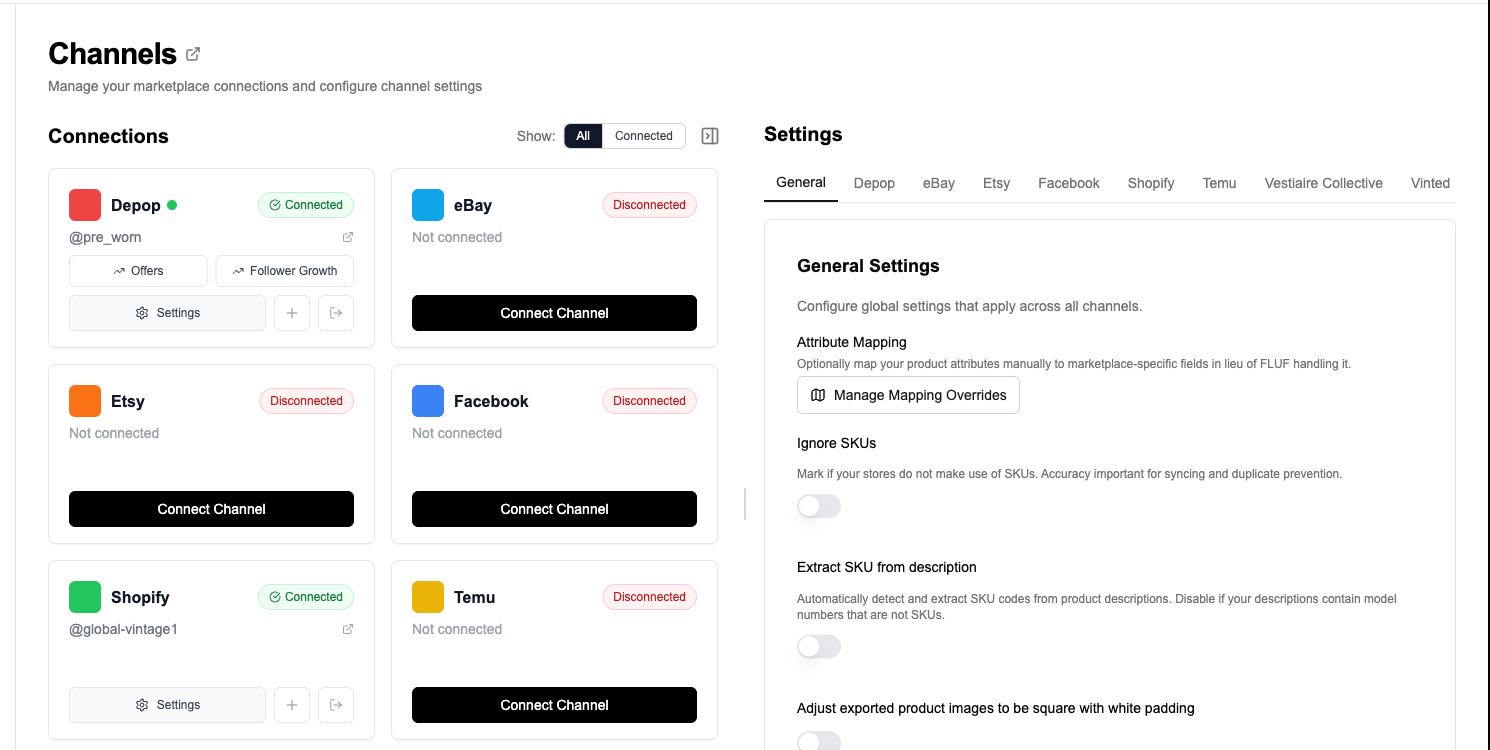
- Connect your shops in one click — Sign in to Etsy in your browser, then click Connect in the FLUF dashboard. No developer accounts, no API keys, no setup forms. Link Depop, eBay, Vinted, Shopify, or Facebook Marketplace accounts the same way.
- Import or create listings — Pull in your existing Etsy listings or create new ones. FLUF Connect stores your product data centrally.
- Cross-list with one click — Push any listing to any connected channel. Inventory sync keeps everything aligned, and bulk operations let you manage hundreds of listings efficiently.
Pricing
FLUF Connect plans start at £9/month (Starter); There is no free plan, but every new account gets a 7-day trial for £1. Paid plans scale up for sellers who need higher volumes and advanced features like auto-relisting and priority sync. Check the pricing page for current plans.
List on Etsy, Depop, eBay, Vinted, and Shopify — all from one dashboard.
Related Guides
- How to Sell on Depop — The complete guide for Depop sellers
- How to Sell on eBay — Everything you need to know about eBay in 2026
- Etsy Crosslisting — How to cross-list your Etsy products to other platforms
- Inventory Sync — How FLUF Connect prevents overselling across channels
- Sell on Multiple Platforms — Why multi-channel selling works
- FLUF vs Vendoo — How FLUF Connect compares to Vendoo
- Crosslist Wallapop vintage and handmade to Etsy — Extend your Wallapop listings to Etsy’s 92M global buyers.
- Crosslist from Gumtree to Etsy
- Source guide: Vestiaire Collective to Etsy — archive designer pieces qualifying under Etsy’s 20-year vintage rule.
- Crosslist from Facebook Marketplace to Etsy — For Facebook Marketplace sellers moving local-pickup inventory into Etsy
- Crosslist from Temu to Etsy — For Temu sellers expanding into handmade and vintage on Etsy
- Crosslist Etsy to Grailed
- Crosslist from Squarespace to Etsy
- Crosslist from Bidzzy to Etsy
- Crosslist from Etsy to Discogs — the release-matching problem
More crosslisting guides
Related guide: how to crosslist from Whatnot to Etsy.
Related guide: how to crosslist from Etsy to Vestiaire Collective.
New crosslisting guides (May 2026)
- Looking for less-saturated markets? Yaga reaches Baltic and South African buyers — see our Etsy-to-Yaga crosslisting guide. Crosslist from Etsy to Yaga
Crosslist from Poshmark to Etsy
Poshmark sellers expanding outward: see our Poshmark to Etsy crosslisting guide for field mapping, condition translation and inventory sync details.
More Crosslisting Guides
More crosslisting guides
Related guides
Related guide: How to crosslist from BigCommerce to Etsy.
Sources & Verification
Last verified: 2026-06-28. Please contact us if any figure is out of date.
- Etsy investor relations — Q4 & Full Year 2025 Results — 86.5 million active buyers, 5.6 million active sellers, full-year GMS (~$11.9bn), ~46% of GMS via the Etsy app
- Etsy investor relations — eBay to Acquire Depop from Etsy — ~$1.2bn Depop sale to eBay, expected to close Q2 2026
- Etsy investor relations — Leadership Transition — Kruti Patel Goyal becomes CEO 1 Jan 2026, Josh Silverman becomes Executive Chair
- Etsy — Fees & Payments Policy — $0.20 listing fee, 6.5% transaction fee on item price plus shipping
- Etsy Help Centre — Payment Processing Fees — per-country payment-processing rates (US 3% + $0.25, UK 4% + £0.20, EU 4% + €0.30)
- Etsy Help Centre — How Etsy’s Offsite Ads Work — 15% fee under $10,000/yr (optional), 12% fee at $10,000+/yr (mandatory), 30-day attribution window
- Etsy Seller Handbook — Strengthening New-Shop Onboarding — one-time $15 new-shop set-up fee (from Sept 2024)
- Etsy Help Centre — What Information Does Etsy Report (EU/UK/Canada) — DAC7 reporting thresholds of 30 transactions or €2,000
- GOV.UK — Tax-free trading allowance — £1,000 trading allowance per tax year
- GOV.UK — VAT registration — £90,000 VAT registration threshold
- Etsy — Wikipedia — founding (2005, Brooklyn, New York)
Related guides
- Can you have multiple Etsy shops? — Etsy's rules and how to manage several shops
- Crosslist from Tilt to Etsy — the reselling rules, quoted in full
- Crosslist from Subito to Etsy
- Crosslist from Vendora to Etsy
- Crosslist from PrestaShop to Etsy — why most catalogues are ineligible
- Crosslist from Tradera to Etsy — the 20-year vintage test
- Sell on Amazon — the complete seller guide
- Promote your Etsy products on Instagram
FLUF data This week on Etsy via FLUF: 73 sales (+0% vs last week), average sale £29.09, 17k active listings.
Subscribe to seller brief
Choose topics firstFrequently Asked Questions
Etsy charges a $0.20 listing fee per item, a 6.5% transaction fee on the total sale including shipping, and payment processing fees of 3-4% plus a fixed fee. New shops also pay a one-time $15 setup fee. Offsite ads can add 12-15% on attributed sales. Total fees typically range from 10-25% depending on your situation.
Connect your Etsy shop in one click through the FLUF browser extension. There are no developer accounts, API keys, or setup forms to fill in — just sign in to Etsy in your browser and click Connect in the FLUF dashboard. Your listings, inventory, and orders sync automatically from there.
Etsy allows three categories: handmade items (made or designed by you), vintage items (at least 20 years old), and craft supplies or tools. Mass-produced goods are prohibited. If you use production partners, you must disclose them. Items made with tools like laser cutters or 3D printers must use your original design.
An item must be at least 20 years old to qualify as vintage on Etsy. In 2026, that means items manufactured in 2006 or earlier. You do not need to prove the exact year, but you should be able to date the item approximately through labels, materials, and construction methods.
Personalised jewellery, home decor, vintage clothing, digital products such as printables and templates, and craft supplies are consistently the top-performing categories. Items with a unique, handmade, or personalised angle tend to outperform generic alternatives.
Etsy uses semantic search with multiple ranking factors including relevancy, listing quality score based on click-through and conversion rates, recency, shipping price, customer experience metrics, and personalisation. Using specific long-tail keywords in your titles and tags is more effective than broad generic terms.
Yes. FLUF Connect lets you crosslist Etsy products to Depop, eBay, Vinted, Shopify, and Facebook Marketplace with automatic inventory sync to prevent overselling. You can also import products from those platforms into Etsy.
In the UK, you have a £1,000 trading allowance before you need to report income. Above that threshold, you must register for self-assessment. VAT registration is required if your turnover exceeds £90,000. Tax rules vary by country, so consult a tax professional for your specific situation.
The Star Seller badge does not directly affect search ranking, but it can improve click-through rates by building buyer trust. The requirements — 95% response rate, 95% on-time shipping, and 4.8+ star reviews — are good business practices regardless. Pursue it for the discipline it encourages rather than as a ranking strategy.
Etsy has higher fees but a more targeted audience specifically looking for handmade and vintage goods. eBay has zero seller fees for private listings and a much broader audience. Depop skews younger and is fashion-focused. The most effective strategy is selling across multiple platforms and using inventory sync to prevent overselling.
For the right products and strategy, yes. Etsy provides access to 86.5 million active buyers and strong brand trust that is difficult to replicate independently. The fees are high and competition is intense, but sellers who optimise their listings, price correctly, and sell across multiple platforms can build meaningful income. The key is treating Etsy as one channel in a broader strategy.