
eBay vs Facebook Marketplace: Which Is Better for Sellers in 2026?
A side-by-side comparison of fees, audience, features, shipping, and what real sellers think — plus how to sell on both automatically.



- Choose eBay if: you sell niche, collectible, or shippable items and want access to 134 million dedicated buyers worldwide, structured seller protection, and mature listing tools.
- Choose Facebook Marketplace if: you sell large or bulky items locally (furniture, appliances, baby gear), want zero fees, and prefer instant cash from local pickup sales.
- Fees: Both are free for casual sellers. eBay private sellers pay £0 in the UK. Facebook Marketplace charges £0 on local pickup. In the US, shipped FBMP orders are also fee-free since June 2024.
- Audience: eBay has 134 million active buyers searching for products. Facebook Marketplace has over 1 billion monthly users, but they are casual browsers — not dedicated shoppers.
- UK note: Facebook Marketplace in the UK is local pickup only — no checkout, no shipping, no buyer protection.
- Best strategy: Use both — list locally on FBMP for quick, zero-fee sales while reaching eBay’s global audience. Cross-list free with FLUF Connect.
eBay vs Facebook Marketplace at a Glance
eBay and Facebook Marketplace are fundamentally different selling platforms. eBay is a dedicated online marketplace with 134 million active buyers who come specifically to search for and purchase products, backed by structured checkout, shipping, and seller protection. Facebook Marketplace is a local classifieds feature built into Facebook’s social network, used by over a billion people monthly to browse, buy, and sell items — primarily through in-person pickup with no platform fees.
eBay was founded in 1995 in San Jose, California, by Pierre Omidyar. Over three decades, it has evolved from an auction site into one of the world’s largest online marketplaces, with approximately 2.5 billion live listings across every product category imaginable. Its strength is connecting sellers with the right buyer, anywhere in the world.
Facebook Marketplace launched in 2016 as a feature within Facebook’s main app. Built on Facebook’s existing social graph, it lets users buy and sell within their local community. In the UK, Marketplace is exclusively local pickup — there is no on-platform checkout, shipping label integration, or payment processing. In the US, shipped orders are supported with zero selling fees since June 2024. Despite being newer than eBay, Marketplace’s integration into Facebook’s 3 billion-user network gives it unmatched local reach.
| eBay | Facebook Marketplace | |
|---|---|---|
| Founded / Launched | 1995 | 2016 |
| Headquarters | San Jose, California | Menlo Park, California (Meta) |
| Active buyers / users | 134 million active buyers | 1 billion+ monthly users |
| Markets | 190+ countries | 70+ countries |
| Best for | Everything — electronics, collectibles, fashion, niche items | Local sales — furniture, appliances, baby gear, vehicles |
| Seller fees (UK) | £0 for private sellers. Business: 8–15% | £0 — no fees on local pickup |
| Shipping | Yes — integrated labels, Global Shipping Programme | UK: No. US: Yes (zero fees) |
| Buyer protection | Yes — eBay Money Back Guarantee | UK: No (local pickup). US: Purchase Protection on shipped orders |
| Mobile app | Yes — dedicated eBay app | Built into Facebook app |
For a deeper look at each platform individually, see our full guides: How to Sell on eBay and How to Sell on Facebook Marketplace.
eBay vs Facebook Marketplace: Feature-by-Feature Comparison
eBay is a fully-featured e-commerce platform with three decades of seller tools, analytics, and logistics integrations. Facebook Marketplace is deliberately stripped-back — a classified ads board with social features. The feature gap is significant and intentional: FBMP prioritises simplicity and speed, while eBay prioritises control and reach.
| Feature | eBay | Facebook Marketplace |
|---|---|---|
| Auction listings | Yes — with reserve prices | No — fixed price only |
| Fixed-price listings | Yes | Yes |
| Built-in messaging | Yes — email-style system | Yes — Facebook Messenger (real-time chat) |
| Offer/haggle system | Yes — Best Offer (binding once accepted) | Yes — “Make Offer” button (non-binding) |
| Seller analytics | Detailed — Seller Hub with traffic, conversion data | Minimal — views count only |
| Promoted listings | Yes — Standard (CPA) and Advanced (CPC) | Yes — Boost Listing (daily budget) |
| Integrated shipping labels | Yes — Royal Mail, Evri, USPS, UPS, FedEx | US only — no UK support |
| Buyer protection | Yes — eBay Money Back Guarantee | US shipped orders only — none for UK local pickup |
| Seller protection | Yes — Seller Protection programme | Very limited |
| Social features | Limited — watchers and followers | Strong — profile, mutual friends, social trust signals |
| Business accounts | Yes — Store subscriptions from £27/month | Businesses can sell via Facebook Page |
| International selling | Yes — Global Shipping Programme, 190+ markets | No — primarily local |
| Multi-quantity listings | Yes — stock quantity per listing | Limited |
| Item specifics / categories | Extensive — dozens of attributes per category | Basic — category, condition, location |
| Authenticity programme | Yes — mandatory for luxury items above thresholds | No |
The most significant difference is Facebook Marketplace’s use of Messenger for buyer communication. Unlike eBay’s email-style messaging, Messenger enables real-time negotiation — which is faster for arranging local pickups but also means sellers deal with more low-effort messages, lowball offers, and ghosting from buyers who never follow through.
Listing Experience: eBay vs Facebook Marketplace
Facebook Marketplace is the fastest platform to list on — most items can be live in under 60 seconds from a phone. eBay’s listing process is more involved but gives sellers far more control over how items appear in search results and how buyers find them.
On Facebook Marketplace, you tap “Sell,” take or upload photos, write a title and description, select a category and condition, set a price, and choose your location. That is it. There are no item specifics to fill in, no shipping configurations, no listing format decisions. The simplicity is a genuine advantage for casual sellers listing a few items from home — but it means your listing has very little structured data, making it harder for buyers to find through targeted searches.
On eBay, you get up to 24 photos, a detailed item specifics system (brand, model, MPN, material, and dozens of category-specific attributes), auction and fixed-price format options, configurable shipping per listing, and promotional tools. Each field exists because it helps eBay’s search algorithm match your item with the right buyer. For sellers with niche or specialist items, this structured data is the difference between being found and being invisible.
Photography differs too. Facebook Marketplace buyers expect casual, authentic photos — smartphone shots in natural light, showing the item in its current location. Overly professional photos can actually decrease trust on FBMP because they look like stock images. eBay buyers prefer clear, well-lit product photos on neutral backgrounds showing every angle and any imperfections.
Time to list: under 1 minute on Facebook Marketplace, 3–5 minutes on eBay. If you sell on both, FLUF Connect’s crosslisting lets you create a listing once and push it to both platforms simultaneously.
Fees Compared: How Much Do eBay and Facebook Marketplace Actually Cost?
This is the area where eBay and Facebook Marketplace converge most surprisingly. Both platforms now offer zero-fee selling for casual and private sellers — a dramatic shift from even a few years ago when eBay charged 12.8% and FBMP charged 5% on shipped items.
Fee Breakdown
| Fee Type | eBay (UK Private) | eBay (UK Business) | Facebook Marketplace |
|---|---|---|---|
| Listing fee | Free (up to 1,000/month) | Free (up to 1,000/month) | Free — unlimited |
| Transaction / final value fee | £0 | 8–15% depending on category | £0 (local pickup). US shipped: £0 since June 2024 |
| Payment processing | £0 — included | Included in FVF | N/A — UK has no on-platform checkout |
| Per-order fee | None | £0.30–0.40 | None |
| Promoted / boosted listings | 1–20% (optional, CPA) | Daily budget boost (optional) | Daily budget boost (optional) |
| Store subscription | N/A | From £27/month | N/A |
- eBay (private seller): No fees = You keep £30.00
- eBay (business seller, general category): FVF £3.27 + Per-order £0.40 + Regulatory £0.13 = You keep £26.20
- Facebook Marketplace (local pickup): No fees = You keep £30.00
For UK private sellers, both platforms are genuinely free. The fee difference only emerges for eBay business sellers — and even then, you are paying for access to 134 million buyers, structured checkout, shipping integration, and seller protection. On Facebook Marketplace, the “zero fees” come with trade-offs: no buyer protection, no shipping support, and no dispute resolution in the UK.
Payouts: How Quickly You Get Your Money
| eBay | Facebook Marketplace (UK) | |
|---|---|---|
| Payout method | Bank transfer or debit card | Cash at pickup, or bank transfer arranged privately |
| Payout speed | Within 2 business days (daily options available) | Instant — cash in hand at pickup |
| On-demand payouts | Yes — within 30 minutes to debit card | N/A — no platform payment |
| New seller holds | Up to 21 days (first 90 days) | None — direct payment |
| Payment guarantee | Yes — buyer must pay before receiving item | No — payment is between buyer and seller |
Facebook Marketplace has the fastest “payout” of any platform — you get cash the moment the buyer picks up the item. No waiting, no holds, no processing fees. But this speed comes at the cost of security: there is no payment guarantee, no chargeback protection, and no recourse if a buyer’s payment bounces or a transaction goes wrong.
Audience and Demand: Who Is Buying on eBay vs Facebook Marketplace?
eBay and Facebook Marketplace reach fundamentally different types of buyers with fundamentally different intent. This is exactly why selling on both works — the overlap is minimal, and each platform finds buyers the other cannot reach.
| eBay | Facebook Marketplace | |
|---|---|---|
| Buyer type | Dedicated shoppers with purchase intent | Casual browsers within a social app |
| Reach | 134 million active buyers, 190+ countries | 1 billion+ monthly users, primarily local |
| Search behaviour | Keyword search — “Nike Air Max 90 size 10” | Browse-led — scrolling a local feed |
| Buyer commitment | High — 99.9% follow through on purchase | Low — estimated 15% follow-through rate |
| Best for sellers of | Niche items, collectibles, electronics, fashion | Furniture, appliances, baby gear, vehicles, local services |
| Price sensitivity | Moderate — willing to pay for the right item | High — bargain-hunting, expects deals |
eBay’s audience comes with purchase intent. Buyers search for specific products, compare options, and commit to buying through a structured checkout process. This makes eBay the stronger platform for anything niche, specialist, or collectible — items that “need to find the right person,” as one seller put it. The auction format also creates unique opportunities for rare items where competitive bidding drives prices above market value.
Facebook Marketplace’s audience is vast but casual. Users are primarily browsing their local area within the Facebook app — they are not dedicated shoppers. This creates high volume but low commitment: sellers report that most interactions involve lowball offers, ghosting, or buyers who never show up for arranged pickups. However, for large, bulky, or everyday items (furniture, appliances, kids’ toys), FBMP’s local audience is unbeatable — these items sell quickly because buyers can see and collect them same-day.
Shipping and Local Pickup: eBay vs Facebook Marketplace
This is the defining structural difference between the two platforms. eBay is built around shipping — connecting buyers and sellers globally through integrated logistics. Facebook Marketplace in the UK is built around local pickup — connecting neighbours through the Facebook app.
| eBay | Facebook Marketplace (UK) | |
|---|---|---|
| Shipping support | Yes — Royal Mail, Evri, DPD, Parcelforce, and more | No — local pickup only in the UK |
| International shipping | Yes — Global Shipping Programme to 100+ countries | No |
| Local pickup option | Yes — collection in person | Yes — this is the primary model |
| Prepaid shipping labels | Yes — discounted rates via eBay | No (UK) |
| Tracking | Required for seller protection | N/A — no shipping |
| Best for | Items under 30kg that can be packaged and posted | Large/bulky items, same-day sales, items buyers want to inspect |
eBay’s Global Shipping Programme is a significant advantage for sellers wanting international reach — ship to a UK hub, and eBay handles customs, duties, and delivery to over 100 countries. 47% of eBay sellers report international sales, unlocking a global buyer pool that FBMP simply cannot access.
Facebook Marketplace’s local-only model in the UK is both a limitation and a strength. It eliminates shipping costs, packaging time, and return logistics entirely — but it also means your audience is limited to people within driving distance. For furniture, large appliances, and other items that are expensive to ship, this is ideal. For clothing, electronics, and anything easily posted, it is a significant constraint.
Safety and Seller Protection: eBay vs Facebook Marketplace
Safety is where eBay and Facebook Marketplace diverge most dramatically — and it is the single biggest concern sellers raise about FBMP. eBay’s structured checkout system means you never meet a buyer in person, never handle cash, and have formal dispute resolution. Facebook Marketplace’s local pickup model means meeting strangers, handling cash, and having very little recourse if something goes wrong.
Facebook Marketplace safety risks are well-documented. 1 in 6 FBMP users report being scammed, and fraud on the platform rose 16% in recent years. Common scams include fake payment confirmations, buyers sending someone else to collect claiming payment was made, and brand-new accounts making immediate purchase offers that turn out to be phishing attempts.
“Facebook Marketplace is a useless scam-a-thon. I listed a coffee table last weekend and got about 10 responses within 10 minutes, all from accounts that were brand new.”
Practical safety tips for FBMP sellers: meet at public locations (police station car parks are increasingly designated as safe meetup spots), bring someone with you, accept digital payment (bank transfer) rather than cash where possible, and vet buyer profiles — check account age, mutual friends, and activity history before agreeing to meet.
eBay’s seller protection is structured and formal. The eBay Money Back Guarantee protects buyers, while the Seller Protection programme shields sellers from certain fraudulent claims. Payments are processed through eBay’s managed payments system — buyers pay before receiving items, and sellers never need to meet anyone in person. The trade-off is that eBay’s buyer-friendly return policies can sometimes be exploited: sellers report that it is “much easier for a bad actor to make claims that an item arrived broken or not as described.”
What Real Sellers Say About eBay vs Facebook Marketplace
The most revealing insights come from sellers who actively use both platforms. The consensus is clear: each platform serves a different purpose, and the smartest sellers use both strategically.
“I sell a lot more on Marketplace than eBay. Even small items. I had over 130 listings on eBay and dropped it back down to 2. Always have lingering thoughts about being done with eBay but never with FBM.”
“My stuff is sellable but it needs to find the right person and I want the wider eBay audience.”
“Once I make the sale, it’s done and they have the object and I have their cash.”
“That’s why I prefer to pay eBay fees and ship — you’re protected.”
Common themes from sellers who use both:
- Facebook Marketplace strengths: zero fees, instant cash, fast sales for everyday items, no packaging or shipping, massive local reach.
- Facebook Marketplace frustrations: lowball offers, ghosting, and no-shows (estimated 20–30% no-show rate), scam bots on new listings, no seller protection, and Facebook showing listings to users worldwide despite specifying local pickup only.
- eBay strengths: global buyer reach, 99.9% payment follow-through rate, structured checkout, seller protection, zero fees for UK private sellers, mature analytics tools.
- eBay frustrations: buyer-favoured dispute resolution, complex fee structures for business sellers, returns that feel unfair, and slower time-to-sale for common items.
- The winning strategy: experienced resellers cross-post to both platforms — list locally on FBMP first, keep the item on eBay for wider reach, and whichever sells first, delist from the other.
How to Choose Between eBay and Facebook Marketplace
The right platform depends on what you sell, how quickly you want to sell it, and how much effort you want to invest in each listing. Here is a practical decision framework.
- Sell niche, collectible, or specialist items that need to find the right buyer
- Want access to 134 million buyers in 190+ countries
- Sell shippable items (clothing, electronics, books, small goods)
- Value payment security, buyer verification, and formal dispute resolution
- Want auction listings for rare items where bidding drives prices up
- Sell large or bulky items that are impractical to ship (furniture, appliances, exercise equipment)
- Want zero fees and instant cash from local sales
- Need to sell quickly — same-day pickup is common on FBMP
- Sell everyday household items, baby gear, seasonal goods, or vehicles
- Are comfortable with in-person meetups and can manage safety precautions
Category-by-category verdict:
| Category | Best Platform | Why |
|---|---|---|
| Furniture | Facebook Marketplace | Local pickup eliminates shipping. Buyers want to inspect first. |
| Electronics | eBay | Global audience, item specifics for exact model matching, authentication. |
| Collectibles | eBay | Specialist buyers, auction format for rare items, buyer protection. |
| Baby gear & kids’ toys | Facebook Marketplace | Fast local sales, parents prefer to see items before buying. |
| Clothing & fashion | eBay | Wider audience, category-specific search, global shipping. |
| Appliances | Facebook Marketplace | Heavy, expensive to ship. Local pickup is practical. |
| Vehicles & parts | Both | FBMP for local vehicles, eBay for parts (global audience). |
| Sporting goods | Both | FBMP for large equipment, eBay for specialist/branded items. |
For most sellers, the answer is not either/or. Facebook Marketplace catches local buyers who want to see, touch, and collect items immediately. eBay catches everyone else — the niche collector, the international buyer, the person searching for that exact model at 2am. Using both platforms means you never miss a potential buyer.
Why Not Both? Sell on eBay and Facebook Marketplace at the Same Time
The smartest resellers do not choose between eBay and Facebook Marketplace — they use both. Professional flippers cross-post items to multiple platforms as standard practice, listing locally on FBMP for quick, zero-fee sales while keeping the same items on eBay for global reach. Whichever sells first, they delist from the other.
The challenge is managing this manually. If an item sells on Facebook Marketplace, you need to immediately remove it from eBay (and any other platform) to avoid overselling. With dozens or hundreds of active listings, keeping track of what is live where becomes a full-time job.
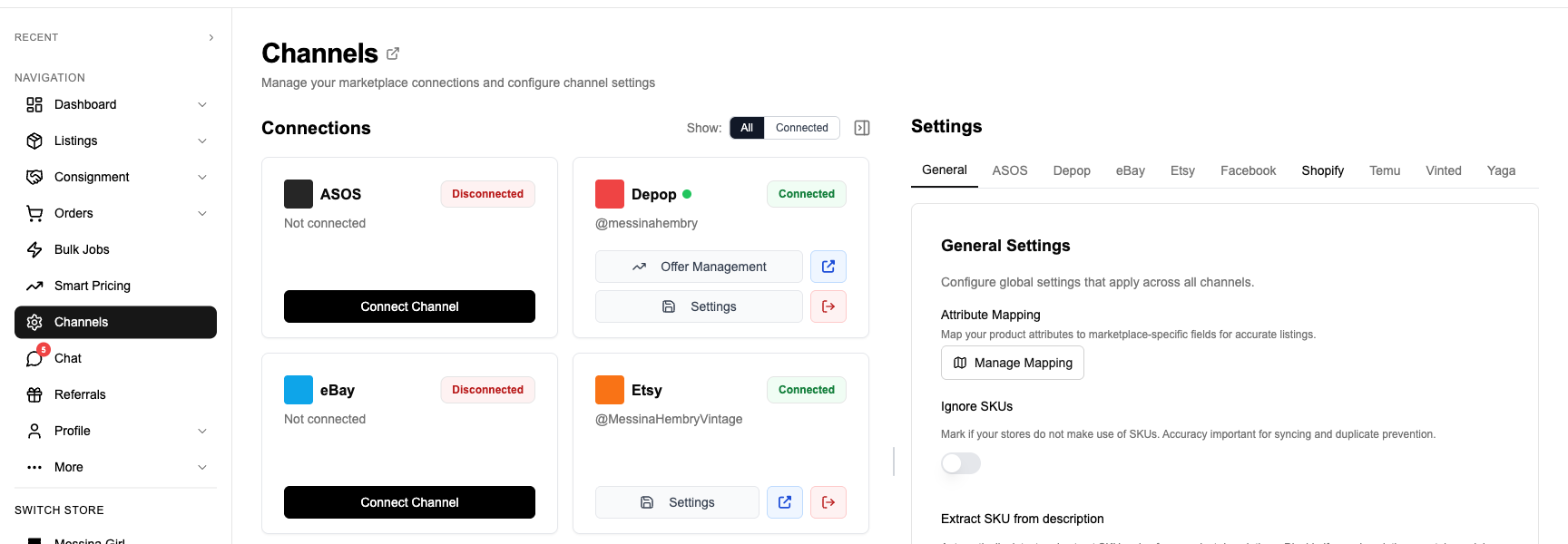
FLUF Connect automates this. List your products once, crosslist to eBay, Facebook Marketplace, and seven other marketplaces, and FLUF handles real-time inventory sync. When an item sells on one platform, it is automatically removed from the others. No overselling, no manual tracking, no wasted time.
How It Works
- Connect your accounts — Link your eBay and Facebook accounts to FLUF Connect.
- Import or create listings — Pull in existing inventory or create new listings in FLUF.
- Crosslist to both platforms — Push products to eBay and Facebook Marketplace simultaneously. FLUF adapts listings to each platform’s format.
- Automatic sync — When an item sells on eBay, FLUF removes it from Facebook Marketplace (and vice versa).
| FLUF Connect Feature | eBay | Facebook Marketplace |
|---|---|---|
| Crosslisting | Yes | Yes |
| Inventory sync | Yes | Yes |
| Auto-relisting | Yes | Not yet |
| Offer management | Yes | Not yet |
| Order sync | Yes (via Shopify) | Not yet |
| Bulk operations | Yes | Yes |
eBay has full feature support in FLUF Connect, including automated relisting and offer management — both included free. Facebook Marketplace supports crosslisting, inventory sync, and bulk operations, with additional features planned.
Free for 30 days, no credit card required. Then from £19/month for up to 500 products.
Frequently Asked Questions: eBay vs Facebook Marketplace
Is eBay or Facebook Marketplace better for selling?
It depends on what you sell. Facebook Marketplace is best for large, local-pickup items — furniture, appliances, baby gear — with zero fees and instant cash. eBay is best for niche, collectible, or shippable items that need a global audience of 134 million buyers. Many sellers use both — cross-listing free with FLUF Connect.
Which has lower fees, eBay or Facebook Marketplace?
Both are free for casual sellers. Facebook Marketplace charges zero fees on local pickup. eBay charges zero fees for UK private sellers. For eBay business sellers, fees are 8–15% depending on category.
Is Facebook Marketplace safe for sellers?
Local pickup sales carry inherent risks. 1 in 6 FBMP users report being scammed, and no-shows are common (estimated 20–30% of arranged meetups). Use public locations, bring someone, accept digital payment, and vet buyer profiles. eBay’s structured checkout avoids these risks entirely.
Does Facebook Marketplace support shipping in the UK?
No. In the UK, Facebook Marketplace is local pickup only — no checkout, no shipping labels, no payment processing, and no buyer protection. In the US, shipped orders are supported with zero selling fees.
Which is easier for beginners, eBay or Facebook Marketplace?
Facebook Marketplace is easier — list in under 60 seconds with just a Facebook account. eBay has more options and a steeper learning curve, but its structure makes selling safer and more reliable.
Does eBay or Facebook Marketplace have more buyers?
Facebook Marketplace has more users (1 billion+ monthly) but they are casual browsers. eBay has 134 million active buyers who are specifically searching for products to buy — making them higher-intent and more likely to complete a purchase.
Can I crosslist between eBay and Facebook Marketplace automatically?
Yes. FLUF Connect lets you crosslist to eBay, Facebook Marketplace, and seven other marketplaces. List once, push to both, and inventory syncs automatically.
eBay vs Facebook Marketplace for selling furniture?
Facebook Marketplace wins for furniture. Large items are impractical to ship, and FBMP’s local pickup model lets buyers collect directly with zero fees. eBay can work for smaller, shippable pieces or high-value antiques needing specialist buyers.
eBay vs Facebook Marketplace for selling electronics?
eBay is stronger for electronics. Its 134 million buyers include dedicated tech shoppers, item specifics help buyers find exact models, and authentication builds trust on high-value items. FBMP works for quick local phone or laptop sales, but lacks buyer protection.
Which platform pays faster, eBay or Facebook Marketplace?
Facebook Marketplace pays instantly — cash in hand at local pickup. eBay pays within 2 business days via managed payments, with daily payout options for established sellers. For speed, FBMP wins. For security and reliability, eBay wins.
Related Guides
- How to Sell on eBay — our complete eBay seller guide
- How to Sell on Facebook Marketplace — our complete FBMP guide
- Depop vs eBay — another popular comparison
- eBay vs Etsy — marketplace comparison for handmade and vintage
- Inventory Sync — never oversell across platforms
- FLUF Connect vs List Perfectly — crosslisting tool comparison
Frequently Asked Questions
Start Crosslisting for Free Today
500 free crosslistings. No credit card. Set up in under 10 minutes.