
Whatnot vs Facebook Marketplace: Which Is Better for Sellers in 2026?
A side-by-side comparison of fees, audience, selling format, and what real sellers think — plus how to sell on both with synced inventory.



- Choose Whatnot if: you sell collectibles (sports cards, TCG, Funko, comics), sneakers, vintage fashion, or jewellery and want live-stream auctions with a loyal community of repeat buyers.
- Choose Facebook Marketplace if: you sell locally (furniture, electronics, household items), want zero fees on pickup sales, or need the largest possible audience (1.2 billion monthly shoppers).
- Fees: Facebook Marketplace is completely free for local pickup. Shipped items cost 10% of the total. Whatnot charges ~12% all-in (you keep £26.33 on a £30 sale). For local sales, Facebook cannot be beaten on price.
- Format: Whatnot is live-first — sellers run video auctions on camera. Facebook Marketplace is listing-first — static photos with local and shipped options.
- Audience: Facebook Marketplace has 1.2 billion monthly shoppers across 228 countries. Whatnot is in 9 countries with 20M+ new accounts in 2025 and far deeper engagement (95 min/day vs quick browse-and-buy).
- Best strategy: Use both — Whatnot for community-driven collectible and fashion sales, Facebook Marketplace for local pickup items and reaching casual buyers. FLUF Connect syncs inventory across both.
Whatnot vs Facebook Marketplace at a Glance
Whatnot and Facebook Marketplace are two of the most different selling platforms you could compare. Whatnot is a live-stream commerce platform built around video auctions, community engagement, and category expertise. Facebook Marketplace is a local-first classifieds board embedded inside the world’s largest social network, designed for convenience rather than commerce depth. If Whatnot is a live auction house, Facebook Marketplace is a neighbourhood notice board — with 1.2 billion people reading it.
Facebook Marketplace launched in 2016 as a peer-to-peer buying and selling feature within the Facebook app. It has since grown to serve approximately 1.2 billion monthly shoppers across 228 countries, making it by far the largest marketplace by user count. But the experience is fundamentally casual — most transactions are local pickup with cash or bank transfer, no platform protection, and no seller verification. Whatnot, by contrast, launched in 2019, pivoted to live commerce in 2020, and has built a $8 billion+ GMV business with professional sellers running structured live shows, buyer protection, and integrated shipping.
| Whatnot | Facebook Marketplace | |
|---|---|---|
| Launched | 2019 (live commerce from 2020) | 2016 |
| Owned by | Whatnot (private, $11.5B valuation) | Meta Platforms |
| Monthly shoppers | 20M+ new accounts in 2025 (MAU undisclosed) | ~1.2 billion |
| Countries | 9 (US, UK, CA, DE, FR, NL, BE, AT, AU) | 228 |
| Best for | Sports cards, TCG, sneakers, vintage fashion, Funko, comics, jewellery | Local furniture, electronics, household items, vehicles, casual fashion |
| Selling format | Live video auctions + Buy It Now | Static listings (local pickup or shipped) |
| UK seller fees | ~12% on a £30 sale | 0% (local pickup) / 10% (shipped) |
| Seller application required | Yes (application + ID + product video) | No (just a Facebook account) |
| Buyer protection | Whatnot Buyer Protection (all transactions) | Purchase Protection (shipped checkout only; not local pickup) |
| Primary transaction type | Shipped (all transactions go through platform) | Local pickup (majority of transactions) |
For deeper dives into each platform individually, read our complete guides: How to Sell on Whatnot and How to Sell on Facebook Marketplace.
Whatnot vs Facebook Marketplace: Feature-by-Feature Comparison
These platforms share almost no features. Whatnot is a purpose-built commerce platform with live video, auctions, buyer protection, and integrated shipping. Facebook Marketplace is a listing layer on top of a social network — powerful in reach but thin in commerce infrastructure.
| Feature | Whatnot | Facebook Marketplace |
|---|---|---|
| Live-stream selling | Core format — live video auctions and BIN | Not supported |
| Static listings | Marketplace BIN (off-stream) — limited discovery | Core format — photo-based local and shipped listings |
| Auction format | Live real-time bidding with auto-extend timer | Not supported |
| Buy It Now | Yes (in-stream and Marketplace) | Yes (all listings are fixed-price) |
| Offer / haggle system | No formal offer system | Informal (via Messenger) |
| Local pickup | Not supported — all transactions are shipped | Core transaction type — majority of sales |
| Integrated shipping labels | Yes — free to seller (Royal Mail/DPD in UK) | No (prepaid labels discontinued Feb 2025; sellers source own) |
| Buyer protection | Whatnot Buyer Protection (all transactions) | Purchase Protection (shipped checkout only) |
| Seller analytics | Basic (show performance, sales history) | Minimal (views, saves, messages) |
| Promoted / boosted listings | Promote, Boost, Bumps (optional, US/UK/CA) | Meta Ads boost (~£0.30–£1.00 CPC) |
| Social features | Follows, live chat, giveaways, tipping | Facebook profile, Messenger, Groups integration |
| Seller verification / KYC | Application + ID + product video required | None (just a Facebook account) |
| International selling | Cross-border within 9 supported countries | Available in 228 countries (most transactions are local) |
| In-app checkout | Yes (all transactions) | Available for shipped items; Meta pushing toward website checkout |
The core difference: Whatnot is a commerce platform that happens to include social features. Facebook Marketplace is a social platform that happens to include commerce. That distinction matters for everything from buyer trust to dispute resolution to how seriously the platform invests in seller tools.
Listing Experience: Live Shows vs Local Listings
The selling experience on these platforms could not be more different. Facebook Marketplace is the easiest place on the internet to sell something — take a photo, set a price, post it, wait. Whatnot is one of the most demanding — schedule a show, go on camera, run auctions live, entertain an audience. Each model suits a completely different seller profile.
Facebook Marketplace: photograph, post, wait
Open the Facebook app, tap “Sell,” take a photo, write a title and short description, set a price, choose your location, and post. The entire process takes 2–3 minutes. For local sales, buyers message you via Messenger and you arrange a meetup. For shipped items, the buyer checks out through Facebook and you ship with your own label. There is no application process, no identity verification, and no learning curve. If you can use Facebook, you can sell on Facebook Marketplace.
Whatnot: schedule, go live, perform
You create listing cards (title, photo, starting price), schedule a live show about a week in advance, and go on camera at the scheduled time. During the show you present items one by one, run timed auctions, interact with the chat, and run giveaways to build your audience. The per-item listing effort is low (2–5 minutes), but the show itself is a 1–3 hour live performance. Most successful Whatnot sellers run 2–3 shows per week.
Time investment comparison
A Facebook Marketplace listing takes 2–3 minutes and requires no further time commitment beyond responding to messages and meeting the buyer. A Whatnot listing card takes 2–5 minutes, but each show requires 1–3 hours of live performance plus prep and post-show packing. The total weekly time for a serious Whatnot seller (2–3 shows) is 8–15 hours. A serious Facebook Marketplace seller might spend 2–4 hours per week listing and arranging pickups. The trade-off is velocity: Whatnot moves 100–300+ items per show at speed; Facebook Marketplace moves items one at a time as buyers find them.
Which is easier for beginners?
Facebook Marketplace is the easiest starting point in all of resale. No application, no fees on local sales, no camera, no verification. You can sell your first item within 5 minutes. Whatnot requires an application, identity verification, a product video, and comfort presenting on camera. If you are completely new to selling, start with Facebook Marketplace to build confidence, then consider Whatnot once you have inventory depth and a category you want to go deeper on.
Fees Compared: How Much Do Whatnot and Facebook Marketplace Actually Cost?
Facebook Marketplace’s fee structure is the simplest in e-commerce: zero fees on local pickup, 10% on shipped items. Whatnot charges a seller commission plus payment processing on every sale. The comparison depends entirely on whether you are selling locally or shipping.
| Fee Type | Whatnot (UK) | Facebook Marketplace (UK) |
|---|---|---|
| Listing fee | £0 (unlimited) | £0 (unlimited) |
| Seller fee — local pickup | N/A (no local pickup) | 0% — completely free |
| Seller fee — shipped | 6.67% + VAT (~8%) commission | 10% of total (item + shipping) |
| Payment processing | 2.42% + VAT on total + £0.25 + VAT per order | Included in the 10% (no separate charge) |
| Monthly subscription | £0 | £0 |
| Promoted listings | Optional (Promote/Boost/Bumps) | Optional (Meta Ads boost, from ~£1/day) |
What You Keep on a £30 Sale
- Facebook Marketplace (local pickup): Zero fees. You keep: £30.00 (100%).
- Facebook Marketplace (shipped, £3.50 postage): 10% of £33.50 = £3.35 fee, plus you buy your own label (~£3.50). You keep: £26.65 (after label cost).
- Whatnot: Commission 6.67% × £30 + VAT = £2.40. Processing 2.42% × £33.50 + £0.25 + VAT = £1.27. Total fees: £3.67. You keep: £26.33 (Whatnot provides the label free).
For local pickup, Facebook Marketplace is unbeatable — zero fees. For shipped items, the platforms are comparable, with Whatnot slightly cheaper because it provides the shipping label free while Facebook sellers must source their own.
The Hidden Costs of Facebook Marketplace
- No-shows: the most frequently cited frustration. Buyers agree to a local pickup, you drive across town, and they do not show up. This costs time and petrol money that never appears in a fee comparison.
- Scam exposure: local cash transactions have no platform protection. Overpayment scams, counterfeit banknotes, and fake payment confirmations are common complaints.
- Label cost: since February 2025, Facebook no longer provides prepaid shipping labels for new listings. Sellers must source and pay for their own labels (Royal Mail, Evri, DPD), adding a cost that Whatnot absorbs automatically.
- No seller protection on local: if something goes wrong with a local transaction, Facebook offers no dispute resolution, no refund mechanism, and no recourse.
Payouts
| Whatnot | Facebook Marketplace | |
|---|---|---|
| Payout method | Bank transfer (GBP for UK) | Bank transfer (shipped items only) |
| Payout timing | After delivery confirmed + 48–96hr hold | ~5 business days after delivery confirmed |
| Local pickup payment | N/A | Cash, bank transfer, or payment app (instant, off-platform) |
| New seller holds | 48hr (US) / +96hr (UK/EU) | Standard holds until delivery confirmed |
| Payout fee | £0 | £0 |
Audience and Demand: Who Is Buying on Whatnot vs Facebook Marketplace?
Facebook Marketplace has the largest audience of any selling platform on the planet — roughly 1.2 billion monthly shoppers. Whatnot’s audience is a fraction of that size but dramatically more engaged and commercially focused. The question is not “which has more buyers” but “which has the right buyers for what you sell.”
| Whatnot | Facebook Marketplace | |
|---|---|---|
| Monthly shoppers | 20M+ new accounts in 2025 | ~1.2 billion |
| Primary age group | 18–35 (collectible and fashion enthusiasts) | 25–34 (largest group at ~32% of users) |
| Buyer behaviour | Entertainment-driven — 95 min/day, live shows, impulse bidding, repeat buyers | Convenience-driven — browse-and-buy, local focus, one-off transactions |
| Repeat buyer rate | Very high (>80% month-on-month for active audiences) | Low — most transactions are one-off local purchases |
| Top categories | Sports cards, TCG, sneakers, vintage fashion, Funko, beauty | Furniture, electronics, vehicles, household items, casual fashion |
| Transaction type | All shipped (platform-mediated) | Majority local pickup (no platform involvement) |
| Geographic reach | 9 countries | 228 countries |
Different Buyer Intent
Facebook Marketplace buyers are looking for convenience and deals. They want a cheap sofa near their house, a secondhand phone at a bargain price, or a free item someone is giving away. The buying behaviour is casual, local, and often price-driven. Most buyers will never return to the same seller.
Whatnot buyers are looking for entertainment and collecting. They tune into shows the way they tune into Twitch or YouTube Live, spending an average of 95 minutes per day in the app. They follow specific sellers, return every week, and build relationships through live chat. The buying behaviour is community-driven, enthusiast-focused, and loyalty-based.
Category Strengths
Facebook Marketplace dominates local, bulky, and general items: furniture (its #1 category), vehicles, electronics for local pickup, household goods, and anything where the buyer wants to inspect before paying. These categories do not work on Whatnot because they depend on physical proximity.
Whatnot dominates collectibles and enthusiast categories: sports cards, TCG, Funko, comics, sneakers, vintage fashion, jewellery, and beauty. These categories thrive on the live auction format where competitive bidding, authenticity demonstration on camera, and community engagement drive both discovery and price. Facebook Marketplace has listings in these categories, but no specialised infrastructure (no authentication, no live bidding, no category expertise).
Shipping: Whatnot vs Facebook Marketplace
Shipping is where the platforms diverge most. Whatnot is built entirely around shipped transactions with platform-provided labels. Facebook Marketplace is built primarily around local pickup, with shipped commerce as a secondary feature that Meta has invested less in over time — including discontinuing prepaid shipping labels in February 2025.
| Whatnot | Facebook Marketplace | |
|---|---|---|
| Primary transaction mode | All shipped | Mostly local pickup |
| UK shipping labels | Provided free by Whatnot (Royal Mail domestic, DPD international) | Seller sources own label (prepaid labels discontinued Feb 2025) |
| Approved UK carriers | Royal Mail, DPD (Whatnot-issued only) | Royal Mail, Evri, Yodel, DPD (seller’s choice) |
| Who pays shipping | Buyer (at checkout, Whatnot sets rate) | Buyer or seller (configurable); buyer pays at checkout for shipped |
| Ship-by window | ~3 business days after show | 3 business days after order |
| Delivery window | Carrier-dependent | 10 business days maximum |
| Tracking requirement | Automatic (Whatnot labels are pre-tracked) | Required — seller must manually enter tracking number |
| International shipping | Between 9 supported countries (Whatnot DPD labels) | Seller arranges own international shipping |
For sellers who ship regularly, Whatnot’s free, pre-tracked labels are a significant advantage. You print the label, pack the item, and drop it at Royal Mail. On Facebook Marketplace, you source your own label from Parcel2Go, Royal Mail, or another provider, manually enter the tracking number, and absorb the label cost yourself. That operational overhead adds up for high-volume sellers.
For sellers who prefer local, Facebook Marketplace is the only option. Whatnot does not support local pickup at all — every transaction is shipped through the platform.
What Real Sellers Are Saying About Whatnot vs Facebook Marketplace
Facebook Marketplace and Whatnot attract completely different seller profiles. Facebook Marketplace sellers tend to be casual — clearing out a house, selling spare furniture, offloading unwanted gifts. Whatnot sellers tend to be semi-professional or professional resellers with deep category knowledge. The overlap is smaller than you might expect.
“Facebook Marketplace is the easiest place to sell anything — zero fees, massive audience, items can sell within hours. But the scams and no-shows make it exhausting for anything beyond occasional local sales.”
— Seller community consensus, multiple sources
“On Whatnot, buyers spend 80+ minutes a day watching streams and make far more transactions than traditional marketplace users. The engagement is not even comparable to Facebook.”
— Platform comparison, CLOSO seller guide
“You cannot get ahold of any kind of support on Facebook Marketplace. When something goes wrong with a local sale, you are completely on your own.”
— Seller review, PissedConsumer
“Facebook Marketplace is a notice board. Whatnot is a show. You go to Facebook to find a cheap table near your house. You go to Whatnot to watch someone open Pokémon packs for two hours and bid on the ones you want.”
— Reseller community observation
The consensus: Facebook Marketplace is unmatched for local, casual, zero-fee selling. Whatnot is unmatched for community-driven, category-specialist selling. They solve entirely different problems, which is precisely why running both makes strategic sense.
How to Choose Between Whatnot and Facebook Marketplace
This is one of the easier platform comparisons to make, because the two platforms serve almost completely different use cases. The decision usually comes down to what you sell and whether you want local or shipped transactions.
- Sell collectibles (sports cards, TCG, Funko, comics) — Facebook Marketplace has no specialist infrastructure for these
- Want to build a loyal community of repeat buyers who return every week
- Are comfortable on camera and enjoy live interaction
- Want integrated shipping with free labels (no label-sourcing hassle)
- Sell items that benefit from live demonstration (jewellery, sneakers, vintage fashion)
- Sell large, bulky, or heavy items best suited for local pickup (furniture, appliances, vehicles)
- Want zero fees — you cannot beat free
- Prefer casual, low-commitment selling (no application, no camera, no schedule)
- Need the largest possible audience (1.2 billion monthly shoppers)
- Sell general household items, electronics, or anything the local market wants
By Seller Type
| Seller Profile | Recommendation |
|---|---|
| Casual seller — clearing out a wardrobe or house | Facebook Marketplace for local items (zero fees, instant cash). Whatnot if any items are collectible. |
| Sports card / TCG dealer | Whatnot primarily. Facebook Marketplace has no live auction or card-break infrastructure. |
| Furniture / household seller | Facebook Marketplace exclusively. Whatnot does not support local pickup or bulky items. |
| Vintage fashion / streetwear reseller | Both. Whatnot for live haul shows and volume sales. Facebook Marketplace for local finds and impulse buyers. |
| Full-time multi-channel reseller | Both, plus eBay, Depop, and Vinted. Use FLUF Connect to sync everything. |
Why Not Both? Sell on Whatnot and Facebook Marketplace at the Same Time
Whatnot and Facebook Marketplace are so different that running both creates almost no conflict — they reach different buyers, use different transaction models, and sell different categories. The main risk of running both simultaneously is the same as any multi-channel setup: selling the same item on Whatnot during a live show while it is still listed on Facebook Marketplace (or vice versa). The solution is automated inventory sync.
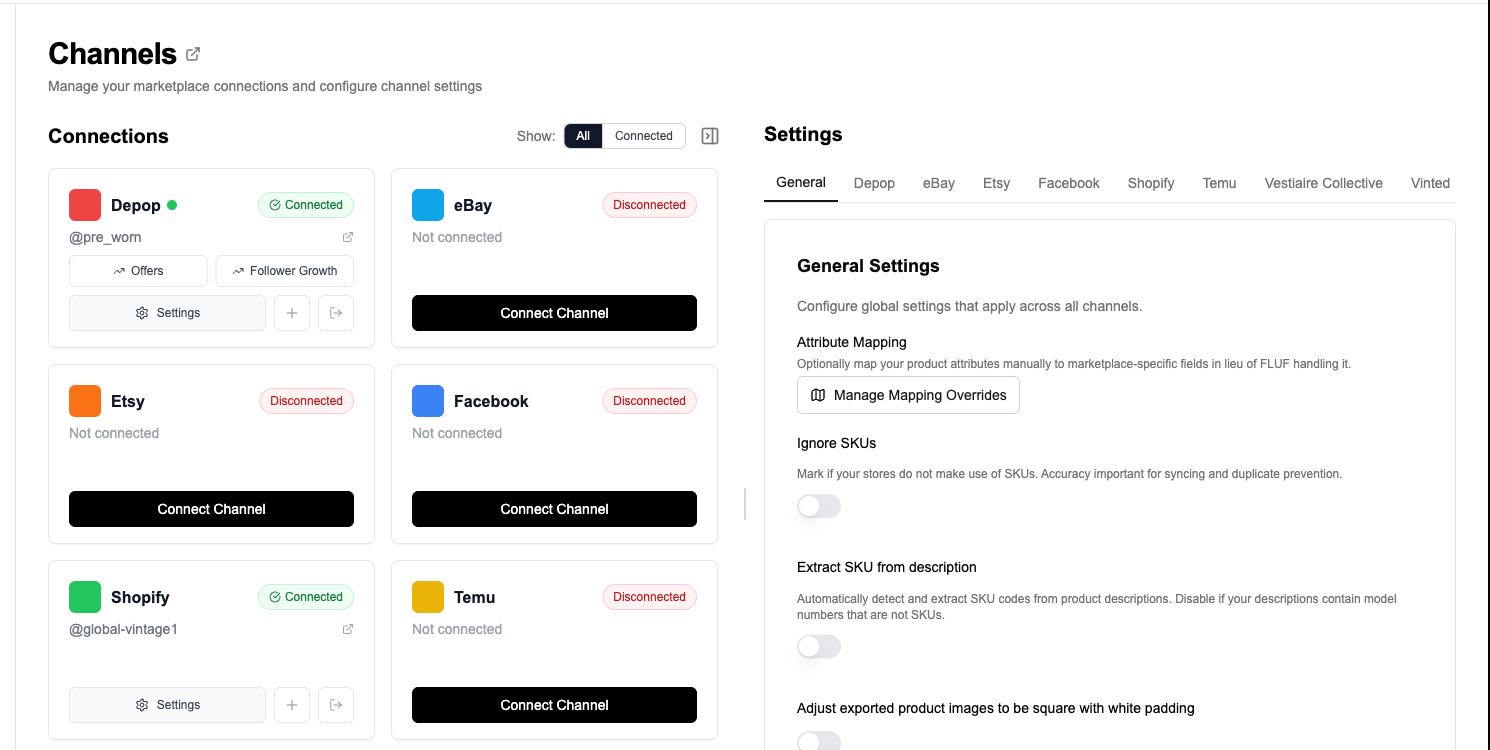
FLUF Connect links your Whatnot and Facebook Marketplace accounts (alongside eBay, Depop, Vinted, Shopify, and Etsy) in a single dashboard. When an item sells on Whatnot during a live show, FLUF Connect automatically delists it from Facebook Marketplace and every other connected channel. When an item sells on Facebook Marketplace, it disappears from your Whatnot Marketplace listings before your next show.
How It Works
- Connect: link your Whatnot and Facebook Marketplace accounts to FLUF Connect (takes minutes)
- Crosslist: push your inventory to both platforms — FLUF handles title, description, image, and category mapping
- Sync: when a sale happens on any channel, inventory updates everywhere else automatically
FLUF Connect Features for Whatnot and Facebook Marketplace Sellers
| FLUF Connect Feature | Whatnot | Facebook Marketplace |
|---|---|---|
| Crosslisting | Yes — to/from all connected channels | Yes — to/from all connected channels |
| Inventory sync | Yes — real-time delist on sale | Yes — real-time delist on sale |
| Auto-relisting | Yes | Yes |
| Offer management | N/A (no offer system) | N/A (offers via Messenger) |
| Order sync | Yes | Yes |
| Bulk operations | Yes | Yes |
To get started, create a free FLUF Connect account and connect your Whatnot and Facebook Marketplace accounts. You get 300 active products on the £9/month Starter plan — see the FLUF Connect pricing page for plans beyond that.
Sell on Whatnot and Facebook Marketplace without the overselling risk. FLUF Connect syncs your inventory in real time across both platforms — plus eBay, Depop, Vinted, Shopify, and Etsy.
Frequently Asked Questions: Whatnot vs Facebook Marketplace
Is Whatnot or Facebook Marketplace better for selling collectibles?
Whatnot, by a wide margin. Whatnot is purpose-built for sports cards, TCG, Funko, comics, and collectibles with live auctions, category-specific policies, and an enthusiast audience. Facebook Marketplace has collectible listings but no specialised infrastructure, no live bidding, and no authentication features.
Which has lower fees, Whatnot or Facebook Marketplace?
Facebook Marketplace is free for local pickup sales — you cannot beat zero fees. For shipped items, Facebook charges 10% of the total (item + shipping) and you source your own label. Whatnot charges ~12% all-in but provides the shipping label free. Net of label costs, the two are comparable for shipped items.
Can I sell on Whatnot and Facebook Marketplace at the same time?
Yes. FLUF Connect syncs inventory across both platforms in real time, automatically delisting items from one when they sell on the other.
Do I have to go on camera to sell on Whatnot?
Whatnot supports off-stream Marketplace listings, but the live show format is the dominant driver of sales and discovery. Facebook Marketplace requires no camera work at all — listings are photo-based. If camera work is a dealbreaker, Facebook Marketplace is the simpler option.
Which is easier for beginners?
Facebook Marketplace is the easiest starting point in all of resale. No application, no fees on local sales, no camera, no verification. You can list and sell within 5 minutes. Whatnot requires an application, ID verification, a product video, and comfort presenting live.
Does Facebook Marketplace or Whatnot have more buyers?
Facebook Marketplace has approximately 1.2 billion monthly shoppers across 228 countries — the largest audience of any marketplace. Whatnot reported 20 million new accounts in 2025 across 9 countries. Facebook has overwhelming reach; Whatnot has overwhelming engagement (95 min/day vs quick browse-and-buy).
Is Facebook Marketplace safe for sellers?
For shipped items via checkout, Purchase Protection provides some coverage. For local pickup sales — which are the majority of Facebook Marketplace transactions — there is no platform protection for sellers. No-shows, scams, and fake payment confirmations are widely reported frustrations. Whatnot’s platform-mediated transactions with buyer protection and seller protection are significantly safer.
Can I sell furniture on Whatnot?
Practically, no. Whatnot is a shipped-only platform — all transactions go through Whatnot’s shipping infrastructure. Bulky items like furniture, appliances, and vehicles are not viable. Facebook Marketplace’s local pickup model is purpose-built for these categories.
Whatnot vs Facebook Marketplace for selling fashion?
Both work, but differently. Facebook Marketplace reaches casual local buyers looking for deals on everyday clothing. Whatnot reaches fashion enthusiasts who tune into live shows for streetwear, vintage, and Y2K pieces — with women’s fashion growing +223% YoY on the platform. For curated fashion, also consider Depop and Vinted.
Is it worth selling on both Whatnot and Facebook Marketplace?
Yes, because they serve completely different purposes. Facebook Marketplace handles local sales (furniture, electronics, household items) at zero fees. Whatnot handles community-driven collectible and fashion sales at speed. Together with FLUF Connect syncing inventory, you cover both the local and shipped sides of your reselling business.
Want to learn more? Read our complete guides to selling on Whatnot and selling on Facebook Marketplace, or compare other marketplace combinations like Whatnot vs eBay, Whatnot vs Depop, and Depop vs Vinted. New to crosslisting? See our guide to selling on multiple platforms.
Frequently Asked Questions
Whatnot, by a wide margin. Whatnot is purpose-built for sports cards, TCG, Funko, comics, and collectibles with live auctions, category-specific policies, and an enthusiast audience. Facebook Marketplace has collectible listings but no specialised infrastructure.
Facebook Marketplace is free for local pickup sales. For shipped items, Facebook charges 10% of the total and you source your own label. Whatnot charges about 12% all-in but provides the shipping label free. Net of label costs, the two are comparable for shipped items.
Yes. FLUF Connect syncs inventory across both platforms in real time, automatically delisting items from one when they sell on the other. 1,000 products on the £19/month Growth plan on the free tier.
Whatnot supports off-stream Marketplace listings, but the live show format is the dominant driver of sales. Facebook Marketplace requires no camera work at all. If camera work is a dealbreaker, Facebook Marketplace is the simpler option.
Facebook Marketplace is the easiest starting point in all of resale. No application, no fees on local sales, no camera, no verification. You can list and sell within 5 minutes. Whatnot requires an application, ID verification, and comfort presenting live.
Facebook Marketplace has approximately 1.2 billion monthly shoppers across 228 countries. Whatnot reported 20 million new accounts in 2025 across 9 countries. Facebook has overwhelming reach; Whatnot has overwhelming engagement at 95 minutes per day.
For shipped items via checkout, Purchase Protection provides coverage. For local pickup sales, there is no platform protection. No-shows, scams, and fake payment confirmations are widely reported. Whatnot platform-mediated transactions with buyer and seller protection are significantly safer.
Practically no. Whatnot is a shipped-only platform. Bulky items like furniture, appliances, and vehicles are not viable. Facebook Marketplace local pickup model is purpose-built for these categories.
Both work differently. Facebook Marketplace reaches casual local buyers looking for deals on everyday clothing. Whatnot reaches fashion enthusiasts who tune into live shows for streetwear, vintage, and Y2K pieces with women's fashion growing 223% year-on-year.
Yes, because they serve completely different purposes. Facebook Marketplace handles local sales at zero fees. Whatnot handles community-driven collectible and fashion sales at speed. Together with FLUF Connect syncing inventory, you cover both local and shipped selling.