
Whatnot vs Yaga: Which Is Better for Sellers in 2026?
A side-by-side comparison of fees, audience, selling format, shipping, and what real sellers think — plus how to sell on both automatically.



- Choose Whatnot if: you enjoy live selling, want to move collectibles, trading cards, or fashion fast through real-time auctions, and sell from the US, UK, Canada, or Europe.
- Choose Yaga if: you sell preloved fashion in South Africa and want zero seller fees, escrow payment protection, and access to 1M+ local buyers.
- Fees: Whatnot charges sellers ~11% total (8% commission + 2.9% + $0.30 processing). Yaga charges sellers nothing — buyers pay a 6.5% + R19.90 protection fee instead.
- Audience: Whatnot has 20M+ accounts with buyers spending 80 minutes daily watching live streams. Yaga has 1M+ registered users and 12M+ monthly visits in South Africa.
- Selling format: This is the core difference — Whatnot is live-stream auctions (like QVC meets Twitch). Yaga is traditional fixed-price listings. Completely different selling experiences.
- Best strategy: If you sell across both markets, list on both and let automation handle inventory sync. Cross-list free with FLUF Connect.
Yaga isn’t only South Africa. The same marketplace also runs in Latvia (shopyaga.lv), Estonia (yaga.ee) and Kenya (yaga.co.ke). FLUF Connect works with whichever country’s Yaga you sell on — using the right currency (ZAR, EUR or KES) and local shipping automatically. See where Yaga operates →
Whatnot vs Yaga at a Glance
Whatnot and Yaga represent two fundamentally different approaches to online selling. Whatnot is a live-stream auction platform where sellers host real-time video shows — think QVC meets Twitch — moving collectibles, trading cards, and fashion through rapid-fire bidding. Yaga is a traditional fixed-price marketplace focused on preloved fashion in South Africa, where sellers list items, set prices, and wait for buyers to purchase. They serve different geographies, different categories, and different selling styles entirely.
Whatnot was founded in 2019 in Los Angeles by Grant LaFontaine and Logan Head. It went through Y Combinator’s W20 batch and has since raised nearly $1 billion in venture capital, reaching an $11.5 billion valuation in October 2025. The platform processes over $8 billion in live sales annually, with the top 500 sellers each generating over $1 million in revenue. Yaga was founded in Estonia in 2017 by Aune Aunapuu and Karl Erik Kotkas, launching in 2019. It quickly became South Africa’s leading preloved fashion marketplace, backed by H&M Group Ventures and other investors with €7.2 million in total funding. Yaga has facilitated over 6 million item sales and paid out €80+ million to sellers.
| Whatnot | Yaga | |
|---|---|---|
| Founded | 2019 (Los Angeles, USA) | 2017 (Tallinn, Estonia) |
| Headquarters | Marina Del Rey, California | Tallinn, Estonia / Cape Town, South Africa |
| Active users | 20M+ accounts; 7.6M monthly visits | 1M+ registered; 12M+ monthly visits |
| Top markets | US (83%), UK (5%), Germany (4%), Canada, France | South Africa (expanding to Kenya, MENA) |
| Best for | Trading cards, collectibles, sneakers, fashion, electronics, vintage | Preloved women’s fashion, shoes, accessories |
| Selling format | Live-stream auctions + fixed-price “Buy It Now” | Fixed-price listings only |
| Seller fees | 8% commission + 2.9% + $0.30 processing | None (0%) |
| Buyer protection | Included (platform-funded) | 6.5% + R19.90 (paid by buyer) |
| Valuation / Funding | $11.5 billion (2025) | €7.2 million total funding |
| Mobile app | iOS & Android (hit #1 US shopping app, June 2025) | iOS & Android (4.8/5 App Store) |
Whatnot vs Yaga: Feature-by-Feature Comparison
The feature sets reflect each platform’s selling model. Whatnot is built around live commerce — scheduled shows, real-time bidding, audience interaction, and content-driven selling. Yaga is built around traditional marketplace features — static listings, search filters, and structured product data. Comparing them is less about “which has more features” and more about which selling experience fits your products and personality.
| Feature | Whatnot | Yaga |
|---|---|---|
| Live-stream selling | Yes — core feature with scheduled shows and real-time auctions | No |
| Fixed-price listings | Yes (“Buy It Now” alongside live shows) | Yes (primary selling method) |
| Auction listings | Yes — 10-second to 3-minute bidding rounds during live shows | No |
| Offer/haggle system | Yes (during live streams — real-time negotiation) | Yes (Make Offer button on listings) |
| Built-in messaging | Yes (live chat during streams + direct messages) | Yes (in-app messaging) |
| Integrated shipping labels | Yes — USPS labels generated automatically | Yes — integrated with SA couriers (The Courier Guy, PAXI, Pargo, Aramex, PostNet) |
| Buyer protection | Yes — platform-funded, covers damaged/counterfeit/not-as-described | Yes — escrow-based, payment held until buyer confirms receipt |
| Promoted listings/shows | Yes — Promoted Shows ($25–$200+/hr) and Bump features ($5–$25) | No promotion tools available |
| Seller verification | Application required — ID, video showcase, approval in 5–14 days | Open signup — no approval needed |
| Seller ratings/reviews | Yes — buyer reviews after each transaction | No public seller rating system |
| Social features | Yes — follows, live chat, community engagement, loyalty rewards | Limited — follows and likes |
| International selling | Yes — up to 60% of European sales are cross-border | No — South Africa only |
| Business accounts | Yes (all sellers go through application) | Yes (business entity registration available) |
| Categories | 50+ (collectibles, fashion, electronics, plants, toys, sports cards) | Fashion-focused (clothing, shoes, accessories, beauty, some tech) |
The standout differences: Whatnot’s live selling format means sellers interact directly with buyers in real time — building a following, creating urgency through auctions, and moving inventory fast. Yaga’s traditional format lets sellers list items passively and wait for sales. Whatnot supports 50+ categories including collectibles and electronics; Yaga is focused on preloved fashion. Whatnot offers promotion tools; Yaga keeps things organic.
Listing Experience: Whatnot vs Yaga
The listing experience on these two platforms could not be more different. On Whatnot, “listing” means preparing items to sell through live video shows or as fixed-price Buy It Now listings. On Yaga, listing follows the traditional marketplace pattern of uploading photos, filling in product details, and publishing a static listing page.
Whatnot
On Whatnot, the primary selling method is live shows. You schedule a stream, set up your camera and lighting, go live, and present items to your audience in real time. Each item gets a bidding round lasting 10 seconds to 3 minutes — buyers compete by tapping to bid. You can also create Buy It Now listings that sit on your profile for passive sales between shows. The live format requires preparation: you need decent lighting, a camera (phone or dedicated), a clean backdrop, and enough inventory to fill a show. Most successful sellers stream 3–4 times per week, 2–4 hours per session. The listing itself requires a title, category (with dynamic per-category attributes), condition, price, photos, and shipping profile.
Yaga
On Yaga, you upload up to 10 photos, select a category, and fill in structured fields: brand, size, colour (19 options), condition (New, Like New, Good, or Fair), and material (32 options including Cotton, Leather, Silk, Wool). You write a description, set a price in ZAR, select your preferred shipping options from integrated South African couriers, and publish. The entire process takes 3–5 minutes per item. Yaga’s app is clean and intuitive — multiple sellers describe the experience as “not at all intimidating” — and the structured fields feed directly into search filters, making accurate data entry important for discoverability.
Which is easier?
Yaga is dramatically easier for beginners. You need a phone with a camera and clothes to sell — that’s it. Whatnot has a meaningful barrier to entry: you must apply and be approved (5–14 days), invest in streaming equipment ($200–$1,000+), develop on-camera comfort, and commit to regular live sessions. The trade-off is that Whatnot’s live format can convert far more effectively — sellers report moving 50+ items per hour during live shows, compared to the passive wait-and-see approach of traditional listings.
Fees Compared: How Much Do Whatnot and Yaga Actually Cost?
This is where the two platforms differ most sharply. Whatnot charges sellers a commission on every sale. Yaga charges sellers nothing at all — it makes money from buyer-side protection fees instead. For sellers focused on maximising take-home pay per item, this is the single most important difference.
| Fee Type | Whatnot | Yaga |
|---|---|---|
| Listing fee | Free | Free |
| Seller commission | 8% of sale price (excl. shipping). Reduced rates: 4% Coins & Money, 5% Electronics | None (0%) |
| Payment processing | 2.9% + $0.30 per transaction (on full amount incl. shipping and tax) | None |
| Buyer Protection Fee | N/A (included in platform fees) | 6.5% + R19.90 (paid by buyer) |
| Promoted shows | $25–$200+/hour (bid-based) | Not available |
| Monthly subscription | None | None |
| High-value discount | 0% commission on portion above $1,500 (select categories) | N/A |
- Whatnot ($30 sale, US): Commission $2.40 (8%) + Processing $1.17 (2.9% + $0.30) = $3.57 in fees. You keep $26.43 (88%).
- Yaga (R500 sale, South Africa): Commission R0.00 + Processing R0.00 = R0.00 in fees. You keep R500.00 (100%). Buyer pays R52.40 protection fee separately.
On pure take-home percentage, Yaga wins decisively — sellers keep 100% of the sale price. Whatnot takes roughly 11–12% of each sale when you combine commission and processing fees. However, Whatnot’s live auction format often drives prices above what the same item would sell for on a traditional marketplace. Trading cards regularly sell 20–30% above comparable eBay prices due to bidding psychology and the excitement of live competition. So while Yaga takes less per sale, Whatnot may generate higher sale prices — especially for collectibles and rare items.
Hidden costs to consider
Whatnot’s fees don’t tell the full story. Successful live sellers invest in streaming equipment (lighting, cameras, backdrops), often give away items to build audience loyalty, and spend on Promoted Shows to attract viewers. The time investment is significant — 30+ hours weekly of streaming before income becomes predictable. On Yaga, the hidden cost is indirect: the buyer protection fee (6.5% + R19.90) inflates the total price buyers see, which can suppress demand on lower-priced items. A R150 item costs the buyer R179.65 after fees, nearly 20% more.
Payout comparison
| Whatnot | Yaga | |
|---|---|---|
| Payout method | Direct bank transfer | Yaga Wallet → bank account |
| Funds available | ~4 hours after delivery confirmation (Early Payout: when label is generated) | After buyer confirms receipt |
| Bank withdrawal | 1–2 business days | 1–3 business days |
| Total: sale to bank | ~2–4 days (with Early Payout: same day as shipping) | ~3–7 days (depends on buyer confirmation) |
| Minimum payout | Not specified | Not publicly specified |
Whatnot’s Early Payout Program is a significant advantage — earnings appear in your balance as soon as you generate a shipping label, before the item even arrives. This means sellers can access funds within hours of a sale. Yaga uses a standard escrow model where payment is held until the buyer confirms receipt, which introduces a delay that depends entirely on how quickly the buyer acts.
Audience and Demand: Who’s Buying on Whatnot vs Yaga?
Whatnot and Yaga serve entirely different buyer demographics in entirely different parts of the world. There is no geographic overlap — Whatnot doesn’t operate in South Africa, and Yaga doesn’t operate in the US, UK, or Europe. The comparison here is about which audience matches your products and selling style.
| Whatnot | Yaga | |
|---|---|---|
| Primary age group | 18–35 (collectors and enthusiasts) | 18–35 (fashion-conscious women) |
| Top markets | US (83%), UK, Germany, Canada, France | South Africa (expanding to Kenya) |
| Estimated active buyers | 20M+ accounts; first-time buyers grew 285% YoY in 2025 | 1M+ registered users; 12M+ monthly visits |
| Average engagement | 80 minutes/day watching; 12+ purchases/week (average buyer) | Standard marketplace browsing patterns |
| Best-selling categories | Pokémon/trading cards, sports cards, Funko Pops, sneakers, vintage | Women’s clothing (Zara, Nike, H&M), shoes, accessories |
| Buyer behaviour | Entertainment-driven: watch live shows, impulse bid, community loyalty | Search-driven: browse listings, filter by brand/size, compare prices |
Whatnot buyers are uniquely engaged — spending 80 minutes daily on the platform, watching shows, chatting, and bidding. The average buyer makes 12+ purchases per week, driven by the entertainment value of live auctions and the thrill of competition. This creates a loyal, high-frequency buyer base that’s difficult to replicate on traditional platforms. Whatnot hit #1 on the US App Store’s free shopping apps in June 2025, demonstrating mainstream traction.
Yaga’s audience is concentrated in South Africa, where it has established itself as the go-to platform for preloved fashion. With 12 million monthly visits and over R1 billion in annual GMV, it punches well above what you might expect from a single-country marketplace. The buyer base is fashion-focused, price-conscious, and values the zero-seller-fee model that keeps listed prices competitive. Yaga’s expansion into Kenya signals ambitions to become the dominant resale marketplace across Africa.
Shipping: Whatnot vs Yaga
Both platforms offer integrated shipping solutions, but tailored to their respective markets. Whatnot uses USPS for most US shipments with platform-generated labels. Yaga integrates with South Africa’s courier network, giving sellers multiple local delivery options.
| Whatnot | Yaga | |
|---|---|---|
| Integrated shipping labels | Yes — USPS labels generated automatically | Yes — integrated SA couriers (The Courier Guy, PAXI, Pargo, Aramex, PostNet) |
| Who pays shipping | Buyer (added at checkout) | Buyer (delivery cost added at checkout) |
| Shipping options | USPS Ground Advantage, USPS Priority, Flat Rate ($9.21 up to 70 lbs) | Multiple courier options per listing — seller selects which to offer |
| Shipping deadline | 2 business days after sale | Not strictly enforced (standard marketplace expectations) |
| International shipping | Yes — cross-border within supported countries | No — domestic South Africa only |
| Tracking required | Yes — automatic via USPS labels | Yes — courier tracking integrated |
| Return shipping | Prepaid return label provided to buyer | Buyer pays return postage |
Whatnot’s shipping is straightforward but limited to USPS in the US (with some flexibility for approved sellers using their own labels). The 2-business-day shipping requirement keeps things moving quickly, which matters when you’re processing dozens of sales from a single live show. Yaga’s multi-courier integration is a strength — sellers can offer PAXI (locker-based, convenient for buyers), Pargo, PostNet, or traditional courier delivery, giving buyers more choice and often cheaper options for lighter items.
What Real Sellers Say About Whatnot vs Yaga
No platform comparison is complete without hearing from actual sellers. Whatnot has a large, vocal seller community across Reddit, Trustpilot, and social media. Yaga’s community is smaller and concentrated on South African platforms like HelloPeter, App Store reviews, and Facebook groups.
What sellers love
“Show me another platform where I can sell 100+ items in 3 hours.”
— Whatnot seller, via Vendoo blog
Whatnot sellers who find their groove consistently praise the speed of inventory turnover. Live auctions create urgency that traditional listings can’t match — trading cards regularly sell 20–30% above eBay comparable prices due to bidding competition. The community aspect is another draw: sellers build loyal followings who return stream after stream.
“Best platform I’ve used to sell pre-loved clothes.”
— Yaga seller, App Store review
Yaga sellers appreciate the simplicity and zero fees. The South African market has fewer established resale platforms, so Yaga fills a genuine gap. Multiple sellers describe the app as intuitive and easy to use, with the zero-commission model being the single most-cited reason for choosing Yaga over alternatives.
Common frustrations
“Since I became a seller I sit there with nobody coming into my room.. they won’t even respond to any of my messages.”
— Whatnot seller, Trustpilot (April 2026)
Whatnot’s biggest challenge for new sellers is discoverability. The platform heavily favours established sellers with existing audiences, and new sellers often struggle to attract viewers to their streams. An estimated 80% of new sellers leave within the first month. Customer support is a frequent complaint — Whatnot holds a 1.8/5 on Trustpilot and has an F rating with the Better Business Bureau (700+ complaints).
“Buyer was refunded without any prior communication.. no explanation.”
— Yaga seller, Trustpilot
Yaga sellers most frequently cite dispute resolution as a pain point. Several report that buyers are refunded without seller consultation, and the lack of a public seller rating system means there’s no mechanism for building visible trust. Yaga also holds a low Trustpilot score (1.7/5), primarily due to reported payment delays and one-sided dispute outcomes. However, Yaga’s App Store rating tells a different story — 4.8/5 from 17,000+ ratings — suggesting the broader user base is more satisfied than the vocal minority on review sites.
Sellers who use both
Due to the zero geographic overlap, almost no sellers currently use both Whatnot and Yaga. Whatnot sellers who diversify typically pair it with eBay (for passive sales between live shows). Yaga sellers in South Africa pair it with local alternatives or social selling on Instagram and Facebook groups. The case for using both would apply to a seller with access to both markets — for instance, a South African seller of collectibles who also has US/UK shipping capabilities, or a reseller sourcing internationally and selling in South Africa.
How to Choose Between Whatnot and Yaga
The right platform depends on where your buyers are, what you sell, and how you want to sell it. In many cases, geography alone makes the decision — if you sell in South Africa, Whatnot isn’t an option; if you sell in the US or UK, Yaga isn’t available. But for sellers with flexibility, here’s a framework.
- Sell collectibles, trading cards, sneakers, vintage, or electronics
- Are comfortable on camera and enjoy live interaction with buyers
- Want to move inventory fast through auction-style selling
- Sell from the US, UK, Canada, France, or Germany
- Can commit 10–20+ hours per week to streaming
- Sell preloved fashion, shoes, or accessories in South Africa
- Want zero seller fees — keep 100% of every sale
- Prefer passive, list-and-wait selling without time commitments
- Want integrated South African courier options (PAXI, Pargo, PostNet)
- Are a beginner who wants a simple, low-barrier entry to reselling
For casual sellers looking to declutter a wardrobe in South Africa, Yaga is the obvious choice — no fees, no approval process, no equipment needed. For dedicated resellers with collectibles or fashion inventory and an appetite for live selling, Whatnot offers a format that can generate significantly higher revenue per hour of effort. The two platforms aren’t really competitors — they serve different people in different places selling different things in fundamentally different ways.
Why Not Both? Sell on Whatnot and Yaga at the Same Time
While most sellers will naturally gravitate toward one platform based on their location and inventory, there’s a growing case for diversifying across both — particularly if you source internationally. A South African reseller importing collectibles from the US could sell fashion locally on Yaga while moving higher-value items on Whatnot. A UK-based vintage seller could target European buyers on Whatnot’s live shows while listing preloved fashion to South African buyers on Yaga.
The challenge with selling on multiple platforms is operational: keeping inventory in sync, avoiding overselling, and managing orders across different currencies and shipping systems. That’s where crosslisting tools come in.
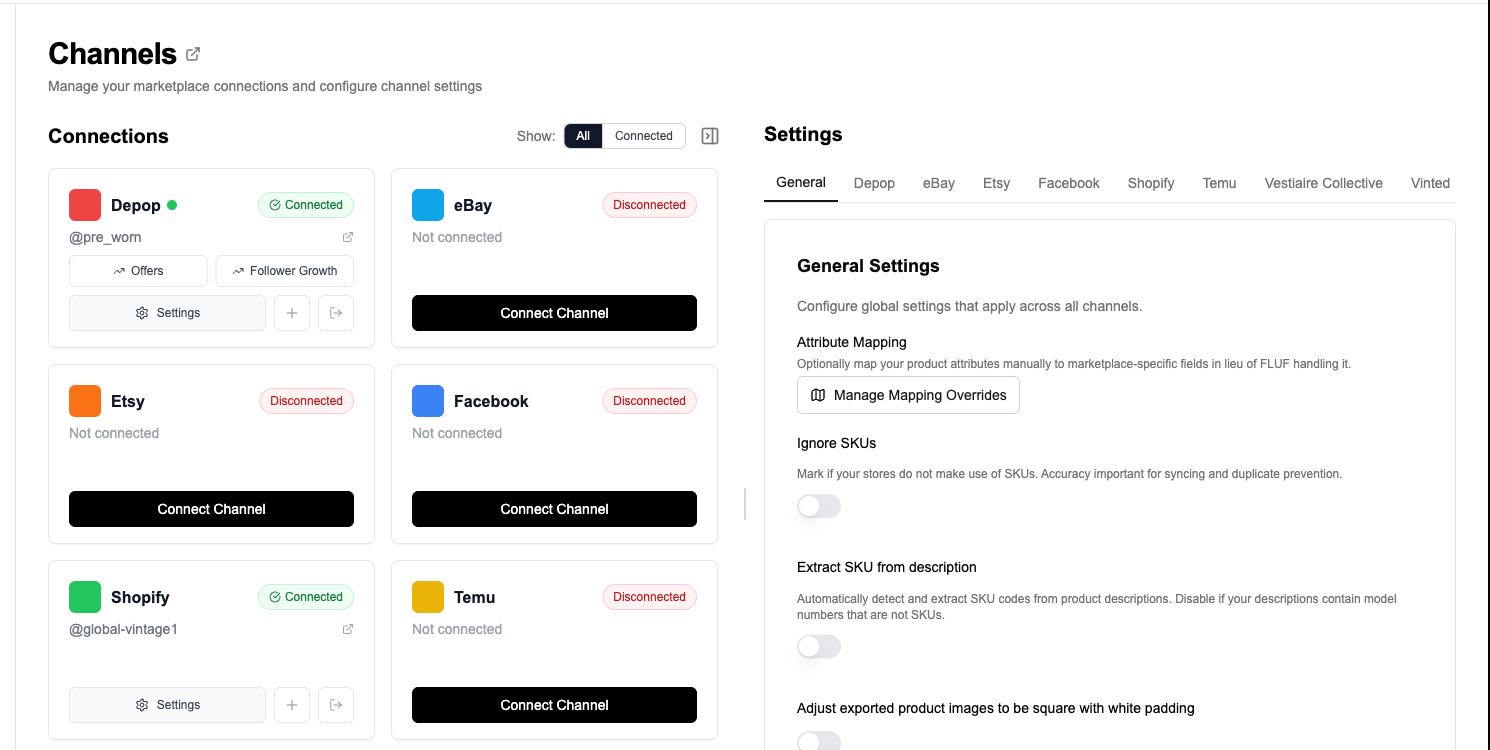
FLUF Connect supports both Whatnot and Yaga — along with Depop, eBay, Shopify, Etsy, Vinted, Facebook Marketplace, and more. You can crosslist products from any source channel to either platform, with automatic inventory sync that delists items when they sell elsewhere.
| FLUF Connect Feature | Whatnot | Yaga |
|---|---|---|
| Crosslisting | Yes | Yes |
| Inventory sync | Yes | Yes |
| Order sync | Yes | Yes |
| Auto-relisting | No | No |
| Offer management | No | Yes — auto-accept/counter buyer offers + auto-message likers |
| Bulk operations | Yes | Yes |
How it works: connect your Whatnot and Yaga accounts to FLUF Connect, select products to crosslist, and publish to both platforms. When an item sells on Whatnot, it’s automatically delisted from Yaga (and vice versa). No manual tracking, no overselling risk.
On the Yaga side, FLUF Connect goes further than crosslisting: it automates offer management in your Yaga inbox. Set your minimum acceptable price, and FLUF will auto-accept any buyer offer at or above your threshold and counter anything below it. Yaga doesn’t have a native “send offer to liker” feature — so FLUF sends a friendly custom chat message to anyone who likes your items instead, turning passive interest into real conversations. Both run in the background on a schedule you control.
FLUF Connect plans start from £9/month. See pricing.


Frequently Asked Questions: Whatnot vs Yaga
Is Whatnot or Yaga better for selling clothes?
For selling preloved fashion in South Africa, Yaga is the better choice — zero seller fees, a fashion-focused audience, and integrated local couriers. For selling fashion internationally through live auctions, Whatnot offers a more dynamic format with higher engagement. Whatnot’s fashion category is growing but still secondary to collectibles and trading cards.
Which has lower fees, Whatnot or Yaga?
Yaga charges sellers nothing — 0% commission, 0% processing fees. Sellers keep 100% of the sale price. Whatnot charges 8% commission plus 2.9% + $0.30 payment processing, totalling roughly 11–12% per sale. On a pure fee comparison, Yaga wins. However, Whatnot’s auction format can drive higher sale prices that offset the fees.
Can I sell on Whatnot and Yaga at the same time?
Yes. FLUF Connect supports both platforms, letting you crosslist products and sync inventory automatically. This is particularly useful if you sell across different markets — for example, live-selling collectibles to US/UK buyers on Whatnot while listing fashion to South African buyers on Yaga.
Which is easier for beginners, Whatnot or Yaga?
Yaga is significantly easier to start with. You can list and sell within minutes — no approval process, no equipment needed, no on-camera skills required. Whatnot requires a seller application, streaming equipment, and comfort with live video. Most successful Whatnot sellers invest 3–6 months before seeing consistent income.
Does Whatnot work in South Africa?
Currently, Whatnot is available for sellers in the US, Canada, UK, France, and Germany. South African sellers cannot sell on Whatnot. Buyers in South Africa may be able to purchase items, but cross-border shipping and customs apply. If you’re based in South Africa, Yaga is the relevant local alternative.
Can I crosslist between Whatnot and Yaga automatically?
Yes. FLUF Connect supports crosslisting to and from both Whatnot and Yaga. You can list products from either platform (or from Shopify, eBay, Depop, and others) to both, with inventory sync ensuring items are delisted when sold. Plans start from £9/month.
Which platform pays out faster, Whatnot or Yaga?
Whatnot is faster. With the Early Payout Program, earnings appear in your balance as soon as you generate a shipping label — potentially within hours of a sale. Standard payout is ~4 hours after delivery confirmation. Yaga uses escrow, releasing funds only after the buyer confirms receipt, which can take several days.
Is it worth selling on both Whatnot and Yaga?
If you have access to both markets, yes. The platforms serve completely different audiences in different countries with different product preferences. There’s zero buyer overlap, so listing on both means reaching entirely new customers. The key is having inventory suited to each platform — collectibles and trending items for Whatnot, preloved fashion for Yaga — and using a tool like FLUF Connect to manage inventory across both.
Related Guides
Frequently Asked Questions
For selling preloved fashion in South Africa, Yaga is the better choice — zero seller fees, a fashion-focused audience, and integrated local couriers. For selling fashion internationally through live auctions, Whatnot offers a more dynamic format with higher engagement.
Yaga charges sellers nothing — 0% commission, 0% processing fees. Whatnot charges 8% commission plus 2.9% + $0.30 payment processing, totalling roughly 11–12% per sale. On fees alone, Yaga wins, but Whatnot auction format can drive higher sale prices.
Yes. FLUF Connect supports both platforms, letting you crosslist products and sync inventory automatically between Whatnot, Yaga, and 8+ other marketplaces.
Yaga is significantly easier. You can list and sell within minutes with no approval process or equipment. Whatnot requires a seller application, streaming equipment, and live-selling skills.
Currently, Whatnot is available for sellers in the US, Canada, UK, France, and Germany. South African sellers cannot sell on Whatnot.
Yes. FLUF Connect supports crosslisting to and from both Whatnot and Yaga, with inventory sync ensuring items are delisted when sold. Plans start from £9/month.
Whatnot is faster. With the Early Payout Program, earnings appear as soon as you generate a shipping label. Yaga uses escrow, releasing funds only after the buyer confirms receipt.
If you have access to both markets, yes. The platforms serve completely different audiences in different countries — there is zero buyer overlap, so listing on both means reaching entirely new customers.