Crosslist from Shopify to Yaga — Automatically
Move your Shopify products to Yaga in minutes — photos, descriptions, prices, and categories map automatically. Inventory stays in sync. Free for 30 days.



- Shopify: 5.5M+ stores worldwide, your own branded online shop, full control over branding, customer data, and checkout
- Yaga: 1M+ active users in South Africa, zero seller fees, integrated shipping via 5 couriers, fashion-focused marketplace
- Fields that transfer automatically: title, description, up to 8 images, price (ZAR), brand, size, colour, condition, and category
- Inventory sync: When it sells on one platform, it’s removed from the other within minutes
- Time saved: ~5–8 minutes per item manually vs ~30 seconds with FLUF Connect
- Cost: Free for 30 days, then from £19/month — crosslist to Yaga and 8 other channels from one dashboard
Why Sell on Both Shopify and Yaga?
Crosslisting from Shopify to Yaga gives your products access to South Africa’s fastest-growing fashion resale marketplace — over 1 million active users and 12 million monthly visits — without leaving your Shopify dashboard. If you sell fashion, vintage, or second-hand clothing and want to reach South African buyers, Yaga is the marketplace to be on.
Shopify is your branded home base — full control over design, customer data, and checkout. But a Shopify store has no built-in traffic; every visitor must come from your own marketing. Yaga solves that problem for the South African market by putting your products in front of an engaged, fashion-focused audience that’s already browsing and buying.
Yaga charges sellers zero fees — buyers pay a protection fee of 6.5% + R19.90 instead. This means every Rand of your listed price goes directly to you. Combined with Shopify’s brand-building capabilities, the two platforms are genuinely complementary: Shopify for your global D2C brand, Yaga for South African marketplace exposure at zero cost.
| Shopify | Yaga | |
|---|---|---|
| Active users / stores | 5.5M+ stores worldwide | 1M+ active users in South Africa |
| Primary market | Global (175+ countries) | South Africa |
| Strongest categories | Any product type | Fashion, shoes, accessories, beauty |
| Seller fees | £19–259/month subscription + 2% + 25p processing | Zero — buyer pays 6.5% + R19.90 protection fee |
| Built-in traffic | None — seller drives all traffic | Yes — 12M monthly visits, browse and search |
| Shipping | Shopify Shipping (global carriers) | 5 integrated SA couriers (The Courier Guy, PAXI, Pargo, Aramex, PostNet) |
| Payments | Shopify Payments (instant/daily) | Escrow → Yaga Wallet → bank withdrawal |
For more detail on each platform, see our guides to selling on Shopify and selling on Yaga.
How to Crosslist from Shopify to Yaga with FLUF Connect
Crosslisting from Shopify to Yaga with FLUF Connect takes about 30 seconds per item — or minutes for hundreds of items in bulk. Here is the exact process.
1. Sign Up and Connect Shopify
Create a free FLUF Connect account at fluf.io/connect. Connect your Shopify store — FLUF imports your entire Shopify product catalogue automatically, including all photos, descriptions, prices, variants, and categories.
2. Connect Yaga
Install the FLUF Connect Chrome extension, visit Yaga, and click the extension icon. This securely links your Yaga account. Any existing Yaga listings are also imported into the dashboard.
3. Select Products to Crosslist
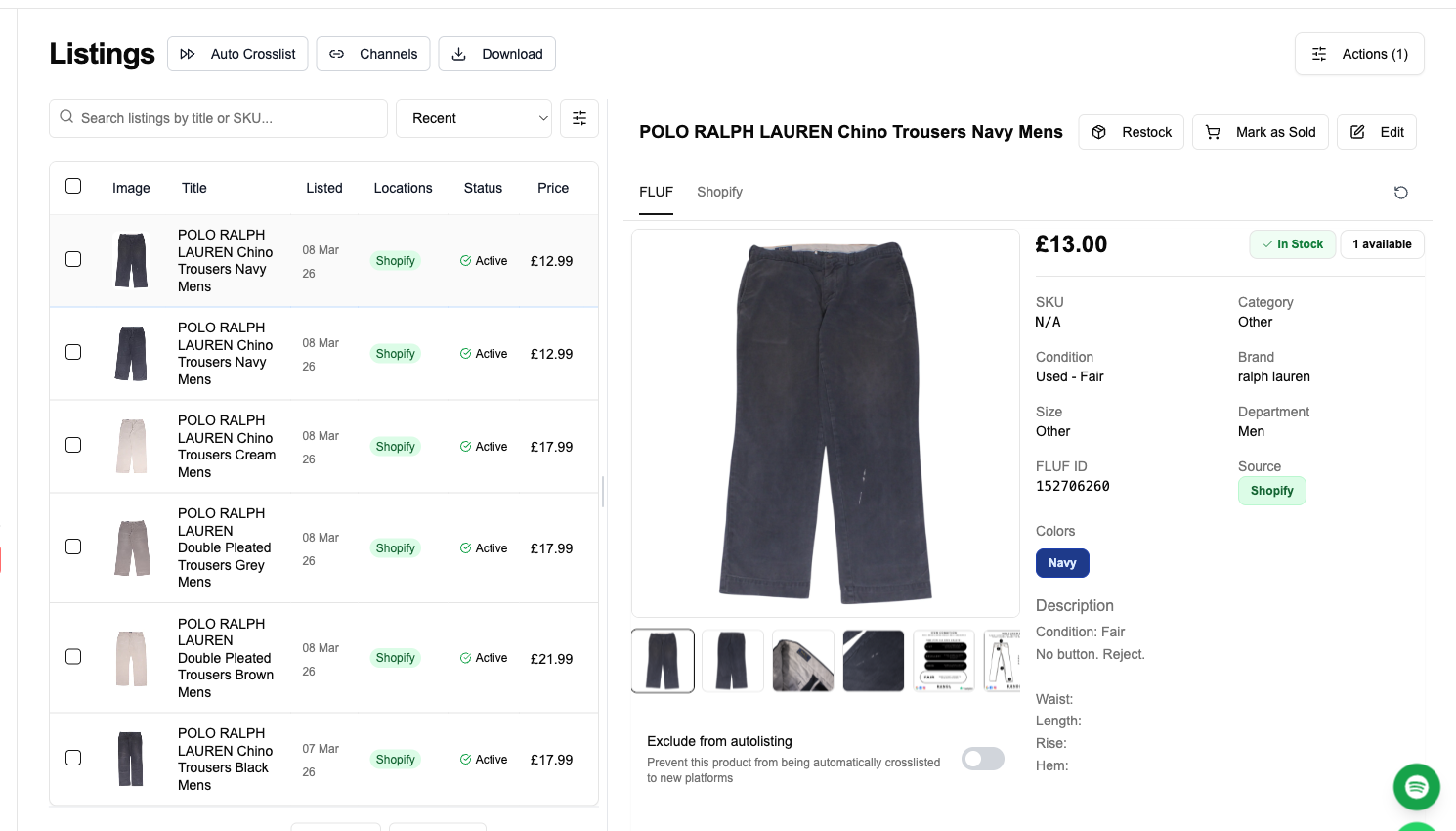
In the FLUF Connect dashboard, select the Shopify products you want to list on Yaga. You can select individually, use filters (by category, price range, brand, collection), or select all.
4. Review Field Mapping
FLUF shows you a preview of how each listing will appear on Yaga. Title, description, images, price, size, brand, colour, and condition are mapped automatically. You can adjust anything before publishing — for example, converting prices to ZAR or adjusting descriptions for the South African audience.
5. Crosslist
Click crosslist. FLUF uploads your images, maps your categories to Yaga’s taxonomy, and publishes the listings. Products typically appear on Yaga within a few minutes.
6. Inventory Syncs Automatically
From this point on, inventory stays in sync. When something sells on either platform, it’s removed from the other. No manual tracking, no spreadsheets, no overselling risk.
Auto-crosslisting: Set up rules so new Shopify products are automatically crosslisted to Yaga. Add a product to Shopify, and it appears on Yaga without any extra steps.
What Transfers When You Crosslist from Shopify to Yaga?
When you crosslist a Shopify product to Yaga, FLUF Connect maps every field to its Yaga equivalent. Some fields transfer directly. Others are intelligently converted between the two platforms’ different systems.
Field Mapping — Shopify to Yaga
| Shopify Field | Yaga Field | Transfer | Notes |
|---|---|---|---|
| Title | Title | ✅ Automatic | Transfers directly. Yaga titles should be descriptive — include brand, item type, and size. |
| Description (HTML) | Description | ✅ Automatic | HTML stripped to plain text for Yaga. Links and formatting removed. |
| Images | Images (up to 8) | ✅ Automatic | Shopify allows unlimited images. First 8 transfer to Yaga. Lead with your strongest photos. |
| Price | Price (ZAR) | ✅ Automatic | Currency converted to South African Rand if your Shopify store uses a different currency. Price rules can adjust automatically. |
| Product type / Category | Category | ⚡ Smart mapped | Shopify product types mapped to Yaga’s fashion-focused category taxonomy. |
| Tags | — | ❌ Not used | Yaga doesn’t use tags. Shopify tags are used internally by FLUF for filtering but don’t transfer. |
| Vendor (brand) | Brand | ✅ Automatic | Mapped to Yaga’s brand database. |
| Variants (size) | Size | ⚡ Smart mapped | Shopify variants are mapped to Yaga’s size system. Each variant may create a separate Yaga listing (one item per listing on Yaga). |
| — | Condition | ⚠️ Default set | Shopify doesn’t have a standard condition field. FLUF sets a default (e.g., “Good”) that you can override per listing or in bulk. |
| — | Colour | ⚡ Extracted | If colour is in your Shopify variant options or tags, FLUF maps it. Otherwise set manually or as a default. |
| Weight | — | ❌ Not used | Yaga handles shipping via integrated couriers and doesn’t use product weight. |
| SKU | — | ❌ Not used | Used internally by FLUF for inventory tracking but not visible on Yaga. |
Legend:
- ✅ Automatic — transfers directly, no action needed
- ⚡ Smart mapped — FLUF converts between the platforms’ different systems
- ⚠️ Default set — FLUF sets a sensible default you can override
- ❌ Not used — field doesn’t exist or isn’t relevant on the destination platform
Category Mapping Examples
| Shopify Product Type | Yaga Category | Notes |
|---|---|---|
| Women’s T-Shirt | Women > Tops > T-shirts | Direct equivalent |
| Men’s Sneakers | Men > Shoes > Sneakers | Size chart mapped to SA sizes |
| Women’s Dress | Women > Dresses | Subcategory (mini, midi, maxi) may need manual selection |
| Handbag | Women > Bags > Handbags | Direct equivalent |
| Earrings | Women > Accessories > Jewellery | Broader Yaga category |
Fields That Need Your Attention
- Condition: Shopify doesn’t have a built-in condition field. FLUF sets a default — review and adjust for second-hand items where condition matters.
- Currency: If your Shopify store uses GBP, USD, or EUR, prices are auto-converted to ZAR. Check that converted prices make sense for the South African market.
- Variants: Shopify allows multiple variants per product (size S, M, L). Yaga is one-item-per-listing. Each variant may become a separate Yaga listing — review before crosslisting.
- Image count: Shopify allows unlimited images, but Yaga accepts up to 8. Make sure your best photos are first in the image order.
- Category fit: Yaga is fashion-focused. Non-fashion Shopify products (electronics, homeware, digital goods) won’t fit Yaga’s categories.
Inventory Sync Between Shopify and Yaga — What Stays in Sync?
Inventory sync between Shopify and Yaga is automatic. When an item sells on either platform, FLUF Connect updates the other within minutes. This prevents overselling — the nightmare scenario when you sell the same item on both platforms.
| Event | What Happens | Timing |
|---|---|---|
| Item sells on Shopify | Automatically removed from Yaga (and any other connected channels) | Within minutes |
| Item sells on Yaga | Inventory updated on Shopify (and any other connected channels) | Within minutes |
| Item deleted on Shopify | Left active on Yaga (deletion ≠ sold) | — |
| Price changed on Shopify | Not automatically updated on Yaga | — |
| Description edited on Shopify | Not automatically updated on Yaga | — |
| New Shopify product added | Auto-crosslisted to Yaga (if auto-crosslisting rules are set) | Within minutes |
When an item sells on Shopify, FLUF Connect automatically removes it from Yaga (and every other connected channel) within minutes. When it sells on Yaga, Shopify inventory is updated. You never have to worry about selling the same item twice.
What does NOT sync: Price changes, title edits, and description updates made on one platform do not propagate to the other automatically. If you need to update both, use the FLUF Connect dashboard where changes can apply to all channels at once via bulk operations.
Crosslisting from Shopify to Yaga: Before and After FLUF Connect
Without FLUF Connect (Manual Crosslisting)
- Open Shopify admin, navigate to the product
- Download each product image
- Copy the title and description
- Open the Yaga app on your phone
- Create a new listing
- Upload images one by one (max 8)
- Paste title, adjust for Yaga’s audience
- Paste description, strip HTML formatting
- Select category from Yaga’s taxonomy
- Enter brand, size, colour, condition manually
- Convert and set price in ZAR
- Select shipping options
- Publish
- Record in spreadsheet which items are listed where
- When item sells: manually update the other platform
Time per item: ~5–8 minutes
With FLUF Connect
- Select products in FLUF Connect dashboard
- Click “Crosslist to Yaga”
- Review (fields are pre-mapped)
- Confirm
- Done — inventory syncs automatically
Time per item: ~30 seconds
Manual: ~8–13 hours. With FLUF Connect: ~50 minutes. That’s an entire working day back to source, photograph, and grow your business.
Automation Features for Shopify + Yaga Sellers
Shopify is FLUF Connect’s central hub — your product catalogue and order management system. Yaga gets crosslisting and inventory sync, letting you reach South African buyers without managing a separate inventory.
Auto-Crosslisting Rules
Set up rules to automatically crosslist new Shopify products to Yaga. When you add a product to Shopify, it can automatically appear on Yaga without you lifting a finger. Filter by collection, product type, price range, or tags to control what gets crosslisted.
Bulk Operations
Bulk operations let you crosslist hundreds of Shopify products to Yaga at once, adjust prices in bulk (including currency conversion rules), and manage your multi-channel inventory from one dashboard.
Centralised Order Management
When products sell on other marketplaces (Depop, eBay, Vinted), those orders flow into Shopify for unified fulfilment. Yaga orders are managed within Yaga’s own system (order sync is not available for Yaga), but inventory stays in sync across all channels.
| Feature | Shopify | Yaga |
|---|---|---|
| Crosslisting | ✅ (product catalogue source) | ✅ |
| Inventory sync | ✅ (native) | ✅ |
| Auto-relisting | N/A | ❌ Not supported |
| Offer management | N/A | ❌ Not supported |
| Order sync | ✅ (native — all orders centralised) | ❌ Not supported |
| Bulk operations | ✅ | ✅ |
Note: Yaga’s FLUF integration focuses on crosslisting and inventory sync — the two features that matter most for expanding into the South African market. For channels with full automation (relisting, offers, order sync), see our Shopify to Depop, Shopify to eBay, and Vinted integrations.
How Much Does It Cost to Crosslist from Shopify to Yaga?
| Plan | Price | Products | Includes |
|---|---|---|---|
| Free Trial | £0 for 30 days | Unlimited | All features — no credit card |
| Growth | £19/month | 500 | All automation features |
| Seller | £99/month | 5,000 | All automation features |
| Super Seller | £299/month | Unlimited | Priority sync |
All plans include crosslisting between ALL supported channels — not just Shopify and Yaga. Connect Depop, eBay, Vinted, Facebook Marketplace, and more from the same dashboard at no extra cost. See full pricing details.
Frequently Asked Questions
Yes. FLUF Connect lets you crosslist your entire Shopify catalogue to Yaga in minutes. Select your Shopify products, click crosslist, and FLUF maps titles, descriptions, images, prices, brands, and categories automatically. Inventory syncs in real time — when an item sells on either platform, it is updated on the other.
Title, description, up to 8 images, price (auto-converted to ZAR), brand, size, colour, and category all transfer automatically. Condition needs to be set manually or as a default since Shopify does not have a built-in condition field. Shopify variants may create separate Yaga listings since Yaga uses one item per listing.
No. Yaga charges zero seller fees. Buyers pay a protection fee of 6.5% + R19.90 on each purchase. As a seller, you keep 100% of the listed price. This makes Yaga one of the most cost-effective marketplaces for fashion sellers targeting South Africa.
Yes. When an item sells on Shopify, FLUF Connect automatically removes it from Yaga (and any other connected channels) within minutes. When it sells on Yaga, Shopify inventory is updated. This prevents overselling without any manual tracking.
Yaga is primarily a South African marketplace. You can list items on Yaga from anywhere using FLUF Connect, but shipping is handled through Yagau0027s integrated South African couriers (The Courier Guy, PAXI, Pargo, Aramex, PostNet). You would need a South African shipping address or fulfilment partner.
FLUF Connect offers a free 30-day trial with full access, no credit card required. After the trial, plans start at £19 per month for up to 500 products. All plans include crosslisting to ALL supported channels — not just Yaga.
No. Auto-relisting and offer management are not currently supported on Yaga. FLUF Connect supports crosslisting and inventory sync for Yaga. For channels with full automation, see the Depop, eBay, and Vinted integrations.
If your Shopify store uses a currency other than South African Rand (ZAR), FLUF Connect automatically converts prices. You can also set price rules to adjust Yaga prices — for example, pricing 10% lower for the South African market or adding a markup to cover any conversion costs.
Yaga is a fashion-focused marketplace. Womenu0027s clothing (especially branded basics from Zara, H&M, Cotton On), shoes, handbags, and accessories perform best. Designer and premium brands command higher prices. Non-fashion items like electronics or homeware do not fit Yagau0027s categories.
Yes — crosslisting works in both directions. You can import your Yaga listings into FLUF Connect and crosslist them to Shopify (and any other connected channel). Inventory syncs automatically regardless of direction.
Start Crosslisting for Free Today
500 free crosslistings. No credit card. Set up in under 10 minutes.