
Whatnot vs Depop: Which Is Better for Sellers in 2026?
A side-by-side comparison of fees, audience, selling format, and what real sellers think — plus how to sell on both with synced inventory.



- Choose Whatnot if: you sell collectibles (sports cards, TCG, Funko, comics), sneakers, or vintage fashion in volume and want to move inventory fast through live-stream auctions with a loyal community audience.
- Choose Depop if: you sell curated fashion, Y2K vintage, or streetwear to Gen Z buyers and prefer static listings with strong visual branding — no camera required.
- Fees: Depop charges zero seller commission (just 2.9% + £0.30 processing — you keep £28.83 on a £30 sale). Whatnot charges ~12% all-in (you keep £26.33). Depop is cheaper unless you use Boosted Listings (12% on top).
- Audience: Depop has 7 million active buyers, ~90% under 34. Whatnot had 20M+ new accounts in 2025, with buyers spending 95 min/day in the app.
- Format: Whatnot is live-first — sellers go on camera. Depop is static-first — sellers curate photos and listings.
- Best strategy: Use both — fashion on Depop for full-price static sales, volume inventory on Whatnot for live-show speed. Cross-list with FLUF Connect and inventory sync handles the rest.
Whatnot vs Depop at a Glance
Whatnot and Depop are both popular with younger resellers, but they operate on completely different models. Whatnot is a live-stream commerce platform where sellers run video auctions and Buy It Now sales on camera. Depop is a social, mobile-first marketplace where sellers create static listings with curated photography and buyers browse a visual feed. If Whatnot is a live auction house, Depop is a carefully styled vintage shop window.
Depop launched in 2011 in London as a peer-to-peer fashion marketplace and quickly became the go-to platform for Gen Z vintage and streetwear sellers. Etsy acquired it in 2021 for $1.625 billion; in February 2026, eBay announced a $1.2 billion deal to acquire Depop from Etsy, expected to close mid-2026. Depop has approximately 7 million active buyers, 3.2 million active sellers, and roughly $1 billion in annual GMS. Whatnot launched in 2019, pivoted to live commerce in 2020, and has since grown to $8 billion+ in GMV with a $11.5 billion valuation — an entirely different trajectory fuelled by live-stream collectibles and fashion.
| Whatnot | Depop | |
|---|---|---|
| Founded | 2019 (live commerce from 2020) | 2011 |
| Headquarters | Marina del Rey, California; London | London (owned by Etsy; eBay acquisition pending) |
| Active buyers | 20M+ new accounts in 2025 (MAU undisclosed) | 7 million active buyers (end 2025) |
| Active sellers | Not disclosed (1 in 8 are full-time) | 3.2 million (+41% YoY) |
| GMV / GMS | $8 billion+ (2025, doubled YoY) | ~$1 billion (2025) |
| Countries | 9 (US, UK, CA, DE, FR, NL, BE, AT, AU) | Worldwide (strongest US, UK, AU) |
| Best for | Sports cards, TCG, sneakers, vintage fashion, Funko, comics, jewellery | Y2K vintage, streetwear, designer fashion, one-of-a-kind pieces |
| Selling format | Live video auctions + Buy It Now | Static listings with curated photos |
| UK seller fees | ~12% on a £30 sale | ~3.9% (processing only; 0% commission) |
| Buyer fees | Shipping (set by Whatnot) | Up to 5% + £1 marketplace fee + shipping |
| Primary demographic | 18–35, collectible and fashion enthusiasts | ~90% under 34, fashion-focused Gen Z |
For deeper dives into each platform individually, read our complete guides: How to Sell on Whatnot and How to Sell on Depop.
Whatnot vs Depop: Feature-by-Feature Comparison
Whatnot and Depop have surprisingly little feature overlap. Whatnot is built around live video with community tools (chat, giveaways, follows). Depop is built around a social photo feed with engagement tools (likes, comments, offers). The feature you care about most will probably decide which platform suits you better.
| Feature | Whatnot | Depop |
|---|---|---|
| Live-stream selling | Core format — live video auctions and BIN | Not supported |
| Static listings | Marketplace BIN (off-stream) — limited discovery | Core format — photo-based feed and search |
| Auction format | Live real-time bidding with auto-extend timer | Not supported |
| Buy It Now | Yes (in-stream and Marketplace) | Yes (all listings are fixed-price) |
| Offer / haggle system | No formal offer system | Yes — buyers can make offers on any listing |
| Social features | Follows, live chat, giveaways, tipping | Likes, comments, follows, social feed, activity notifications |
| Seller analytics | Basic (show performance, sales history) | Basic (views, likes, revenue) |
| Promoted / boosted listings | Promote, Boost, Bumps (optional, US/UK/CA) | Boosted Listings (12% fee UK, 8% US/AU) |
| Integrated shipping labels | Yes — free to seller (Royal Mail/DPD in UK) | Yes — Depop Shipping via Evri (buyer pays) |
| Buyer protection | Whatnot Buyer Protection (INAD, counterfeit, damaged) | Depop Protection (INAD, not received, counterfeit) |
| Seller verification / KYC | Application + ID + product video required | ID verification for payouts; no product video |
| International selling | Cross-border within 9 supported countries | Worldwide (seller arranges international shipping) |
| Video in listings | Core — the live show IS the listing | Supported — videos increase sales chance by ~40% |
| Mobile app | Mobile-first (iOS + Android) | Mobile-first (iOS + Android) |
The standout contrast: Whatnot is built for speed and entertainment — sellers run 30-second auctions back-to-back with live commentary. Depop is built for curation and aesthetic — sellers invest in photography, build a visual brand, and let buyers browse at their own pace. One requires a camera personality; the other requires an editorial eye.
Listing Experience: Live Shows vs Curated Feeds
The daily experience of selling on Whatnot and Depop is almost unrecognisable as the same activity. On Depop, selling is asynchronous — you photograph items, write descriptions, post them, and check back later for sales, offers, and messages. On Whatnot, selling is synchronous — you schedule a live show, go on camera, and run auctions in real time while interacting with a live audience. The comparison is not “which listing flow is faster” but “which selling model matches your strengths.”
Depop: curate, photograph, post
You take styled photos (modelled shots and mirror selfies outperform flat lays on Depop), write a description with relevant keywords, set a price, and publish. The listing enters Depop’s search index and visual feed. Buyers discover it through search, the Explore page, or your follower feed. The entire process takes 5–10 minutes per item, and the listing works passively from there. Freshly listed items get a slight algorithm boost, so many sellers relist items periodically — a task FLUF Connect’s auto-relisting can handle automatically.
Whatnot: schedule, go live, perform
You create listing cards for each item (title, photo, starting price), schedule a show about a week in advance, and go live at the scheduled time. During the show, you present items one by one on camera, running timed auctions that typically resolve in 30–60 seconds. The selling itself is fast — per-item time is lower than Depop — but the show commitment is significant: a typical two-hour show plus prep and packing adds up to 3–4 hours of focused work per session.
Which is easier for beginners?
Depop is dramatically easier to start. Download the app, list an item, sell it — no application, no video, no camera work. You can sell your first item within 15 minutes. Whatnot requires an application (including a product video), identity verification, and comfort speaking on camera to a live audience. If you have never sold online before, Depop is the simpler first step. If you are already comfortable on camera from TikTok, Instagram Live, or in-person markets, Whatnot’s format will feel natural.
Listing aesthetics
On Depop, visual branding matters. The platform’s feed is photo-driven and Instagram-inspired — sellers who invest in consistent lighting, backgrounds, and styling build followings faster. On Whatnot, the aesthetic standard is lower because the live video is the primary surface. What matters on Whatnot is your on-camera energy, pacing, and the quality of your inventory, not whether your background matches your brand colour palette.
Fees Compared: How Much Do Whatnot and Depop Actually Cost?
Depop’s fee structure changed dramatically in 2024 when the platform removed its 10% seller commission in the UK (March 2024) and US (July 2024), shifting the cost to buyers via a marketplace fee. For UK sellers, Depop is now one of the cheapest major marketplaces to sell on — unless you use Boosted Listings, which add a 12% fee that pushes your total cost above Whatnot’s.
| Fee Type | Whatnot (UK) | Depop (UK) |
|---|---|---|
| Listing fee | £0 (unlimited) | £0 (unlimited) |
| Seller commission | 6.67% + VAT (~8%) on item price | 0% (removed March 2024) |
| Payment processing | 2.42% + VAT on total order + £0.25 + VAT per order | 2.9% + £0.30 per transaction |
| Boosted listings | Optional (Promote/Boost/Bumps — variable budget) | Optional — 12% of item price + shipping (UK, since Dec 2025; 8% US/AU) |
| Buyer marketplace fee | None (buyer pays shipping only) | Up to 5% + £1 (funds Depop Protection) |
| Monthly subscription | £0 | £0 |
| International fee | None (within 9 countries) | 1.29% EU cross-border fee |
What You Keep on a £30 Sale
- Depop (organic sale): Processing 2.9% × £30 + £0.30 = £1.17. Total fees: £1.17. You keep: £28.83.
- Depop (boosted sale): Processing £1.17 + Boost fee 12% × £30 = £3.60. Total fees: £4.77. You keep: £25.23.
- Whatnot: Commission 6.67% × £30 + VAT = £2.40. Processing 2.42% × £33.50 + £0.25 + VAT = £1.27. Total fees: £3.67. You keep: £26.33.
Depop is the cheaper platform for organic sales — you keep £2.50 more per £30 item than on Whatnot. But if you rely on Boosted Listings for visibility, Depop becomes £1.10 more expensive than Whatnot per sale. The fee comparison swings entirely on whether you need paid promotion.
The Boost Fee Trap
Depop increased its UK Boosted Listings fee from 8% to 12% in December 2025. For sellers who depend on boosts for visibility (particularly in saturated categories like streetwear and Y2K), this effectively reinstates a seller fee — and a higher one than the old 10% commission. On Whatnot, paid promotion is genuinely optional because the live format itself is the discovery mechanism. If you are a strong presenter with good inventory, organic Whatnot reach is often enough.
Payouts
| Whatnot | Depop | |
|---|---|---|
| Payout method | Bank transfer (GBP for UK) | Bank transfer via Depop Payments (Stripe) |
| Payout timing | After delivery confirmed + 48hr hold (US) / +96hr (UK) | 2–3 working days after delivery confirmed; or 10 working days after sale if no tracking |
| New seller holds | 48–96 hour post-delivery hold | Up to 10 working days on first sales |
| Bank transfer time | 1–2 days to send + 2–5 days to land | 2–3 business days after release |
| PayPal option | No | No (legacy PayPal sellers migrated to Depop Payments) |
Audience and Demand: Who Is Buying on Whatnot vs Depop?
Depop’s audience is one of the youngest and most fashion-focused in resale. Whatnot’s audience is community-driven and category-obsessed. The overlap is real — both platforms attract buyers interested in streetwear, vintage, and sneakers — but the buying behaviour is fundamentally different.
| Whatnot | Depop | |
|---|---|---|
| Buyer base | 20M+ new accounts in 2025 | 7 million active buyers |
| Primary age group | 18–35 (collectible and fashion community) | ~90% under 34 (Gen Z core) |
| Gender split | Not disclosed (category-dependent) | ~63% female, ~37% male (male growing fastest at +18% YoY) |
| Top markets | US, UK, Germany, France | US (largest by GMV), UK, Australia |
| Best-selling categories | Sports cards, TCG, sneakers, vintage fashion, Funko, beauty, electronics | Y2K vintage, streetwear, designer fashion, one-of-a-kind pieces |
| Buyer behaviour | Entertainment-driven — 95 min/day, watching shows, impulse bidding | Browse-driven — scrolling visual feed, searching for specific styles |
| Repeat buyer rate | Very high (>80% month-on-month for active audiences) | Moderate — driven by style preferences and seller follows |
| Top brands | Category-dependent (Panini, Topps, Nike, Pokémon) | Nike, Adidas, Supreme, Carhartt, Levi’s, The North Face |
Where the Categories Overlap
Streetwear and sneakers are the biggest crossover. Both platforms attract buyers interested in Nike, Supreme, Jordan, and vintage sportswear. The difference is pricing dynamics: Depop supports full-price static sales where the buyer pays whatever you list. Whatnot’s auction format starts low and lets the market decide — which can mean a $50 streetwear piece sells for $60 in a heated bidding war, or for $8 on a quiet night. Sellers who tested Depop-level pricing on Whatnot static listings report needing to drop prices 10–18% before items moved.
Y2K and vintage fashion is Depop’s strongest category and one of Whatnot’s fastest-growing. Depop essentially defined the Y2K resale trend for Gen Z buyers; Whatnot’s women’s fashion category posted +223% YoY growth in 2025 with 12 million+ orders per month. For vintage, Depop rewards curation and styling (a well-photographed 90s blazer sells itself). Whatnot rewards volume and energy (a live haul of 50 vintage pieces moves in an hour).
Collectibles are where the platforms diverge completely. Sports cards, TCG, Funko, and comics are Whatnot’s core — its reason for existing. Depop has minimal presence in these categories and its audience is not looking for them. If you sell collectibles, Whatnot is the clear choice; Depop is not a substitute.
Growth Trajectory
Whatnot doubled GMV from ~$4 billion (2024) to $8 billion+ (2025) and is expanding aggressively across Europe. Depop’s GMS is roughly $1 billion with ~60% YoY US growth and active buyer growth of 38%. Whatnot is growing faster in absolute terms, but Depop’s growth is accelerating under new momentum — and the pending eBay acquisition (expected Q2 2026) could significantly boost Depop’s resources, international reach, and seller tools.
Shipping: Whatnot vs Depop
Both platforms provide integrated shipping in the UK, but through different carriers with different flexibility levels.
| Whatnot | Depop | |
|---|---|---|
| UK domestic carrier | Royal Mail (Whatnot-provided label only) | Evri (Depop Shipping) or seller’s choice (Royal Mail, DPD, etc.) |
| International from UK | DPD (Whatnot-provided label) | Seller arranges own shipping (no pre-paid international labels) |
| Who pays shipping | Buyer (at checkout, Whatnot sets rate) | Buyer (Depop Shipping) or configurable (free shipping option) |
| Label cost to seller | Free — Whatnot provides the label | Free — Depop provides Evri QR code or printable label |
| Own label allowed | No — third-party labels void buyer protection | Yes — any tracked courier accepted |
| UK domestic shipping cost (buyer) | Weight-based (set by Whatnot) | £2.99 (under 1kg), £4.49 (under 2kg), £6.49 (under 5kg) |
| Tracking requirement | Automatic (Whatnot-issued labels pre-tracked) | Required for Depop Protection coverage; Depop Shipping includes tracking |
| Return shipping | Buyer ships return; refund on receipt or 48hrs after delivery | Depop may reimburse up to £20 for SNAD returns |
Depop offers more flexibility — you can use Evri via Depop Shipping or arrange your own carrier, and you can offer free shipping by building the cost into your item price (a tactic that improves conversion rates). Whatnot is more prescriptive — you must use the Whatnot-provided Royal Mail label, no exceptions. For sellers with negotiated carrier rates or a fulfilment partner, Depop’s flexibility is the better fit. For sellers who want zero shipping decisions, Whatnot’s simplicity wins.
Depop’s international shipping is notably weaker than Whatnot’s — sellers must arrange and pay for their own international labels, handle customs declarations manually, and Depop Protection is limited for international shipments. Whatnot handles cross-border shipping between its 9 supported countries via its own DPD labels with customs included.
What Real Sellers Are Saying About Whatnot vs Depop
Whatnot and Depop attract different seller personalities, and the community discussions reflect that. Depop sellers tend to value aesthetic control and passive income. Whatnot sellers tend to value speed and community engagement. The sellers who use both have the most interesting perspective.
“Clean photos, stylised shots, curated vibes, and cohesive branding help sellers stand out on Depop. Modelled shots and mirror selfies perform significantly better than flat lays.”
— Seller guides, multiple sources
“Whatnot is part auction house, part entertainment, part hangout. You cannot automate being live, or answering questions on the spot.”
— MyListerHub seller analysis, 2026
“One UK seller cleared out winter bundle stock on Whatnot in one night with higher margins than eBay — but that only works if you are willing to run the show.”
— Reseller community discussion
“A seller pushed 11 high-end streetwear pieces at Depop-level pricing on Whatnot. After dropping prices 10–18%, six pieces sold within days. Whatnot buyers expect auction deals; Depop buyers accept full price.”
— CLOSO seller guide, 2025
“If you take a week off Whatnot, sales drop to zero. On Depop, listings keep working while you sleep.”
— Reseller community observation
The recurring theme: Depop rewards patience and curation; Whatnot rewards energy and volume. Sellers who treat both as complementary — listing curated pieces on Depop for full-price static sales while running high-volume live shows on Whatnot — capture the best of both worlds.
How to Choose Between Whatnot and Depop
The right platform depends on what you sell, how you like to sell, and whether you are willing to go on camera. Neither is universally better — they reward completely different skill sets.
- Sell collectibles (sports cards, TCG, Funko, comics) — Depop has no audience for these
- Are comfortable on camera and enjoy live interaction with an audience
- Want to move large volumes fast (100–300+ items per show)
- Sell high-value items where Whatnot’s commission cap saves hundreds per sale
- Thrive on community — building a loyal following of repeat buyers
- Sell curated Y2K vintage, streetwear, or designer fashion to Gen Z buyers
- Prefer passive sales — list once, sell while you sleep, no camera required
- Have strong visual branding and photography skills
- Want the lowest possible seller fees (0% commission, just processing)
- Sell internationally (Depop is available worldwide; Whatnot is limited to 9 countries)
By Seller Type
| Seller Profile | Recommendation |
|---|---|
| Casual seller — clearing out a wardrobe | Depop. Zero fees, no application, no camera. List and sell in 15 minutes. |
| Streetwear / sneaker reseller | Both. Depop for curated static listings at full price. Whatnot for live auctions that move volume and build a community. |
| Vintage / Y2K seller | Both. Depop for the aesthetic-driven Gen Z audience. Whatnot for live haul shows that clear bulk inventory fast. |
| Sports card / TCG dealer | Whatnot primarily. Depop has no meaningful audience for collectibles. |
| Full-time multi-channel reseller | Both, plus eBay and Vinted. Use FLUF Connect to sync everything. |
For most fashion resellers, the smartest answer is not “Whatnot or Depop” but “Whatnot and Depop” — because each fills a gap the other cannot. Depop captures the patient, full-price buyer who browses at 11pm. Whatnot captures the impulse bidder who tunes in for the show. Together, they cover both ends of your inventory lifecycle.
Why Not Both? Sell on Whatnot and Depop at the Same Time
The biggest risk of running both platforms simultaneously is the same as any multi-channel strategy: overselling. You list a vintage Nike jacket on Depop, go live on Whatnot, auction the same jacket on stream, and it sells — but the Depop listing is still active. A Depop buyer purchases it while you are on camera and cannot check your phone. Now you have two sales and one jacket.
FLUF Connect solves this by syncing your inventory across Whatnot, Depop, eBay, Vinted, Shopify, Etsy, and Facebook Marketplace. When an item sells on Whatnot during a live show, FLUF Connect automatically delists it from Depop and every other connected channel. When an item sells on Depop overnight, it disappears from your Whatnot Marketplace listings before your next show.
How It Works
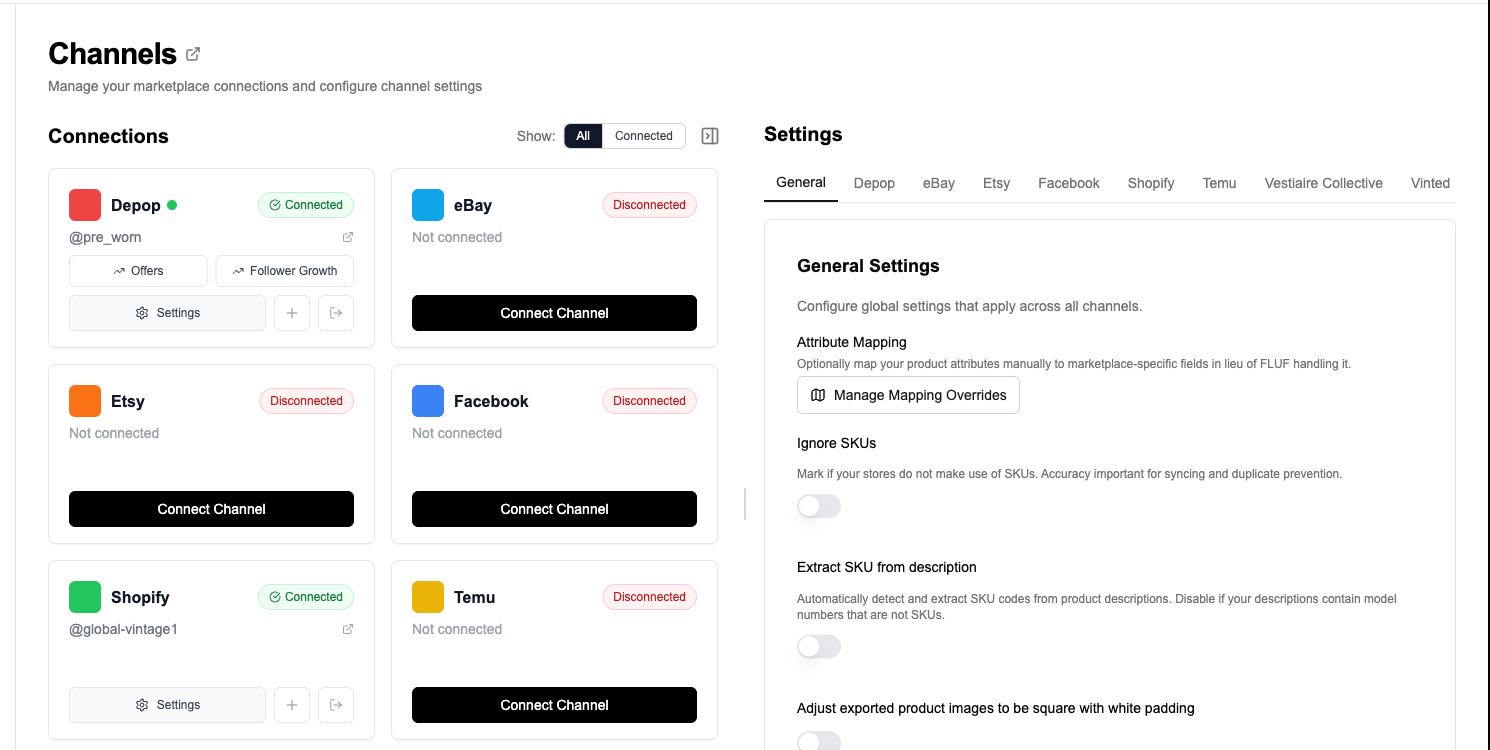
- Connect: link your Whatnot and Depop accounts to FLUF Connect (takes minutes)
- Crosslist: push your inventory to both platforms — FLUF handles title, description, image, and category mapping
- Sync: when a sale happens on any channel, inventory updates everywhere else automatically
FLUF Connect Features for Whatnot and Depop Sellers
| FLUF Connect Feature | Whatnot | Depop |
|---|---|---|
| Crosslisting | Yes — to/from all connected channels | Yes — to/from all connected channels |
| Inventory sync | Yes — real-time delist on sale | Yes — real-time delist on sale |
| Auto-relisting | Yes | Yes — keeps listings fresh in Depop’s algorithm |
| Offer management | N/A (no offer system) | Yes |
| Order sync | Yes | Yes |
| Bulk operations | Yes | Yes |
Auto-relisting is particularly valuable for Depop sellers because Depop’s algorithm favours freshly listed items. FLUF Connect can automatically relist your Depop inventory on a schedule, keeping your listings visible without the manual busywork of deleting and re-uploading.
To get started, create a free FLUF Connect account and connect your Whatnot and Depop accounts. You get unlimited listings on the £9/month Starter plan — see the FLUF Connect pricing page for plans beyond that.
Sell on Whatnot and Depop without the overselling risk. FLUF Connect syncs your inventory in real time — a Whatnot live-show sale instantly delists from Depop, and vice versa.
Frequently Asked Questions: Whatnot vs Depop
Is Whatnot or Depop better for selling vintage clothing?
Both are strong but in different ways. Depop is the established home of Y2K and vintage fashion with a young, style-conscious audience that supports full-price sales. Whatnot’s vintage fashion category grew +223% in 2025 and excels at moving volume through live haul shows. For curated individual pieces, Depop is stronger. For clearing bulk vintage inventory fast, Whatnot wins.
Which has lower fees, Whatnot or Depop?
Depop is cheaper on organic sales — zero commission, just 2.9% + £0.30 processing (you keep £28.83 on a £30 sale). Whatnot takes ~12% all-in (you keep £26.33). However, if you use Depop’s Boosted Listings (12% fee), Depop becomes more expensive than Whatnot per sale.
Can I sell on Whatnot and Depop at the same time?
Yes. FLUF Connect syncs inventory across both platforms in real time. When an item sells on one, it automatically delists from the other — essential during live Whatnot shows when you cannot manually check Depop.
Do I have to go on camera to sell on Whatnot?
Whatnot supports off-stream Marketplace listings, but the live show format is the dominant driver of sales. Depop requires no camera work — listings are entirely photo-based. If camera work is a dealbreaker, Depop is the better fit.
Which is easier for beginners?
Depop. No application process, no video, no camera. You can list and sell your first item in 15 minutes with zero fees. Whatnot requires a seller application, ID verification, and willingness to present live.
Can I sell sports cards and collectibles on Depop?
Technically yes, but Depop’s audience is fashion-focused and there is minimal demand for collectibles. Whatnot is purpose-built for sports cards, TCG, Funko, and comics — it is the clear choice for these categories.
Does Whatnot or Depop have more buyers?
Whatnot reported 20 million new accounts in 2025 across 9 countries. Depop has 7 million active buyers worldwide. Whatnot’s buyers are more engaged (95 min/day in-app vs Depop’s browse-driven sessions), but Depop is available in more countries.
Which platform pays out faster?
Similar timing. Both release funds after delivery confirmation, with holds for new sellers. Depop pays 2–3 working days after tracking shows delivered (or 10 working days if no tracking). Whatnot adds a 48-hour hold (US) or 96-hour hold (UK/EU) after delivery. In practice, the difference is a day or two.
Whatnot vs Depop for selling sneakers?
Both work well. Depop supports static sneaker listings with curated photos — buyers search for specific models. Whatnot’s live auction format creates bidding wars for hyped releases that can push prices above market. Most sneaker resellers benefit from selling on both.
Is it worth selling on both Whatnot and Depop?
Yes, especially for fashion and streetwear sellers. Depop captures the patient, style-conscious buyer browsing at midnight. Whatnot captures the impulse bidder who tunes in for the live show. Together with FLUF Connect syncing inventory, they cover both ends of your sales funnel.
Want to learn more? Read our complete guides to selling on Whatnot and selling on Depop, or compare other marketplace combinations like Whatnot vs eBay, Depop vs Vinted, and Etsy vs Shopify. New to crosslisting? See our guide to selling on multiple platforms.
Related guides
Frequently Asked Questions
Both are strong but different. Depop is the established home of Y2K and vintage fashion with a young, style-conscious audience that supports full-price sales. Whatnot vintage fashion grew 223% in 2025 and excels at moving volume through live haul shows. For curated individual pieces, Depop. For clearing bulk vintage fast, Whatnot.
Depop is cheaper on organic sales - zero commission, just 2.9% plus 30p processing. You keep 28.83 on a 30 pound sale. Whatnot takes roughly 12% all-in so you keep 26.33. However, Depop Boosted Listings at 12% make Depop more expensive than Whatnot per sale.
Yes. FLUF Connect syncs inventory across both platforms in real time. When an item sells on one, it automatically delists from the other - essential during live Whatnot shows when you cannot manually check Depop.
Whatnot supports off-stream Marketplace listings, but the live show format is the dominant driver of sales. Depop requires no camera work - listings are entirely photo-based. If camera work is a dealbreaker, Depop is the better fit.
Depop. No application process, no video, no camera. You can list and sell your first item in 15 minutes with zero seller fees. Whatnot requires an application, ID verification, and willingness to present live.
Technically yes, but Depop's audience is fashion-focused with minimal demand for collectibles. Whatnot is purpose-built for sports cards, TCG, Funko, and comics. For collectibles, Whatnot is the clear choice.
Whatnot reported 20 million new accounts in 2025 across 9 countries. Depop has 7 million active buyers worldwide. Whatnot buyers are more engaged at 95 minutes per day in the app, but Depop is available in more countries.
Similar timing. Both release funds after delivery confirmation with holds for new sellers. Depop pays 2-3 working days after delivery confirmed. Whatnot adds a 48-hour hold for US or 96-hour for UK sellers. The difference is a day or two in practice.
Both work well. Depop supports static sneaker listings with curated photos where buyers search for specific models. Whatnot live auctions create bidding wars for hyped releases. Most sneaker resellers benefit from selling on both with FLUF Connect for inventory sync.
Yes, especially for fashion and streetwear sellers. Depop captures the patient buyer browsing at midnight. Whatnot captures the impulse bidder during a live show. Together with FLUF Connect syncing inventory, they cover both ends of your sales funnel.