
Crosslist from Vinted to Whatnot — Automatically
Move your Vinted listings to Whatnot in minutes. Titles, photos, pricing, and mapped attributes carry across automatically, and inventory stays in sync after every sale.



- Best fit: Vinted to Whatnot works especially well for vintage fashion, sneakers, jewellery, accessories, and collectible-adjacent stock that can sell in live shows as well as static marketplace listings.
- What transfers automatically: FLUF Connect carries over the core Vinted listing data including title, description, images, price, brand, size, colour, condition, and category mapping where the Whatnot destination category supports it.
- Whatnot-specific review points: the main checks before publishing are destination category fit, condition wording, category-specific attributes, and shipping profile selection.
- Inventory sync: when an item sells on Vinted or Whatnot, FLUF Connect removes it from your other connected channels within minutes to help prevent overselling.
- Automation split: Vinted supports relisting and offer automation inside FLUF Connect; Whatnot supports crosslisting, inventory sync, and order sync, but not FLUF relisting or offer automation.
- Pricing: plans start at GBP 19/month, and the same account also covers your other supported marketplaces.
Why Crosslist from Vinted to Whatnot?
Crosslisting from Vinted to Whatnot gives the same item access to two very different buying behaviours. Vinted is strongest when buyers want easy, price-conscious, search-led secondhand shopping. Whatnot is strongest when buyers respond to urgency, community, and the energy of live selling or fast marketplace discovery. Running both means you are not relying on one type of buyer to clear every product.
This pairing is especially useful when your Vinted stock is more curated than average. Vintage jackets, sneakers, branded accessories, jewellery, bundles, and fashion pieces with a bit of personality can sit quietly on Vinted but move faster once they are visible in Whatnot’s ecosystem. Whatnot is not just about auctions on camera. It also supports marketplace Buy It Now listings, which gives resellers a practical destination for inventory that starts life on a more traditional secondhand platform.
The operational problem starts the moment you try to do both manually. You end up copying titles, re-uploading photos, reselecting categories, rebuilding attributes, and then trying to remember whether a sold Vinted item is still live somewhere else. FLUF Connect solves that by putting both channels in one workflow and using inventory sync to remove sold items from the rest of your connected stack within minutes.
| Vinted | Whatnot | |
|---|---|---|
| Core selling style | Search-led secondhand marketplace | Live-commerce platform plus marketplace Buy It Now listings |
| Seller fee model | No standard seller fee; buyer protection is paid by the buyer | Commission and payment processing fees apply |
| Best fit | Everyday fashion, value-led resale, easy browsing | Community-driven demand, live momentum, collectibles and fashion crossover |
| Discovery style | Search, browse, filters, saved interests | Live video, followers, category browsing, marketplace discovery |
| Why use both | Low-friction listing and broad secondhand demand | A second route to sale for inventory that benefits from urgency and stronger presentation |
Move your Vinted inventory into Whatnot without rebuilding every listing by hand.
How to Crosslist from Vinted to Whatnot with FLUF Connect
Vinted to Whatnot crosslisting in FLUF Connect is a review-and-publish workflow, not a manual migration. You connect both channels, import your Vinted listings into the FLUF dashboard, choose what you want to send to Whatnot, review the mapped fields, and publish. After that, the most important automation is sold-item sync, because that is what keeps both channels safe to run at the same time.
1. Connect your Vinted and Whatnot accounts
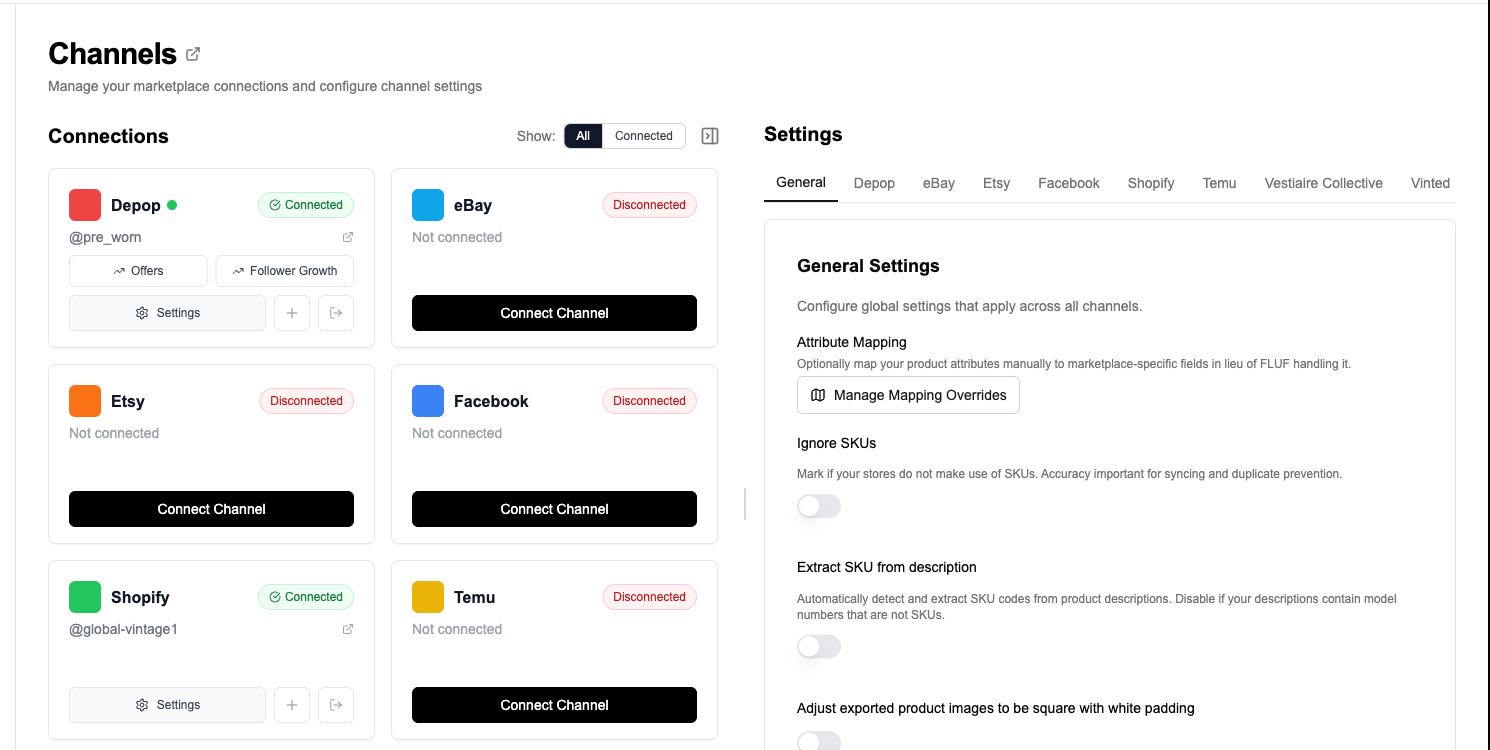
Create a FLUF Connect account, connect Vinted, and connect Whatnot. Once both are connected, your listings can be managed from one place instead of switching back and forth between marketplace dashboards.
2. Import your Vinted inventory
FLUF Connect brings in the main Vinted listing data you already created: images, title, description, price, brand, size, colour, and condition. That becomes your working source for crosslisting, which is much faster than rebuilding the item field by field inside Whatnot.
3. Select the listings you want on Whatnot
Choose one item at a time or work in bulk. Most sellers start with the Vinted inventory that has the best chance of benefiting from Whatnot’s format: stronger branded pieces, live-show-friendly bundles, sneakers, accessories, and stock that is easier to sell when a seller can add energy or context around it.
4. Review the Whatnot mapping
Before publishing, FLUF maps your Vinted listing into a Whatnot-ready destination. In most cases, the key review points are destination category, category-specific attributes, condition wording, and shipping profile. You are reviewing a mapped listing, not starting from zero, which is what makes the workflow much faster.
5. Publish to Whatnot
Once confirmed, FLUF creates the Whatnot listing as a marketplace Buy It Now product. Your images, title, description, price, and mapped attributes go with it, and the new listing becomes part of the same connected inventory system as your Vinted source item.
6. Let sold-item sync handle the risk
After crosslisting, the real value is inventory protection. If the item sells on Vinted, FLUF removes the linked Whatnot listing. If it sells on Whatnot, FLUF removes the Vinted side. That is what turns multi-channel selling from a spreadsheet problem into a workflow you can trust.
What Transfers When You Crosslist from Vinted to Whatnot?
Vinted and Whatnot do not use identical listing structures, so FLUF Connect does not just copy text blindly. It maps the useful selling data from Vinted into Whatnot’s more structured destination format and flags the pieces that may need a seller decision. For fashion and accessories sellers, that usually means the core listing transfers well, while the destination review step focuses on category precision and any Whatnot-specific attributes.
| Vinted field | Whatnot field | Transfer | Notes |
|---|---|---|---|
| Title | Title | ✅ Automatic | Core listing title transfers, with the destination limit enforced when needed. |
| Description | Description | ✅ Automatic | Your Vinted description is reused so you are not rewriting each listing for Whatnot. |
| Images | Listing images | ✅ Automatic | Images transfer into the Whatnot listing creation flow. |
| Price | Price | ✅ Automatic | Price comes across automatically and can still be reviewed before publishing. |
| Category | Whatnot category | ⚡ Smart mapped | FLUF maps the Vinted category to the closest Whatnot destination category. |
| Condition | Condition attribute | ⚡ Mapped | Condition is translated into Whatnot’s category-specific condition values. |
| Brand | Brand attribute | ⚡ Mapped | Brand is carried across where the Whatnot category expects it. |
| Size | Size attribute | ⚡ Mapped | Especially relevant for fashion categories and sneakers. |
| Colour | Colour / attribute data | ⚡ Supported | Useful when the destination category supports colour-level filtering or attributes. |
| Shipping context | Whatnot shipping profile | ⚠️ Auto-set | Whatnot needs shipping-profile logic, so FLUF applies the most suitable destination setup. |
What usually needs a quick check? Whatnot is more structured than Vinted in a few important places. The main review points are category accuracy, category-specific attributes, and whether the listing is best framed as a straightforward marketplace item or something better saved for a live-selling workflow later. That is normal. The value is that you are reviewing a mapped listing, not building it from a blank form.
Examples of Vinted to Whatnot category logic
| Vinted listing type | Likely Whatnot destination | Why it works |
|---|---|---|
| Vintage branded jacket | Fashion / outerwear category | Works well in both passive resale and live-show fashion formats. |
| Branded sneakers | Sneakers category | Strong overlap between Vinted sourcing and Whatnot community demand. |
| Jewellery bundle | Jewellery category | Suited to quick-moving Whatnot listings and show-based selling. |
How Inventory Sync Works Between Vinted and Whatnot
The most important part of Vinted to Whatnot crosslisting is not the first publish. It is what happens after the sale. FLUF Connect monitors your connected channels and removes sold inventory from the rest of your stack within minutes. That is what prevents the classic multi-platform mistake of selling one item twice.
| Event | What happens | Typical timing |
|---|---|---|
| Item sells on Vinted | FLUF removes it from Whatnot and other connected channels | Within minutes |
| Item sells on Whatnot | FLUF removes it from Vinted and other connected channels | Within minutes |
| Listing price changes on Vinted | Not treated as a universal bidirectional price sync event | Review or update in FLUF when needed |
| Listing copy changes on one channel | Not treated like a live mirrored document | Review manually when needed |
If an item sells on Whatnot, FLUF can remove it from Vinted before someone else buys it there. If it sells on Vinted first, the Whatnot side is cleaned up too. That is the difference between safe multi-channel selling and constant manual cleanup.
If sold-state sync is the main pain point in your workflow, read more about inventory sync. If your goal is broader marketplace coverage, start from the main crosslisting hub or compare this workflow to Vinted to eBay and eBay to Whatnot.
Crosslisting from Vinted to Whatnot: Before and After FLUF Connect
Without FLUF Connect
- Open the Vinted listing.
- Download or re-save the photos.
- Copy the title and description into Whatnot.
- Choose a Whatnot category manually.
- Add brand, size, condition, and any category-specific attributes again.
- Choose the right Whatnot shipping setup.
- Publish the listing.
- Keep a mental note or spreadsheet so you remember the item is live in two places.
- Delete the other listing manually when it sells.
Result: repetitive admin at the start and avoidable overselling risk afterwards.
With FLUF Connect
- Import your Vinted inventory once.
- Select the listings you want on Whatnot.
- Review the mapped category and attributes.
- Publish.
- Let inventory sync handle sold updates across both channels.
Result: much less copying, fewer listing mistakes, and a much easier path to running Vinted alongside Whatnot.
Turn Vinted inventory into Whatnot-ready listings without rebuilding your catalogue by hand.
Automation Features for Vinted and Whatnot Sellers
Vinted and Whatnot are not symmetrical channels inside FLUF Connect, so the automation stack is not identical on both sides. Vinted has deeper day-to-day automation, including auto-relisting and offer management. Whatnot’s strength today is crosslisting, sold sync, and order data flow. That still makes the pair valuable, because the biggest multi-channel risk is inventory mismatch, not whether every channel has exactly the same automation layer.
| Feature | Vinted | Whatnot |
|---|---|---|
| Crosslisting | ✅ | ✅ |
| Inventory sync | ✅ | ✅ |
| Auto-relisting | ✅ | — |
| Offer management | ✅ | — |
| Order sync support | ✅ | ✅ |
| Bulk workflow support | ✅ | ✅ for crosslisting-driven listing management |
In practice, that means Vinted can remain a strong source channel for steady resale activity while Whatnot becomes a second route to sale for inventory that benefits from a more engaged audience. If you later want a broader setup, FLUF Connect can also connect Depop, eBay, Shopify, and the rest of the marketplaces listed on the integrations page.
Pricing and Marketplace Fees
FLUF Connect pricing is based on the size of your inventory, not on which pair page you use. That means Vinted to Whatnot crosslisting is covered by the same plans as your other channels.
| Plan | Monthly | Yearly | You save | Crosslisted products |
|---|---|---|---|---|
| Starter | £9/month | £85/year | 21% | Unlimited |
| Pro | £29/month | £155/year | 55% | Unlimited |
| Priority | Custom pricing — tell us what you need | Unlimited | ||
Automatic relisting, offer management, smart pricing and listing boosts are included from Pro upwards. Starter covers unlimited crosslisting, inventory sync, order sync and Instagram posting without them. Accounting integrations are included from Pro upwards. Yearly billing is charged once a year. New accounts get 7 days for £1, then move onto a plan.
The marketplace fee picture on each side is different, which is part of why sellers like this pairing. On Vinted, the standard fee model is buyer-paid rather than seller-paid, with buyer protection charged to the buyer at checkout. On Whatnot, UK and EU sellers typically pay 6.67% + VAT commission plus 2.42% + GBP 0.25 + VAT processing in most categories, with lower rates in selected categories. That means the best destination for any given item can depend on both margin and sell-through speed, not just raw fees.
Frequently Asked Questions
Can I crosslist from Vinted to Whatnot automatically?
Yes. FLUF Connect lets you import Vinted listings, map them to Whatnot, review the destination setup, and publish without recreating every listing manually.
What happens when an item sells on Whatnot?
FLUF Connect removes the sold item from Vinted and your other connected channels within minutes, which helps prevent overselling.
Does everything from Vinted transfer perfectly to Whatnot?
The core listing data transfers cleanly, but Whatnot is more structured in some categories. Category, condition, brand, size, and shipping-profile logic may need a quick review before publishing.
Does Whatnot support relisting and offer automation like Vinted?
No. Vinted has deeper automation coverage for relisting and offers. Whatnot’s strength in FLUF Connect is crosslisting, inventory sync, and order support.
Who should use Vinted and Whatnot together?
Sellers with vintage fashion, sneakers, jewellery, accessories, and other inventory that benefits from both passive resale demand and live-commerce energy are a strong fit. Vinted gives you low-friction secondhand demand, while Whatnot gives you a second route to sale for more engaged buyers.
Sources & Verification
Last verified: 2026-04-17. Please contact us if any marketplace workflow or policy has changed.
- Vinted price list — buyer protection and seller-fee structure.
- Whatnot seller location and currency requirements — supported seller countries.
- Whatnot seller fees — current UK and EU fee structure.
- Whatnot Help Center: Start selling on Whatnot — seller application and onboarding flow.
- Whatnot Help Center: Listing Guidelines — marketplace listing requirements.
- FLUF guide: Sell on Vinted — marketplace context for Vinted sellers.
- FLUF guide: Sell on Whatnot — marketplace context for Whatnot sellers.
- FLUF feature page: Inventory Sync — sync behaviour overview.
- FLUF feature page: Auto Relisting — Vinted relisting workflow.
- FLUF feature page: Offer Management — Vinted offer automation.
- FLUF pricing — current plan pricing and annual billing.
- FLUF integrations — supported marketplace connections.
Frequently Asked Questions
Yes. FLUF Connect lets you import Vinted listings, map them to Whatnot, review the destination setup, and publish without recreating every listing manually.
FLUF Connect removes the sold item from Vinted and your other connected channels within minutes, which helps prevent overselling.
The core listing data transfers cleanly, but Whatnot is more structured in some categories. Category, condition, brand, size, and shipping-profile logic may need a quick review before publishing.
No. Vinted has deeper automation coverage for relisting and offers. Whatnot's strength in FLUF Connect is crosslisting, inventory sync, and order support.
Sellers with vintage fashion, sneakers, jewellery, accessories, and other inventory that benefits from both passive resale demand and live-commerce energy are a strong fit. Vinted gives you low-friction secondhand demand, while Whatnot gives you a second route to sale for more engaged buyers.
Sign up for free
Join the community
You're in.
Open your dashboard