Crosslist from WooCommerce to Yaga — FLUF’s WordPress Plugin for Preloved-Fashion Selling
List your WooCommerce catalogue on Yaga straight from wp-admin and reach preloved-fashion buyers across the Baltics and South Africa, with stock kept in sync automatically.



If you run a WooCommerce store — the WordPress e-commerce plugin that powers roughly a third of all online shops — crosslisting to Yaga puts your stock in front of a large, engaged secondhand-fashion audience across Estonia, Latvia and South Africa without you ever leaving your WordPress dashboard. FLUF Connect reads your WooCommerce catalogue and lists your chosen products on Yaga for you, then keeps stock in sync so you never oversell.
- WooCommerce: your own self-hosted WordPress store — full control of branding, data and catalogue, with 7M+ active installs.
- Yaga: a fast-growing preloved-fashion marketplace with 12M+ monthly visits across Estonia, Latvia and South Africa.
- Fields that transfer automatically: title, description, up to 6 photos, price, category, size, brand and condition — mapped from your WooCommerce product data.
- Inventory sync: when a product sells in WooCommerce or on Yaga, FLUF removes it from the other within minutes.
- Seller fees: Yaga charges sellers no commission and no listing fee — the buyer pays a Buyer Protection fee at checkout.
- Cost: from £9/month — the FLUF Connect plugin for WooCommerce, with sync and bulk tools on every plan, and offers from Seller upwards.
Yaga isn’t only South Africa. The same marketplace also runs in Latvia (shopyaga.lv), Estonia (yaga.ee) and Kenya (yaga.co.ke). FLUF Connect works with whichever country’s Yaga you sell on — using the right currency (ZAR, EUR or KES) and local shipping automatically. See where Yaga operates →
Why Sell on Both WooCommerce and Yaga?
A WooCommerce store gives you complete ownership — your WordPress site, your customer data, your branding — but no built-in audience; every visitor has to be earned through marketing or SEO. Yaga is the opposite: a marketplace with millions of active secondhand-fashion shoppers already browsing, but less control over presentation. Crosslisting from WooCommerce to Yaga combines the two — you keep your owned WordPress store as the master catalogue and tap Yaga’s ready-made demand for preloved clothing in the regions where it leads.
WooCommerce is the dominant WordPress e-commerce plugin, with 7+ million active installations and a market share frequently put around a third of all e-commerce sites. Yaga, founded in Tallinn in 2017, has grown into a serious preloved-fashion destination: 12 million+ monthly visits, 6 million+ items sold and over €80 million paid out to sellers, with strong positions in Estonia, Latvia and South Africa (yaga.co.za) and newer expansion underway.
The audiences barely overlap. Your WooCommerce buyers find you directly; Yaga’s buyers are circular-fashion shoppers hunting preloved and new-with-tags pieces at marketplace prices. Listing the same stock on both lets each item sell to whichever audience values it — and because Yaga takes no seller commission, the added reach costs you nothing per sale.
About Yaga’s markets
Yaga was founded in Tallinn in 2017 and rides the broader shift toward circular, secondhand fashion — buyers hunting preloved and new-with-tags clothing rather than fast fashion. It is the category leader in Estonia and Latvia, where it prices in euros, and a major player in South Africa through yaga.co.za, which alone counts more than a million users and prices in rand. The company raised €4 million in October 2025 to expand further, with Kenya and India already opening up and more regions planned. For a sustainability-minded brand, that concentration of preloved demand is exactly the audience a standalone WordPress shop struggles to reach organically.
Why WordPress store owners add Yaga
The strongest reason a WooCommerce seller adds Yaga is reach without cost. You keep your owned WordPress store — your branding, your customer list, your full-price channel — while pushing end-of-line, sample, vintage or preloved stock to a marketplace that already has the buyers. Because Yaga takes no seller commission, there is no per-sale penalty for the extra exposure; the only cost is the FLUF Connect subscription. It is a particularly neat fit for WordPress stores in or shipping to the Baltics and South Africa, and for any brand with circular-fashion or surplus inventory it would otherwise discount on its own site.
| WooCommerce | Yaga | |
|---|---|---|
| What it is | Your own WordPress store | Preloved-fashion marketplace |
| Built-in audience | None — you drive traffic | 12M+ monthly visits |
| Top markets | Anywhere you configure | Estonia, Latvia, South Africa |
| Seller fee | None (payment processing only) | None — buyer pays Buyer Protection |
| Currency | Your store currency | EUR (Baltics), ZAR (South Africa) |
| Control | Full — it’s your site | Marketplace rules apply |
Sources: WooCommerce stats, Yaga fees, WooPayments fees.
How to Crosslist from WooCommerce to Yaga with FLUF Connect
Because WooCommerce runs on WordPress, the whole flow starts and stays in your WordPress admin. You install one plugin, connect Yaga once, and crosslist in bulk — no copy-pasting product data between tabs.
- Install the FLUF Connect plugin from your WordPress admin — search the plugin directory or upload it, then activate.
- Connect your WooCommerce store — the plugin reads your existing WooCommerce products, including variations, categories and stock levels.
- Connect Yaga through the FLUF browser extension, which links your Yaga seller account.
- Choose products to crosslist — everything, or filter by category, price or stock status.
- Review the mapping — FLUF pre-fills Yaga’s category, size, brand and condition from your WooCommerce attributes.
- Crosslist — publish to Yaga individually or hundreds at a time.
- Your products go live on Yaga within minutes, with photos, price and details in place.
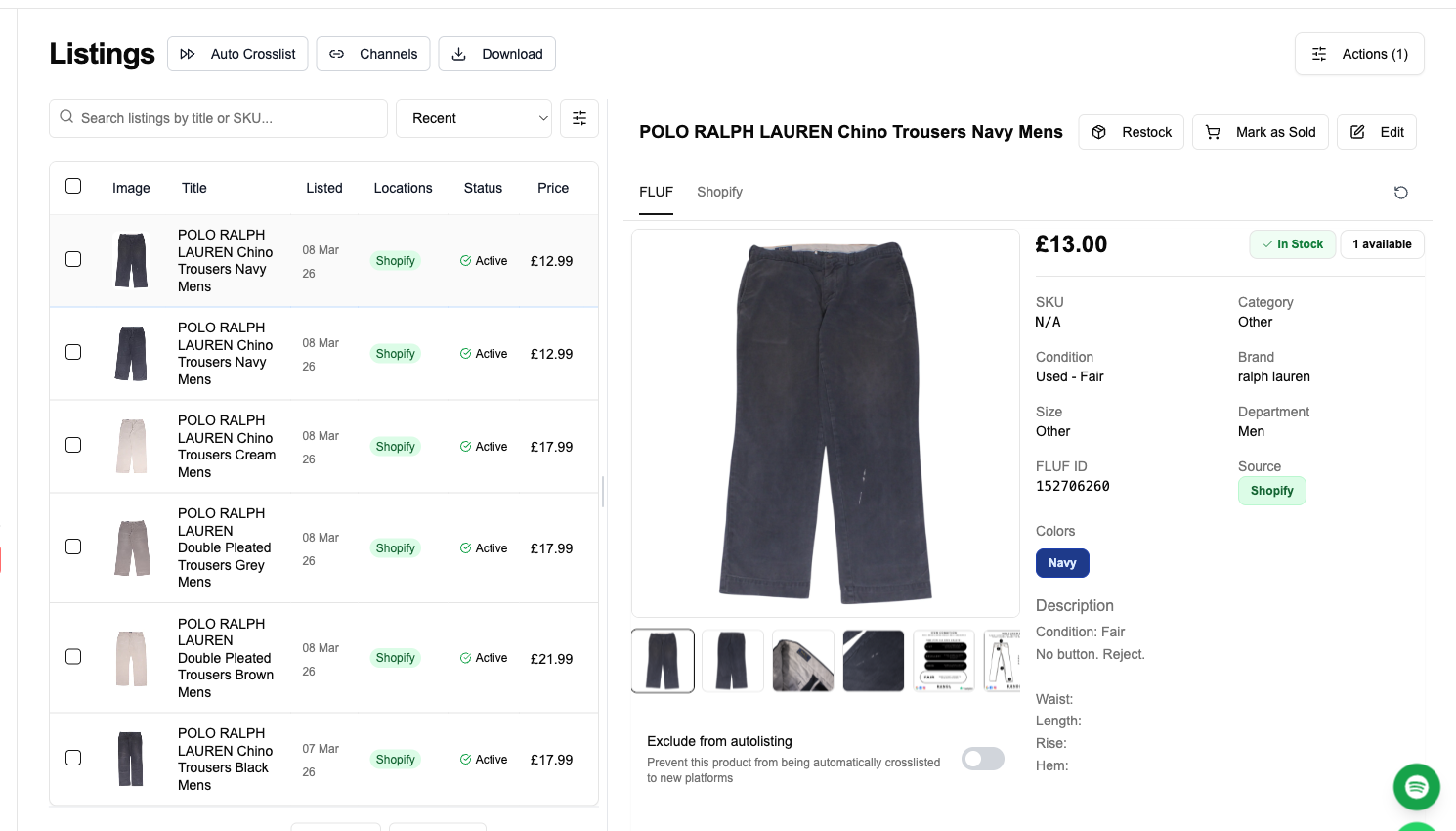
Behind the scenes, the FLUF Connect plugin for WooCommerce reads each product, maps its fields to Yaga’s listing format, uploads the images, and publishes through Yaga. You can set auto-crosslisting rules so any new WooCommerce product is pushed to Yaga automatically, and run a single bulk job to move your entire WordPress catalogue across at once.
What Transfers When You Crosslist from WooCommerce to Yaga?
WooCommerce products are richly structured — title, description, price, SKU, stock, categories, attributes and variations. Yaga listings are leaner and fashion-focused: up to six photos, a title, description, category and sub-category, size, brand, condition and price. FLUF Connect maps the WooCommerce data onto Yaga’s fields so you don’t re-key anything.
The plugin reads your products directly from WooCommerce — including variable products, where a parent has child variations for size or colour, each with its own SKU and stock. Yaga listings are single items, so FLUF lists the variation detail you choose to send, using the WooCommerce size attribute as Yaga’s size value and the brand attribute (or a brand plugin field) as Yaga’s brand tag. Pricing is where the two models differ most: a WooCommerce sale on your own site only costs you payment processing — typically around 2.9% plus a fixed fee via WooPayments, Stripe or PayPal — whereas on Yaga the seller pays nothing at all, since the buyer covers the Buyer Protection fee. That makes Yaga a genuinely low-risk place to send overflow stock from your WordPress store.
Field Mapping — WooCommerce to Yaga
| WooCommerce field | Yaga field | Transfer | Notes |
|---|---|---|---|
| Product name | Title | ✅ Automatic | Carried straight across |
| Description | Description | ✅ Automatic | Long description used; HTML stripped to plain text |
| Product gallery | Photos | ✅ Automatic | WooCommerce allows many images; Yaga takes up to 6 — the first 6 transfer |
| Price | Price | ✅ Automatic | Set to EUR (Baltics) or ZAR (South Africa) for your Yaga market |
| Category | Category + sub-category | ⚡ Smart mapped | WooCommerce categories map to Yaga’s fashion taxonomy |
| Size attribute / variation | Size | ⚡ Mapped | WooCommerce size attribute becomes Yaga’s size field |
| Brand attribute | Brand | ✅ Automatic | From a brand attribute or plugin field if present |
| Condition | Condition | ⚠️ Set default | WooCommerce has no condition field — set new/preloved once and FLUF applies it |
| Stock quantity | Quantity | ✅ Automatic | Drives the oversell protection below |
| SKU | — | Internal | Held by FLUF to match the two listings for sync |
Field references: WooCommerce product data, Yaga seller listing fields.
Category Mapping Examples
| WooCommerce category | Yaga category | Notes |
|---|---|---|
| Clothing > Women > Dresses | Women > Dresses | Size from WooCommerce variation → Yaga size field |
| Accessories > Bags | Women > Bags | No size; brand and condition mapped across |
| Shoes > Trainers | Shoes > Sneakers | WooCommerce shoe-size variation → Yaga size field |
Fields That Need Your Attention
- Condition. A WooCommerce store usually sells new stock and has no condition field, whereas Yaga is built around new and preloved grading. Set a default condition in FLUF, or override per listing for genuinely secondhand pieces.
- Photo count. WooCommerce galleries can be large; Yaga shows up to six images, so FLUF sends your first six. Order your WooCommerce gallery so the best shots come first.
- Currency. Yaga prices in EUR for the Baltic markets and ZAR for South Africa. Set the target market once and FLUF applies the right currency across the batch.
Inventory Sync Between WooCommerce and Yaga — What Stays in Sync?
Your WooCommerce store is the master catalogue, so stock is driven from there. FLUF keeps Yaga aligned to it and reports Yaga sales back into WooCommerce.
| Event | What happens | Timing |
|---|---|---|
| Product sells / out of stock in WooCommerce | Removed from Yaga automatically | Within minutes |
| Product sells on Yaga | Order synced into WooCommerce, stock decremented | Within minutes |
| Price changed in FLUF | Updated on Yaga | On next sync |
| Product deleted in FLUF | Delisted from Yaga | Within minutes |
| New WooCommerce product (auto-rule on) | Crosslisted to Yaga | Automatically |
When a product goes out of stock in your WooCommerce store, or sells on Yaga, FLUF Connect removes it from the other side (and any other connected channel) within minutes — so the same item never sells twice.
Unlike most marketplaces, Yaga does not take a commission from the seller. Instead, a Buyer Protection fee is added to the buyer’s total at checkout — 6.5% plus R19.90 in South Africa, and 5% plus €0.69 in Estonia and Latvia. It funds Yaga’s secure escrow-style payment and dispute handling, and means the price you set in your WooCommerce store is the amount you receive (minus only your own payment processing on direct WooCommerce sales). For a WordPress merchant testing a new region, that no-seller-fee model removes the usual marketplace tax on experimentation.
What to keep in mind: Yaga is an extension-based channel, so its sales are reconciled when the FLUF extension runs — minutes rather than instant webhooks. Yaga orders flow into WooCommerce so your WordPress store stays the single source of truth for fulfilment and reporting.
What doesn’t sync: we keep this honest. Neither WooCommerce nor Yaga offers automated relisting, so there is no relisting cycle for this pair (that feature applies to channels like eBay, Vinted and Etsy). And because Yaga’s listing fields are simpler than a full WooCommerce product, fields with no Yaga equivalent — extra gallery images beyond six, custom WooCommerce attributes — simply aren’t sent. Everything both platforms share stays aligned.
Crosslisting from WooCommerce to Yaga: Before and After FLUF Connect
Without FLUF Connect (manual)
- Open a WooCommerce product in WordPress admin and copy the title and description.
- Download the product images from your media library.
- Open the Yaga app or site and start a new listing.
- Re-upload up to six photos.
- Re-type the title and description.
- Pick a Yaga category and sub-category.
- Set size, brand, condition and quantity.
- Convert and enter the price in EUR or ZAR.
- Publish — then track in a spreadsheet that it’s live on both.
- When it sells, go back to the other side and remove it.
Resellers put manual listing at around six minutes per item from scratch — multiply that across a WooCommerce catalogue and it’s hours of duplicated data entry.
With FLUF Connect
- Select the WooCommerce products in your FLUF dashboard.
- Click crosslist to Yaga.
- Confirm the pre-mapped fields.
- Done — stock syncs automatically.
Manual: roughly 10 hours of copying and re-keying. With FLUF Connect: under an hour, run as a single bulk job from WordPress.
Tips for Listing WooCommerce Products That Sell on Yaga
Yaga is a social-commerce marketplace — buyers follow sellers, like items and browse a personalised feed — so a few adjustments help your crosslisted WooCommerce stock perform:
- Grade condition honestly. Yaga buyers shop by condition, from new-with-tags down through very good, good and satisfactory. If you are sending genuine preloved or sample stock, set the matching grade rather than leaving everything as new — accurate grading builds the seller reputation that drives repeat sales.
- Lead with strong photography. Yaga shows up to six images and favours clean, well-lit flat-lay or on-model shots. Reorder your WooCommerce product gallery so your six best frames sit first, since those are the ones that cross over.
- Tag the brand. Brand is one of Yaga’s most-used filters. Make sure your WooCommerce products carry a brand attribute so FLUF can populate Yaga’s brand tag and surface your items in brand searches.
- Price for the local market. Resale buyers in the Baltics and South Africa expect marketplace pricing, so consider a separate price point for Yaga rather than mirroring your full WooCommerce retail price — you can adjust prices in bulk inside FLUF.
- List seasonally. Push seasonal stock — coats in autumn, swimwear in spring — ahead of demand, and use auto-crosslisting rules to keep new arrivals flowing onto Yaga as you add them in WordPress.
Automation Features for WooCommerce and Yaga Sellers
Crosslisting is the start; the automation keeps both channels working without you babysitting them.
Offer management on Yaga
Yaga supports offers and buyer messaging, and FLUF helps you manage them so you can respond to interested buyers without living in the app.
Auto-crosslisting rules
Set a rule once — for example, “every new WooCommerce product in the Women’s category” — and FLUF crosslists qualifying products to Yaga automatically as you add them in WordPress.
Bulk operations
Bulk crosslist your whole WooCommerce catalogue, bulk-adjust prices, and find-and-replace across listings on both channels at once.
Order sync into WordPress
Yaga sales flow back into WooCommerce as orders, so your WordPress store remains the central place to track revenue and fulfilment across every channel.
| Feature | WooCommerce | Yaga |
|---|---|---|
| Crosslisting | ✅ | ✅ |
| Inventory sync | ✅ | ✅ |
| Order sync | ✅ | ✅ |
| Offer management | — | ✅ |
| Auto-relisting | ❌ | ❌ |
| Bulk operations | ✅ | ✅ |
How Much Does It Cost to Crosslist from WooCommerce to Yaga?
FLUF Connect is a flat monthly subscription — there is no per-sale commission on top. Yaga itself charges sellers nothing; its Buyer Protection fee is paid by the buyer at checkout (6.5% + R19.90 in South Africa, 5% + €0.69 in the Baltics).
| Plan | Monthly | Crosslisted products |
|---|---|---|
| Starter | £9/month | Unlimited |
| Seller | £29/month | Unlimited |
| Pro | £99/month | Unlimited |
| Super Seller | Custom pricing — tell us what you need | Unlimited |
Plans start at £9/month (Starter); There is no free plan, but every new account gets a 7-day trial for £1. Every plan includes crosslisting, inventory sync, offers and bulk tools across all supported channels — so you can add Depop, eBay, Vinted or Shopify to your WooCommerce setup on the same plan. See the full pricing page.
Start crosslisting from WooCommerce to Yaga
Install the FLUF Connect plugin for WooCommerce, connect Yaga, and reach preloved-fashion buyers across the Baltics and South Africa — all from WordPress.
Sources & Verification
- WooCommerce installs & market share: WordPress.org; Barn2
- WooCommerce product data model: Barn2
- WooCommerce payment fees: WooPayments
- Yaga scale & markets: EU-Startups; yaga.co.za
- Yaga fees (buyer-paid Buyer Protection): Yaga
- Yaga listing fields: Yaga seller guide
- Manual listing time: CLOSO case study
Frequently Asked Questions
FLUF Connect plans start at £9/month (Starter). There is no free plan, but every new account gets a 7-day trial for £1. Every plan includes crosslisting, inventory sync and bulk tools across all supported channels, and Seller and above add offers. Yaga itself charges sellers no commission and no listing fee — the buyer pays a Buyer Protection fee at checkout, so adding Yaga to your WooCommerce store costs you nothing per sale.
Yes. FLUF Connect installs as a plugin from your WordPress admin and works on any self-hosted WordPress site running WooCommerce. Once activated, it reads your WooCommerce catalogue and lists your chosen products on Yaga, all managed from inside WordPress.
No. The FLUF Connect plugin for WooCommerce does its crosslisting and syncing work in the background and through the FLUF dashboard, so it does not add front-end load to your WordPress store. Your shop pages load exactly as before.
Yes. FLUF reads WooCommerce variations such as size and colour and maps the relevant attribute — typically size — onto Yaga's listing fields. Because Yaga listings are single items, FLUF lists the variation data you choose to send across.
Yes. Your WooCommerce store is the master catalogue. When a product goes out of stock in WooCommerce it is removed from Yaga automatically, and when it sells on Yaga the order syncs back into WooCommerce and stock is decremented — both within minutes, so you never oversell.
Nothing. Yaga charges sellers no commission and no listing fee, so you keep the full item price. Instead, the buyer pays a Buyer Protection fee at checkout — 6.5% plus R19.90 in South Africa, and 5% plus €0.69 in the Baltic markets.
Yaga is strongest in Estonia, Latvia and South Africa, with newer expansion under way. It is a good fit for a WooCommerce store wanting to move preloved or new-with-tags fashion stock into those secondhand-fashion markets.
Once your WooCommerce store and Yaga account are connected, selecting products and crosslisting takes seconds, and listings appear on Yaga within minutes. You can crosslist your entire WordPress catalogue in a single bulk run rather than one product at a time.