
Crosslist from Vestiaire Collective to Facebook Marketplace — Global Luxury, Local Sales
Keep your luxury pieces selling globally on Vestiaire while clearing items fast and fee-free to a billion local Facebook buyers — synced so nothing oversells.



TL;DR: Vestiaire Collective is the global marketplace for authenticated pre-loved luxury — curated, worldwide, and around 15% in seller fees once selling and payment charges are counted. Facebook Marketplace is the opposite: a billion-plus local buyers, no fees on local pickup sales, instant cash, and no authentication. Crosslisting from Vestiaire Collective to Facebook Marketplace with FLUF Connect lets you keep your luxury pieces working on Vestiaire’s global stage while clearing items fast and fee-free to a local audience — and inventory sync stops the same bag selling in two places. Plans start at £9/month (Starter); There is no free plan, but every new account gets a 7-day trial for £1.
Vestiaire Collective and Facebook Marketplace are about as different as two resale channels can be. One is a slow, global, white-glove platform built around authenticating luxury and reaching collectors anywhere in the world. The other is a fast, local, fee-free marketplace where you sell to someone a few miles away who pays in cash. For a Vestiaire seller, that contrast is the opportunity: the pieces that wait weeks for the right global buyer on Vestiaire can also move today, locally, with no commission — if you list them in both places. This guide explains when that makes sense, what to watch for, and how FLUF Connect crosslists your Vestiaire inventory to Facebook Marketplace without the duplicated work or the oversell risk.
Why Crosslist from Vestiaire Collective to Facebook Marketplace
Vestiaire Collective is the leading global platform for pre-loved luxury, with a curated catalogue of around 5 million items and members across 70 countries (Vestiaire/Zalando). Its superpower is authentication — physical inspection by specialist authenticators, automatic on higher-value purchases — which builds the trust that lets a stranger on the other side of the world spend four figures on a used handbag (Vestiaire services). That trust comes at a cost in both fees and time: a 12% selling fee plus 3% payment processing (Vestiaire seller fees), and a curation-and-authentication process that means listings are reviewed before going live and sales route through an inspection hub before reaching the buyer.
Facebook Marketplace is the mirror image. More than a billion people use it each month (Meta, via Fortune), and for local pickup sales it charges no listing fee and no selling fee — the buyer meets you, pays cash or an instant transfer, and you keep 100% (Meta commerce fees). There is no authentication, no curation queue, and no waiting for a global buyer. What you trade away is reach beyond your local area and the trust infrastructure that Vestiaire provides — which is exactly why these two channels complement rather than replace each other.
The practical case for running both: list a piece on Vestiaire to reach the global luxury buyer who will pay top price after authentication, and list it on Facebook Marketplace to catch a local buyer who wants it now and will pay cash to skip the wait. Whichever sells first wins — as long as your stock stays synced so you do not sell it twice, disappoint a buyer, or have to cancel a sale you have already promised to someone else.
Vestiaire Collective vs Facebook Marketplace at a Glance
| Vestiaire Collective | Facebook Marketplace | |
|---|---|---|
| Audience | Global luxury buyers, 70 countries | 1 billion+ monthly, local-first |
| Seller fee | 12% + 3% payment processing | None on local pickup; fee on shipped orders |
| Authentication | Physical authentication of luxury items | None |
| Best for | Designer, luxury, collectible fashion | Everything; fast local clearance |
| Speed of sale | Slower; global + curation queue | Fast; local cash deals |
| Payment | Held until delivery/authentication | Cash or transfer in person (local) |
| Curation | Listings reviewed before going live | List instantly, no review |
Two Opposite Philosophies of Trust
Underneath the fee and audience differences sits a deeper one: how each platform creates trust. Vestiaire builds it institutionally. Listings pass through curation before they go live, higher-value purchases are physically authenticated by specialists, payment is held until the item is verified and delivered, and the whole apparatus is what lets a buyer in Tokyo confidently buy a used bag from a seller in Paris. You pay roughly 15% for that machinery, and for luxury it is often worth every point.
Facebook Marketplace builds trust personally and locally. There is no authentication and no escrow on local deals; instead, buyers and sellers meet, inspect the item in person, and complete the deal face to face. Trust comes from proximity and your own profile, not from a platform guarantee. That is lighter and faster and free — and riskier, which is why it suits items a buyer can judge for themselves more than four-figure pieces that hinge on authentication. Understanding this split is the key to using both well: send the items that need institutional trust to Vestiaire, and the items a local buyer can verify with their own eyes to Facebook.
The Fee Contrast: 15% vs Nothing
This is the heart of why a Vestiaire seller adds Facebook Marketplace. On Vestiaire, the all-in cost of a sale is roughly 15% — a 12% selling fee, raised from 10% in 2025, plus a 3% payment-processing fee with a small minimum (Vestiaire seller fees). For very low-value items Vestiaire applies a flat fee instead, and for very high-value items a flat cap — but for the typical designer piece, plan on losing about 15% to the platform in exchange for its authentication and global reach.
On Facebook Marketplace, a local-pickup sale costs you nothing: no listing fee, no commission, no payment cut, because the money changes hands directly between you and the buyer (Meta commerce fees). The one caveat to state plainly: if you choose to ship an item through Facebook’s checkout rather than meet locally, a selling fee applies. So the fee-free advantage is specifically a local advantage. For a seller in a city with luxury demand, that can be the difference between netting £850 locally and £720 after Vestiaire’s cut on the same £1,000 bag — though Vestiaire’s global reach may find a higher-priced buyer that your local area never would. The point of crosslisting is that you no longer have to bet on one of those outcomes.
What Sells, and What to Keep on Vestiaire
Not every Vestiaire listing belongs on Facebook Marketplace, and being deliberate about it matters. Genuine high-value luxury — a five-figure watch, a rare Hermès, an item that genuinely needs authentication to sell — is usually better left to Vestiaire’s authenticated, global audience, where buyers expect and trust the process and will pay accordingly. Facebook Marketplace has no authentication, and serious luxury buyers know it, so the very top of your inventory often performs better on Vestiaire alone.
Where Facebook Marketplace shines for a Vestiaire seller is the broad middle and the long tail: contemporary designer, premium high-street, accessories, and pieces that have sat on Vestiaire without selling. It is also the natural home for items Vestiaire will not take at all — the platform is luxury-only and has banned a long list of fast-fashion brands such as Zara, H&M and Mango (Vestiaire). Anything in your wardrobe that Vestiaire rejects on brand grounds can still sell locally on Facebook Marketplace, which has no brand gate at all. Used well, Facebook becomes your fast-clearance and overflow channel, while Vestiaire stays your premium shopfront.
Pricing for Two Very Different Buyers
The same handbag is worth different things to a global Vestiaire buyer and a local Facebook buyer, and pricing it identically in both places leaves money on the table. On Vestiaire, you are selling to someone who has chosen the platform precisely because of authentication and global selection — they expect to pay a premium for certainty, so you can price to the platform’s market and let the 15% fee come out of a higher number. On Facebook Marketplace, you are selling to a local buyer who values speed and a deal and pays nothing in fees, so a slightly keener price still nets you more while moving the item faster.
A simple way to think about it: set your Vestiaire price for the global market and your Facebook price for a quick local sale, and let whichever buyer turns up first take it. Because Facebook charges nothing on local sales, you can often undercut your Vestiaire price by 10–15% and still walk away with the same money or more — while keeping the Vestiaire listing live for the global buyer who will pay full price. Crosslisting with FLUF Connect makes that two-price approach practical: you start from one set of photos and details and adjust the price per platform in a click, rather than rebuilding the listing twice.
Currency, Shipping and Local Logistics
Vestiaire is built for cross-border selling: prices show in the buyer’s currency, sales route through a regional authentication hub, and shipping is handled within the platform’s flow. Facebook Marketplace local sales skip all of that — there is no shipping, no hub, no currency conversion, just a handoff in your own city. That makes Facebook dramatically simpler for the items you sell locally, but it also means the logistics are entirely on you: you arrange the meet, you handle the cash or transfer, and there is no platform sitting between you and the buyer. FLUF Connect maps your price into the local currency when it crosslists, so the Facebook listing shows the right number from the start, and it tracks which channel each sale came from so your records stay clean across a global platform and a local one.
How FLUF Connect Crosslists Vestiaire Listings to Facebook Marketplace
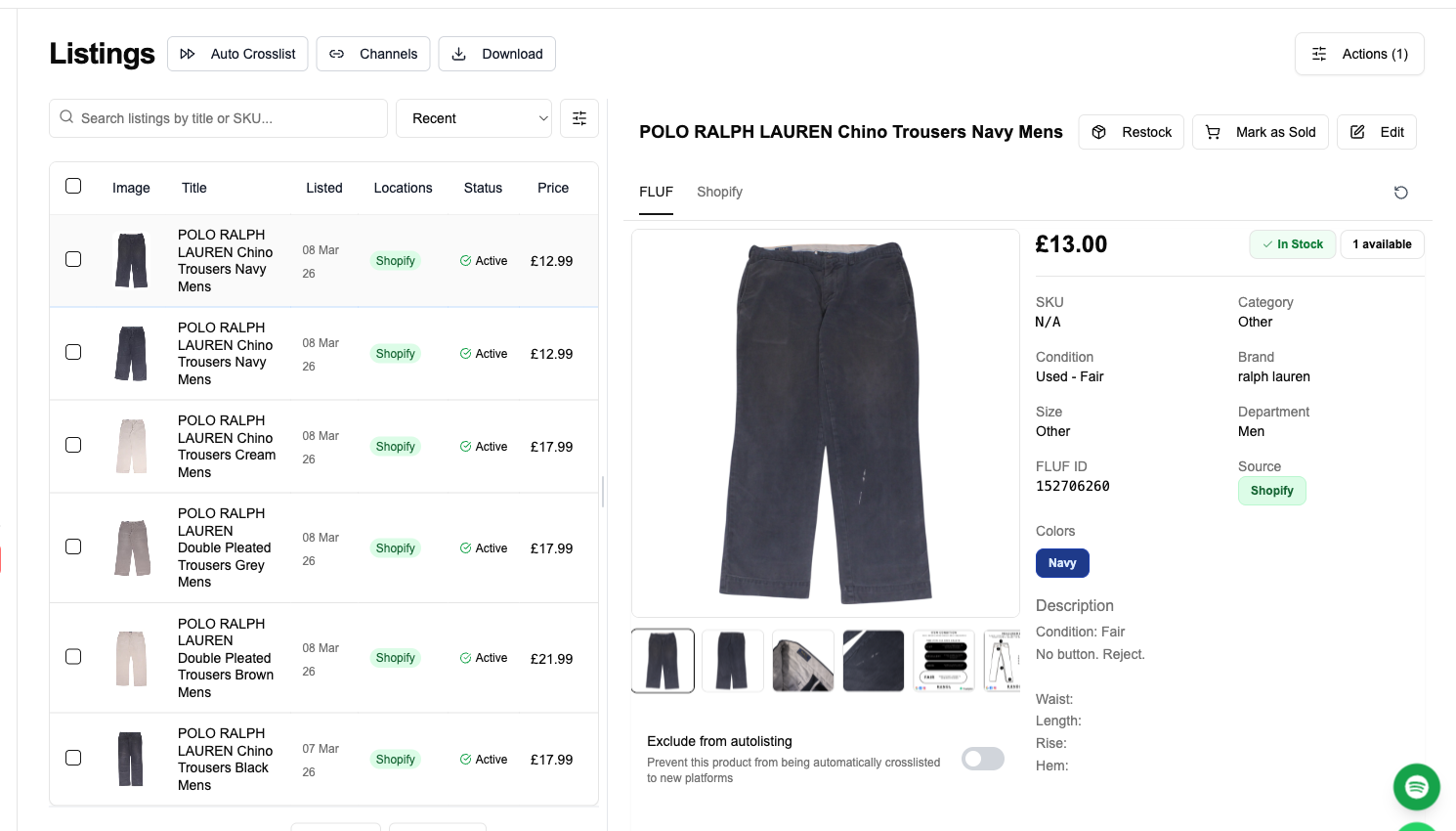
Doing this by hand is where it falls apart: re-photographing and re-describing every Vestiaire item inside Facebook, then watching two places at once so you do not sell a one-of-a-kind piece twice. FLUF Connect removes both problems. You import your Vestiaire inventory into one dashboard, choose what to list on Facebook Marketplace, review the mapped fields, and publish — and FLUF keeps your stock tied together across every connected channel.
FLUF maps your Vestiaire product data into the Facebook Marketplace format:
| Vestiaire field | Maps to Facebook Marketplace as |
|---|---|
| Title / brand / model | Listing title |
| Photos | Listing images |
| Description & condition | Item description |
| Price | Listing price (converted to local currency) |
| Category | Mapped to a Facebook category |
| Location | Your local selling area |
It is worth being precise about what FLUF automates on the Facebook side, because the two platforms expose different capabilities. On Facebook Marketplace, FLUF handles crosslisting and automatic sold-detection — when an item sells anywhere, FLUF marks it sold so you do not oversell — while the buyer conversations happen natively in Messenger, which is where Facebook’s haggling culture lives. On the Vestiaire side, FLUF additionally supports relisting, offer management and order sync, so your premium listings stay fresh and your offers are handled. You get the right automation for each platform rather than an overclaimed promise that does not match how Facebook actually works.
What to Watch For on Facebook Marketplace
Selling luxury locally is not friction-free, and it is fair to go in with eyes open. Facebook Marketplace has no buyer or seller protection on local cash deals — protection only applies to on-platform checkout payments — so meet in safe, public places and be wary of overpayment and “holding fee” scams, which are common (ScamAdviser). Expect lowball offers; the Messenger negotiation culture invites them. And know that Facebook’s algorithm tends to favour local, lower-ticket goods like furniture over clothing and collectibles, so fashion can need more active relisting and sharper photos to get reach. None of this outweighs the upside of a free, billion-strong local channel — but it does mean Facebook is a complement to Vestiaire’s trusted, authenticated environment, not a substitute for it.
Who Benefits Most from This Pairing
Crosslisting Vestiaire to Facebook Marketplace is not for everyone, so it helps to know where you sit:
- Closet sellers with a deep designer wardrobe gain a free local outlet for the contemporary and accessory pieces that take a while to sell globally, without giving up Vestiaire for their top items.
- Resellers carrying mixed inventory can route luxury to Vestiaire and everything Vestiaire rejects — premium high-street, fast-fashion, non-luxury — to Facebook, where there is no brand gate.
- Sellers in cities with real luxury demand benefit most: a local buyer base that can actually afford designer pieces turns Facebook from a clear-out channel into a genuine second sales line.
- Sellers who need cash flow use Facebook’s instant local sales to free up money while higher-value pieces wait for the right global Vestiaire buyer.
If none of those describe you — if you sell only museum-grade luxury to international collectors — you may do better staying on Vestiaire alone. For everyone else, the local channel is found money, and crosslisting is how you capture it without doubling your admin.
How It Works, Step by Step
- Create a FLUF Connect account and connect both Vestiaire Collective and Facebook Marketplace.
- Import your Vestiaire inventory so you manage everything from one product view.
- Select the items to list locally on Facebook — typically your contemporary designer, accessories and slow-moving stock.
- Review the mapped fields — title, photos, price, location — and publish to Facebook Marketplace.
- Let FLUF sync stock so anything that sells on Vestiaire or Facebook is marked sold across both.
Pricing
FLUF Connect plans start at £9/month (Starter). There is no free plan, but every new account gets a 7-day trial for £1. Inventory sync, sold-detection and bulk operations are included in every plan, not a paid add-on. You can connect Vestiaire Collective, Facebook Marketplace and every other supported marketplace on any tier; plans differ by how many products you manage. See FLUF pricing.
Sell Globally and Locally at the Same Time
Vestiaire Collective gives your luxury pieces a trusted, authenticated, worldwide audience that will pay premium prices. Facebook Marketplace gives the same pieces a fast, fee-free, local route to a cash buyer who wants it now. With FLUF Connect you list once, push the right items to Facebook, and let inventory sync keep everything honest across both. Try FLUF Connect and stop choosing between global reach and a fast local sale. The same wardrobe can earn premium prices from a collector overseas and clear quickly for cash in your own city — you just need both listings live and your stock kept in sync, which is exactly what crosslisting delivers.
Sources & Verification
- Vestiaire 5M items, 70 countries, authenticated luxury positioning — Vestiaire/Zalando
- Vestiaire selling and payment fees — Vestiaire seller fees
- Vestiaire authentication service — Vestiaire services
- Vestiaire fast-fashion brand bans — PR Newswire
- Facebook Marketplace 1B+ monthly users — Fortune (citing Meta)
- Facebook Marketplace fees (local free; shipped fee) — Meta commerce fees
- Facebook Marketplace scam risks — ScamAdviser
Frequently Asked Questions
Yes. FLUF Connect imports your Vestiaire inventory, maps the title, brand, photos, description, condition and price into the Facebook Marketplace format, converts the price to your local currency, and publishes the listings to your local selling area. When an item sells on either channel, FLUF marks it sold across both so you never sell the same piece twice.
Not for local pickup sales. If a buyer meets you and pays in person, Facebook charges no listing fee and no selling fee — you keep the full amount. A selling fee only applies if you ship an item through Facebook's on-platform checkout. By contrast, Vestiaire Collective charges roughly 15% all-in (a 12% selling fee plus 3% payment processing).
No — be selective. Genuine high-value luxury that needs authentication usually sells better on Vestiaire's trusted global platform. Facebook Marketplace is best for contemporary designer, accessories, slow-moving stock, and items Vestiaire will not accept because it bans fast-fashion brands. Used together, Vestiaire is your premium global shopfront and Facebook is your fast, fee-free local clearance channel.
Reach and speed at zero cost. Facebook Marketplace has more than a billion monthly users and charges nothing on local sales, so you can clear items today for cash instead of waiting for the right global buyer on Vestiaire. The trade-off is no authentication and local-only reach, which is why most sellers run both channels rather than switching.
It can be, with care. Facebook Marketplace offers no buyer or seller protection on local cash deals, so meet in safe public places and watch for overpayment and holding-fee scams. Expect lowball offers through Messenger. For the highest-value pieces, Vestiaire's authenticated, payment-held process is the safer route, which is why crosslisting — not switching — is usually the right approach.
On Facebook Marketplace, FLUF handles crosslisting and automatic sold-detection, while buyer conversations stay in Messenger. On Vestiaire Collective, FLUF additionally supports relisting, offer management and order sync. You get the automation that matches each platform's capabilities rather than an overclaimed promise. Plans start at £9/month (Starter); There is no free plan, but every new account gets a 7-day trial for £1.