
eBay vs Temu: What Sellers Need to Know in 2026
A side-by-side comparison of eBay and Temu — fees, audience, product quality, seller models, and what the rise of ultra-cheap imports means for resellers in 2026.



- eBay is a marketplace where anyone can sell — 135 million active buyers, zero fees for UK private sellers, 190+ countries. Best for used, vintage, collectible, and branded items.
- Temu is a factory-to-consumer platform — 400M+ monthly users, ultra-low prices direct from Chinese manufacturers. Primarily for manufacturers and wholesalers, not individual resellers.
- Fees: eBay UK private sellers pay £0. Temu charges sellers 2–5% (consignment) or 8–15% (semi-managed). But Temu’s model is designed for factory pricing, not resale margins.
- Temu-to-eBay arbitrage: Legal but margins are razor-thin. After eBay fees + shipping + returns, profit per item is often under £3. Not a sustainable business model for most sellers.
- Tariff shift: The US ended duty-free Chinese imports in 2025, and the EU follows in July 2026. Temu’s price advantage is shrinking as tariffs take effect.
- Best strategy for eBay sellers: Focus on categories Temu cannot touch (used, vintage, authenticated), and diversify across multiple marketplaces. Cross-list free with FLUF Connect.
eBay vs Temu at a Glance
eBay and Temu are fundamentally different platforms serving different purposes. eBay is a peer-to-peer marketplace where anyone — individuals, small businesses, or enterprises — can list and sell items to 135 million active buyers worldwide. Temu is a factory-to-consumer platform that connects Chinese manufacturers directly with bargain-hunting shoppers, offering ultra-low prices by cutting out every middleman in the supply chain.
eBay was founded in 1995 in San Jose, California, by Pierre Omidyar. Over three decades it has evolved into one of the world’s largest online marketplaces, with approximately 2.5 billion live listings and $79.6 billion in annual GMV. Its strength lies in connecting sellers of unique, used, collectible, and branded items with buyers who search for specific products.
Temu launched in September 2022, owned by PDD Holdings (the company behind China’s Pinduoduo). In under three years, it has amassed over 416 million monthly active users and surpassed 1 billion cumulative downloads. Temu’s model is radically different from eBay: manufacturers bid to supply products at the lowest possible price, and Temu controls pricing, logistics, and customer service — delivering products at prices that traditional resellers cannot match.
| eBay | Temu | |
|---|---|---|
| Founded / Launched | 1995 | September 2022 |
| Headquarters | San Jose, California | Dublin, Ireland (PDD Holdings) |
| Active buyers / users | 135 million active buyers | 416 million monthly active users |
| Markets | 190+ countries | 79–90+ countries |
| Business model | Peer-to-peer marketplace (anyone can sell) | Factory-to-consumer (primarily manufacturers) |
| Best for selling | Used, vintage, collectible, branded, niche items | Mass-produced goods at factory prices |
| Seller fees (UK) | £0 for private sellers. Business: 8–15% | 2–5% (consignment) or 8–15% (semi-managed) |
| Can individuals sell? | Yes — anyone can list in minutes | Limited — primarily manufacturers and registered businesses |
| Buyer trust | High — 30-year track record, authentication programmes | Low — EU found preliminary DSA breach, FTC fined operator $2M |
For a deeper look at eBay, see our full guide: How to Sell on eBay. For Temu, see How to Sell on Temu.
How Each Platform Works: Two Very Different Models
Understanding the structural difference between eBay and Temu is essential before comparing fees, audience, or strategy. These platforms do not compete in the same way — they serve different sides of the commerce equation.
eBay is an open marketplace. Any individual or business can create a listing, set their own price, and sell to buyers globally. Sellers control their photos, descriptions, shipping, and pricing. eBay facilitates the transaction — processing payments, providing buyer protection, and offering search and promotional tools — and takes a percentage as fees. The seller is the merchant.
Temu operates more like a factory outlet. In its primary consignment model, manufacturers ship bulk inventory to Temu’s warehouses, and Temu controls everything: pricing, product pages, customer service, returns, and delivery. The manufacturer is a supplier, not a merchant. Temu also offers a semi-managed model where sellers set their own prices and handle fulfilment, and a Local Seller Programme (available in the UK) where businesses sell and ship domestically — but even here, Temu’s extreme price competition makes it hostile territory for anyone without factory-direct pricing.
This distinction matters because most eBay sellers cannot meaningfully sell on Temu. If you sell used clothing, vintage records, or handmade jewellery, Temu has no place for you. If you manufacture phone cases by the thousand at $0.50 each, Temu might work — but you will compete with other factories offering $0.40.
Fees Compared: eBay vs Temu
eBay and Temu’s fee structures reflect their different models. eBay charges transaction-based fees to individual sellers. Temu takes a commission from manufacturers supplying goods at wholesale prices.
| Fee Type | eBay (UK Private) | eBay (UK Business) | Temu (Consignment) | Temu (Semi-Managed) |
|---|---|---|---|---|
| Listing fee | Free (up to 1,000/month) | Free (up to 1,000/month) | None | None |
| Transaction / commission | £0 | 8–15% by category | 2–5% | 8–15% |
| Per-order fee | None | £0.30–0.40 | None | None |
| Payment processing | Included | Included in FVF | Handled by Temu | ~2.9% + £0.25 |
| Shipping cost | Seller sets or offers free | Seller sets or offers free | Seller ships bulk to warehouse | Seller pays; must offer free shipping to buyers |
| Store subscription | N/A | From £19.99/month | None | None |
On paper, Temu’s 2–5% consignment commission looks cheaper than eBay’s business seller fees. In practice, the comparison is misleading: Temu’s commission applies to factory-wholesale prices (often £1–3 per item), while eBay’s fees apply to retail prices (often £10–50+). The absolute fee amount per transaction is often similar or lower on eBay.
- eBay (UK private seller): No fees = You keep £30.00
- eBay (UK business seller, general): FVF £3.27 + Per-order £0.40 + Regulatory £0.13 = You keep £26.20
- Temu: A manufacturer would never price at £30 on Temu. The same item might be listed at £5–8 with a 2–5% commission — keeping £4.75–7.60. The margin comes from manufacturing at £1–2.
The key insight: eBay and Temu’s fee structures are not directly comparable because the platforms serve different seller types at different price points. eBay sellers set retail prices and keep the majority after fees. Temu suppliers sell at near-cost and make money on volume.
Audience and Demand: Who Is Buying on eBay vs Temu?
Temu has more users, but eBay has more valuable buyers — and they search for fundamentally different things.
| eBay | Temu | |
|---|---|---|
| Monthly active users | 135 million active buyers | 416 million MAU |
| Buyer intent | High — searching for specific products | Low-to-moderate — browsing for deals |
| Average order value | ~$67 | ~$20–30 (estimated) |
| Top buying categories | Electronics, collectibles, fashion, auto parts | Fashion accessories, home goods, beauty, gadgets |
| Trust level | High — established reputation, authentication | Mixed — quality concerns, regulatory issues |
| Repeat purchase rate | High for specific categories | 34% buy monthly (vs eBay’s 29%) |
eBay buyers come with purchase intent. They search for specific items — “Nike Air Max 90 size 10 used” or “1970 Star Wars action figure” — and are willing to pay fair prices for items they cannot find elsewhere. eBay’s strength is in categories that Temu fundamentally cannot serve: used goods, vintage, collectibles, refurbished electronics, and authenticated luxury items.
Temu buyers are bargain hunters attracted by gamified promotions, spin-the-wheel discounts, and rock-bottom prices. One buyer reported purchasing 5 items from Temu for $16 that would cost three times more on eBay. For generic, mass-produced items (phone cases, kitchen gadgets, accessories), Temu’s price advantage is decisive. But Temu buyers are not searching for unique, used, or branded items — they want cheap and new.
Product Quality and Trust
This is where eBay’s 30-year head start matters most. Trust is the currency of online commerce, and the two platforms are in entirely different positions.
eBay has established trust through decades of seller ratings, buyer protection (Money Back Guarantee), and authentication programmes for sneakers, watches, handbags, and trading cards. Buyers know what they are getting because seller feedback and detailed item specifics provide transparency. When something goes wrong, structured dispute resolution exists.
Temu faces significant trust challenges. Buyers report product quality as “hit or miss” — items frequently do not match product photos, and quality is inconsistent between orders of the same item. More seriously, Temu faces regulatory action on multiple fronts: the European Commission found Temu in preliminary breach of the Digital Services Act, the FTC fined Temu’s operator $2 million, and multiple US states have filed lawsuits over data privacy practices.
“I used to buy a lot from Temu. Till I got a product that fell apart after three uses.”
For sellers, this trust gap matters: if you resell Temu products on eBay, quality issues lead to returns, negative feedback, and potential Below Standard seller status — which adds a 6% fee surcharge and suppresses your listings in search.
Shipping and Returns
| eBay | Temu | |
|---|---|---|
| Domestic shipping speed | 1–5 days (seller-dependent) | 2–6 days (from local warehouses) |
| International shipping | Global Shipping Programme — 100+ countries | 8–20 days from China; local warehouses expanding |
| Return window | 30 days (seller-configurable) | 90 days |
| Free returns | Seller’s choice (required for Top Rated Plus) | First return per order is free |
| Buyer protection | eBay Money Back Guarantee | Temu Purchase Protection |
| Seller protection | Yes — Seller Protection programme | Minimal for sellers |
Temu’s 90-day return window is generous for buyers but brutal for sellers — particularly for anyone considering Temu-to-eBay arbitrage. If a buyer returns a Temu-sourced product to you on eBay, you may not be able to return it to Temu within their window, leaving you with unsellable stock.
The Tariff Shift: What Changed in 2025–2026
The single biggest development in the eBay vs Temu landscape is the closure of the de minimis tariff loophole — and it fundamentally changes the competitive equation.
What happened: Until May 2025, imports under $800 (US) or €150 (EU) entered duty-free. Temu exploited this aggressively — shipping individual parcels directly from Chinese factories to consumers without customs charges. This is how Temu offered a $2 phone case with free shipping while eBay sellers charged $12 for the same product sourced from a wholesaler.
What changed: The US suspended the de minimis exemption for Chinese imports in May 2025, and expanded it globally in August 2025. The EU will add a €3 customs duty per parcel from July 2026. The impact was immediate: Temu’s US daily active users dropped 52% after the exemption ended.
What it means for sellers: Temu’s prices are rising as tariff costs are passed to consumers. The gap between Temu’s ultra-low prices and eBay’s market prices is narrowing. For eBay sellers who felt squeezed by Temu’s impossible pricing, the competitive pressure is easing — though Temu is adapting by building local warehouses and onboarding domestic sellers in the UK and EU.
Temu-to-eBay Arbitrage: Does It Actually Work?
Buying cheap products on Temu and reselling them on eBay is legal — but the economics rarely work in practice. Here is a realistic breakdown.
- Buy on Temu: £2.50 (including shipping to you)
- List on eBay: £12.99
- eBay FVF (12.9%): −£1.68
- eBay per-order fee: −£0.40
- Shipping to buyer: −£3.50
- Packaging: −£0.50
- Profit per sale: £4.41
- If 1 in 5 buyers returns (eBay return rate for cheap electronics): profit from 5 sales = £22.05 − £12.99 return = £9.06 net (£1.81/sale)
One seller documented buying 20 units from Temu — after one return wiped out the profit from two other sales. The core problems with Temu-to-eBay arbitrage:
- Quality inconsistency: Temu products frequently do not match product photos. Buyers report items “looking more like something from the dollar store.”
- Return risk: Quality issues generate eBay returns. A single return can wipe out profit from multiple sales.
- No dropshipping: eBay explicitly forbids listing items then buying from Temu after they sell. You must have the item in hand.
- Branding exposure: If an eBay buyer receives an item in a Temu bag they know costs £2, they will leave negative feedback.
- IP risk: Many Temu products use branded logos or designs that infringe trademarks. Reselling these on eBay can trigger VeRO takedowns and account restrictions.
The honest conclusion: Temu-to-eBay arbitrage can work for very specific unbranded, low-expectation items at high volume — but it is not a sustainable business model for most sellers. Your time is better spent sourcing used, vintage, or branded items that Temu cannot compete with.
What Real Sellers Are Saying
“For folks selling the kinds of items available on Temu, competing sellers may find it nearly impossible to compete, especially with the new increased postal rates.”
“I purchased 5 items from Temu for $16, including tarot card decks for $3.50 that sell for $20 on Amazon and other items selling for three times more on eBay.”
“It’s squeezing us out of the market. Temu will not accept a price higher than 1.2x the price of 1688.com.”
“A UK seller threw in the towel after six months and returned to Amazon due to extreme price pressure with imposed discounts and margins wiped out.”
The consensus: eBay sellers of generic, mass-produced goods feel the squeeze. eBay sellers of used, vintage, collectible, and authenticated items are largely unaffected — Temu simply does not compete in those categories. The smartest sellers are diversifying across multiple platforms rather than trying to undercut Temu on price.
How eBay Sellers Should Respond to Temu
Temu’s rise does not mean eBay sellers need to panic — but it does mean the strategy of selling mass-produced, readily-available new goods on eBay is increasingly unviable. Here is what works instead.
- Sell what Temu cannot: Used items, vintage, collectibles, authenticated luxury, refurbished electronics. Temu has zero presence in these categories.
- Diversify across platforms: Do not depend on eBay alone. List on Depop, Vinted, Shopify, Etsy, and Facebook Marketplace. If one platform’s buyer base shifts, others sustain your income.
- Compete on trust, not price: eBay’s 30-year reputation, seller ratings, and authentication programmes are moats Temu cannot cross. Lean into them.
- Bundle and differentiate: Create bundles, add personalisation, or offer fast domestic shipping. These add value that factory-direct platforms cannot replicate.
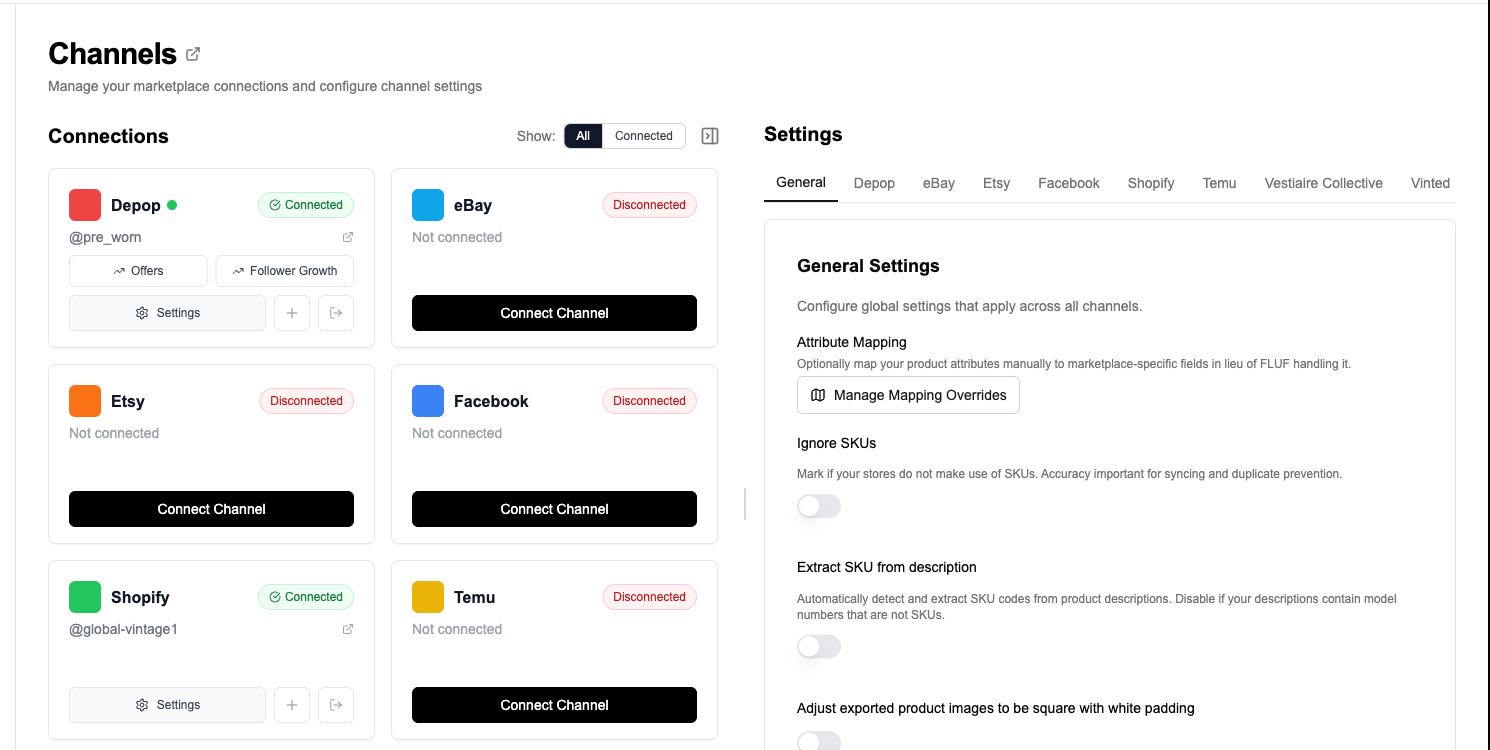
- Automate with FLUF Connect: Crosslist to nine marketplaces, sync inventory automatically, and use auto-relisting to keep listings fresh — all without manual work.
eBay’s own CEO Jamie Iannone has stated that Temu has not impacted eBay’s profits, citing the company’s strategic focus on collectibles, pre-owned items, and authenticated branded goods — categories where eBay has no meaningful competition from Temu.
FLUF Connect helps you execute the diversification strategy. List your eBay products on Depop, Vinted, Shopify, Etsy, Facebook Marketplace, and more — with real-time inventory sync so items are automatically removed from all platforms when they sell on one. Auto-relisting and offer management are included free on eBay.
Free for 30 days, no credit card required. Then from £19/month for up to 500 products.
Related Guides
- How to Sell on eBay — our complete eBay seller guide
- How to Sell on Temu — our complete Temu seller guide
- Depop vs eBay — marketplace comparison
- eBay vs Etsy — marketplace comparison
- Auto-Relist Your Listings — keep listings fresh automatically
- How to Sell on Multiple Platforms — the diversification guide
Frequently Asked Questions
Temu wins on price — products are often 50-80% cheaper than eBay because they ship directly from Chinese factories. eBay wins on quality, trust, and selection — especially for used, vintage, collectible, and branded items that Temu does not carry. eBay also has buyer protection with a 30-year track record, while Temu faces ongoing regulatory scrutiny over product safety and data privacy.
Not easily. eBay is open to anyone — individuals can list items in minutes. Temu primarily accepts manufacturers and wholesalers through its consignment model. Temu's Local Seller Programme (UK, US) accepts some businesses, but individual resellers selling secondhand or one-off items are generally not accepted. eBay remains far more accessible for casual and professional resellers.
Yes, this is legal under the first sale doctrine — once you own an item, you can resell it. However, margins are thin: after eBay fees (8-15%), shipping, and packaging, profit on a cheap Temu item is often under £3. A single return can wipe out profit from multiple sales. You must have the item in hand before listing — dropshipping from Temu to eBay violates eBay's policies.
For sellers of generic, mass-produced goods — yes. Temu undercuts on price because it ships from factories with no middleman. For sellers of used, vintage, collectible, handmade, or branded items — no. Temu cannot compete in these categories. The smartest response is to diversify: sell across multiple platforms so no single competitor can threaten your income.
For UK private sellers, eBay is free — zero fees on most categories. Temu charges sellers 2-5% (consignment model) or 8-15% (semi-managed). However, Temu's model is designed for manufacturers selling at wholesale prices, not resellers. For individual sellers, eBay's zero private-seller fees make it the cheaper option.
The US ended its duty-free exemption for Chinese imports under $800 in May 2025, and the EU is adding a €3 customs duty per parcel from July 2026. This directly hits Temu's ultra-low-price model — Temu's US daily active users dropped 52% after the initial change. Prices on Temu are rising as tariffs take effect, narrowing the gap with eBay.
Temu has more monthly users — over 416 million worldwide. eBay has 135 million active buyers. However, eBay's buyers are dedicated shoppers with high purchase intent, while many Temu users are casual browsers attracted by gamified promotions. For sellers, eBay's buyer base is more valuable because they search for specific products and complete purchases at a higher rate.
Temu offers a 90-day return window and purchase protection, but product quality is inconsistent. Multiple US states have filed lawsuits over data privacy practices, the EU found Temu in preliminary breach of the Digital Services Act, and the FTC fined Temu's operator $2 million in 2025. eBay has a 30-year trust record, established buyer protection, and authentication programmes for high-value items.
Focus on what Temu cannot offer: used and vintage items, authenticated branded goods, collectibles, personalised service, and fast domestic shipping. Diversify across multiple marketplaces — Depop, Vinted, Shopify, Etsy — so your income does not depend on any single platform. FLUF Connect automates crosslisting and inventory sync across nine marketplaces.
eBay is far stronger for electronics. Buyers trust eBay for high-value purchases, and eBay's authentication programme covers electronics above certain thresholds. Temu sells new electronics at rock-bottom prices direct from factories — competing on price is nearly impossible. eBay sellers should focus on used, refurbished, and niche electronics where Temu has no presence.
Start Crosslisting for Free Today
500 free crosslistings. No credit card. Set up in under 10 minutes.