eBay vs Vinted: Which Is Better for Sellers in 2026?
A side-by-side comparison of fees, audience, features, shipping, and what real sellers think — plus how to sell on both automatically.



- Choose eBay if: you sell across many categories (electronics, collectibles, homeware, fashion), want access to 135 million buyers worldwide, and value auction-style listings and a mature seller ecosystem.
- Choose Vinted if: you sell second-hand clothing and accessories, want zero seller fees, and prefer a simple, mobile-first listing experience with a social, fashion-focused community.
- Fees: Both platforms now charge private sellers £0. eBay removed private seller fees in September 2024. Vinted has never charged seller fees — buyers pay a Buyer Protection fee instead. Business sellers pay 8–15% on eBay; Vinted Pro is currently free.
- Audience: eBay has 135 million active buyers across 190+ markets. Vinted has 100 million+ members across more than 20 countries, primarily in Europe.
- Shipping: eBay offers integrated shipping labels and global shipping programme. Vinted provides prepaid shipping labels with tracked delivery built into the Buyer Protection system.
- Best strategy: Sell on both — items listed on multiple platforms sell significantly faster. Cross-list free with FLUF Connect.
eBay vs Vinted at a Glance
eBay and Vinted are two of the most popular platforms for selling second-hand goods in the UK and Europe, but they serve very different purposes. eBay is a global marketplace where you can sell virtually anything — from electronics and collectibles to fashion and auto parts — to 135 million active buyers. Vinted is a dedicated second-hand fashion platform with 100 million+ members, built around zero seller fees and a social, mobile-first experience.
eBay was founded in 1995 in San Jose, California, originally as an auction site. Over three decades, it has evolved into one of the world’s largest online marketplaces, hosting 2.3 billion live listings across every imaginable category. Its strength lies in sheer scale: if there’s a buyer for what you’re selling, they’re probably on eBay. In February 2026, eBay announced its acquisition of Depop from Etsy for $1.2 billion — a clear signal that eBay is doubling down on the younger, fashion-focused market where Vinted dominates.
Vinted launched in 2008 in Vilnius, Lithuania, created by Milda Mitkutė and Justas Janauskas as a way to sell unwanted clothes between friends. It has since grown into Europe’s largest dedicated second-hand marketplace, with a fierce focus on fashion and sustainability. Vinted’s appeal is simplicity — no seller fees, a clean mobile app, and a community of fashion-conscious buyers who actively browse for unique pieces.
| eBay | Vinted | |
|---|---|---|
| Founded | 1995 | 2008 |
| Headquarters | San Jose, California | Vilnius, Lithuania |
| Active buyers/members | 135 million | 100 million+ |
| Markets | 190+ countries | ~22 countries + US pilot |
| Top markets | US, UK, Germany, Australia | UK, France, Germany, Netherlands |
| Best for | Everything — electronics, collectibles, fashion, homeware | Second-hand clothing, shoes, bags, accessories |
| Seller fees | £0 for private sellers (since Sep 2024). Business: 8–15% | £0 — buyers pay a Buyer Protection fee instead |
| Free listings | Up to 1,000 per month | Unlimited |
| Mobile app | Yes — functional but complex | Yes — sleek, mobile-first design |
For a deeper look at each platform individually, see our full guides: How to Sell on eBay and How to Sell on Vinted.
eBay vs Vinted: Feature-by-Feature Comparison
eBay offers a wider range of seller tools and listing formats, reflecting its position as a mature, all-category marketplace. Vinted keeps things intentionally simple, prioritising ease of use over feature depth. The table below compares every major seller-facing feature across both platforms.
| Feature | eBay | Vinted |
|---|---|---|
| Auction listings | Yes — with reserve prices | No — fixed price only |
| Fixed-price listings | Yes | Yes |
| Built-in messaging | Yes — email-style system | Yes — WhatsApp-style chat |
| Offer/haggle system | Yes — Best Offer feature | Yes — Make an Offer button |
| Seller analytics | Yes — Seller Hub with detailed reports | Basic — views and favourites only |
| Promoted listings | Yes — from 1% ad rate | Yes — Bump (£0.95–2.95) and Wardrobe Spotlight (£6.95/7 days) |
| Integrated shipping labels | Yes — Royal Mail, Evri, and more | Yes — prepaid labels via multiple carriers |
| Buyer protection | Yes — eBay Money Back Guarantee | Yes — Buyer Protection (buyer-paid) |
| Social features (likes, follows) | Limited — watchers and followers | Strong — likes, follows, forums, bundles |
| Seller verification | ID verification for new sellers | Phone number verification |
| Business accounts | Yes — with Store subscriptions | Yes — Vinted Pro (launched UK Oct 2024) |
| International selling | Yes — Global Shipping Programme | Limited — within Vinted markets only |
| Multi-quantity listings | Yes — stock quantity per listing | No — one item per listing |
| Item specifics/categories | Extensive — detailed attributes | Fashion-focused — brand, size, colour, condition |
The biggest standout differences: eBay’s auction format and multi-quantity listings make it far more versatile for professional sellers and varied inventory. Vinted’s social features — the chat-style messaging, community forums, and bundle offers — create a more personal, engaging buying experience that drives impulse purchases in fashion.
Listing Experience: eBay vs Vinted
Vinted is the faster, easier platform to list on — most sellers can photograph an item and have it live in under two minutes using the mobile app. eBay’s listing process is more involved, but the additional options give sellers greater control over how their items appear in search results.
On Vinted, you upload up to 20 photos, select a category (clothing, shoes, bags, etc.), enter the brand, size, colour, and condition, write a description, and set a price. That’s it. The app guides you through each step, and most fields are tap-to-select rather than free-text. There are no item specifics to fill in beyond the basics, no shipping configurations to worry about (Vinted handles it), and no listing format decisions to make. For someone selling a handful of items from their wardrobe, this simplicity is a genuine advantage.
On eBay, you get up to 24 photos per listing, a detailed item specifics system (brand, model, MPN, condition, material, and dozens of category-specific attributes), a choice between auction and fixed-price formats, shipping options you can customise per listing, and promotional tools like subtitles and bold text. eBay also supports product identifiers (UPC, EAN, ISBN) which help your items appear in product-based search results. The listing form is more complex, but each field exists because it helps match your item with the right buyer.
Photography expectations differ too. Vinted buyers expect lifestyle-style photos — flat lays on clean backgrounds, items worn or styled, and close-ups of labels and details. eBay buyers, particularly in categories like electronics and collectibles, prefer clear white-background product photos that show every angle and any imperfections. Clothing on eBay tends to perform best with a mix of both styles.
Time to list: Expect 1–2 minutes per item on Vinted, and 3–5 minutes on eBay (longer for complex items with many specifics). If you’re listing hundreds of items, this time difference compounds — which is one reason sellers turn to bulk crosslisting tools like FLUF Connect.
Fees Compared: How Much Do eBay and Vinted Actually Cost?
Both eBay and Vinted now offer zero-fee selling for private sellers — a remarkable convergence that happened in late 2024 when eBay dropped private seller fees to compete directly with Vinted. However, the fee structures still differ in important ways, particularly for business sellers and when you factor in buyer-side costs that affect your pricing strategy.
Private Seller Fees
Since September 2024, eBay charges private sellers no listing fees, no final value fees, and no payment processing fees on most categories. You get up to 1,000 free listings per month, and you keep 100% of the sale price. This was a seismic shift — eBay previously charged private sellers up to 12.8% + 30p per order.
Vinted has never charged sellers a penny. No listing fees, no commission, no payment processing fees. Sellers have always kept 100% of the sale price. Instead, Vinted charges buyers a Buyer Protection fee on every purchase.
Business Seller Fees
| Fee Type | eBay (Business Sellers) | Vinted Pro |
|---|---|---|
| Listing fee | First 1,000 free, then ~35p each | Free — unlimited listings |
| Final value / transaction fee | 8–15% depending on category | Currently free |
| Payment processing | Included in final value fee | Free |
| Per-order fee | 30p (orders up to £10) / 40p (orders above £10) | None |
| Monthly subscription | Optional: Basic Store £25/mo, Featured £70/mo, Anchor £400/mo | Free |
| Promoted listing cost | From 1% ad rate (you choose) | Bump: £0.95–2.95, Wardrobe Spotlight: £6.95/7 days |
- eBay: Listing fee £0 + Final value fee £0 + Processing £0 = You keep £30.00
- Vinted: Listing fee £0 + Commission £0 + Processing £0 = You keep £30.00
- eBay: Final value fee ~£3.84 (12.8%) + Per-order fee £0.40 = You keep ~£25.76
- Vinted Pro: Commission £0 + Processing £0 = You keep £30.00 (Vinted Pro fees are currently waived)
The Hidden Cost: Buyer-Side Fees
Here’s what most comparison articles miss: while sellers keep the same amount on both platforms, buyers now pay extra fees on both — and this affects your pricing strategy.
Vinted charges buyers a Buyer Protection fee of 3–8% + £0.30–0.80 per purchase. On a £30 item, a buyer might pay £32–£34 total. This has always been Vinted’s model.
eBay introduced a Buyer Protection Fee in January 2025 (4% + 75p per item) when it removed seller fees. On a £30 item, the buyer now pays an extra £1.95 on top of the listed price and shipping.
The practical effect: buyers on both platforms pay more than the listed price, which can suppress demand for lower-value items. Many experienced Vinted sellers recommend pricing 15–20% above your target to account for the aggressive offer culture on the platform. On eBay, the BPF is newer and its long-term impact on buyer behaviour is still playing out.
Payout Comparison
| eBay | Vinted | |
|---|---|---|
| Payout method | Bank transfer (Managed Payments) | Vinted Wallet → Bank transfer |
| Payout schedule | 2 business days (daily for established sellers) | After buyer confirms receipt (up to 2 days auto), then 1–5 days to bank |
| New seller holds | Up to 21 days for new sellers | Funds held until delivery confirmed |
| Minimum payout | None | £0.01 (no minimum) |
eBay pays faster once you’re established. Vinted’s payout depends on the buyer confirming receipt — if they don’t, funds auto-release after 2 days. For more detail on each platform’s fee structure, see our full guides on selling on eBay and selling on Vinted.
Audience and Demand: Who’s Buying on eBay vs Vinted?
eBay and Vinted attract fundamentally different buyer demographics, which directly affects what sells well on each platform. Understanding these audiences is key to deciding where to list — or how to position the same item differently on each.
eBay’s buyer base spans all age groups, with the strongest representation in the 25–54 range. Buyers come to eBay with specific purchase intent — they search for a particular product, compare options, and buy. This intent-driven behaviour means eBay excels for items where buyers know what they want: a specific phone model, a particular Lego set, a replacement part, or a vintage band t-shirt in a specific size. eBay’s 135 million active buyers across 190+ markets give sellers access to the largest second-hand buyer pool on the internet.
Vinted’s audience skews younger (18–35) and is predominantly fashion-focused. Buyers browse more than they search — scrolling through feeds, following sellers whose style they like, and making impulse purchases on items that catch their eye. This browsing behaviour makes Vinted excellent for trend-driven fashion, streetwear, and “aesthetic” pieces. With 100 million+ members across more than 20 countries (17 million in the UK alone), Vinted is the dominant second-hand fashion platform in Europe.
| eBay | Vinted | |
|---|---|---|
| Primary age group | 25–54 | 18–35 |
| Top markets | US, UK, Germany, Australia | UK, France, Germany, Netherlands, Lithuania |
| Estimated active buyers | 135 million | 100 million+ members |
| Average order value | Higher — especially electronics, collectibles | Lower — typically £5–25 per item |
| Best-selling categories | Electronics, fashion, collectibles, auto parts, homeware | Women’s clothing, shoes, bags, accessories, kids’ clothing |
| Buyer behaviour | Search-driven, intent-based | Browse-driven, social, impulse purchases |
Where to List by Category
Not every category performs the same on each platform. Here’s a category-by-category breakdown based on seller consensus and platform strengths:
| Category | Better on eBay | Better on Vinted | Both |
|---|---|---|---|
| Everyday women’s clothing | ✓ | ||
| Children’s clothing | ✓ | ||
| Branded streetwear (Nike, Adidas) | ✓ | ||
| Vintage/retro fashion | ✓ (eBay for rare pieces, Vinted for everyday vintage) | ||
| Designer handbags | ✓ (higher prices) | ||
| Shoes and trainers | ✓ | ||
| Electronics and tech | ✓ | ||
| Collectibles and trading cards | ✓ | ||
| Books and media | ✓ | ||
| Homeware and furniture | ✓ | ||
| Bundles and lots | ✓ |
As one seller on Mumsnet put it: “If I’m selling general clothes and accessories I go to Vinted. Anything like collectibles — unusual ornaments and the like, eBay is still the place.” For categories that work on both platforms, crosslisting to both eBay and Vinted maximises your chances of a sale.
Shipping: eBay vs Vinted
Shipping works differently on each platform, and the differences affect both your costs and your buyer’s experience. eBay gives sellers more control over shipping options, while Vinted simplifies the process by integrating shipping into its Buyer Protection system.
| eBay | Vinted | |
|---|---|---|
| Integrated shipping labels | Yes — Royal Mail, Evri, DPD, InPost, and more | Yes — prepaid labels via Royal Mail, Evri, InPost, Yodel |
| Who pays shipping | Configurable — buyer, seller, or free shipping offers | Buyer pays (included in Buyer Protection checkout) |
| Free shipping option | Yes — seller absorbs cost (boosts search ranking) | Yes — seller can offer free shipping to attract buyers |
| International shipping | Yes — Global Shipping Programme handles customs | Limited — available within Vinted’s 20+ markets |
| Return shipping | Seller pays for “not as described”; buyer pays for remorse | Buyer pays via Buyer Protection process |
| Tracking required | Recommended (affects seller performance) | Yes — built into all prepaid labels |
eBay’s Global Shipping Programme is a significant advantage for sellers who want international reach without the hassle of customs forms and international postage. You ship to a domestic fulfilment centre, and eBay handles the rest. This opens up eBay’s 190+ markets without any additional effort.
Vinted’s shipping is simpler: when an item sells, the buyer selects a carrier, and a prepaid shipping label is generated automatically. You print it, pack the item, and drop it off. No calculating postage, no visiting the Post Office to weigh parcels, no customs paperwork. For casual sellers shipping a few items a week, this simplicity is a genuine time-saver.
For sellers shipping dozens of parcels daily, eBay’s flexibility — custom shipping profiles, calculated shipping based on weight and distance, and bulk label printing — makes operations more efficient at scale. If you’re selling on multiple platforms, FLUF Connect’s inventory sync ensures tracking numbers and order data flow between platforms automatically.
What Real Sellers Say About eBay vs Vinted
Numbers and feature tables only tell part of the story. We dug through Mumsnet, PistonHeads, MoneySavingExpert, and the eBay UK Community to find what real sellers — not marketing departments — think about both platforms. Here are the unfiltered verdicts.
Sellers who prefer Vinted
“Vinted all the way. I was an eBay seller for over 20 years… I love Vinted.”
— sleepismyhobby, Mumsnet
“Vinted is sooo much easier to use as a platform. No filling in endless pages of ‘item specifics’.”
— MattsCar, PistonHeads
“I made the move to Vinted. Buyer pays all fees which is welcome news as a seller, especially since eBay started taking a percentage of your postage costs in fees too. I personally wouldn’t go back to eBay, even as a buyer.”
— Thegirlhasnamechanged, Mumsnet
Sellers who prefer eBay
“I sell on both, but find that I get better prices on eBay.”
— MidnightMeltdown, Mumsnet
“eBay things have gone missing but there’s a lot better service as both a seller and a buyer imo and the buyers mess around less.”
— HashtagShitShop, Mumsnet
The honest downsides
No platform is perfect. Vinted sellers commonly complain about the lowball offer culture:
“Add 20% to anything you want to sell it for as nobody on there seems to want to pay the asking price.”
— cheesejunkie, PistonHeads
eBay sellers, meanwhile, are still adjusting to the platform’s fee restructuring. When eBay dropped seller fees, it introduced a Buyer Protection Fee (4% + 75p) paid by buyers — and some sellers report it’s suppressing sales:
“4% plus 75p flat fee every item! Which will bump up the price of low value items to the buyer a lot.”
— HelloMist, Mumsnet
Sellers who use both
“I double list on both sites, just have to remember to take a listing down on one if you sell it on the other.”
— IDontHateRainbows, Mumsnet
The consensus: Vinted wins on ease of use and speed for fashion items. eBay wins on price realisation, category breadth, and buyer reach. The happiest sellers don’t choose — they list on both and let each platform’s strengths work for them. The main frustration? Managing inventory across two platforms manually, with the constant risk of overselling. That’s exactly the problem crosslisting tools solve.
How to Choose Between eBay and Vinted
The right platform depends on what you sell, how much you sell, and how much time you want to spend managing listings. Here’s a clear framework to help you decide — though for most sellers, the answer is increasingly “use both.”
- Sell across multiple categories — electronics, collectibles, homeware, not just fashion
- Want access to 135 million buyers in 190+ countries
- Sell higher-value or rare items where auction format can drive prices up
- Need detailed analytics, seller tools, and Store customisation
- Ship internationally and want eBay’s Global Shipping Programme to handle customs
- Primarily sell second-hand clothing, shoes, and accessories
- Want the simplest possible listing and selling experience
- Prefer a mobile-first app with social features and community
- Value zero seller fees — you keep 100% of every sale, always
- Sell mainly to buyers in the UK and Europe
For casual sellers clearing a wardrobe or selling the occasional item, Vinted’s simplicity makes it the easiest starting point. Zero fees, simple listings, no learning curve.
For scaling resellers with hundreds of items across multiple categories, eBay’s breadth and tooling make it essential. The analytics, bulk listing options, and Store features are built for volume.
For serious sellers trying to maximise revenue, the answer is both. eBay and Vinted complement each other — different buyer demographics, different category strengths, different price points. Listing on both means more exposure, faster sales, and the ability to test which platform performs best for your specific inventory.
Why Not Both? Sell on eBay and Vinted at the Same Time
The smartest resellers don’t choose between eBay and Vinted — they sell on both. Multi-platform sellers consistently report faster sales and higher total revenue, because each platform reaches buyers the other misses. An eBay buyer searching for a specific vintage jacket and a Vinted buyer browsing for weekend outfit inspiration are two completely different people, and your listing needs to be where both of them are looking.
The challenge with selling on both platforms manually is real: duplicate listings to create and maintain, inventory to track across two dashboards, the risk of overselling when an item sells on one platform but is still live on the other, and twice the admin for shipping and orders. This is where automation transforms the economics.
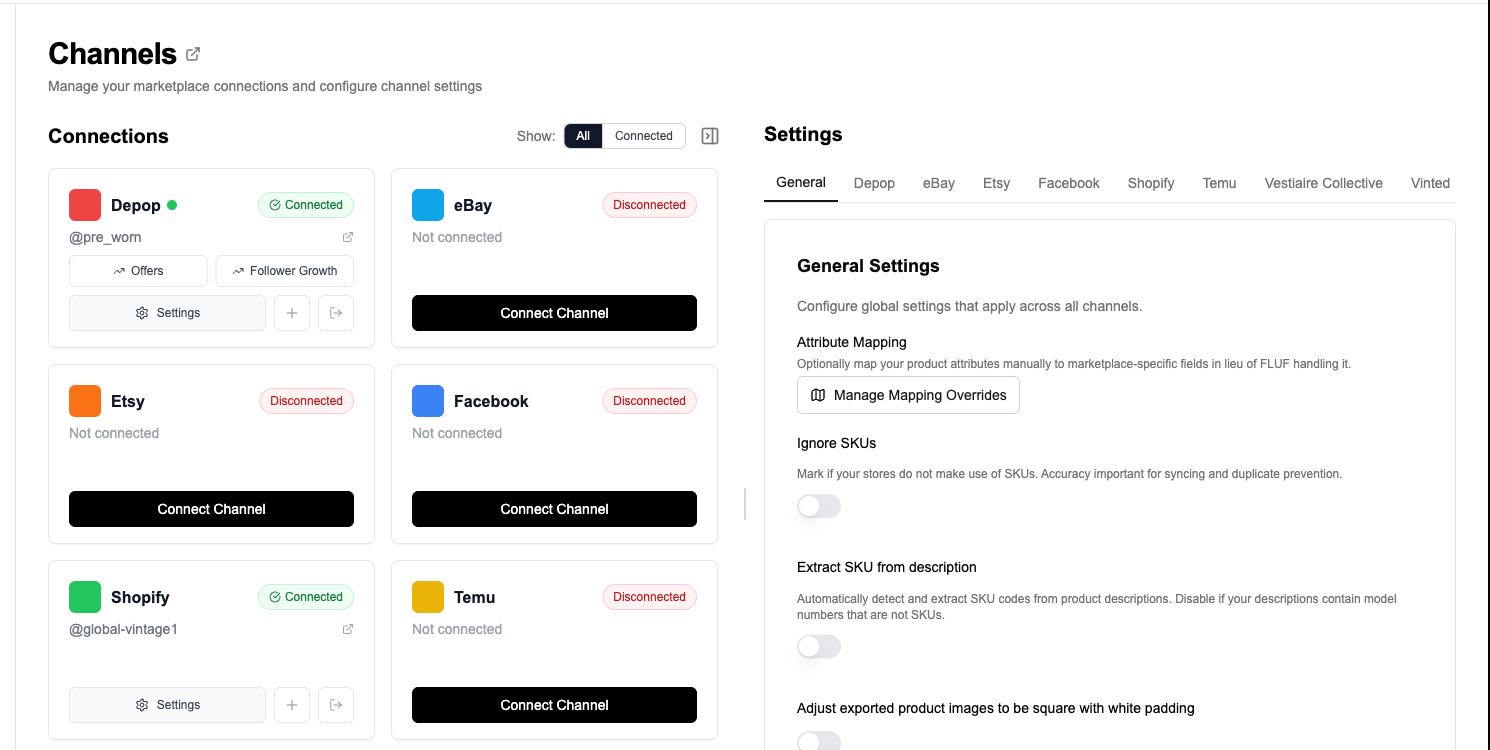
FLUF Connect lets you list on one platform and crosslist to the other automatically. Your inventory syncs in real time — when an item sells on eBay, it’s removed from Vinted within minutes (and vice versa). No overselling, no manual updates, no duplicated effort.
How it works
- Connect your accounts — Link your eBay and Vinted accounts to FLUF Connect in a few clicks.
- Crosslist your inventory — Select items to crosslist individually, in bulk, or set up auto-crosslisting rules to handle new inventory automatically.
- Sit back while FLUF manages the rest — Real-time inventory sync, automatic relisting, offer management, and order sync keep both platforms in perfect sync.
| FLUF Connect Feature | eBay | Vinted |
|---|---|---|
| Crosslisting | Yes | Yes |
| Inventory sync | Yes | Yes |
| Auto-relisting | Yes | Yes |
| Offer management | Yes | Yes |
| Order sync | Yes (via Shopify) | Yes |
| Bulk operations | Yes | Yes |
FLUF Connect is one of the only crosslisting platforms that supports Vinted at all — most competitors like List Perfectly and Vendoo don’t offer Vinted integration. Combined with full eBay support including relisting and offer management, FLUF Connect is purpose-built for sellers who want to be on both platforms without the double workload.
Free for 30 days, no credit card required. Then from £19/month with 500 free crosslistings on the Growth plan.
Frequently Asked Questions
Both work well for clothing, but they attract different buyers. Vinted is purpose-built for second-hand fashion with zero seller fees, making it ideal for casual sellers clearing wardrobes. eBay reaches a broader audience and typically achieves higher prices on branded, vintage, or rare items. Many clothing sellers use both platforms to maximise exposure — cross-listing free with FLUF Connect.
Both platforms now offer zero seller fees for private sellers. eBay removed fees for private sellers in September 2024. Vinted has never charged seller fees — instead, buyers pay a Buyer Protection fee of 3-8% plus a small fixed amount. For business sellers, eBay charges 8-15% final value fees while Vinted Pro is currently free to use.
Yes. Many sellers list on both platforms to reach different buyer pools. The main challenge is managing inventory across both — if an item sells on one platform, you need to remove it from the other to avoid overselling. FLUF Connect automates this with real-time inventory sync, crosslisting, and automatic removal when items sell.
Vinted is generally easier for beginners. The listing process is simpler, there are no fees to worry about, and the app-first design makes selling from your phone straightforward. eBay has a steeper learning curve with more listing options, shipping configurations, and fee structures — but this flexibility becomes an advantage as you scale.
eBay has more active buyers globally — around 135 million across 190+ markets. Vinted has over 100 million registered members across more than 20 countries, primarily in Europe and the UK. However, Vinted's audience is highly engaged in fashion and second-hand goods, so for clothing sellers, the effective audience can be comparable.
Yes. FLUF Connect lets you crosslist products between eBay and Vinted (and seven other marketplaces) automatically. List on one platform, crosslist to the other in a few clicks, and inventory syncs in real time so you never oversell. Both auto-relisting and offer management are included free.
eBay pays out faster. With eBay Managed Payments, funds are typically available within 2 business days, and daily payouts are available for established sellers. On Vinted, funds go to your Vinted Wallet after the buyer confirms receipt (or after 2 days automatically), then bank transfers take 1-5 business days.
Yes — sellers who list on multiple platforms consistently report faster sales and higher total revenue. eBay and Vinted complement each other well: eBay gives you access to a massive global audience across all categories, while Vinted connects you with fashion-focused buyers who prefer a zero-fee, social shopping experience. Using both means more eyes on your items.
eBay is the clear winner for electronics. It has a massive buyer base actively searching for tech products, supports detailed item specifics for electronics, and has established buyer protection for higher-value purchases. Vinted added electronics in 2024, but the category is still new and the buyer base is primarily fashion-focused.
Both platforms are excellent for vintage clothing, but they attract different buyers. eBay tends to achieve higher prices on rare or collectible vintage pieces, with buyers willing to pay premium prices and search specifically for niche items. Vinted moves trend-driven vintage faster at slightly lower price points, with a younger audience looking for unique everyday pieces.
Start Crosslisting for Free Today
500 free crosslistings. No credit card. Set up in under 10 minutes.