
Etsy vs Facebook Marketplace: Which Is Better for Sellers in 2026?
A side-by-side comparison of fees, audience, features, and what real sellers think — plus how to sell on both automatically.



- Choose Etsy if: you sell handmade goods, vintage items, or craft supplies and want access to 87 million buyers who specifically seek unique, artisan products and are willing to pay premium prices.
- Choose Facebook Marketplace if: you want to sell locally with zero fees, shift general merchandise, furniture, or used items quickly, or test product ideas without any upfront cost.
- Fees: Etsy charges ~11% in combined fees (listing + 6.5% transaction + 4% + £0.20 processing) — you keep about £26.54 on a £30 sale. Facebook Marketplace local pickup is completely free — you keep £30.
- Audience: Etsy has 87 million active buyers globally, intent-driven and craft-focused. Facebook Marketplace has 1 billion+ monthly browsers, mainly local and bargain-hunting.
- Shipping: Etsy has integrated Royal Mail labels and a Global Shipping Programme. Facebook Marketplace in the UK has no integrated shipping — you arrange your own.
- Best strategy: Sell on both — Etsy for premium global sales, Facebook Marketplace for local reach. Cross-list free with FLUF Connect.
Etsy vs Facebook Marketplace at a Glance
Etsy and Facebook Marketplace are two of the most popular places to sell online, but they serve fundamentally different purposes and attract very different buyers. Etsy is a global marketplace dedicated to handmade goods, vintage items, and craft supplies — its 87 million active buyers come specifically looking for unique, artisan products and expect to pay fair prices for craftsmanship. Facebook Marketplace is a social selling platform built into the world’s largest social network, where over 1 billion people browse monthly for local deals on everything from furniture to electronics.
Etsy was founded in 2005 in Brooklyn, New York, by Rob Kalin, Chris Maguire, and Haim Schoppik as a platform for independent artists and crafters to sell their work. Two decades later, it hosts 5.5 million active sellers across 40+ countries, with the UK as its second-largest market (9.25% of traffic). Despite growing pains around mass-produced goods and rising fees, Etsy remains the go-to marketplace for anything handmade, personalised, or vintage — 44% of transactions are gift purchases, and roughly one-third involve personalisation.
Facebook Marketplace launched in 2016 as an extension of Facebook (founded 2004 by Mark Zuckerberg). By leveraging Facebook’s existing 3 billion users, it grew rapidly into one of the world’s largest selling platforms — available in 70+ countries with an estimated 10 million active sellers and 4 billion active listings at any time. Its strength is local selling: most UK transactions are in-person pickups with zero platform fees, making it the easiest and cheapest way to sell anything quickly.
| Etsy | Facebook Marketplace | |
|---|---|---|
| Founded | 2005 | 2016 (Facebook: 2004) |
| Headquarters | Brooklyn, New York | Menlo Park, California |
| Active buyers / reach | 87 million active buyers | 1 billion+ monthly browsers |
| Available in | 40+ countries | 70+ countries |
| Best for | Handmade, vintage, craft supplies, personalised gifts | Furniture, electronics, vehicles, local items, secondhand goods |
| Seller fees (UK) | ~12–15% combined (listing + 6.5% + 4% + £0.20) | Local pickup: £0. No shipped order support in UK |
| Listing fees | £0.16 per listing (4-month expiry) | Free — unlimited |
| Mobile app | Yes — dedicated Etsy Seller app | Yes — integrated into Facebook app |
For a deeper look at each platform individually, see our full guides: How to Sell on Etsy and How to Sell on Facebook Marketplace.
Etsy vs Facebook Marketplace: Feature-by-Feature Comparison
Etsy is a mature ecommerce marketplace with structured seller tools, analytics, and a dedicated search algorithm that rewards well-optimised listings. Facebook Marketplace is a social selling layer built on top of a social network — simple, fast, and local-first, but with minimal seller infrastructure. The table below compares every major seller-facing feature.
| Feature | Etsy | Facebook Marketplace |
|---|---|---|
| Store/shop page | Yes — branded Etsy shop with customisable banner and sections | No — listings appear in general Marketplace feed |
| Search algorithm | Sophisticated — keyword matching, listing quality score, recency boost | Location-based — algorithm promotes to nearby buyers |
| Seller analytics | Comprehensive — traffic sources, conversion rates, search terms | Minimal — views and message counts only |
| Promoted listings | Yes — Etsy Ads (CPC) + Offsite Ads (Google, social) | Yes — boost via Facebook/Instagram Ads |
| Built-in messaging | Yes — Conversations (response time tracked) | Yes — Facebook Messenger |
| Buyer protection | Yes — Etsy Purchase Protection (cases within 100 days) | Limited — Purchase Protection for shipped items only |
| Seller verification | Yes — Star Seller badge (based on performance) | No formal seller verification |
| Review system | Yes — 1-5 star reviews with text, photos, and seller response | No product reviews — buyer/seller ratings only |
| Shipping labels | Yes — Royal Mail (UK), USPS (US), and more | No integrated labels in UK |
| International selling | Yes — 40+ countries, currency conversion, calculated shipping | Limited — primarily local within your country |
| Product variants | Yes — variations (colour, size, material) | No — one listing per item |
| Digital products | Yes — instant downloads supported | No — physical items only |
| Local pickup | No — shipping only | Yes — core feature, zero fees |
The most significant difference is depth of seller tools. Etsy gives you a search algorithm you can optimise for (keywords, tags, quality score), detailed analytics showing exactly how buyers find you, and a review system that builds credibility over time. Facebook Marketplace gives you speed and simplicity — list in under a minute, reach thousands of local buyers instantly, and close deals in person. They excel at entirely different selling models.
Listing Experience: Etsy vs Facebook Marketplace
Facebook Marketplace is dramatically faster to list on — most sellers can post an item in under a minute using the Facebook app. Etsy’s listing process is more involved but gives you far more control over how your products appear and how buyers find them.
On Facebook Marketplace, you tap “Sell”, take a photo (or upload from your gallery), select a category, write a title and brief description, set a price, and choose “Local pickup” or “Shipping”. The entire process takes 30-60 seconds. There are no keywords to optimise, no tags to select, no shipping configurations, and no item specifics beyond the basics. The algorithm handles discovery by showing your listing to nearby buyers based on their browsing history and interests.
On Etsy, you upload up to 10 photos and a video, write an SEO-optimised title (recommended under 15 words since February 2026’s algorithm update), craft a detailed description, select up to 13 tags, choose a category and subcategory, set item attributes (material, colour, dimensions), configure variations (size, colour), set shipping profiles, and define a return policy. Each field matters — Etsy’s search algorithm uses your title, tags, and attributes to match your listing with buyer searches, and your listing quality score (click-through rate, conversion rate) determines your ranking over time.
Photography expectations differ considerably. Etsy buyers expect high-quality, well-lit product photography — clean backgrounds, multiple angles, lifestyle shots showing the item in use, and close-ups of details and textures. The first photo is critical as it appears in search results. Facebook Marketplace buyers expect far less polish — a quick phone photo of the actual item is standard, and overly professional photography can actually seem suspicious in a local selling context (“Is this a stock photo? Is it a scam?”).
Time to list: expect under 1 minute on Facebook Marketplace and 5-15 minutes on Etsy (longer for first-time sellers learning the tag and SEO system). For sellers with large inventories, this difference is substantial — which is why bulk crosslisting tools like FLUF Connect let you create a listing once and push it to both platforms simultaneously, with titles and descriptions adapted for each.
Fees Compared: How Much Do Etsy and Facebook Marketplace Actually Cost?
This is where Etsy and Facebook Marketplace diverge most dramatically. Etsy has one of the most complex fee structures of any selling platform, with multiple layered charges that can consume 12–20% of your sale price. Facebook Marketplace is the opposite — local pickup sales in the UK are completely free, with no on-platform checkout or shipping support. In the US, shipped orders carry a 10% selling fee.
Fee Breakdown
| Fee Type | Etsy | Facebook Marketplace |
|---|---|---|
| Listing fee | £0.16 per listing (4-month expiry, auto-renews) | Free — unlimited |
| Transaction / selling fee | 6.5% of total (item + shipping + gift wrap) | Local pickup: £0. Shipped (US only): 10% |
| Payment processing | 4% + £0.20 per transaction (Etsy Payments, mandatory UK) | Included in selling fee (shipped) |
| Regulatory operating fee | 0.25-0.32% (UK) | None |
| Offsite Ads | 15% (optional under $10K/year) or 12% (mandatory above $10K/year) — only on attributed sales | None |
| On-platform advertising | Etsy Ads: CPC, $0.20-$0.50 average per click | Facebook Ads: boost from listing |
| Subscription | Free (or $10/month for Etsy Plus) | Free |
Important context on Etsy fees: Etsy’s total take rate averages approximately 16.1% of transaction value when all fees are combined. The 6.5% transaction fee — increased from 5% in April 2022 — is calculated on the total amount including shipping, which means higher shipping costs increase your fee. The mandatory Offsite Ads fee for sellers earning over $10,000/year (12% on attributed sales) is widely resented and cannot be opted out of once triggered, even if revenue drops below the threshold.
- Etsy: Listing fee £0.16 + Transaction fee £1.95 (6.5% of £30) + Processing £1.40 (4% of £30 + £0.20) + Regulatory £0.10 (0.32%) = You keep £26.39
- Facebook Marketplace (local pickup): No fees = You keep £30.00
- Facebook Marketplace (shipped, US only): Selling fee $3.00 (10%) = You keep ~$27.00 — UK has no shipped order support
Payouts: How Quickly You Get Your Money
| Etsy | Facebook Marketplace | |
|---|---|---|
| Payout method | Bank transfer (via Etsy Payments) | Cash at pickup / bank transfer (shipped) |
| Payout schedule | Weekly (Monday), daily, biweekly, or monthly options | Immediate at pickup; 5 days after delivery (shipped) |
| Clearing time | ~3 business days after deposit initiated | Varies by bank |
| New seller holds | Up to 75% held for up to 45 days | No holds on local sales |
| Payment reserve removal | Star Seller status or sustained good standing | N/A |
Facebook Marketplace is dramatically faster for local sales — you receive payment (cash, bank transfer, or PayPal) immediately when the buyer picks up the item. Even for shipped items, payouts begin just 5 days after confirmed delivery. Etsy’s default weekly payouts with 3-day clearing mean you could wait up to 10 days for your money. Worse, new Etsy sellers face payment reserves of up to 75% of funds held for 45 days — a serious cash flow challenge for sellers who need materials to fulfil the next order.
Hidden Costs to Watch For
On Etsy: the Offsite Ads fee is the most contentious hidden cost. Etsy advertises your listings on Google, Facebook, Instagram, and Pinterest without asking, and if a buyer clicks one of those ads and purchases within 30 days, you pay 12-15% on top of all other fees. For sellers earning over $10,000/year, this is mandatory and permanent — you cannot opt out. Combined with the base fees, a single Offsite Ads-attributed sale can cost you 25%+ in total fees. Listing auto-renewal also catches new sellers off guard: every 4 months, each listing renews at £0.16 whether it has sold or not.
On Facebook Marketplace: the costs are less visible but real. Lowball offers are endemic — offers at less than half the asking price are routine. No-shows waste your time (agreeing to meet, then ghosting). Scam risk is significant: TSB Bank reported that 73% of all purchase fraud reports they received were attributed to Facebook Marketplace. And because there are no seller analytics, you cannot track conversion rates, traffic sources, or buyer behaviour to optimise your listings.
Audience and Demand: Who Is Buying on Etsy vs Facebook Marketplace?
Etsy and Facebook Marketplace attract fundamentally different types of buyers with very different purchasing behaviours, which makes selling on both a powerful strategy — the overlap is minimal, meaning you reach almost entirely separate audiences.
| Etsy | Facebook Marketplace | |
|---|---|---|
| Primary age group | 25-44 (66% aged 18-44) | 25-54 (broadest age spread) |
| Gender split | 58-59% female, 41% male | Roughly even |
| Top markets | US (57%), UK (9%), Canada (5%), Germany (4%) | US, UK, India, Philippines, Thailand |
| Active buyers / reach | 87 million active buyers | 1 billion+ monthly browsers |
| Annual GMV | $11.92 billion (2025) | ~$10 billion+ (estimated) |
| Best-selling categories | Homewares (30-35%), jewellery (30%), apparel, craft supplies | Furniture, electronics, vehicles, clothing, collectibles |
| Buyer behaviour | Search-led, intent-driven, willing to pay premium for unique items | Browse-led, bargain-hunting, local convenience |
Etsy’s audience is intent-driven and craft-focused. Buyers come to Etsy specifically to find handmade, personalised, or vintage items — 44% of purchases are gifts, and roughly one-third involve personalisation. This means buyers are prepared to pay premium prices and value craftsmanship over convenience. Etsy’s 6.75 million “habitual buyers” (6+ purchases, $200+ annually) represent 41% of total sales, showing strong buyer loyalty. The platform’s strength categories — homewares, jewellery, and personalised gifts — all benefit from this intent-driven audience.
Facebook Marketplace’s audience is vastly larger but far less focused. Over 1 billion people browse monthly, but most are looking for local bargains, secondhand goods, or everyday items. The dominant categories — furniture, electronics, vehicles — reflect a buyer base seeking convenience and value rather than uniqueness. Buyers expect competitive pricing and fast local transactions. The social element of Facebook means buyers can see your profile, which builds some trust but also means you have less anonymity than on other platforms.
Category guidance: Etsy dominates for handmade jewellery, personalised gifts, home decor, craft supplies, vintage clothing (20+ years old), wedding items, and art. Facebook Marketplace dominates for furniture, electronics, vehicles, everyday clothing, tools, sports equipment, and anything bulky that benefits from local pickup. Items that straddle both worlds — vintage homewares, upcycled furniture, handmade clothing — can perform well on both platforms simultaneously.
Shipping: Etsy vs Facebook Marketplace
Shipping is where these two platforms diverge most sharply. Etsy is built around shipped ecommerce with integrated labels, calculated shipping, and global delivery. Facebook Marketplace in the UK is primarily a local pickup platform — sellers must arrange their own shipping with no integrated tools.
| Etsy | Facebook Marketplace | |
|---|---|---|
| Integrated shipping labels (UK) | Yes — Royal Mail (Tracked 24, Tracked 48, International) | No — sellers arrange own shipping |
| Who pays shipping | Buyer pays, or seller offers free shipping | Buyer pays, or seller absorbs (shipped items) |
| Free shipping algorithm boost | Yes — free/low shipping ranks higher in search | No formal algorithm boost |
| International shipping | Yes — 40+ countries, DDP option for US via Royal Mail | Limited — primarily within your country |
| Local pickup | No — Etsy is shipping-only | Yes — core feature, zero fees |
| Tracking required | Strongly recommended (affects Star Seller status) | Required for shipped items with buyer protection |
| Return shipping | Seller sets policy (most offer 14-30 day returns) | Buyer/seller negotiate directly |
Etsy’s shipping infrastructure is a genuine advantage for sellers who ship products. Royal Mail labels can be purchased directly through Etsy, tracking syncs automatically to orders, and the November 2025 launch of Royal Mail DDP (Duties Delivered Paid) for US orders means UK sellers can now offer customs-inclusive pricing to American buyers — Etsy was the first marketplace to offer this. The algorithm actively rewards listings with free or low-cost shipping, giving shippers a discovery advantage.
Facebook Marketplace has no equivalent shipping infrastructure in the UK. Sellers must arrange their own carriers (Royal Mail, Evri, DPD, Parcel2Go), purchase their own labels, and manually upload tracking numbers. This is manageable for occasional shipped items but impractical at volume. The overwhelming majority of UK Facebook Marketplace transactions are local pickup, which eliminates shipping entirely — the buyer comes to you, pays in person, and takes the item.
For sellers who primarily sell in person, Facebook Marketplace wins by eliminating shipping entirely. For sellers who need to reach buyers across the UK and internationally, Etsy’s integrated shipping makes it far more practical and professional.
What Real Sellers Say About Etsy vs Facebook Marketplace
The seller experience on these two platforms could not be more different — one is a structured marketplace with professional tools and high fees, the other is a social platform with zero fees and zero infrastructure. Here is what real sellers actually say about using each.
“Etsy’s pool of customers is more likely to value handmade products and to purchase them for a price that will allow you to profit off each sale.”
“When I opened my shop about seven years ago, the fees were minimal, but now I’m finding myself coming up short after every sale.”
“On Facebook Marketplace, handmade sellers compete with your neighbor who found a stash of her daughter’s old jewelry from the 2010s and lists it for $10 for the whole box.”
“Facebook Marketplace is like a citywide garage sale — great for shifting stuff quickly, but not where you build a brand.”
Common themes from sellers who have used both:
- Etsy’s strengths: buyers who value and pay for craftsmanship, built-in global reach, professional shop page that builds credibility, detailed analytics, strong review system that rewards quality sellers.
- Etsy’s frustrations: fee fatigue (the 6.5% transaction fee increase triggered seller strikes), mandatory Offsite Ads for high-volume sellers, aggressive payment reserves for new shops, and growing competition from mass-produced goods being sold as “handmade”.
- Facebook Marketplace strengths: zero fees on local sales, massive audience, instant payment at pickup, no listing limits, no account setup required, ideal for testing product ideas.
- Facebook Marketplace frustrations: endemic lowballing, buyer ghosting and no-shows, high scam risk (73% of purchase fraud reports per TSB Bank), no seller analytics, no review system to build reputation, and race-to-the-bottom pricing.
- The consensus: use Etsy for products where craftsmanship and uniqueness command premium prices, and Facebook Marketplace for local sales, overstock, seconds, or general merchandise. Crosslisting between both gives you access to fundamentally different buyer pools.
How to Choose Between Etsy and Facebook Marketplace
The right platform depends on what you sell, how you sell it, and what kind of business you want to build. These two platforms are so different that most sellers will find one clearly suits their primary products — but the smartest approach is often to use both for different purposes.
- Sell handmade goods, personalised items, craft supplies, or vintage (20+ years old)
- Want a global audience of buyers who specifically seek unique, artisan products
- Need professional seller tools: analytics, SEO optimisation, shipping labels, review system
- Are building a brand around craftsmanship and want to charge premium prices
- Sell digital products (printables, templates, patterns)
- Sell locally — furniture, electronics, vehicles, or anything suited to in-person pickup
- Want zero fees and instant payment (local cash sales)
- Are clearing out used items, overstock, or seconds quickly
- Want to test product ideas with zero upfront investment
- Sell bulky or fragile items where shipping is impractical or too expensive
For handmade sellers, Etsy is almost always the better primary platform — its buyers expect and respect handmade pricing, while Facebook Marketplace buyers tend to compare your handmade jewellery against factory-produced alternatives at a fraction of the price. For resellers and casual sellers, Facebook Marketplace’s zero-fee local selling model is unbeatable for shifting inventory quickly. For established sellers with a diverse product range, the answer is both — Etsy for premium products sold globally, Facebook Marketplace for local sales and quick turnover items.
The honest answer is that these platforms complement each other remarkably well. The buyers on Etsy and Facebook Marketplace barely overlap — a craft-loving Etsy buyer searching for a personalised necklace is not the same person browsing Facebook Marketplace for a second-hand sofa. Listing on both means reaching two entirely separate audiences.
Why Not Both? Sell on Etsy and Facebook Marketplace at the Same Time
Restricting yourself to a single platform means missing out on an entirely separate pool of buyers. Etsy’s 87 million craft-focused buyers and Facebook Marketplace’s billion-plus local browsers have almost zero overlap — a hand-thrown ceramic mug that takes weeks to sell on Facebook Marketplace might move in days on Etsy, and a vintage furniture set that sits on Etsy could sell within hours on Facebook Marketplace. Multi-platform sellers consistently report faster sales and higher total revenue.
The challenge with managing both is the operational overhead. Listing the same items on two very different platforms (different photo expectations, different descriptions, different pricing strategies) takes time. If something sells on Etsy, you need to immediately remove it from Facebook Marketplace to avoid overselling. Keeping inventory accurate across platforms that have completely different tools and interfaces requires constant attention.
This is exactly what FLUF Connect automates. List your products once, crosslist to Etsy, Facebook Marketplace, and seven other marketplaces in a few clicks, and FLUF handles the rest — real-time inventory sync and automatic removal when items sell.
How It Works
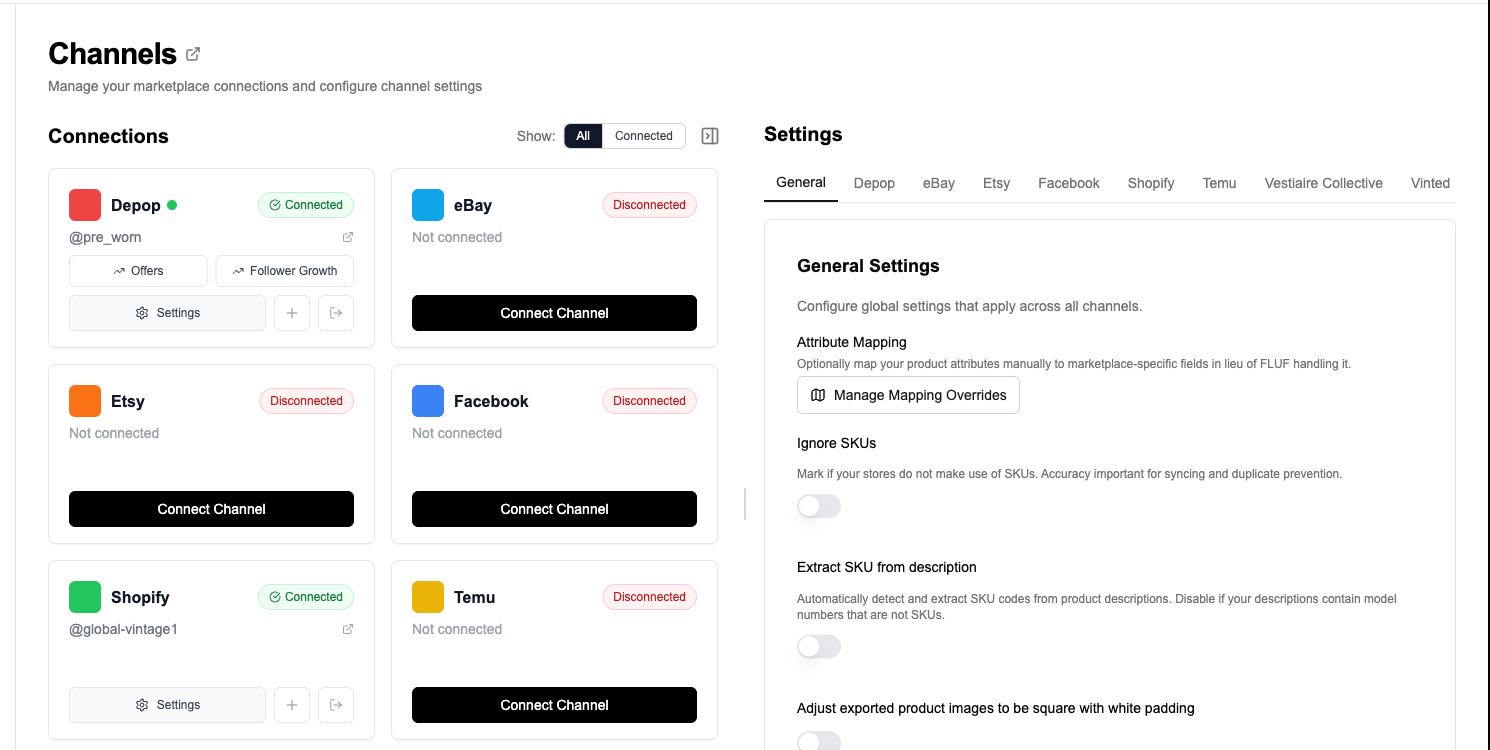
- Connect your accounts — Link your Etsy shop and Facebook account to FLUF Connect in seconds.
- Import or create listings — Pull in your existing inventory from either platform, or create new listings directly in FLUF.
- Crosslist to both platforms — Select products and push them to Etsy and Facebook Marketplace simultaneously. FLUF adapts titles, descriptions, and categories to each platform’s requirements.
- Automatic sync — When an item sells on Etsy, FLUF removes it from Facebook Marketplace (and vice versa). Inventory stays accurate across all platforms.
| FLUF Connect Feature | Etsy | Facebook Marketplace |
|---|---|---|
| Crosslisting | Yes | Yes |
| Inventory sync | Yes | Yes |
| Auto-relisting | No | No |
| Offer management | No | No |
| Order sync | Yes (via Shopify) | No |
| Bulk operations | Yes | Yes |
Both Etsy and Facebook Marketplace are supported in FLUF Connect with crosslisting, inventory sync, and bulk operations. Etsy also supports order sync via Shopify, centralising your fulfilment. For channels with full automation (like Depop and eBay), FLUF Connect also includes auto-relisting and offer management — all included free with every plan.
Free for 30 days, no credit card required. Then from £19/month for up to 500 products.
Frequently Asked Questions
Etsy is better for handmade goods, vintage items (20+ years old), and craft supplies — its 87 million buyers specifically seek unique, creative products and pay premium prices. Facebook Marketplace is better for local sales of furniture, appliances, and everyday items — zero fees on local pickup and a massive audience. Many sellers use both to reach different buyers.
Facebook Marketplace is free for local pickup sales — genuinely zero fees. Etsy charges roughly 12-15% per sale across listing fees, transaction fees, and payment processing. On a £30 sale, you keep £30 on Facebook Marketplace (local) versus roughly £26.39 on Etsy. However, Facebook's shipped orders (US only) carry a 10% fee.
Yes. Etsy captures craft-and-vintage buyers willing to pay premium prices. Facebook Marketplace captures local buyers wanting quick, zero-fee transactions. FLUF Connect automates crosslisting and inventory sync between both platforms plus seven others.
It can work but is challenging. On Facebook Marketplace, your handmade jewellery sits alongside someone's clearout items listed for a few pounds. Buyers expect bargain prices, not artisan pricing. Etsy buyers specifically seek handmade products and understand they carry higher value — making it far better for commanding fair prices on craft items.
Local pickup sales carry safety risks — meeting strangers, handling cash, and scams. Facebook Marketplace scams increased 78% in late 2023. There is no buyer protection for local sales in the UK, and no on-platform checkout or shipping. Etsy has structured buyer and seller protection, reviews, and dispute resolution.
No. Facebook Marketplace in the UK is local pickup only — no checkout, no shipping labels, no payment processing. In the US, shipped orders are supported but carry a 10% selling fee. Etsy supports shipping globally with integrated labels for Royal Mail (UK), USPS, and FedEx.
Facebook Marketplace is easier to start — just a Facebook account, a photo, and a price. No listing fees, no setup. Etsy requires understanding listing fees, tags, SEO, and shop policies. However, Etsy's structure makes selling safer and more predictable once set up.
Facebook Marketplace has far more users — over 1 billion monthly. But they are casual browsers, not dedicated shoppers. Etsy has 87 million active buyers who come specifically to buy handmade, vintage, and unique items — making them higher-intent and more willing to pay fair prices.
Yes. FLUF Connect lets you crosslist to Etsy, Facebook Marketplace, and seven other marketplaces. List once, push to both, and inventory syncs automatically so you never oversell.
Etsy is stronger for vintage — it requires items to be 20+ years old, and buyers actively seek curated vintage finds at fair prices. Facebook Marketplace has no vintage category or age requirement, and buyers expect secondhand pricing. For high-value vintage, Etsy commands better margins. For quick local vintage sales, FBMP works.
Start Crosslisting for Free Today
500 free crosslistings. No credit card. Set up in under 10 minutes.