Etsy vs Shopify: Which Is Better for Sellers in 2026?
A side-by-side comparison of fees, audience, traffic, branding, and what real sellers think — so you can choose the right platform (or use both).



- Choose Etsy if: you sell handmade, vintage, or custom items and want access to 86 million active buyers without spending on marketing.
- Choose Shopify if: you want to build your own branded store with full control over customer data, design, and pricing — and you’re prepared to drive your own traffic.
- Fees: Etsy takes ~10–12% per sale (listing + transaction + processing), rising to 20–25% with Offsite Ads. Shopify charges £19–£299/month + 2.9% + £0.30 payment processing — no per-listing or transaction fees.
- Audience: Etsy has 86 million active buyers who come to browse. Shopify has no built-in audience — you bring your own customers.
- The real difference: Etsy is a marketplace (buyers find you). Shopify is a platform (you build your own store). They solve different problems.
- Best strategy: Use both — Etsy for discovery, Shopify for brand building and repeat customers. Sync inventory across both with FLUF Connect.
Etsy vs Shopify at a Glance
Etsy and Shopify are fundamentally different types of platform. Etsy is a marketplace — buyers come to Etsy to browse and discover products, much like walking into a craft fair. Shopify is a platform for building your own online store — you create the shop, design the brand, and drive the traffic yourself. Understanding this distinction is the key to choosing between them (or using both).
Etsy launched in 2005 in Brooklyn as a marketplace for handmade and vintage goods. It now hosts approximately 5 million sellers and 86 million active buyers worldwide, with a strong focus on handmade, personalised, and vintage items. Shopify launched in 2006 in Ottawa as an e-commerce platform, and has grown into the infrastructure behind 5.5 million active online stores — powering brands from solo makers to enterprise retailers like Gymshark and Allbirds.
| Etsy | Shopify | |
|---|---|---|
| Type | Marketplace (buyers come to you) | E-commerce platform (you build your own store) |
| Founded | 2005 (Brooklyn, New York) | 2006 (Ottawa, Canada) |
| Active buyers/users | 86 million active buyers | 875 million shoppers served (across all stores) |
| Active sellers/stores | ~5 million sellers | 5.5 million active stores |
| Best for | Handmade, vintage, custom, craft supplies | Any product type — full brand control |
| Monthly cost | None (pay per listing + per sale) | £19–£299/month |
| Seller fees | $0.20/listing + 6.5% transaction + ~3% processing | 2.9% + £0.30 processing (no platform commission) |
| Built-in traffic | Yes — 86 million buyers browsing | No — you drive your own traffic |
| Brand control | Limited — you’re a shop within Etsy | Full — your own domain, design, branding |
| Customer data ownership | No — Etsy owns the customer relationship | Yes — full access to customer data |
Etsy vs Shopify: Feature-by-Feature Comparison
Etsy gives you a ready-made marketplace with built-in search, buyer trust, and payment infrastructure — but limited control over branding and customer relationships. Shopify gives you a blank canvas with powerful tools for design, marketing, analytics, and growth — but no audience until you build one.
| Feature | Etsy | Shopify |
|---|---|---|
| Built-in marketplace traffic | Yes — millions of active buyers | No — you drive your own traffic |
| Custom domain | No (yourshop.etsy.com) | Yes (yourbrand.com) |
| Store design control | Minimal — banner, logo, shop sections | Full — 900+ themes, drag-and-drop editor |
| Email marketing | Limited — Etsy controls buyer communications | Built-in (Shopify Email) + integrations |
| Discount codes and promotions | Basic (sales, coupon codes) | Advanced (automatic discounts, buy X get Y, bundles) |
| Analytics | Basic (views, visits, revenue) | Advanced (customer cohorts, product analytics, attribution) |
| Payment options | Etsy Payments (credit card, PayPal, Apple Pay, Klarna) | Shopify Payments + 100+ third-party gateways |
| Mobile app for selling | Yes (Sell on Etsy app) | Yes (Shopify mobile app) |
| App ecosystem | Limited integrations | 8,000+ apps in Shopify App Store |
| Multi-channel selling | Etsy only (plus Pattern for custom site) | Yes — sell on Amazon, eBay, TikTok, Instagram, POS |
| Seller support | Email + community forums | 24/7 chat, email, phone support |
| Product categories allowed | Handmade, vintage (20+ years), craft supplies, digital | Virtually any legal product |
| Buyer reviews | Built-in, prominent (Star Seller badge) | Requires app (Shopify Reviews or third-party) |
| International selling | Built-in multi-currency | Managed Markets — handles taxes, duties, customs |
| B2B / wholesale | No | Yes (wholesale channel, B2B pricing) |
The simplest way to think about it: Etsy handles the hard parts of starting (traffic, trust, payments) but limits your growth. Shopify requires more setup but removes the ceiling — you can scale as far as your brand and marketing can take you.
Listing and Store Experience: Etsy vs Shopify
Getting your first product listed on Etsy takes about 10 minutes. Setting up a Shopify store takes a few hours to a few days, depending on how much you customise. The trade-off is control: Etsy’s simplicity comes with constraints, while Shopify’s flexibility requires more decisions.
Etsy: list and sell in minutes
You create an Etsy account, name your shop, and start listing. Each listing has structured fields: title (140 characters), description, 10 images, up to 13 tags, category, price, shipping, and item specifics. The process is guided — Etsy tells you what to fill in. Your shop sits within the Etsy marketplace, so buyers discover you through Etsy search, ads, and browsing. You can’t change the overall layout — every Etsy shop looks fundamentally the same.
Shopify: build your brand from scratch
You choose a theme (900+ options, free and paid), customise your storefront with a drag-and-drop editor, add products with unlimited images and variants (up to 2,048 variants per product as of Winter 2026), and set up your own domain. The product listing process is more flexible — no character limits on descriptions, no tag restrictions, rich content blocks, embedded video. But there’s no marketplace feeding you customers. You need SEO, social media, email marketing, or paid ads to drive traffic.
Which is easier for beginners?
Etsy is dramatically easier if your goal is “list something and sell it today.” You can go from zero to live listing in under 15 minutes with no technical knowledge. Shopify is easier than building a website from scratch, but it still requires decisions about design, domain, shipping settings, and payment configuration before you sell anything. The $1/month introductory pricing (first 3 months) lowers the financial barrier, but not the setup effort.
Fees Compared: How Much Do Etsy and Shopify Actually Cost?
Etsy charges nothing upfront but takes a cut of every sale — and those cuts add up. Shopify charges a monthly subscription but takes no platform commission beyond payment processing. The breakeven point depends on your sales volume: at lower volumes, Etsy is cheaper. At higher volumes, Shopify’s flat monthly fee becomes better value.
| Fee Type | Etsy | Shopify (Basic plan) |
|---|---|---|
| Monthly subscription | Free (Etsy Plus: $10/month) | £19/month (£49 Grow, £299 Advanced) |
| Listing fee | $0.20 per item (renews every 4 months) | None |
| Transaction / platform fee | 6.5% of total sale price (incl. shipping) | None (with Shopify Payments) |
| Payment processing | 3% + $0.25 per transaction (UK) | 2.9% + £0.30 per transaction |
| Offsite Ads (mandatory over $10k/yr) | 12–15% on attributed sales | None |
| Currency conversion | 2.5% | Included in processing rate |
- Etsy: £30.00 − £0.16 listing fee − £1.95 transaction fee (6.5%) − £1.15 processing (3% + £0.25) = You keep ~£26.74 (10.9% in fees)
- Shopify (Basic): £30.00 − £1.17 processing (2.9% + £0.30) = You keep ~£28.83 (3.9% in fees) + £19/month subscription
On a single £30 sale, Etsy takes £3.26 in fees. Shopify takes £1.17 plus your share of the monthly subscription. If you sell 10 items a month at £30, your Etsy fees total £32.60. Your Shopify costs total £11.70 + £19 = £30.70. At around 10 sales per month, they’re roughly equal. Above that, Shopify becomes significantly cheaper per sale.
But here’s the critical nuance: Etsy’s fees buy you something Shopify’s don’t — traffic. Shopify’s lower fees don’t include the cost of acquiring customers. If you need to spend £200/month on Facebook ads or Google Ads to drive the same traffic Etsy provides for free, Shopify isn’t actually cheaper.
The Offsite Ads trap
Etsy’s most controversial fee is Offsite Ads. If your shop earns over $10,000 per year, Etsy automatically enrols you in Offsite Ads and you cannot opt out. When a buyer clicks an Etsy ad on Google, Facebook, or Instagram and purchases from your shop within 30 days, Etsy charges you 12% of the total order value — on top of all other fees. This can push your total fee burden to 20–25% per sale. Many established sellers cite this as the primary reason they move to Shopify.
Payout speed
| Etsy | Shopify | |
|---|---|---|
| Payout method | Direct to bank account | Direct to bank account (Shopify Balance optional) |
| Payout schedule | Daily, weekly, biweekly, or monthly (seller chooses) | 1–3 business days (automatic) |
| New seller holds | Possible extended holds for new accounts | No extended holds with Shopify Payments |
| Additional features | None | Shopify Balance: same-day ACH, 2–3% earnings on balance, cashback card |
Audience and Traffic: Who’s Buying on Etsy vs Shopify?
This is the single most important difference between the two platforms. Etsy has a massive built-in audience of 86 million active buyers who come to Etsy specifically to browse and buy. Shopify has no audience at all — every visitor to your Shopify store comes from your own marketing efforts.
| Etsy | Shopify | |
|---|---|---|
| Built-in traffic | Yes — 86 million active buyers | No — you drive your own traffic |
| Customer discovery | Etsy search, Browse, Offsite Ads | Google SEO, social media, paid ads, email, word of mouth |
| Buyer demographics | Skews younger, craft-oriented, gift buyers | Depends entirely on your brand and marketing |
| Repeat customers | Hard to build — Etsy controls the relationship | Full control — email lists, loyalty programmes, retargeting |
| Customer data ownership | No — Etsy owns buyer data | Yes — full customer data including email, purchase history |
| Brand recognition | Buyers remember “I bought it on Etsy” | Buyers remember YOUR brand |
For new sellers without an existing audience, Etsy’s built-in traffic is transformative. You can list a product today and make a sale tomorrow without spending a penny on marketing. On Shopify, you might have the most beautiful store on the internet and sell nothing for weeks because nobody knows it exists.
For established sellers building a brand, Shopify’s customer data ownership is the decisive advantage. On Etsy, you can’t email your past buyers, can’t retarget them with ads, can’t build a loyalty programme. Every customer belongs to Etsy. On Shopify, every customer is yours — you can nurture them into repeat buyers, which is where long-term profitability lives.
The algorithm factor
Etsy’s search algorithm determines your visibility. It weighs relevance (keywords in titles, tags, descriptions), listing quality (click-through rate, favourites, purchases), freshness (new and renewed listings get a boost), and seller reputation (Star Seller status, response time, shipping speed). This means your success on Etsy is partly in Etsy’s hands — algorithm changes can tank your visibility overnight.
On Shopify, you control your own visibility through SEO, content marketing, and paid advertising. There’s no algorithm deciding whether buyers see your products. The downside is that nobody will find you by accident — every visitor requires effort or spend.
Shipping: Etsy vs Shopify
Both platforms offer integrated shipping solutions, but Shopify’s are significantly more powerful — reflecting its positioning as a full e-commerce platform rather than a marketplace.
| Etsy | Shopify | |
|---|---|---|
| Discounted shipping labels | Yes (USPS, FedEx, Canada Post) | Yes — up to 88% off carrier rates |
| Carrier options | Limited (depends on region) | Extensive — Royal Mail, DHL, FedEx, UPS, Australia Post, and more |
| Bulk label creation | No | Yes — up to 250 labels at once |
| Free shipping insurance | No | Yes — up to $200/order (Grow plan and above) |
| International shipping | Seller-arranged | Managed Markets — handles taxes, duties, customs automatically |
| Delivery date estimates | Processing time displayed | Shop Promise — delivery guarantees for buyers |
| Fulfilment network | No | Yes — 3PL partner connections, Shopify Fulfillment Network |
| Return labels | No (seller arranges) | Yes (FedEx return labels, US) |
For small sellers shipping a few parcels a week, Etsy’s shipping tools are adequate. For sellers processing dozens or hundreds of orders, Shopify’s bulk label creation, deeper carrier discounts, and managed international shipping make a significant operational difference.
What Real Sellers Say About Etsy vs Shopify
The seller community is vocal about both platforms. The pattern is consistent: sellers love Etsy’s traffic but resent its fees and control. They love Shopify’s freedom but struggle with the traffic problem.
On leaving Etsy for Shopify
“Making the jump from Etsy over to Shopify was the best decision I’ve ever made. I honestly believe there is no better online solution than Shopify.”
On outgrowing Etsy
“I found that once I started to grow larger in popularity, Etsy put a stall to my growth. That made the choice to move forward from that platform to Shopify easy.”
— Seller interview (Bold Commerce)
On Etsy losing its identity
“[Etsy] acts like it cares so much about artists, but this is just an e-commerce site. This could be eBay or Craigslist or any other website where people can sell whatever they want.”
— Rachal Duggan, 10+ year Etsy seller (TIME)
On moving away from Etsy
“Personally, I feel glad to be moving away from Etsy and towards Shopify at this point.”
On the migration pain
“Despite Shopify saying they would make it easy, the image ratios were wrong, the text formatted weird, and the absurd amount of tags I had for my products completely flooded the system.”
On using both platforms
Many successful sellers run both simultaneously. They use Etsy as a discovery channel — leveraging its built-in traffic to find new customers — while building their Shopify store for brand equity and repeat purchases. The key challenge is keeping inventory synchronised across both to avoid overselling, which is where crosslisting tools become essential.
The common frustrations
Etsy sellers complain about: fees stacking to 20–25% with mandatory Offsite Ads, shop suspensions without clear explanation, no ownership of customer data, and copycat sellers undercutting with mass-produced knockoffs. Shopify sellers complain about: driving traffic being harder and more expensive than expected, essential features requiring paid apps, and the monthly subscription cost even in months with no sales.
How to Choose Between Etsy and Shopify
The right platform depends on your business stage, your products, and whether you have an existing audience. For most sellers, the answer evolves over time — many start on Etsy and add Shopify as they grow.
- Sell handmade, vintage, custom, or craft supply products
- Are just starting out and have no existing audience or marketing experience
- Want to test product ideas with real buyers before investing in a brand
- Prefer zero upfront costs (pay only when you sell)
- Value simplicity over customisation
- Want to build a recognisable brand with your own domain and design
- Already have an audience (social media following, email list, existing customers)
- Sell products outside Etsy’s handmade/vintage restrictions
- Want to own your customer data for email marketing and retargeting
- Are scaling beyond what a marketplace can support (wholesale, B2B, subscriptions)
For brand-new sellers with no audience and handmade products, start on Etsy. It’s the fastest path to your first sale. You’ll learn what works, which products resonate, and how to photograph and describe your items — all with built-in traffic.
For growing sellers who’ve proven their product on Etsy, add Shopify. Keep Etsy running for discovery while building your brand on Shopify. Funnel Etsy customers to your Shopify store (through business cards in packages, social media, etc.) for repeat purchases at higher margins.
For established businesses, Shopify is the better long-term home — but keeping an Etsy shop running costs you almost nothing and continues to bring in discovery traffic. There’s rarely a good reason to close your Etsy shop entirely.
Why Not Both? Sell on Etsy and Shopify at the Same Time
The smartest sellers don’t choose between Etsy and Shopify — they use Etsy for discovery and Shopify for brand building, running both simultaneously. Etsy brings you new customers who are actively searching for products like yours. Shopify lets you own those relationships and build a brand that outlasts any single marketplace.
The operational challenge is keeping both platforms synchronised. When a product sells on Etsy, it needs to be removed from Shopify (and vice versa) to avoid overselling. Pricing changes need to propagate. New products need to be listed on both. Managing this manually is tedious and error-prone.
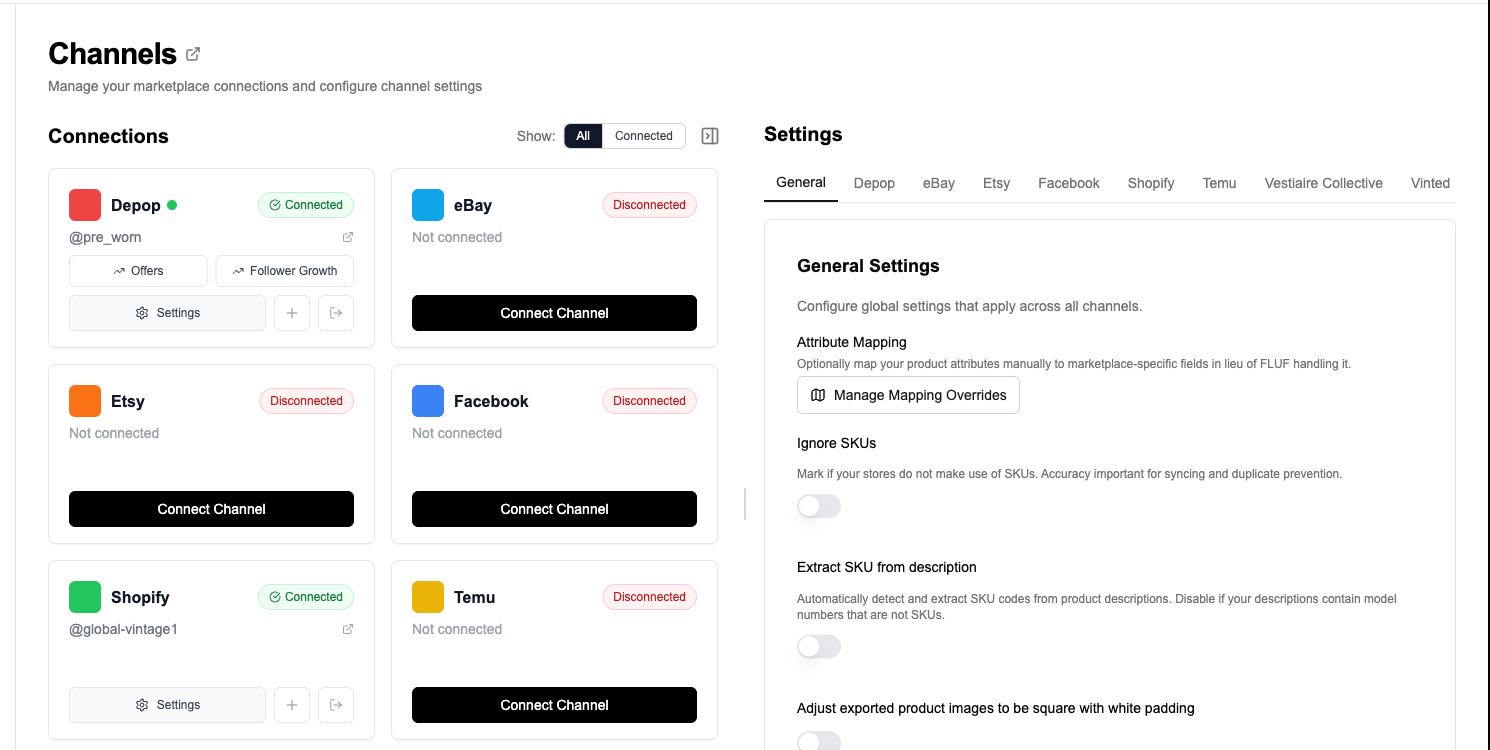
FLUF Connect solves this. It connects Etsy, Shopify, and 7 other marketplaces — including Depop, eBay, Vinted, and Facebook Marketplace — with automatic inventory sync across all of them. List once, sell everywhere.
How it works
- Connect your accounts — Link your Etsy shop and Shopify store (plus any other marketplaces) in minutes.
- Crosslist your products — Move listings between platforms individually or in bulk. Set up auto-crosslisting rules to automatically push new products to all connected channels.
- Sync automatically — When a product sells on Etsy, FLUF removes it from Shopify and every other connected marketplace. Stock levels, prices, and order data stay in sync.
| FLUF Connect Feature | Etsy | Shopify |
|---|---|---|
| Crosslisting | Yes — to/from all channels | Yes — to/from all channels |
| Inventory sync | Yes — real-time | Yes — real-time |
| Order sync | Yes (via Shopify) | Native |
| Bulk operations | Yes — find & replace, bulk pricing, bulk crosslist | Yes — find & replace, bulk pricing, bulk crosslist |
The real power of FLUF Connect isn’t just Etsy + Shopify — it’s Etsy + Shopify + Depop + eBay + Vinted + Facebook Marketplace, all managed from one dashboard. Every marketplace you add increases your exposure to different buyer pools without multiplying your workload.
Pricing: Free 30-day trial with full access. Plans start at £19/month for 500 products. No credit card required to start. See full pricing.
Frequently Asked Questions
Etsy is better for beginners. You can list your first product in minutes, pay nothing upfront, and immediately access 86 million active buyers. Shopify requires more setup and you need to drive your own traffic.
It depends on volume. Etsy charges 10-12% per sale with no monthly cost. Shopify charges £19/month + 2.9% + £0.30 per sale. Above roughly 10 sales of £30/month, Shopify is cheaper per sale. But Etsy fees include built-in traffic.
Yes, and many sellers do. Use Etsy for product discovery and new customers, Shopify for brand identity and repeat customers. Tools like FLUF Connect keep inventory synchronised automatically.
No. Many successful sellers use both. Etsy provides built-in traffic and discovery. Shopify gives you brand control and customer data ownership. They complement each other.
Etsy restricts sellers to handmade items, vintage goods (20+ years old), craft supplies, and digital downloads. Shopify has virtually no product restrictions.
If you earn over 10000/year on Etsy, almost certainly. Etsys mandatory Offsite Ads (12-15% on attributed sales) eat into margins. A Shopify store gives you a direct sales channel with lower fees.
Yes. FLUF Connect supports automatic crosslisting between Etsy and Shopify, along with inventory sync, bulk operations, and order management.
Etsy promotes your listings on Google, Facebook, and Instagram. If a buyer clicks and purchases within 30 days, Etsy charges 12-15% on top of all other fees. Above 10000/year in sales, they are mandatory.
Start on Etsy. Its buyer base specifically seeks handmade goods and you benefit from built-in traffic. As you grow, add Shopify for higher margins and brand building, but keep Etsy running.
Start Crosslisting for Free Today
500 free crosslistings. No credit card. Set up in under 10 minutes.