
Vinted vs Etsy: Which Is Better for Sellers in 2026?
A side-by-side comparison of fees, audience, features, shipping, and what real sellers think — plus how to sell on both automatically.



- Choose Vinted if: you sell everyday secondhand fashion, mid-range brands, electronics, or homeware and want zero seller fees, fast sales, and a massive European audience.
- Choose Etsy if: you sell handmade goods, craft supplies, or true vintage items (20+ years old) and want a curated marketplace where buyers pay premium prices for unique, creative products.
- Fees: Vinted charges sellers £0 — buyers pay a 3–8% protection fee. Etsy charges sellers £0.16 per listing + 6.5% transaction fee + 4% + £0.20 processing. On a £30 sale: keep £30 on Vinted vs ~£26.49 on Etsy.
- Audience: Vinted has 100M+ registered members (75M+ monthly active). Etsy has 87 million trailing-twelve-month active buyers who spend $121 per buyer annually.
- Watch out: Etsy’s mandatory offsite ads (12–15%) kick in above $10,000/year — pushing total fees past 25%. Vinted has no equivalent.
- Best strategy: Sell on both — secondhand fashion on Vinted, handmade and premium vintage on Etsy. Cross-list free with FLUF Connect.
Vinted vs Etsy at a Glance
Vinted and Etsy occupy different corners of the resale world. Vinted is Europe’s largest secondhand marketplace — built for everyday fashion, electronics, and homeware, with zero seller fees and over 100 million registered members. Etsy is a global marketplace for handmade goods, craft supplies, and true vintage items (20+ years old), where 87 million active buyers seek unique, creative products and are willing to pay premium prices.
Vinted was founded in 2008 in Vilnius, Lithuania, by Milda Mitkutė and Justas Janauskas. What began as a wardrobe-swapping app between friends has become one of Europe’s most successful marketplaces, surpassing €10 billion in GMV and €813 million in revenue in 2024. Vinted’s defining feature is its zero-fee model for sellers: the platform monetises through buyer protection fees rather than seller commissions.
Etsy was founded in 2005 in Brooklyn, New York, by Rob Kalin, Chris Maguire, and Haim Schoppik. Purpose-built for artisans and makers, Etsy has grown into the world’s largest handmade and vintage marketplace. In Q4 2025, Etsy reported 86.5 million active buyers spending an average of $121 per year, generating $2.9 billion in annual revenue. Unlike Vinted, Etsy charges sellers a layered fee structure — listing fees, transaction fees, payment processing, and potentially offsite ads.
| Vinted | Etsy | |
|---|---|---|
| Founded | 2008 | 2005 |
| Headquarters | Vilnius, Lithuania | Brooklyn, New York |
| Registered members / active buyers | 100M+ registered (75M+ MAU) | 87 million TTM active buyers |
| Countries | 26 (Europe + US) | Global (Etsy Payments in 40+ countries) |
| Top markets | France, Germany, UK, Netherlands, Italy | US, UK, Germany, Canada, Australia |
| Best for | Secondhand fashion, electronics, homeware | Handmade, vintage (20+ years), craft supplies |
| Seller fees | £0 — zero seller fees | ~11.7% total (listing + transaction + processing) |
| Avg spend per buyer | Low-to-mid (mass market) | $121/year per active buyer |
| Mobile app | Yes — mobile-first, clean design | Yes — buyer-focused with seller tools |
For a deeper look at each platform, see our full guides: How to Sell on Vinted. An Etsy overview page is coming soon.
Vinted vs Etsy: Feature-by-Feature Comparison
Vinted is built for speed and simplicity — list fast, sell fast, pay nothing. Etsy is built for creative commerce — shop branding, SEO-driven discovery, and product storytelling. The feature sets reflect these different philosophies.
| Feature | Vinted | Etsy |
|---|---|---|
| Listing fee | Free — unlimited | £0.16 per listing (auto-renews every 4 months) |
| Seller commission | None — buyers pay protection fee | 6.5% transaction fee + 4% + £0.20 processing |
| Offer/haggle system | Yes — Make an Offer + bundle discounts | Yes — Make an Offer |
| Seller analytics | Basic — views, favourites | Moderate — Stats with traffic sources, revenue, search terms |
| Promoted listings | Bumps (from £1) + Wardrobe Spotlight (£6.95/7 days) | Etsy Ads (CPC, daily budget) + mandatory Offsite Ads |
| Shop customisation | Minimal — profile photo and bio | Strong — banner, logo, about section, shop sections, custom URL |
| Integrated shipping labels | Yes — Evri, Yodel, InPost, Royal Mail, DPD, DHL | Yes — USPS, FedEx, Royal Mail, Canada Post |
| Buyer protection | Yes — Buyer Protection (buyer-paid) | Yes — Etsy Purchase Protection |
| Social features | Strong — followers, bundles, chat | Moderate — favourites, shop followers, teams |
| Digital product sales | No | Yes — native digital download delivery |
| Multi-quantity listings | No — one item per listing | Yes — quantity and variations |
| Handmade verification | No — secondhand focus | Yes — production partners must be disclosed |
| Categories | Fashion, electronics, home, sports, hobbies, pets | Handmade, vintage (20+ years), craft supplies only |
| Business seller programme | Vinted Pro (free, no commission) | Etsy Plus ($10/month — limited extras) |
Two standout differences: Etsy’s native digital download system is a major advantage for sellers of printables, patterns, and digital art — a category with zero shipping costs and infinite scalability. Vinted’s bundle offer system lets sellers combine multiple items into discounted deals, driving higher order values and clearing inventory faster.
Listing Experience: Vinted vs Etsy
Vinted is the faster platform to list on — most items go live in under two minutes. Etsy rewards sellers who invest more time in descriptions, tags, and storytelling, with better search visibility as the payoff.
On Vinted, you take photos, select a category, enter brand and size, describe the item, and set a price. The app is intuitive and guides you through each step. There are no SEO tags to optimise, no listing fees to worry about, and no approval process — your item goes live immediately. As one seller put it: “Vinted is definitely easier, and you just print out a prepaid label to post.”
On Etsy, you upload up to 10 photos and 1 video, write a title (up to 140 characters), craft a description that tells the story of your product, add up to 13 tags for search visibility, set attributes (material, colour, dimensions), and set a price. Etsy’s search algorithm rewards descriptive, keyword-rich listings — sellers who invest in compelling descriptions and relevant tags consistently appear higher in search results. As one seller noted: “If you don’t take the time to create proper Etsy listings it is not worth listing there.”
Photography expectations differ. Vinted buyers expect authentic, casual smartphone photos — the item as it actually is. Etsy buyers expect styled, lifestyle photography: products in use, on attractive backgrounds, with close-ups of materials and craftsmanship. 70% of Etsy buyers rank high-quality visuals as critical to their purchase decision.
Time to list: 1–2 minutes on Vinted, 3–5 minutes on Etsy (more for items requiring detailed descriptions). If you sell on both, FLUF Connect’s crosslisting lets you list once and push to both simultaneously.
Fees Compared: How Much Do Vinted and Etsy Actually Cost?
This is where Vinted and Etsy diverge most dramatically. Vinted charges sellers absolutely nothing. Etsy layers multiple fees on every sale — and for successful sellers, mandatory offsite ads can push total costs past 25%.
Fee Breakdown
| Fee Type | Vinted | Etsy |
|---|---|---|
| Listing fee | Free — unlimited | £0.16 per listing (renews every 4 months) |
| Transaction / commission | £0 | 6.5% of total order (incl. shipping) |
| Payment processing | £0 | 4% + £0.20 per transaction (UK) |
| Regulatory operating fee | None | 0.32% (UK) |
| Offsite ads | None | 12–15% if buyer came via offsite ad (mandatory above $10K/year) |
| Currency conversion | None | 2.5% when currencies differ |
| Promoted listings | Bumps from £1; Spotlight £6.95/7 days (optional) | Etsy Ads — CPC, daily budget (optional) |
| Subscription | None | Etsy Plus $10/month (optional) |
- Vinted: Zero seller fees = You keep £30.00
- Etsy (no offsite ad): Listing £0.16 + Transaction £1.95 (6.5%) + Processing £1.40 (4% + £0.20) + Regulatory £0.10 = You keep £26.39
- Etsy (with offsite ad, 15%): Above fees + Offsite ad £4.50 = You keep £21.89
Etsy’s offsite ads are the biggest hidden cost. Reddit sellers call offsite ads “an absolute profit vampire” because the 12–15% fee stacks on top of all other fees. Crucially, once you earn over $10,000 per year, you cannot opt out — offsite ads become mandatory. One seller documented $124 in offsite ad fees on just $950 in sales in a single month. Vinted has no equivalent — its only paid visibility tools are optional Bumps and Wardrobe Spotlight.
Etsy’s listing fee also adds up quietly. The £0.16 per listing auto-renews every 4 months whether the item sells or not, and charges again when an item sells if stock remains. For sellers with hundreds of listings, these recurring micro-fees accumulate into a meaningful cost — one seller reported losing money because “I kept losing money” on listing fees alone.
Payouts: How Quickly You Get Your Money
| Vinted | Etsy | |
|---|---|---|
| Payout trigger | 2 days after delivery confirmed (auto-confirmed) | Varies — typically next scheduled deposit |
| Payout method | Bank transfer or Vinted Wallet (use for purchases) | Bank transfer |
| Time to bank | 2–5 working days after withdrawal | Typically daily or weekly deposits |
| New seller holds | Standard (2 days post-delivery) | Up to 3–7 days after delivery |
| Fee deduction | N/A — no fees to deduct | Fees auto-deducted from each sale before deposit |
Vinted’s payout is straightforward: buyer confirms receipt (or it auto-confirms after 2 days), funds go to your Vinted Wallet, and you transfer to your bank within 2–5 working days. Etsy deposits on a schedule (daily, weekly, or less frequent for new sellers), with all fees pre-deducted — so the amount hitting your bank is already net of Etsy’s cut.
Audience and Demand: Who Is Buying on Vinted vs Etsy?
Vinted and Etsy attract fundamentally different buyer types with different expectations and different willingness to pay. This is why selling on both works — there is almost no overlap in what buyers search for on each platform.
| Vinted | Etsy | |
|---|---|---|
| Active buyers | 75M+ monthly active users | 87 million TTM active buyers |
| Avg annual spend per buyer | Low-to-mid | $121 per buyer per year |
| Buyer profile | Bargain-seekers, fashion shoppers, sustainability-conscious | Craft enthusiasts, collectors, gift shoppers, home decorators |
| Price sensitivity | Very high — expects deals, lowball offers common | Moderate — pays premium for handmade and unique |
| Eco-consciousness | High — circular fashion is core to Vinted’s brand | Very high — 98% of Etsy buyers identify as eco-conscious |
| Top selling categories | High-street fashion, sportswear, kids’ clothes, electronics | Handmade jewellery, home décor, digital downloads, craft supplies, vintage |
| Search behaviour | Browse-led — scrolling a feed, filtering by brand/size | Search-led — keyword searches, curated collections |
Vinted’s audience is massive, fashion-focused, and bargain-hunting. Buyers expect secondhand pricing — lowball offers are part of the culture. Sellers report that everyday items sell “significantly faster on Vinted” than on any other platform. The speed advantage comes from sheer volume: with 75M+ monthly active users across Europe, there is always someone looking for what you are selling.
Etsy’s audience is creative, intentional, and higher-spending. Buyers come to Etsy for things they cannot get elsewhere — personalised gifts, handmade jewellery, vintage home décor, digital planners and printables. 54% of Etsy sellers also sell on other channels, and 95% run their business from home. Etsy’s search algorithm rewards sellers who invest in SEO — optimised titles, tags, and descriptions — which makes discoverability more skill-dependent than Vinted’s feed-based browsing.
Category guidance: Vinted dominates for secondhand clothing (Zara, H&M, Nike, Adidas), kids’ wear, electronics, and everyday homeware. Etsy dominates for handmade jewellery, art prints, digital downloads, personalised gifts, wedding items, and vintage home décor. For vintage fashion specifically, both work — but Etsy requires items to be 20+ years old, while Vinted has no age restriction.
Shipping: Vinted vs Etsy
| Vinted | Etsy | |
|---|---|---|
| Integrated shipping labels (UK) | Yes — Evri, Yodel, InPost, Royal Mail, DPD, DHL | Yes — Royal Mail (UK), USPS, FedEx (US/CA) |
| Who pays shipping | Buyer selects carrier and pays at checkout | Buyer pays, or seller offers free shipping |
| Shipping deadline | 5 business days | Seller sets own handling time |
| International shipping | Within Vinted’s 26 markets | Global — sellers set international shipping options |
| Large items | Yes — AnyVan integration for furniture/heavy items | Seller arranges own |
| Tracking | Included with prepaid labels | Recommended for Star Seller badge |
Vinted’s shipping experience is more streamlined in the UK: the buyer selects a carrier at checkout, a prepaid label is generated automatically, and the seller drops the parcel at a collection point. Six UK carriers are integrated, including AnyVan for large items. Etsy offers shipping labels in fewer markets and gives sellers more control (and more complexity) over shipping configuration.
Etsy has a global shipping advantage — sellers can ship to buyers worldwide and set their own international rates. Vinted’s shipping is limited to within its 26 market countries, though UK-to-US cross-border shopping was recently enabled.
What Real Sellers Say About Vinted vs Etsy
“My new Etsy listings began to sell almost immediately and soon outpaced my eBay sales by 10 to 1.”
“The price you list it for is what you get.”
— Vinted seller, on the zero-fee model
“I find it frustrating that Etsy, in order to keep showing increases, they come up with a new seller fee.”
“If you want higher-value sales and enjoy creating a visually appealing brand, Etsy is the better fit. If you prioritise ease, speed, and keeping every penny of your earnings, Vinted will serve you better.”
Common themes from sellers who use both:
- Vinted’s strengths: zero fees, massive audience, fast sales for everyday items, simple listing process, excellent UK carrier integration, sustainable/circular fashion positioning.
- Vinted’s frustrations: constant lowball offers, weak seller protection for disputes, automated systems that can ban legitimate sellers, buyers who expect everything at rock-bottom prices.
- Etsy’s strengths: higher prices on unique items, creative shop branding, SEO-driven discoverability, digital product sales, loyal repeat buyers, strong for handmade and vintage.
- Etsy’s frustrations: mandatory offsite ads above $10K/year, listing fees that auto-renew even on unsold items, mass-produced goods flooding the marketplace, and a take rate that reached 24.5% in Q4 2025.
- The consensus: sellers who list on 3+ marketplaces have a sell-through rate 180% higher than those using fewer platforms.
How to Choose Between Vinted and Etsy
- Sell everyday secondhand fashion, high-street brands, sportswear, or kids’ clothing
- Want zero seller fees — keep 100% of your listed price
- Also sell electronics, homeware, or sporting goods
- Sell in volume and need fast turnover with a massive European audience
- Prefer a simple, mobile-first listing experience
- Sell handmade goods — jewellery, art, ceramics, candles, clothing you design
- Sell true vintage items (20+ years old) to collectors willing to pay premium prices
- Sell digital products — printables, patterns, templates, digital art
- Sell craft supplies and materials
- Want to build a brand with shop customisation and storytelling
For vintage sellers specifically: Etsy requires items to be 20+ years old to qualify as “vintage,” and its buyers are willing to pay fair-to-premium prices for curated vintage finds — particularly home décor, jewellery, and art. Vinted has no age restriction on items, so recent secondhand and older vintage sit side by side. Vintage fashion under 20 years old (90s/Y2K pieces, for example) performs well on Vinted. True collectible vintage performs better on Etsy.
The practical answer: most sellers benefit from listing on both. Vinted captures the high-volume, everyday-fashion buyer. Etsy captures the craft-and-vintage enthusiast who pays more for unique items. The audiences barely overlap.
Why Not Both? Sell on Vinted and Etsy at the Same Time
Limiting yourself to one platform means missing the other’s buyers entirely. Vinted’s 75 million+ monthly active users are primarily looking for affordable secondhand fashion. Etsy’s 87 million active buyers are searching for handmade, vintage, and unique items. A vintage Levi’s jacket might sell in a day on Vinted at £25 — or in a week on Etsy at £45. Listing on both captures both outcomes.
The operational challenge: Vinted and Etsy have different listing formats, different photo expectations (casual vs styled), and different category systems. If a vintage dress sells on Vinted, you need to immediately remove it from Etsy to avoid overselling. Managing this manually across hundreds of listings is impractical.
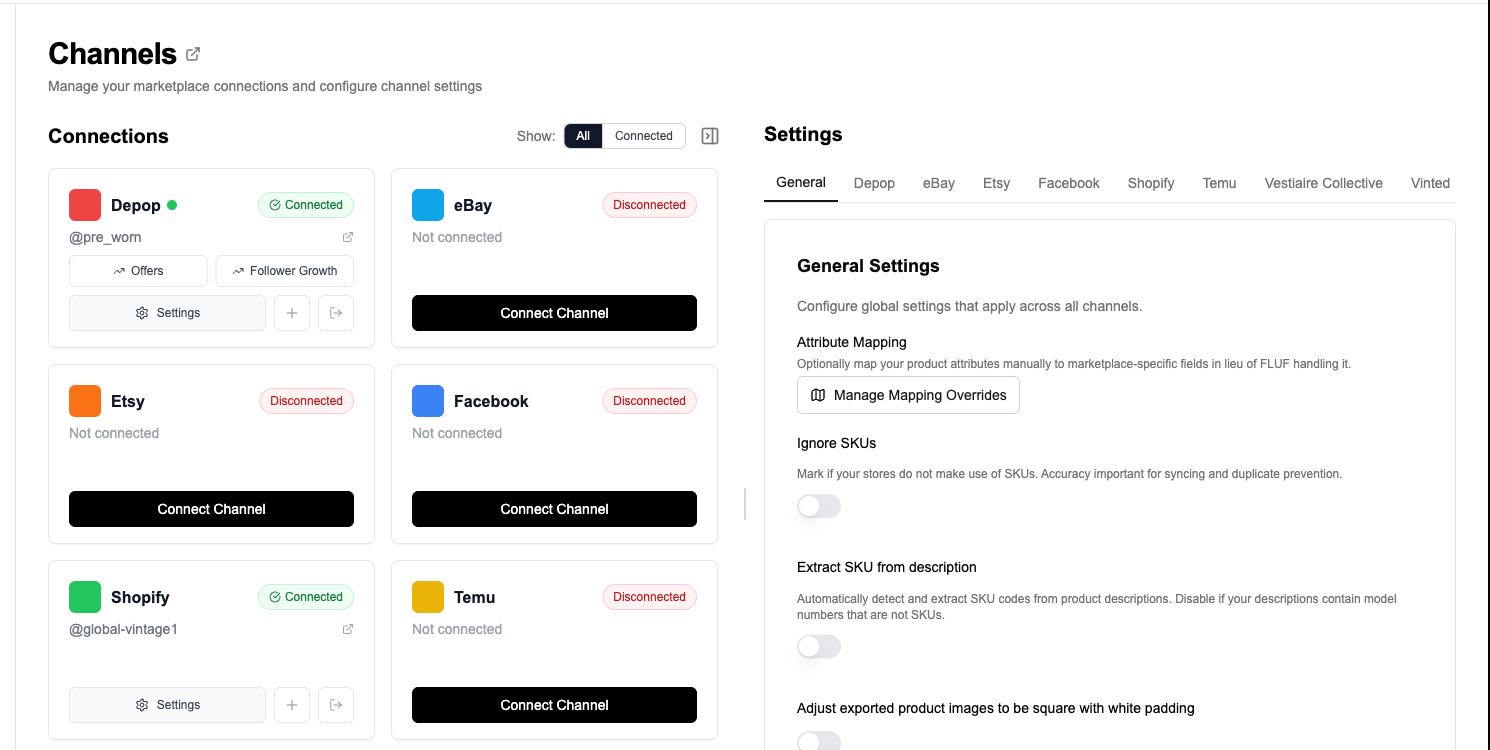
FLUF Connect automates this. List your products once, crosslist to Vinted, Etsy, and seven other marketplaces, and FLUF handles real-time inventory sync. When an item sells on one platform, it is automatically removed from the others.
| FLUF Connect Feature | Vinted | Etsy |
|---|---|---|
| Crosslisting | Yes | Yes |
| Inventory sync | Yes | Yes |
| Auto-relisting | Yes | Not yet |
| Offer management | Yes | Not yet |
| Order sync | Yes | Yes (via Shopify) |
| Bulk operations | Yes | Yes |
Vinted has full feature support in FLUF Connect, including automated relisting and offer management — both included free. Etsy supports crosslisting, inventory sync, order sync, and bulk operations, with relisting and offer management planned for future release.
Free for 30 days, no credit card required. Then from £19/month for up to 500 products.
Related Guides
- How to Sell on Vinted — our complete Vinted seller guide
- Etsy Crosslisting — crosslist to Etsy automatically
- Depop vs Vinted — fashion marketplace comparison
- eBay vs Etsy — marketplace comparison
- Vinted vs Vestiaire Collective — luxury vs everyday comparison
- Auto-Relist Your Listings — keep listings fresh on Vinted
Frequently Asked Questions
Vinted is better for everyday secondhand fashion — zero seller fees, massive audience, fast sales. Etsy is better for handmade goods, craft supplies, and true vintage items (20+ years old) where buyers pay premium prices. Many sellers use both to reach different audiences — cross-listing free with FLUF Connect.
Vinted charges sellers zero fees — buyers pay a 3-8% protection fee. Etsy charges sellers a £0.16 listing fee, 6.5% transaction fee, and 4% + £0.20 payment processing. On a £30 sale, you keep £30 on Vinted versus roughly £26.49 on Etsy. If Etsy's offsite ads trigger, fees climb even higher.
Yes. Vinted excels at everyday fashion, while Etsy serves handmade and vintage buyers willing to pay more. FLUF Connect automates crosslisting and inventory sync between both platforms plus seven others, so you never oversell.
It depends on the type of vintage. Etsy requires items to be 20+ years old and attracts collectors willing to pay premium prices for curated vintage. Vinted has no age requirement — anything secondhand can be listed — and sells vintage fashion faster but at lower prices. For high-value vintage, Etsy commands better margins. For everyday vintage fashion, Vinted moves items quicker.
Vinted is easier — list in under two minutes with zero fees and no learning curve. Etsy requires understanding listing fees, SEO tags, transaction fees, and shop setup. However, Etsy's guided seller tools and Seller Handbook help new sellers learn quickly.
Etsy has slightly more active buyers — 87 million trailing-twelve-month buyers versus Vinted's 75+ million monthly active users across 100 million registered members. However, Vinted's buyers are concentrated in fashion, while Etsy's span handmade, vintage, and craft supplies.
Yes. FLUF Connect lets you crosslist to Vinted, Etsy, and seven other marketplaces. List once, push to both, and inventory syncs automatically. Vinted also gets auto-relisting and offer management included free.
Vinted is faster — funds release 2 days after delivery confirmation, then 2-5 working days to your bank. Etsy deposits vary by account standing — typically daily or weekly, but new sellers may face longer holds.
Vinted is primarily a secondhand marketplace — handmade items are not its core focus and may not perform well. Etsy is purpose-built for handmade goods, with buyers who specifically seek artisan products and are willing to pay premium prices. For handmade, Etsy is the clear choice.
Etsy promotes your listings on Google, Facebook, and other sites. If a buyer clicks and purchases within 30 days, Etsy charges 15% (or 12% above $10,000/year revenue). Sellers under $10,000 can opt out; above $10,000 it is mandatory. Vinted has no equivalent — its only paid visibility tools are Bumps and Wardrobe Spotlight.
Start Crosslisting for Free Today
500 free crosslistings. No credit card. Set up in under 10 minutes.