
Vinted vs Facebook Marketplace: Which Is Better for Sellers in 2026?
A side-by-side comparison of fees, audience, safety, shipping vs local pickup, and what real sellers think — so you can choose the right platform (or use both).



- Choose Vinted if: you sell clothing, shoes, and accessories and want zero seller fees, built-in shipping labels, and buyer protection on every sale.
- Choose Facebook Marketplace if: you sell furniture, electronics, or bulky items locally — no fees on local pickup, instant cash, and the largest audience on earth.
- Fees: Vinted charges sellers nothing (buyer pays ~5% + £0.70 protection fee). Facebook Marketplace is free for local pickup; shipped items incur a 10% selling fee.
- Audience: Vinted has 75+ million monthly active users across 26 countries. Facebook Marketplace has over 1 billion monthly users in 228 countries.
- Safety: Vinted holds payment in escrow and handles shipping — no stranger meetups. Facebook Marketplace local sales are between buyer and seller directly — no payment protection.
- Best strategy: Use both — Vinted for postable items (fashion, accessories, books), Facebook Marketplace for bulky local items (furniture, appliances). Sync inventory with FLUF Connect.
Vinted vs Facebook Marketplace at a Glance
Vinted and Facebook Marketplace are two of the most popular places to sell second-hand items, but they work in fundamentally different ways. Vinted is a dedicated second-hand marketplace with built-in shipping, buyer protection, and zero seller fees — optimised for fashion and postable items. Facebook Marketplace is a local classifieds platform integrated into Facebook, covering everything from clothing to cars — strongest for local pickup transactions with no fees at all.
Vinted was founded in Vilnius, Lithuania in 2008 and has grown into Europe’s largest second-hand fashion platform, surpassing €10 billion in annual GMV in 2025 with 75+ million monthly active users across 26 countries. Facebook Marketplace launched in 2016 as part of Facebook’s ecosystem and now reaches over 1 billion monthly users in 228 countries — making it the world’s largest peer-to-peer selling platform by sheer reach.
| Vinted | Facebook Marketplace | |
|---|---|---|
| Type | Dedicated second-hand marketplace | Local classifieds platform (within Facebook) |
| Founded | 2008 (Vilnius, Lithuania) | 2016 (part of Meta/Facebook) |
| Monthly active users | 75+ million | 1+ billion |
| Countries | 26 | 228 |
| Top markets | France, UK, Germany, Netherlands, Spain | US, UK, Canada, Australia |
| Best for | Fashion, shoes, accessories, kids’ clothes, homeware | Furniture, electronics, vehicles, local items, everything |
| Seller fees | None | None (local pickup) / 10% (shipped items) |
| Primary selling model | Ship to buyer (national/international) | Local pickup (buyer collects) |
| Payment protection | Yes — escrow via Vinted Wallet | No (local pickup) / Yes (shipped via checkout) |
| Mobile app | iOS & Android (dedicated app) | Within the Facebook app |
Vinted vs Facebook Marketplace: Feature-by-Feature Comparison
Vinted is purpose-built for selling second-hand items with structured tools, buyer protection, and integrated shipping. Facebook Marketplace is a more open platform — enormous reach but fewer seller tools and protections, especially for local transactions.
| Feature | Vinted | Facebook Marketplace |
|---|---|---|
| Fixed-price listings | Yes | Yes |
| Offer/haggle system | Yes (Make Offer + counter-offers) | Yes (Make Offer button + Messenger negotiation) |
| Built-in messaging | Yes (in-app chat) | Yes (Facebook Messenger) |
| Integrated shipping labels | Yes — buyer selects carrier, prepaid label generated | Discontinued (Feb 2025) — sellers arrange own shipping |
| Local pickup option | No (shipping only) | Yes — the primary selling model |
| Buyer protection | Yes — payment held in escrow, 2-day claim window | Limited — Purchase Protection on shipped items only |
| Seller verification | ID at payout threshold (Mangopay KYC) | Facebook account required; optional ID verification |
| Promoted listings | Yes — Item Bump (~£0.75–£5), Closet Spotlight (~£6.95/7 days) | Yes — boost as Facebook ad |
| Vacation mode | Yes | No |
| Seller ratings/reviews | Yes — star ratings after each transaction | Yes — buyer/seller ratings |
| Item categories | Fashion, kids, homeware, electronics, books | Everything — vehicles, property, furniture, fashion, electronics, free items |
| Cross-border selling | Yes — within EU + UK-US pilot | Limited — primarily local |
| AI listing tools | No | Yes (Mar 2026) — AI auto-generates listings from photos |
The core difference: Vinted is a structured selling experience with protections built in. Facebook Marketplace is more like a digital car boot sale — massive reach, total flexibility, but you’re largely on your own for payment and logistics.
Listing Experience: Vinted vs Facebook Marketplace
Both platforms make it quick to list items — you can go from photos to live listing in under 5 minutes on either. The experience differs in structure and polish.
Vinted
Vinted’s listing flow is structured and guided. You upload up to 20 photos, select a category, enter brand, size, colour, and condition from dropdown menus, write a title and description, and set your price. The structured fields help buyers find your item through search and filters. Descriptions don’t need to be elaborate — accurate detail about condition and measurements is what matters. The app is mobile-first and optimised for listing items quickly.
Facebook Marketplace
Facebook Marketplace is more freeform. You upload photos, write a title and description, set a price, choose a category, and specify your location. There are fewer structured fields — no mandatory brand, size, or condition dropdowns for most categories. As of March 2026, Meta AI can auto-generate listing titles and descriptions from your photos, making listing even faster. The trade-off is less search precision — buyers rely more on keywords and browsing than structured filters.
Which is easier?
Both are easy, but for different reasons. Vinted’s structured form ensures your listing is complete and searchable. Facebook Marketplace’s freeform approach is faster for a quick listing, especially with the new AI tools, but produces less consistent results. For clothing, Vinted’s structured fields (size, brand, condition) make a noticeable difference in discoverability.
Fees Compared: How Much Do Vinted and Facebook Marketplace Actually Cost?
Both platforms position themselves as fee-free for sellers — and for the most common use cases, that’s true. Vinted charges sellers nothing at all, with the buyer paying a protection fee. Facebook Marketplace charges nothing for local pickup transactions, which are the majority of sales. The fees diverge for shipped items on Facebook, where a 10% selling fee applies.
| Fee Type | Vinted | Facebook Marketplace |
|---|---|---|
| Listing fee | Free | Free |
| Seller commission | None | None (local pickup) / 10% (shipped items) |
| Payment processing | None to seller | None (local) / included in 10% fee (shipped) |
| Buyer protection fee | ~5% + £0.70 (paid by buyer) | None (local) / included (shipped) |
| Promoted listings | Item Bump: ~£0.75–£5 (pay upfront) | Boost as ad (variable cost) |
| Subscription | None | None |
- Vinted: £30.00 − £0.00 seller fees = You keep £30.00 (buyer pays ~£2.20 protection fee separately)
- Facebook Marketplace (local pickup): £30.00 − £0.00 fees = You keep £30.00 (cash or direct payment)
- Facebook Marketplace (shipped): £30.00 − £3.00 selling fee (10%) = You keep £27.00
For fashion items you can post, Vinted and Facebook Marketplace local are equally free for sellers. But the economics differ in practice: Vinted buyers expect to pay the buyer protection fee on top, which can make them haggle harder. Facebook local buyers pay exactly the listed price in cash — but you deal with no-shows, lowballers, and the logistics of meetups.
If you’re shipping items on Facebook Marketplace, the 10% fee makes it significantly more expensive than Vinted. For shipped fashion items, Vinted is the clear winner on fees.
Payout speed
| Vinted | Facebook Marketplace | |
|---|---|---|
| Local pickup | N/A (no local pickup) | Instant — cash or direct payment at meetup |
| Shipped items | Vinted Wallet (2 days after delivery confirmation) → bank (2–5 days) | 5 business days after delivery confirmation |
| Fastest possible | ~4–7 days from sale to bank | Instant (local cash) or ~7–10 days (shipped) |
Facebook Marketplace’s killer advantage: instant cash on local pickup. No waiting, no processing, no holds. If cashflow matters to you — and for many casual sellers it does — local pickup on Facebook is unbeatable. Vinted’s escrow system is slower but safer.
Audience and Reach: Who’s Buying on Vinted vs Facebook Marketplace?
Facebook Marketplace has a vastly larger audience — over 1 billion monthly users compared to Vinted’s 75+ million. But audience size alone doesn’t determine where your items sell. What matters is whether the right buyers see your listing, and these platforms attract fundamentally different types of shoppers.
| Vinted | Facebook Marketplace | |
|---|---|---|
| Monthly active users | 75+ million | 1+ billion |
| UK users | 17 million (Feb 2026) | ~44 million Facebook users (Marketplace subset unknown) |
| Primary audience | Second-hand fashion buyers, deal-hunters, sustainability-conscious | Local buyers across all categories, bargain hunters |
| Buyer intent | Browsing for specific items (size, brand, style) | Browsing locally — “what’s near me?” |
| Reach | National/international (ships across 26 countries) | Primarily local (within your area) |
| Best-selling categories | Fashion, shoes, kids’ clothes, accessories | Furniture, electronics, vehicles, fashion, free items |
The key distinction is local vs national reach. A buyer on Vinted in London can buy your dress listed in Manchester — it ships. A buyer on Facebook Marketplace typically only sees items within their local area. This means Vinted gives your item exposure to millions of potential buyers across the country, while Facebook Marketplace limits you to whoever lives nearby.
For fashion, this makes Vinted far more effective. Your vintage Levi’s jacket gets seen by fashion-conscious buyers across the UK and Europe, not just people within 30 miles who happen to be browsing. For a sofa or a washing machine, Facebook Marketplace’s local model is the only practical option — nobody’s shipping a sofa.
What sells best where
| Category | Better Platform | Why |
|---|---|---|
| Clothing, shoes, accessories | Vinted | Dedicated fashion audience, structured search by size/brand, national reach |
| Kids’ clothes and toys | Both | Vinted for postable items; FBMP for bulky toys, pushchairs |
| Furniture and appliances | Facebook Marketplace | Local pickup only — too expensive to ship |
| Electronics | Both | FBMP for instant local cash; Vinted for buyer-protected shipped sales |
| Vehicles | Facebook Marketplace | Vinted doesn’t support vehicles |
| Books, DVDs, games | Vinted | Light, easy to post; FBMP buyers won’t drive across town for a book |
| Homeware and decor | Both | Small items on Vinted; large items on FBMP |
| Free items | Facebook Marketplace | Vinted doesn’t support free listings |
Shipping vs Local Pickup: The Strategic Fork
This is the single biggest difference between the two platforms and the most important factor in choosing where to list. Vinted is shipping-only. Facebook Marketplace is primarily local pickup (with an increasingly limited shipped option). Each model has clear advantages.
When shipping (Vinted) wins
- Small, lightweight items — clothing, accessories, books, small electronics. Shipping costs are reasonable and the item reaches a national audience.
- Fashion specifically — buyers search by size, brand, and style. A size 10 dress in Edinburgh needs to reach buyers in London, not just Edinburgh.
- No stranger meetups — you pack it, drop it at a pickup point, done. No coordinating schedules, no strangers at your door.
- Payment protection — Vinted holds the money in escrow until the buyer confirms receipt. If the parcel gets lost, you’re covered.
When local pickup (Facebook Marketplace) wins
- Large, heavy, or fragile items — furniture, appliances, exercise equipment. Shipping a wardrobe would cost more than the wardrobe.
- Instant cash — buyer collects, pays in cash or bank transfer on the spot. No waiting for postage, delivery confirmation, or payout processing.
- No packaging or postage — especially valuable for awkwardly shaped items.
- Zero fees — truly free. No buyer protection fee, no seller fee, no processing fee.
The practical rule: if it fits in a posting bag, list it on Vinted. If it needs a van, list it on Facebook Marketplace. Many sellers use both, matching each item to the platform that suits it best.
Safety and Buyer Protection: Vinted vs Facebook Marketplace
Safety is where these platforms diverge most starkly. Vinted’s model eliminates most risk — everything ships, payment is held in escrow, and you never meet the buyer. Facebook Marketplace’s local pickup model exposes both buyers and sellers to real-world risks.
| Vinted | Facebook Marketplace | |
|---|---|---|
| Payment protection | Yes — escrow (money held until buyer confirms) | No (local pickup) / Purchase Protection (shipped only) |
| In-person meetups required | No — everything ships | Yes (for local pickup) |
| Scam risk | Moderate — fraudulent buyer claims | High — no-shows, fake payments, meetup robberies |
| Dispute resolution | Vinted mediates (2-day claim window) | Limited — Purchase Protection for shipped items only |
| Seller identity protection | Name/address shared only for shipping label | Facebook profile visible; address shared for pickup |
Facebook Marketplace’s safety issues are well-documented. Police departments across the US and UK have set up designated “safe exchange zones” specifically for Marketplace transactions. While most transactions go smoothly, the risk of no-shows, fake payments, and — in extreme cases — robbery during meetups is real and disproportionately affects high-value items like electronics and jewellery.
Vinted’s escrow system eliminates the in-person risk entirely. The buyer pays, Vinted holds the money, you ship the item, and the buyer has 2 days to confirm receipt or raise a dispute. The trade-off is that Vinted’s dispute resolution can favour buyers — sellers occasionally report losing disputes even when they shipped the item correctly and have packaging evidence.
For high-value items, neither platform is ideal. Vinted’s buyer protection caps and dispute system create risk for expensive items. Facebook Marketplace’s lack of any protection on local sales is worse. If you’re selling items worth £200+, consider using both platforms alongside a more structured marketplace like eBay with its established buyer/seller protection.
What Real Sellers Say About Vinted vs Facebook Marketplace
The seller community has strong opinions about both platforms. The consensus: Vinted for clothes, Facebook for furniture, and brace yourself for time-wasters on both.
On what sells where
“Vinted is good for selling clothes but don’t expect to get a lot for each item. Facebook is ok for selling toys and furniture on but a few time wasters. Accept cash only.”
— Mumsnet seller
On Facebook Marketplace’s safety concerns
“The wider Facebook Marketplace is dodgy AF though, lots of scammers and people who aren’t even in the UK, people who will case you out for burglaries, etc.”
On Facebook Marketplace’s buyer quality
“You list a couch on Facebook Marketplace. Within an hour, you get 15 messages. Half are ‘Is this available?’ with no follow-up.”
On Vinted’s strengths
“I’ve sold loads on Vinted! It’s been much better for me than eBay.”
On Vinted’s limitations
“Budget pieces like $15 jeans and $8 sweaters often sold within days. Non-clothing moved at a glacial pace… phone case listings sat unsold for months.”
— Jason Angle, Vinted seller (Nifty.ai)
The common frustrations
Vinted sellers complain about: lowball offers, AI-driven customer service with no human review, and buyers abusing the dispute system. Facebook Marketplace sellers complain about: no-shows for pickups, scam messages, the “Is this still available?” spam with no follow-up, and safety concerns with meeting strangers.
How to Make Your Choice
The choice between Vinted and Facebook Marketplace is less about which is “better” and more about what you’re selling and how you want to sell it. They solve different problems.
- Sell clothing, shoes, accessories, or other postable items
- Want zero seller fees and built-in shipping labels
- Prefer not to meet strangers in person
- Want payment protection on every sale
- Want your items seen by buyers across the country, not just locally
- Sell furniture, appliances, vehicles, or other items too large to post
- Want instant cash with zero fees
- Prefer local transactions with no shipping hassle
- Sell a wide range of item types beyond fashion
- Want access to the largest possible local audience
The practical answer for most sellers: use both. List postable items on Vinted for national reach with buyer protection. List bulky items on Facebook Marketplace for local pickup. Many sellers also crosslist their postable items on Facebook Marketplace to double their exposure — if someone local wants to collect a dress, great. If not, it sells on Vinted and ships.
Why Not Both? Sell on Vinted and Facebook Marketplace at the Same Time
Vinted and Facebook Marketplace are naturally complementary — they serve different item types and buyer behaviours. The smartest sellers list postable items on both platforms simultaneously: Vinted reaches buyers nationally with shipping built in, while Facebook Marketplace catches local buyers who’d prefer to collect.
The challenge is inventory management. When an item sells on Vinted, you need to remove it from Facebook Marketplace (and vice versa) to avoid selling the same item twice. With dozens or hundreds of listings, this quickly becomes unmanageable.
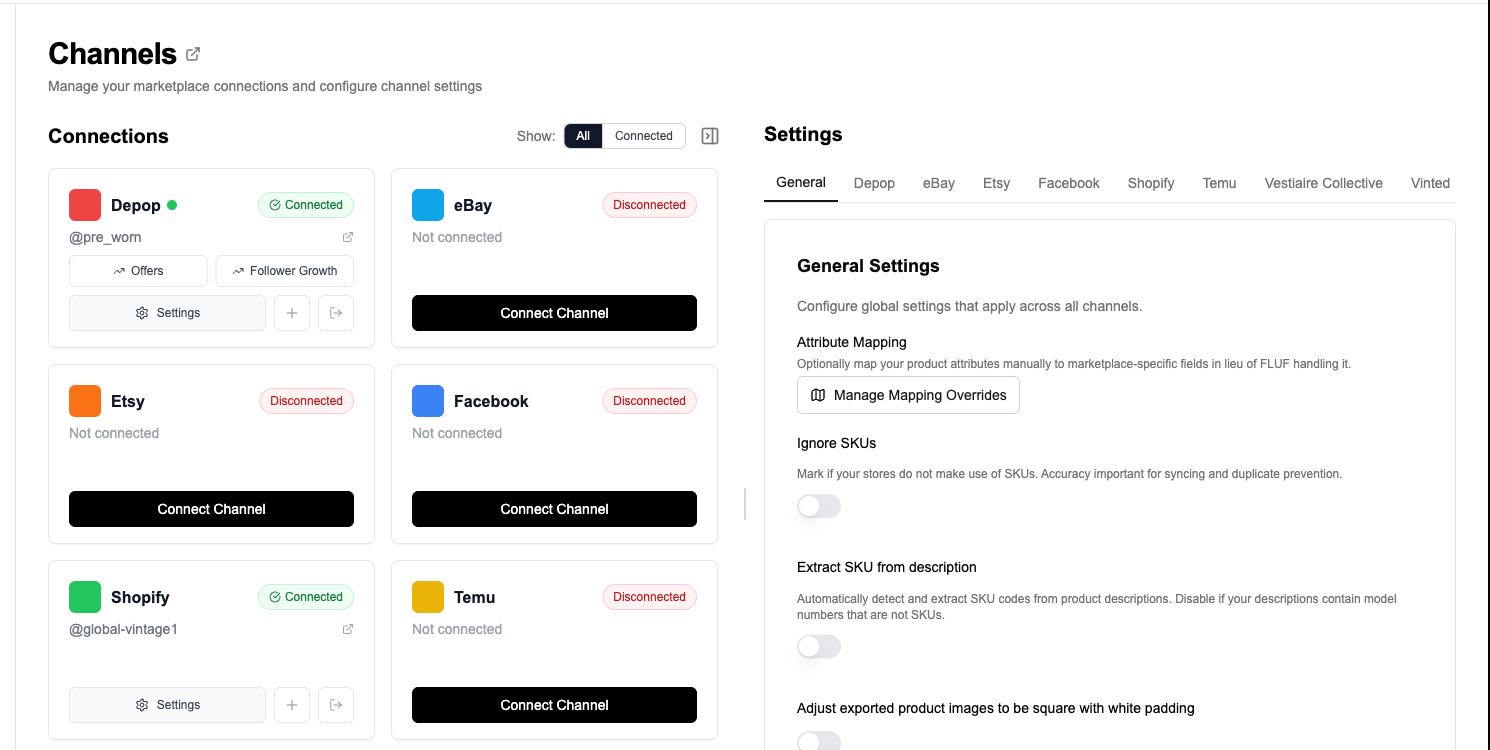
FLUF Connect handles this automatically. It connects Vinted, Facebook Marketplace, and 7 other channels — including Depop, eBay, Shopify, and Etsy — with real-time inventory sync across all of them.
How it works
- Connect your accounts — Link your Vinted and Facebook Marketplace accounts (plus any other marketplaces) in minutes.
- Crosslist your products — Move listings between platforms individually or in bulk. Set up auto-crosslisting rules to push new items to all connected channels.
- Sync automatically — When an item sells on Vinted, FLUF removes it from Facebook Marketplace and every other channel. No double-selling.
| FLUF Connect Feature | Vinted | Facebook Marketplace |
|---|---|---|
| Crosslisting | Yes — to/from all channels | Yes — to/from all channels |
| Inventory sync | Yes — real-time | Yes — real-time |
| Auto-relisting | Yes — smart strategies by age, price, category | No |
| Offer management | Yes — automated offers to likers | No |
| Bulk operations | Yes — find & replace, bulk pricing, bulk crosslist | Yes |
Vinted gets full automation support in FLUF Connect — including relisting and offer management, included free on every plan. Facebook Marketplace gets crosslisting, inventory sync, and bulk operations. Most competitors don’t support either Vinted or Facebook Marketplace at all.
Pricing: Free 30-day trial with full access. Plans start at £19/month for 500 products. No credit card required to start. See full pricing.
Try FLUF Connect Free — Sell on Vinted and Facebook Marketplace Together
Frequently Asked Questions
Vinted is better for selling clothes. It has a dedicated fashion audience, structured search filters, national reach via shipping, and zero seller fees.
Both are free for sellers in their primary use cases. Vinted charges sellers nothing. Facebook Marketplace charges nothing for local pickup. Shipped items on Facebook have a 10% fee.
Local pickup carries real-world safety risks. Always meet in public places, bring someone for high-value items, and accept cash or instant bank transfer only. Shipped items have Purchase Protection but local sales have none.
Yes. List postable items on Vinted for national reach, bulky items on Facebook for local pickup. FLUF Connect keeps inventory synced across both automatically.
Facebook Marketplace has over 1 billion monthly users compared to Vinteds 75+ million. But Vinteds users are specifically looking for second-hand fashion.
Yes. FLUF Connect supports crosslisting between Vinted and Facebook Marketplace with real-time inventory sync.
Facebook Marketplace. Furniture is too large to ship so local pickup is the only practical option. Vinted doesnt support large furniture listings.
Facebook local pickup is instant cash. Vinted holds payment in escrow until the buyer confirms receipt then you withdraw to your bank in 2-5 business days.
Use both. Vinted for kids clothing and small toys that are easy to post. Facebook Marketplace for bulky items like pushchairs, car seats, and large toys.
Start Crosslisting for Free Today
500 free crosslistings. No credit card. Set up in under 10 minutes.