
Whatnot vs Temu: Which Is Better for Sellers in 2026?
A side-by-side comparison of fees, audience, selling format, shipping, and what real sellers think — plus how to sell on both with synced inventory.
7 days for £1, then from £9/month.



- Choose Whatnot if: you sell collectibles (sports cards, TCG, Funko, comics, sneakers) or vintage fashion and want to move inventory fast through live-stream auctions with a loyal community audience.
- Choose Temu if: you manufacture or wholesale new products at scale and want access to 292 million monthly buyers shopping for ultra-low prices — no camera required.
- Fees: Whatnot charges ~12% all-in on a £30 UK sale (you keep £26.33). Temu charges zero commission for many sellers, but controls retail pricing in the Fully Managed model, so your margin depends on the wholesale price Temu agrees to pay.
- Format: Whatnot is live-first — sellers go on camera and run video auctions. Temu is catalogue-based — sellers supply products and Temu handles the storefront.
- Key difference: Whatnot supports secondhand, vintage, and collector items. Temu is new products only — no pre-owned inventory allowed.
- Best strategy: If you sell new products AND collectibles, use both alongside eBay and Vinted. Cross-list with FLUF Connect and sync inventory across all channels.
Whatnot vs Temu at a Glance
Whatnot and Temu are both fast-growing marketplaces that exploded in popularity since 2020, but they serve entirely different seller types and buying experiences. Whatnot is a live-stream commerce platform where sellers run video auctions in real time, primarily for collectibles, trading cards, and vintage fashion. Temu is a mass-market retail marketplace where manufacturers and wholesalers supply new products at ultra-low prices to hundreds of millions of budget-focused buyers worldwide.
Whatnot launched in 2019 in Los Angeles as a Funko Pop authentication service before pivoting to live-stream selling in 2020. It closed a $225 million Series F at an $11.5 billion valuation in October 2025 and generated more than $8 billion in GMV that year. Temu launched in September 2022, owned by PDD Holdings (the company behind China’s Pinduoduo), and grew explosively to approximately 292 million monthly active users and ~$47.5 billion in GMV by 2024 — a 239% increase year-on-year. Temu operates in 90+ countries and became the most downloaded shopping app in the UK in 2024.
| Whatnot | Temu | |
|---|---|---|
| Founded | 2019 (live commerce from 2020) | September 2022 |
| Headquarters | Marina del Rey, California; London (UK/EU) | Boston, Massachusetts; Dublin, Ireland (PDD Holdings) |
| Active users | 20M+ new accounts in 2025 (MAU undisclosed) | 292 million monthly active users |
| GMV | $8 billion+ (2025, doubled YoY) | ~$47.5 billion (2024, +239% YoY) |
| Countries | 9 (US, UK, CA, DE, FR, NL, BE, AT, AU) | 90+ |
| Best for | Sports cards, TCG, sneakers, vintage fashion, collectibles | New products at scale — electronics, homeware, fashion, accessories |
| Product types | New and pre-owned (secondhand, vintage, collector items) | New products only — no secondhand or pre-owned |
| Selling format | Live video auctions + Buy It Now | Catalogue listings (Temu controls storefront) |
| Seller fees | ~12% on a £30 UK sale | Zero commission for many sellers (pricing controlled by Temu) |
| Seller type | Individual resellers, collectors, small businesses | Manufacturers, wholesalers, brands |
| Mobile app | Mobile-first (iOS + Android) | Yes (iOS + Android) — most downloaded shopping app 2024 |
For a deeper dive into each platform individually, read our complete guides: How to Sell on Whatnot and How to Sell on Temu.
Whatnot vs Temu: Feature-by-Feature Comparison
Whatnot and Temu offer fundamentally different selling experiences because they serve different seller profiles. Whatnot is designed for individuals and small businesses selling unique or limited-quantity items through live video. Temu is built for suppliers managing bulk inventory through a structured, platform-controlled process. The differences are less about which is “better” and more about which matches your business model.
| Feature | Whatnot | Temu |
|---|---|---|
| Live-stream selling | Core format — live video auctions and BIN | Not supported |
| Static / catalogue listings | Marketplace BIN (off-stream) — limited discovery | Core format — all sales are catalogue-based |
| Auction format | Live real-time bidding with auto-extend timer | Not supported |
| Secondhand / pre-owned items | Yes — vintage, used, collector items welcome | No — new products only |
| Pricing control | Seller sets starting bid and BIN price | Temu controls retail price (Fully Managed) or targets ~85% of Amazon pricing (Semi-Managed) |
| Offer / haggle system | No formal offer system | No — prices set by platform |
| Seller analytics | Basic (show performance, sales history) | Temu Seller Centre dashboard |
| Promoted listings / ads | Promote, Boost, Bumps (optional) | Available — cost varies by campaign |
| Integrated shipping labels | Yes — free to seller (Royal Mail, DPD) | Platform-managed (Fully Managed); seller-managed (Semi-Managed) |
| Buyer protection | Whatnot Buyer Protection (INAD, counterfeit, damaged) | Temu Purchase Protection (90-day return window) |
| Seller verification / KYC | Application + ID + product video required | Business registration + ID verification |
| Business accounts | No distinction — all sellers treated equally | All sellers are businesses — no individual seller accounts |
| International selling | Cross-border within 9 supported countries | Global — 90+ countries from a single listing |
| Social features | Follows, live chat, giveaways, tipping | Minimal — reviews and ratings only |
| Authenticity programme | Category-specific (sneakers, luxury bags) | None — platform relies on supplier verification |
The critical distinction: Whatnot sellers are performers who build personal audiences and sell unique items at prices determined by live bidding. Temu sellers are suppliers who feed inventory into a platform-controlled retail machine. The skill sets, business models, and inventory types barely overlap.
Listing Experience: Live Shows vs Catalogue Supply
The listing experience on Whatnot and Temu could not be more different — they are not even comparable in the traditional sense. On Whatnot, you create listing cards and then go on camera to present and auction items live. On Temu, you submit product data to the Seller Centre and Temu builds the product page, often controlling the title, pricing, and merchandising.
Whatnot: performance-based live selling
You create listing cards (title, photo, starting price, description) for each item, then schedule a live show. When you go live, you present items one by one on camera, running timed auctions that typically resolve in 30–60 seconds. Buyers bid in real time via the app. Successful Whatnot sellers are entertainers as much as merchants — pacing, personality, and chat engagement determine whether viewers stay and bid. Off-stream, you can list items on Whatnot’s Marketplace for Buy It Now sales, but discovery is limited compared to live shows.
Temu: structured catalogue submission
Selling on Temu is closer to being a supplier than a shopkeeper. In the Fully Managed model, you submit product information (images, descriptions, specifications, wholesale pricing) to Temu’s Seller Centre. Temu reviews the submission, sets the retail price, creates the consumer-facing listing, and handles everything from marketing to customer service. In the Semi-Managed and Local-to-Local models, sellers have more control over pricing and fulfilment, but Temu still targets aggressive below-market pricing.
Time investment
A Whatnot listing card takes 2–5 minutes, but live shows run 1–3 hours covering 50–300+ items, with additional prep and packing time. A Temu product submission takes 10–30 minutes for detailed product data, but once submitted, sales run continuously without seller involvement. Whatnot demands concentrated bursts of high-energy effort; Temu demands upfront product setup followed by passive operations.
Which is easier for beginners?
Neither is “easy” in the way eBay or Vinted are easy. Whatnot requires an application, product video, and willingness to go on camera. Temu requires a registered business, product documentation, and comfort navigating a platform originally designed for Chinese manufacturers. If you are a casual reseller with a box of vintage finds, Whatnot is the more natural fit. If you run a wholesale business sourcing new products, Temu is the more scalable option.
Fees Compared: How Much Do Whatnot and Temu Actually Cost?
Whatnot and Temu take fundamentally different approaches to seller economics. Whatnot charges transparent percentage-based fees on each sale. Temu advertises zero commission for many sellers but controls pricing in ways that effectively determine your margin. Understanding this distinction is essential.
| Fee Type | Whatnot (UK) | Temu |
|---|---|---|
| Registration fee | Free | Free |
| Listing fee | £0 (unlimited) | Free |
| Seller commission | 6.67% + VAT (~8%) on item price | Zero commission for many sellers |
| Payment processing | 2.42% + VAT on total order + £0.25 + VAT per order | Included — no separate charge |
| Pricing control | Seller sets starting bid and BIN price freely | Temu controls retail price (Fully Managed) or targets ~85% of Amazon pricing (Semi-Managed) |
| Monthly subscription | £0 | £0 |
| Promoted listings | Optional (Promote, Boost, Bumps) | Available — cost varies by campaign |
| Penalties | None (standard seller terms) | “Refund without return” penalties up to 5x order amount |
| High-value commission cap | Commission on first $1,500 only (select categories) | N/A — no commission structure |
The Real Cost: Transparent Fees vs Pricing Control
On Whatnot, the maths is straightforward: you set a starting bid or Buy It Now price, buyers pay, and Whatnot takes ~12% in commission plus processing. You know exactly what you keep on every sale, and competitive bidding can push realised prices above your expectations.
On Temu, “zero commission” is technically accurate for many sellers — but the reality is more complex. In the Fully Managed model, Temu buys from sellers at a low wholesale cost and sets the consumer price independently. Your “fee” is effectively built into the gap between your wholesale price and Temu’s retail price. In the Semi-Managed model, sellers have more pricing flexibility, but Temu targets approximately 85% of Amazon’s average price for comparable products.
- Whatnot: Commission 6.67% × £30 = £2.00, + VAT = £2.40. Processing 2.42% × £33.50 + £0.25 = £1.06, + VAT = £1.27. Total fees: £3.67. You keep: £26.33.
- Temu (Fully Managed): Temu controls the £30 retail price. Your wholesale price might be £8–15 depending on the product and negotiation. You keep: £8–15.
- Temu (Semi-Managed): More pricing flexibility, but Temu targets below-market pricing. Margins vary widely by category.
These are fundamentally different economics. On Whatnot, you sell unique or limited items at auction prices you cannot predict (sometimes higher than expected). On Temu, you supply new products at wholesale margins that Temu largely controls. Direct fee comparison is misleading because the business models are so different.
Hidden Costs on Temu
Temu’s “refund without return” policy means buyers can get refunds without shipping items back, and sellers absorb the full loss. Penalties can reach up to 5x the order amount for quality or compliance issues. Return rates on Temu average 10–20% (up to 30% for fashion). These costs do not appear in the fee table but significantly affect real-world margins. Whatnot’s return process is more conventional — buyers return items and sellers receive them before refunds are processed.
Payouts
| Whatnot | Temu | |
|---|---|---|
| Payout method | Bank transfer (GBP for UK) | Bank transfer |
| Payout schedule | On request, after delivery confirmed | Regular settlement cycles — timing varies by seller model and contract |
| New seller holds | 48-hour hold (US); 96-hour additional (UK/EU) | Payment after buyer return window closes (Fully Managed) |
| Fast-track payout | Early Payout Program for established sellers | Not available |
| Payout fee | £0 | £0 |
Audience and Demand: Who Is Buying on Whatnot vs Temu?
Temu has the far larger audience — 292 million monthly active users across 90+ countries versus Whatnot’s 20 million new accounts across 9 countries. But the buyer profiles could not be more different. Temu buyers are bargain hunters browsing for the lowest price on everyday goods. Whatnot buyers are enthusiasts willing to pay premium prices in live-auction environments for items they are passionate about.
| Whatnot | Temu | |
|---|---|---|
| Active users | 20M+ new accounts in 2025 (MAU undisclosed) | 292 million MAU globally |
| Primary age group | 18–35 (collectible and fashion community) | 18–44 (broadest demographic — price-driven) |
| Top markets | US, UK, Germany, France, Australia | US, UK, Germany, France, Australia, and 85+ more |
| UK monthly buyers | Not disclosed | 20 million |
| Best-selling categories | Sports cards, TCG, sneakers, vintage fashion, Funko, beauty | Electronics, homeware, fashion, accessories, beauty, toys |
| Buyer behaviour | Entertainment-driven — 95 min/day, watching shows, impulse bidding | Bargain-driven — browsing deals, flash sales, gamified coupons |
| Average order value | Varies widely (live auctions can spike to hundreds or thousands) | Low — typically £5–£20 per item |
| Repeat buyer rate | Very high (>80% month-on-month for active audiences) | High — driven by constant notifications, deals, and gamification |
Category Strengths
Whatnot dominates live-auction collectibles: sports card breaks, sealed TCG product openings, Funko lots, sneaker drops, and vintage fashion hauls. The live format creates competitive bidding that can push prices well above retail. Beauty (+791% YoY), jewellery (+259%), and electronics (+444%) are growing fast on Whatnot but remain niche compared to Temu’s scale.
Temu dominates mass-market new goods at ultra-low prices: phone accessories, homeware, kitchen gadgets, beauty products, fashion basics, and consumer electronics. Temu’s strength is volume at low margins — products that sell thousands of units per day at £3–£15. If your product is a commodity that competes on price, Temu’s audience dwarfs anything Whatnot can offer.
Growth Trajectory
Both platforms are among the fastest-growing in e-commerce. Whatnot doubled GMV from ~$4 billion (2024) to $8 billion+ (2025). Temu grew GMV from ~$15.1 billion (2023) to ~$47.5 billion (2024). Temu’s absolute scale is larger, but both growth rates are exceptional. Whatnot is expanding deeper into fashion and electronics; Temu is building out its Semi-Managed and Local-to-Local models to attract local sellers and improve delivery speed.
Shipping: Whatnot vs Temu
Shipping on Whatnot and Temu works very differently because the platforms serve different seller models. Whatnot sellers ship individual items directly to buyers using platform-provided labels. Temu handles most shipping centrally, particularly in the Fully Managed model where sellers ship to Temu warehouses and Temu handles last-mile delivery.
| Whatnot | Temu | |
|---|---|---|
| Seller ships directly to buyer | Yes — always | Semi-Managed and Local-to-Local only |
| Platform handles fulfilment | No | Yes (Fully Managed — seller ships to Temu warehouse) |
| UK domestic carrier | Royal Mail (Whatnot-provided label) | Varies by model (Temu logistics or seller choice) |
| International shipping | DPD (Whatnot label) — within 9 countries | Platform-managed — 90+ countries |
| Who pays shipping | Buyer (at checkout) | Often free to buyer (Temu subsidises heavily) |
| Label cost to seller | Free — Whatnot provides the label | Logistics costs vary by model and destination |
| Delivery speed | Standard domestic (2–5 days UK) | 5–15 days (Fully Managed from China); 2–5 days (Local-to-Local) |
| Tracking | Automatic (Whatnot-issued labels) | Automatic (Temu tracking system) |
| Return shipping | Buyer ships return; refund on receipt | “Refund without return” common — buyer keeps item, seller absorbs cost |
The critical difference is the return model. On Whatnot, returns follow conventional marketplace rules — buyers ship items back, and sellers receive them before refunds are processed. On Temu, “refund without return” is common practice: buyers receive a refund without sending the item back, and the seller absorbs the total loss. This policy, combined with return rates of 10–20% (up to 30% for fashion), can significantly erode margins on Temu.
On the positive side, Temu’s Fully Managed fulfilment means sellers do not deal with individual customer shipments at all — you send bulk inventory to a warehouse and Temu handles everything. For high-volume suppliers, this eliminates the packaging and posting burden entirely. Whatnot sellers pack and post every single order, which is manageable at moderate volumes but labour-intensive at scale.
What Real Sellers Are Saying About Whatnot vs Temu
The Whatnot-vs-Temu conversation is rare in reselling communities because the platforms attract such different seller types. Whatnot sellers are typically resellers and collectors; Temu sellers are typically wholesalers and manufacturers. But sellers who have experience with both — or who operate across multiple marketplace models — have clear views.
“Whatnot is performance selling — you get out what you put in on camera. Temu is supply selling — you feed inventory into the machine and hope the margins hold up. Completely different businesses.”
— Multi-channel reseller, MyListerHub
“Fun, but exhausting. You have to be comfortable talking, joking, keeping energy high, planning what to show in what order, and reacting in real-time to comments, trolls, and technical hiccups.”
— Whatnot seller on the live-show format, MyListerHub
“The return rate on Temu is brutal. We were running at 18% returns, and with the refund-without-return policy, that’s 18% of revenue just gone. No other marketplace does that to sellers.”
— Temu seller, e-commerce forum
“Temu’s traffic is insane — 292 million users is hard to argue with. But the pricing pressure means you need serious volume to make it work. On Whatnot, I can sell one £500 card and make more profit than a month of Temu sales.”
— Seller comparison, reseller community
“I sell new electronics accessories on Temu and vintage electronics on Whatnot. They don’t compete at all — different products, different buyers, different margins. The only thing they share is my time.”
— Multi-platform seller, Reddit r/Flipping
The consensus: these platforms rarely compete for the same seller’s attention because they serve different inventory types and business models. Sellers who use both tend to have genuinely separate product lines — new commodity goods for Temu, unique or collector items for Whatnot. Managing both alongside eBay, Vinted, and Depop is where tools like FLUF Connect become essential.
How to Choose Between Whatnot and Temu
The right platform depends almost entirely on what you sell and how your business operates. These are not competing options in the way that Depop and Vinted are — they serve fundamentally different seller models.
- Sell collectibles, sports cards, TCG, vintage fashion, sneakers, or Funko
- Are comfortable on camera and enjoy entertaining a live audience
- Sell unique or limited-quantity items that benefit from competitive bidding
- Want full control over your pricing (set starting bids, let the market decide)
- Sell secondhand, pre-owned, or vintage items (not allowed on Temu)
- Manufacture or wholesale new products at scale
- Can operate at low margins with high volume
- Want access to 292 million monthly buyers without going on camera
- Have supply chain infrastructure for bulk inventory management
- Sell commodity products that compete on price (electronics accessories, homeware, fashion basics)
By Seller Type
| Seller Profile | Recommendation |
|---|---|
| Casual reseller — clearing out a collection or wardrobe | Whatnot (if collectibles/vintage) or skip Temu entirely — it requires a registered business and does not accept secondhand items. |
| Sports card / TCG dealer | Whatnot. Temu has no meaningful market for trading cards or collectibles. |
| Vintage / streetwear reseller | Whatnot for live haul shows. Temu does not accept pre-owned items. |
| Wholesale / manufacturer | Temu primarily. The scale and reach are unmatched. Add Whatnot only if you also sell collector or vintage items separately. |
| Full-time multi-channel reseller | Both if you have mixed inventory (new wholesale + collectibles/vintage). Use FLUF Connect to sync inventory across all channels. |
For most sellers, Whatnot and Temu are not an either/or decision — they are different tools for different product types. The real question is whether your inventory suits one platform, the other, or both.
Why Not Both? Sell on Whatnot and Temu at the Same Time
If you sell both new wholesale products and collectibles or vintage items, using Whatnot and Temu together makes strategic sense. Each platform captures a buyer segment the other cannot reach — Temu’s 292 million budget-focused shoppers and Whatnot’s passionate community of collectors and fashion enthusiasts.
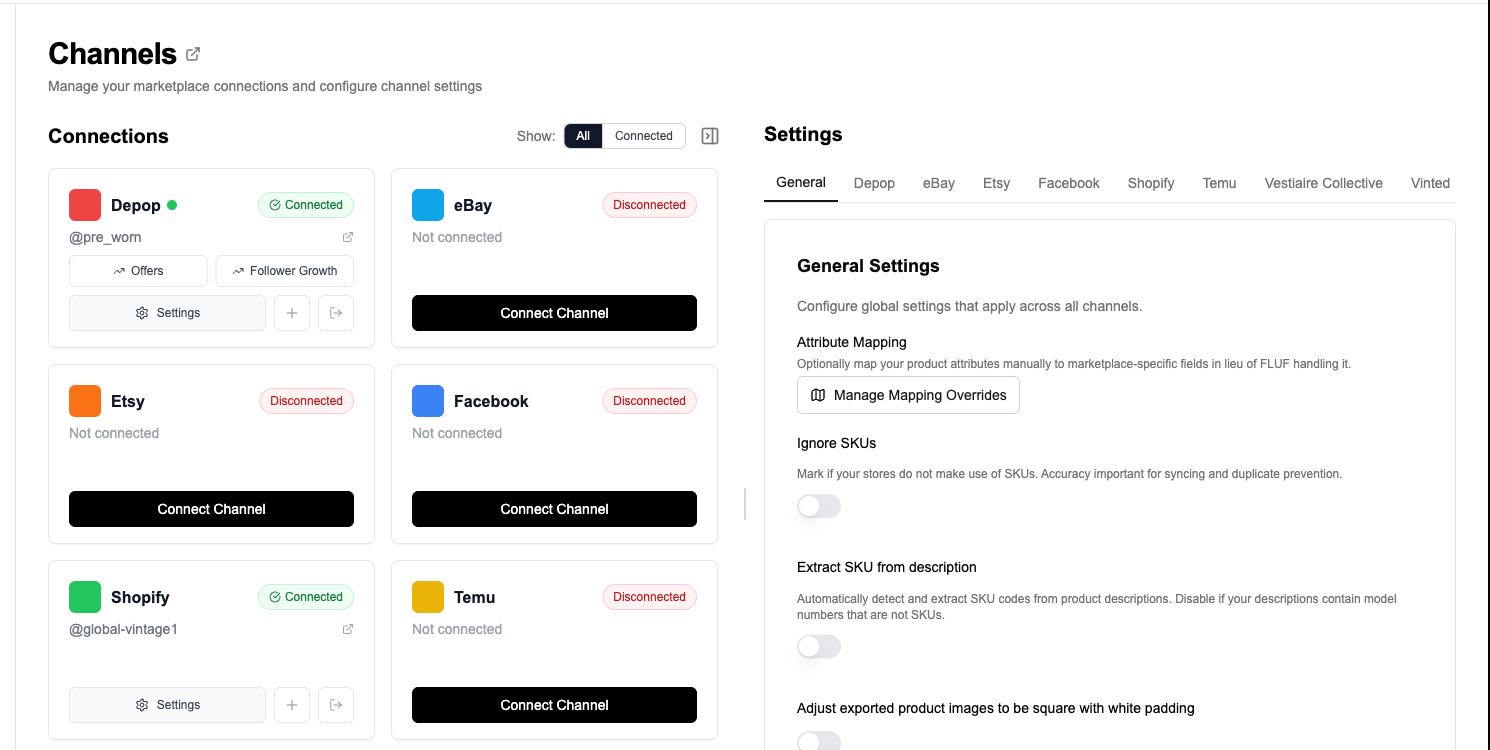
The challenge of selling on multiple platforms is inventory management. If you list the same new product on Temu and Whatnot (where applicable), you need to ensure stock levels stay synchronised to avoid overselling. That is what FLUF Connect is built for — connecting all your marketplace accounts in a single dashboard with real-time inventory sync.
How It Works
- Connect: link your Whatnot and Temu accounts to FLUF Connect (takes minutes)
- Crosslist: push your inventory to both platforms — FLUF handles title, description, image, and category mapping
- Sync: when a sale happens on any channel, inventory updates everywhere else automatically
FLUF Connect Features for Whatnot and Temu Sellers
| FLUF Connect Feature | Whatnot | Temu |
|---|---|---|
| Crosslisting | Yes — to/from all connected channels | Yes — to/from all connected channels |
| Inventory sync | Yes — real-time delist on sale | Yes — synced stock levels |
| Auto-relisting | No | No |
| Offer management | N/A (no offer system on Whatnot) | N/A |
| Order sync | Yes | Yes |
| Bulk operations | Yes | Yes |
To get started, create a free FLUF Connect account and connect your marketplace accounts. You get unlimited listings on the £9/month Starter plan — see the FLUF Connect pricing page for plans beyond that.
Sell on Whatnot, Temu, and every other marketplace from one dashboard. FLUF Connect syncs your inventory in real time across all connected channels.
Frequently Asked Questions: Whatnot vs Temu
Can I sell secondhand items on Temu?
No. Temu only accepts new products from registered businesses. If you sell pre-owned, vintage, or collector items, Whatnot, eBay, Vinted, or Depop are the right platforms.
Which has lower fees, Whatnot or Temu?
Temu advertises zero commission for many sellers, but controls pricing in the Fully Managed model — your real margin depends on the wholesale price Temu agrees to pay. Whatnot charges ~12% on a £30 UK sale (£3.67 in fees). On paper, Temu is cheaper. In practice, Whatnot’s transparent fees often deliver better per-item margins because sellers control their own pricing and competitive bidding can push prices above expectations.
Can I sell on Whatnot and Temu at the same time?
Yes, if you have inventory suited to both platforms — for example, new wholesale electronics on Temu and vintage fashion on Whatnot. FLUF Connect syncs inventory across both channels to prevent overselling.
Do I need a registered business to sell on Temu?
Yes. Temu requires business registration and does not offer individual seller accounts. Whatnot accepts individual sellers who pass the application process (ID verification + product video).
Which is easier for beginners?
Neither is beginner-friendly in the way Vinted or eBay are. Whatnot requires an application, camera comfort, and live-selling skills. Temu requires a registered business, product documentation, and tolerance for platform-controlled pricing. If you are brand new to selling online, consider starting on eBay or Vinted first.
Does Whatnot or Temu have more buyers?
Temu has 292 million monthly active users across 90+ countries. Whatnot reported 20 million new accounts in 2025 across 9 countries but does not disclose MAU. Temu has a dramatically larger audience, but Whatnot’s buyers are far more engaged in collectible and fashion categories.
Can I crosslist between Whatnot and Temu automatically?
Yes. FLUF Connect supports both Whatnot and Temu as integrated channels. You can crosslist products between them with synced inventory —
Whatnot vs Temu for selling electronics?
Temu is stronger for new, commodity electronics (phone cases, cables, accessories, gadgets) where price competition drives volume. Whatnot is better for vintage or collectible electronics (retro consoles, rare tech, limited editions) where the live-auction format attracts enthusiast buyers willing to pay more than commodity prices.
What are Temu’s return policies for sellers?
Temu has a “refund without return” policy where buyers can receive refunds without sending items back, and sellers absorb the full loss. Penalties can reach up to 5x the order amount for quality issues. Return rates average 10–20%. Whatnot’s returns are more conventional — buyers ship items back within 7 days and sellers receive them before refunds are processed.
Is it worth selling on both Whatnot and Temu?
It depends on your inventory. If you only sell secondhand or vintage items, Temu is not relevant (new products only). If you only wholesale new products, Whatnot may not be the best fit. If you sell both, using Whatnot and Temu together — along with eBay, Vinted, and Shopify via FLUF Connect — gives you the broadest possible buyer reach.
Want to learn more? Read our complete guides to selling on Whatnot and selling on Temu, or compare other marketplace combinations like Whatnot vs eBay, Whatnot vs Vinted, and Depop vs Temu. New to crosslisting? See our guide to selling on multiple platforms.
Frequently Asked Questions
No. Temu only accepts new products from registered businesses. If you sell pre-owned, vintage, or collector items, Whatnot, eBay, Vinted, or Depop are the right platforms.
Temu advertises zero commission for many sellers, but controls pricing in the Fully Managed model so your real margin depends on the wholesale price Temu agrees to pay. Whatnot charges roughly 12 percent on a GBP30 UK sale. On paper Temu is cheaper, but Whatnot often delivers better per-item margins because sellers control pricing and competitive bidding can push prices up.
Yes, if you have inventory suited to both — for example new wholesale electronics on Temu and vintage fashion on Whatnot. FLUF Connect syncs inventory across both channels to prevent overselling.
Yes. Temu requires business registration and does not offer individual seller accounts. Whatnot accepts individual sellers who pass the application process with ID verification and a product video.
Neither is beginner-friendly like Vinted or eBay. Whatnot requires an application, camera comfort, and live-selling skills. Temu requires a registered business, product documentation, and tolerance for platform-controlled pricing. New sellers should consider starting on eBay or Vinted first.
Temu has 292 million monthly active users across 90+ countries. Whatnot reported 20 million new accounts in 2025 across 9 countries but does not disclose MAU. Temu has a dramatically larger audience, but Whatnot buyers are far more engaged in collectible and fashion categories.
Yes. FLUF Connect supports both Whatnot and Temu as integrated channels. You can crosslist products between them with synced inventory
Temu is stronger for new commodity electronics like phone cases, cables, and gadgets where price competition drives volume. Whatnot is better for vintage or collectible electronics like retro consoles and rare tech where the live-auction format attracts enthusiast buyers.
Temu has a refund without return policy where buyers can receive refunds without sending items back and sellers absorb the full loss. Penalties can reach up to 5x the order amount. Return rates average 10 to 20 percent. Whatnot returns are more conventional — buyers ship items back within 7 days.
It depends on your inventory. If you only sell secondhand or vintage items, Temu is not relevant. If you only wholesale new products, Whatnot may not fit. If you sell both, using Whatnot and Temu together via FLUF Connect gives you the broadest possible buyer reach.