
Depop vs Facebook Marketplace: Which Is Better for Sellers in 2026?
A side-by-side comparison of fees, audience, features, shipping, and what real sellers think — plus how to sell on both automatically.



- Choose Depop if: you sell second-hand fashion, streetwear, or vintage clothing to Gen Z buyers and want a dedicated social marketplace with zero seller commission, nationwide shipping, and a curated fashion audience.
- Choose Facebook Marketplace if: you want to sell anything locally with zero fees, reach 1.2 billion monthly users, and prefer cash-in-hand local pickup — especially for bulky, heavy, or lower-value items that aren’t worth shipping.
- Fees: Depop charges zero commission (UK/US) with payment processing of 2.9% + £0.30. Facebook Marketplace is completely free for local pickup sales — zero fees of any kind. Shipped items on Facebook cost 2% (UK) or 10% (US).
- Audience: Depop has 7 million active buyers (90% under 34, fashion-focused). Facebook Marketplace has 1.2 billion monthly users across every demographic and category.
- Selling model: Depop is shipping-first with nationwide reach. Facebook Marketplace is local-first with optional shipping in some markets.
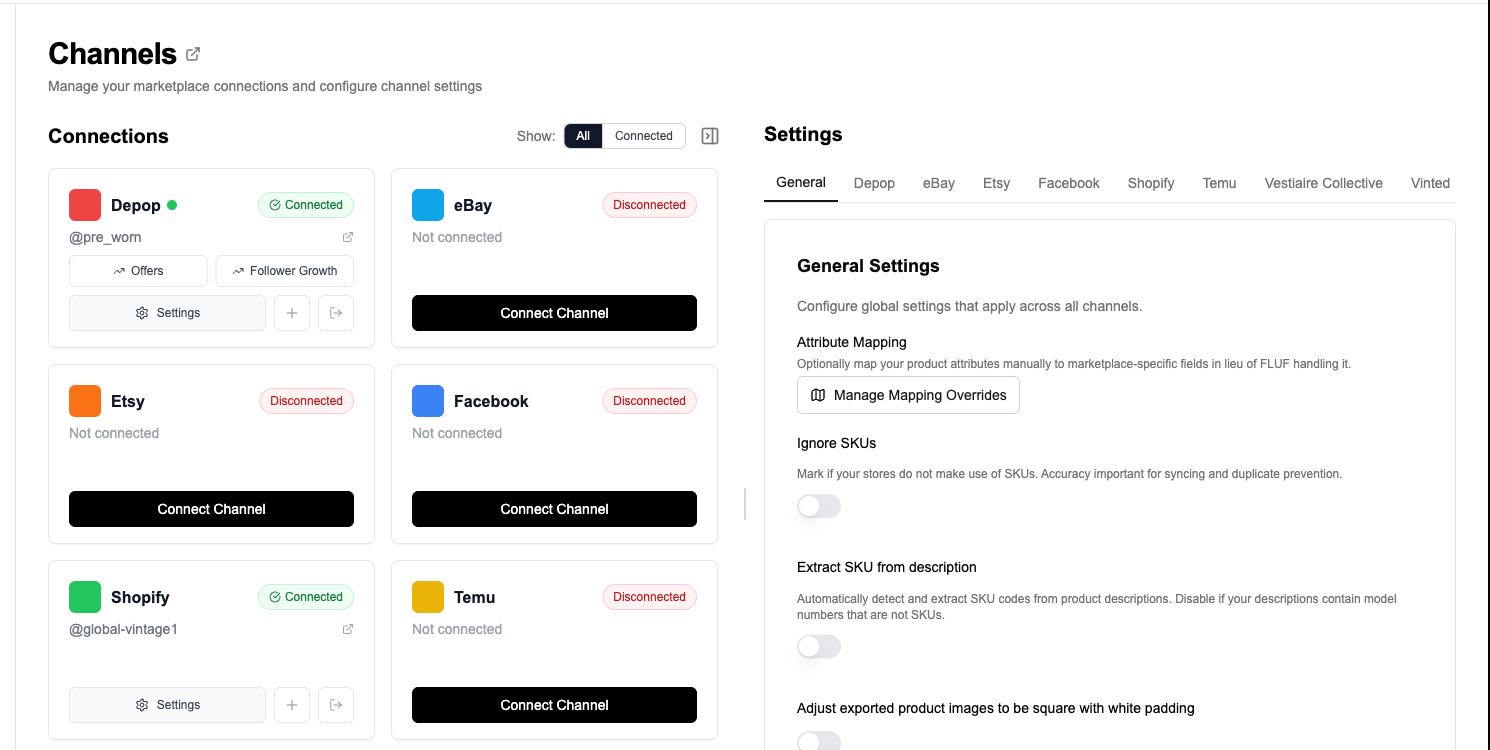
- Best strategy: Use both — Depop for fashion shipped nationwide, Facebook for local sales and bulky items. Cross-list free with FLUF Connect.
Depop vs Facebook Marketplace at a Glance
Depop and Facebook Marketplace are fundamentally different selling platforms that happen to overlap in one category: second-hand clothing. Depop is a dedicated fashion marketplace with social features, nationwide shipping, and a curated Gen Z audience. Facebook Marketplace is a classifieds-style platform built into Facebook where 1.2 billion people buy and sell virtually anything — mostly through local pickup with no fees whatsoever.
Depop was founded in 2011 in London by Simon Beckerman as a social marketplace for fashion. It’s the platform where Gen Z shops for vintage, streetwear, and one-of-a-kind pieces. Owned by Etsy since 2021, Depop is being acquired by eBay for $1.2 billion (expected Q2 2026). With 7 million active buyers and approximately $1 billion in annual sales, Depop is small but intensely focused — and growing rapidly, with 60% year-on-year US buyer growth in 2025.
Facebook Marketplace launched in October 2016 as Meta’s answer to Craigslist and Gumtree. It’s integrated directly into the Facebook app, instantly giving it access to Facebook’s 3 billion+ monthly users. An estimated 1.2 billion people use Marketplace each month, making it the single largest online marketplace by user count. But most transactions are local pickup — buyer meets seller, inspects the item, and pays cash or via bank transfer. It’s less a curated marketplace and more a digital car boot sale.
| Depop | Facebook Marketplace | |
|---|---|---|
| Founded / Launched | 2011 | 2016 |
| Parent company | Etsy (being acquired by eBay) | Meta Platforms |
| Active users | 7 million active buyers | 1.2 billion monthly users |
| Markets | 150+ countries | 227+ countries |
| Best for | Fashion, vintage, streetwear, Y2K | Everything — furniture, electronics, vehicles, clothing, homeware |
| Primary selling model | Shipping (nationwide/international) | Local pickup (with optional shipping in some markets) |
| Seller fees | Zero commission (UK/US). Processing: 2.9% + £0.30 | Zero for local pickup. 2% for shipped items (UK) |
| Listing limit | Unlimited | 150 active listings (lower for new accounts) |
| Mobile app | Dedicated app — mobile-first | Built into the Facebook app |
For a deeper look at each platform individually, see our full guides: How to Sell on Depop and How to Sell on Facebook Marketplace.
Depop vs Facebook Marketplace: Feature-by-Feature Comparison
Depop is purpose-built for fashion selling with social features and buyer protection. Facebook Marketplace is a general-purpose classifieds tool with minimal seller infrastructure but massive built-in reach. The feature gap is wide — and intentional.
| Feature | Depop | Facebook Marketplace |
|---|---|---|
| Listing format | Fixed price with offers | Fixed price with offers |
| Built-in messaging | In-app chat (Instagram-style) | Facebook Messenger |
| Offer/haggle system | Yes — Make an Offer button | Yes — “Is this still available?” + informal offers via Messenger |
| Seller analytics | Basic — views, likes, sell-through | Minimal — view count only |
| Promoted listings | Yes — Depop Boost (12% UK, 8% US/AU) | Yes — “Boost listing” via Facebook/Instagram Ads |
| Buyer protection | Yes — Depop Protection for shipped items | Yes — Purchase Protection for shipped items only |
| Social features | Strong — likes, follows, feed, explore page | Minimal — tied to Facebook profile |
| Seller verification | ID verification + phone | Facebook account required (identity tied to profile) |
| Shipping integration | Yes — Depop Shipping (Evri UK, USPS US) | Limited — available for some categories in some markets |
| Local pickup | No — shipping only | Yes — the primary selling model |
| Payment processing | Depop Payments (Stripe) | Cash, bank transfer (local). Meta Pay (shipped) |
| International selling | Yes — global listings | Limited — primarily local/regional |
| Categories | Fashion-focused (clothing, shoes, accessories) | Everything (vehicles, property, furniture, electronics, clothing) |
| Shop branding | Profile page with bio, banner, following | None — listings are individual, no shop concept |
The core trade-off: Depop gives you a curated, fashion-specific marketplace with buyer protection, social discovery, and nationwide shipping — but a smaller audience. Facebook Marketplace gives you the largest audience on earth with zero fees on local sales — but minimal seller tools, no shop identity, and the expectation that most buyers want to pick up in person.
Listing Experience: Depop vs Facebook Marketplace
Both platforms make listing fast and mobile-friendly, but for very different selling models. Depop listings are designed to be discovered through search and social feeds. Facebook Marketplace listings are designed to be found by local buyers browsing nearby.
On Depop, listing takes under a minute from your phone. Upload up to 4 photos (video supported), write a description with hashtags for discovery, select brand/category/size/condition, set a price, and choose your shipping method. The listing goes live to a nationwide (or international) audience immediately. Success depends on photography quality, hashtag strategy, and social engagement — liking, following, and listing frequently to stay visible in the algorithm.
On Facebook Marketplace, listing is even faster. Take photos, write a title and description, set a price and category, choose “local pickup” or “shipping” (where available), and set your location radius. Facebook auto-suggests a category and price based on your photos and description. The listing is shown to people within your chosen radius — typically 10–60 miles. There’s no hashtag system, no social feed, and no follower mechanic. Buyers find you through search or browsing their local Marketplace feed.
Photography expectations differ significantly. Depop rewards styled, curated photography — flat lays, modelled shots, aesthetic consistency across your profile. Facebook Marketplace buyers want clear, honest photos that show the item’s actual condition — well-lit, multiple angles, any flaws visible. Overly styled photos on Facebook can actually reduce trust, as buyers expect a casual, “what you see is what you get” presentation.
Time to list: Under 1 minute on both platforms. Facebook is marginally faster because there are fewer fields to fill in and no shipping to configure for local sales. For sellers listing across multiple platforms, FLUF Connect’s bulk crosslisting eliminates the duplication entirely.
Fees Compared: How Much Do Depop and Facebook Marketplace Actually Cost?
This is where the comparison gets interesting. Facebook Marketplace’s local pickup model is genuinely free — no fees of any kind. Depop charges zero commission but still takes a payment processing cut. And Facebook’s shipped items have their own fee structure that varies dramatically by country.
Fee Breakdown
| Fee Type | Depop (UK) | Facebook Marketplace (UK) |
|---|---|---|
| Listing fee | Free — unlimited | Free — up to 150 active listings |
| Commission / transaction fee | Zero (since March 2024) | Zero for local pickup. 2% for shipped items |
| Payment processing | 2.9% + £0.30 per sale | None for local (cash/bank transfer). Included in 2% for shipped |
| Promoted listing cost | Boost: 12% of sale (optional) | Facebook Ads: budget-based (from £1/day) |
| Monthly subscription | None | None |
- Depop: Processing fee £1.17 (2.9% + £0.30) = You keep £28.83
- Facebook (local pickup): Zero fees = You keep £30.00
- Facebook (shipped, UK): Commission £0.60 (2%) = You keep £29.40
- Depop: Processing fee £3.20 (2.9% + £0.30) = You keep £96.80
- Facebook (local pickup): Zero fees = You keep £100.00
- Facebook (shipped, UK): Commission £2.00 (2%) = You keep £98.00
Facebook Marketplace is the cheapest way to sell anything — if you sell locally. Zero fees, zero processing costs, zero commissions. The buyer hands you cash or transfers money directly. This makes Facebook unbeatable for furniture, large electronics, vehicles, and anything too bulky or heavy to ship cost-effectively.
The catch: Facebook’s zero-fee local model means no buyer protection, no payment processing, and no shipping infrastructure. You meet strangers in person, accept cash, and handle everything yourself. Depop’s 2.9% + £0.30 processing fee buys you buyer protection, in-app payments, integrated shipping labels, and nationwide reach — which is worth the cost for fashion items that ship easily.
US sellers note: Facebook’s shipped item fee is 10% in the US (doubled from 5% in 2025) — significantly higher than the UK’s 2%. US sellers shipping on Facebook Marketplace pay more than they would on Depop.
Payout Comparison
| Depop | Facebook Marketplace | |
|---|---|---|
| Payout method | Bank transfer (via Stripe) | Cash/bank transfer (local). Meta Pay (shipped) |
| Payout schedule | 10 working days after sale, or 2 days after delivery | Instant for local (cash). 5–20 business days for shipped |
| New seller holds | 10-day default hold | 15–20 day hold on shipped items for new sellers |
| Minimum payout | No minimum | No minimum (local is immediate) |
For local sales, Facebook wins hands-down — cash in hand the moment the buyer collects. For shipped items, Depop and Facebook are comparable, though both hold payments for new sellers. See our full guides on selling on Depop and selling on Facebook Marketplace.
Audience and Demand: Who’s Buying on Depop vs Facebook Marketplace?
Depop and Facebook Marketplace have almost no audience overlap. Depop’s buyers are young, fashion-obsessed, and willing to pay for shipping. Facebook’s buyers are local, price-sensitive, and want to see items in person before buying. This makes the two platforms genuinely complementary.
Depop’s audience is niche but highly engaged. Over 90% of active users are under 34, with the core being 16–24 year-olds shopping for vintage fashion, streetwear, and unique pieces. Buyers browse for inspiration, follow sellers whose style they like, and make purchases based on aesthetic appeal. The 7 million active buyers are fashion-focused and national/international — location doesn’t matter because everything ships.
Facebook Marketplace’s audience is everyone. With 1.2 billion monthly users, it’s the most diverse buyer base of any marketplace. But “buyer” is generous — most people browse opportunistically, looking for bargains near them. The audience skews older than Depop (25–55), is less fashion-conscious, and heavily favours local pickup. Facebook Marketplace excels for items where seeing, touching, or testing the product matters: furniture, electronics, vehicles, children’s equipment, and everyday household goods.
| Depop | Facebook Marketplace | |
|---|---|---|
| Primary age group | 16–26 (Gen Z) | 25–55 (broad) |
| Monthly active users | 7 million active buyers | 1.2 billion |
| Average order value | £10–30 | Highly variable — £5 to £5,000+ |
| Best-selling categories | Vintage fashion, streetwear, Y2K, accessories | Furniture, electronics, vehicles, homeware, clothing (casual) |
| Buyer behaviour | Browse-driven, social, shipping-based | Search-driven, local, price-sensitive, pickup-based |
| Geographic reach | Nationwide / international | Local (typically 10–60 mile radius) |
Where to List by Category
| Category | Better on Depop | Better on Facebook | Both |
|---|---|---|---|
| Vintage fashion / streetwear | ✓ | ||
| Designer clothing / bags | ✓ (buyer protection + authentication) | ||
| Everyday casual clothing | ✓ | ||
| Children’s clothing (bundles) | ✓ (local parents) | ||
| Furniture and homeware | ✓ (local pickup essential) | ||
| Electronics and phones | ✓ (buyers want to test first) | ||
| Vehicles and auto parts | ✓ | ||
| Shoes and trainers | ✓ (branded, trend-driven) | ||
| Books and media | ✓ | ||
| Sports equipment | ✓ (bulky, local) |
The pattern is clear: if it’s fashion and ships easily, Depop wins. If it’s bulky, heavy, needs inspection, or appeals to a local buyer, Facebook wins. For everyday clothing that works on both, crosslisting to both platforms maximises exposure without extra effort.
Shipping and Local Pickup: Depop vs Facebook Marketplace
This is the most fundamental difference between the two platforms. Depop is shipping-first. Facebook Marketplace is local-first. Everything else — fees, audience, trust, speed of sale — flows from this distinction.
| Depop | Facebook Marketplace | |
|---|---|---|
| Primary model | Shipping (nationwide/international) | Local pickup (meet buyer in person) |
| Integrated shipping labels | Yes — Evri (UK), USPS (US) | Limited — available for some categories in select markets |
| Local pickup option | No | Yes — the default and most common method |
| Free shipping option | Yes — seller absorbs cost | N/A for local. Buyer or seller pays for shipped |
| International shipping | Yes — seller arranges own label | No — local/domestic only |
| Buyer protection | Yes — for all shipped transactions | Only for shipped items paid through checkout. No protection for local pickup |
| Tracking | Included with Depop Shipping labels | Included for shipped. None for local pickup |
Depop’s shipping model means you package items, print a label (or scan a QR code), and drop off at a pickup point. Buyers anywhere in the country — or internationally — can purchase. This is ideal for lightweight, high-value fashion items where shipping costs are a small fraction of the sale price.
Facebook’s local pickup model means you arrange a meeting spot, the buyer inspects the item, and you exchange goods for cash. No packaging, no postage, no waiting for delivery confirmation. This is ideal for heavy, bulky, or low-value items where shipping would cost more than the item is worth — furniture, bicycles, kitchen appliances, baby equipment.
Safety considerations for Facebook: Meeting strangers carries inherent risk. Best practice: meet in public places during daylight, bring someone with you, never invite buyers to your home, and use bank transfer rather than large amounts of cash. Many police stations now offer “safe exchange zones” specifically for online marketplace transactions.
For sellers who sell on multiple platforms, FLUF Connect’s inventory sync ensures items sold on either platform are automatically removed from the other — preventing the double-selling headache that plagues multi-platform sellers.
What Real Sellers Say About Depop vs Facebook Marketplace
The Depop vs Facebook Marketplace divide is stark. We dug through Mumsnet, Whirlpool, seller blogs, and community forums to find what real sellers think about both platforms.
The Facebook Marketplace frustrations
The number one complaint from Facebook sellers? Time-wasters and no-shows.
“You wait. And wait. No call. No message. No apology.”
— Seller experience, The Rights of Fans
“Hate when you get ‘Is this still available?’ And you say yes and then. nothing more!”
— Mumsnet seller, Mumsnet
One seller called Facebook Marketplace “a waste of time” entirely: “Out of all the messages received, 95% of them have been from time wasters” and “eBay outstripped sales compared to the FB marketplace by at least 70 times.” (eSeller365)
Safety is also a real concern. A study found 6 in 10 respondents had encountered a scammer on Facebook Marketplace — the highest of any platform (CNBC). Sellers on Mumsnet warn: “Don’t let them put it in the car before payment. It’s happened — some people have driven off before paying.”
The Depop frustrations
Depop sellers cite lowball offers as a constant annoyance, plus payment delays (up to 10 working days for new sellers) and the Boost fee increase from 8% to 12%. Some also note the “zero fee” marketing is misleading — payment processing (2.9% + £0.30) still applies to every sale.
The pricing gap
The same item can sell for vastly different prices on each platform. One buyer noted finding jeans for $20 on Facebook Marketplace that “would have been labelled ‘Y2K’ and marked up to around $90 on Depop” (Fashion Journal). For sellers, this cuts both ways — Depop commands higher prices for fashion, but Facebook moves everyday items faster at lower prices.
“It’s so easy to start on Facebook — take a photo, write a title and set your price. Local and majority of the time fast transactions.”
— Seller review, Algonquin College blog
The consensus: Use both for different things. Depop for fashion you can ship — it commands higher prices from a fashion-focused audience. Facebook for everything else you can hand over locally — zero fees and instant cash. The sellers who struggle are the ones selling the wrong items on the wrong platform. Match the item to the platform, and both work well.
How to Choose Between Depop and Facebook Marketplace
The choice between Depop and Facebook Marketplace often isn’t either/or — it’s about matching each item in your inventory to the right platform. Here’s when each one wins.
- Sell second-hand fashion, vintage clothing, or streetwear
- Want to reach Gen Z and millennial fashion buyers nationwide
- Prefer shipping items rather than meeting buyers in person
- Want buyer protection and in-app payments on every sale
- Enjoy social selling — building a following, curating an aesthetic
- Sell furniture, electronics, vehicles, or other bulky/heavy items
- Want zero fees — keep 100% of every local sale
- Prefer cash-in-hand, same-day local transactions
- Sell items that buyers want to see or test before purchasing
- Want access to the largest buyer pool on the internet (1.2 billion users)
For clothing sellers: Depop is almost always the better primary platform. Its fashion-focused audience, buyer protection, and shipping infrastructure are purpose-built for clothing. Facebook Marketplace works as a secondary channel for local clothing sales — especially bundles, children’s clothing, and everyday basics where buyers prefer to try on before buying.
For general resellers: Facebook Marketplace is your local sales workhorse — furniture, electronics, homeware, anything heavy. Depop is your specialist channel for fashion items that command higher prices with the right audience.
For clearing a wardrobe: Start with Depop for anything fashionable or branded. Anything that doesn’t sell on Depop within a few weeks, crosslist to Facebook Marketplace for local pickup at a lower price.
Why Not Both? Sell on Depop and Facebook Marketplace at the Same Time
Depop and Facebook Marketplace are as complementary as two platforms can be. Different audiences, different selling models, different item strengths, virtually zero buyer overlap. A 22-year-old browsing Depop for a vintage Nike windbreaker and a 40-year-old scrolling Facebook Marketplace for a second-hand sofa are not the same person — and your listings should be where both of them are looking.
The practical challenge of selling on both: keeping inventory in sync. If a jacket sells on Depop, you need to remove it from Facebook before someone else messages you about it. If a table sells locally on Facebook, you need to take it off any other platform. Managing this manually across two apps is tedious and error-prone.
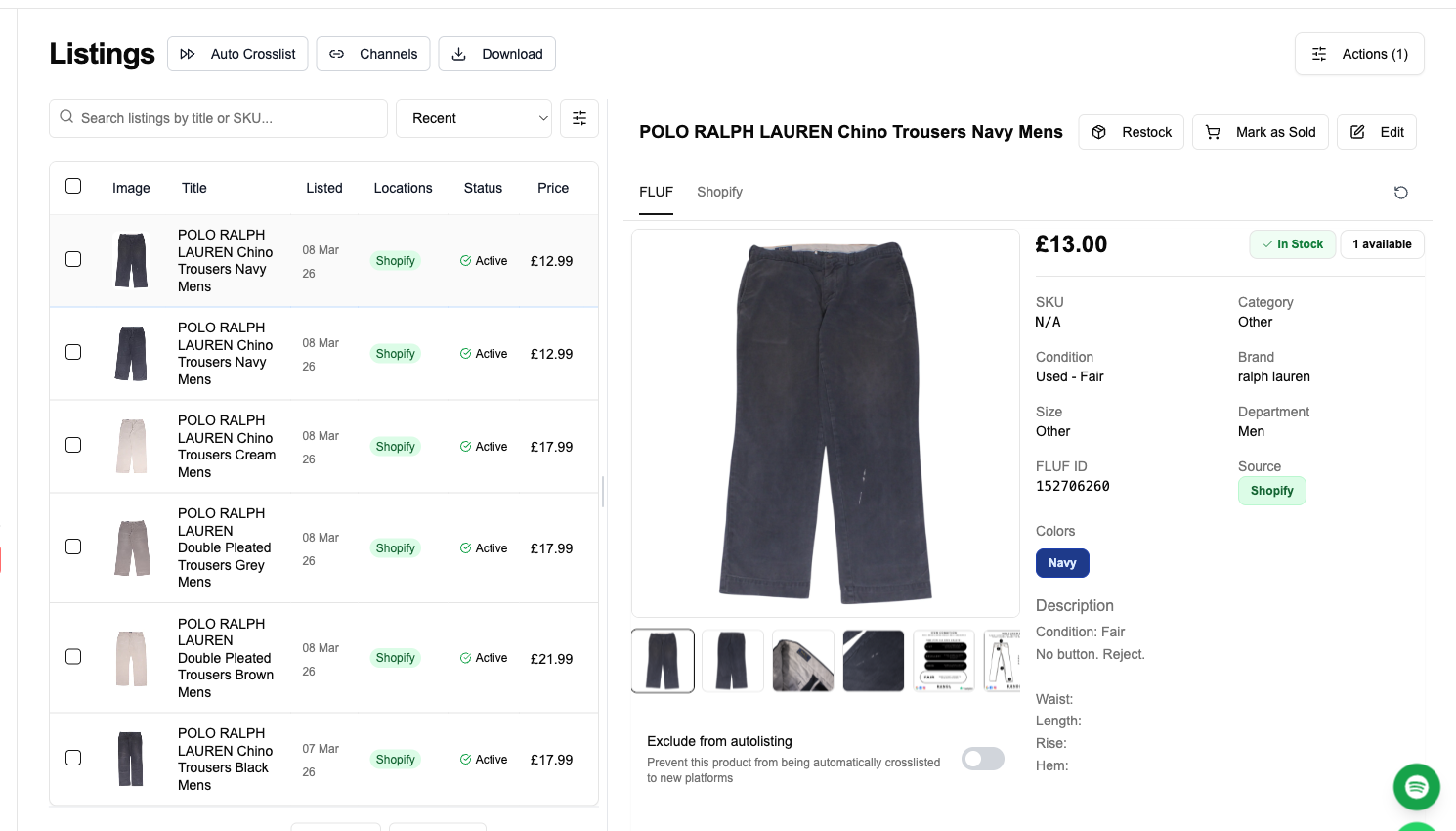
FLUF Connect automates this. Crosslist items between Depop and Facebook Marketplace (and seven other channels), and when something sells on one platform, it’s removed from the others automatically. No double-selling, no awkward “sorry, it’s already gone” messages.
How it works
- Connect your accounts — Link Depop and Facebook Marketplace to FLUF Connect.
- Crosslist your inventory — Select items individually, in bulk, or set auto-crosslisting rules.
- FLUF keeps everything in sync — Real-time inventory sync, plus auto-relisting and offer management on Depop.
| FLUF Connect Feature | Depop | Facebook Marketplace |
|---|---|---|
| Crosslisting | Yes | Yes |
| Inventory sync | Yes | Yes |
| Auto-relisting | Yes | No |
| Offer management | Yes | No |
| Order sync | Yes (via Shopify) | No |
| Bulk operations | Yes | Yes |
Depop gets full automation support — crosslisting, relisting, offer management, and order sync — all included on every plan except relisting, offer management and smart pricing, which start at Seller.. Facebook Marketplace gets crosslisting and inventory sync, which is exactly what local sellers need: list once, stay in sync, never oversell. Most competitors like List Perfectly and Vendoo don’t support Facebook Marketplace at all.
Starts at £9/month.
Frequently Asked Questions
Depop is better for selling clothes, especially fashion, vintage, and streetwear. Its 7 million active buyers are specifically looking for clothing, and the platform has built-in shipping, buyer protection, and a social discovery feed. Facebook Marketplace can work for casual clothing bundles and local wardrobe clearouts, but buyers expect lower prices and the audience is not fashion-focused.
Facebook Marketplace is cheaper — local pickup sales have zero fees of any kind. Depop charges zero commission but takes 2.9% + £0.30 payment processing per sale. For shipped items, Facebook charges 2% (UK) while Depop charges 2.9% + £0.30. The fee difference is small for shipped items, but Facebook local sales are genuinely free.
Yes, and they complement each other well. Use Depop for fashion items you can ship nationwide, and Facebook Marketplace for local sales of bulky items, furniture, or everyday goods. FLUF Connect lets you crosslist between both with automatic inventory sync, so items sold on one platform are removed from the other.
Facebook Marketplace is easier — if you have a Facebook account you can list in seconds with zero fees. Depop requires downloading a separate app, verifying your identity, and understanding the social selling model. However, Depop is easier for clothing sellers specifically because the entire platform is built for fashion.
Local pickup on Facebook Marketplace carries inherent risk since you meet strangers in person. Best practice: meet in well-lit public places during daylight, bring someone with you, never give out your home address, and prefer bank transfer over large amounts of cash. Shipped items have Purchase Protection, but local sales have no buyer or seller protection.
Yes. FLUF Connect supports both Depop and Facebook Marketplace crosslisting with automatic inventory sync. List on one platform, crosslist to the other, and when an item sells it is automatically removed everywhere. Depop also gets auto-relisting and offer management included from Seller upwards.
Facebook Marketplace charges zero fees for local pickup sales in the UK — you keep 100% of the sale price. For shipped items, there is a 2% selling fee. In the US, the shipped item fee is much higher at 10%.
For everyday casual clothing, children's clothes in bundles, and local wardrobe clearouts — yes, especially since there are zero fees on local sales. For fashionable, branded, or vintage clothing, Depop will typically achieve better prices because the audience is specifically looking for fashion. Many sellers list trendy pieces on Depop and casual items on Facebook.
Facebook Marketplace buyers are primarily local bargain hunters. They can see dozens of similar items nearby, expect to negotiate, and often make lowball offers. There is no curated shopping experience or fashion-focused algorithm. Depop's audience is specifically looking for fashion and is willing to pay for style, shipping, and uniqueness — so the same item typically commands a higher price.
No — Depop is a fashion-focused marketplace and does not support furniture, large electronics, vehicles, or most non-fashion categories. Facebook Marketplace is the best platform for furniture, where buyers can see the item in person and arrange local collection without any shipping costs or fees.