
Facebook Marketplace vs Shopify: Which Is Better for Sellers in 2026?
A detailed, data-driven comparison of fees, features, audience, and shipping to help you decide where to sell — or why the best sellers use both.



- Choose Facebook Marketplace if: you want to sell locally with zero fees, reach over 1 billion monthly browsers, or test product ideas without any upfront cost or technical setup.
- Choose Shopify if: you want to build a branded online store, own your customer data, sell globally, and scale a long-term ecommerce business with full customisation.
- Fees: Facebook Marketplace local pickup is completely free. Shipped items cost 2%. Shopify charges 2.0% + 25p processing (Basic) plus £19/month subscription — on a £30 sale you keep £30 on Marketplace (local) vs £29.15 on Shopify before subscription costs.
- Audience: Facebook Marketplace has 1 billion+ monthly users with unmatched local reach. Shopify stores reached 875 million consumers in 2024, but each store must drive its own traffic.
- Best strategy: Use both — Facebook Marketplace for local and impulse buyers, Shopify for brand building and global sales. Cross-list with FLUF Connect.
Facebook Marketplace vs Shopify at a Glance
Facebook Marketplace and Shopify represent two fundamentally different approaches to selling online. Facebook Marketplace is a social marketplace built into the world’s largest social network — over 1 billion people browse it monthly, most looking for local deals on everything from furniture to electronics. Shopify is a dedicated ecommerce platform that lets you build your own branded online store with a custom domain, full design control, and access to 8,000+ apps.
Facebook Marketplace launched in 2016 as an extension of Facebook (founded 2004 by Mark Zuckerberg in Menlo Park, California). It grew rapidly by leveraging Facebook’s existing user base, turning the platform’s local buying-and-selling groups into a structured marketplace with listings, categories, and shipping options. Today it is available in over 70 countries with an estimated 10 million+ active sellers and 4 billion+ active listings at any given time.
Shopify was founded in 2006 in Ottawa, Canada, by Tobias Lutke, Daniel Weinand, and Scott Lake — originally because they needed a better online store for selling snowboards. It has since grown into the world’s leading ecommerce platform, powering 5.6 million live stores across 175+ countries and facilitating $292.3 billion in gross merchandise volume in 2024 alone. Shopify is not a marketplace — it is the infrastructure that lets you build your own marketplace.
The core difference is this: Facebook Marketplace gives you a built-in audience of over a billion browsers but limited control over your brand. Shopify gives you total control over your brand, customer relationships, and store experience — but you must drive every visitor yourself through marketing, SEO, and social media.
| Facebook Marketplace | Shopify | |
|---|---|---|
| Founded | 2016 (Facebook: 2004) | 2006 |
| Headquarters | Menlo Park, California | Ottawa, Canada |
| Monthly users/reach | 1 billion+ browsing Marketplace | 875 million consumers (2024, across all stores) |
| Available in | 70+ countries | 175+ countries |
| Best for | Furniture, electronics, vehicles, local items, secondhand goods | Branded products, DTC, global ecommerce, scaling businesses |
| Seller fees (UK) | Local pickup: £0. Shipped: 2% | 2.0% + 25p processing (Basic) + £19/month subscription |
| Listing fees | Free — unlimited | Free — unlimited products |
| Mobile app | Yes — integrated into Facebook app | Yes — Shopify mobile app for store management |
| Own domain | No — listings live on facebook.com | Yes — your own.com /.co.uk |
For a deeper look at each platform individually, see our full guides: How to Sell on Facebook Marketplace and How to Sell on Shopify.
Facebook Marketplace vs Shopify: Feature-by-Feature Comparison
These two platforms are built for entirely different use cases, so their feature sets barely overlap. Facebook Marketplace is designed for quick, social selling with minimal setup. Shopify is a full ecommerce operating system with store design, payment processing, app integrations, and customer management. The table below compares every major seller-facing feature.
| Feature | Facebook Marketplace | Shopify |
|---|---|---|
| Store customisation | No — standard Marketplace listing format | Full — custom themes, branding, layout |
| Own domain | No | Yes — custom domain included |
| Customer data ownership | No — Facebook controls buyer data | Yes — full customer database, email lists |
| Built-in messaging | Yes — Facebook Messenger | Yes — Shopify Inbox (live chat) |
| Payment processing | Facebook Pay (shipped items) | Shopify Payments (Stripe-powered) |
| Seller analytics | Minimal — views and messages only | Comprehensive — sales, traffic, conversion, customer reports |
| SEO capabilities | None — listings not indexed by Google | Full — meta tags, sitemaps, blog, custom URLs |
| App/plugin ecosystem | None | 8,000+ apps in Shopify App Store |
| Local pickup | Yes — core feature, zero fees | Yes — available but not the primary model |
| Auction/offer system | Informal — buyers message offers | No native auction — apps available |
| Multi-quantity listings | Yes | Yes — with variants and inventory tracking |
| International selling | Limited — primarily local | Yes — Shopify Markets for global selling |
| 24/7 support | No dedicated seller support | Yes — 24/7 chat, email, and phone |
| Subscription required | No | Yes — from £9/month |
The most significant difference is ownership. On Facebook Marketplace, you are a seller within Facebook’s ecosystem — you cannot collect email addresses, retarget buyers, or build a brand beyond your personal profile. On Shopify, you own everything: customer data, store design, marketing lists, and the relationship with every buyer. This matters enormously for long-term business building.
Listing Experience: Facebook Marketplace vs Shopify
Facebook Marketplace is the faster platform to list on — most sellers can photograph an item and have it live in under a minute using the Facebook app. Shopify requires more upfront setup but gives you far greater control over how your products are presented to buyers.
On Facebook Marketplace, you tap “Sell”, upload photos, select a category, enter a title and price, add a description, and choose whether the item is available for local pickup, shipping, or both. That is it. There are no complex product attributes, no shipping configurations to wrestle with, and no design decisions. The algorithm immediately begins showing your listing to nearby Facebook users based on their location, browsing history, and interests. Most items receive their first views within minutes of listing.
On Shopify, the listing process is more involved but more powerful. You create a product with a title, description, photos, pricing, variants (sizes, colours), inventory tracking, weight for shipping calculations, SEO metadata, and product tags. You control the product page layout through your store theme, can add custom sections, and write content optimised for Google search. Products live on your own domain and are indexed by search engines — unlike Facebook Marketplace listings, which are not discoverable via Google. Shopify’s Winter 2026 update also introduced “Agentic Storefronts” — making your products discoverable via ChatGPT, Microsoft Copilot, and Perplexity (Shopify Editions).
Photography expectations differ substantially. Facebook Marketplace buyers expect casual, authentic photos — smartphone pictures of the actual item in natural lighting are the norm. Overly polished or stock-looking images can actually reduce trust, as buyers want to see the real product they will receive. Shopify store buyers expect professional-quality imagery — clean backgrounds, consistent lighting, multiple angles, and lifestyle shots that reflect your brand aesthetic.
Time to list: expect under 1 minute per item on Facebook Marketplace, and 5–15 minutes on Shopify (longer for the first listing while you set up your store). The initial Shopify store setup — choosing a theme, configuring payments, setting up shipping — can take several hours, but this is a one-time investment. For sellers managing large inventories across both platforms, bulk crosslisting tools like FLUF Connect eliminate the need to list manually on each platform.
Sell on Facebook Marketplace and Shopify from one dashboard.
FLUF Connect lets you crosslist products to both platforms in a few clicks — with real-time inventory sync so you never oversell.
Fees Compared: How Much Do Facebook Marketplace and Shopify Actually Cost?
Facebook Marketplace and Shopify have completely different cost structures. Facebook Marketplace is free for local sales and charges a small percentage on shipped items. Shopify charges a monthly subscription plus payment processing on every transaction. For low-volume or local sellers, Facebook Marketplace is dramatically cheaper. For high-volume sellers, Shopify’s per-transaction costs can be competitive — but the subscription is always there.
Fee Breakdown
| Fee Type | Facebook Marketplace (Local) | Facebook Marketplace (Shipped) | Shopify (Basic) |
|---|---|---|---|
| Monthly subscription | Free | Free | £19/month (annual billing) |
| Listing fee | Free — unlimited | Free — unlimited | Free — unlimited products |
| Selling fee | £0 | 2% of sale price | £0 |
| Payment processing | N/A — cash/direct payment | Included in 2% fee | 2.0% + 25p (Shopify Payments) |
| Third-party payment surcharge | N/A | N/A | 2.0% if not using Shopify Payments |
| Transaction fee on plans | N/A | N/A | £0 with Shopify Payments |
Shopify Plan Comparison
| Shopify Plan | Monthly Cost (Annual) | Payment Processing (UK) |
|---|---|---|
| Basic | £19/month | 2.0% + 25p |
| Grow | £49/month | 1.7% + 25p |
| Advanced | £259/month | 1.5% + 25p |
- Facebook Marketplace (local pickup): No fees = You keep £30.00
- Facebook Marketplace (shipped, UK): 2% selling fee = £0.60 = You keep £29.40
- Shopify (Basic plan): 2.0% + 25p processing = £0.85 = You keep £29.15 (plus £19/month subscription)
Payouts: How Quickly You Get Your Money
| Facebook Marketplace | Shopify | |
|---|---|---|
| Payout method | Bank transfer | Bank transfer (via Shopify Payments) |
| Payout schedule (shipped items) | 5 days after confirmed delivery | 2 business days (UK, Shopify Payments) |
| Local pickup payments | Direct — cash, bank transfer, or buyer’s choice | Online payment at checkout |
| On-demand payouts | No | No (standard), Yes (Shopify Balance) |
| New seller holds | Yes — up to 21 days initially | No holds with Shopify Payments |
For local pickup sales on Facebook Marketplace, payment is handled directly between buyer and seller — typically cash on collection or bank transfer — so there is no payout delay at all. For shipped items, Facebook holds funds for 5 days after confirmed delivery. Shopify Payments typically disburses within 2 business days in the UK, and there are no holds for established merchants.
Hidden Costs to Watch For
On Facebook Marketplace: the platform itself is free, but the lack of analytics means you cannot track which listings perform best or why. There is no integrated advertising system for Marketplace specifically (though you can boost listings via Facebook Ads at additional cost). The biggest hidden cost is time — managing individual Messenger conversations with buyers, dealing with no-shows for local pickups, and handling the high volume of lowball offers that Marketplace is notorious for. US sellers should also note that the selling fee doubled from 5% to 10% in 2024, and a class action lawsuit alleges that this fee is calculated on the total buyer payment — including shipping and taxes — not just the item price (ClassAction.org).
On Shopify: the £9/month subscription is just the starting point. Premium themes cost £100–300, and many sellers find themselves adding paid apps for features like reviews (£5–50/month), email marketing (£10–30/month), advanced analytics (£15–50/month), and SEO tools (£10–40/month). These costs compound quickly. A fully featured Shopify store can easily cost £50–150/month before you sell a single item. Additionally, if you use a payment gateway other than Shopify Payments, you pay an extra 2.0% transaction fee on top of the gateway’s own fees.
Audience and Demand: Who Is Buying on Facebook Marketplace vs Shopify?
Facebook Marketplace and Shopify serve entirely different buyer types, which is precisely why selling on both can be so effective — there is virtually zero overlap between someone browsing local Marketplace deals and someone shopping on a branded Shopify store.
| Facebook Marketplace | Shopify | |
|---|---|---|
| Primary age group | 25–54 (most active demographic) | Varies by store — typically 18–44 |
| Buyer intent | Browse-led, bargain-hunting, local convenience | Brand-driven, intent-driven, global |
| Monthly reach | 1 billion+ browsing Marketplace | 875 million consumers across all stores (2024) |
| Annual GMV | Not publicly disclosed | $292.3 billion (2024) |
| Best-selling categories | Furniture, electronics, vehicles, clothing, home goods | Fashion, beauty, home & garden, food & drink |
| Buyer behaviour | Price-sensitive, local-first, impulse browsing | Brand-loyal, research-driven, willing to pay for quality |
| Discovery method | Facebook algorithm promotes to local users | Google search, social media, email marketing, ads |
Facebook Marketplace’s audience is enormous and geographically concentrated. The algorithm surfaces listings to users within their local area, making it the dominant platform for local buying and selling in the UK. Buyers browse Marketplace casually — often while scrolling their Facebook feed — and are typically looking for deals on secondhand goods, furniture, electronics, and everyday items. The demographic skews 25–54, with strong representation from parents, homeowners, and budget-conscious shoppers. The average time to sell common items is 3–7 days.
Shopify’s audience is not a single audience at all — it is whatever audience each store attracts. A Shopify store selling handmade candles reaches a completely different buyer than one selling streetwear or electronics. This is both Shopify’s greatest strength and its biggest challenge: you can reach anyone in the world, but you must invest in marketing to reach anyone at all. Shopify stores that succeed typically combine SEO, social media advertising, email marketing, and content to build a loyal customer base over time.
Where to Sell by Category
| Category | Better on Facebook Marketplace | Better on Shopify | Both |
|---|---|---|---|
| Furniture and homeware | Yes (local pickup essential) | ||
| Electronics and phones | Yes (buyers want to test first) | ||
| Vehicles and parts | Yes | ||
| Children’s items and baby gear | Yes (local parents) | ||
| Branded fashion line | Yes (needs brand identity and storytelling) | ||
| Beauty and skincare | Yes (needs trust, branding, repeat purchase) | ||
| Digital products | Yes (delivery infrastructure) | ||
| Handmade / artisan products | Yes (storytelling, brand value) | ||
| Secondhand clothing | Yes | ||
| Sports equipment | Yes (bulky, local) | ||
| Vintage / collectibles | Yes | ||
| Wholesale / bulk resale | Yes (B2B features, volume pricing) |
The pattern: if it is bulky, heavy, local, or secondhand, Facebook Marketplace wins. If it needs branding, storytelling, global reach, or repeat customers, Shopify wins. Many categories — especially clothing and collectibles — benefit from being listed on both platforms simultaneously with FLUF Connect.
Shipping: Facebook Marketplace vs Shopify
Shipping is where these two platforms diverge most dramatically. Facebook Marketplace is built primarily around local pickup, with shipping as a secondary option. Shopify is built entirely around shipped ecommerce, with sophisticated tools for managing carriers, rates, and international logistics.
| Facebook Marketplace | Shopify | |
|---|---|---|
| Primary model | Local pickup (majority of UK transactions) | Shipped ecommerce |
| Integrated shipping labels (UK) | No — sellers use own carriers | Yes — Shopify Shipping (Royal Mail, Evri, DPD, and more) |
| Shipping rate calculation | Flat rate set by seller | Calculated rates by weight/location, free shipping rules |
| International shipping | Not supported for most UK sellers | Yes — Shopify Markets with duty/tax calculation |
| Local pickup option | Core feature — zero fees | Available via settings |
| Tracking | Varies — seller provides manually | Automatic tracking emails to buyers |
| Returns management | Informal — buyer-seller negotiation | Built-in returns system with labels |
Shopify’s shipping infrastructure is far more robust. Shopify Shipping offers discounted rates with major UK carriers, automatic tracking notifications, calculated shipping rates at checkout based on weight and destination, and tools for managing international shipping including customs forms and duty calculations through Shopify Markets. For sellers shipping hundreds of orders monthly, these tools save significant time and money.
Facebook Marketplace’s strength is local pickup — which eliminates shipping entirely. In the UK, the majority of Marketplace transactions are local, with buyers and sellers meeting in person. For shipped items, Facebook does not provide integrated shipping labels in the UK — sellers must arrange their own carriers, print their own labels, and provide tracking manually. This works fine for occasional shipped sales but becomes cumbersome at volume.
For sellers managing both platforms, inventory sync through FLUF Connect ensures that when an item sells on either platform, stock is updated across both — preventing the frustration of selling an item on Shopify that you have already handed to a local Marketplace buyer.
What Real Sellers Say About Facebook Marketplace vs Shopify
The best insights come from sellers who have used both platforms. We researched seller communities, forums, and reviews to find honest opinions — not marketing claims.
The Facebook Marketplace reality
Sellers love the instant, free access to buyers — but the experience comes with significant frustrations.
“You will have to deal with many flaky buyers, low-ball offers, and manage all the pickup logistics yourself.”
— PieLab, Shopify Community
“Out of all the messages received, 95% of them have been from time wasters.”
— Seller review, eSeller365
Scams are a significant concern. A CNBC-reported study found 6 in 10 respondents had encountered a scammer on Facebook Marketplace — the highest rate of any platform (CNBC). And in October 2025, a class action lawsuit (Cook Et Al V. Meta Platforms, Inc.) alleged that Facebook withheld seller payments and calculated its 10% US selling fee on the total buyer payment — including shipping and taxes — not just the item price (ClassAction.org).
Account bans are another recurring frustration. Meta tightened enforcement in 2025–2026, and many legitimate sellers report having Marketplace access suspended without explanation or recourse — losing their entire selling history overnight.
The Shopify reality
Sellers appreciate the control and professionalism — but the “build it and they will come” trap catches many newcomers off guard.
“I feel Facebook Marketplace has more presence and people know more about it than the Facebook Shop.”
— s2perez, Shopify Community
“Managing everything separately gets messy fast.”
— Licommerce, Shopify Community
The most common Shopify frustration is paying monthly fees with zero sales. Without built-in traffic, new Shopify stores can sit empty for weeks or months. Reddit’s r/shopify is full of merchants surprised by compounding costs: £19/month subscription, plus apps for reviews (£10/month), email marketing (£15/month), and SEO (£20/month) — all before a single sale. For casual or low-volume sellers, the fixed costs make Shopify uneconomical.
Sellers who use both
The community consensus is clear: start on Facebook Marketplace to validate demand, then add Shopify for scale and branding. Facebook gives you instant sales and market feedback at zero cost. Shopify gives you the infrastructure to build a real business. The challenge, as multiple sellers note, is managing inventory, pricing, and orders across both — which is where crosslisting tools become essential.
Tired of managing listings on Facebook Marketplace and Shopify separately?
FLUF Connect syncs your inventory across both platforms automatically. List once, sell everywhere.
How to Choose Between Facebook Marketplace and Shopify
The right platform depends on what you sell, your budget, and your long-term goals. Here is a practical decision framework based on seller type and product category.
- Sell furniture, vehicles, electronics, or bulky items suited to local pickup
- Want to sell with zero fees and zero upfront investment
- Are testing a product idea before committing to a full ecommerce setup
- Sell primarily secondhand, used, or one-off items
- Want instant exposure to a massive local audience without marketing spend
- Want to build a branded online store with your own domain and design
- Sell new or branded products and want to own the customer relationship
- Need professional analytics, SEO, and marketing tools to grow
- Plan to sell internationally through Shopify Markets
- Want 24/7 support and access to 8,000+ apps for every ecommerce need
For casual sellers clearing out a home or selling occasional items, Facebook Marketplace is the obvious choice — zero cost, minimal effort, and a built-in audience. For side hustlers testing a product niche, start on Facebook Marketplace to validate demand, then add Shopify when you are ready to invest in branding and scale. For established businesses, Shopify’s professional toolset, customer data ownership, and global reach make it the foundation of your operation — with Facebook Marketplace as an additional sales channel for local reach.
But the honest answer is: the smartest sellers do not choose just one. Facebook Marketplace and Shopify serve completely different purposes and reach entirely different buyers. Using both means you capture local impulse shoppers and long-term brand customers simultaneously.
Why Not Both? Sell on Facebook Marketplace and Shopify at the Same Time
Limiting yourself to a single platform means missing an entire segment of potential buyers. Facebook Marketplace’s billion-plus local browsers and Shopify’s global brand-building capabilities are not competing — they are complementary. A vintage desk that sits unseen in a Shopify store might sell within hours on Facebook Marketplace to a local buyer. A handmade product that gets buried in Marketplace noise might thrive in a curated Shopify store with proper SEO and marketing.
The challenge with selling on both is the operational overhead. Managing inventory across a Shopify store and Facebook Marketplace manually means constantly checking stock levels, removing sold items, and updating prices in two places. If something sells locally on Marketplace, you need to immediately update Shopify to prevent overselling — and vice versa.
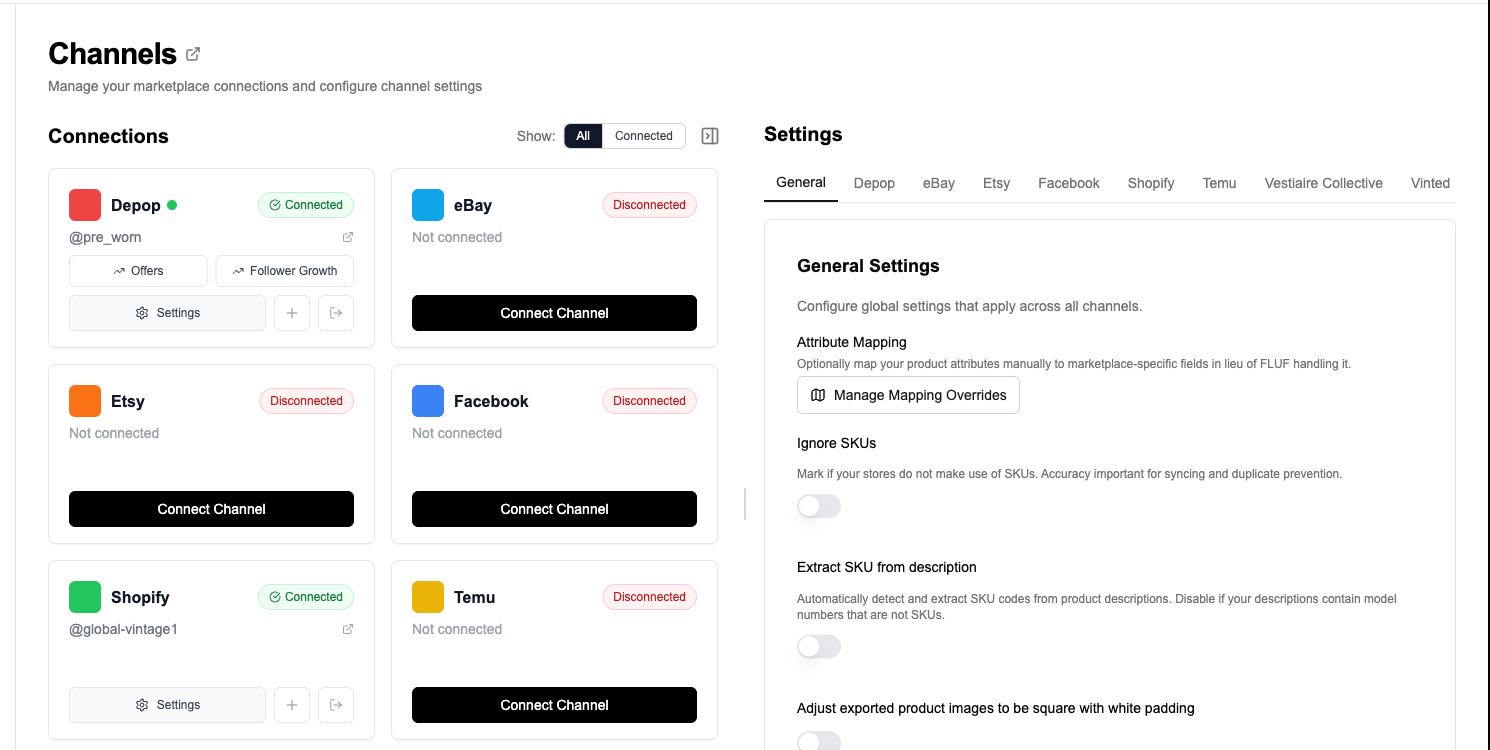
This is exactly what FLUF Connect automates. List your products once, crosslist to Facebook Marketplace, Shopify, and seven other marketplaces, and FLUF handles the rest — real-time inventory sync keeps stock accurate across every platform automatically.
How It Works
- Connect your accounts — Link your Facebook and Shopify accounts to FLUF Connect in seconds.
- Import or create listings — Pull in your existing inventory from either platform, or create new listings directly in FLUF.
- Crosslist to both platforms — Select products and push them to Facebook Marketplace and Shopify simultaneously. FLUF adapts titles, descriptions, and categories to each platform’s requirements.
- Automatic sync — When an item sells on Marketplace, FLUF updates stock on Shopify (and vice versa). Inventory stays accurate across both platforms.
| FLUF Connect Feature | Facebook Marketplace | Shopify |
|---|---|---|
| Crosslisting | Yes | Yes |
| Inventory sync | Yes | Yes |
| Auto-relisting | No | N/A |
| Offer management | No | N/A |
| Order sync | No | Native |
| Bulk operations | Yes | Yes |
A note on Facebook Marketplace support: FLUF Connect supports crosslisting and inventory sync for Facebook Marketplace, along with bulk operations. However, auto-relisting, offer management, and order sync are not currently available for Facebook Marketplace due to platform limitations. Shopify has native order sync built into FLUF Connect. For full-featured support including auto-relisting and offer management, consider also listing on eBay or Depop alongside your Marketplace and Shopify listings.
From £9/month, with no cap on how much you list.
Related Guides
- How to Sell on Facebook Marketplace — our complete Facebook Marketplace seller guide
- How to Sell on Shopify — our complete Shopify seller guide
- Depop vs Facebook Marketplace — social fashion marketplace vs local classifieds
- eBay vs Facebook Marketplace — auction giant vs local selling
- eBay vs Shopify — marketplace vs own-store comparison
- Cross-List with FLUF Connect — list on multiple platforms simultaneously
Related guides
Related guides
Frequently Asked Questions
It depends on what you sell and how you sell it. Facebook Marketplace is better for quick local sales, secondhand goods, furniture, and testing product ideas with zero upfront cost. Shopify is better for building a branded online store, selling globally, and scaling a long-term ecommerce business. Many sellers start on Facebook Marketplace and add Shopify as they grow — or use both simultaneously with FLUF Connect.
Facebook Marketplace is cheaper for most sellers. Local pickup sales are completely free — zero fees. Shipped items cost just 2% in the UK. Shopify charges 2.0% + 25p payment processing on every sale (Basic plan) plus a £19/month subscription. On a £30 sale, you keep £30 on Facebook Marketplace (local) versus £29.15 on Shopify — but Shopify also costs £19/month on top.
Yes. Many sellers use Facebook Marketplace for local and secondhand sales while running a Shopify store for their branded products. The challenge is keeping inventory consistent across both. FLUF Connect lets you crosslist products between Facebook Marketplace and Shopify with real-time inventory sync, so you never oversell.
Facebook Marketplace is much easier for beginners. You can list an item in under a minute using the Facebook app — no website to build, no subscription to set up, and no technical knowledge needed. Shopify requires choosing a plan, customising a store theme, setting up payment processing, and configuring shipping — which gives you far more control but takes longer to get started.
Facebook Marketplace has over 1 billion monthly users browsing listings globally, giving it unmatched reach for local sales. Shopify stores collectively reached 875 million consumers in 2024, but each individual store must drive its own traffic through marketing, SEO, and social media. Facebook Marketplace gives you a built-in audience; Shopify requires you to build one.
Yes. FLUF Connect supports crosslisting and inventory sync between Facebook Marketplace and Shopify. When an item sells on one platform, FLUF updates stock on the other automatically. Both channels support bulk operations, making it practical to manage large catalogues across both platforms.
Facebook Marketplace wins decisively for furniture, large items, and anything suited to local pickup. There are zero fees on local transactions, the algorithm promotes listings to nearby buyers, and most furniture transactions happen in person. Shopify is not designed for local pickup — it is built for shipped ecommerce.
Yes — they serve completely different purposes. Facebook Marketplace gives you instant access to a massive local audience with zero cost, perfect for testing products and selling secondhand goods. Shopify lets you build a professional brand with your own domain, customer data, and global reach. Using both means you capture local impulse buyers and long-term brand customers simultaneously.
Neither platform requires a business licence to start selling. Facebook Marketplace lets anyone with a Facebook account list items immediately. Shopify lets you open a store with just an email address. However, if you sell regularly for profit in the UK, HMRC may consider you a trader — in which case you should register as self-employed regardless of which platform you use.