
Depop vs Temu: Which Is Better for Sellers in 2026?
A side-by-side comparison of two very different marketplaces — peer-to-peer resale vs ultra-low-price retail — covering fees, audience, features, and which sellers each platform actually suits.



- Choose Depop if: you sell secondhand, vintage, or curated fashion and want to reach a young, engaged community of 7 million buyers who value unique finds.
- Choose Temu if: you manufacture or wholesale new products at scale and want access to 292 million monthly buyers shopping for ultra-low prices.
- Fees: Depop charges 2.9% + £0.30 payment processing — you keep £28.83 on a £30 sale. Temu charges zero commission for many sellers but controls retail pricing, so your margin depends on the wholesale price Temu agrees to pay.
- Audience: Depop has 7 million active buyers, 90% under 34. Temu has 292 million monthly active users across 90+ countries.
- Key difference: Depop is peer-to-peer resale (secondhand and vintage). Temu is mass-market retail (new products only). They serve fundamentally different seller types.
- Best strategy: Sell on both if you have mixed inventory — plus other marketplaces like eBay and Vinted. Cross-list free with FLUF Connect.
Depop vs Temu at a Glance
Depop and Temu are two of the most talked-about marketplaces in 2026, but they could not be more different. Depop is a peer-to-peer platform built for selling secondhand, vintage, and handmade fashion to a young, style-conscious audience. Temu is a mass-market retail marketplace where manufacturers and wholesalers sell new products at ultra-low prices to hundreds of millions of budget-focused buyers worldwide.
Depop was founded in 2011 in London by Simon Beckerman, originally as a social shopping app inspired by his magazine PIG. It became the go-to platform for Gen Z fashion resellers, blending Instagram-style aesthetics with peer-to-peer selling. Etsy acquired Depop in 2021 for $1.625 billion, and in February 2026, eBay announced it would acquire Depop for $1.2 billion, with the deal expected to close in Q2 2026.
Temu launched in September 2022 in the United States and expanded to the UK in 2023. Owned by PDD Holdings (the same company behind China’s Pinduoduo), Temu grew explosively by offering new products at rock-bottom prices — reaching 292 million monthly active users and approximately $47.5 billion in GMV by 2024, a 239% increase from the previous year. Temu operates three seller models: Fully Managed, Semi-Managed, and Local-to-Local, each with different logistics and pricing arrangements.
| Depop | Temu | |
|---|---|---|
| Founded | 2011 | 2022 |
| Headquarters | London, UK | Boston, MA (US ops); Dublin, Ireland (PDD Holdings) |
| Active buyers | 7 million | 292 million monthly active users |
| Markets | US, UK, Australia (primary) | 90+ countries |
| Best for | Secondhand fashion, vintage, streetwear, handmade | New products at scale — electronics, homeware, fashion, accessories |
| Product types | New and pre-owned | New products only — no secondhand |
| Seller fees | £0 selling fee + 2.9% + £0.30 processing | Zero commission for many sellers (pricing controlled by Temu) |
| Seller type | Individual resellers, small shops | Manufacturers, wholesalers, brands |
| Mobile app | Yes — mobile-first, Instagram-style | Yes — mass-market shopping app |
For a deeper look at each platform individually, see our full guides: How to Sell on Depop and How to Sell on Temu.
Depop vs Temu: Feature-by-Feature Comparison
Depop and Temu offer fundamentally different selling experiences because they serve different types of sellers. Depop is designed for individuals listing one-off items with personality and style. Temu is built for suppliers managing bulk inventory through a structured, platform-controlled process. The table below highlights the most important differences for sellers evaluating both platforms.
| Feature | Depop | Temu |
|---|---|---|
| Secondhand / pre-owned items | Yes — core use case | No — new products only |
| Auction listings | No — fixed price only | No — fixed price only |
| Fixed-price listings | Yes — seller sets price | Yes — but Temu controls retail pricing in Fully Managed model |
| Built-in messaging | Yes — WhatsApp-style chat | Limited — buyer-seller messaging via platform |
| Offer/haggle system | Yes — Make an Offer | No |
| Seller analytics | Basic — views and likes | Seller dashboard with sales, returns, and quality metrics |
| Promoted listings | Yes — Boosted Listings (12% in UK) | Yes — on-platform advertising available |
| Integrated shipping labels | Yes — Evri (UK), USPS (US) | Temu manages logistics (Fully Managed) or seller ships (Semi-Managed) |
| Buyer protection | Yes — Depop Protection | Yes — Temu Purchase Protection + refund without return policy |
| Social features (likes, follows) | Strong — likes, follows, social feed | Minimal — product-focused, not social |
| Seller verification | ID verification + Top Seller status | Business registration + product compliance documentation required |
| Business accounts | No formal tiers | Required — all sellers must be registered businesses |
| International selling | Limited — seller arranges own shipping | Built-in — Temu handles global logistics |
| Multi-quantity listings | No — one item per listing | Yes — bulk inventory per SKU |
| Minimum order requirements | None | Varies by model — Fully Managed requires bulk shipments |
The most fundamental difference is who can sell. Depop is open to anyone with a smartphone — list a jacket from your wardrobe, and it is live in two minutes. Temu requires business registration, product compliance documentation, and (for Fully Managed sellers) the ability to ship bulk inventory to warehouses. This makes Temu inaccessible to the individual reseller who makes up the vast majority of Depop’s seller base.
Listing Experience: Depop vs Temu
The listing experience on Depop and Temu could not be more different — one is designed for individuals selling unique items, the other for businesses uploading product catalogues at scale.
On Depop, you upload up to 20 photos (with video support), select a category, enter the brand, size, colour, and condition, write a description, and set a price. The mobile-first app guides you through each step with tap-to-select fields. There are no complex item specifics, no compliance requirements, and no minimum quantities. Depop also offers AI-powered photo editing through its Photoroom integration, which can remove backgrounds and enhance images automatically. Most sellers can photograph and list an item in under two minutes.
On Temu, the listing process is structured around product catalogue management. Sellers submit products through a seller portal, providing detailed specifications including product dimensions, materials, certifications, and compliance documentation (particularly important for electronics, toys, and cosmetics). In the Fully Managed model, Temu’s merchandising team reviews and controls how products appear to buyers, including titles, pricing, and promotional placement. Sellers in the Semi-Managed model have more control over listings but must still meet Temu’s product quality and documentation standards.
Photography expectations differ significantly. Depop buyers expect lifestyle-style photos — flat lays on clean backgrounds, items worn or styled, close-ups of labels and details. The aesthetic is Instagram-influenced and curated. Temu expects professional product photography on white backgrounds, showing the item from multiple angles with clear detail shots. Flat-lay “what’s in the box” images showing all included items are particularly effective on Temu.
Time to list: expect 1–2 minutes per item on Depop. On Temu, onboarding a new product can take considerably longer due to compliance documentation, quality checks, and Temu’s review process — but once a product is approved, bulk inventory management is streamlined. For sellers managing inventory across both platforms, FLUF Connect’s bulk operations can significantly reduce the manual effort.
Fees Compared: How Much Do Depop and Temu Actually Cost?
Depop and Temu take fundamentally different approaches to seller fees. Depop charges a transparent percentage on each sale. Temu advertises zero commission but controls pricing in ways that effectively determine your margin. Understanding this difference is critical before committing inventory to either platform.
Fee Breakdown
| Fee Type | Depop | Temu |
|---|---|---|
| Registration fee | Free | Free |
| Listing fee | Free — unlimited | Free |
| Selling / commission fee | £0 (removed July 2024) | Zero commission for many sellers |
| Payment processing | 2.9% + £0.30 per transaction | Included — no separate charge |
| Pricing control | Seller sets price freely | Temu controls retail price (Fully Managed) or targets ~85% of Amazon pricing (Semi-Managed) |
| Promoted listings | 12% (Boosted Listings, UK) | Available — cost varies by campaign |
| Subscription | N/A | N/A |
| Penalties | None (standard) | “Refund without return” penalties up to 5x order amount |
The Real Cost: Pricing Control vs Transparent Fees
On Depop, the fee calculation is straightforward: you set your price, a buyer pays it, and Depop takes 2.9% + £0.30 in payment processing. You know exactly what you keep on every sale.
On Temu, “zero commission” is technically accurate for many sellers — but the reality is more nuanced. In the Fully Managed model, Temu buys from sellers at a low wholesale cost and sets the consumer price independently. The seller’s “fee” is effectively built into the low purchase price Temu offers. In the Semi-Managed model, sellers have more pricing control, but Temu targets approximately 85% of Amazon’s average price for comparable items, with subsidies of 20–30% to keep consumer prices competitive.
- Depop: Selling fee £0.00 + Processing fee £1.17 (2.9% + £0.30) = You keep £28.83
- Temu (Fully Managed): Temu controls the £30 retail price. Your wholesale price might be £8–15 depending on the product and negotiation = You keep £8–15
- Temu (Semi-Managed): More pricing flexibility, but Temu targets below-market pricing. Margins vary widely by product category.
Important: These are very different economics. On Depop, you sell a curated secondhand item at a price you choose and keep the vast majority. On Temu, you supply new products at wholesale prices and Temu handles the retail side. Depop sellers and Temu sellers are running fundamentally different businesses.
Payouts: How Quickly You Get Your Money
| Depop | Temu | |
|---|---|---|
| Payout method | Bank transfer (via Stripe) | Bank transfer |
| Payout schedule | 2–3 working days after delivery confirmed, or up to 10 days after sale | Regular settlement cycles — timing varies by seller model and contract |
| On-demand payouts | No | No |
| New seller holds | Up to 10 working days | Payment after buyer return window closes (Fully Managed) |
| PayPal option | No — phased out | No |
Depop ties payouts to delivery confirmation — your money arrives after the tracking shows delivered, or after a 10-day waiting period. Temu’s settlement cycles vary by seller model, with Fully Managed sellers typically receiving payment after the buyer’s return window closes. Neither platform offers particularly fast payouts compared to eBay’s daily payout option.
Hidden Costs to Watch For
On Depop: the buyer-side marketplace fee (up to 5% + £1) does not come from the seller but increases the total cost to buyers, which can affect your pricing strategy. If you use Boosted Listings, the 12% fee in the UK is steep, and a class action has been filed over how buyer fees are disclosed at checkout.
On Temu: the biggest hidden cost is Temu’s “refund without return” policy, where buyers can receive a refund without sending the item back — and sellers can face penalties up to 5x the order amount for quality issues. Product compliance failures can also result in listings being removed and inventory being held. For Fully Managed sellers, thin margins combined with return costs can make profitability challenging.
Audience and Demand: Who Is Buying on Depop vs Temu?
Depop and Temu attract almost entirely different buyer demographics with almost zero overlap. This is what makes the comparison unusual — these platforms are not competing for the same buyers. Understanding who shops where helps you decide which platform suits your products.
| Depop | Temu | |
|---|---|---|
| Primary age group | 16–34 (90% of buyers under 34) | 25–45 (broad demographic, value-driven) |
| Top markets | US, UK, Australia | US, UK, Germany, France, 90+ countries |
| Monthly active users | 7 million | 292 million |
| Annual GMV | ~$1 billion (2025) | ~$47.5 billion (2024) |
| Best-selling categories | Streetwear, Y2K fashion, vintage clothing, handmade items | Electronics accessories, homeware, fashion basics, beauty products |
| Buyer behaviour | Browse-led, social, looking for unique finds | Search-led, price-driven, comparison shopping for lowest price |
| Average order value | £15–30 (single unique items) | £8–20 (multiple low-cost items) |
Depop’s audience skews young, fashion-forward, and social. Buyers browse Depop like a social media feed — scrolling through curated shops, following sellers whose style they admire, and making purchases on unique pieces they cannot find anywhere else. The platform’s strength is in fashion subcategories that resonate with Gen Z: Y2K, vintage sportswear, streetwear, and indie brands. Depop buyers value authenticity, story, and curation over price.
Temu’s audience is vastly larger, broader in age range, and overwhelmingly price-driven. Temu buyers are looking for the lowest possible price on everyday products — phone cases, home accessories, basic clothing, kitchen gadgets. The platform’s gamified shopping experience (spin-to-win, flash sales, group buying) encourages impulse purchases of low-cost items. Temu’s 20 million monthly UK buyers represent a massive audience, but they expect new, mass-produced goods — not curated vintage finds.
Category guidance: Depop wins for anything unique, secondhand, vintage, or curated — items whose value comes from scarcity, style, or provenance. Temu wins for new, mass-produced products where the primary differentiator is price — electronics accessories, basic homeware, fast fashion basics, and beauty products. A vintage Levi’s jacket belongs on Depop. A pack of new phone screen protectors belongs on Temu.
Shipping: Depop vs Temu
Shipping works very differently on each platform, reflecting their fundamentally different seller models. Depop sellers handle their own shipping as individuals posting parcels. Temu manages large-scale logistics across continents.
| Depop | Temu | |
|---|---|---|
| Integrated shipping labels (UK) | Yes — Evri only | N/A — Temu manages logistics (Fully Managed) |
| Who manages shipping | Seller posts each parcel | Temu (Fully Managed) or seller (Semi-Managed/Local-to-Local) |
| Domestic shipping cost | From £2.99 (under 1kg via Evri) | Varies — often free to buyers (Temu absorbs cost) |
| Free shipping option | Yes — seller absorbs cost | Frequently offered by Temu as promotion |
| International shipping | No integrated labels — seller arranges own | Built-in — Temu handles global logistics |
| Return shipping | Buyer pays unless item not as described | Temu often offers free returns; “refund without return” for low-cost items |
| Tracking required | Strongly recommended (affects payout speed) | Provided automatically by Temu’s logistics network |
For Fully Managed sellers on Temu, shipping is almost entirely hands-off. Sellers ship bulk inventory to Temu’s warehouses (typically in China or overseas fulfilment centres), and Temu handles storage, packing, and delivery to end customers worldwide. This is more akin to Amazon FBA than to traditional marketplace selling. Delivery times to UK buyers have been a common concern — typically 7–15 business days from Chinese warehouses, though Semi-Managed and Local-to-Local models offer faster domestic delivery.
For Depop sellers, shipping is a personal process — you pack the item yourself, print a prepaid Evri label through the app, and drop it at an Evri parcel point. Many Depop sellers add personal touches like thank-you notes and tissue paper, which builds community and repeat buyers. International shipping is not integrated, so sellers must arrange their own cross-border postage.
The biggest practical difference: Depop sellers ship one item at a time to individual buyers. Temu sellers (Fully Managed) ship bulk inventory to warehouses. These are completely different logistics operations.
What Real Sellers Say About Depop vs Temu
Because Depop and Temu serve such different seller types, direct comparisons from sellers who use both are rare. Most seller discussions focus on whether Temu is viable as a selling platform at all, compared to established peer-to-peer marketplaces like Depop.
“Extreme price pressure with imposed discounts and a very low ‘optimal’ price. Margins wiped out once discounts and Temu’s commission are deducted.”
— Adrian Chua, TradeDownCo (UK seller who quit Temu after six months)
“I tried to sign up but it’s extremely difficult. Seems like you need to live in China for it to work.”
“Many sellers underestimate landed costs and end up losing money.”
“The most successful clothing resellers often use both platforms. They list their trendy, niche items on Depop to capture the youth market while using eBay for their broader inventory.”
— Reeva.ai
Common themes from sellers:
- Depop’s strengths: easy to start, no business registration needed, full pricing control, personal connection with buyers, great for unique and secondhand items.
- Depop’s frustrations: small buyer pool compared to larger marketplaces, non-binding offers that waste time, algorithm changes that can bury small sellers.
- Temu’s strengths: enormous buyer base, global logistics handled by the platform, zero commission, fast-growing marketplace.
- Temu’s frustrations: thin margins from pricing control, “refund without return” penalties, requires business registration, no secondhand items allowed, long delivery times from overseas warehouses.
- The consensus: these are not interchangeable platforms. Depop is for individual resellers selling unique items. Temu is for manufacturers and wholesalers selling new products at scale. Most sellers who use both are running different product lines on each.
How to Choose Between Depop and Temu
This comparison is less about “which is better” and more about “which suits your business model.” Depop and Temu serve such different seller types that the right choice usually depends on what you sell and how you sell it, not on which platform has better features or lower fees.
- Sell secondhand, vintage, or handmade items
- Want to list individual unique pieces with personal descriptions and curated photos
- Prefer full control over your pricing, branding, and customer relationships
- Sell primarily fashion, streetwear, or accessories to a young, engaged audience
- Want to start selling immediately with no business registration required
- Manufacture or wholesale new products that you can supply at scale
- Want access to 292 million buyers across 90+ countries without managing your own logistics
- Can compete on price — your products must be priced competitively against global suppliers
- Have a registered business and can provide product compliance documentation
- Sell categories like electronics accessories, homeware, beauty products, or basic fashion at volume
For casual resellers clearing out a wardrobe or selling secondhand finds, Depop is the obvious choice — Temu does not even allow pre-owned items. For small brands and manufacturers who produce new goods and want massive reach, Temu’s scale is compelling if you can handle the margin expectations. For scaling resellers who source both secondhand and new inventory, using both platforms alongside eBay, Vinted, and Shopify gives you the broadest possible reach.
The smartest sellers match each product to the platform where it fits best. A vintage Adidas tracksuit goes on Depop. A bulk order of new phone cases goes on Temu. And everything gets managed from one place.
Why Not Both? Sell on Depop and Temu at the Same Time
While Depop and Temu serve different types of inventory, many sellers have both secondhand and new products in their catalogue. A reseller might source vintage pieces for Depop while also selling new accessories or basics that suit Temu’s mass-market audience. Managing inventory, listings, and orders across multiple platforms is where the complexity multiplies — and where automation becomes essential.
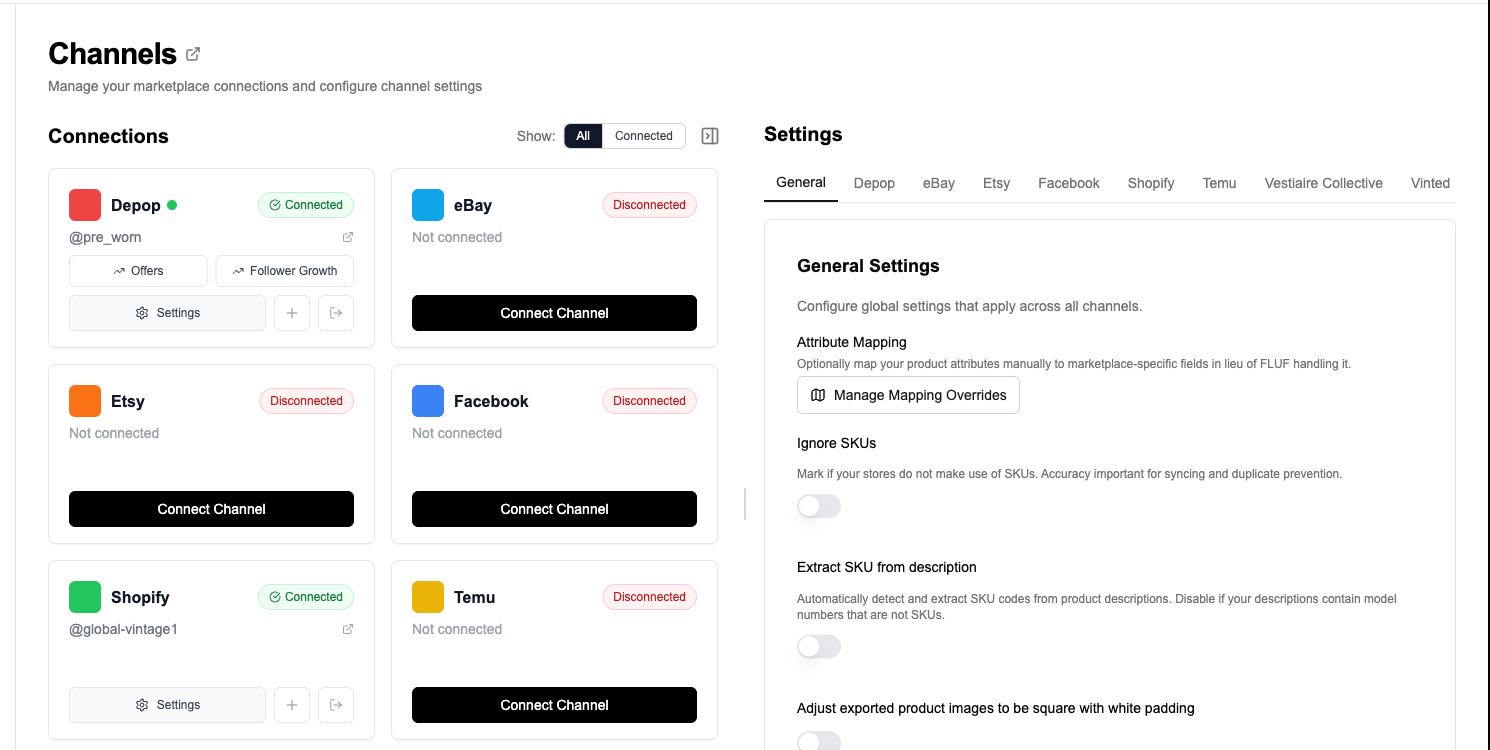
FLUF Connect supports both Depop and Temu, along with seven other marketplaces including eBay, Vinted, Shopify, and Facebook Marketplace. Rather than logging into each platform separately, you manage everything from a single dashboard.
How It Works
- Connect your accounts — Link your Depop and Temu accounts to FLUF Connect in seconds.
- Import or create listings — Pull in your existing inventory from any connected platform, or create new listings directly in FLUF.
- Crosslist to the right platforms — Push products to the marketplaces that suit them. Secondhand fashion to Depop, Vinted, and eBay. New products to Temu and Shopify. FLUF adapts listings to each platform’s requirements.
- Automatic sync — When an item sells on any platform, FLUF updates inventory everywhere. No overselling, no manual removal.
| FLUF Connect Feature | Depop | Temu |
|---|---|---|
| Crosslisting | Yes | Yes |
| Inventory sync | Yes | Yes |
| Auto-relisting | Yes | No |
| Offer management | Yes | No |
| Order sync | Yes (via Shopify) | Yes |
| Bulk operations | Yes | Yes |
Depop has full feature support in FLUF Connect — including automated relisting and offer management, which are included from Seller upwards. Temu supports crosslisting, inventory sync, and order sync. Most competitors do not support Temu at all.
From £9/month, with no cap on how much you list.
Related Guides
- How to Sell on Depop — our complete Depop seller guide
- How to Sell on Temu — our complete Temu seller guide
- Depop vs eBay — peer-to-peer marketplace comparison
- Auto-Relist Your Listings — keep listings fresh automatically
- Depop vs Vinted — the most popular UK resale comparison
- FLUF Connect vs List Perfectly — crosslisting tool comparison
- Amazon vs Temu for sellers
Frequently Asked Questions
Depop is better for selling secondhand and vintage clothing. Temu does not allow used or pre-owned items — it is a marketplace for new products only, primarily from manufacturers and brands selling at wholesale prices. If you sell secondhand fashion, Depop is the right choice. If you manufacture or wholesale new clothing, Temu gives you access to 292 million monthly buyers.
No. Temu only allows new products. If you sell pre-owned, vintage, or secondhand items, Temu is not an option. Depop, eBay, Vinted, and Facebook Marketplace all support secondhand selling. You can crosslist secondhand items across these platforms using FLUF Connect.
Temu charges zero commission for many sellers, but controls your retail pricing — meaning your margin is effectively set by Temu, not by you. Depop charges 2.9% + £0.30 payment processing per sale but lets you set your own prices. On a £30 Depop sale, you keep £28.83. On Temu, your take-home depends on the wholesale price Temu agrees to pay you, which is typically much lower than the retail price.
Yes, but only if you sell both secondhand items (on Depop) and new products (on Temu). The platforms serve completely different inventory types. FLUF Connect supports both Depop and Temu, so you can manage listings, inventory, and orders across both platforms from one dashboard.
Depop is far easier for individual sellers. You can download the app, take photos of items you want to sell, and list them in under two minutes. Temu requires a business registration, product compliance documentation, and — for Fully Managed sellers — shipping bulk inventory to warehouses. Temu is designed for manufacturers and wholesalers, not casual resellers.
Temu has significantly more buyers — approximately 292 million monthly active users across 90+ countries, compared to Depop's 7 million active buyers. However, Depop's buyers are specifically looking for unique, secondhand, and vintage items, while Temu's buyers are shopping for new products at the lowest possible prices. The audiences barely overlap.
Yes. FLUF Connect supports both Depop and Temu (and seven other marketplaces). You can crosslist products, sync inventory in real time, and manage orders from a single dashboard. This is most useful if you sell new products that suit both platforms.
Temu is a legitimate marketplace owned by PDD Holdings. However, sellers should be aware of risks: Temu controls retail pricing in the Fully Managed model, the 'refund without return' policy can result in penalties up to 5x the order amount, and margins can be thin. Depop gives sellers full control over pricing and terms, which many independent sellers prefer.
For secondhand, vintage, or curated fashion, Depop is the clear choice — it is built specifically for this. Temu is for new fashion at ultra-low prices, targeting budget-conscious mass-market buyers. A vintage Nike jacket would thrive on Depop but would not be allowed on Temu. A bulk order of new phone cases would suit Temu but would feel out of place on Depop.