Crosslist from Facebook Marketplace to Poshmark — Automatically
Take your Facebook Marketplace listings national. FLUF enriches thin local listings and crosslists them to Poshmark's shipped, social fashion audience, with stock kept in sync.



Key Takeaways
- Facebook Marketplace is the giant local marketplace — over a billion people shop it and around 250 million sellers list on it — but it is local-first, with thin, unstructured listings and free local pickup.
- Poshmark is national and fashion-focused — about 80 million registered users shopping a social feed, with prepaid shipping and a 20% commission on $15+ sales.
- FLUF Connect crosslists your Facebook Marketplace fashion and home listings to Poshmark in seconds — and because Facebook listings are usually thin, it helps enrich brand, size, category and condition so they meet Poshmark’s structured form.
- Inventory syncs both ways, so a sale on one channel ends the twin on the other within minutes.
- Poshmark is shipping-only, so a Facebook seller used to local meet-ups commits to posting items — but in return reaches a national, engaged fashion audience.
- The cheapest plan is Starter at £9/month, with no cap on how much you list. There is no free plan, but every new account gets a 7-day trial for £1; every plan includes the Facebook Marketplace, Poshmark bridge, sync, bulk tools, Seller and above add relisting, and Seller and above add offers.
Why Crosslist from Facebook Marketplace to Poshmark?
Facebook Marketplace and Poshmark solve different problems. Facebook is where you clear items locally — fast, free, and to whoever is nearby. Poshmark is where you reach a national audience that came specifically to shop fashion. Crosslisting lets the same garment work both: local browsers on Facebook, and engaged, shipping-ready fashion buyers on Poshmark.
Facebook Marketplace is vast — more than a billion people shop it, with around 250 million sellers — but its reach is broad and shallow: listings are general, local-first, and light on structured detail. Poshmark is smaller and deeper: around 80 million registered users in a feed built for fashion, with sharing, Posh Parties and an audience that expects to pay for shipped, described items.
| Dimension | Facebook Marketplace | Poshmark |
|---|---|---|
| Reach | 1B+ shoppers, ~250M sellers | ~80M registered users |
| Model | Local-first, broad categories | National, shipped, fashion-led |
| Fees | Local free; 10% (min $0.80) on shipped orders | 20% on $15+, $2.95 flat under $15 |
| Listing detail | Thin — title, price, free-text, photos | Structured — brand, size, category, condition |
| Discovery | Local browse, search | Social feed, sharing, Posh Parties |
| Photos per listing | Up to 10 | Up to 16 |
On fees, Facebook is cheaper at the headline — local sales are free and shipped orders cost 10% with an $0.80 minimum — while Poshmark takes a flat 20%. But Facebook gives you a local crowd browsing for anything, whereas Poshmark gives you a national crowd browsing for exactly what you sell, with the shipping handled. The two are complementary, not competing — Facebook clears what is bulky or hyper-local, while Poshmark reaches the shipped, fashion-minded buyer who would never have appeared in your local feed in the first place.
Thin Facebook Listings and the Enrichment Step
Here is the honest difference that defines this pair. Facebook Marketplace listings are deliberately light: a title, a price, a free-text description and a few photos, with condition, size and brand usually buried in the description rather than recorded as structured fields. Poshmark needs the opposite — a department, category and subcategory, a brand, a size, colours and a condition flag.
So crosslisting from Facebook to Poshmark is rarely a clean copy. It usually needs enrichment: pulling the brand, size and category out of your Facebook description (or adding them) so the Poshmark listing is complete and findable. This is exactly where a tool earns its keep — FLUF Connect parses what your Facebook listing already contains and helps you fill the structured Poshmark fields, rather than leaving you to re-type everything from scratch.
One commitment to make up front: Poshmark is shipping-only. If you have only ever sold locally on Facebook with meet-ups, moving to Poshmark means packing and posting items. In exchange you stop being limited to buyers in driving distance.
How to Crosslist from Facebook Marketplace to Poshmark with FLUF Connect
Setup takes about 10 minutes, then each listing crosslists in roughly a minute once enrichment is in place.
- Create a FLUF Connect account. Sign up at FLUF Connect and choose Starter (£9/month), with no cap on how much you list.
- Install the extension. Facebook Marketplace and Poshmark require the FLUF browser extension. Sign in to both accounts and follow the connection prompts.
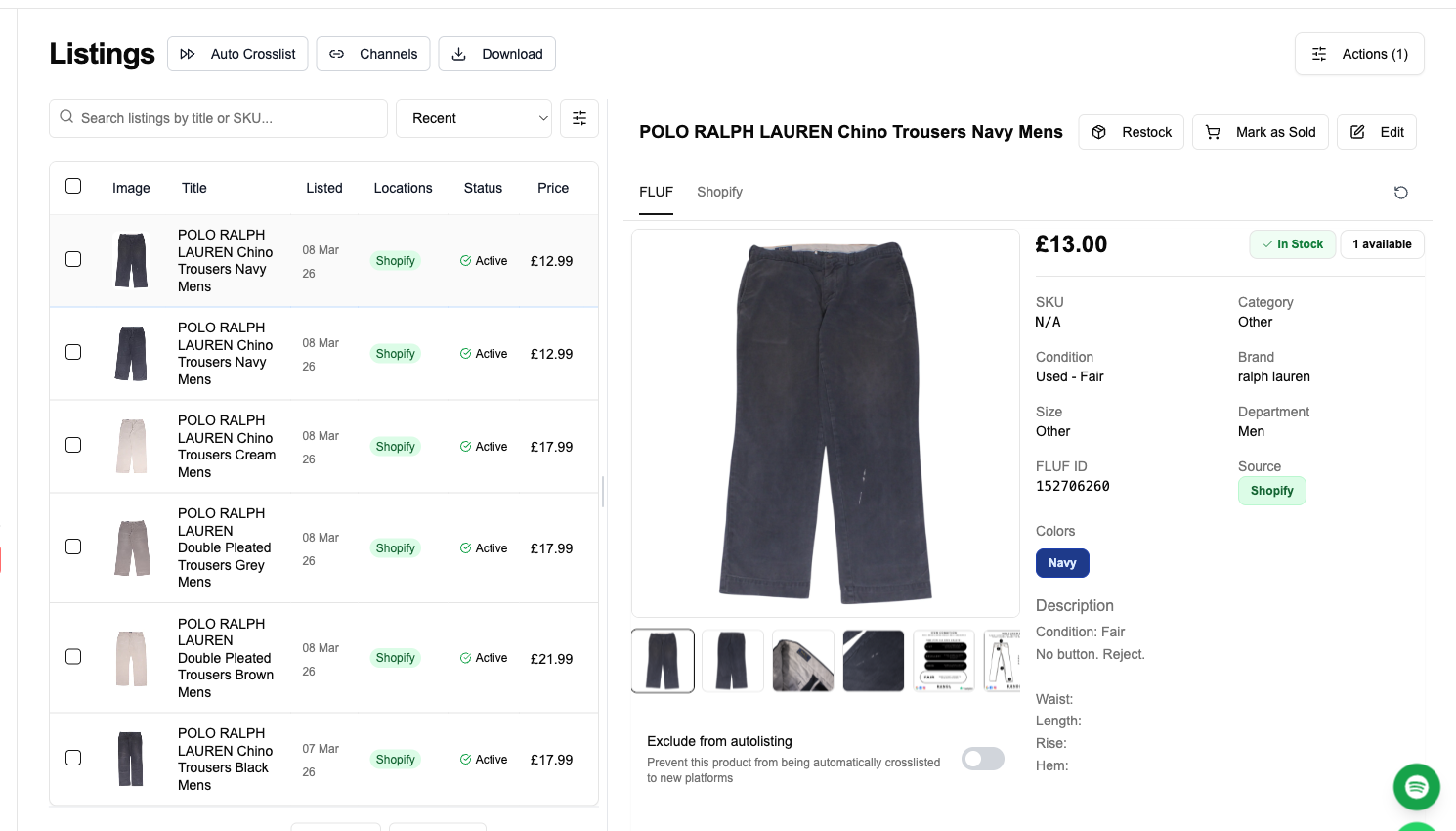
- Connect Facebook Marketplace. FLUF imports your listings — titles, descriptions, photos and price — into one dashboard.
- Connect Poshmark. Log in and connect it the same way.
- Enrich the listings. Add or confirm brand, size, category and condition so the Poshmark form is complete.
- Crosslist. Confirm and publish into your Poshmark closet; inventory then stays in sync.
What Transfers When You Crosslist from Facebook Marketplace to Poshmark?
Because Facebook listings carry few structured fields, the mapping is less about translating and more about completing. FLUF carries across what exists and flags what Poshmark needs you to add.
Field mapping — Facebook Marketplace to Poshmark
| Facebook field | Poshmark field | Transfer | Notes |
|---|---|---|---|
| Title | Title | ✅ Automatic | Tidied for Poshmark’s brand-led format. |
| Description | Description | ✅ Automatic | Brand and size are often hidden here and pulled out during enrichment. |
| Photos | Photos | ⚡ Mapped | Facebook allows up to 10, Poshmark up to 16, so all transfer. |
| Price | Price | ⚡ Smart mapped | Converted to USD where needed; add a markup for the 20% commission. |
| Condition | Condition | ⚠ Often manual | Facebook’s New/Used note maps to Poshmark’s New-With-Tags vs used flag. |
| — | Brand | ⚠ Manual / enriched | Facebook has no real brand field; added during enrichment. |
| — | Size | ⚠ Manual / enriched | Usually only in the description; mapped to Poshmark’s size picker. |
| Category (free-form) | Department / Category | ⚡ Smart mapped | Mapped to the nearest Poshmark subcategory. |
| — | Colour | ⚠ Manual | Up to two colours on Poshmark. |
Legend: ✅ Automatic · ⚡ Smart-mapped · ⚠ Manual or enriched (Facebook has no structured field).
Category mapping examples
| Facebook category | Poshmark path | Note |
|---|---|---|
| Women’s Clothing & Shoes | Women → (subcategory from title) | Review the subcategory |
| Men’s Clothing & Shoes | Men → (subcategory from title) | Review the subcategory |
| Home Goods → Décor | Home → Home Décor | Maps where Poshmark has a home category |
The fields that need your attention here are brand and size — Facebook simply does not record them as fields, so enrichment is the difference between a Poshmark listing that gets found and one that does not.
Inventory Sync Between Facebook Marketplace and Poshmark — What Stays in Sync?
Once an item is live in two places, sync keeps it honest.
| Event | What happens | Timing |
|---|---|---|
| Item sells on Facebook Marketplace | Removed from Poshmark automatically | Within minutes |
| Item sells on Poshmark | Removed from Facebook Marketplace automatically | Within minutes |
| Price changed in FLUF | Updated on both channels | Minutes |
| Item deleted in FLUF | Delisted from both | Minutes |
When an item sells on Facebook Marketplace, FLUF Connect removes it from Poshmark within minutes — and from any other connected channel — so you never sell the same item twice.
Both connections require the FLUF browser extension. Keep it connected and allow time for inventory updates; sync is not instantaneous.
Crosslisting from Facebook Marketplace to Poshmark: Before and After
Without FLUF Connect (manual)
- Open the Facebook listing and download each photo.
- Read the description to find the brand, size and condition.
- Start a Poshmark listing and re-type a trimmed title.
- Re-write the description and add the structured detail.
- Upload the photos one at a time.
- Pick department, category and subcategory, and add brand and size.
- Set condition and a US price that absorbs the 20% fee.
- Publish, log it, and remember to pull it when it sells.
Sellers commonly describe losing hours to this repetitive, error-prone re-keying across platforms.
With FLUF Connect
- FLUF imports your Facebook listings and flags the missing fields.
- Add brand, size and category once.
- Click crosslist to Poshmark.
- Done — inventory syncs from then on.
Manual: roughly 15-25 hours, given the enrichment each item needs. With FLUF Connect: a couple of hours including enrichment, then sync runs itself.
Automation Features for Facebook Marketplace and Poshmark Sellers
FLUF Connect automates the parts of selling that reward consistency.
Auto-relisting
Poshmark surfaces fresher listings higher, so FLUF can refresh your Poshmark listings on a schedule to keep them visible in the feed.
Offer management
Poshmark’s “Offer to Likers” converts interested browsers into buyers — a tool Facebook Marketplace does not offer. FLUF runs offer rules across the listings that have drawn likes.
Auto-crosslist rules and bulk operations
Auto-push new Facebook listings to Poshmark, bulk-adjust prices, and run find-and-replace across descriptions.
| Feature | Facebook Marketplace | Poshmark |
|---|---|---|
| Crosslisting | ✅ | ✅ |
| Inventory sync | ✅ | ✅ |
| Auto-relisting | ❌ | ✅ |
| Offer management | ❌ | ✅ |
| Bulk operations | ✅ | ✅ |
Local-Free vs National-Shipped: The Real Trade-Off
The instinct of many Facebook Marketplace sellers is to resist Poshmark’s 20% commission, because Facebook local sales cost nothing at all. That instinct misreads the trade. Facebook’s free local model limits you to buyers within driving distance and to whatever they happen to be browsing that day; the audience is enormous in total but thin for any one item, and a niche piece can sit for weeks because the right local buyer never scrolls past it. Poshmark charges 20% but hands you a national audience that came specifically to shop fashion, with the shipping label already sorted.
So the honest comparison is not “free versus 20%” — it is “a free listing nobody local wants” versus “a 20% sale to a buyer two states away who would never have found you on Facebook.” For general bulky goods that only make sense as local pickup, Facebook stays the right home. For clothing, shoes, bags, accessories and smaller home items that ship cheaply, Poshmark’s reach usually more than covers its cut. Crosslisting lets you keep the free local channel running for what suits it while opening a national channel for what does not.
Enrichment in Practice: Turning a Thin Listing into a Findable One
Facebook Marketplace was built for speed: snap a few photos, type a sentence, set a price, post. There is no required brand field, no structured size, and condition is often just “New” or “Used.” That is fine for a local buyer who can ask a question in chat, but it fails on Poshmark, where shoppers filter by brand, by size and by category, and a listing missing those fields is effectively invisible.
Enrichment is the work of bridging that gap, and it is where most of the value sits on this pair. In practice it means, for each crosslisted item: identifying the brand (often mentioned in your Facebook description but not tagged), setting the correct size against Poshmark’s size picker, choosing a department, category and subcategory rather than a free-text label, and translating a casual “good used condition” note into Poshmark’s condition flag plus an honest description of any wear. FLUF Connect reads what your Facebook listing already contains and pre-fills as much of this as it can, then flags what still needs your input — so you are confirming and completing rather than re-keying every listing from a blank Poshmark form. Done once per item, it is the difference between a Poshmark closet that gets found and one that quietly never sells.
Committing to Shipping
The other shift to plan for is operational. On Facebook Marketplace many sellers only ever meet buyers in person, take cash, and never touch a parcel. Poshmark does not offer local pickup at all — every sale ships, on a prepaid label Poshmark generates for you. That is genuinely easier than arranging eBay postage, because the label, the rate and the address all come pre-set, but it does mean keeping packing materials on hand and getting items to a post office or collection point promptly to protect your ratings. For most fashion and small-goods sellers this is a minor adjustment; for anyone whose Facebook business is built entirely around heavy local items, it is the signal that only part of your catalogue belongs on Poshmark. As ever, the prepaid label is US-origin only and Poshmark requires a US or Canadian address, so sellers elsewhere need a fulfilment route before the maths works.
It helps to start small rather than mirroring your entire Facebook Marketplace inventory at once. Pick the twenty or thirty fashion and small-home items most likely to suit a national shipped audience, enrich those properly with brand, size and category, and learn how Poshmark’s sharing and offers convert for your stock before scaling up. Because FLUF keeps everything in sync, you can leave those items live on Facebook for local buyers at the same time, with no risk of selling the same piece twice. Once you see which categories move, you can turn on auto-crosslist rules so new qualifying Facebook listings flow to Poshmark automatically, and let the bulk tools handle the rest of the catalogue in one pass.
One last point specific to Facebook sellers: photography standards differ. Facebook Marketplace tolerates quick, in-situ snaps because buyers expect to inspect items in person, but Poshmark is a visual feed where styling and clean, well-lit photos drive shares and offers. You do not need a studio, but the items you crosslist will perform noticeably better with bright, square-friendly images and a consistent background. Since FLUF carries your existing Facebook photos across, the easy win is to re-shoot just your best candidates before crosslisting them, then reuse those stronger images back on Facebook too — so the effort improves both channels at once rather than only Poshmark, and your best items end up presented well wherever a buyer happens to come across them, whether that is a local browser on Facebook or a fashion shopper on Poshmark.
How Much Does It Cost to Crosslist from Facebook Marketplace to Poshmark?
| Plan | Monthly | Crosslisted products |
|---|---|---|
| Starter | £9/month | Unlimited |
| Seller | £29/month | Unlimited |
| Pro | £99/month | Unlimited |
| Super Seller | Custom pricing — tell us what you need | Unlimited |
there is no free plan, but every new account gets a 7-day trial for £1; the cheapest option is Starter at £9/month, with no cap on how much you list. Every plan covers all supported channels, so the same items can also reach Depop, Vinted, eBay, Etsy and more at no extra cost. See the full pricing page.
Sources & Verification
- Capital One Shopping — Facebook Marketplace statistics (users, sellers, demographics)
- LitCommerce — Facebook Marketplace fees (local free; 10% / $0.80 min shipped)
- SellerAider — Poshmark vs Facebook Marketplace (local vs national, listing structure)
- Poshmark user statistics
- Poshmark Support — What can I sell on Poshmark
Start crosslisting from Facebook Marketplace to Poshmark
Related guides
Frequently Asked Questions
FLUF Connect plans start at £9/month on Starter, with Seller at £29/month and Pro at £99/month; every plan is unlimited on listings and marketplaces, and the tiers differ only by how often we check your channels for sales. There is no free plan. Every plan includes crosslisting, inventory sync, auto-relisting, offers and bulk operations across all supported channels, so automation is never a paid add-on.
Facebook listings are thin — usually just a title, price, free-text description and photos, with brand, size and condition buried in the text. Poshmark needs structured fields: department, category, brand, size, colour and condition. FLUF Connect pulls what your Facebook listing already contains and helps you complete the rest so the Poshmark listing is findable.
Poshmark is shipping-only — there is no local meet-up option. A Facebook Marketplace seller used to local pickup commits to packing and posting items on Poshmark, but in return reaches a national audience rather than only nearby buyers.
Yes. When an item sells on Facebook Marketplace, FLUF removes it from Poshmark within minutes, and a Poshmark sale ends the Facebook listing the same way, so you never sell the same item twice.
Both connections require the FLUF browser extension. Keep it available and allow time for inventory updates; sync is not instantaneous.
Facebook Marketplace is free for local sales and charges 10% with an $0.80 minimum on shipped orders. Poshmark charges a flat 20% on sales of $15 or more, or $2.95 under that, but bundles the prepaid label and supplies a national fashion audience. Price your Poshmark listings slightly higher to absorb the larger cut.
Poshmark's prepaid label is US-only and Poshmark gates sellers by US or Canadian address and IP, so a UK seller needs a US fulfilment route to make Poshmark orders economical. US-based sellers can crosslist directly.
Yes. Every FLUF Connect plan includes all supported channels, so the same items can also go to Depop, Vinted, eBay, Etsy and more from one dashboard at no extra cost.