
Designer Wardrobe vs Depop: Audience, Fees & Which to Choose (2026)
An honest comparison of two resale fashion marketplaces \u2014 Designer Wardrobe's NZ premium audience versus Depop's global Gen-Z reach \u2014 on fees, geography, audience and style, plus how to sell on both at once.
7 days for £1, then from £9/month.



TL;DR: Designer Wardrobe and Depop are both resale fashion marketplaces, but they barely overlap. Designer Wardrobe is New Zealand’s leading preloved and designer-fashion marketplace — curated, women’s-led, premium, and focused on the NZ/Australasian audience. Depop is a global, Gen-Z social resale app (owned by Etsy, being acquired by eBay) with around 7 million active buyers, strongest for streetwear, vintage and Y2K. Choose Designer Wardrobe to sell premium womenswear into New Zealand; choose Depop for global Gen-Z reach. Most resellers do both — and with FLUF Connect you can crosslist the same inventory to both (and eBay, Vinted and more) with inventory synced so you never oversell.
If you sell preloved or designer fashion, Designer Wardrobe and Depop can both look like obvious homes for your inventory — but they are very different platforms serving very different buyers. One is a focused, premium marketplace rooted in New Zealand; the other is a sprawling global app built around Gen-Z culture. Understanding where each is strong, what each costs, and who each reaches is the difference between listing strategically and spreading yourself thin.
This comparison sticks to verified, current facts — both platforms have changed in the last year, and Depop’s ownership is itself in transition — and it is deliberately balanced. We cover what each marketplace is, the audience and geography behind it, how the fees work, and which seller each suits. Then we cover the most useful conclusion of all: because their audiences barely overlap, the two are far more complementary than competitive, and there is a simple way to sell on both at once without doubling your workload.
Designer Wardrobe vs Depop: Quick Verdict
There is no single winner because they serve different markets. Designer Wardrobe is the stronger fit for premium and designer womenswear aimed at New Zealand buyers, with a curated, trust-led marketplace and a buyer base that values quality preloved fashion. Depop is the stronger fit for reaching a global, predominantly young audience with streetwear, vintage and creative fashion at scale. They differ so much in geography, demographic and positioning that, for many sellers, the real answer is to use both.
Choose Designer Wardrobe if you sell premium or designer womenswear and want to reach New Zealand’s (and the wider Australasian) preloved-fashion audience through a curated, protection-backed marketplace. Choose Depop if you want global reach into a Gen-Z audience for streetwear, vintage and Y2K, and you value scale and social discovery. Do both if your inventory spans those buyers — the overlap of designer preloved sells on either, and the audiences hardly compete.
Designer Wardrobe at a glance
Designer Wardrobe is a New Zealand-founded resale marketplace for preloved and designer fashion, available as an app and on the web since 2014. It positions itself as the home of premium second-hand fashion in New Zealand, with a curated, women’s-led feel and a buyer base that comes specifically for quality designer and brand-name pieces. It is a focused marketplace rather than a sprawling one, and that focus is part of its appeal to both buyers and sellers.
The scale is modest but meaningful within its market. Designer Wardrobe reports over 350,000 members and gross sales exceeding NZ$4 million in both May and June 2025, having historically facilitated around NZ$1.6 million in transactions a month. These are company-supplied figures rather than audited numbers, and they are small next to a global app — but in the context of New Zealand’s preloved-fashion market, Designer Wardrobe is the category leader, and a concentrated local audience can convert better for the right inventory than a vast but diffuse one.
Geographically, Designer Wardrobe is New Zealand-centric. Its primary audience and its integrated courier-booking service are NZ-based, and while the company talks about the wider “Australasian” circular-fashion space, its published operating scale is firmly New Zealand. That focus is the key fact for any seller weighing it: Designer Wardrobe is the way to reach NZ preloved-fashion buyers specifically, not a global channel. The platform handles checkout, holds buyer funds in an escrow-style “DW Wallet” released once the buyer confirms receipt, and in 2025 added AI-assisted listing to speed sellers up.
What a focused marketplace like Designer Wardrobe offers a seller is quality of audience rather than quantity. The buyers who open it are there specifically for preloved designer and premium fashion, so a listing for a genuine designer handbag or a well-kept brand-name coat is reaching exactly the right person, in a context where they already trust the platform to handle payment and protect the transaction. That intent and trust can convert better, item for item, than exposure to a far larger but more diffuse audience that is mostly looking for something else. The trade-off is ceiling: there is only so much demand in a single national market, and once you have reached New Zealand’s preloved-fashion buyers, growth means looking elsewhere — which is where a global channel comes in.
Depop at a glance
Depop is a global social resale app, founded in 2011 and now one of the best-known names in fashion resale. It was acquired by Etsy in 2021 and, as of early 2026, is being acquired by eBay — a sign of how strategically valuable its young, engaged audience is. Where Designer Wardrobe is curated and premium, Depop is cultural and social: a scrollable feed where buyers follow sellers, and where streetwear, vintage, Y2K and creative one-offs thrive.
The scale is an order of magnitude larger than Designer Wardrobe. Per eBay’s acquisition announcement, Depop has around 7 million active buyers — nearly 90% of them under 34 — more than 3 million active sellers, and roughly $1 billion in annual gross merchandise sales in 2025, with about 60% year-on-year growth in the US. Since its founding the platform reports over 80 million items given a second life and more than $3.5 billion in total sales. It is a genuinely global marketplace, strongest in the US and UK.
Depop’s defining quality is its Gen-Z, social-first nature. Discovery happens through the feed, hashtags and follows rather than pure search, and the platform rewards sellers who curate a recognisable look and engage with the community. That makes it superb for trend-led, vintage and streetwear inventory aimed at a young audience — and a less natural fit for, say, classic designer womenswear aimed at an older, premium buyer, which is precisely where Designer Wardrobe is strong. The two platforms are almost mirror images in audience: different ages, different geographies, different style sensibilities.
The pending eBay acquisition is worth a seller’s attention because it signals where Depop is heading. Having passed from Etsy to eBay’s ownership in a deal valuing it in the billions, Depop sits inside a group with deep marketplace infrastructure and a clear interest in growing its young audience further. For sellers, that points to continued investment in the platform and likely tighter integration with eBay’s tooling over time — a reason to take Depop seriously as a long-term channel rather than a passing trend. None of that changes the day-to-day of selling today, but it underlines that Depop’s scale and momentum are backed by serious owners, which is not something every niche marketplace can claim.
Selling well on Depop is also a distinct skill from selling on a search-led marketplace. Because discovery is social, the sellers who do best treat their shop like a curated profile — consistent photography, a recognisable aesthetic, active engagement with followers and buyers, and an awareness of what is trending. That suits sellers who enjoy the community side of resale and have the time to invest in it. A seller who simply wants to list good products and have search find them may get more predictable results from a curated, browse-led marketplace like Designer Wardrobe — another way the two platforms suit different temperaments as well as different inventory.
Fees and Pricing
Both marketplaces are free to list and charge only when you sell, but the structures differ — and Depop’s changed significantly in 2024. Here are the verified details side by side.
| Designer Wardrobe | Depop | |
|---|---|---|
| Listing cost | Free to list | Free to list |
| Seller fee on sale | Under NZ$40: flat $4.95; over $40: 12.95% commission (max $249) on final value | No seller selling fee in the US since July 2024 (a buyer-paid marketplace fee applies instead) |
| Buyer fee | Buyer pays the item price | Buyer pays a marketplace fee of up to 5% + up to $1 |
| Payment processing | Small card/payment fee | Seller pays payment-processing costs |
| Payout | DW Wallet, released after buyer confirms receipt | Depop Payments to your linked account |
Designer Wardrobe fees: DW fees. Depop fee change: Depop fee structure.
The practical read: Designer Wardrobe takes a clear, sale-based cut — a flat NZ$4.95 on cheaper items and 12.95% (capped at NZ$249) on anything over NZ$40, charged on the final value including shipping. That is simple to model and, for premium items, the cap means very high-value sales are not punished proportionally. Depop, by contrast, removed its long-standing 10% US seller fee in July 2024 and shifted to a buyer-paid marketplace fee of up to 5% plus up to $1, so US sellers now keep more of the headline price while buyers carry a small fee at checkout. Sellers on both still cover payment-processing costs. Neither platform’s fees are likely to be the deciding factor — geography and audience matter far more — but it is worth pricing each listing for the platform it sits on.
One nuance worth flagging: Depop’s fee model has varied by region and changed recently, so if you sell outside the US it is worth confirming the current structure for your market rather than assuming the US no-seller-fee position applies everywhere. Designer Wardrobe’s fees, being NZ-specific, are quoted in New Zealand dollars and apply to its single market, which makes them easy to reason about.
To make Designer Wardrobe’s structure concrete, consider a NZ$200 designer dress. The 12.95% commission is roughly NZ$26, well under the NZ$249 cap, leaving you the bulk of the sale minus a small payment fee. On a NZ$500 handbag the commission is around NZ$65 — still proportional — and only once you reach very high-value items (above roughly NZ$1,900) does the NZ$249 cap start to make the effective percentage fall, which is favourable for premium sellers. On Depop, the same items sold to a US buyer would carry no seller selling fee, with the buyer paying the marketplace fee; you would keep more of the headline price but should set that price knowing the buyer sees an added fee at checkout. Neither is dramatically more expensive than the other for typical items — the deciding factors remain who the buyers are and where they are, not the fee line.
Audience, Geography and Positioning
This is where the two genuinely diverge, and it is the most important part of the comparison — because for a reseller, the right marketplace is the one whose buyers want your products.
Geography
Designer Wardrobe is New Zealand-focused; Depop is global. If your buyers — or the buyers you want — are in New Zealand, Designer Wardrobe reaches them in a way a global app diluted across dozens of countries cannot. If you want international reach, particularly into the US and UK, Depop is the channel. This single difference resolves a lot of the decision on its own: they are not really competing for the same shoppers.
Demographic
Depop is overwhelmingly young — nearly 90% of its active buyers are under 34 — and its culture is built around Gen-Z trends and social discovery. Designer Wardrobe skews toward women shopping for premium and designer preloved, a buyer who tends to be looking for quality and brand rather than the latest trend. Match your inventory to the demographic: trend-led and streetwear pieces to Depop’s younger crowd, premium designer womenswear to Designer Wardrobe’s audience.
Positioning and style
Designer Wardrobe is curated and premium, with a women’s-led, designer-and-brand focus and a trust-backed buying experience. Depop is cultural and eclectic — streetwear, vintage, Y2K and creative one-offs presented through a social feed. A seller of classic designer handbags and premium womenswear will feel at home on Designer Wardrobe; a seller of vintage tees, reworked pieces and streetwear will thrive on Depop. The platforms reward different inventory and different presentation, which is the clearest signal of where a given item belongs.
Selling Experience and Format
Both are app-and-web marketplaces that handle checkout, payments and shipping for you, so the day-to-day of listing is broadly familiar on either. The differences are in the details. Designer Wardrobe holds buyer payments in its DW Wallet and releases them once the buyer confirms the item arrived, an escrow-style protection that builds trust on higher-value designer sales; it offers an integrated courier-booking option in New Zealand and added AI-assisted listing in 2025 to speed sellers up. Depop provides in-app checkout, integrated and printable shipping labels, and Depop Payments with buyer and seller protection, all geared toward fast, mobile-first listing and a social selling style.
The deeper difference is how buyers find you. On Designer Wardrobe, the curated, search-and-browse marketplace surfaces items to buyers actively looking for designer preloved. On Depop, discovery is social — the feed, follows and hashtags drive views, so building an audience and a recognisable aesthetic matters more. Neither is harder, exactly, but they reward different habits: consistency and quality on Designer Wardrobe, engagement and trend-awareness on Depop.
One practical consequence worth planning for: the way you photograph and describe an item may differ between the two. Designer Wardrobe’s premium audience expects clear, accurate detail on condition, authenticity and measurements — the information that reassures a buyer spending real money on a designer piece. Depop’s audience responds to styled, on-brand imagery that fits the feed and to trend-aware titles and tags. The same garment can sell on both, but presenting it to suit each platform’s buyer helps it move faster. This is a small overhead per item, but it is worth knowing before you assume a single listing copied verbatim will perform equally well in both places.
Which Should You Choose?
The honest answer depends on your inventory and your target market. Here is a balanced recommendation by seller type.
Sellers of premium and designer womenswear targeting New Zealand should prioritise Designer Wardrobe. Its curated, premium positioning and NZ-focused audience are exactly matched to that inventory, and being the category leader in its market means concentrated, intent-led demand for the right pieces.
Sellers of streetwear, vintage and trend-led fashion wanting global reach should prioritise Depop. Its scale, its overwhelmingly young audience, and its social discovery make it the natural home for that inventory, with reach into the US and UK that a regional marketplace cannot match.
Sellers with mixed or designer-resale inventory are the clearest case for using both. Designer preloved — the overlap between the two — sells on either platform, and because the audiences barely intersect by geography and age, listing on both genuinely expands your reach rather than splitting one audience in two. The only real cost of doing both is the extra listing and inventory work, which is precisely what a crosslisting tool removes.
New or part-time resellers often do best starting on whichever platform matches their first batch of stock, then expanding. If your initial inventory is premium womenswear and you are in New Zealand, begin on Designer Wardrobe, learn its rhythms, and add Depop as you accumulate trend-led pieces. If you are starting with vintage and streetwear and want global reach, begin on Depop and add Designer Wardrobe if you come across designer items that suit its audience. Treating the decision as a sequence rather than a one-time choice keeps it manageable, and a crosslisting tool means adding the second channel later is a setting rather than a fresh round of manual listing.
A quick way to settle it: if your single biggest constraint is “I need to reach NZ buyers for premium pieces,” that is Designer Wardrobe. If it is “I need global reach for trend-led fashion,” that is Depop. If it is “I have inventory that suits both and I am leaving sales on the table,” the answer is both — and the question becomes how to run them together without doubling the effort.
Sell on Both — and More — with FLUF Connect
Because Designer Wardrobe and Depop reach such different buyers, listing on both is one of the rare cases where multi-channel selling clearly adds reach rather than cannibalising it. The obstacle has always been operational: re-listing every item twice, then keeping stock straight so you do not sell the same piece on both. FLUF Connect removes that obstacle.
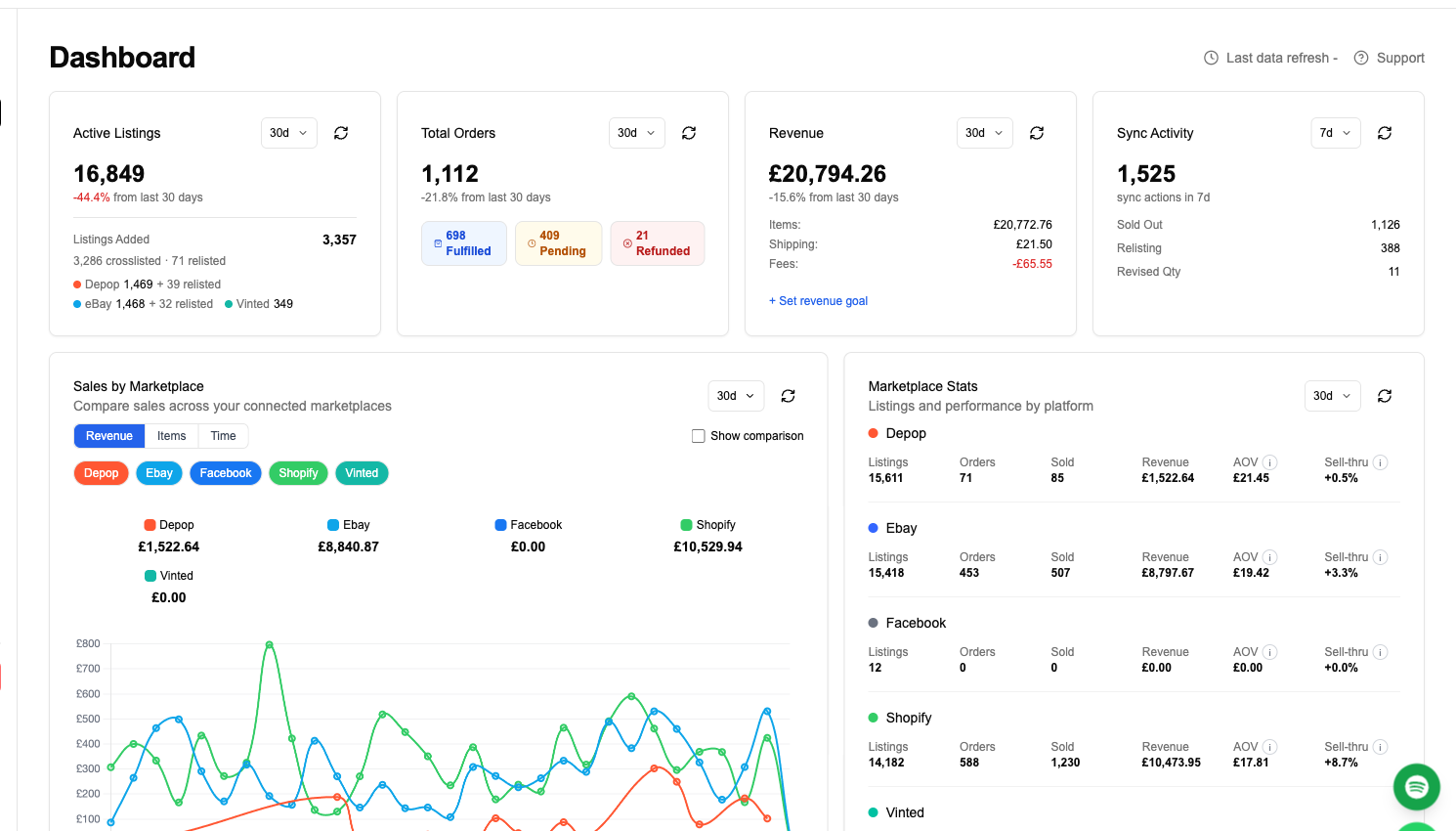
FLUF Connect lets you crosslist the same inventory to both Designer Wardrobe and Depop — and beyond them to eBay, Vinted, Shopify, Etsy and more — from one dashboard. You list a piece once, choose the channels, and FLUF maps the fields each marketplace needs and publishes it everywhere you selected. Inventory stays in sync across every channel, so when an item sells on one, FLUF marks it sold on the others and you never oversell the same garment twice.
The automation available depends on what each marketplace supports, and FLUF only claims what is real. On Depop, which exposes a full set of selling tools, FLUF supports inventory sync, order sync into one central view, automatic relisting to keep your items fresh in the feed, offer management to convert interested buyers, and automatic mark-as-sold. On Designer Wardrobe, FLUF supports inventory sync, order sync and automatic mark-as-sold, so a sale on either side keeps your stock honest everywhere — relisting and offer automation are not currently part of the Designer Wardrobe integration, and we would rather say so than imply otherwise. Either way, the core promise holds: list once, reach both audiences, and never sell the same item twice.
The workflow takes about ten minutes to set up. You connect each marketplace — a quick authentication, with no passwords stored — import or create your listings, and crosslist. From then on, a sale on Depop updates your Designer Wardrobe listing and your other channels automatically, and orders from the marketplaces that support it flow into one place. For a reseller whose inventory spans premium designer pieces and trend-led fashion, that means serving both a New Zealand premium audience and a global Gen-Z one from a single catalogue, without the manual double-listing that usually makes multi-channel selling more trouble than it is worth.
The overselling problem is the one this solves most visibly. When you list the same physical item on two marketplaces by hand, you are always one sale away from an awkward situation: the piece sells on Depop, you forget to pull it from Designer Wardrobe, and a second buyer purchases something you no longer have. Cancelling that order costs you a refund, a hit to your seller standing, and a frustrated buyer. FLUF’s inventory sync removes that risk entirely — the moment an item sells anywhere, it comes down everywhere else automatically. For a single-quantity resale business, where almost every item is one-of-a-kind, that protection is not a nice-to-have; it is the thing that makes listing the same piece across multiple marketplaces safe to do at all.
And the reach you unlock is genuinely additive here, more than in most channel pairings, precisely because Designer Wardrobe and Depop share so little audience. Listing on both is not splitting one pool of buyers between two storefronts — it is reaching a New Zealand premium shopper who would never see your Depop profile and a young US or UK buyer who would never browse Designer Wardrobe. Add eBay and Vinted to the same catalogue and the effect compounds. The strategy only works in practice, though, if the operational cost of being on all of them stays near zero, and that is exactly what crosslisting delivers: one catalogue, many audiences, listed once and kept in sync.
Pricing
FLUF Connect plans start at £9/month (Starter). There is no free plan, but every new account gets a 7-day trial for £1. Higher plans sync more often, and automation — relisting and offers on the channels that support them, plus inventory and order sync — is included from Seller upwards rather than sold as a paid add-on. You can connect Designer Wardrobe, Depop and your other channels and start crosslisting from the FLUF Connect dashboard in about ten minutes.
So Designer Wardrobe versus Depop is not really a contest — they are different tools for different audiences, and the strongest move for a reseller with the right inventory is to use both well. FLUF Connect is what makes running them together a single, synced operation rather than twice the work — list each piece once, reach a premium New Zealand audience and a global Gen-Z one at the same time, and let inventory sync keep everything honest.
Sources & Verification
- https://www.scoop.co.nz/stories/BU2509/S00185/designer-wardrobe-launches-ai-powered-selling-to-nzs-growing-pre-loved-market.htm
- https://help.designerwardrobe.co.nz/article/44-dw-fees
- https://help.designerwardrobe.co.nz/article/58-how-it-works
- https://investors.etsy.com/news-events/press-releases/detail/217/ebay-to-acquire-depop-from-etsy
- https://news.depop.com/company-news/depop-removes-selling-fees-in-the-united-states-evolves-fee-structure/
- https://www.prnewswire.com/news-releases/etsy-completes-acquisition-of-depop-the-global-fashion-resale-marketplace-for-gen-z-301331913.html
- https://en.wikipedia.org/wiki/Depop
Related guides
Related guides
Frequently Asked Questions
Designer Wardrobe is New Zealand's leading preloved and designer-fashion marketplace — curated, women's-led, premium and NZ-focused. Depop is a global, Gen-Z social resale app (owned by Etsy, being acquired by eBay) strongest for streetwear, vintage and Y2K. They differ in geography, age of audience and style, so they reach almost entirely different buyers.
Depop, by a wide margin. Depop reports around 7 million active buyers globally with roughly $1 billion in annual gross merchandise sales, while Designer Wardrobe reports over 350,000 members and gross sales of around NZ$4 million a month. Designer Wardrobe is the category leader within New Zealand; Depop is a global platform an order of magnitude larger.
Designer Wardrobe is free to list and charges a success fee only when you sell: a flat NZ$4.95 on items under NZ$40, and 12.95% commission (capped at NZ$249) on items over NZ$40, charged on the final value including shipping, plus a small payment fee. The cap means very high-value designer sales are not penalised proportionally.
No. Depop removed its 10% seller fee in the US in July 2024 and shifted to a buyer-paid marketplace fee of up to 5% plus up to $1. US sellers now keep more of the headline price, while buyers pay a small fee at checkout. Sellers still cover payment-processing costs, and fee structures can vary by region, so confirm the current model for your market.
Designer Wardrobe is New Zealand-centric today — its audience and integrated courier-booking service are NZ-based, and the wider Australasian market is described as an ambition rather than a published operating scale. If you want to reach NZ preloved-fashion buyers, Designer Wardrobe is the channel; for global reach, Depop is the better fit.
Match the platform to your inventory and target market. Choose Designer Wardrobe for premium and designer womenswear aimed at New Zealand buyers; choose Depop for streetwear, vintage and trend-led fashion aimed at a global Gen-Z audience. Because the audiences barely overlap, sellers with mixed or designer-resale inventory often do best listing on both.
Yes. FLUF Connect crosslists the same inventory to both Designer Wardrobe and Depop — and to eBay, Vinted, Shopify and more — from one dashboard, with inventory synced so a sale on one channel marks the item sold on the others. You list once and reach both a New Zealand premium audience and a global Gen-Z one without double-listing.
FLUF Connect plans start at £9/month (Starter). There is no free plan, but every new account gets a 7-day trial for £1. Higher plans sync more often, and automation — relisting and offers on the channels that support them, plus inventory and order sync — is included from Pro upwards rather than sold as a paid add-on.