Leboncoin vs Facebook Marketplace: Which Is Better for French Sellers?
Fees, audience, trust and categories compared — and how to sell on both with FLUF Connect
7 days for £1, then from £9/month.



TL;DR: If you are selling second-hand goods in France, Leboncoin and Facebook Marketplace are the two heavyweights, and they win in different ways. Leboncoin is France’s dedicated #2 e-commerce destination behind Amazon, with roughly 30.2 million monthly unique visitors, built-in secure payment and delivery, and unrivalled authority in cars, real estate and jobs. Facebook Marketplace bolts onto a billion-plus monthly shoppers worldwide and shines for impulsive, local, in-person sales of furniture and electronics, but it carries far higher fraud risk and offers no native French checkout. Most French sellers should list on both: Leboncoin for reach and buyer protection, Facebook Marketplace for fast local pickups. With FLUF Connect you manage one catalogue and push to both. Plans start at £9/month (Starter); There is no free plan, but every new account gets a 7-day trial for £1.
Choosing where to sell your second-hand goods in France is no longer a coin toss between two equivalent platforms. The French resale economy has matured into one of Europe’s largest, with the second-hand market reaching roughly €14 billion in 2024 and more than 80% of French shoppers reporting they have bought used goods at least once source. Against that backdrop, two platforms dominate the casual and semi-professional resale conversation: Leboncoin, the home-grown generalist classifieds giant, and Facebook Marketplace, the social-network bolt-on that reaches an enormous local audience. They are not interchangeable. The fee structures, the audiences, the trust mechanics and the category strengths diverge sharply, and the right choice depends almost entirely on what you are selling and how you want to be paid. This guide compares the two head-to-head for French sellers, with citations for every claim, and explains how a single FLUF Connect catalogue can feed both at once.
The Two Platforms at a Glance
Leboncoin launched in 2006 and grew into France’s dominant generalist classifieds platform, covering everything from real estate and vehicles to jobs, furniture, electronics and fashion source. It was long owned by the Norwegian-Spanish classifieds group Adevinta; in 2024 Adevinta was taken private by a consortium led by Permira and Blackstone in a deal that valued the group at roughly €12 billion source. That ownership change matters because it signals heavy investment intent behind Leboncoin’s secure-payment and logistics push, which is reshaping how second-hand goods change hands in France.
Facebook Marketplace, by contrast, is a feature inside the world’s largest social network rather than a standalone classifieds business. It launched globally in 2016 and now serves more than one billion monthly shoppers worldwide source. In France specifically, the Facebook platform has roughly 30 million users, a substantial slice of the population that Marketplace can tap for local, in-person trades source. The distinction between a dedicated commerce platform and a social-graph feature runs through almost every comparison point below.
It is worth pausing on why that distinction matters so much for a seller’s bottom line. A dedicated classifieds platform is engineered end to end around the act of buying and selling: search filters are tuned for product attributes, listings carry structured fields like condition and category, and the entire monetisation model rests on connecting buyers with sellers efficiently. A social-network feature inherits its plumbing from a product designed for engagement and advertising, then layers commerce on top. Neither approach is wrong, but they produce different experiences. On Leboncoin, a buyer typing “canapé d’angle” expects a clean grid of relevant local and national results with filters for price, condition and delivery options. On Facebook Marketplace, the same buyer gets a feed-shaped experience where relevance is blended with proximity and the platform’s own engagement signals. For sellers, the practical consequence is that Leboncoin rewards complete, well-structured listings, while Facebook Marketplace rewards eye-catching photos and a compelling first line that survives the scroll.
Side-by-Side Comparison
The table below summarises the headline differences a French seller cares about. The detail behind each row follows in the sections after it.
| Factor | Leboncoin | Facebook Marketplace |
|---|---|---|
| Owner / model | Permira + Blackstone (private, 2024); dedicated classifieds platform source | Meta; feature inside a social network |
| Audience in France | ~30.2M monthly unique visitors, ~47% of the population source | ~30M Facebook users in France source |
| Listing cost (private seller) | Free to list; no commission on private sales source | Free to list for individuals source |
| Transaction fee | Buyer pays the service fee (~€0.70 + 5%, or €0.99 flat hand-to-hand); free for the private seller source | No fee on local pickup; shipped-order fee (10% / min $0.80) is US/UK only and checkout is not generally available in France source |
| Paid visibility | “Options de visibilité” ~€0.99–€29.99+ source | No native paid boost inside Marketplace; reach comes from the social feed |
| Payment & delivery | Integrated secure payment + delivery built in source | Effectively local in-person cash; no integrated French checkout source |
| Trust / fraud | Buyer protection via secure payment escrow source | High scam exposure: 73% of purchase-fraud cases in a TSB study, 34% of sampled ads showed fraud indicators source |
| Category strengths | Cars, real estate, jobs, furniture, electronics, fashion source | Impulse local furniture, electronics, household goods |
| FLUF Connect automation | None — extension-first classifieds (no relisting, offers, order-sync, mark-as-sold) | Mark-as-sold only (no relisting, offers, order-sync) |
Fees and Cost: What You Actually Pay
For a private seller, both platforms are inexpensive to start with, but the way money moves differs in ways that affect your net proceeds. On Leboncoin, listing an item is free for private sellers and there is no commission charged to the seller on a private sale source. Where Leboncoin does take a cut is through its integrated secure-payment and delivery service: when a buyer chooses to pay through the platform, a service fee is applied, but crucially it is the buyer who pays it — around €0.70 plus 5% of the item price for shipped transactions, or a €0.99 flat fee for hand-to-hand exchanges paid through the app source. The private seller receives the full asking price. That structure makes Leboncoin attractive to anyone who wants the protection of escrow without surrendering a percentage of their sale.
Facebook Marketplace is also free to list for individuals source. The often-quoted selling fee — 10% of the sale price with a minimum of $0.80 — applies only to shipped orders processed through Facebook’s integrated checkout, and that checkout flow is a US and UK feature. In France, Marketplace functions effectively as a local listings board: there is no integrated checkout, no platform commission, and transactions are settled in person, typically in cash or via a peer-to-peer transfer the buyer and seller arrange themselves source. The headline “free” looks identical on both platforms, but the substance is different: Leboncoin offers a paid, protected payment rail that the buyer funds, while Facebook Marketplace in France offers no payment rail at all.
Run the numbers on a concrete example to see how this plays out. Imagine you are selling a used designer coat for €120. On Leboncoin, you list it at no charge; if the buyer chooses to ship it via the secure payment service, the platform fee of roughly €0.70 plus 5% — about €6.70 — is added on top of your price and paid by the buyer, so you still pocket the full €120 while gaining escrow protection and a shipping label. On Facebook Marketplace in France, you also list at no charge, but you must arrange the exchange yourself: the buyer comes to you, pays €120 in cash, and you keep all of it — with no protection if the cash turns out to be counterfeit or the buyer disputes the deal afterwards. The economics favour Facebook Marketplace only if you value keeping the transaction entirely off-platform and are confident in a safe local meet-up. For shipped or higher-value goods, Leboncoin’s structure delivers both the full sale price and a safety net, which is why it has become the default for sellers who want to scale beyond their immediate neighbourhood.
There is also a hidden cost to consider on Facebook Marketplace: time and risk-management effort. Because there is no platform to mediate disputes, sellers spend more time vetting buyers, dodging obvious scam messages, and coordinating pickups that sometimes fall through at the last minute. That friction does not show up as a fee, but it is a real cost in hours. Leboncoin’s secure payment service absorbs much of this overhead by standardising the transaction flow, which is one reason higher-volume sellers gravitate toward it even though the buyer-paid fee makes their listings marginally more expensive for the purchaser.
Audience and Scale in France
Raw reach is where Leboncoin’s home-field advantage becomes obvious. According to FEVAD’s Q3 2025 e-commerce audience barometer, Leboncoin drew roughly 30.2 million monthly unique visitors in France, equivalent to about 47% of the entire population, placing it as the country’s number-two e-commerce destination behind only Amazon source. Critically, those visitors arrive with intent: they are on Leboncoin specifically to browse and buy classifieds, which means a listing reaches an audience already in shopping mode.
Facebook Marketplace’s reach is harder to compare like-for-like. Globally it serves more than one billion monthly shoppers source, and France hosts around 30 million Facebook users overall source. On paper the French numbers look comparable, but the quality of attention is different. Facebook users open the app to socialise; Marketplace surfaces items inside that browsing session, which can drive impulsive local purchases but does not concentrate buying intent the way a dedicated classifieds destination does. For a seller, this means Leboncoin tends to deliver a more motivated audience per impression, while Facebook Marketplace delivers serendipitous reach to people who were not necessarily shopping when they saw your item.
Geography shapes the two audiences differently as well. Leboncoin operates as a genuinely national marketplace: a listing in Lille can sell to a buyer in Marseille because the secure payment and delivery layer makes distance irrelevant. That national pool is a significant advantage for niche or higher-value items where the right buyer may be hundreds of kilometres away. Facebook Marketplace, lacking that delivery infrastructure in France, is inherently local — its results prioritise nearby items because the implicit assumption is that the buyer will collect in person. For a seller in a smaller town or a rural area, this can be limiting: the local pool of Facebook buyers may simply be too thin to move a specialist item, whereas Leboncoin opens the whole country. Conversely, in a dense urban area, Facebook Marketplace’s local concentration can be a strength, surfacing your sofa to thousands of nearby flat-dwellers who can collect within days.
Seasonality and category demand also flow through these audiences in ways worth anticipating. Leboncoin’s intent-driven traffic tends to track real purchasing cycles — a surge in furniture searches around moving season, in vehicles ahead of summer holidays, in baby goods among expecting families. Facebook Marketplace’s exposure is more opportunistic and tied to whatever the feed surfaces on a given day. A patient seller pricing toward the higher end will often do better waiting for the right intent-driven buyer on Leboncoin, while a seller who wants speed above price will benefit from Facebook Marketplace’s constant churn of local browsers.
Categories: Where Each Platform Wins
Category authority is one of the clearest dividing lines. Leboncoin grew up as a generalist classifieds platform and is the de facto national marketplace for high-consideration categories: it dominates used cars, real estate listings, and job postings, and is also strong in furniture, electronics and fashion source. If you are selling a vehicle, advertising a rental, or moving anything where buyers expect to do research, compare options and travel to view, Leboncoin is the platform French buyers reach for first.
Facebook Marketplace plays a different game. Its sweet spot is impulse, local, in-person transactions — the kind where a buyer sees a sofa, a games console or a kitchen table appear in their feed, lives nearby, and arranges a same-week pickup. The social-feed surfacing rewards items with strong visual appeal and a clear local hook. It is excellent for furniture and household electronics that are awkward to ship and benefit from a buyer who can collect quickly. It is weaker for categories that demand trust, documentation or shipping, precisely because it lacks the payment and protection infrastructure those categories need.
Fashion and small consumer goods sit in an interesting middle ground. Both platforms list clothing, shoes and accessories, and both attract bargain-hunters. But here the broader French resale landscape matters: dedicated fashion-resale apps compete hard for that category, and a seller deciding between Leboncoin and Facebook Marketplace for a wardrobe clear-out should weigh shippability against locality. A box of fast-fashion items priced at a few euros each rarely justifies the friction of shipping, so Facebook Marketplace’s local model can work well. A handful of genuine designer pieces, by contrast, benefits from Leboncoin’s national reach and escrow, which protect a higher-value transaction and connect you with a buyer who may not live nearby.
Electronics deserve a specific note because they straddle the trust divide. High-value electronics — a recent smartphone, a games console, a laptop — are exactly the items scammers target, and they are also items buyers want to test before paying. On Facebook Marketplace, that means insisting on a face-to-face meeting where the buyer can power the device on and pay cash, which is workable but exposes both parties to the platform’s elevated fraud risk. On Leboncoin, the secure payment service lets a remote buyer purchase with the confidence that funds are held until delivery, widening the pool of serious buyers for these higher-ticket items. For lower-value electronics — cables, older accessories, small gadgets — the calculus flips back toward Facebook Marketplace’s quick local sale.
Payment, Delivery, Trust and Safety
This is the dimension where the two platforms diverge most sharply, and where French sellers should weigh their priorities carefully. Leboncoin has invested heavily in an integrated secure payment and delivery system. When a transaction runs through it, the buyer’s money is held and released on delivery, the platform handles shipping logistics, and both parties get a layer of dispute protection — with the service fee borne by the buyer and the listing remaining free for the private seller source. For a seller, this dramatically reduces the risk of non-payment and chargeback disputes, and it unlocks selling to buyers anywhere in France rather than only those willing to meet in person.
Facebook Marketplace offers no equivalent in France. Transactions are arranged directly between buyer and seller, typically settled in cash at a local meet-up. That informality is part of its appeal for quick declutters, but it carries real risk. A widely reported study by UK bank TSB found that Facebook Marketplace accounted for 73% of the purchase-fraud cases it analysed, and that 34% of sampled adverts showed indicators of being fraudulent source. While that study focused on the UK, the underlying dynamic — an open social platform with weak transaction controls — applies equally in France. Sellers and buyers alike must rely on their own judgement, meet in safe public places, and avoid advance transfers. The practical upshot: Leboncoin’s protected rail is the safer choice for higher-value items and remote buyers, while Facebook Marketplace demands DIY caution.
Paid Visibility vs Social Reach
The two platforms also amplify listings in fundamentally different ways. Leboncoin offers a menu of paid “options de visibilité” — boosts, premium placement, and repeated re-surfacing — priced from roughly €0.99 up to €29.99 or more depending on the option and category source. This is a transparent, pay-to-promote model: you decide how much extra visibility is worth on a given listing and buy it directly. For semi-professional sellers moving volume, these options provide a predictable lever to accelerate sales.
Facebook Marketplace has no comparable native boost inside the Marketplace surface itself. Instead, reach is a function of the social graph and the feed algorithm: items can spread through local buy-and-sell groups, shares, and the algorithmic surfacing of relevant nearby listings. This can produce viral, no-cost exposure for the right item, but it is unpredictable and outside the seller’s direct control. A seller who wants guaranteed incremental visibility has a clear paid path on Leboncoin and no equivalent dial on Facebook Marketplace.
The French Second-Hand Market Backdrop
Both platforms ride a powerful structural tailwind. France’s second-hand market reached roughly €14 billion in 2024, and more than 80% of French shoppers report having bought used goods at least once source. Resale has shed its stigma and become mainstream, driven by cost-of-living pressure, sustainability concerns, and a generation comfortable with buying pre-owned. That normalisation expands the buyer pool for every category, from luxury handbags to children’s toys, and it is the reason both Leboncoin and Facebook Marketplace can sustain such large audiences simultaneously rather than cannibalising each other.
For sellers, the size and maturity of this market mean there is room to be deliberate rather than scattergun. With four out of five French consumers already comfortable buying used, the question is less “will anyone buy this?” and more “where will the right buyer find it fastest, and on what terms?” That is precisely the question the platform choice answers. A growing market also draws more semi-professional sellers — people who source, refurbish and flip goods at volume — and for them the platform decision compounds across hundreds of listings, making the structural differences in fees, protection and reach far more consequential than they are for a one-off declutter.
A Decision Framework for French Sellers
Rather than crowning one platform, it is more useful to match the platform to the seller. Here are four common French seller personas and the recommendation for each.
The furniture mover. If you are clearing bulky furniture — a sofa, a wardrobe, a dining set — that is expensive or impractical to ship, lead with Facebook Marketplace for fast local pickups, where its feed-driven local reach excels. List on Leboncoin in parallel to widen the funnel and capture buyers willing to travel or arrange collection. The combination maximises the chance of a quick local sale while keeping a national audience in reserve.
The car or property seller. For a vehicle or a real-estate listing, Leboncoin is the unambiguous choice. It is the category authority French buyers default to for high-consideration purchases, and its scale in these verticals dwarfs Facebook Marketplace source. Facebook Marketplace is a poor fit here; the buyers, the trust requirements and the documentation expectations all favour the dedicated platform.
The volume reseller who wants shipping and protection. If you sell regularly, ship to buyers across France, and want to avoid the friction and risk of cash meet-ups, Leboncoin’s secure payment and delivery system is built for you. It lets you reach remote buyers, get paid through escrow, and minimise fraud and non-payment exposure source. Facebook Marketplace’s lack of a French checkout makes it a weaker primary channel for this profile, though it can still serve as a supplementary local outlet.
The casual declutterer. If you just want to offload a few unused items quickly and locally with minimal fuss, Facebook Marketplace is the path of least resistance. Listing is free, the audience is already in your pocket via the app you check daily, and local pickups settle the same week. Just apply the standard safety precautions: meet in public, accept payment on collection, and be wary of buyers pushing for advance transfers source.
The thread running through all four personas is that the platform should follow the item and the seller’s tolerance for friction, not the other way around. Sellers who try to force every item onto a single platform — insisting on Facebook Marketplace for a car, or on Leboncoin for a €5 lamp they could hand to a neighbour — tend to leave money or time on the table. The more useful mental model is to ask three quick questions of any item: Is it practical to ship? Does it warrant buyer protection? And is the buyer most likely to be local or national? Shippable, higher-value, potentially-national items lean Leboncoin; bulky, low-value, hyper-local items lean Facebook Marketplace. When the answers are mixed — as they often are for furniture — listing on both is the rational hedge.
Selling on Both via FLUF Connect
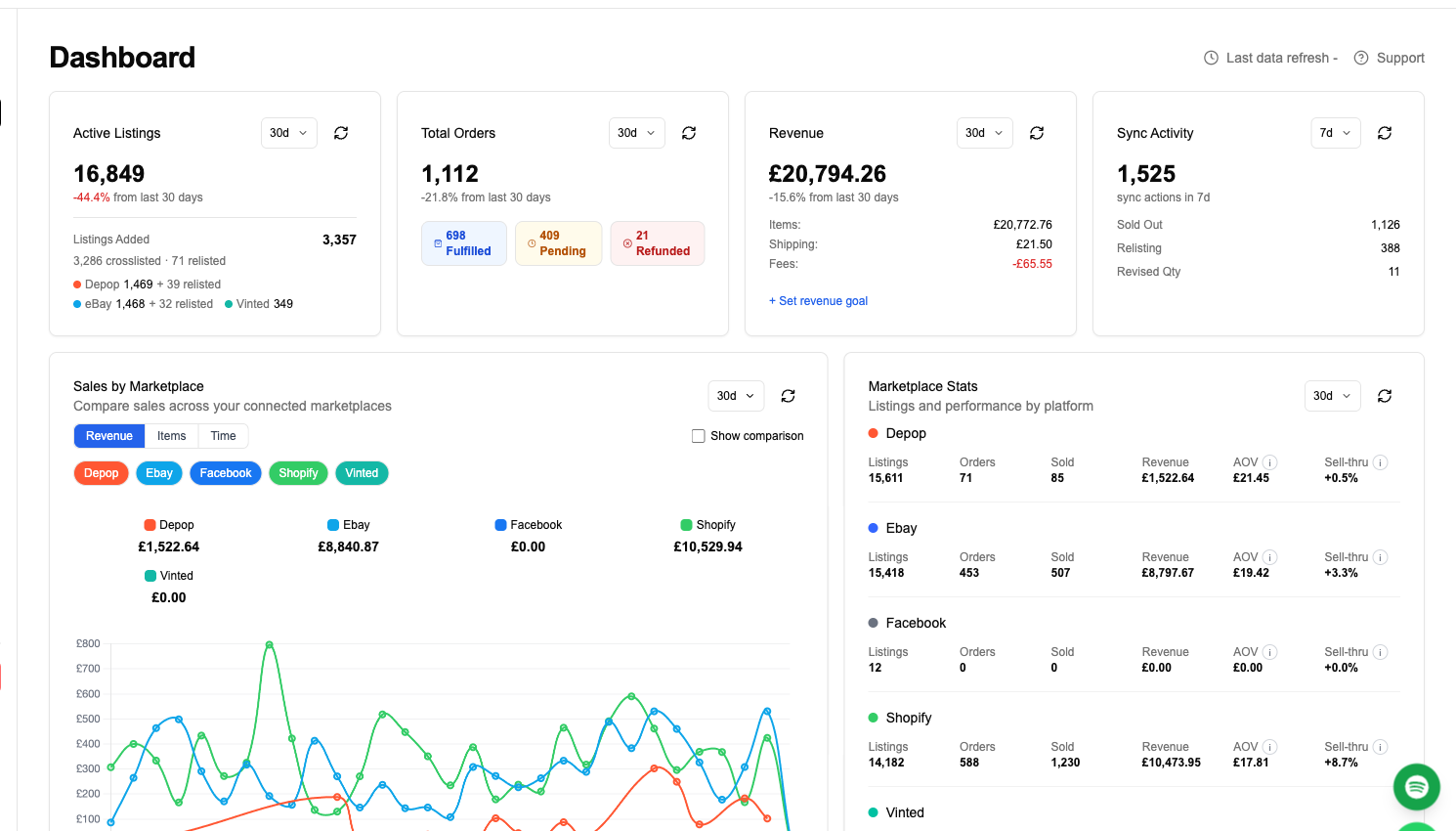
For most French sellers, the honest answer to “Leboncoin or Facebook Marketplace?” is “both” — Leboncoin for reach, intent and buyer protection, Facebook Marketplace for fast local pickups. The obstacle is the manual effort of building and maintaining the same listing twice. FLUF Connect solves that by letting you keep one inventory catalogue and crosslist it to both platforms from a single dashboard, so you write a description, set a price and add photos once, then publish across channels.
It is important to be precise about what FLUF Connect does and does not automate on these two channels, because both are extension-first integrations with deliberately limited automation. On Leboncoin, FLUF Connect supports no automation beyond crosslisting itself: there is no automatic relisting, no offer handling, no order-sync, and no automatic mark-as-sold — it is an extension-first classifieds integration where the platform’s own flows remain manual. On Facebook Marketplace, FLUF Connect adds one piece of automation on top of crosslisting: mark-as-sold, so that when an item sells you can flag it across your catalogue; relisting, offers and order-sync are not automated. In practice this means FLUF Connect saves you the duplicate listing work and gives you a single place to see your inventory, while the day-to-day messaging, negotiation and fulfilment on each platform continue through that platform’s own tools. That is a genuine time saving for anyone managing more than a handful of items, without overpromising automation that these classifieds-style channels do not support.
FLUF Connect’s automation features are included from Seller upwards rather than sold as an add-on, and there is no free tier. The cheapest plan is Starter at £9/month, and no plan caps how much you list — comfortably enough for most casual and semi-professional French resellers to run both Leboncoin and Facebook Marketplace from one catalogue.
List on Both — One Catalogue
You do not have to choose between Leboncoin’s reach and protection and Facebook Marketplace’s local speed. Build your inventory once, crosslist it to both, and manage everything from a single dashboard. Try FLUF Connect and start with the Starter at £9/month, with no cap on how much you list — with automation included from Seller upwards and no free tier to expire on you.
Sources & Verification
- FEVAD — Baromètre de l’audience du e-commerce, 3e trimestre 2025 (Leboncoin ~30.2M monthly unique visitors, France’s #2 e-commerce destination)
- Leboncoin — Paiement sécurisé et livraison (integrated secure payment + delivery; buyer pays the service fee; free for private seller)
- TSB — Urgent consumer warning on Facebook Marketplace fraud (73% of purchase-fraud cases; 34% of sampled ads showed fraud indicators)
- Adevinta — Permira and Blackstone voluntary offer (2024 take-private at ~€12bn)
- Wikipedia (FR) — Leboncoin (launched 2006; dominant generalist classifieds; category coverage)
- Sequr — Leboncoin frais vendeur 2026 (free listing for private sellers; no commission on private sales)
- Leboncoin Assistance — options de visibilité (paid visibility ~€0.99–€29.99+)
- Capital One Shopping — Facebook Marketplace statistics (1bn+ monthly shoppers worldwide)
- DataReportal — Digital 2024 France (~30M Facebook users in France)
- Spocket — Facebook Marketplace fees (free listing for individuals)
- LitCommerce — Facebook Marketplace fees (10%/min $0.80 shipped-order fee is US/UK; checkout not generally available in France)
- MBADMB — Marché de la seconde main en France 2024 (~€14bn market; 80%+ of French shoppers bought used)
Frequently Asked Questions
Both reach a large French audience, but in different ways. Leboncoin drew roughly 30.2 million monthly unique visitors in France in Q3 2025, about 47% of the population, making it the country's number-two e-commerce destination behind Amazon. Facebook has around 30 million users in France, and Marketplace surfaces items inside that social feed. The key difference is intent: Leboncoin visitors arrive specifically to browse classifieds, while Facebook Marketplace reaches people who were socialising rather than shopping.
Both are free to list for private individuals. On Leboncoin there is no commission charged to the seller on a private sale; when a buyer uses the secure payment service, the buyer pays the service fee (around €0.70 + 5% for shipped items, or €0.99 flat hand-to-hand). On Facebook Marketplace in France, listing is free and there is no platform fee, because the 10% (min $0.80) shipped-order fee and integrated checkout are US/UK features that are not generally available in France.
Leboncoin is generally safer because it offers an integrated secure payment and delivery system that holds the buyer's money and releases it on delivery, reducing non-payment and chargeback risk. Facebook Marketplace in France has no integrated checkout, so transactions are arranged directly and usually settled in cash in person. A TSB study found Facebook Marketplace accounted for 73% of analysed purchase-fraud cases and that 34% of sampled ads showed fraud indicators, so DIY caution is essential there.
Use Leboncoin for cars, real estate, jobs and any higher-value or shipped items where buyer protection matters, since it is the category authority French buyers default to. Use Facebook Marketplace for bulky furniture, electronics and household goods you want to sell locally and quickly, where its feed-driven local reach excels. Many sellers list bulky furniture on both: Facebook Marketplace for fast local pickup and Leboncoin to widen the audience.
Yes. FLUF Connect lets you keep one inventory catalogue and crosslist it to both platforms from a single dashboard, so you write the description, set the price and add photos once. Be aware of the automation limits: on Leboncoin there is no automation beyond crosslisting (no relisting, offers, order-sync or mark-as-sold), and on Facebook Marketplace FLUF Connect supports mark-as-sold only (no relisting, offers or order-sync). Both are extension-first integrations, so messaging and fulfilment continue through each platform's own tools.
There is no free plan. The cheapest plan is Starter at £9/month, and no plan caps how much you list. Automation features are included in every plan rather than sold as a separate add-on, so the Growth plan is enough for most casual and semi-professional French resellers to run both Leboncoin and Facebook Marketplace from one catalogue.