Crosslist from Designer Wardrobe to Poshmark — Automatically
Move your Designer Wardrobe closet to Poshmark in minutes. Prices, photos and details transfer, and inventory stays in sync across both.
7 days for £1, then from £9/month.



- Designer Wardrobe: the largest pre-loved designer marketplace in Australia and New Zealand — 350,000+ members, curated luxury, priced in local dollars.
- Poshmark: 80 million+ users with the buying audience concentrated in the United States — a vastly larger pool than the trans-Tasman market.
- Fields that transfer automatically: title, description, photos, price, brand, condition, size and colour — FLUF Connect maps your Designer Wardrobe listing into Poshmark’s department, category, size and brand structure.
- Inventory sync: when a piece sells on either Designer Wardrobe or Poshmark, FLUF Connect removes it from the other within minutes — no double-selling your one-off designer pieces.
- Currency & fees: Designer Wardrobe prices in AUD/NZD and charges 12.95% over $40; Poshmark prices in USD and charges a 20% commission over $15 (flat $2.95 under). FLUF carries your price across — set the USD figure once.
- Cost: from £9/month — crosslisting, inventory sync and bulk tools included on every plan, no add-ons.
Why Sell on Both Designer Wardrobe and Poshmark?
If you have built a pre-loved designer business on Designer Wardrobe, crosslisting to Poshmark puts the same wardrobe in front of a buying audience many times larger. Designer Wardrobe is the biggest curated luxury resale marketplace in Australia and New Zealand — but its pool is the trans-Tasman market. Poshmark has more than 80 million users, with demand concentrated in the United States. Listing on both keeps your loyal AU/NZ buyers while opening your closet to American shoppers who never see a Designer Wardrobe listing.
The audiences barely overlap, which is exactly why the case is strong. Designer Wardrobe reports 350,000+ members across Australia and New Zealand, built around authenticated designer and luxury fashion priced in Australian and New Zealand dollars. Poshmark, by contrast, surpassed 70 million users on its way to 80 million-plus, and after winding down its overseas operations now earns roughly 93% of revenue in the United States. A buyer hunting a pre-loved Scanlan Theodore dress in Auckland and a Posher scrolling for a designer bag in Los Angeles are two different markets — crosslisting lets one piece reach whichever values it most.
There is also a discovery difference. Designer Wardrobe leans on curation and a tight luxury community that already knows the local labels. Poshmark is built around social selling — sharing, following, Posh Parties and offers to likers — and rewards sellers who keep their closet active. The same designer piece gets curated trust on one platform and social reach on the other.
Who this is for: Australian and New Zealand designer-resale sellers who have hit the ceiling of a trans-Tasman audience and want access to the much larger US Poshmark buyer base — without re-photographing, re-typing and re-pricing every listing by hand. If your Designer Wardrobe closet is mostly one-off luxury pieces, the inventory sync below is what makes running both channels safe.
| Designer Wardrobe | Poshmark | |
|---|---|---|
| Users / members | 350,000+ (AU + NZ) | 80M+ users |
| Primary audience | Australia & New Zealand | United States (~93% of revenue) |
| Focus | Curated pre-loved designer & luxury | Social fashion resale, all price points |
| Discovery model | Curated, community, browse-by-brand | Social — sharing, following, Posh Parties |
| Seller fee | 12.95% over $40 ($4.95 under, max $249) | 20% over $15 (flat $2.95 under) |
| Authentication | Designer authentication built in | Posh Authenticate (no seller cost) on items $500+ |
| Listing currency | AUD / NZD | USD |
Fee figures: Designer Wardrobe fees, Poshmark fees 2026.
Designer Wardrobe gives you a focused, trusting audience of 350,000+ designer shoppers across Australia and New Zealand. Poshmark adds 80 million-plus users concentrated in the United States. Crosslisting puts each piece in front of both at once — the local luxury community that knows your labels, plus the enormous US social-resale demand that finds you through sharing and search.
How to Crosslist from Designer Wardrobe to Poshmark with FLUF Connect
FLUF Connect reads your live Designer Wardrobe listings and republishes them on Poshmark, reformatting each one into Poshmark’s department, category, size and brand structure as it goes. Designer Wardrobe needs no open browser after connecting, while Poshmark connects through the FLUF browser extension — so you never copy-paste between tabs. You select pieces and crosslist them in bulk.
- Create your FLUF Connect account and open the dashboard.
- Connect Designer Wardrobe — a secure sign-in links your account; FLUF reads your existing listings, including brand, size, condition and photos.
- Connect Poshmark via the FLUF browser extension, which handles your Poshmark session safely.
- Import your Designer Wardrobe catalogue — pull in everything, or filter by brand, category or price.
- Review the mapping — FLUF pre-fills Poshmark’s department, category, size and brand from your Designer Wardrobe data and flags anything that needs a value.
- Select and crosslist — choose pieces and publish to Poshmark in one action, individually or hundreds at a time.
- Your listings go live on Poshmark within minutes, with photos, price and category in place.
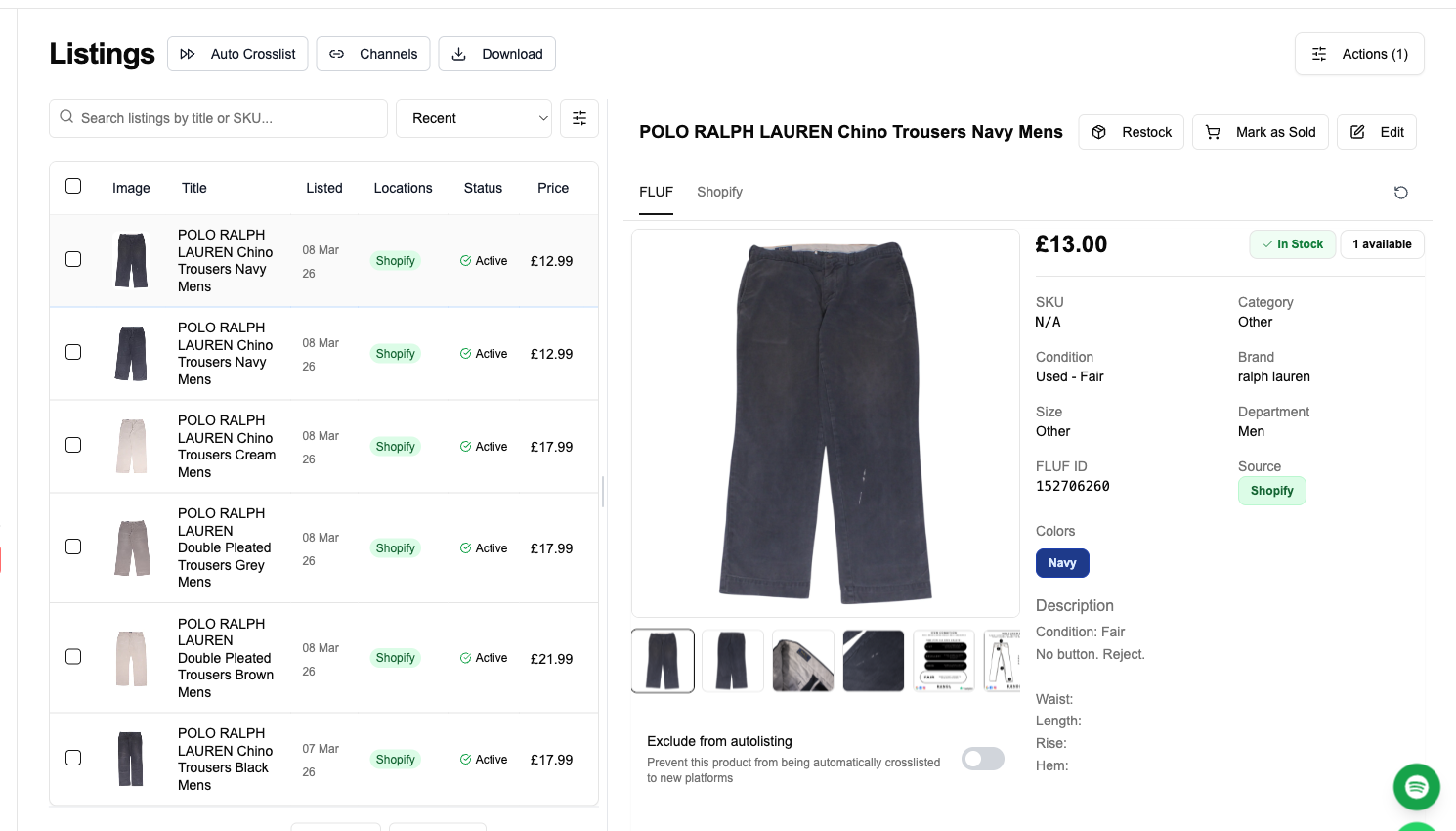
Behind the scenes, FLUF maps each Designer Wardrobe field to its Poshmark equivalent, uploads the photos, resolves your brand against Poshmark’s brand catalogue, and selects the right department, category and size set. You can also set auto-crosslisting rules so any new Designer Wardrobe listing is pushed to Poshmark automatically, and crosslist your whole back-catalogue in a single bulk run. For more on getting set up, see our guide to selling on multiple platforms.
How FLUF compares to manual crosslisting tools
Generic crosslisting apps such as Vendoo, List Perfectly and Crosslist support Poshmark, but few list Designer Wardrobe as a channel at all — and their deeper features tend to sit behind higher tiers. FLUF Connect bundles crosslisting, inventory sync and bulk tools into one flat plan, connects Designer Wardrobe without an open browser, and treats Poshmark as a first-class destination with real brand and category resolution rather than a blind copy. For an AU/NZ designer seller who wants the listing and the post-listing automation in one place, that’s the difference between a copy tool and a selling system.
What Transfers When You Crosslist from Designer Wardrobe to Poshmark?
This is where a Designer Wardrobe-to-Poshmark move gets fiddly by hand. Poshmark enforces a three-level catalogue — Department, Category and (often) a Category Feature — plus a structured size set and a resolved brand. Designer Wardrobe holds your brand, size, condition and photos in its own format. FLUF Connect does the restructuring so each listing lands in the right Poshmark department with a recognised brand.
Field Mapping — Designer Wardrobe to Poshmark
| Designer Wardrobe field | Poshmark field | Transfer status | Notes |
|---|---|---|---|
| Title | Title | ✅ Automatic | Carried across; trimmed to Poshmark’s title limit if longer |
| Description | Description | ✅ Automatic | Free-text carries over as written |
| Photos | Photos (cover + gallery) | ✅ Automatic | First photo becomes the Poshmark cover shot; the rest fill the gallery |
| Price | Listing price (USD) | ✅ Automatic | Designer Wardrobe prices in AUD/NZD; set your USD price once and FLUF applies it |
| Brand | Brand | ⚡ Resolved | Review the Poshmark brand and correct it if needed. |
| Category | Department > Category > Feature | ⚡ Smart mapped | Poshmark uses a three-level taxonomy — FLUF maps to the closest department, category and feature |
| Condition | Condition (NWT / Excellent / Good…) | ⚡ Mapped | Designer Wardrobe’s condition maps to Poshmark’s condition codes |
| Size | Size (size set) | ⚡ Mapped | FLUF selects the Poshmark size set for the category; AU/NZ sizing may shift one notch from US |
| Colour | Colour | ⚡ Mapped | Review and confirm the colour on Poshmark. |
| — | Style tags | ⚠️ Optional / default | Poshmark supports style tags for discovery — set defaults or add per listing |
| — | Original price (retail) | ⚠️ Manual / default | Optional on Poshmark; add to show the discount where you have it |
Field references: Designer Wardrobe how it works, Poshmark listing & authentication.
Category Mapping Examples
| Designer Wardrobe category | Poshmark category | Notes |
|---|---|---|
| Women’s > Dresses | Women > Dresses > (Midi / Mini / Maxi) | Feature level picks the dress length where available |
| Women’s > Bags | Women > Bags > (Shoulder Bags / Crossbody…) | Designer bags $500+ qualify for Posh Authenticate at no seller cost |
| Women’s > Shoes | Women > Shoes > (Heels / Boots / Flats) | Size set switches to the shoe size table; AU size maps to nearest US |
| Men’s > Jackets & Coats | Men > Jackets & Coats | Brand resolved against Poshmark’s catalogue |
Fields That Need Your Attention
Three friction points are worth knowing before you crosslist a large Designer Wardrobe closet:
- Currency. Designer Wardrobe prices in Australian or New Zealand dollars; Poshmark prices in US dollars. A figure that reads well in AUD can be far too high or low once it lands in USD — set your intended USD price in FLUF and it applies across the batch rather than copying the dollar number blindly.
- Sizing. Australian and US clothing and shoe sizing differ. FLUF maps to the nearest Poshmark size set, but a borderline size is worth a quick check so US buyers filter to the right listing.
- Brand resolution. Poshmark recognises brands from its own catalogue. Well-known labels resolve cleanly; a smaller AU/NZ designer may fall back to a free-text brand, which still lists but is worth confirming for search.
- Authentication thresholds. Poshmark runs Posh Authenticate at no charge to the seller on items priced $500 and above — price genuine luxury accordingly to gain that buyer reassurance.
Inventory Sync Between Designer Wardrobe and Poshmark — What Stays in Sync?
Most pre-loved designer inventory is one-of-one. The single biggest risk in selling the same piece on two marketplaces is selling it twice. FLUF Connect prevents that by syncing availability across both channels — both Designer Wardrobe and Poshmark support marking an item as sold, so the delist works in both directions.
| Event | What happens | Timing |
|---|---|---|
| Item sells on Designer Wardrobe | Removed from Poshmark automatically | Within minutes |
| Item sells on Poshmark | Removed from Designer Wardrobe automatically | Within minutes |
| Price changed in FLUF | Updated on both channels | On next sync |
| Item deleted in FLUF | Delisted from both | Within minutes |
| New Designer Wardrobe listing (auto-rule on) | Crosslisted to Poshmark | Automatically |
When a piece sells on Designer Wardrobe, FLUF Connect removes it from Poshmark (and any other connected channel) within minutes — and the same in reverse. You list once and never have to remember to take a sold piece down manually. See how inventory sync works across every channel.
Allow a few minutes for sync. Keep the FLUF extension available for Poshmark. Designer Wardrobe order details appear in FLUF without an open browser.
What doesn’t sync: we keep this honest. Neither Designer Wardrobe nor Poshmark supports automated relisting or offer automation through FLUF, so there is no relist-on-schedule or send-offer-to-likers feature for this pair — you manage Poshmark’s social tools (sharing, Posh Parties, manual offers) yourself. And because Poshmark does not yet return structured orders to FLUF, a Poshmark sale triggers the delist via the extension but does not create a full order record in FLUF the way Designer Wardrobe does. Everything both platforms share — price, availability, core listing content and photos — stays aligned.
Crosslisting from Designer Wardrobe to Poshmark: Before and After FLUF Connect
Without FLUF Connect (manual)
- Open the Designer Wardrobe listing and copy the title and description.
- Download or screenshot every photo.
- Open Poshmark and start a new listing.
- Re-upload the photos and set a cover shot.
- Pick the right Poshmark department, category and feature from a different taxonomy.
- Resolve and select the brand from Poshmark’s catalogue.
- Choose the size from the Poshmark size set, converting from AU/NZ sizing.
- Re-enter the condition against Poshmark’s scale.
- Convert the price from AUD/NZD into USD and set it.
- Publish — then note in a spreadsheet that it’s live on both.
- When it sells, go back to the other platform and pull it down.
Resellers consistently report manual listing taking around 5–15 minutes per item — and that’s before you account for currency conversion and tracking what’s live where.
With FLUF Connect
- Select the Designer Wardrobe pieces in your FLUF dashboard.
- Click crosslist to Poshmark.
- Confirm the pre-filled department, brand, size and USD price.
- Done — availability syncs automatically.
Manual: roughly 15–25 hours of copying, reformatting, converting prices and tracking. With FLUF Connect: under an hour. That’s most of a working week back to source and photograph.
Automation Features for Designer Wardrobe and Poshmark Sellers
Crosslisting is the start. For the Designer Wardrobe–Poshmark pair, FLUF’s value sits in moving inventory across both channels in bulk and keeping availability in sync — not in relisting or offer automation, neither of which this pair supports. We are deliberate about that distinction.
Auto-crosslisting rules
Set a rule once — for example, “every new Designer Wardrobe listing over $80” — and FLUF crosslists qualifying pieces to Poshmark automatically as you add them, so new inventory reaches the US audience without extra work.
Bulk operations
Bulk crosslist your entire Designer Wardrobe back-catalogue, bulk-adjust prices, and find-and-replace across listings on both channels at once. For closets in the hundreds or thousands, this is where the hours come back. See bulk operations in detail.
Inventory sync across every channel
The delist-on-sale behaviour above isn’t limited to two channels. Add Depop, Vinted, eBay or Shopify and the same one-sells-everywhere-delists logic keeps your whole catalogue safe from overselling.
| Feature | Designer Wardrobe | Poshmark |
|---|---|---|
| Crosslisting | ✅ | ✅ |
| Inventory sync (delist on sale) | ✅ | ✅ |
| Auto-relisting | ❌ | ❌ |
| Offer management | ❌ | ❌ |
| Order sync | ✅ | ❌ (delist only) |
| Bulk operations | ✅ | ✅ |
Which Designer Wardrobe pieces tend to do well on Poshmark
Some inventory travels better than others. Recognised international luxury and contemporary labels — think established designer handbags, shoes and dresses — resolve cleanly against Poshmark’s brand catalogue and tap directly into US demand, with genuine luxury over $500 gaining no-cost Posh authentication. Premium Australian and New Zealand labels that have a following abroad can find new collectors who never see them on a trans-Tasman feed. More local, lesser-known designers may convert more slowly on Poshmark and benefit from clear styling and brand notes — but they cost nothing extra to keep listed while they wait for the right buyer.
How Much Does It Cost to Crosslist from Designer Wardrobe to Poshmark?
FLUF Connect charges a flat monthly subscription — there is no per-sale commission on top of each marketplace’s own fees.
| Plan | Monthly | Crosslisted products |
|---|---|---|
| Starter | £9/month | Unlimited |
| Seller | £29/month | Unlimited |
| Pro | £99/month | Unlimited |
| Super Seller | Custom pricing — tell us what you need | Unlimited |
Plans start at £9/month (Starter); There is no free plan, but every new account gets a 7-day trial for £1. Every plan includes crosslisting, inventory sync and bulk tools across all supported channels — not just Designer Wardrobe and Poshmark — so you can add Depop, Vinted, eBay or Shopify on the same plan. You still pay each marketplace’s own selling fees: Designer Wardrobe’s 12.95% over $40 and Poshmark’s 20% over $15. See the full pricing page.
Start crosslisting from Designer Wardrobe to Poshmark
Move your Designer Wardrobe closet onto Poshmark’s 80 million-plus users — and keep both in sync automatically.
Sources & Verification
- Designer Wardrobe members & AU/NZ market: Power Retail; Ragtrader
- Designer Wardrobe fees: Designer Wardrobe Help Centre
- Poshmark users & US revenue share: Ragtrader; Statista; Wikipedia
- Poshmark fees: Voolist
- Poshmark authentication ($500+): Posh Authenticate; Poshmark support
- Manual listing time: Vendoo
Frequently Asked Questions
FLUF Connect plans start at £9/month (Starter). There is no free plan, but every new account gets a 7-day trial for £1. Every plan includes crosslisting, inventory sync and bulk tools across all supported channels, so you can connect more marketplaces than just Designer Wardrobe and Poshmark on the same plan. You still pay each marketplace's own selling fees.
Yes. When a piece sells on Designer Wardrobe it is removed from Poshmark automatically, and when it sells on Poshmark it is removed from Designer Wardrobe — both within minutes. Because most pre-loved designer inventory is one-off, this is the feature that stops you accidentally selling the same item twice.
Yes. A sale on either channel removes the matching listing from the other within minutes. Keep the FLUF extension active for Poshmark.
Designer Wardrobe prices in Australian or New Zealand dollars, while Poshmark prices in US dollars. FLUF Connect carries your listing across, but you set the intended USD price once — it then applies across the whole batch rather than copying the dollar figure blindly. This avoids a price that reads well in AUD landing far too high or low on Poshmark.
Yes. FLUF Connect is a flat monthly subscription and does not change a marketplace's own fees. Poshmark charges 20% on sales of $15 or more (a flat $2.95 under $15), and Designer Wardrobe charges 12.95% on sales over $40 ($4.95 under, capped at $249). You pay those marketplace fees on sales as normal.
Poshmark runs Posh Authenticate at no charge to the seller on items priced $500 and above — its luxury experts check the item before it ships, which protects both buyer and seller. Price genuine luxury accordingly to qualify. Designer Wardrobe has its own designer authentication built into the platform.
Once both accounts are connected, selecting pieces and crosslisting takes seconds, and listings appear on Poshmark within minutes. You can crosslist your whole Designer Wardrobe back-catalogue in a single bulk run rather than one item at a time.
Yes, for Poshmark. Connect it with the FLUF browser extension. Designer Wardrobe needs no open browser or API key copying.
Yes. The same FLUF Connect plan lets you crosslist from Designer Wardrobe to Poshmark, Depop, Vinted, eBay, Shopify and other supported marketplaces simultaneously, with inventory kept in sync across all of them.