
Crosslist from Facebook Marketplace to Gumtree — Double Your UK Local Reach
Selling locally on Facebook Marketplace? Gumtree reaches a separate UK audience — including buyers who avoid Facebook entirely. List to both from one dashboard.



TL;DR: Facebook Marketplace and Gumtree are both UK local marketplaces, but they reach different people — and a large share of Gumtree’s audience does not use Facebook at all. Crosslisting from Facebook Marketplace to Gumtree with FLUF Connect puts the same item in front of both local audiences from one dashboard, roughly doubling your local reach for goods that sell on convenience rather than brand. Both are free for private sellers, both are collection-led, and FLUF lets you manage the two listings together instead of posting each by hand. Plans start at £9/month for the Starter plan (unlimited listings); crosslisting is included in every plan.
If you already sell locally on Facebook Marketplace, you have learned that local selling is a numbers game: the more nearby buyers see your item, the faster it sells and the better the price. Facebook Marketplace shows your listing to a big local audience — but only to the slice of it that uses Facebook and browses Marketplace. Gumtree reaches a different and overlapping slice of the same towns: the UK’s long-established default classifieds site, where people go to buy and sell furniture, electronics, cars and general goods locally, many of them without ever touching Facebook. Listing on both is not redundant; it is reaching two different sets of local buyers for the same item. FLUF Connect lets you do it from one dashboard, so widening from one UK local marketplace to two is a single step rather than double the work.
Different audiences in the same towns
The reason crosslisting between two UK local platforms works is that their audiences overlap far less than you would expect. Facebook Marketplace’s reach is tied to Facebook: you need an account, and you have to be someone who browses Marketplace. Gumtree needs no social login at all — buyers browse by location on a site built purely for classifieds, and it remains the UK’s leading classifieds destination, reaching a very large share of UK online users every month (Gumtree describes itself as reaching roughly one in five UK online users, with tens of millions of visits; independent traffic measures put it in the millions of monthly visitors). Crucially, that audience includes people Facebook Marketplace simply never shows you: the privacy-conscious who avoid Facebook, older buyers who never adopted it, and anyone who treats Gumtree as their default for second-hand goods. For a seller, those are net-new buyers — extra eyes on the same item, at no extra listing cost.
Both free, both local — a natural pairing
The two platforms also work the same way, which is what makes running both painless. Both let private sellers list at no cost in the general for-sale categories, with no listing limit and no commission on a classic classified sale (Gumtree’s ad charges confirm free private listings, with businesses paying to post and optional paid promotions available). Both default to local collection — cash on handover, buyer comes to you — so there is no new fulfilment model to learn when you add Gumtree to a Facebook Marketplace routine. You are listing the same item, in the same way, for the same kind of local sale; you are just doing it on a second platform that reaches buyers the first one does not. That symmetry is exactly why these two are a natural pair to crosslist, and why doing so adds reach without adding complexity.
How crosslisting from Facebook Marketplace to Gumtree works
FLUF Connect lets you manage both from one place:
- Connect your accounts. Link Facebook Marketplace and Gumtree to FLUF.
- Choose what to crosslist. Select the items you want on both — typically the general, local, collection-friendly goods both audiences want.
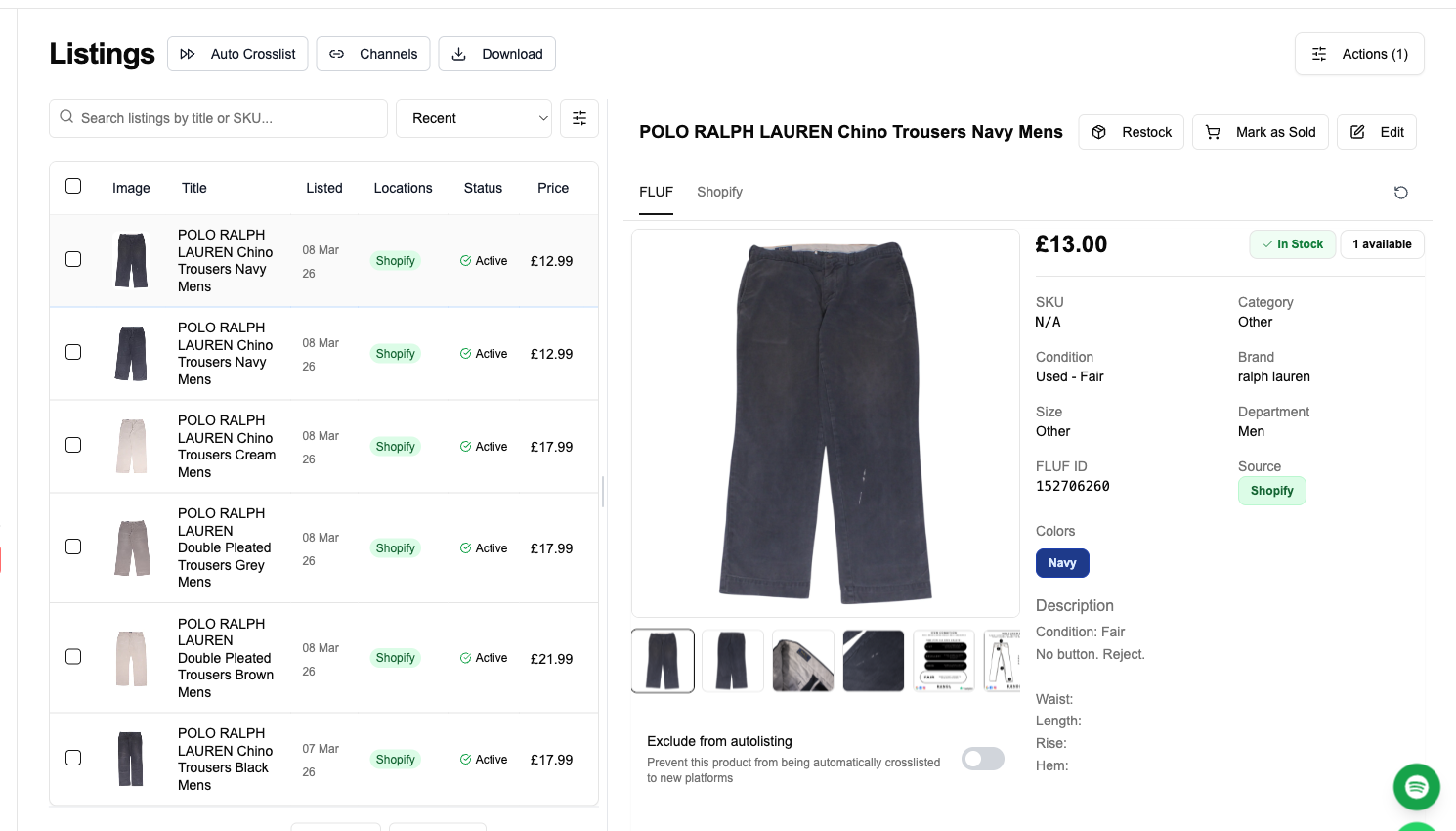
- Publish to both. FLUF carries your photos, title, description and price across and creates the Gumtree listing alongside your Facebook Marketplace one.
- Manage in one dashboard. You keep both listings in a single view, so when an item sells locally you can take it down without hunting through two separate apps.
Because both platforms are collection-led classifieds where deals are completed locally between buyer and seller, you finalise each sale the way you already do — meeting the buyer and exchanging item for payment — and remove the listing once it is gone. FLUF’s value here is the listing side: getting your item onto both UK audiences from one place, and giving you a single view to manage them, rather than posting and tracking each platform separately.
What to crosslist between them
The inventory that benefits most is exactly what both platforms are built for: general, local, collection-friendly goods. Furniture, white goods and appliances, electronics, household items, tools, kids’ equipment, bikes — anything where the buyer pool is “people nearby who want this” rather than “collectors who recognise a brand.” These items sell on price, condition and convenience, and the single biggest lever on how fast they sell is how many local buyers see them. That is precisely what a second local platform delivers. Branded or collectible items that depend on a specialist audience are a different story — they often do better on a dedicated marketplace than on either local classifieds — but for the broad mass of everyday second-hand goods, Facebook Marketplace and Gumtree together simply reach more of the local buyers who matter.
There is also a regional dimension worth noting. Gumtree organises everything by UK location, with strong, long-established presence in towns and cities across the country, and in some areas its classifieds audience runs deeper than Facebook Marketplace’s — particularly outside the biggest metropolitan centres, where Gumtree has been the default for years. That means crosslisting can be especially valuable depending on where you are: in some locations Gumtree will be where the serious local buyers are, in others Facebook Marketplace will dominate, and you rarely know in advance which will produce the buyer for a given item. Listing on both removes the guess. Rather than betting your sale on the single platform that happens to be strongest in your town, you cover both and let whichever audience contains the right buyer come through.
Gumtree’s new delivery option
Gumtree has historically been a pure local-classifieds platform, and that is still its default, but it is worth knowing it has begun adding an opt-in delivery and payments option. As of late 2025, Gumtree introduced built-in payments and shipping for certain categories — initially fashion and similar goods, with an item-value cap and a buyer-paid protection fee — so that some items can be sold to buyers beyond collection distance with funds held until delivery (ChannelX on Delivery on Gumtree). For a Facebook Marketplace seller, the practical takeaway is that Gumtree still suits the same local, collection-based goods you already sell, with a newer option to ship eligible items if you want to widen beyond your immediate area. Either way, the core reason to crosslist — reaching Gumtree’s separate UK local audience — is unchanged.
Why two local listings sell faster than one
It helps to be concrete about why doubling local exposure matters so much for second-hand goods. Unlike a branded collectible, which has a defined market price a buyer anywhere will pay, an everyday used item sells for roughly whatever the most motivated nearby buyer will give — and how quickly it sells depends almost entirely on how many such buyers see it before they find an alternative. A sofa listed only on Facebook Marketplace is seen by the local Marketplace browsers; the same sofa listed on Gumtree as well is also seen by the local Gumtree browsers, who are often different people. More viewers means a faster sale and, because more interested buyers create gentle competition, often a slightly better price than a single channel achieves. For high-turnover sellers clearing a lot of items, that compounding effect across a whole inventory is significant: things move quicker, sit for less time, and you spend fewer weeks babysitting stale listings. The crosslisting model is what makes capturing that worthwhile, because without it the extra sales would be eaten by the extra effort of posting and tracking everything twice.
Reaching the buyers Facebook can’t show you
The most valuable part of Gumtree’s audience, for a Facebook Marketplace seller, is the part that is structurally invisible on Facebook. A meaningful number of people simply do not use Facebook — some never signed up, some deleted their accounts over privacy concerns, some are older buyers who never adopted it — and yet many of them still buy second-hand goods regularly. For these buyers, Gumtree is not a secondary option; it is their primary or only classifieds destination, because it asks for no social account and exists purely to connect local buyers and sellers. When you list only on Facebook Marketplace, this entire segment never sees your items, no matter how well you price or photograph them. Crosslisting to Gumtree is the only way to reach them, and they are exactly the kind of motivated, ready-to-collect local buyer who completes a sale quickly. Adding the channel does not just give you more of the same audience — it gives you access to a distinct one that a Facebook-only strategy can never touch.
Trust and safety on both platforms
Both platforms share the same safety culture, so nothing new is required of you. Local classifieds selling runs on sensible precautions: agree the deal in-platform, meet in a safe place, and take cash on collection for local handovers — Gumtree and consumer bodies advise treating a buyer’s refusal to meet in person as a warning sign (MoneyHelper on Gumtree scams). These are the same habits that keep Facebook Marketplace sales safe, so a seller moving between the two is on familiar ground. Honest descriptions and clear photos — which FLUF carries across from your existing listings — do the rest, building the straightforward trust that local cash-on-collection sales depend on.
What transfers when you crosslist
The mechanics are deliberately light. When FLUF crosslists an item from Facebook Marketplace to Gumtree, it carries over the things that make a listing work: your photos, the title, the description and the price, arranged into Gumtree’s location-and-category structure. You do not re-shoot anything or rewrite your copy from scratch — the listing you already built is recreated on the second platform. Gumtree organises items around location and condition, so the main thing worth a glance after crosslisting is that the item landed in a sensible category and that the description reads well for a Gumtree audience, but in practice the same plain, honest listing that sells on Facebook Marketplace sells on Gumtree. Because both are free for private sellers, there is no cost to having the same item live on both at once, and no penalty if one sells first — you simply take the other down. The whole point is that reaching a second local audience should cost you a few clicks, not a second evening of listing work, and that is exactly what crosslisting delivers.
Who this is for
This is for UK sellers already doing local sales on Facebook Marketplace who want more buyers on the same items without more effort — house-clearers, casual sellers, and anyone shifting furniture, electronics or general second-hand goods. If your stock is niche or brand-dependent, a specialist marketplace may serve it better; but for the everyday local goods that make up most Marketplace selling, adding Gumtree reaches a separate UK audience — including the many buyers who never use Facebook — and FLUF Connect makes listing to both, and managing them together, a single workflow.
The deeper reason this is worth setting up is that local selling rewards coverage, not loyalty to one app. There is no prize for selling exclusively on Facebook Marketplace; the only thing that matters is that the buyer who wants your item sees it before they buy someone else’s. Some of those buyers live on Facebook Marketplace, some live on Gumtree, and you cannot tell in advance which platform holds the person who will collect your wardrobe or your dining set this weekend. Covering both is simply refusing to miss either, and the only thing that ever made it impractical was the manual labour of duplicate listing and tracking. Remove that — which is precisely what crosslisting does — and there is no longer a reason to leave half the local market unserved. You list once, your item appears for both UK audiences, you manage them in one view, and you sell to whoever turns up first. For everyday second-hand goods, that is the simplest reliable way to sell faster, and it costs you nothing but the few minutes it takes to crosslist — a small, one-time effort in exchange for steady, ongoing extra reach across both of the UK’s biggest local marketplaces.
Sources & Verification
- Gumtree scale (UK classifieds reach): Gumtree statistics and facts.
- Gumtree fees (free private listings, business/promotion charges): Gumtree — ad charges.
- Gumtree delivery/payments option (2025): ChannelX — Delivery on Gumtree.
- Local classifieds safety: MoneyHelper — Gumtree scams.
Frequently Asked Questions
Because Gumtree reaches a different and overlapping set of local buyers — including the many people who avoid or never use Facebook. It is the UK's leading classifieds site and needs no social login, so listing on both roughly doubles the local audience for the same item at no extra listing cost.
For private sellers, yes — general for-sale listings are free, with no listing limit and no commission on a standard classified sale. Businesses pay to post, and there are optional paid promotions (like bumping an ad to the top), but a private seller can list at no cost, just like Facebook Marketplace.
FLUF Connect lets you create and manage both listings from one dashboard, so you list once and keep them in a single view. Both platforms are local, collection-led classifieds where sales are completed in person, so you take a listing down when the item sells. FLUF's role is putting your items on both UK audiences and giving you one place to manage them.
General, local, collection-friendly goods — furniture, appliances, electronics, household items, tools, bikes and kids' equipment. These sell on price and convenience, where reaching more local buyers directly speeds up the sale. Niche or brand-dependent items may do better on a specialist marketplace.
Gumtree is collection-led by default, but it added an opt-in delivery and payments option in late 2025 for certain categories, with an item-value cap and a buyer-paid protection fee. So you can keep selling locally for collection, with the newer option to ship eligible items if you want to reach beyond your area.
FLUF Connect plans start at £9/month on Starter, with Pro at £29/month and custom Super Seller plans above that; every plan is unlimited on listings and marketplaces, and the tiers differ by which automations they include and how often we check your channels for sales. Crosslisting is included in every plan, not charged as a separate add-on.