
Crosslist from Mercari to Shopify — Keep the Demand, Stop Paying 10% Forever
Turn your Mercari listings into products in a Shopify store you own. Titles, descriptions, photos and prices transfer, order sync runs both ways, and the marketplace keeps doing what it is good at.
7 days for £1, then from £9/month.



- Source: Mercari — US resale at a flat 10% seller fee on item price plus buyer-paid shipping, charged on every single sale, forever.
- Destination: Shopify — a storefront you own, with unlimited products on every plan and no per-sale commission to the platform.
- The trade: you swap a percentage of every sale for a fixed monthly cost plus card processing. Above a certain monthly volume that inverts in your favour, and below it, it does not.
- What transfers: title, description, photos, price and category, into real Shopify products you control.
- What you lose: Mercari’s demand. A Shopify store has no buyers on day one — that is the whole job, and this page says so plainly.
- Connection: Install the FLUF browser extension and sign in to Mercari. Connect Shopify with your account credentials; it does not require an open browser.
- Sync: order sync and sold-detection work on both sides, so the store and the marketplace do not oversell each other.
- Cost of FLUF: 7 days for £1, then plans from £9/month (Starter). There is no free plan.
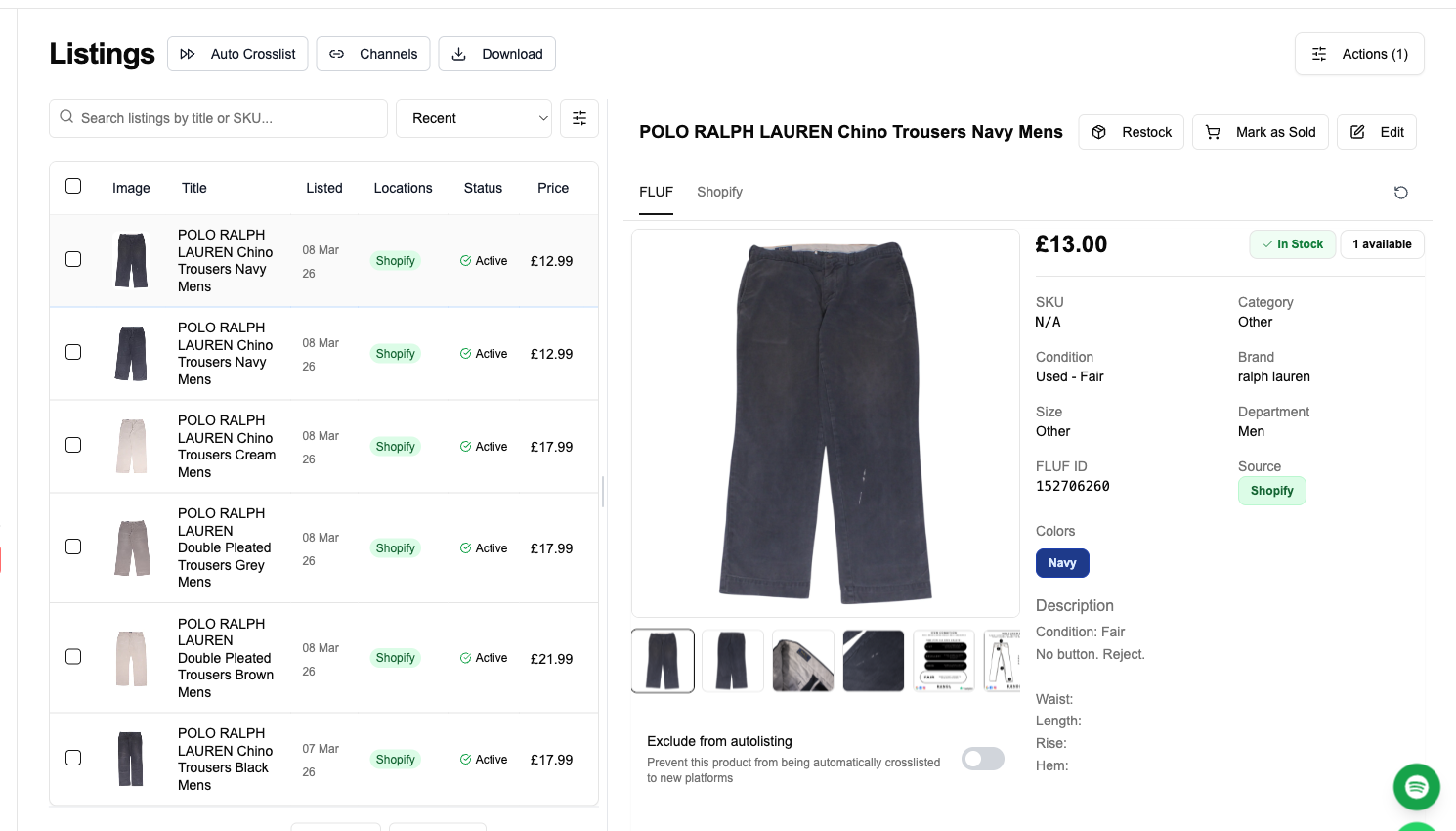
Why A Mercari Seller Builds A Store
There is a moment in most resale businesses where the arithmetic stops being about individual items and starts being about the year. You look at twelve months of payouts, work out what the platform kept, and the number is larger than any single decision you made.
On Mercari that number is easy to compute, because the fee is flat. Since 6 January 2025 the seller pays 10% of the item price and the buyer-paid shipping combined; the buyer pays a separate 3.6% Buyer Protection fee on the same base; and listing is free. There are no separate processing fees on listings created or updated from that date. It is a clean, comprehensible, unavoidable 10%.
A store changes the shape of that. Shopify does not take a commission on your sales. What it takes is a subscription and, if you use an outside payment gateway rather than Shopify’s own, a small percentage — 2% on Basic, 1% on Grow, 0.6% on Advanced and 0.2% on Plus, falling to zero when you use Shopify Payments. Every plan carries unlimited products. Plan prices are regional, so read them on Shopify’s own pricing page for your country rather than from an article.
The other half of the argument has nothing to do with fees. On Mercari you have a seller rating. In a store you have a domain, an email list, an analytics account and a customer record. A buyer who found you on Mercari is Mercari’s buyer, and always will be. A buyer who found your store is yours, and can be sold to again for the cost of an email.
Where The Cost Curves Cross
The maths is not complicated and it is worth doing before you build anything.
Mercari’s cost is purely variable: ten cents on every dollar of item-plus-shipping, whether you sell four things this month or four hundred. A store’s cost is mostly fixed: the subscription lands whether you sell anything or not, and the variable part is card processing, which is a fraction of what a marketplace commission is.
So the two lines cross at a monthly revenue figure specific to your plan and your card rate. Below it, Mercari is straightforwardly cheaper and building a store is a bet on the future rather than a saving today. Above it, every additional month on marketplace-only economics is money you are choosing to spend.
| Cost | Mercari | Your Shopify store |
|---|---|---|
| Commission on a sale | 10% of item price + buyer-paid shipping | None — you are the merchant |
| Buyer-side charge | 3.6% Buyer Protection, paid by the buyer | Whatever you set for postage |
| Monthly cost | None | Plan subscription, priced by region |
| Card processing | Included in the 10% | Your processor’s rate |
| Outside payment gateway | Not applicable | 2% Basic, 1% Grow, 0.6% Advanced, 0.2% Plus; none with Shopify Payments |
| Catalogue size | Unlimited | Unlimited on every plan |
| Traffic | Included, and considerable | Yours to earn — see below |
The Honest Part: A New Store Has No Buyers
The last row of that table is the one that decides whether this works, and most articles about leaving a marketplace bury it.
Mercari’s 10% is not a tax. It is the price of demand. When you list there, people who were already looking for what you have find it, without you doing anything. A Shopify store on day one has a beautiful product page and precisely nobody on it. If you turn off the marketplace and open a store, you have not cut costs — you have replaced a 10% fee with a marketing problem, and marketing problems cost more than 10%.
Which is why the only version of this that works for most resellers is additive. The store is where your repeat buyers, your Instagram followers, your local reputation and your search traffic land. The marketplace stays exactly where it is, doing the job it is good at, and paying its 10% for the privilege of introducing you to strangers.
The store earns its place slowly, from the buyers the marketplace already gave you. That is a much better trade than it sounds, because the second sale to a known customer costs you nothing to acquire.
How It Works
- Connect Mercari. Mercari has no public seller API and its session is bound to your browser, so FLUF’s extension works inside your own signed-in session. Nothing happens that you could not do yourself, with considerably more clicking.
- FLUF reads your listings. Mercari returns your own listings roughly twenty at a time, and FLUF paces the walk rather than following pagination indefinitely, so a large inventory is read across several passes.
- Connect Shopify. This side is straightforward: credentials, no browser session to maintain, and FLUF talks to Shopify from its own servers.
- Review before you publish. This is the step people skip and regret, and the section below explains exactly which fields to look at.
- Publish. The items appear in Shopify as ordinary products you can collection, tag, merchandise and discount like anything else you would have created by hand.
Because the destination is your own store, there is no category taxonomy to satisfy, no moderation queue and no listing limit. A product exists the moment you publish it.
What Transfers, Field By Field
| Mercari | Becomes in Shopify | Notes |
|---|---|---|
| Title | Product title | Mercari titles are keyword-stuffed for in-app search and read badly as a product page heading |
| Description | Product description | Carries over as text; see the pitfalls below |
| Photos | Product images | Mercari allows up to 12; Shopify has no practical limit |
| Price | Price | USD on both sides |
| Category | Product type / collection | You will almost certainly want to re-organise this properly once, by hand |
| Condition | Nothing structural | Shopify has no condition field — it becomes description text or a tag you define |
| Quantity | Inventory quantity | Usually 1 — see the next section, which matters more than it looks |
| Shipping weight | Weight | Worth checking, because your store now calculates its own postage |
One-Of-One Stock In A System Built For Stock Levels
Shopify was built for merchants who have forty of something. Resale is the opposite: you have one of everything, and once it is gone it is gone forever.
That mismatch shows up in small, annoying ways. A Shopify product with inventory tracking off will happily sell the same vintage jacket to three people. A product marked out of stock stays on your site as a dead page rather than disappearing the way a sold marketplace listing does. Neither is a bug; both are defaults designed for someone restocking.
Two settings fix most of it. Turn inventory tracking on, and set Shopify to stop selling when a product hits zero. Then decide deliberately what a sold-out product page should do — keep it for the search traffic, or hide it. Both are defensible; drifting into one by accident is not.
This is also why the sync direction in the next section matters more on this pair than on most.
What Syncs, And What Does Not
| Behaviour | Mercari | Shopify |
|---|---|---|
| Order sync into FLUF | Yes | Yes |
| Sold elsewhere, pull it down here | Yes | Yes |
| Price and stock pushes | Yes | Yes |
| Automatic relisting | No | Not applicable — a store product does not expire |
| Offer management | No | Not applicable |
Both sides report orders, which makes this one of the better-behaved pairs FLUF supports. A sale on Mercari drops the Shopify product to zero; a sale in your store pulls the Mercari listing down. You are not relying on remembering.
It is close to real time rather than instantaneous, and no crosslisting tool anywhere can honestly claim instantaneous. For genuinely irreplaceable stock, sellers who care keep it in one place on purpose, and that is a reasonable decision the tool does not argue with.
Automation features are included in every FLUF plan rather than sold as add-ons. They work on the channels that support them, which for this pair means order sync and sold-detection on both sides.
What You Actually Have To Build
Importing the catalogue is the easy hour. The store around it is the work, and it is worth knowing the list before you start rather than discovering it on launch day.
A way to take money. Shopify Payments where it is available in your country, or an outside gateway — in which case the plan-tier transaction fee applies on top of whatever the gateway charges you.
Policies that are yours. Shopify will generate refund, privacy and terms templates for you, which is a starting point and not an answer. On a marketplace the returns window was decided for you and enforced by someone else. Here it is a sentence you write and then have to honour.
Product pages that can be found. A marketplace listing is discovered inside the marketplace. A store product is discovered by search engines or not at all, which means titles, descriptions and the search-engine listing fields Shopify exposes per product are doing a different job than they did on Mercari. This is also the strongest argument for keeping sold-out pages live rather than deleting them.
A reason for anyone to come back. Email capture is the single highest-return thing a resale store does, because it is the only asset in this entire exercise that a platform cannot take away from you. It is also the thing most people leave until month six.
Curation Is The Feature A Marketplace Cannot Give You
On Mercari your items are individual results in someone else’s search. They sit next to eleven other listings of roughly the same thing, and the only levers you have are price and photograph.
In a store the unit is not the item, it is the collection. Twenty pieces grouped as one coherent drop, with a story attached, is a fundamentally different proposition from twenty separate listings — and it is the reason a buyer will pay your price rather than scrolling to the cheaper one underneath. Shopify’s collections can be built by hand or set to fill themselves from the tags you assign, which is where an imported catalogue starts paying you back for the half hour you spent tagging it properly.
This is the part of owning a store that does not show up in a fee comparison and usually matters more than one. You cannot merchandise on a marketplace. You can only compete on it.
Four Things That Catch Resellers Out
Marketplace titles are not product titles. “Vintage Y2K Baby Tee Pink Small Coquette Aesthetic Grunge 90s” is a good Mercari title and an embarrassing product page heading. The first fifty products you care about deserve a real title; the rest can wait.
Your descriptions promise Mercari’s terms. References to Buyer Protection, to bundling, to Mercari’s returns window and to its dispute process are all statements about a service your store does not provide. Search for the platform’s name across your imported descriptions and deal with every hit.
You are now the customer-service department. Mercari holds the money, arbitrates the dispute and decides who was right. In your store, that is you, and your refund policy is a document you have to write rather than a page you can point at.
Postage was a solved problem and now it is not. Mercari’s prepaid labels came with negotiated rates. Your store’s shipping is whatever you configure, and getting it wrong in either direction — undercharging, or scaring buyers off at checkout — is the most common way a new store leaks money quietly.
Keeping Both, Which Is The Only Sane Plan
Run the store as the place that compounds and the marketplace as the place that discovers. Mercari keeps introducing you to people; the store keeps the ones worth keeping. Sold-detection stops the two from selling the same jacket twice, which is the only real operational risk in running both.
And once the catalogue lives in one place, it does not have to stop at two channels. The same FLUF inventory reaches Poshmark, eBay or Facebook Marketplace without another round of typing, and every one of them can point its buyers at a store that is yours.
Pricing
FLUF Connect starts with 7 days for £1, with every feature available immediately. After that, plans start at £9/month for Starter, with no cap on how much you list. There is no free plan.
Every channel is included on every plan, and automation is included from Seller upwards too rather than sold as an add-on.
Sources & Verification
- Mercari — selling fees — 10% seller fee on item price plus buyer-paid shipping; 3.6% Buyer Protection paid by the buyer; listing always free. Structure effective 6 January 2025.
- Mercari — the January 2025 fee change — no separate payment processing fee for listings created or updated from that date.
- Mercari — creating a listing — up to 12 photos; prepaid labels at discounted rates or ship on your own.
- Shopify — pricing — unlimited products on every plan; third-party payment gateway fees of 2% on Basic, 1% on Grow, 0.6% on Advanced and 0.2% on Plus, and none when using Shopify Payments. Plan prices are shown per region on that page.
- Shopify — set up inventory tracking — enabling tracking and stopping sales when stock reaches zero.
- Shopify — importing products — the limits and hazards of bulk product import.
- Shopify — shipping rates — how store-side postage is configured once you are the merchant.
- Shopify — collections — manual and automated collections, and how product tags drive them.
- Shopify — refund, privacy and terms of service templates — the policy documents a store owner has to supply.
- Shopify — editing the search engine listing — the per-product SEO fields a marketplace listing has no equivalent of.
- Shopify — product types and organisation — how imported marketplace categories map onto collections and product types.
Last verified 22 August 2026. Fees and plan prices change without notice and vary by region; where this page and the source disagree, the source is right.
Related guides
Related guides
- Crosslist from Mercari to Depop — another route out of a Mercari catalogue
Frequently Asked Questions
It depends entirely on your monthly revenue. Mercari's cost is purely variable at 10% of item price plus buyer-paid shipping. A store's cost is mostly fixed — the subscription arrives whether you sell or not — with card processing as the small variable part. The two cross at a figure specific to your plan and card rate. Below it the marketplace is cheaper; above it, staying marketplace-only is a choice you are paying for.
Almost certainly not. Mercari's 10% is not a tax, it is the price of demand — people who were already looking find you without you doing anything. A new store has a good-looking product page and nobody on it. Closing the marketplace does not remove a cost, it replaces it with a marketing problem, and marketing problems cost more than 10%.
Yes. Both Mercari and Shopify report orders back to FLUF, so a Mercari sale drops the Shopify product to zero and a store sale pulls the Mercari listing down. It is close to real time rather than instantaneous, which no crosslisting tool can honestly promise, so genuinely irreplaceable stock is often best kept on one channel deliberately.
Not by default, because it was built for merchants who hold forty of something. Turn inventory tracking on and set Shopify to stop selling when a product reaches zero, otherwise the same vintage jacket can be sold to three people. Then decide deliberately whether a sold-out product page stays live for its search traffic or is hidden.
For the Mercari side, yes — Mercari offers no public seller API and its session is bound to your browser, so FLUF acts inside your own signed-in session. Shopify is the easy side: it connects with credentials and FLUF talks to it from its own servers, with no browser session to keep alive.
They transfer as text, and they need one pass. Mercari descriptions routinely reference Buyer Protection, bundling, the returns window and Mercari's dispute process — all statements about a service your own store does not provide. Search your imported descriptions for the platform's name and resolve every hit before you go live.
No. Mercari does not charge for listing, and Shopify allows unlimited products on every plan. The constraint on the FLUF side is your plan's active-product allowance, which starts at 300 on Starter and rises with catalogue size.
FLUF Connect starts with 7 days for £1, with every feature available immediately. After that plans start at £9/month for Starter, with no cap on how much you list. There is no free plan, and automation is included from Pro upwards rather than sold as an add-on.