
Crosslist from Shopify to Grailed — Reach Designer and Streetwear Buyers
List your Shopify store's streetwear, designer and archive pieces on Grailed's fashion-literate global audience — without rekeying a single product.
7 days for £1, then from £9/month.



TL;DR: FLUF Connect reads your Shopify catalogue and lists the right pieces on Grailed — the curated peer-to-peer marketplace for designer, streetwear and archive fashion. Photos, titles, descriptions, sizes and prices transfer automatically, and when an item sells on either side FLUF keeps your stock honest so you never double-sell. Best for Shopify brands and boutiques sitting on overstock, samples or archive that a DTC storefront cannot move at value but Grailed’s fashion-literate, brand-loyal buyers will. Plans start at £9/month for the Starter plan (unlimited listings); crosslisting automation is included from Seller upwards.
A Shopify store gives you everything except an audience. You own the storefront, the brand, the checkout and the data — but Shopify sends you no buyers of its own; every visitor you get, you earned through ads, content or social. That is fine for your core range, where your marketing is already pointed. It is a problem for the long tail of a fashion business: overstock, sample-sale pieces, last-season archive, the one-off grails that never quite fit a campaign. Those items sit in your Shopify catalogue earning nothing, because the people who would pay for them are not the people your DTC ads reach. Grailed is where those people are: a curated marketplace built specifically for designer, streetwear and archive fashion, with a brand-literate audience that hunts exactly the pieces a Shopify boutique struggles to surface. FLUF Connect is the bridge that puts your store’s catalogue in front of them without re-listing anything by hand.
Why a Shopify brand lists on Grailed
The two platforms solve opposite halves of the same problem. Shopify is owned demand you have to generate; Grailed is borrowed demand that already exists. Grailed’s audience skews exactly toward the buyer a streetwear or designer brand wants to reach: traffic is heavily US-based (around two-thirds of Grailed’s visits come from the United States), concentrated in the 25–34 age band, brand-literate and authenticity-focused, and willing to pay real money for the right label. Grailed’s own 2025 marketplace report had Chrome Hearts, Balenciaga, Rick Owens, Supreme and Nike as its top-selling brands (WWD / Footwear News) — the kind of names a DTC fashion brand either stocks, sits adjacent to, or competes with.
For a Shopify seller, that means Grailed is the natural outlet for the inventory your own store cannot monetise efficiently: discontinued lines, sample pieces, collaborations, and any archive a collector would value more than a casual site visitor. You keep Shopify as your primary, brand-controlled channel and use Grailed as a curated secondary surface that reaches buyers actively searching for what you are clearing — without diluting your main storefront or discounting in front of your core customers.
Shopify and Grailed, side by side
| Shopify | Grailed | |
|---|---|---|
| What it is | Your own branded store | Curated fashion marketplace |
| Built-in demand | None — you drive traffic | Brand-literate buyers, US-heavy |
| Best for | Current-season range at full price | Overstock, samples, archive, grails |
| Cost model | Subscription + your ad spend | No listing fee; commission on sale |
| Audience | Whoever your marketing reaches | 25–34 streetwear/designer collectors |
| Curation | None — you control everything | Curated; quality + authenticity bar |
Read the table as a division of labour, not a contest. Shopify is the brand-controlled home for your range; Grailed is the demand channel for the inventory that home cannot place efficiently. Running both is how a fashion brand captures full-price sales on its core and still monetises the long tail.
How crosslisting from Shopify to Grailed works
FLUF Connect runs the whole flow from one dashboard:
- Connect your Shopify store and your Grailed account. Authorise both once; FLUF reads your live Shopify products.
- Choose what to list. Grailed is curated, so you select the designer, streetwear and archive SKUs that belong there rather than pushing your whole catalogue — the pieces with brand pull.
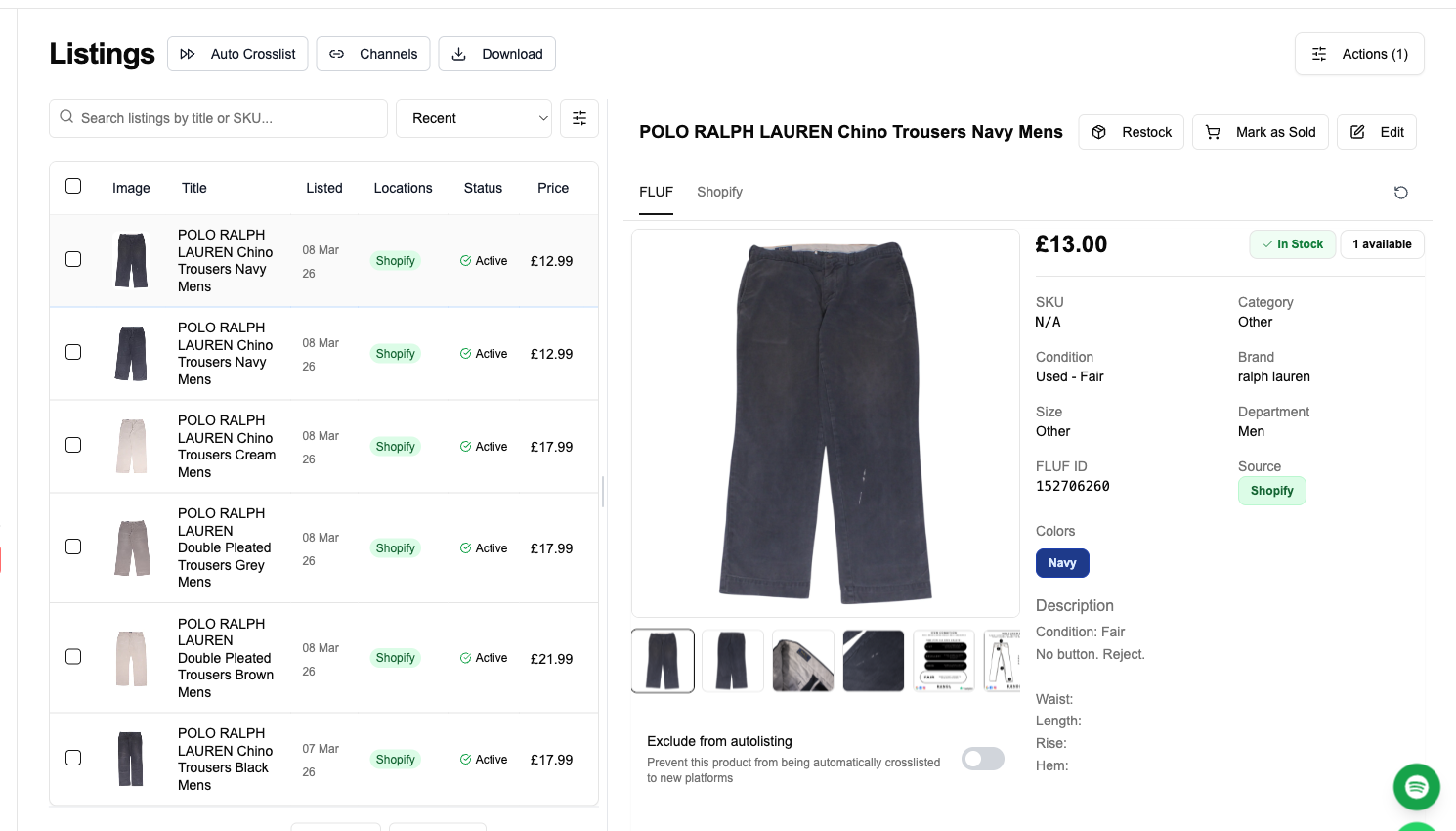
- Map and publish. FLUF carries titles, descriptions, photos, sizes and prices across, and creates the Grailed listings.
- Sell on either side without overselling. Shopify and Grailed both support sold-status sync in FLUF, so when a unit sells on Grailed your Shopify stock is decremented, and when it sells on Shopify FLUF withdraws it from Grailed.
That last point matters more on Grailed than on most channels, because Grailed listings are individual and curated; a stale listing for an item you already sold on Shopify is exactly the kind of thing that frustrates a serious buyer and dents your seller standing. Keeping the two in sync is automatic and is included in every FLUF Connect plan, not a paid add-on.
What sells on Grailed — and what to leave on Shopify
Grailed rewards being selective. Its buyers are there for designer, archive and hyped streetwear — labels like Rick Owens, Supreme, Maison Margiela, Saint Laurent and the streetwear staples — and they pay premiums for genuine grails: archive runway pieces, deadstock, collaborations. What does not perform is generic or mass-market product; fast-fashion basics sell slowly and thinly on Grailed and are better left on your own store, where they fit your range and your pricing. The discipline that makes this channel work is sending Grailed only the SKUs whose brand and rarity its audience will reward, and keeping everything else on Shopify. Because Grailed charges no listing fee — you only pay when an item sells (Grailed seller fees) — testing which of your pieces resonate costs nothing but the listing effort, which FLUF removes.
Grailed’s fees and standards
Grailed’s economics are straightforward. There is no charge to list; on a sale, Grailed takes a commission — 9% on items of $120 and above, and 6% (minimum $1.99) on items under $120 — plus payment processing of around 3.49% + $0.49 for domestic US sales. Compared with the cost of acquiring a buyer through Shopify ads, a commission you only pay on a completed sale is an efficient way to monetise inventory your paid traffic was never going to convert.
Grailed also holds a quality bar, and a Shopify brand is well placed to clear it. Listings need clear, well-lit photos from multiple angles — at least three — showing detail and any flaws, and a curation team sorts and can reject items that do not meet its fashion-focused standards or fail authentication (Grailed listing guidance). The product photography you already shot for your Shopify store is usually exactly what Grailed wants, which is one more reason this direction is efficient: the assets that sell on your own site travel straight to the marketplace.
Pricing your pieces for a Grailed audience
Pricing for Grailed is a different exercise from pricing on your own store, and it is worth doing deliberately rather than copying your Shopify retail price across. On Shopify you price for your brand and your margin; on Grailed you price into a market where buyers know exactly what a given piece trades for, because they track it. That cuts both ways. For genuinely sought-after archive or collaboration pieces, Grailed’s brand-literate audience and its documented high ceilings — the platform’s 2025 report noted individual sales running into five figures for the rarest items — mean you can often ask more than a casual buyer on your own site would pay. For ordinary current-season stock, the same buyers will not overpay, so the realistic move is to price overstock to clear. A practical approach is to let FLUF carry your Shopify price as a starting point and then adjust the Grailed listings up for the grails and down for the clearance, treating each piece on its own merits. Because there is no listing fee, leaving a well-priced piece up costs nothing while it waits for the right collector.
Authentication and trust on Grailed
Grailed’s value to buyers — and therefore to you as a seller — rests on trust, and that trust is enforced. The marketplace runs authentication and a curation process designed to keep counterfeits and off-brand items out, which is precisely why its buyers are willing to pay designer prices to strangers. For a legitimate Shopify brand or boutique, that bar is an advantage, not an obstacle: your genuine product clears it easily, and you benefit from selling into a marketplace that buyers trust enough to spend real money on. The practical requirements are straightforward — clear photos showing the item and any flaws honestly, accurate brand and condition information, and listings that match what arrives. Sellers who describe accurately and ship promptly build the kind of standing that makes future sales easier, and FLUF carrying your existing, accurate Shopify product data across is a clean foundation for exactly that.
What to expect when you start
Crosslisting to Grailed is not a switch that floods you with orders overnight; it is a channel that works as your right pieces meet their buyers. Some grails sell quickly to a collector who has been waiting for them; some overstock sits until the price and the buyer align. The advantage of the crosslisting model is that none of this costs you anything to wait out — Grailed charges no listing fee, so a piece can stay live indefinitely until it sells, while your Shopify store carries on as normal. Over time you learn which of your SKUs resonate on Grailed and which belong only on your own store, and you send the channel more of what works. FLUF keeping stock in sync throughout means you can leave pieces listed on both surfaces without ever risking a double-sale, which is what makes “just list it and see” a safe strategy rather than a liability.
Keeping your brand intact
A reasonable worry for a Shopify brand is channel conflict — does selling on Grailed undercut your own store? Handled well, it does the opposite. Your Shopify store stays the front door for current-season product at full price and full brand experience; Grailed becomes the controlled outlet for the pieces that would otherwise be marked down in front of your core customers or sit dead in inventory. You are not competing with yourself; you are reaching a different buyer, in a different context, for different stock. And because FLUF keeps stock synced, the operational risk of running both — overselling, stale listings — is handled, leaving you free to treat Grailed as exactly what it is: a demand channel for the inventory your owned store cannot place.
Reaching the US market from your Shopify store
One underrated benefit of this direction is geography. Grailed’s audience is heavily concentrated in the United States — roughly two-thirds of its traffic — which makes it one of the most efficient ways for a non-US Shopify brand to put product in front of American buyers without building US-specific marketing from scratch. A UK or European streetwear label that would struggle and spend heavily to acquire US customers through its own Shopify ads can instead list directly into a marketplace where those customers already are, hunting exactly the kind of pieces it sells. The brand keeps its Shopify store as its global shopfront and uses Grailed as a ready-made route into the single biggest market for designer and streetwear resale. Even for US-based brands, the concentration of serious, brand-literate buyers in one place is hard to replicate with paid traffic — you are renting access to an audience that took Grailed years to assemble, and paying for it only when you sell. For a brand weighing the cost of US customer acquisition, that is often the most compelling reason of all to crosslist, and FLUF makes tapping it a matter of selecting which products to send rather than standing up a whole new sales operation.
Who this is for
This fits Shopify sellers in the streetwear, designer and contemporary-fashion space: brands with sample-sale and end-of-line stock, boutiques carrying labels Grailed’s buyers hunt, and resellers running a Shopify storefront who want a curated global audience for their best pieces. If your catalogue is mass-market or non-fashion, Grailed is the wrong fit and your own store is the right home. But if you sit on designer or archive inventory that deserves a brand-literate buyer, crosslisting from Shopify to Grailed turns dead stock into sales — and FLUF Connect makes running both one workflow instead of two.
The operational case is as important as the audience case. The reason most Shopify brands never seriously work a marketplace like Grailed is not that they doubt the demand — it is that listing and maintaining products in a second system, by hand, alongside running a store, is more work than the long-tail revenue seems to justify. Crosslisting removes that objection. You manage one catalogue in Shopify, select the pieces that belong on Grailed, and let FLUF create and sync the listings; there is no second spreadsheet, no manual re-keying, and no risk of a sold item lingering live. What was previously a project becomes a setting, and a channel that was not worth the effort becomes worth switching on. For a brand sitting on designer overstock, that shift in effort is often the difference between leaving the money on the table and collecting it.
Sources & Verification
- Grailed audience & US traffic skew: Similarweb — grailed.com.
- Grailed top-selling brands 2025: WWD / Footwear News — Grailed marketplace report.
- Grailed seller fees (free listing, 9%/6% commission + processing): Grailed — What are the fees.
- Grailed listing standards: Grailed — Listing FAQ.
- Grailed ownership (GOAT Group): GOAT Group to acquire Grailed.
Frequently Asked Questions
Designer, streetwear, archive and contemporary-fashion pieces — the brands and rarities Grailed buyers actively hunt. Overstock, sample-sale items, discontinued lines and collaborations are ideal. Mass-market or non-fashion products do not perform on Grailed and are better kept on your own Shopify store.
Yes. FLUF Connect keeps sold-status in sync between Shopify and Grailed, so when an item sells on Grailed it is decremented in Shopify, and when it sells on Shopify it is withdrawn from Grailed. This prevents double-selling and is included in every plan.
Grailed has no listing fee — you only pay when an item sells. Commission is 9% on items of $120 and above and 6% (minimum $1.99) under $120, plus payment processing of around 3.49% + $0.49 for domestic US sales.
Not if you use it as an outlet rather than a discount channel. Keep current-season product at full price on your Shopify store, and use Grailed for overstock, samples and archive that would otherwise be marked down in front of your core customers. You reach a different buyer for different stock.
Usually not. Grailed wants clear, well-lit photos from multiple angles showing detail and any flaws — typically the same product photography you already use on Shopify. FLUF transfers your existing images when it creates the Grailed listings.
FLUF Connect plans start at £9/month on Starter, with Pro at £29/month and custom Super Seller plans above that; every plan is unlimited on listings and marketplaces, and the tiers differ by which automations they include and how often we check your channels for sales. Crosslisting and the sync around it are included in every plan, not charged separately.