Crosslist from Tilt to Vinted — Automatically
Move the stock that didn't sell on stream onto Europe's biggest second-hand marketplace u2014 without relisting anything by hand.



- Tilt: a London-built live-auction app for fashion, streetwear and collectibles, live in the UK, Spain, Poland and Italy, with over a million buyers. Sellers pay 2% + 50p a transaction.
- Vinted: Europe’s largest second-hand fashion marketplace — over €10 billion of GMV in 2025 and 75 million+ members across 26 markets. Sellers pay nothing; the buyer pays a protection fee.
- Two opposite selling mechanics: Tilt sells in minutes to a live room; Vinted sells over days or weeks to someone searching. The item that gets no bids on stream is often exactly what a Vinted buyer is filtering for.
- Fields that transfer automatically: title, description, photos, price, brand, size and condition. Both channels cap titles at 100 characters, so nothing gets truncated in transit.
- Inventory sync runs both ways on this pair — Tilt began emitting real sale signals on 15 August 2026, so a sale on either side withdraws the item from the other.
- Vinted publishes through your own logged-in session — the FLUF browser extension on a computer, or the FLUF mobile app on your phone. Tilt needs the extension once, at connect, and never again.
- Check Tilt’s cross-platform policy first: while an item is live on Tilt, Tilt asks you not to list it elsewhere. Crosslist the stock that has already run and not sold — details below.
- Cost: 7 days for £1, then plans from £9/month (Starter — 300 products). There is no free plan.
Why sell on both Tilt and Vinted?
Crosslisting from Tilt to Vinted puts the same piece in front of two audiences that behave nothing alike. On Tilt an item sells in ninety seconds to whoever is in the room and wants it most. On Vinted it sells whenever somebody searches for exactly that brand in exactly that size, which might be tonight or might be in March. Running both is not selling twice to the same person — it is covering the two ways second-hand fashion actually gets bought.
Tilt is a live-auction marketplace built in London by Retro Labs Ltd, a company incorporated in 2021, and it is genuinely active rather than aspirational. Tilt’s own help desk lists four live markets — the UK, Spain, Poland and Italy — while accepting seller applications from five, adding France. It raised $26 million in June 2026, with Vinted’s own venture arm joining the round, and says it has grown eightfold since 2024, passed a million buyers, and takes 70% of monthly sales from repeat buyers. FLUF’s own index of Tilt seller records on 15 August 2026 found that base heavily concentrated in Great Britain, with smaller but real populations in Italy, Spain and Poland.
The seller fee is 2% plus 50p a transaction, with no listing fee, no monthly fee and no category surcharge — among the lowest seller-side rates of any marketplace FLUF connects to. Read the whole picture, though. Tilt also charges the buyer a Buyer Protection fee of 50p plus 5% of the order up to £150, dropping to 3% above that, so the platform’s total take is meaningfully more than 2% — it is just mostly charged to the person buying from you. That still compares well against a live rival: Whatnot’s UK sellers pay 6.67% plus VAT in commission on most categories, before payment processing.
Vinted is the other end of the scale. It passed €10 billion in gross merchandise value in 2025, with revenue of €813 million, and it operates across 26 markets with a membership counted in the tens of millions. Sellers pay no commission, no listing fee and no payment processing — the Buyer Protection fee is charged to the buyer, not to you. Vinted also covers categories Tilt’s live format handles badly: everyday clothing, kids’ wear, homeware and the mid-value stock that nobody will sit through an auction for.
The strategic point is about pace. A live seller can clear 40 items in an evening on Tilt, but only the items that photograph well on camera and carry a story. Everything else — the plain Zara coat, the four pairs of jeans in the same size, the item you have re-run on stream twice with no bids — is dead weight on a live platform and perfectly ordinary stock on Vinted. Crosslisting moves that tail somewhere it can actually sell, without you photographing or writing it a second time.
| Tilt | Vinted | |
|---|---|---|
| Selling format | Live-hosted auction rooms, plus off-stream fixed-price listings | Static, search- and feed-driven fixed-price listings |
| Scale | 2,301 active sellers measured across seven countries (15 Aug 2026) | Over €10 billion GMV in 2025; 26 markets |
| Seller markets | GB, IT, US, ES, PL, FR, AU | 26 markets across Europe, plus the US and Australia |
| Seller fees | 2% + 50p per transaction | Nothing — the buyer pays the Buyer Protection fee |
| Strongest stock | Streetwear, designer vintage, collectibles, anything with a story | Everyday fashion, kids’ clothing, high-volume mid-value stock |
| Time to sell | Minutes, during a stream | Days to months, whenever a buyer searches |
| Effort per sale | High — you have to be live and hosting | Low — the listing works while you don’t |
One honest caveat before the mechanics: Tilt is small. If you are choosing where to put your first hundred listings, Vinted is where the buyers are. Tilt is the better place to convert the pieces that need a human selling them, and the case for crosslisting is precisely that you should not have to choose.
How to crosslist from Tilt to Vinted
The two channels connect in genuinely different ways, and it is worth knowing which is which before you start, because it determines what has to be running when a listing goes out.
Tilt has no password login at all — sign-in is phone and SMS one-time code, Apple or Google — so there is no username and password pair for a tool to hold. FLUF uses the browser extension exactly once, at connect, to lift your existing Tilt session token out of the seller portal. After that every read, crosslist, price change and withdrawal runs server-side against Tilt’s GraphQL API, with no browser involved.
Vinted works the other way round. Vinted listings are created through your own logged-in Vinted session, which means either the FLUF browser extension on a computer or the FLUF mobile app on your phone acts as the host. You do not need to keep a Vinted tab open and watch it — you queue the work in FLUF and the host executes it — but one of the two has to be installed and signed in for Vinted listings to actually publish.
- Sign up for FLUF Connect and open the Channels page.
- Connect Tilt. The extension prompts you to sign in to Tilt as normal, then hands the session to FLUF. You do this once.
- Connect Vinted, on the same computer or in the FLUF mobile app.
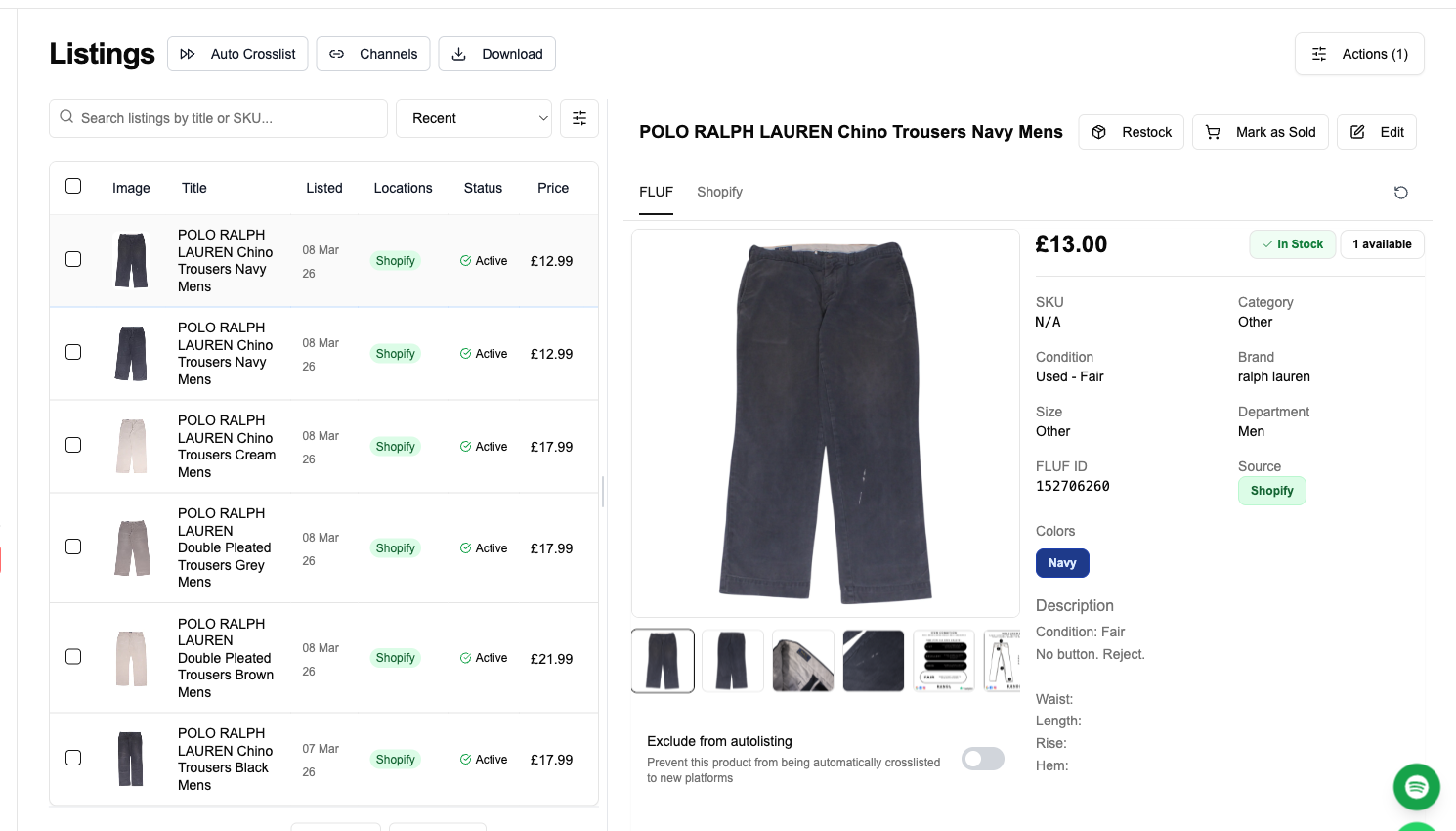
- Import your Tilt listings. FLUF reads your live Tilt catalogue — titles, descriptions, brands, sizes, conditions, prices and every photo.
- Review the mapping. Brand, size and condition come across pre-filled; you can correct anything before it goes out.
- Select the items you want on Vinted and crosslist, one at a time or several hundred in a single bulk pass.
- FLUF re-uploads each photo to Vinted, publishes the listing, and links the two records so stock stays in step from then on.
You can also set auto-crosslisting rules, so anything new that lands in your Tilt catalogue above a price threshold, or in a particular category or brand, is pushed to Vinted without you opening the dashboard at all.
Tilt’s cross-platform rule — check this before you crosslist
Tilt publishes a cross-platform sales policy, and it is the first thing to understand before moving anything off Tilt. Tilt’s position is that while an item is live on Tilt you must not attempt to sell, promote or list that same item on another platform. The stated penalties escalate from reduced visibility and temporary suspension to permanent removal for repeat violations.
Read the scope carefully, because it is narrower than it first sounds. The restriction attaches to an item while that item is live on Tilt. Tilt says the opposite about your shows — you are encouraged to promote your Tilt livestreams anywhere you like. It is not a blanket exclusivity clause over everything you own, and it is not a reason to avoid crosslisting. It is a reason to sequence it.
- Crosslist the tail, not the stream. The pieces that have already run on Tilt and did not sell are the ones worth moving, and they are no longer live.
- Sequence it. Run the auction, then crosslist what is left. Do not put the same jacket into a Vinted listing and a Tilt room on the same evening.
- Let sold-out sync do the withdrawal. If a crosslisted item does sell on Vinted first, FLUF pulls it out of your Tilt catalogue automatically — which is precisely the outcome the policy exists to protect.
- Ask if you are unsure. Tilt assigns sellers an account manager and the policy page is short; a direct question beats an assumption.
We flag this rather than quietly working around it because the point of a crosslisting tool is that nothing surprises you. Most channels FLUF connects to have no such rule. Tilt does, and once you know the shape of it, running the pair sequentially costs you nothing.
What transfers — field and category mapping
This is the section that determines how much tidying up you do afterwards. Tilt’s listing shape is unusual: price and stock quantity live on a SKU object underneath the product rather than on the product itself, and there is no reference-code or SKU text field anywhere. Vinted’s shape is closer to conventional. Here is the field-by-field picture, taken from the code that actually performs the transfer.
| Field | Tilt (source) | Vinted (destination) | What FLUF does |
|---|---|---|---|
| Title | 100 characters | 100 characters | Carried across unchanged — the limits match exactly, so nothing is cut |
| Description | 2,000 characters | Fitted to Vinted’s limit | Trimmed on a word boundary if the source description is unusually long |
| Photos | Up to 20 | Minimum 2 required | Each photo is downloaded and re-uploaded into Vinted’s own image host — neither channel will accept a bare image URL |
| Price | Held on the SKU object, in the shop’s currency | Listing price | Read off the SKU and converted if the currencies differ |
| Brand | Free-text brand field | Matched against Vinted’s brand list | Resolved to a Vinted brand; falls back to “Unbranded” when Tilt has no brand set |
| Size | Free-text size | Vinted size taxonomy, per category | Mapped into the size list for the matched Vinted category |
| Condition | Five values: new with tags, new, like new, used, damaged | Vinted’s own condition scale | Mapped value to value |
| Category | Roughly 300 category nodes | Vinted’s category tree | Mapped node to node; you can override before publishing |
| Colour | Not a first-class field | Optional attribute | Inferred from your product data where available, otherwise left unset |
| SKU / reference | No such field exists on Tilt | Not used | Nothing to carry — FLUF tracks the link internally instead |
| Quantity | Held on the SKU object | Single-item listings | Read but not surfaced — Vinted listings are one-of-one |
Condition mapping in detail
Tilt stores condition as one of five fixed values — NEW_WITH_TAGS, NEW, LIKE_NEW, USED and DAMAGED. Vinted’s scale covers the same ground with slightly different labels, so the mapping is close to one-for-one and rarely needs correcting. The place to check is the top of the scale: an item you listed on Tilt as simply “new” because it never had tags will land on Vinted as new-without-tags, which is the honest reading, but worth glancing at if the piece is deadstock and you want the tags mentioned in the description.
Categories, and why you should still look
Tilt carries around 300 category nodes; Vinted’s tree is considerably deeper, particularly in womenswear and kids. FLUF maps to the closest match, but “closest” on a shallower source tree sometimes means a level or two above where you would place the item yourself. Vinted’s search leans hard on category and attributes, so a listing sitting one level too high is a listing that fewer people see. On a bulk crosslist of a hundred items it is worth spot-checking a handful before publishing the rest.
What does not come across
- Nothing about the live sale. A stream, a hosted event, the bidding history — none of it has a Vinted equivalent, and none of it transfers. The Vinted listing is a plain fixed-price listing.
- Your Tilt reputation. Followers, ratings and sales history are per-platform. You start on Vinted with whatever your Vinted account already has.
- Tilt’s engagement counters. Views and favourites are Tilt’s own numbers and do not travel.
What syncs between Tilt and Vinted, and what doesn’t
The reason to crosslist through a tool rather than by hand is overselling. Two live listings for one physical jacket is a refund and a bad review waiting to happen, and this pair is one where FLUF genuinely covers both directions.
| Event | What happens | Timing |
|---|---|---|
| Item sells on Tilt | The Vinted listing is withdrawn automatically | Next sales-detection sweep — 15 to 90 minutes depending on plan |
| Item sells on Vinted | The Tilt listing is withdrawn automatically | Next sales-detection sweep |
| Price changed in FLUF | Pushed to both channels | Within minutes |
| Description edited in FLUF | Pushed to both channels | Within minutes |
| Item deleted in FLUF | Withdrawn from both channels | Within minutes |
| Price changed directly on Tilt or Vinted | Read back on the next index, not mirrored to the other channel | Next index |
Tilt only began emitting real sale signals into FLUF on 15 August 2026. Before that date a Tilt sale did not stock the item out elsewhere. It does now, and the path is self-healing — if an order is recorded but the product is somehow still showing as in stock, FLUF re-issues the withdrawal rather than leaving it live. If you were crosslisting from Tilt before mid-August, this is the behaviour that changed.
Two honest limitations. First, sync is driven by a polling sweep, not a webhook: FLUF re-checks your channels on an interval set by your plan, from 90 minutes on Starter down to 15 minutes on Super Seller. It is fast, but it is not instantaneous, and on a live Tilt stream where forty items sell in an hour the gap is worth understanding. Second, an edit you make in the Tilt app or the Vinted app rather than in FLUF is read back on the next index but is not mirrored across to the other channel — if you want a change on both, make it in FLUF.
Before and after FLUF Connect
Doing it by hand
- Open Tilt, find the item that did not sell on stream.
- Save each photo to your phone or download it from the portal.
- Open Vinted and start a new listing.
- Upload the photos one at a time.
- Retype the title, then the description.
- Pick the category from Vinted’s tree.
- Set brand, size, condition and colour again.
- Set the price, converting if your Tilt shop is in another currency.
- Publish.
- Write down somewhere that this item is now live in two places.
- When it sells on either one, remember to go and pull the other listing down.
Realistically that is six to eight minutes per item once you are practised, and the last two steps are the ones people skip. Across fifty unsold items from a month of streams, that is most of a working day — and the manual ledger is what fails first.
With FLUF Connect
- Open FLUF, filter your Tilt inventory to the items still unsold.
- Select them.
- Click crosslist to Vinted.
- Spot-check the category mapping on a few.
Fifty items takes a few minutes of your attention and then runs on its own. The withdrawal step disappears entirely, because it stopped being your job.
Automation on this pair
What FLUF can automate differs sharply between these two channels, and it is better to know that up front than to find out.
| Feature | Tilt | Vinted |
|---|---|---|
| Crosslisting in and out | Yes | Yes |
| Bulk operations | Yes | Yes |
| Withdraw when sold elsewhere | Yes | Yes |
| Sale detection feeding other channels | Yes, since 15 August 2026 | Yes |
| Price and description updates | Yes | Yes |
| Automated relisting | No — Tilt’s API does not expose it | Yes |
| Offer management | No — Tilt’s API does not expose it | Yes |
The asymmetry is worth exploiting rather than regretting. Vinted rewards freshness — a listing that has sat for weeks sinks in the feed — and it has an active offer culture, with buyers who expect to haggle. Both of those are things FLUF can run for you on the Vinted side: automated relisting keeps your Vinted stock near the top of the newly-listed feed, and offer management handles the back-and-forth to a floor price you set. Neither exists on Tilt, because Tilt’s API does not expose them, and we would rather say so than let you discover it.
In practice that means Tilt is where you sell actively — you show up, you host, items go — and Vinted is where FLUF sells passively on your behalf between streams. That is a reasonable division of labour, and it is the actual argument for running the pair.
What it costs
FLUF Connect is a paid tool. Every new account starts with 7 days for £1 — the rest of the first month is charged after those seven days, so you are not paying more, just not all of it up front. After that it is a monthly plan. There is no free plan.
| Plan | Monthly | Active products | Sales-detection interval |
|---|---|---|---|
| Starter | £9 | 300 | 90 minutes |
| Growth | £19 | 1,000 | 60 minutes |
| Seller | £49 | 2,500 | 45 minutes |
| Pro | £99 | 5,000 | 30 minutes |
| Super Seller | £299 | Unlimited | 15 minutes |
Crosslisting, inventory sync, automated relisting, offer management and bulk operations are included on every plan rather than sold as add-ons — the plan you pick changes how many products you can hold active and how often FLUF re-checks your channels for sales, not which features you get. The full table is on the pricing page. Every plan covers all your connected channels, not just the two on this page.
Sources and verification
Every figure on this page is either taken from a primary source linked below, or measured directly by FLUF against the live channel and dated where that is the case. Marketplace fees and policies change — check the source before relying on a number.
- Tilt Help Desk — Seller fees (2% + 50p per transaction)
- Tilt Help Desk — Buyer Protection policy
- Tilt Help Desk — Cross-platform sales policy
- Tilt Help Desk — Supported countries
- Tilt Help Desk — Become a seller
- Tilt Help Desk — Payouts FAQ
- Tilt — $26M funding announcement, June 2026
- Whatnot — UK tax and fee guide
- Tilt — Sell on Tilt
- Tilt — About
- Dazed — on livestream vintage auction apps
- Vinted — 2025 financial results (GMV and revenue)
- Vinted — Buyer Protection fee
- Vinted — price list
- Tilt seller-population counts: measured by FLUF directly against Tilt’s API on 15 August 2026, counting sellers who are active and have a currency set. Not a Tilt-published figure.
- Field limits, condition values and sync behaviour: read from the FLUF Connect integration code for both channels, August 2026.
Related guides
Frequently Asked Questions
FLUF Connect starts at £1 for your first 7 days, then plans run from £9/month (Starter — 300 active products). There is no free plan. Crosslisting, inventory sync, relisting and offer management are included on every plan rather than sold as add-ons, and every plan covers all your connected channels, not just Tilt and Vinted.
Yes. A sale on Vinted withdraws the Tilt listing, and a sale on Tilt withdraws the Vinted listing. The Tilt side of this is recent — Tilt only began emitting real sale signals into FLUF on 15 August 2026, so if you crosslisted from Tilt before then, sales did not propagate.
You need one of two hosts: the FLUF browser extension on a computer, or the FLUF mobile app on your phone. Vinted listings are published through your own logged-in Vinted session, so one of those has to be installed and signed in. You do not have to sit and watch it — you queue the work in FLUF and the host runs it.
Only once, at connect. Tilt has no password login — sign-in is phone and SMS code, Apple or Google — so the extension is used a single time to hand your Tilt session to FLUF. Every crosslist, price change and withdrawal after that runs server-side with no browser involved.
No. Both Tilt and Vinted cap titles at 100 characters, so a title that fits on one fits on the other. Descriptions are fitted to Vinted's limit on a word boundary if the source description is unusually long.
Tilt stores five values — new with tags, new, like new, used and damaged — and these map closely onto Vinted's own scale. The one worth checking is an item you listed on Tilt as simply “new” because it never had tags: that lands on Vinted as new-without-tags, which is accurate, but you may want the description to mention it is deadstock.
No. Tilt's API does not expose relisting or offer management, so FLUF does not claim them there. Both work on the Vinted side, which is where they matter more — Vinted rewards freshly listed stock and has an active offer culture.
Tilt's cross-platform sales policy says that while an item is live on Tilt you must not sell, promote or list that same item on another platform, with penalties running from reduced visibility to a permanent ban. The scope is the item while it is live — Tilt separately encourages you to promote your streams anywhere. The safe way to run this pair is sequentially: auction the item on Tilt, then crosslist it to Vinted if it did not sell.
Tilt's standard payout is free and arrives 5 to 7 business days after delivery, not after the sale. Fast costs 1.5% and pays the next business day after delivery; Instant costs 3% and pays about 30 minutes after. Because Tilt estimates delivery at roughly 7 days and up to 14, a standard payout can realistically be about three weeks from the moment an item sells.
Yes. Every FLUF plan covers all your connected channels, so the same Tilt inventory can go to Vinted, Depop, eBay, Whatnot and the rest in one pass. Sold-out sync then covers every channel the item is live on, not just this pair.