Crosslist from Vestiaire Collective to Grailed — Reach US Menswear and Archive Buyers
Your authenticated luxury catalogue on Vestiaire Collective belongs in front of Grailed's US menswear, streetwear and archive collectors too. Crosslist it without rekeying a thing.



TL;DR: Vestiaire Collective and Grailed are both curated, authentication-led luxury resale marketplaces — but they point at different buyers. Vestiaire skews women’s luxury, Europe, and local-to-local; Grailed skews menswear, streetwear, archive, and the United States. Crosslisting from Vestiaire to Grailed with FLUF Connect puts the same authenticated pieces in front of a US menswear and archive audience Vestiaire under-serves, without re-listing anything by hand, and marks items sold across both so you never double-sell. Plans start at £9/month for the Starter plan (unlimited listings); crosslisting is included in every plan.
If you already sell luxury and designer secondhand on Vestiaire Collective, you have done the hard part: you have authenticated, well-photographed designer pieces listed on a marketplace built for exactly that. What you may not be reaching is a whole second audience for the same inventory. Vestiaire is a Paris-founded platform whose gravity is women’s luxury, a European buyer base, and a largely local-to-local trading pattern. Grailed is a curated marketplace with the same DNA — designer, authenticated, premium — but a different centre of mass: menswear, streetwear and archive fashion, with an audience concentrated in the United States. For a great deal of luxury inventory, especially menswear, designer archive and the brands both platforms share, that is a second pool of buyers your Vestiaire listings never touch. FLUF Connect lets you list to both at once, turning one authenticated catalogue into two audiences.
Two curated luxury marketplaces, different gravity
The reason this direction works so cleanly is that the two platforms are more alike than most marketplace pairs — and it is their differences that create the opportunity. Both are curated rather than open, both lead with authentication, and both attract buyers willing to pay real money for genuine designer goods. The luxury houses overlap almost completely: brands like Chanel, Dior, Prada, Saint Laurent and Maison Margiela sell strongly on both, so a Vestiaire luxury catalogue maps directly onto Grailed’s top-selling labels (Grailed’s 2025 marketplace report had Chrome Hearts, Balenciaga, Rick Owens, Saint Laurent and others among its best sellers). Where they diverge is audience: Vestiaire’s strength is women’s luxury and a European, local-to-local market; Grailed’s is menswear, streetwear and archive, with around two-thirds of its traffic coming from the United States and a 25–34 fashion-enthusiast core. Crosslisting bridges that gap: the authenticated pieces you have already prepared for Vestiaire reach Grailed’s distinct demand without any new work.
Reaching US menswear and archive demand
For certain inventory the difference is not marginal — it is the difference between a thin audience and a deep one. Menswear, designer archive, and hyped or collectible pieces are Grailed’s heartland and Vestiaire’s softer edge. An archive Raf Simons piece, a Rick Owens grail, a collectible Saint Laurent menswear item, a piece of designer streetwear — these have a small audience on a women’s-luxury-skewed European platform and a large, hungry one on a US menswear-and-archive marketplace. Grailed’s buyers actively hunt exactly this material, track what it trades for, and pay accordingly, with the rarest pieces on the platform selling into five figures. By crosslisting, a Vestiaire seller stops asking a women’s-luxury audience to value menswear and archive, and instead puts those pieces in front of the buyers built to want them — while keeping the women’s luxury that performs on Vestiaire exactly where it already sells.
Vestiaire Collective and Grailed, side by side
| Vestiaire Collective | Grailed | |
|---|---|---|
| Origin / centre of mass | Paris; European | US-heavy (≈two-thirds of traffic) |
| Category skew | Women’s luxury | Menswear, streetwear, archive |
| Trading pattern | Largely local-to-local | National / global collector hunt |
| Model | Curated, authenticated luxury resale | Curated, authenticated designer resale |
| Shared brands | Chanel, Dior, Prada, Saint Laurent, Margiela… | …the same houses, plus streetwear/archive |
The overlap in model and brands is what makes the catalogue portable; the difference in geography and category is what makes the second listing worth making. You are not duplicating an audience — you are adding one.
How crosslisting from Vestiaire Collective to Grailed works
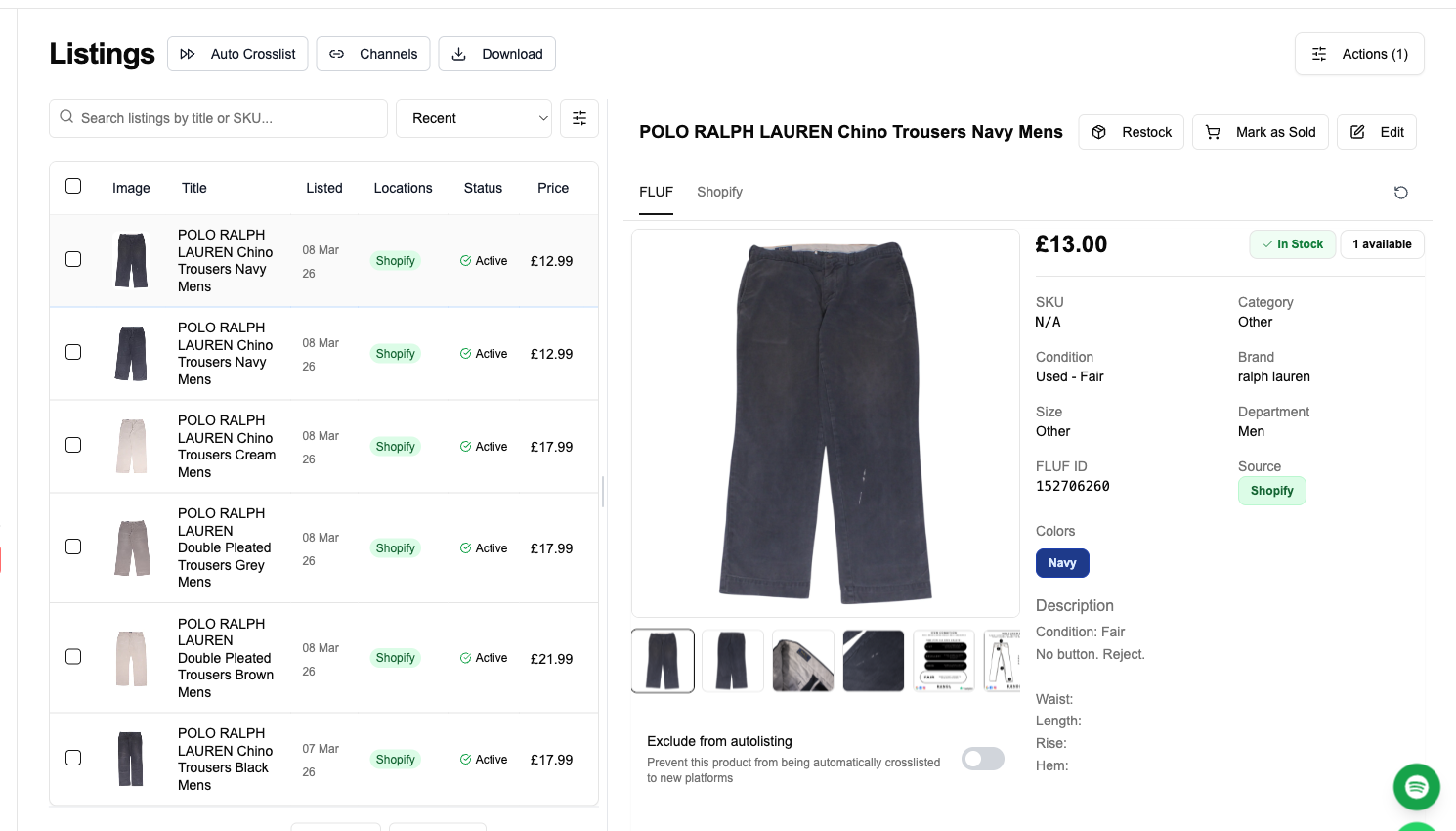
FLUF Connect runs both from one dashboard:
- Connect your Vestiaire Collective and Grailed accounts. Authorise both once; FLUF reads your live Vestiaire listings.
- Choose what to crosslist. Send Grailed the menswear, streetwear, archive and designer pieces its audience wants, and keep the rest on Vestiaire.
- Publish to both. FLUF carries photos, titles, descriptions, sizes, brands and prices across and creates the Grailed listings.
- Sell once, sold everywhere. When a piece sells on either platform, FLUF marks it sold on the other so the same authenticated item is never sold twice.
Because luxury resale is overwhelmingly one-of-a-kind, that sold-status sync is essential rather than nice-to-have: a single authenticated piece listed on two marketplaces must come down everywhere the instant it sells, or you risk failing a sale and damaging your standing. FLUF handles that automatically, and it is included in every plan, not a paid add-on.
The photography and detail you already have
One of the quiet advantages of this direction is that you have already done Grailed’s homework. Grailed holds a quality bar — clear, well-lit photos from multiple angles showing detail and any flaws, accurate brand and condition information, and a curation process that rejects items failing its standards or authentication (Grailed listing guidance). Those are essentially the same standards Vestiaire enforces, so the photos and descriptions you prepared for Vestiaire are usually exactly what Grailed wants. FLUF carries that work across, which means clearing Grailed’s bar costs you almost nothing — the authenticated, well-documented listings you built for one premium marketplace travel straight to the other.
Grailed’s fees for a luxury seller
Grailed’s costs are simple and sit comfortably against luxury price points. There is no listing fee; on a sale, Grailed takes a commission of 9% on items of $120 and above (6%, minimum $1.99, under $120), plus payment processing of around 3.49% + $0.49 for domestic US sales. For luxury and designer pieces — almost all well above the $120 threshold — that is a straightforward 9%-plus-processing on items that command high prices, paid only when the item sells. Against the value of reaching the largest market for designer and streetwear resale, it is an efficient cost, and because there is no charge to list, testing which of your Vestiaire pieces resonate on Grailed costs nothing but the listing effort FLUF removes.
Geography and the US opportunity
The single biggest thing Grailed adds to a Vestiaire seller’s reach is the United States. Vestiaire is European-founded and European-centred, with much of its trade happening locally within markets; the US is a meaningful but secondary slice of its business. Grailed is the opposite — it is where American buyers go for designer and streetwear resale, and its US concentration makes it one of the most efficient ways to reach that market without building US-specific selling from scratch. For a European luxury seller, crosslisting to Grailed is effectively a route into American demand for the menswear and archive pieces that travel best, using listings you have already made. You are not entering a new market by trial and error; you are extending an existing, authenticated catalogue into the marketplace where the buyers you are missing already gather.
For a European seller, the practical reality of reaching American buyers is mostly a shipping question, and for luxury it is an easy one. Designer pieces are typically small, high-value and very postable, so the economics of sending a Saint Laurent jacket or an archive piece from Europe to a US collector work comfortably — the item’s value dwarfs the postage, and a buyer paying a strong Grailed price expects to cover international shipping on something rare. That is a different calculus from bulky or low-value goods, where cross-border postage kills the deal; here it barely registers. So the geographic leap that looks daunting in the abstract — selling from Europe into the US market — is, for authenticated luxury and archive fashion, simply listing the pieces and posting the ones that sell. The audience is the hard part, and Grailed already assembled it.
Pricing the same piece for two different markets
A piece can be worth genuinely different amounts on Vestiaire and on Grailed, and a seller who crosslists well takes advantage of that rather than copying one price across. Vestiaire’s women’s-luxury, European audience values certain pieces — classic designer handbags, women’s runway, European house staples — at prices its buyers understand. Grailed’s menswear-and-archive, US audience values a partly different set — archive menswear, streetwear collaborations, hyped grails — and will often pay more for those than a women’s-luxury crowd would. The smart approach is to let FLUF carry your Vestiaire price as a starting point and then set each Grailed listing to its own market: hold or raise the price on menswear and archive pieces that are Grailed’s heartland, and keep the women’s luxury anchored to wherever it sells best. Because neither platform charges to list, you can leave a piece priced to its strongest market on each side and let whichever buyer values it most come through first. Crosslisting is not about one price everywhere; it is about meeting two markets each at their own number.
Authentication: the trust your prices are built on
Both platforms exist because buyers trust them not to sell fakes, and that trust is what lets strangers pay luxury prices online. Vestiaire built its reputation on authentication; Grailed runs its own curation and authentication process to keep counterfeits out (Grailed’s authentication and legitimacy). For a genuine luxury seller this shared rigour is pure upside: your authentic pieces clear both bars, and you sell into two marketplaces whose buyers are willing to pay full value precisely because the platforms police authenticity. It also means the standard you already hold yourself to on Vestiaire — honest condition notes, accurate brand details, real photos — is exactly the standard that earns trust and strong prices on Grailed. There is no new discipline to learn, only a second audience that rewards the one you already have.
What to expect listing luxury on Grailed
Luxury and archive pieces tend to sell to a specific buyer rather than the first passer-by, and that shapes the rhythm. Some pieces move quickly to a collector who has been searching for exactly that item; others sit a while until the right person finds them. Grailed’s no-listing-fee model makes the wait costless — a piece can stay live indefinitely at a fair price — and the crosslisting setup means it waits on Grailed while still being available to your Vestiaire audience, with FLUF removing it everywhere the moment it sells on either. Over time you will see which parts of your catalogue resonate with Grailed’s US menswear-and-archive buyers and which remain Vestiaire’s domain, and you can lean the crosslisting toward what works. The model rewards patience without punishing it, which is exactly the right fit for inventory whose value is real but whose perfect buyer is specific.
Keeping Vestiaire as your home base
None of this means leaving Vestiaire — it means widening from it. Vestiaire remains the right home for women’s luxury and for the European, often local-to-local sales it does best, and you keep selling there exactly as before. Grailed becomes the additional channel for the menswear, streetwear and archive inventory whose natural audience sits elsewhere. Run together, the two cover far more of the luxury resale market than either does alone: women’s-luxury Europe on Vestiaire, menswear-and-archive US on Grailed, with the same authenticated pieces working both sides. FLUF keeping stock in sync is what makes running both safe and effortless rather than a manual juggling act.
Who this is for
This suits established Vestiaire Collective sellers with luxury and designer inventory that leans menswear, archive or streetwear — the pieces whose buyers concentrate on Grailed rather than on a women’s-luxury European platform. If your catalogue is entirely women’s luxury selling well locally on Vestiaire, the gain is smaller. But if you hold menswear, designer archive or collectible pieces that deserve the largest, most brand-literate US audience, crosslisting from Vestiaire Collective to Grailed reaches it — and FLUF Connect turns running both authenticated marketplaces into a single, synced workflow.
It is worth being clear about why this is not something every Vestiaire seller already does, because the barrier has never been the idea — it has been the labour. Maintaining the same authenticated pieces across two curated platforms by hand, and pulling a one-off the instant it sells on either, is fiddly enough that most sellers stick to the marketplace they started on and quietly accept the missed audience. Crosslisting collapses that labour to a setting. You keep one catalogue, choose which pieces belong on Grailed, and let FLUF create the second listing and keep sold-status in sync, so a piece that sells on Vestiaire vanishes from Grailed automatically and vice versa. The work that made running both feel not-worth-it disappears, and what is left is simply a wider audience for inventory you have already prepared to a luxury standard. For a seller sitting on menswear or archive that a women’s-luxury European platform was never going to value fully, that is the whole case: the same pieces, a second market, and none of the manual overhead that used to make it more trouble than it was worth.
Sources & Verification
- Grailed audience & US traffic skew: Similarweb — grailed.com.
- Grailed top-selling brands (2025): WWD / Footwear News — Grailed marketplace report.
- Grailed seller fees: Grailed — What are the fees.
- Grailed listing standards: Grailed — Listing FAQ.
Frequently Asked Questions
They are both curated, authentication-led luxury marketplaces but reach different buyers. Vestiaire skews women's luxury and a European, local-to-local market; Grailed skews menswear, streetwear and archive with a US-heavy audience. Crosslisting puts your authenticated menswear and archive pieces in front of the Grailed buyers Vestiaire under-serves, using listings you already made.
Menswear, designer archive, streetwear and collectible pieces — the labels Grailed buyers actively hunt, many of which overlap exactly with Vestiaire's luxury houses. Women's luxury that already performs locally on Vestiaire can stay there; send Grailed the inventory whose audience is concentrated on its platform.
Yes. Luxury resale is almost entirely one-of-a-kind, so FLUF Connect marks an item sold on one marketplace when it sells on the other, automatically removing it everywhere. This prevents the failed sale and reputation damage of selling a single authenticated piece twice, and is included in every plan.
Usually not. Grailed's standards — clear multi-angle photos, accurate brand and condition details — are essentially what Vestiaire Collective already requires, so the listings you prepared for Vestiaire typically clear Grailed's bar. FLUF carries your existing photos and details across when it creates the Grailed listings.
Grailed has no listing fee. On a sale it takes 9% commission on items of $120 and above (6%, minimum $1.99, under $120), plus payment processing of around 3.49% + $0.49 for domestic US sales. For luxury pieces above the threshold, that is a simple commission paid only when the item sells.
FLUF Connect plans start at £9/month on Starter, with Pro at £29/month and custom Super Seller plans above that; every plan is unlimited on listings and marketplaces, and the tiers differ by which automations they include and how often we check your channels for sales. Crosslisting and the sold-status sync are included in every plan, not charged separately.