
Vinted vs Shopify: Which Is Better for Sellers in 2026?
A side-by-side comparison of costs, audience, features, and what real sellers think — plus how to sell on both automatically.



- Choose Vinted if: you want to sell second-hand items to 100 million+ members across Europe without paying a single penny in fees. Vinted is a marketplace — list your items and buyers find you through search and recommendations.
- Choose Shopify if: you want to build your own brand, own your customer relationships, and control every aspect of your store — from design to checkout to email marketing. Shopify is a platform — you build the store and drive the traffic yourself.
- Fees: Vinted charges sellers absolutely nothing — zero listing fees, zero commission, zero payment processing. Shopify charges £19–259/month subscription plus 2% + 25p payment processing per sale.
- Traffic: This is the critical difference. Vinted has 100 million+ registered members actively browsing. Shopify has zero — every visitor to your store must come from your own marketing efforts.
- Best strategy: Use both — sell on Vinted for free exposure to millions of European buyers, build a Shopify store for long-term brand equity. FLUF Connect syncs both automatically.
Vinted vs Shopify at a Glance
Vinted and Shopify are fundamentally different types of selling platforms. Vinted is a marketplace — it has over 100 million registered members who browse and search for second-hand items. Shopify is a platform — it gives you the tools to build your own online store, but brings zero buyers. You drive all the traffic yourself.
Think of it like this: Vinted is a stall in Europe’s busiest second-hand market where millions of shoppers browse every day — and the stall is completely free. Shopify is your own boutique on a quiet street — beautifully designed, fully yours, but you need to advertise to get anyone through the door and pay rent every month.
Vinted was founded in 2008 in Vilnius, Lithuania, by Milda Mitkutė and Justas Janauskas. It has grown into Europe’s largest second-hand marketplace, surpassing €10 billion in GMV in 2025 with revenue of over €800 million. Vinted operates in 26 countries across Europe and has begun expanding into the US. Its defining feature for sellers is zero fees — sellers keep 100% of the sale price, with all transaction costs paid by the buyer.
Shopify was founded in 2006 in Ottawa, Canada, and is now one of the world’s largest e-commerce platforms. Over 5.5 million stores run on Shopify across 175+ countries, collectively generating $292 billion in GMV in 2024. Shopify powers everything from one-person vintage shops to global brands like Gymshark and Allbirds.
| Vinted | Shopify | |
|---|---|---|
| Type | Marketplace (built-in buyers) | E-commerce platform (build your own store) |
| Founded | 2008 | 2006 |
| Headquarters | Vilnius, Lithuania | Ottawa, Canada |
| Registered members / stores | 100 million+ members | 5.5 million+ stores (no buyer count — each store has its own audience) |
| Markets | 26 countries (Europe + limited US) | 175+ countries |
| Built-in traffic | Yes — browse, search, personalised feed | No — seller drives all traffic |
| Best for | Second-hand fashion, home, electronics, sports | Any product — new, used, digital, services |
| Seller fees | Zero — no listing fees, no commission, no processing fees | Subscription: £19–259/month. Processing: 2% + 25p (Basic) |
| Brand control | Minimal — profile page within Vinted | Complete — your own domain, design, branding |
| Customer data ownership | No — Vinted owns the buyer relationship | Yes — full customer data, email lists, analytics |
For a deeper look at each platform individually, see our full guides: How to Sell on Vinted and How to Sell on Shopify.
Vinted vs Shopify: Feature-by-Feature Comparison
Vinted gives you marketplace infrastructure — search, discovery, payments, shipping, and buyer protection — completely free, in exchange for operating within its ecosystem. Shopify gives you complete control over every aspect of your business — but you build and pay for everything yourself.
| Feature | Vinted | Shopify |
|---|---|---|
| Product discovery | Built-in — search, personalised feed, categories | None — you must drive traffic via SEO, social media, ads |
| Shop branding | Minimal — profile photo, bio, ratings | Complete — custom domain, themes, logos, branded checkout |
| Customer data | No access to buyer emails or data | Full ownership — email lists, purchase history, analytics |
| Email marketing | Not available | Built-in (Shopify Email) + integrations (Klaviyo, Mailchimp) |
| Payment processing | Vinted handles everything — seller receives full amount | Shopify Payments or 100+ third-party gateways |
| Offer/haggle system | Yes — Make an Offer + bundle discounts | No (unless you add an app) |
| Social features | Follows, favourites, reviews, community forums | None built-in — integrate with Instagram, TikTok, etc. |
| SEO control | Limited — titles, descriptions, categories | Full — meta titles, descriptions, URLs, blog, sitemap |
| Product variations | No — one item per listing | Yes — sizes, colours, materials per product |
| Digital products | No | Yes — downloads, courses, subscriptions |
| Discount codes | No built-in tools | Yes — automatic discounts, codes, bundles, free shipping thresholds |
| Shipping integration | Vinted Shipping (Evri, InPost, Royal Mail, DPD, Yodel UK) | Shopify Shipping (Royal Mail, DPD, Evri, UPS, FedEx, and more) |
| Analytics | Basic — views, favourites | Advanced — traffic sources, conversion rates, customer lifetime value |
| Business accounts | Yes — Vinted Pro (zero fees, mandatory 14-day returns) | All plans are business-grade |
| Third-party apps | None | 8,000+ apps in Shopify App Store |
The trade-off is clear: Vinted gives you buyers for free. Shopify gives you a business you own. Vinted handles discovery, payments, and shipping — but you are a seller within their ecosystem, not a brand. Shopify lets you build a real brand with customer relationships, email marketing, and full analytics — but every single customer must be acquired through your own efforts.
Listing and Store Experience: Vinted vs Shopify
Listing on Vinted takes under a minute. Building a Shopify store takes days to weeks. But that comparison is not quite fair — they are solving different problems.
On Vinted, you list individual items for a marketplace audience. Photograph your item, select a category, write a description, set a price. Vinted even suggests shipping options and handles labels automatically. The listing goes live to millions of potential buyers immediately. No design work, no domain setup, no marketing strategy needed. For someone clearing out their wardrobe or selling a few vintage finds, this is perfect.
On Shopify, you build an entire online store. Choose a theme, customise your design, set up your domain, create product pages, configure shipping rates, write an About page, set up payment processing, and plan how you will drive traffic. The initial setup is significantly more work — but the result is a professional online shop that you fully own and control. For someone building a vintage clothing brand or a curated resale business, this is essential.
Ongoing effort also differs dramatically:
- Vinted rewards freshness and activity — listing new items, bumping older listings, responding to messages quickly, and pricing competitively. The algorithm favours active sellers. Stop listing for a week and your visibility drops.
- Shopify rewards marketing investment — SEO, social media content, email campaigns, paid advertising. Your store stays visible regardless of listing frequency, but traffic dries up if you stop marketing.
The sweet spot for most growing sellers: list on Vinted for immediate free sales while building a Shopify store for long-term brand value. FLUF Connect keeps products in sync across both.
Fees and Costs: How Much Do Vinted and Shopify Actually Cost?
This is where Vinted and Shopify differ most dramatically. Vinted is genuinely free for sellers — not “free with catches,” but zero fees of any kind. Shopify charges a monthly subscription whether you sell or not, plus payment processing on every transaction. Which is better depends entirely on your business model and volume.
Vinted Fees (UK)
Sellers pay nothing. No listing fees, no commission, no payment processing fees. You list an item for £25, it sells for £25, you receive £25. This has been the case since Vinted removed seller fees in 2023.
The buyer pays a Buyer Protection fee of 3–8% plus £0.30–0.80 (varies by item and order value), plus shipping. This is invisible to the seller but affects what buyers see at checkout — a £25 item might cost a buyer £28–30 after fees and postage.
Optional paid features: Item Bump (£0.75–3.00 to boost visibility) and Wardrobe Spotlight (paid promotion). Both are optional.
Source: Vinted UK Price List
Shopify Costs (UK)
Shopify charges a monthly subscription plus payment processing per sale:
| Plan | Monthly Cost | Card Rate (Shopify Payments) | Third-Party Gateway Surcharge |
|---|---|---|---|
| Basic | £19/month (annual) / £24 monthly | 2% + 25p | 2% |
| Shopify (Grow) | £49/month (annual) / £69 monthly | 1.7% + 25p | 1% |
| Advanced | £259/month (annual) / £349 monthly | 1.5% + 25p | 0.6% |
| Plus | From $2,300/month | Custom rates | Custom |
Source: Shopify UK Pricing
| Fee Type | Vinted (UK) | Shopify Basic (UK) |
|---|---|---|
| Monthly subscription | £0 | £19/month (annual billing) |
| Listing fee | Free — unlimited | Free — unlimited |
| Commission / transaction fee | Zero | Zero |
| Payment processing | Zero (buyer pays all fees) | 2% + 25p (Shopify Payments) |
| Promoted listings | Item Bump: £0.75–3.00 (optional) | N/A (run your own ads externally) |
- Vinted: Zero fees = You keep £25.00
- Shopify Basic: Processing £0.75 (2% + 25p) = You keep £24.25 (plus £19/month subscription)
- 10 sales/month: Vinted = £0 total fees. Shopify Basic = £26.50 (£19 sub + £7.50 processing). Vinted is far cheaper.
- 50 sales/month: Vinted = £0 total fees. Shopify Basic = £56.50 (£19 sub + £37.50 processing). Vinted is still free.
- 200 sales/month: Vinted = £0 total fees. Shopify Basic = £169 (£19 sub + £150 processing). Vinted is still free.
On a pure fee basis, Vinted wins at every volume level. There is no break-even point — Vinted is always cheaper because it charges sellers nothing. But this comparison misses two critical factors.
First: buyer-side fees affect your pricing. Vinted buyers pay 3–8% plus a fixed fee on top of your listing price, plus shipping. A £25 item might cost a buyer £29–31 at checkout. This means you may need to price lower on Vinted to stay competitive — effectively sharing the cost burden indirectly. On Shopify, you control the entire checkout experience and can absorb processing fees into your pricing transparently.
Second: traffic costs on Shopify are the real expense. On Vinted, 100 million+ members are already browsing. Your listing is discoverable immediately at zero cost. On Shopify, every visitor must be earned through paid ads, social media, SEO, or email marketing — all of which cost time and money that dwarfs the subscription fee. For many Shopify sellers, monthly ad spend is 5–10x the subscription cost.
Payout Comparison
| Vinted | Shopify | |
|---|---|---|
| Payout method | Bank transfer (via Vinted Wallet) | Bank transfer (Shopify Payments) |
| Payout schedule | 2 days after buyer confirms receipt, then 2–5 days to bank | Daily, weekly, or monthly (you choose). Typically 2–5 business days |
| New seller holds | Auto-confirms 2 days after delivery if buyer does not respond | May hold funds for new stores (varies) |
| Vinted Pro note | Up to 14 days for Pro accounts | N/A |
| Minimum payout | No minimum | No minimum |
Shopify pays faster and more predictably for established sellers. You can set up daily payouts from day one. Vinted’s timeline depends on the buyer confirming receipt, which adds variability. For detailed cost breakdowns, see our full guides on selling on Vinted and selling on Shopify.
Audience and Traffic: The Critical Difference
This is the single most important difference between Vinted and Shopify — and the one that should drive your decision. Vinted brings you buyers. Shopify does not.
On Vinted, over 100 million registered members are already browsing. They are searching for specific brands, scrolling personalised feeds, and browsing categories across 26 European markets. Your listing appears in their search results the moment you publish it. You do not need a marketing budget, a social media following, or SEO knowledge. The marketplace does the work of connecting buyers with your items — and it costs you nothing.
On Shopify, your store launches to an audience of zero. You can build the most beautiful vintage clothing store on the internet, but nobody will visit unless you actively drive traffic. That means investing in at least one (ideally several) of:
- Social media — Instagram, TikTok, Pinterest (hours per week of content creation)
- Paid advertising — Meta Ads, Google Ads, TikTok Ads (£5–50+/day)
- SEO — blog content, product descriptions, technical optimisation (months to see results)
- Email marketing — building a subscriber list and sending campaigns (ongoing effort)
- Influencer partnerships — gifting or paying for promotion (variable cost)
| Vinted | Shopify | |
|---|---|---|
| Built-in buyers | 100M+ registered members across 26 markets | Zero — you bring every visitor |
| Customer acquisition cost | £0 (marketplace handles discovery) | £10–30+ per purchase (via ads) |
| Time to first sale | Hours to days (if priced well) | Weeks to months (after store build + marketing) |
| Buyer demographics | Broad — all ages, second-hand focused, heavily European | Whoever your marketing targets |
| Geographic strength | Europe (France, Germany, UK, Netherlands, Italy, Poland) | Global — 175+ countries |
| Customer ownership | No — Vinted owns the relationship | Yes — full email lists, purchase data, retargeting |
| Repeat customers | Limited — buyers can follow sellers but discovery is algorithmic | Strong — email marketing, loyalty programmes, retargeting ads |
Vinted’s audience skews European — France is its largest market (Vinted is reportedly the largest clothing retailer by volume in France), followed by Germany, the UK, the Netherlands, and Italy. If your buyers are in Europe, Vinted’s audience is unmatched for second-hand goods. Shopify is global from day one, but you have to find those global customers yourself.
The long-term play: Vinted is faster to start and completely free, but you are always dependent on the algorithm and the platform’s rules. Shopify is slower and more expensive to build, but creates an asset you own — a customer base, a brand, and a store that does not disappear if a marketplace changes its policies. The smartest sellers use Vinted for immediate cash flow while building a Shopify store for long-term value.
Shipping: Vinted vs Shopify
Both platforms offer integrated shipping, but they work very differently. Vinted handles shipping labels automatically and the buyer pays. Shopify gives you deep carrier discounts and full control over shipping strategy.
| Vinted | Shopify | |
|---|---|---|
| Integrated carriers (UK) | Evri, InPost, Royal Mail, DPD, Yodel, AnyVan | Royal Mail, Evri, DPD, UPS, FedEx, and more |
| Who pays shipping | Buyer pays at checkout | Configurable — free, flat-rate, or calculated |
| Discounted rates | Standard Vinted-negotiated rates | Up to 88% off major carrier rates |
| Label generation | Automatic — QR code or printable label | Print from Shopify admin |
| International shipping | Within Vinted’s markets (cross-border EU) | Global — with customs forms and duty calculation |
| Large items | AnyVan for furniture and bulky items | Configurable per product weight/size |
| Fulfilment options | Self-ship only | Self-ship, Shopify Fulfilment Network, third-party 3PLs |
Vinted’s shipping is simpler — the buyer picks a method, pays for it, and you get a label. No decisions to make beyond packaging the item. This is ideal for casual sellers who do not want to think about shipping strategy.
Shopify’s shipping is far more powerful for businesses. Carrier-negotiated discounts of up to 88%, weight-based pricing, shipping zones, free-shipping thresholds, and third-party fulfilment integration. If you are shipping dozens of parcels daily, Shopify’s infrastructure saves real money. For sellers on multiple platforms, FLUF Connect’s inventory sync centralises all orders in Shopify for unified fulfilment — ship from one place, tracking syncs back to every marketplace automatically.
What Real Sellers Say About Vinted vs Shopify
The marketplace-versus-own-store debate is one of the most common discussions among growing resellers. For Vinted sellers specifically, the conversation often centres on whether to stay within the free marketplace or invest in building something you own.
“Vinted is brilliant for clearing stock fast. Zero fees means I keep everything. But I can’t build a brand there — my shop looks identical to every other seller’s, and I have no way to email past buyers or build loyalty.”
— Seller discussion, Mumsnet
“When you sell on a marketplace you don’t own the customer relationship. On your own website you collect email addresses, track customer behaviour, and build a loyal audience.”
— Seller strategy discussion, Bootstrapping Ecommerce
“Every one of our products is a unique piece. Uploading everything manually to both Vinted and Shopify would take too much time — we needed a crosslisting tool to make it work.”
— Vintage shop owner, Shopify Community
Why sellers add Shopify to Vinted
Growing sellers often add a Shopify store when they hit Vinted’s limitations: no email marketing (you cannot re-engage past buyers), no brand control (every seller’s profile looks the same), algorithm dependency (visibility can drop without warning — sellers report suspected “shadow bans”), and platform risk (accounts can be suspended with limited recourse). Shopify solves all of these — but requires significant marketing investment.
Why sellers keep Vinted alongside Shopify
Almost nobody abandons Vinted entirely after starting a Shopify store. Vinted’s zero fees and massive audience are too valuable to give up. Even established Shopify stores use Vinted as a discovery channel — new customers find them on Vinted, and the best sellers convert those buyers into direct Shopify customers over time by including their website URL in packages. It is a funnel, not a replacement.
The Vinted Pro angle
Vinted Pro — available for registered businesses in the UK and across Europe — lets you sell at scale with unlimited listings and a “Pro” badge. You still pay zero seller fees, which is remarkable compared to other marketplace business accounts. However, Pro accounts must accept mandatory 14-day returns and may wait up to 14 days for payment (versus ~2 days for personal accounts). Bank verification has also been problematic for some sellers. Despite these friction points, the zero-fee model makes Vinted Pro attractive for volume resellers.
How to Choose Between Vinted and Shopify
The choice between Vinted and Shopify is not really “which one” — it is “which one first” and “when do I add the other.” Here is a framework based on where you are in your selling journey.
- Want to start selling immediately with zero cost
- Sell second-hand items — fashion, home, electronics, sports gear
- Do not have a social media following or marketing budget
- Want access to millions of European buyers without any effort
- Prefer a simple, mobile-first listing experience
- Are ready to build a brand — not just sell individual items
- Want to own your customer relationships and email lists
- Have a marketing strategy (social media, SEO, ads) to drive traffic
- Sell new or handmade items alongside second-hand goods
- Need advanced features: discount codes, analytics, wholesale, subscriptions
For casual sellers clearing a wardrobe or selling part-time: Vinted alone. The zero cost and massive audience mean you can start earning immediately. A Shopify store would be an unnecessary expense.
For growing sellers doing 50+ sales per month: Consider adding Shopify. At this volume, you start building the brand equity and customer data that enable long-term growth — even though Vinted’s fees never become a problem.
For brands and businesses: Shopify is your home base. Vinted (plus Depop, eBay, and other marketplaces) are your sales channels. FLUF Connect keeps everything in sync from one dashboard.
Why Not Both? Use Vinted and Shopify Together
The most successful resellers and fashion businesses do not choose between Vinted and Shopify — they use them together as complementary parts of the same strategy. Vinted is the free discovery channel that brings new customers. Shopify is the brand home where those customers become repeat buyers.
Here is how the strategy works in practice:
- List on Vinted for free exposure to 100 million+ members across Europe
- Build a Shopify store as your branded home base
- Use FLUF Connect to sync inventory between both — plus Depop, eBay, and Facebook Marketplace
- Convert Vinted buyers to direct Shopify customers over time (include your URL in packages, build an email list)
- Centralise fulfilment — all marketplace orders flow into Shopify for unified shipping
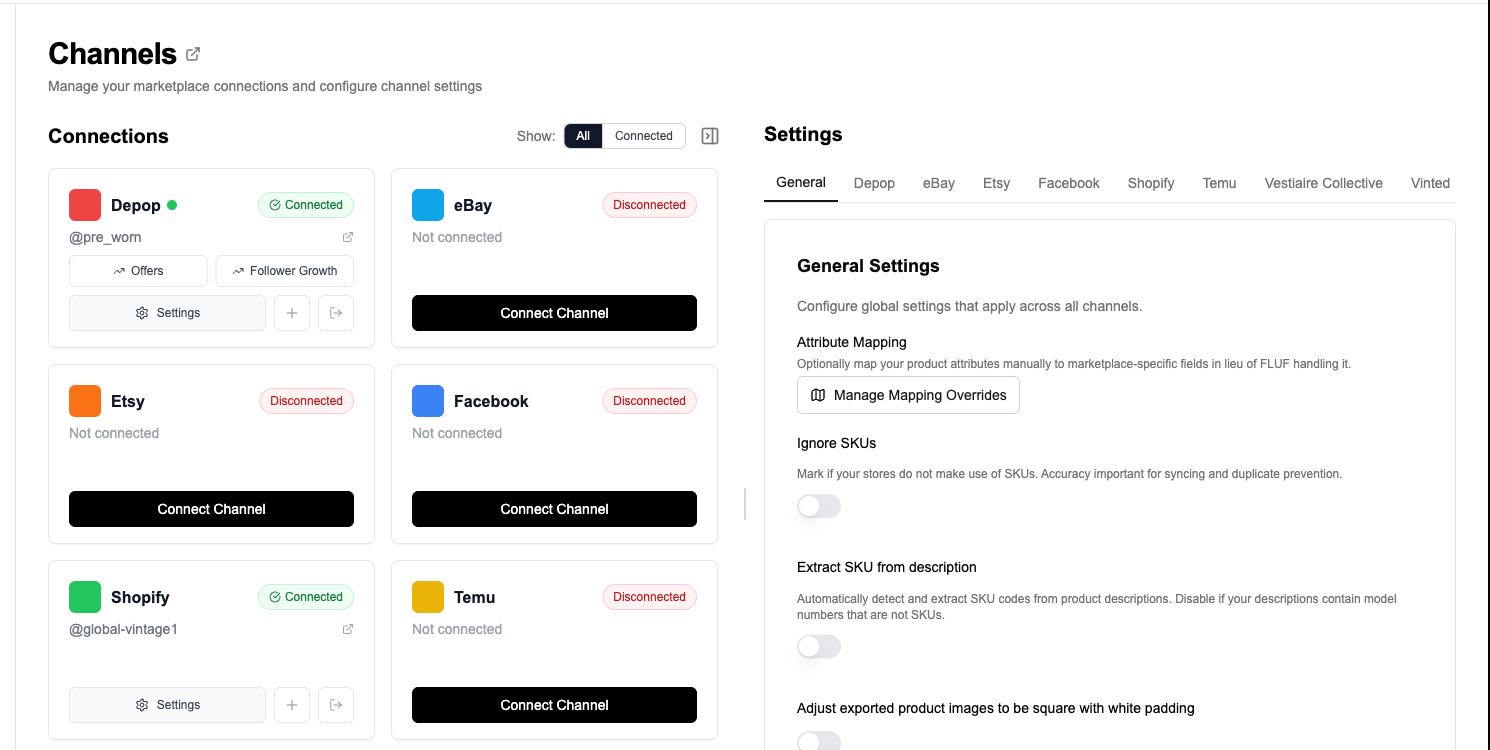
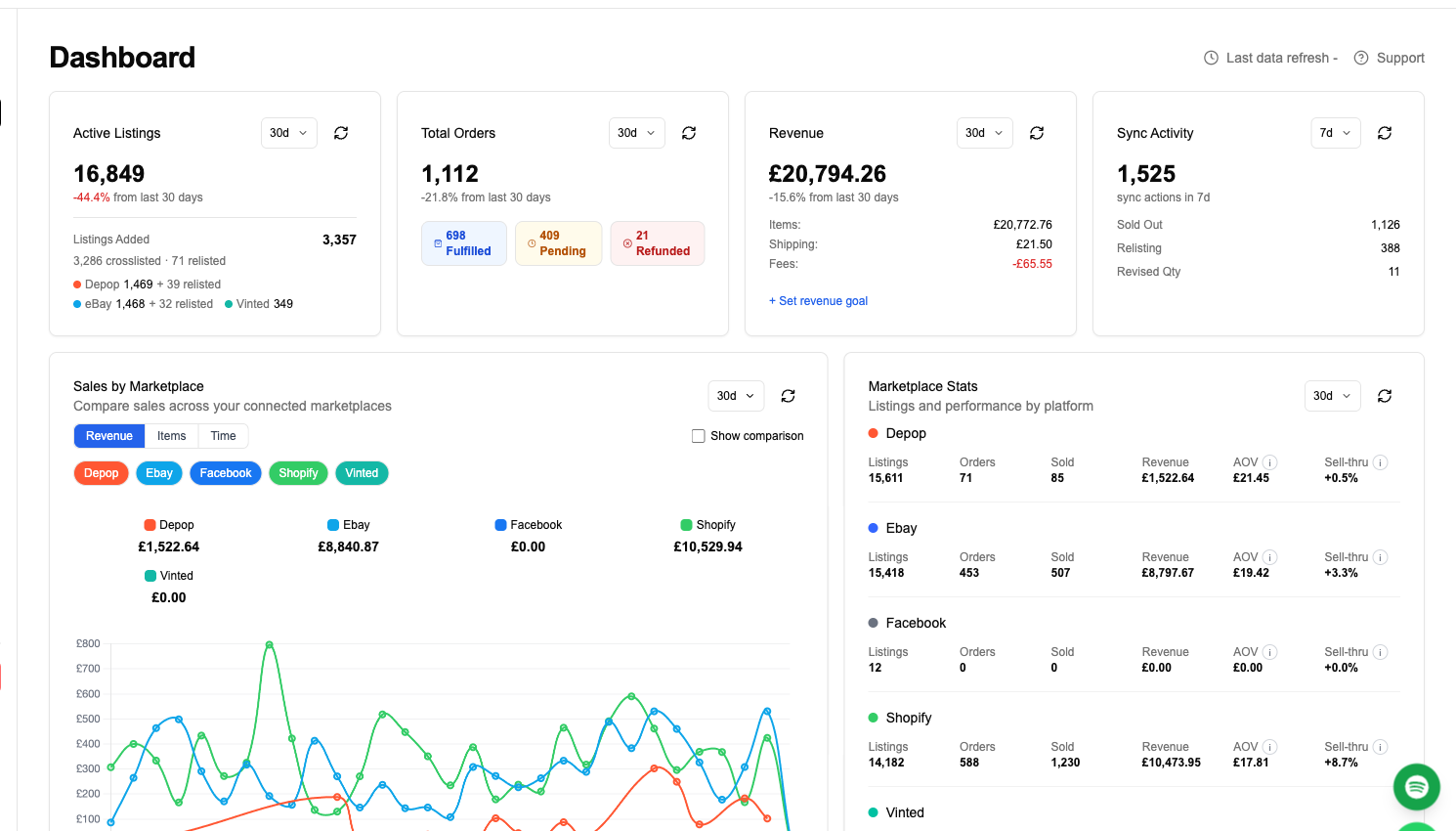
This is exactly what FLUF Connect was built for. Shopify sits at the centre as your product catalogue and order hub. Every marketplace — Vinted, Depop, eBay, Facebook — syncs with Shopify automatically. When a jacket sells on Vinted, the order appears in Shopify, inventory updates everywhere, and you ship from one place.
| FLUF Connect Feature | Vinted | Shopify |
|---|---|---|
| Crosslisting | Yes | Yes (product catalogue source) |
| Inventory sync | Yes | Yes (native integration) |
| Auto-relisting | Yes | N/A (not a marketplace) |
| Offer management | Yes | N/A |
| Order sync | Yes | Native — all orders centralised |
| Bulk operations | Yes | Yes |
Shopify is FLUF Connect’s anchor channel — the hub that connects to every marketplace. Vinted gets full automation: crosslisting, auto-relisting, offer management, and inventory sync — all included on every plan. Competitors like List Perfectly and Vendoo charge extra for these features.
Starts at £9/month.
Frequently Asked Questions
Vinted is better for selling second-hand clothing quickly — its 100 million members are actively searching for pre-loved fashion, and you pay zero seller fees. Shopify is better if you are building a clothing brand with your own designs, want full control over your store, and plan to invest in marketing. Many clothing sellers use both: Vinted for high-volume second-hand sales and Shopify as their branded home base, syncing inventory automatically with FLUF Connect.
Vinted has the lowest possible fees for sellers: zero. No listing fees, no commission, no payment processing fees — you keep 100% of the sale price. Shopify Basic costs £19/month plus 2% + 25p per transaction. On a £25 sale, you keep £25.00 on Vinted versus £24.25 on Shopify — plus you pay Shopify's monthly subscription. The trade-off is that Vinted buyers pay a Buyer Protection fee (3–8% + 30p–80p) which can make your items appear more expensive at checkout.
Yes, and it is an increasingly popular strategy. Vinted gives you free access to over 100 million potential buyers across Europe. Shopify lets you build a branded store you fully own. The challenge is managing inventory across both — FLUF Connect automates this with real-time inventory sync, crosslisting, and automatic removal when items sell.
Vinted is far easier for beginners. Download the app, photograph your item, write a description, and list it — completely free, with instant access to millions of buyers. Shopify requires setting up a store, choosing a theme, configuring payment processing, setting shipping rules, and building a marketing strategy before you make a single sale. Shopify is powerful, but it has a much steeper learning curve.
Vinted has over 100 million registered members across 26 European markets and growing US presence — all browsing within the app. Shopify has no shared buyer pool at all. Each Shopify store is independent and every visitor must be earned through the seller's own marketing. If you want built-in traffic, Vinted is the clear winner. If you want to build your own audience that you fully control, Shopify wins.
Yes. FLUF Connect lets you crosslist products between Vinted and Shopify (and seven other marketplaces) automatically. List on one platform, crosslist to the other in a few clicks, and inventory syncs in real time so you never oversell. Vinted gets full automation including auto-relisting and offer management — both included from Seller upwards.
Not necessarily. If you are casually selling second-hand items, Vinted alone is excellent — zero fees and a massive audience. But if you are scaling into a business, Shopify adds capabilities Vinted cannot offer: customer data ownership, email marketing, branded packaging, discount codes, and analytics. Many growing sellers start on Vinted and add Shopify once they are ready to build a brand.
Shopify pays faster for established sellers — funds are typically available within 2–5 business days, with daily payout options. On Vinted, funds move to your balance 2 days after the buyer confirms receipt (or auto-confirms), then bank withdrawals take 2–5 additional working days. Vinted Pro accounts may wait up to 14 days.
No — Vinted has expanded well beyond fashion. You can now sell electronics (cameras, phones, laptops, gaming consoles), home and kitchenware, furniture, sports equipment, books, beauty products (new and sealed), and children's items. Fashion is still the core category, but Vinted is becoming a general second-hand marketplace.