
Crosslist from Wix to Shopify — Automatically | FLUF Connect
Move your Wix catalogue onto Shopify in minutes — prices, images, variants and SKUs transfer automatically, and one shared inventory keeps both stores in sync.
7 days for £1, then from £9/month.



- Wix: a website builder and store platform used across more than 272 million sites; the entry-level way to put a shop online, with selling unlocked on its Core plan and up.
- Shopify: a dedicated commerce platform that processed $292.28 billion in GMV in 2024; built for scaling, marketplace expansion, wholesale, POS and international selling.
- Fields that transfer automatically: title, description, images, price, SKU, inventory quantity, variants/options, weight and brand (vendor).
- Inventory sync: when a product sells on Wix it is marked out of stock on Shopify within minutes, and vice versa — the same one stock count drives both stores plus every other connected channel.
- Order sync: FLUF Connect pulls orders from both Wix and Shopify. Relisting and offer management do not apply to either store platform.
- Cost: FLUF Connect plans start at £9/month (Starter). Every plan includes crosslisting, inventory sync and bulk operations across all supported channels. There is no free plan, but every new account gets a 7-day trial for £1.
Running a shop on Wix and want the products on Shopify too — without rebuilding every listing by hand? FLUF Connect reads your Wix catalogue, maps each product to Shopify’s structure, uploads the images, and keeps one shared inventory count in sync between the two stores. When something sells on either side, the other is updated automatically. This page explains exactly what transfers, what stays in sync, and how the whole flow works.
Why Sell on Both Wix and Shopify?
Adding Shopify alongside your Wix store puts your catalogue on the platform built specifically for scaling a commerce business — a larger app ecosystem, native marketplace and social channel connections, built-in POS, wholesale and international tooling — while your existing Wix site keeps doing what it already does well. Selling from both means you are not forced to migrate and lose your Wix site’s SEO history, content and design; you simply extend the same inventory onto a second, commerce-first storefront.
Wix and Shopify suit different stages. Wix is a general website builder: it is fast to launch, strong for content-led and service businesses, and it turns into a store once you reach its Core plan or higher. Shopify is a purpose-built commerce platform — it is what many sellers graduate to when product count, order volume, or the need for deeper reporting, discounts, and third-party apps outgrows a website-builder store. Keeping both live is common during a transition, or permanently when the Wix site is the brand’s marketing home and Shopify is the scaling engine and multichannel hub.
The strategic reason to run Shopify as your second store is reach beyond the store itself. Shopify becomes the central catalogue you push out to marketplaces — eBay, Etsy, Depop, Vinted, Facebook Marketplace and more — and where all of those orders land for unified fulfilment. Starting that catalogue from your Wix products, rather than typing everything twice, is what FLUF Connect handles.
| Wix | Shopify | |
|---|---|---|
| What it is | Website builder with an online-store add-on | Dedicated commerce platform |
| Best for | Content, services and small catalogues; fast DIY launch | Scaling product businesses, multichannel and wholesale |
| Scale signal | 272M+ sites created on the platform | $292.28bn GMV processed in 2024 |
| Entry cost to sell | Core plan required to accept online payments | Basic plan from £9/month billed annually (£25 monthly) |
| Card fees (Wix Payments / Shopify Payments) | ~2.9% + $0.30 payment processing | 2% + 25p on Basic online card rate |
| Third-party gateway surcharge | None beyond processor fee | 2% on Basic (falls to 0.2% on Plus) |
| Listing format | Product pages with options and collections | Product pages with variants, tags and collections |
Wix’s entry point for selling is its Core plan, the first tier that unlocks online payments and a real store, with plans rising to Business and Business Elite. Shopify’s entry commerce plan, Basic, is £19/month billed annually (£25 on monthly billing) and carries a 2% + 25p online card rate through Shopify Payments, with a 2% surcharge if you use a third-party gateway. Those platform fees are separate from FLUF Connect and are worth comparing when you decide how much of your volume to route through each store.
How to Crosslist from Wix to Shopify with FLUF Connect
Crosslisting from Wix to Shopify with FLUF Connect takes five main steps. You connect both stores once, import your Wix catalogue, review the field mapping, select what to publish, and FLUF Connect creates matching Shopify products and keeps stock in sync from then on. There is no manual copy-paste and no spreadsheet to maintain.
- Sign up and log in to FLUF Connect. Create an account and open the dashboard.
- Connect your Wix store. Authorise FLUF Connect to read your Wix products, prices and stock.
- Connect your Shopify store. Link your Shopify store as a destination so FLUF Connect can create products and receive stock updates.
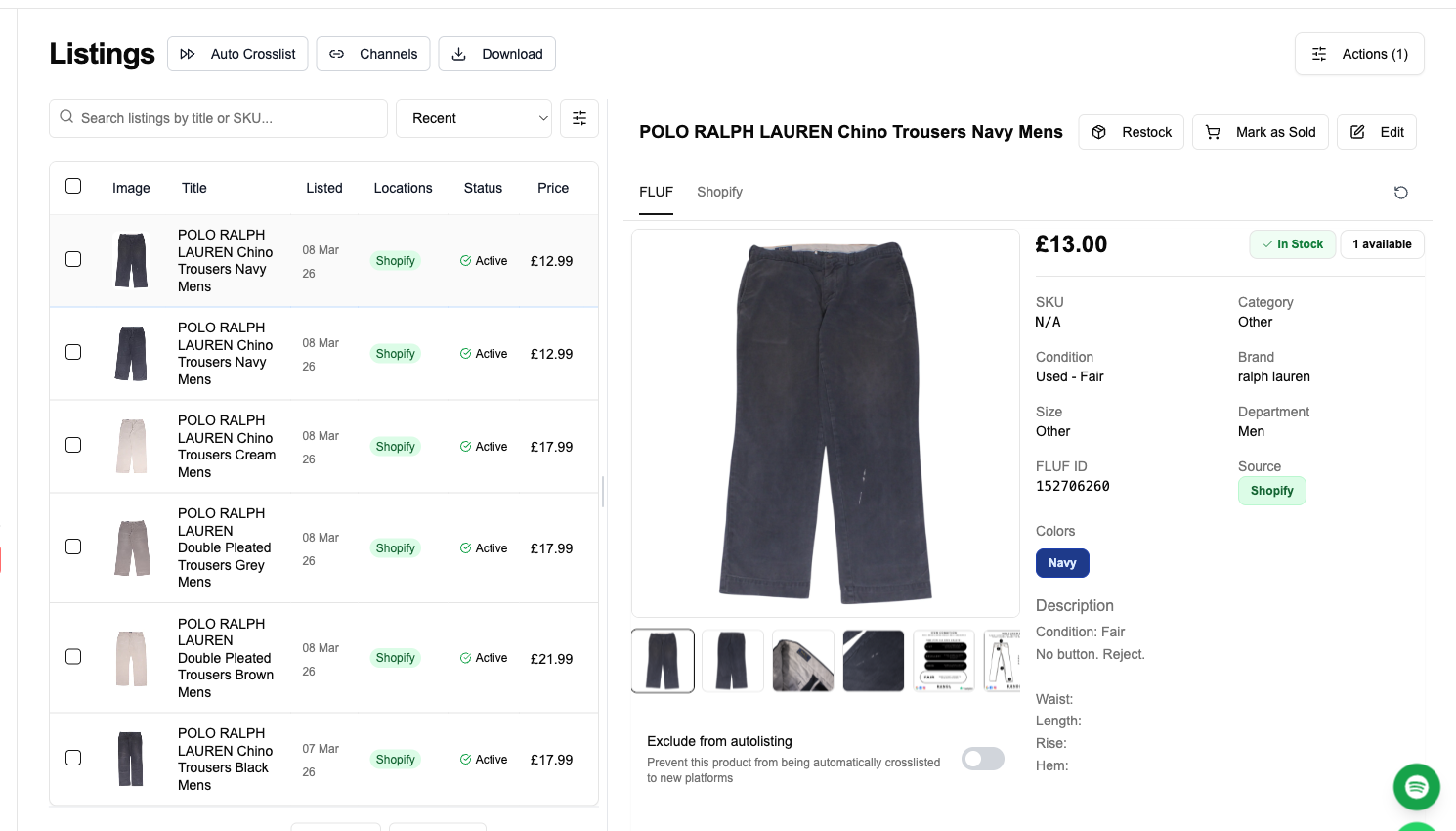
- Import your Wix listings. FLUF Connect pulls your Wix catalogue into a single product list — images, prices, SKUs, variants and descriptions included. Import everything or filter to a subset.
- Review the field mapping. Check how Wix fields line up with Shopify’s structure (title, description, variants, vendor, weight). Set any Shopify-side defaults you want, such as a product type or tags.
- Select products and crosslist. Tick the products to publish, choose Shopify as the destination, and click crosslist. Bulk-select hundreds or thousands at once.
- Products appear on Shopify. FLUF Connect creates the matching Shopify products, uploads the images, and begins syncing inventory. New listings typically appear within minutes.
Behind the scenes, FLUF Connect reads each Wix product, translates it into Shopify’s product and variant format, uploads the image set, publishes the product, and then registers it in your shared inventory so the two stores share one stock count. You do not need to understand any of that to use it — you select products and click once.
You can also set auto-crosslisting rules so new Wix products are pushed to Shopify automatically as you add them, filtered by collection, price or brand — useful when your Wix site is where you first load new stock. And because FLUF Connect treats Shopify as a hub, the same imported catalogue can be crosslisted onward to marketplaces such as Whatnot or Vestiaire Collective in the same flow.
What Transfers When You Crosslist from Wix to Shopify?
Wix and Shopify are both full store platforms, so the field overlap is unusually high — far higher than a marketplace-to-marketplace move. Almost every core commerce field on a Wix product has a direct equivalent on Shopify, which means most listings transfer cleanly with little or no manual input. The table below shows how each field maps.
Field Mapping — Wix to Shopify
| Wix Field | Shopify Field | Transfer Status | Notes |
|---|---|---|---|
| Product name | Title | Automatic | Both allow long titles, so no truncation. |
| Description | Description (body) | Automatic | Rich-text formatting is preserved as HTML. |
| Images | Images | Automatic | Both support large image sets; the full gallery transfers in order. |
| Price | Price | Automatic | Same store currency carries over as-is. |
| Sale / discounted price | Compare-at price | Smart-mapped | A Wix sale price maps to Shopify’s price with the original as compare-at. |
| SKU | SKU | Automatic | Carried across so stock and reporting stay aligned. |
| Inventory quantity | Inventory quantity | Automatic | Becomes the shared stock count that keeps both stores in sync. |
| Product options (size, colour) | Variants / options | Smart-mapped | Wix option sets map to Shopify variant options and combinations. |
| Brand | Vendor | Automatic | Wix brand populates Shopify’s vendor field. |
| Ribbon / category | Product type & tags | Smart-mapped | Wix collections and ribbons map to Shopify product type and tags. |
| Weight | Weight | Automatic | Used for Shopify shipping-rate calculation. |
| Cost of goods | Cost per item | Automatic | Feeds Shopify profit reporting where present. |
| — | Barcode (GTIN/UPC) | Manual | Shopify supports a barcode field Wix products may not carry; set it if you need it. |
| — | Collections (manual) | Manual | Assign to Shopify collections, or use a default; automated collections populate by rule. |
Legend:
- Automatic — transfers directly, no action needed.
- Smart-mapped — FLUF Connect converts between the two platforms’ formats.
- Manual — a Shopify-specific field you can set a default for or fill per listing.
- Not available — the field has no equivalent on the destination.
Category and Collection Mapping Examples
Wix organises products with collections and ribbons; Shopify uses product type, tags and collections. FLUF Connect maps the closest equivalent so your catalogue arrives organised rather than as an undifferentiated list.
| Wix | Shopify | Notes |
|---|---|---|
| Collection: “Women’s Tops” | Product type “Tops” + tag “Women” | Collection name becomes type and tag for filtering. |
| Ribbon: “Sale” | Tag “Sale” + compare-at price | Merchandising label carries as a tag and pricing cue. |
| Collection: “Homeware > Mugs” | Product type “Mugs” + tag “Homeware” | Nested Wix collections flatten to type plus tag. |
Fields That Need Your Attention
Because both are store platforms rather than marketplaces, there is no condition-grade or size-system mismatch to worry about — neither imposes a fixed marketplace taxonomy. The two things worth checking are Shopify’s barcode (GTIN/UPC) field, which Wix products may not carry and which some sales channels connected to Shopify prefer, and Shopify collections, which you may want to assign deliberately or drive with Shopify’s automated collection rules. Neither blocks a successful crosslist; both are quick to set as defaults so every product lands tidy.
Inventory Sync Between Wix and Shopify — What Stays in Sync?
Once a Wix product is crosslisted to Shopify, FLUF Connect treats it as one item with one stock count. Sell it on either store — or on any other connected channel — and the quantity drops everywhere within minutes. This two-way stock sync is the core protection against selling the same unit twice.
| Event | What Happens | Timing |
|---|---|---|
| Item sells on Wix | Marked out of stock / removed on Shopify | Within minutes |
| Item sells on Shopify | Marked out of stock / removed on Wix | Within minutes |
| Stock restocked on either store | Quantity updated on the other | Within minutes |
| Order placed on Wix or Shopify | Pulled into FLUF Connect for unified order management | Regular sync cycle |
| Price changed on Wix | Not automatically pushed to Shopify (edit in FLUF Connect or bulk-edit to update both) | — |
| Description edited on Wix | Not automatically pushed after initial crosslist | — |
| Item deleted on Wix | Left active on Shopify (managed via FLUF Connect) | — |
When an item sells on Wix, FLUF Connect automatically marks it out of stock on Shopify — and on any other connected channel — within minutes. You never have to remember which store a product is still live on, and you will not sell a one-off item twice.
To be clear about what does not sync automatically: FLUF Connect keeps stock quantities in two-way sync, but ongoing price and description edits made directly inside Wix are not pushed to Shopify after the initial crosslist. If you want a price or title change to hit both stores, make it in FLUF Connect (or with a bulk edit) and it applies everywhere at once. This is deliberate — it stops an accidental Wix edit from silently overwriting a Shopify listing you have tuned differently.
Crosslisting from Wix to Shopify: Before and After FLUF Connect
The value is easiest to see by comparing the manual route with the automated one.
Without FLUF Connect (manual)
- Open the Wix dashboard and find the product.
- Copy the product name and description.
- Download each product image.
- Open Shopify admin and create a new product.
- Paste the title and description, fixing any formatting.
- Upload the images one by one.
- Re-enter the price, SKU and cost.
- Rebuild every variant option (size, colour) by hand.
- Set vendor, product type, tags and weight.
- Publish, then note in a spreadsheet that it is now live on both stores.
- When it sells on one store, go to the other and set it out of stock manually.
Time per item: roughly 8–15 minutes, and the overselling risk never goes away.
With FLUF Connect
- Select the products in the FLUF Connect dashboard.
- Choose Shopify as the destination and click crosslist.
- Review — fields are already mapped.
- Confirm. Inventory then syncs automatically both ways.
Time per item: about 30 seconds, dropping close to zero when auto-crosslisting rules handle new stock for you.
Manual: roughly 15–25 hours of copy-paste and image handling. With FLUF Connect: about 50 minutes. That is most of a working week returned to sourcing, photographing and growing — not re-typing listings you already wrote once.
Automation Features for Wix and Shopify Sellers
Both Wix and Shopify are storefront platforms rather than auction- or feed-style marketplaces, so a couple of FLUF Connect features that apply to channels like eBay or Wallapop are not relevant here — specifically, relisting and offer management do not apply to either Wix or Shopify. What you do get is the automation that matters for two connected stores: import, bulk crosslisting, two-way inventory sync, order sync and rules.
Auto-crosslisting rules
Set rules so new Wix products are automatically published to Shopify as you add them — filter by collection, price band or brand so only the right stock flows through. New inventory then appears on both stores with no manual step.
Bulk operations
Crosslist hundreds or thousands of products at once with filters, run find-and-replace across titles and descriptions, and apply bulk price adjustments. Because edits made in FLUF Connect apply across connected stores, a single bulk change updates both Wix and Shopify together. Learn more on the bulk operations page.
Order sync and unified fulfilment
FLUF Connect pulls orders from both Wix and Shopify. With Shopify positioned as your hub, orders from other connected marketplaces can be centralised there too, so you ship from one place. See how the shared stock count works on the inventory sync page.
| Feature | Wix | Shopify |
|---|---|---|
| Crosslisting | Yes | Yes |
| Inventory sync | Yes | Yes |
| Order sync | Yes | Yes (native) |
| Mark-as-sold | Yes | Yes |
| Bulk operations | Yes | Yes |
| Auto-relisting | No | No |
| Offer management | No | No |
How Much Does It Cost to Crosslist from Wix to Shopify?
FLUF Connect plans start at £9/month. Every plan is unlimited; higher plans check your channels for sales more often. Every plan includes crosslisting, inventory sync, order sync and bulk operations across all supported channels — automation is included, not a paid add-on. There is no free plan, but every new account gets a 7-day trial for £1.
| Plan | Monthly | Crosslisted products |
|---|---|---|
| Starter | £9/month | Unlimited |
| Pro | £29/month | Unlimited |
| Super Seller | Custom pricing — tell us what you need | Unlimited |
All plans include crosslisting between every supported channel — not just Wix and Shopify. Connect as many marketplaces as you want and manage them from one dashboard. See the full pricing page for details. Note that Wix and Shopify each charge their own separate platform and payment fees, described in the comparison above.
Looking to go the other way? See Shopify to Wix. You can also crosslist from Wix to eBay or Etsy, read the guide to selling on multiple platforms, or return to the crosslisting hub.
Sources & Verification
- Shopify plan pricing and transaction fees (Basic from £9/month annual; 2% + 25p online card rate; 2% third-party gateway surcharge) — shopify.com/pricing
- Shopify 2024 GMV of $292.28 billion (up 24% year on year) and $8.88 billion full-year revenue — Shopify Q4 & Full Year 2024 results
- Wix plan structure and the requirement for the Core plan (and up) to sell online — wix.com/plans
- Wix eCommerce costs and payment-processing fees (~2.9% + $0.30) — Wix: How much does an eCommerce website cost
- FLUF Connect plans, annual billing and included automation — fluf.io/pricing
- Square vs Shopify — fees by country, the eight-country limit and the catalogue asymmetry that breaks migrations
- Crosslist from PrestaShop to Shopify — what native multistore and daily FX cost to replace
Frequently Asked Questions
FLUF Connect plans start at £9/month on Starter, with Pro at £29/month and custom Super Seller plans above that; every plan is unlimited on listings and marketplaces, and the tiers differ by which automations they include and how often we check your channels for sales. There is no free plan, but every new account gets a 7-day trial for £1. Every plan includes crosslisting, inventory sync, order sync and bulk operations across all supported channels — automation is included, not a paid add-on. Wix and Shopify each charge their own separate platform and payment fees.
Yes. Once a product is crosslisted, FLUF Connect treats it as one item with one stock count. Sell it on Wix, Shopify or any other connected channel and the quantity updates everywhere within minutes, so you never sell the same unit twice.
Yes. When an item sells on Wix, FLUF Connect automatically marks it out of stock on Shopify (and any other connected store or marketplace) within minutes. The same works in reverse when a sale happens on Shopify.
After connecting both stores, crosslisting a product takes about 30 seconds, and new listings usually appear on Shopify within minutes. Bulk crosslisting publishes hundreds or thousands of products at once, and auto-crosslisting rules can push new Wix stock to Shopify with no manual step.
Title, description, images, price, SKU, inventory quantity, product options and variants, brand (as vendor), weight and cost transfer automatically. Because both are full store platforms the overlap is high. Shopify's barcode and collection assignment can be set as defaults or per listing.
Stock quantities sync two-way automatically, but ongoing price and description edits made directly inside Wix are not pushed to Shopify after the initial crosslist. To update both stores at once, make the change in FLUF Connect or use a bulk edit.
No. Relisting and offer management do not apply to Wix or Shopify, as both are storefront platforms rather than auction- or feed-style marketplaces. FLUF Connect does provide crosslisting, two-way inventory sync, order sync and bulk operations for both.
Yes. Every FLUF Connect plan includes crosslisting across all supported channels — Depop, eBay, Etsy, Vinted, Facebook Marketplace, Whatnot, Vestiaire Collective, Wallapop and 20+ more — from the same dashboard. Shopify can act as the hub where all marketplace orders are centralised for fulfilment.
Yes. Crosslisting does not migrate or replace your Wix site — it keeps running with its own design, content and SEO history. FLUF Connect simply extends the same inventory onto Shopify and keeps both stores in sync.
Start Crosslisting Today
Plans from £9/month. Set up in under 10 minutes.