
Depop vs Vestiaire Collective: Which Is Better for Sellers in 2026?
A side-by-side comparison of fees, authentication, audience, shipping, and what real sellers think — plus how to sell on both automatically.



- Choose Depop if: you sell vintage fashion, streetwear, Y2K pieces, or mid-range designer items and want zero commission, a fast-moving Gen Z audience, and an Instagram-style selling experience.
- Choose Vestiaire Collective if: you sell luxury and designer items (Chanel, Louis Vuitton, Hermès) and want authentication that builds buyer trust, a premium audience willing to pay full resale value, and global reach across 70+ countries.
- Fees: Depop charges zero commission (UK/US) with 2.9% + £0.30 payment processing. Vestiaire charges 12% selling fee + 3% processing. On a £200 sale, you keep £194.50 on Depop versus £170 on Vestiaire.
- Audience: Depop has 7 million active buyers (90% under 34). Vestiaire has 23 million registered members across 70+ countries — smaller but wealthier and luxury-focused.
- Authentication: Vestiaire authenticates items via 100+ dedicated staff — a major trust signal for luxury buyers. Depop has no authentication service.
- Best strategy: Use both — Vestiaire for luxury items over £200 where authentication commands premium prices, Depop for everything else. Cross-list free with FLUF Connect.
Depop vs Vestiaire Collective at a Glance
Depop and Vestiaire Collective are both secondhand fashion marketplaces, but they serve completely different segments of the resale market. Depop is a social, mobile-first marketplace where Gen Z buys and sells vintage, streetwear, and trend-driven fashion — with zero seller commission in the UK and US. Vestiaire Collective is a luxury-focused resale platform with a professional authentication service, where buyers pay premium prices for verified designer goods across 70+ countries.
Depop was founded in 2011 in London by Simon Beckerman as a social marketplace blending fashion and community. It grew into the go-to platform for Gen Z shoppers hunting for vintage, Y2K, and one-of-a-kind pieces. Owned by Etsy since 2021, Depop is being acquired by eBay for approximately $1.2 billion (expected to close Q2 2026). With 7 million active buyers and approximately $1 billion in annual sales, Depop is intensely focused on fashion — and growing rapidly, with 60% year-on-year US buyer growth in 2025 (Depop).
Vestiaire Collective was founded in 2009 in Paris by Fanny Moizant and Sophie Hersan with a mission to make luxury fashion more sustainable and accessible. It has grown into the world’s leading authenticated luxury resale marketplace, with 23 million registered members, over 12,000 recognised brands, and approximately €1 billion in annual GMV. Kering (parent company of Gucci and Saint Laurent) holds a minority stake, and the company is targeting its first annual profit in 2026 (Modaes). With over 100 employees dedicated to authentication, Vestiaire’s core promise is trust — every luxury item can be verified before reaching the buyer.
| Depop | Vestiaire Collective | |
|---|---|---|
| Founded | 2011, London | 2009, Paris |
| Parent / ownership | Etsy (being acquired by eBay) | Independent (Kering minority stake) |
| Active users | 7 million active buyers (56M+ registered) | 23 million registered members |
| Markets | 9 countries (primarily UK, US) | 70+ countries |
| Best for | Vintage, streetwear, Y2K, trend-driven fashion | Luxury, designer, premium fashion |
| Seller fees | Zero commission (UK/US). Processing: 2.9% + £0.30 | 12% selling fee + 3% processing |
| Authentication | None | Yes — physical and digital (100+ staff) |
| Mobile app | Dedicated app — mobile-first | Dedicated app — iOS and Android |
| Annual GMV | ~$1 billion (2025) | ~€1 billion (2025) |
For a deeper look at each platform individually, see our full guides: How to Sell on Depop and How to Sell on Vestiaire Collective.
Depop vs Vestiaire Collective: Feature-by-Feature Comparison
Depop is built for fast, social selling with an Instagram-style experience. Vestiaire Collective is built for curated, authenticated luxury resale with a more structured marketplace format. The feature sets reflect these fundamentally different approaches to secondhand fashion.
| Feature | Depop | Vestiaire Collective |
|---|---|---|
| Listing format | Fixed price with offers | Fixed price (price reductions only — cannot increase) |
| Authentication | None | Physical + digital (100+ dedicated staff) |
| Built-in messaging | In-app chat (Instagram-style) | In-app messaging |
| Offer/haggle system | Yes — Make an Offer button | Yes — Make an Offer (seller can accept, decline, or counter) |
| Seller analytics | Basic — views, likes, sell-through | Basic — views, favourites, offers |
| Promoted listings | Yes — Depop Boost (12% UK/US, 8% elsewhere) | No promoted listings |
| Buyer protection | Depop Protection (shipped items, up to £250) | Authentication + buyer service fee covers inspection and disputes |
| Social features | Strong — likes, follows, feed, explore page | Limited — favourites, following, curated edits |
| Seller badges/tiers | Top Seller (no ranking impact) | Trusted Seller / Expert Seller (increases search visibility) |
| Shipping integration | Yes — Depop Shipping (Evri UK, USPS US) | Yes — prepaid labels provided |
| International selling | Limited — primarily UK and US | Yes — 70+ countries with built-in logistics |
| Payment processing | Depop Payments (Stripe) | Vestiaire Payments (bank, PayPal, Venmo) |
| Return policy | No mandatory returns (all sales final) | No returns — buyers can relist free within 72 hours |
| Categories | Fashion-focused (clothing, shoes, accessories) | Luxury fashion only (clothing, bags, shoes, watches, jewellery) |
| Minimum listing price | None | $18 USD / equivalent |
The defining difference: authentication. Vestiaire’s verification service is its core competitive advantage — buyers trust that items are genuine, which translates into higher sale prices for luxury goods. Depop has no authentication, which means genuine luxury sellers compete alongside counterfeits without any trust signal. For designer items, this trust gap directly affects the price you can command.
Listing Experience: Depop vs Vestiaire Collective
Depop is the faster platform to list on — most sellers go from photographing an item to live listing in under a minute. Vestiaire Collective is slower and more demanding, requiring detailed documentation that feeds its authentication process. The listing experience reflects each platform’s audience: Depop rewards creative, aesthetic presentation; Vestiaire rewards thorough, accurate documentation.
On Depop, listing feels like posting to Instagram. Upload up to 4 photos (video supported), write a description with hashtags for discovery, select brand, category, size, and condition, set a price, and choose your shipping method. The listing goes live immediately to a nationwide audience. Success depends on photography quality, hashtag strategy, and social engagement — liking, following, and listing frequently to stay visible in the algorithm. The explore page and social feed reward sellers with a distinctive aesthetic.
On Vestiaire Collective, listing is a more structured process. You must provide high-resolution photos of the item from every angle — including hardware, linings, labels, date codes, and any imperfections. Write a detailed description specifying brand, model, material, colour, size, and condition. Select from Vestiaire’s catalogue of 12,000+ recognised brands. Once submitted, items undergo digital verification before becoming visible to buyers. The process is slower (some sellers report waiting days for listings to go live), but the result is a polished, standardised catalogue that gives buyers confidence.
Photography expectations differ fundamentally. Depop rewards curated, styled photography — flat lays, modelled shots, creative lighting, and aesthetic consistency across your profile. Buyers browse like they browse Instagram. Vestiaire demands documentation-quality photos — clear, well-lit images of hardware, stitching, serial numbers, date codes, and condition details. Think forensic evidence, not fashion editorial. Items with incomplete documentation may be rejected.
A critical limitation on Vestiaire: once your item is listed, you can only reduce the price — never increase it. As one seller noted: “It only allows price adjustments for price reductions, which could be inconvenient if wanting to make upwards adjustments” (Sitejabber). On Depop, you can change the price freely in either direction at any time.
Time to list: Under 1 minute on Depop. 5–15 minutes on Vestiaire Collective (longer for luxury items requiring detailed provenance documentation). For sellers listing across multiple platforms, FLUF Connect’s bulk crosslisting eliminates the duplication.
Fees Compared: How Much Do Depop and Vestiaire Collective Actually Cost?
This is where the two platforms diverge most dramatically. Depop charges zero commission in the UK and US — you only pay payment processing. Vestiaire Collective charges a 12% selling fee plus 3% payment processing on every sale. The fee difference is substantial, especially on lower-value items where Vestiaire’s minimum fees bite hardest.
Fee Breakdown
| Fee Type | Depop (UK) | Vestiaire Collective |
|---|---|---|
| Listing fee | Free — unlimited | Free — unlimited |
| Commission / selling fee | Zero (since March 2024, UK/US) | 12% on items in standard price range. Flat fee on items below/above thresholds |
| Payment processing | 2.9% + £0.30 per sale | 3% (minimum £3) |
| Buyer fee | Up to 5% + £1 (buyer pays) | 15–28% service fee (buyer pays) |
| Promoted listing cost | Boost: 12% of sale (optional, UK/US) | None — no promoted listings available |
| Authentication fee | N/A | £15 for Authenticated Shipping (buyer pays) |
| Monthly subscription | None | None |
| Minimum listing price | None | $18 USD / equivalent |
- Depop (UK): Processing fee £3.20 (2.9% + £0.30) = You keep £96.80
- Vestiaire Collective: Selling fee £12.00 (12%) + Processing £3.00 (3%) = You keep £85.00
- Depop (UK): Processing fee £14.80 (2.9% + £0.30) = You keep £485.20
- Vestiaire Collective: Selling fee £60.00 (12%) + Processing £15.00 (3%) = You keep £425.00
- Depop (UK): Processing fee £58.30 (2.9% + £0.30) = You keep £1,941.70
- Vestiaire Collective: Selling fee £240.00 (12%) + Processing £60.00 (3%) = You keep £1,700.00
Depop is dramatically cheaper on pure fees. At every price point, you keep significantly more on Depop. On a £500 designer jacket, the difference is £60.20 — that’s money in your pocket vs money in Vestiaire’s pocket.
But fees aren’t the whole story. Vestiaire’s authentication enables higher sale prices. A designer handbag might sell for £800 on Vestiaire (authenticated, trusted) versus £600 on Depop (no authentication, buyer scepticism). Even after Vestiaire’s 15% total fees, the seller keeps £680 from Vestiaire versus £582.60 from Depop. Authentication is a revenue multiplier for luxury goods — the question is whether your items are premium enough for it to matter.
Fee trend warning: Vestiaire’s fees have increased significantly — from 10% to 12% in July 2025 (Vestiaire Collective). As the company pushes toward its first annual profit in 2026, further increases are possible. Depop’s zero-commission model has been stable since March 2024.
International sellers note: Depop sellers outside the UK and US still pay 10% commission. For those sellers, Vestiaire’s 12% + 3% is only marginally higher than Depop’s 10% + processing — and Vestiaire’s 70+ country reach makes it a more viable international platform.
Sell on Depop and Vestiaire Collective at the same time — FLUF Connect crosslists your inventory and keeps everything in sync automatically.
Payout Comparison
| Depop | Vestiaire Collective | |
|---|---|---|
| Payout method | Bank transfer (via Stripe) | Bank transfer, PayPal, or Venmo |
| Payout schedule | 2 working days after delivery (tracked) or 10 days after sale (untracked) | Authenticated: ~24 hours after authentication. Direct: 72 hours after delivery confirmed |
| Authentication delay | N/A | 2+ business days at warehouse (adds to total payout time) |
| New seller holds | 10-day default hold | No special holds — standard timeline applies |
| Minimum payout | No minimum | No minimum |
Depop pays out faster for standard sales — 2 working days after delivery confirmation. Vestiaire’s Authenticated Shipping adds time: the item ships to the warehouse (2+ days), undergoes authentication, then ships to the buyer — only then does your payout begin. Total time from sale to cash in bank can be 1–2 weeks. For Direct Shipping, payouts come 72 hours after delivery — comparable to Depop.
Audience and Demand: Who’s Buying on Depop vs Vestiaire Collective?
Depop’s buyers are young, trend-obsessed, and hunting for unique fashion finds at accessible prices. Vestiaire’s buyers are affluent, brand-conscious, and willing to pay premium prices for authenticated luxury. There is some overlap in contemporary designer fashion, but the core audiences are fundamentally different — which is exactly why selling on both works.
Depop’s audience is Gen Z and fashion-forward. Nearly 90% of active buyers are under 34, with the core demographic being 16–26 year-olds shopping for vintage, streetwear, Y2K, and one-of-a-kind pieces. Buyers browse for inspiration, follow sellers whose style they admire, and make purchases based on aesthetic appeal. The 7 million active buyers are engaged and fashion-obsessed — but price-sensitive. Lowball offers are common, and the expectation is bargain pricing. Average order value sits around £10–30 (Depop).
Vestiaire’s audience is luxury-focused and global. With 23 million registered members across 70+ countries, Vestiaire attracts buyers specifically shopping for authenticated designer goods — Chanel, Louis Vuitton, Hermès, Gucci, Prada, and similar brands. The audience skews older than Depop (25–45), is more affluent, and expects to pay resale market value — not bargain-bin prices. Authentication removes the trust barrier that plagues luxury sales on peer-to-peer platforms. Vestiaire generates approximately 3.3x higher average revenue per item compared to general fashion marketplaces (ExportYourStore).
| Depop | Vestiaire Collective | |
|---|---|---|
| Primary age group | 16–26 (Gen Z) | 25–45 (Millennial / Gen X) |
| Registered users | 56 million+ | 23 million |
| Active buyers | 7 million | Not disclosed (23M registered members) |
| Geographic focus | UK and US (9 countries total) | Global (70+ countries) |
| Average order value | £10–30 | Significantly higher (luxury pricing) |
| Best-selling categories | Vintage, streetwear, Y2K, unique fashion | Luxury bags, designer clothing, watches, jewellery |
| Buyer behaviour | Browse-driven, social, trend-chasing | Search-driven, brand-focused, authentication-dependent |
| Price sensitivity | High — expects bargains, frequent lowballing | Lower — accepts resale market pricing for authenticated items |
Where to List by Category
| Category | Better on Depop | Better on Vestiaire | Both |
|---|---|---|---|
| Luxury handbags (Chanel, LV, Hermès) | ✓ (authentication builds trust) | ||
| Designer shoes (Louboutin, Jimmy Choo) | ✓ (higher prices, premium buyers) | ||
| Luxury watches | ✓ (authentication essential) | ||
| Fine jewellery | ✓ (verification + global reach) | ||
| Vintage streetwear | ✓ (trend-driven audience) | ||
| Y2K fashion | ✓ (core Gen Z demand) | ||
| Vintage band/graphic tees | ✓ (community + aesthetic appeal) | ||
| Indie / handmade fashion | ✓ (social discovery model) | ||
| Contemporary designer (Acne, Ganni, APC) | ✓ | ||
| Mid-range designer (Coach, Kate Spade) | ✓ (Vestiaire’s fees eat margin) | ||
| Trainers / sneakers | ✓ (branded, trend-driven) | ||
| Designer clothing (Dior, Prada, Gucci) | ✓ |
The price-point crossover is roughly £200. Below that, Depop’s zero commission and fast-moving audience make it the clear winner. Above that, Vestiaire’s authentication and premium buyer base can command higher sale prices that more than offset the higher fees. In the £100–300 range, it depends on the brand and item — which is exactly why crosslisting to both maximises your chances.
Shipping and Authentication: Depop vs Vestiaire Collective
Both platforms are shipping-first — unlike Facebook Marketplace or Gumtree, items are posted to buyers rather than collected in person. The critical difference is Vestiaire’s authentication step, which adds a stop between seller and buyer. This builds buyer trust but slows delivery and extends payout timelines.
| Depop | Vestiaire Collective | |
|---|---|---|
| Primary model | Shipping (seller to buyer) | Shipping (seller to warehouse to buyer, or direct) |
| Integrated shipping labels | Yes — Evri (UK), USPS (US) | Yes — prepaid labels provided |
| Authentication step | None | Physical inspection at warehouse (Authenticated Shipping) or digital review (Direct Shipping) |
| Shipping deadline | 10 days from sale | 7 days from receiving label |
| Delivery time (typical) | 2–5 days (domestic) | 5–12 days (Authenticated Shipping). 3–7 days (Direct Shipping) |
| International shipping | Seller arranges own label | Built-in — Vestiaire handles cross-border logistics |
| Buyer protection | Depop Protection (up to £250) | Authentication + buyer service fee (inspection, disputes) |
| Return policy | All sales final (no mandatory returns) | No returns — buyer can relist free within 72 hours |
| Tracking | Included with Depop Shipping labels | Included — tracking for all shipments |
Vestiaire’s Authentication Process
Vestiaire offers two shipping methods, and understanding the difference matters for both delivery speed and buyer experience:
Authenticated Shipping: The seller ships to a Vestiaire authentication centre (prepaid label provided). A team of 100+ authenticators physically inspects the item — checking hardware, stitching, materials, serial numbers, and date codes against a database of genuine items. Items that pass are forwarded to the buyer. Items that fail are returned to the seller, and the order is cancelled with a full buyer refund. The authentication fee (£15) is paid by the buyer. This process adds 2+ business days to delivery time.
Direct Shipping: For items generally valued under €1,000, sellers can ship directly to buyers. High-risk items still receive digital authentication (photo review). Direct Shipping is faster but provides less buyer assurance — though the quality control team still reviews flagged items.
Rejection rate: Approximately 10% of listed items are rejected during Vestiaire’s verification process. This is a genuine concern for sellers — particularly since multiple sellers report legitimate items being falsely rejected. One PurseForum seller described having “brand new Chanel items purchased directly from Chanel with receipts” rejected, and then being flagged so that “all subsequent Chanel items got refused even those with original receipts” (PurseForum).
Depop’s shipping is simpler — seller to buyer, no intermediary. Print a label (or scan a QR code), drop off at an Evri ParcelShop or USPS location, and the buyer receives the item in 2–5 days. No authentication step means faster delivery and faster payouts — but also no trust signal for luxury items.
For sellers who sell on multiple platforms, FLUF Connect’s inventory sync ensures items sold on either platform are automatically removed from the other — preventing the double-selling headache that plagues multi-platform sellers.
What Real Sellers Say About Depop vs Vestiaire Collective
The Depop vs Vestiaire divide comes down to one question: is your inventory luxury enough to justify Vestiaire’s fees and friction? We researched seller communities, forums, and review sites to find what real sellers think.
On Vestiaire’s premium positioning
“Vestiaire Collective is good for branded and higher value items, it’s international and in my experience people will spend more on there.”
— OhRosalind, Mumsnet
“They authenticate items so you can get a good price. They take £13 commission, but that includes shipping.”
— Beketaten, Mumsnet
On Vestiaire’s frustrations
“Vestiaire Collective is too much hassle and commission is too high, better for designer bags but it’s not going to be an instant sale.”
— mena51, Mumsnet
“Huge consignment cuts taken by VC. Save your items and use another platform.”
— BA S., Sitejabber (March 2026)
One Mumsnet seller did the maths directly: they listed a luxury coat at £600 on Vestiaire and would have kept only £450 after fees. They sold it on eBay for £550 instead — a better outcome because eBay’s fees were lower. The conclusion: “Unless you’ve got something worth thousands that you didn’t pay thousands for, their seller fees make it unprofitable to use” (Mumsnet).
On Depop’s lowball culture
“Depop is good if your item fits a very specific aesthetic or is in demand right now, but usually you get lots of cheeky fuckers slashing the price to half.”
— mena51, Mumsnet
Depop’s Gen Z audience expects bargain prices. Sellers with genuine designer goods find their items undervalued — competing alongside counterfeits without any authentication to signal legitimacy. For luxury items, this trust gap directly translates to lower sale prices.
The consensus
Sellers who have tried both consistently recommend a price-tier strategy: Vestiaire for high-value luxury pieces (£200+) where authentication adds value and premium buyers pay accordingly. Depop for vintage, streetwear, Y2K, and mid-range items where speed and low fees matter more than authentication. As OhRosalind summarised: “Vestiaire Collective for branded and higher value items… Depop for the rest.”
How to Choose Between Depop and Vestiaire Collective
The choice between Depop and Vestiaire Collective is primarily determined by what you sell and at what price point. Here’s a clear decision framework.
- Sell vintage, streetwear, Y2K, or trend-driven fashion
- Want zero commission and the lowest possible fees (UK/US)
- Prefer a fast, social selling experience — list in seconds, sell in days
- Sell items primarily under £200
- Want to build a following with a curated, aesthetic shop
- Sell luxury/designer items from recognised brands (Chanel, LV, Hermès, Gucci)
- Want authentication to build buyer trust and command premium prices
- Sell items worth £200+ where higher fees are offset by higher sale prices
- Want to reach luxury buyers across 70+ countries
- Have verifiable provenance (receipts, dust bags, original packaging)
For sellers with mixed inventory: This is the most common scenario. If your wardrobe contains both a Hermès scarf and a vintage Levi’s jacket, the answer isn’t one or the other — it’s both. The Hermès goes on Vestiaire for authenticated sale at full resale value. The Levi’s goes on Depop where the vintage-loving audience will snap it up at zero commission. Matching items to the right platform maximises your total earnings.
For luxury-only sellers: Vestiaire Collective is your primary platform. The authentication service is a genuine competitive advantage that justifies the higher fees. Complement it with listings on Depop for pieces that appeal to a younger, trend-driven audience — limited-edition sneakers, contemporary designer collaborations, and Y2K-era luxury.
For vintage/streetwear sellers: Depop is your home base. Zero commission, social features, and a massive Gen Z audience make it unbeatable for this market. Consider Vestiaire only for genuinely high-value designer pieces that benefit from authentication.
Why Not Both? Sell on Depop and Vestiaire Collective at the Same Time
Depop and Vestiaire Collective are as complementary as two fashion platforms can be. Different audiences, different price tiers, different trust mechanisms. A 20-year-old browsing Depop for a vintage Nike windbreaker and a 35-year-old searching Vestiaire for an authenticated Chanel bag are not the same buyer — and your listings should be where both of them are looking.
The practical challenge of selling on both: keeping inventory in sync and managing different listing requirements. Vestiaire needs documentation-quality photos and detailed provenance. Depop rewards styled, lifestyle photography. If a dress sells on Vestiaire, you need to remove it from Depop before someone buys it there too. Managing this manually is tedious and error-prone — especially when Vestiaire’s authentication timeline means items are in limbo for days.
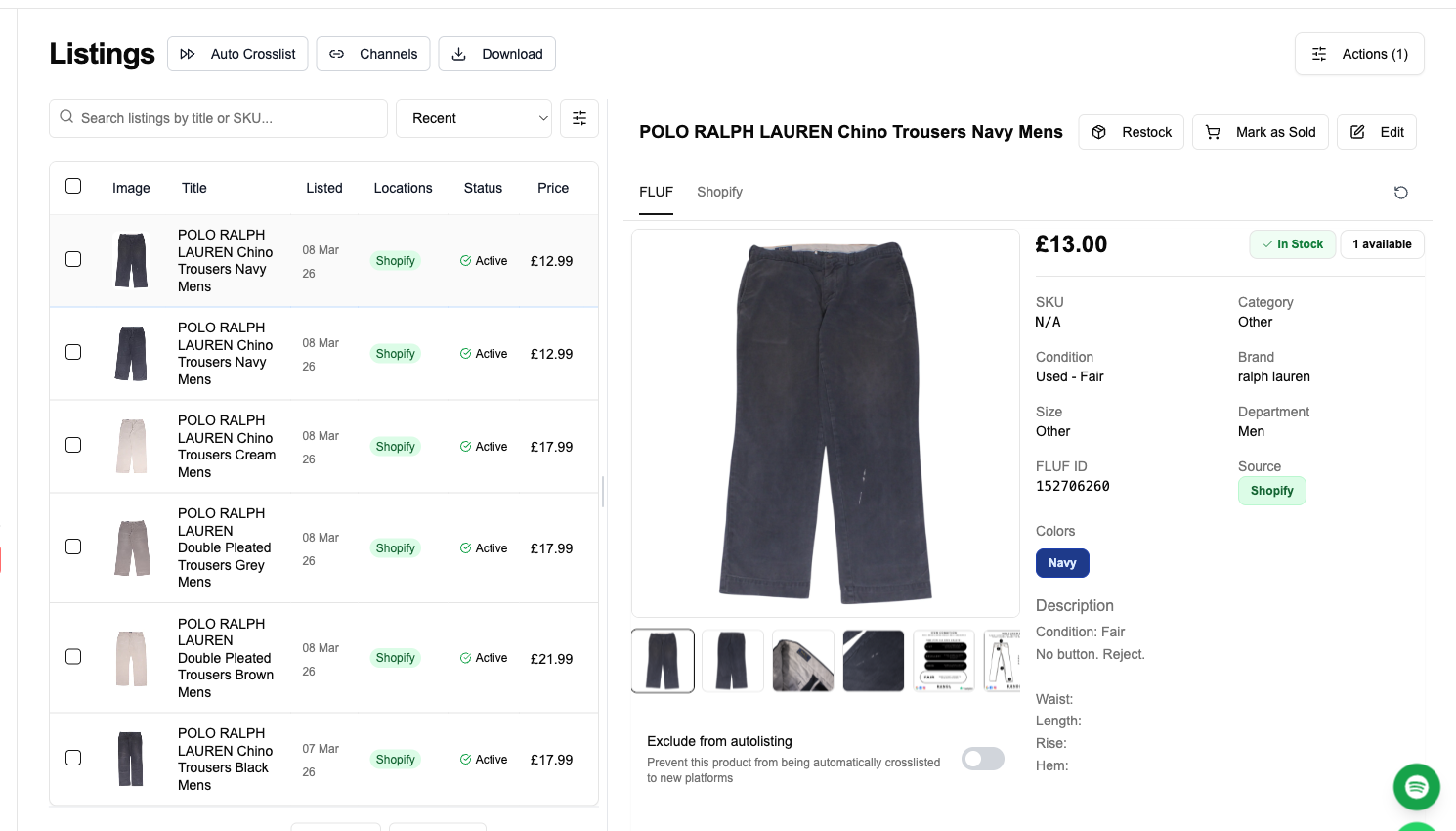
FLUF Connect automates the hard parts. Crosslist items between Depop and Vestiaire Collective (and seven other channels), and when something sells on one platform, it’s removed from the others automatically. No double-selling, no manual inventory updates.
How it works
- Connect your accounts — Link Depop and Vestiaire Collective to FLUF Connect.
- Crosslist your inventory — Select items individually, in bulk, or set auto-crosslisting rules to push items to both platforms automatically.
- FLUF keeps everything in sync — Real-time inventory sync, plus auto-relisting and offer management on Depop.
| FLUF Connect Feature | Depop | Vestiaire Collective |
|---|---|---|
| Crosslisting | Yes | Yes |
| Inventory sync | Yes | Yes |
| Auto-relisting | Yes | No |
| Offer management | Yes | No |
| Order sync | Yes (via Shopify) | Yes |
| Bulk operations | Yes | Yes |
Depop gets full automation support — crosslisting, relisting, offer management, and order sync — all included free. Vestiaire Collective gets crosslisting, inventory sync, order sync, and bulk operations. Most competitors like List Perfectly and Vendoo support both platforms but charge significantly more for automation features that FLUF includes free.
Starts at £9/month.
Related Guides
- How to Sell on Depop — our complete Depop seller guide
- How to Sell on Vestiaire Collective — our complete Vestiaire guide
- Crosslist Depop to Vestiaire Collective — step-by-step crosslisting guide
- Crosslist Depop to eBay — another popular crosslisting route
- Inventory Sync — never oversell across platforms
- Auto-Relisting — keep your Depop listings fresh automatically
- Offer Management — manage Depop offers from one dashboard
- Crosslisting Hub — all supported platforms and routes
- Grailed vs Vestiaire Collective comparison
Related guides
Frequently Asked Questions
It depends on what you sell. Depop is better for vintage fashion, streetwear, Y2K pieces, and items under £200 — it has zero commission (UK/US), a fast-moving Gen Z audience, and social features that reward curated shops. Vestiaire Collective is better for luxury and designer items over £200 — its authentication service builds buyer trust and its audience expects to pay premium prices. Many sellers use both.
Depop is significantly cheaper. UK and US sellers pay zero commission — only 2.9% + £0.30 payment processing per sale. Vestiaire Collective charges a 12% selling fee plus 3% payment processing on every transaction. On a £200 sale, you keep £194.50 on Depop versus £170 on Vestiaire. However, Vestiaire's authentication can command higher sale prices for luxury items.
Yes. Many sellers list luxury items on Vestiaire Collective for the authenticated buyer audience and higher prices, while listing vintage, streetwear, and mid-range fashion on Depop for faster sales and lower fees. FLUF Connect lets you crosslist products between both platforms with real-time inventory sync.
Depop is much easier. Listing feels like posting to Instagram — snap photos, write a description, set a price, and you are live immediately. No approval process, no authentication delays. Vestiaire Collective requires detailed photos of hardware, linings, and date codes, plus items go through authentication. Depop gets you selling in minutes; Vestiaire takes days.
No. Vestiaire offers Authenticated Shipping (item ships to Vestiaire's warehouse for physical inspection — £15 fee) and Direct Shipping (seller ships directly to buyer, available for items under approximately €1,000). High-risk items receive digital authentication even on Direct Shipping. About 10% of listed items are rejected during verification.
Depop has 7 million active buyers (56 million registered users), nearly 90% under 34. Vestiaire Collective has 23 million registered members across 70+ countries. Depop's audience is larger and younger; Vestiaire's audience is smaller but wealthier and specifically shopping for luxury fashion.
Yes. FLUF Connect supports crosslisting and inventory sync for both Depop and Vestiaire Collective. List your items once and push them to both platforms — when something sells on one, FLUF removes it from the other automatically. Depop also gets auto-relisting and offer management, both included free.
Vestiaire Collective is generally better for designer bags. Its authentication service gives buyers confidence the item is genuine, which means they are willing to pay closer to market value. Depop has no authentication — genuine luxury sellers compete with counterfeits, which can drive prices down. However, if your bag is a trendy or Y2K-era piece, Depop's audience may pay more.
For luxury items over £200, often yes. Vestiaire's authentication builds buyer trust, which translates into higher sale prices. A designer bag might sell for £800 on Vestiaire (you keep £680 after 15% fees) versus £600 on Depop (you keep £582.60 after processing). For items under £200, the maths usually favours Depop.
Authenticated Shipping adds 2+ business days at the warehouse for physical inspection, on top of shipping time. Total delivery is typically 5-12 days for Authenticated Shipping versus 2-5 days on Depop. Direct Shipping on Vestiaire (under approximately €1,000) takes 3-7 days — comparable to Depop.