Crosslist from Facebook Marketplace to Etsy — Automatically
Move your Marketplace catalogue onto Etsy in minutes. Titles, photos, prices and categories transfer automatically; inventory stays in sync so you never sell the same handmade or vintage item twice.



- Facebook Marketplace: over 1.1 billion monthly users, hyper-local reach, dominant for furniture, home goods and bulky pieces — but no global search audience and patchy buyer-protection.
- Etsy: 86.5M active buyers (Q4 2025), intentional gift-shoppers, willing to pay a premium for handmade, vintage and craft items.
- Fields that transfer automatically: title (resized to Etsy’s 140-character limit), description, up to 10 images, price (currency-converted), condition and a best-match category.
- Inventory sync: When something sells on Marketplace, FLUF Connect closes the Etsy listing within minutes — and vice versa. No double-sales on one-of-a-kind pieces.
- What FLUF automates: bulk crosslisting, auto-crosslisting rules, image and category mapping, sold-out sync, Etsy order sync into one dashboard.
- Cost: From £9/month — Starter covers unlimited listings with every automation included, not as a paid add-on.
Why graduate from Facebook Marketplace to Etsy?
Most Facebook Marketplace sellers reach a ceiling. You can only sell to people within driving distance, you compete on price with anyone willing to undercut you, and every fifth message is a lowball or a scam-bait “is this still available?” with no follow-through. Etsy flips that economics — buyers come pre-qualified, they search for exactly what you make, and they expect to pay a premium for handmade, vintage or one-of-a-kind goods. Crosslisting from Marketplace to Etsy is how a local hobby becomes a national brand without giving up the steady cash-flow Marketplace already brings in.
The two audiences barely overlap. Facebook Marketplace is local, browse-driven and skewed toward functional purchases — sofas, baby gear, used electronics, the odd bargain dress. Etsy is global, search-driven and built around intention: someone types “personalised dog collar leather”, finds your shop, and orders one. Listing a hand-poured candle, a refurbished mid-century lamp or a small-batch ceramic on both platforms doubles the surface area without cannibalising either side. The Marketplace listing catches a neighbour scrolling for “lamp”; the Etsy listing catches a stranger in Texas, Berlin or Sydney searching for “1960s teak floor lamp restored”.
Etsy’s fee stack is heavier than Marketplace’s — but that’s the trade-off for the audience. Per Etsy’s own Fees & Payments policy, you pay a $0.20 listing fee per item (auto-renewed every four months or after a sale), a 6.5% transaction fee on item price plus shipping, plus payment processing of roughly 3% + $0.25 in the US, 4% + £0.20 in the UK, or 4% + €0.30 across most of the EU. By contrast, Facebook Marketplace has no listing fees and zero seller fees on local-pickup sales — the only Marketplace fees come on the optional shipping flow. That gap is the case for keeping Marketplace, not abandoning it: use Marketplace for bulky local sales where shipping is uneconomic, and use Etsy for everything that fits in a small parcel and deserves a global audience.
The other reason to crosslist is buyer behaviour. Marketplace shoppers haggle, ghost, no-show and routinely message at 11pm asking for “best price”. Etsy buyers click “Buy Now”, pay in full, and leave reviews. Per Etsy’s Q4 2025 results, the platform added 6.8 million new buyers and reactivated 10.4 million more in a single quarter — that’s a fresh stream of intent-driven traffic your existing Marketplace listing will never see. If you’re already photographing items for Marketplace, you’ve done 80% of the work an Etsy listing needs. FLUF Connect handles the rest.
| Facebook Marketplace | Etsy | |
|---|---|---|
| Active buyers | 1.1B+ monthly users | 86.5M active buyers |
| Primary demographic | 25–55+, very broad, local-first | 25–44, predominantly women, gift and lifestyle shoppers |
| Top markets | Global wherever Facebook operates | US, UK, Canada, Germany, Australia |
| Strongest categories | Furniture, baby gear, electronics, vehicles, bulky home goods | Handmade, personalised gifts, vintage (20+ years), craft supplies, jewellery, paper goods |
| Seller fees | None on local pickup; low fees on shipped items | $0.20 listing + 6.5% transaction + 3% + $0.25 processing (US) |
| Listing format | Location-based feed, no global search | SEO-driven search with tags, attributes, categories |
| Buyer intent | Browsing, price-sensitive, often haggling | Intentional, gift-focused, willing to pay premium |
| Shipping | Local pickup preferred | Shipping expected globally |
One important sanity check before you crosslist: Etsy’s Creativity Standards were tightened in June 2025. Items listed as handmade must be produced from your own original designs, not templated; items listed as vintage must be at least 20 years old (so 2005 or earlier in 2025) and personally curated. Resold high-street goods, mass-produced dropship items and obvious factory-made products are not eligible. If your Marketplace inventory is mostly resold retail, build an Etsy sub-catalogue of the items that genuinely qualify — handmade pieces, true vintage, supplies for crafters — and crosslist those.
Take your Marketplace catalogue global — list on Etsy in minutes, not hours.
How to crosslist from Facebook Marketplace to Etsy with FLUF Connect
Connect both accounts in FLUF Connect. Facebook Marketplace requires the FLUF browser extension; Etsy does not. Review the imported listings before crosslisting individually or in bulk.
1. Create a FLUF Connect account
Sign up at fluf.io/connect. Plans start at £9/month. Every plan includes the full automation suite — sync, bulk operations, auto-crosslisting rules, Etsy order sync — included in the monthly price, not as paid add-ons.
2. Install the FLUF Chrome extension and connect Facebook Marketplace
Install the FLUF Connect Chrome extension, open Facebook Marketplace in Chrome while logged in, and click the extension icon. The extension reads your existing Marketplace listings — photos, titles, descriptions, prices, locations — and imports them into the FLUF Connect dashboard. Setup is one-time; afterwards you control everything from the dashboard.
3. Connect Etsy
In FLUF Connect, click Add Channel → Etsy, then follow Etsy’s authorisation prompts. Check your shop categories, shipping profiles and currency before publishing new listings.
4. Choose the Marketplace items to send to Etsy
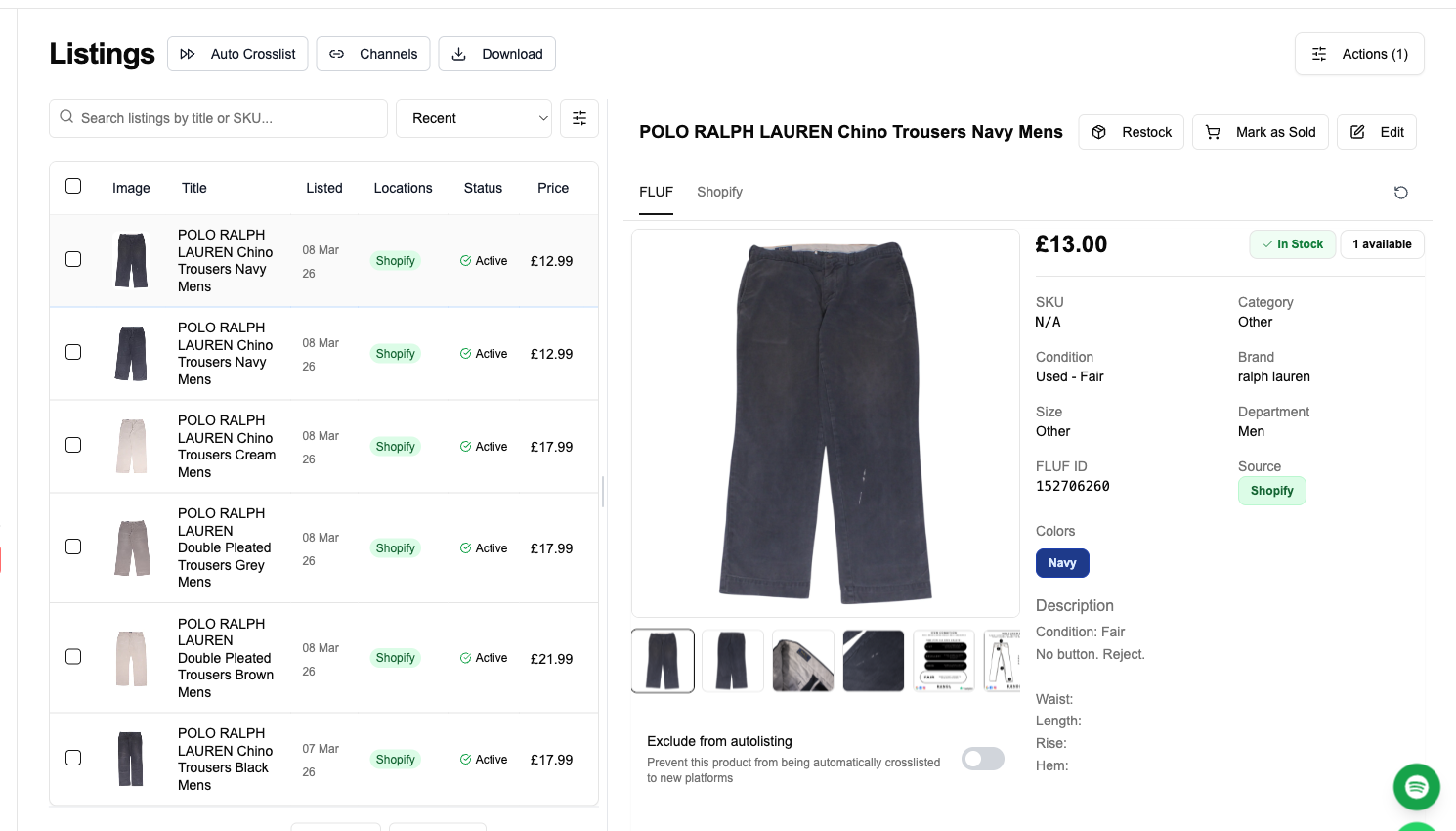
In the FLUF Connect Listings view, filter your Marketplace inventory by category, price range or keyword. Select individual items, a filtered batch, or your full catalogue. For a typical handmade or vintage seller, you’ll usually exclude bulky furniture and resold high-street items at this step, since they don’t fit Etsy’s Creativity Standards.
5. Review the Etsy preview
Preview the title, description, images, category, condition and price in your Etsy shop’s currency. Edit any field before publishing. Use a clear title and remove destination-inappropriate wording such as “pickup only” where it no longer applies.
6. Choose shipping profile and tags
Etsy requires a shipping profile and lets you add up to 13 tags. FLUF prompts you to pick a default shipping profile (e.g. your standard UK 2nd Class) which applies to the whole batch, and suggests tags drawn from your Marketplace title and description. You can edit the tag list per item or apply a single set to the whole batch.
7. Click Crosslist
Publish from FLUF Connect and check the listing status and URL in your dashboard. Inventory sync keeps the matching listings up to date when an item sells.
Auto-crosslisting: Set a rule once and forget it. New Facebook Marketplace listings can be automatically crosslisted to Etsy whenever they match your conditions (price above £15, category = home decor, brand absent, etc.). Each match drops into Etsy without another click. See inventory sync and auto-relisting for the wider automation stack.
What transfers when you crosslist from Facebook Marketplace to Etsy?
Facebook Marketplace is built around a small set of fields — title, description, photos, price, condition, category, location. Etsy is the opposite: a long taxonomy of attributes (materials, occasion, recipient, holiday, primary colour, secondary colour, room, finish) plus shipping profiles, tags, and variations. The good news is that Marketplace’s data fits cleanly inside Etsy’s structure; the work is mostly enrichment, not translation. Here is exactly how FLUF maps each field.
Field mapping — Facebook Marketplace to Etsy
| Marketplace field | Etsy field | Transfer | Notes |
|---|---|---|---|
| Title (max 100 chars) | Title (max 140 chars) | Automatic | Marketplace titles fit comfortably; FLUF can append a tag-like phrase if you want SEO-style Etsy titles. |
| Description | Description | Automatic | Full description transfers. FLUF strips “Local pickup only”, “Cash on collection”, and similar Marketplace-specific phrases if you tick the cleanup option. |
| Images (up to 10) | Images (up to 10) | Automatic | All Marketplace photos transfer in the original order. Etsy’s recommended size is 2700×2025 — FLUF uploads originals where possible. |
| Price | Price | Automatic | Currency-converted to your Etsy shop currency (e.g. GBP → USD) using a daily mid-market rate. You can override per item. |
| Condition | Condition (vintage/handmade subset) | Smart mapped | “New” → Etsy “new”; “Used – Like New” / “Used – Good” / “Used – Fair” → Etsy “vintage condition” descriptor (if eligible) or noted in description. |
| Category | Etsy taxonomy | Best match | Marketplace’s flat categories map to nearest Etsy leaf — Home Goods → Home & Living > subcategory; Clothing → Clothing > type. Review per item. |
| Location | — | Not used | Etsy is global by default; your shop location is set once at shop level. |
| — | Tags (up to 13) | Manual / suggested | Review the suggested Etsy tags and edit or replace them before publishing. |
| — | Materials (up to 13) | Manual | Etsy-only field. Set common defaults at shop level (e.g. “soy wax, cotton wick, recycled glass”) or fill per item. |
| — | Shipping profile | Manual | Pick once per batch. FLUF saves your last-used profile as the default. |
| — | Production partners / Who made it | Manual | Etsy requires you to declare whether you made it, a partner made it, or you collected it (vintage). Set as a per-shop default. |
| — | Quantity | Defaults to 1 | Marketplace listings are typically one-off. FLUF sets quantity = 1 unless you mark the item as multi-quantity. |
| — | Variations (size, colour, style) | Manual | Marketplace has no variations. If you want size or colour options on Etsy, add them after crosslisting. |
Category mapping examples
| Facebook Marketplace category | Etsy category |
|---|---|
| Home Goods > Home Decor | Home & Living > Home Decor > (chosen subcategory) |
| Home Goods > Lighting | Home & Living > Lighting > Lamps |
| Home Goods > Kitchen & Dining | Home & Living > Kitchen & Dining > (drinkware / serveware / etc.) |
| Arts & Crafts | Craft Supplies & Tools > (relevant subcategory) |
| Antiques & Collectibles | Vintage > (era-appropriate subcategory) — only if item is 20+ years old |
| Furniture > Tables | Vintage > Furniture > Tables — if 20+ years old; otherwise Etsy does not accept non-handmade modern furniture |
| Health & Beauty > Bath & Body | Bath & Beauty > Bath & Body |
| Apparel > Women’s Clothing | Clothing > Women’s Clothing — handmade or vintage only |
Fields that need your attention
- Etsy shop defaults: shipping profile, production partner declaration, return policy. FLUF saves these as defaults so every crosslist re-uses them.
- Materials and tags: Etsy’s algorithm leans heavily on tags and materials for discoverability. Spend time on the first ten listings — FLUF will reuse the patterns on the rest.
- Eligibility: Etsy isn’t a general resale marketplace. Per Etsy’s Creativity Standards, listings must be handmade, vintage 20+ years, or craft supplies. Filter out any resold high-street goods at the Listings step.
- Title rewrite: Marketplace titles often skew casual (“Lovely vintage lamp, perfect for cosy corner”). Etsy titles win on keywords — “Mid-century teak floor lamp 1960s Danish modern lighting” performs measurably better. FLUF lets you edit titles in the preview step.
- Currency: If your Etsy shop is USD and your Marketplace prices are GBP, double-check the conversion on the first batch. FLUF uses a daily rate but you can override per item.
Inventory sync between Facebook Marketplace and Etsy
FLUF Connect keeps availability up to date across your connected Marketplace and Etsy listings. Keep Chrome and the FLUF extension running when a Marketplace availability update is needed.
| Event | What happens | Timing |
|---|---|---|
| Sale on Facebook Marketplace | Etsy listing closed automatically; all other connected channels delisted too | Within minutes |
| Sale on Etsy | Marketplace listing marked sold/removed via extension; other channels delisted | Within minutes (next time Chrome is open with the extension running) |
| Etsy order received | Order syncs into FLUF Connect order dashboard for fulfilment tracking | Within minutes |
| Facebook Marketplace order | Managed in Facebook directly (no public order API) | — |
| Price change on Etsy | Not auto-pushed to Marketplace | Use bulk price update in FLUF dashboard |
| Price change on Marketplace | Not auto-pushed to Etsy | Use bulk price update in FLUF dashboard |
| Item deleted in FLUF | Removed from both channels | Within minutes |
Marketplace + Etsy crosslisting is risky without sync — Etsy’s intent-driven traffic plus Marketplace’s local browsers can easily collide on the same handmade ceramic on the same afternoon. FLUF Connect closes the loop within minutes, so the buyer who pays second gets an apology refund instead of an item that doesn’t exist. Etsy’s review system in particular punishes cancellations, so the sync is doing more than tidying inventory — it’s protecting your shop’s metrics.
What does not sync: Price, description and title edits you make directly on Etsy do not push back to your Marketplace listing, and vice versa. Make changes in the FLUF Connect dashboard and apply them to both channels at once. Facebook Marketplace orders are not currently pulled into the FLUF order dashboard because Facebook has no public order API — you’ll continue managing them inside Facebook itself, exactly as you do today.
Before and after FLUF Connect
Without FLUF Connect — the manual workflow
- Open Facebook Marketplace, find the listing
- Right-click and save each photo (up to 10) — Marketplace doesn’t offer a bulk download
- Open Etsy seller dashboard, click “Add a listing”
- Pick the listing type — handmade / vintage / supply — and category from a four-level taxonomy
- Upload photos one at a time, drag to reorder
- Rewrite the title with Etsy keywords (Marketplace titles are casual)
- Rewrite the description to remove “local pickup”, “cash on collection”, phone numbers
- Pick a shipping profile or create a new one
- Fill out 13 tags, 13 materials, attributes (occasion, recipient, holiday, primary colour…)
- Set quantity, price (converted to USD/your shop currency), and renewal preferences
- Declare production partners and “who made it”
- Publish and pay the $0.20 listing fee
- Track in a spreadsheet which items are now on both platforms
- When an item sells on Marketplace: open Etsy, find the listing, click End → confirm
Time per item: 8–12 minutes for a competent seller who already knows Etsy’s interface. For 50 items: 7–10 hours of tedious copy-paste. For a 200-item shop: an entire week.
With FLUF Connect
- Open the FLUF Connect Listings view — your Marketplace inventory is already imported
- Filter to the items you want on Etsy (handmade, vintage, craft supplies)
- Click “Crosslist to Etsy”
- Review the preview (titles, categories, tags pre-suggested)
- Confirm
- Done — inventory syncs automatically; Etsy orders flow into your FLUF dashboard
Time per item: ~30 seconds. For 50 items: about 25 minutes. For 200 items: about 90 minutes including thoughtful review.
Manual: 13–20 hours of click-and-paste. With FLUF Connect: roughly 50 minutes. That’s an entire working week back — time you can spend making, sourcing or photographing instead of re-typing.
Stop re-typing every listing into Etsy. Crosslist from your Marketplace catalogue in one click.
Automation features for Facebook Marketplace and Etsy sellers
Facebook Marketplace requires the FLUF Chrome extension. Etsy supports order sync and inventory updates without an extension. The table below shows the features available on each channel.
| Feature | Facebook Marketplace | Etsy |
|---|---|---|
| Crosslisting | Yes (via Chrome extension) | Yes |
| Inventory sync | Yes | Yes |
| Order sync into FLUF dashboard | No — manage Facebook orders in Facebook | Yes |
| Auto-relisting | No (Marketplace listings auto-renew at 7 days) | No (Etsy auto-renews 4-monthly) |
| Offer management | No | No |
| Bulk crosslisting | Yes | Yes |
| Auto-crosslisting rules | Yes | Yes |
| Bulk price / find-and-replace | Yes | Yes |
| Shopify order centralisation | — | Yes (Etsy orders flow into Shopify if connected) |
Two practical notes. First, both platforms have their own renewal model — Marketplace listings auto-bump every seven days, Etsy listings auto-renew every four months — so dedicated auto-relisting (the kind FLUF runs on Depop, eBay and Vinted) isn’t needed here. Second, because Facebook has no public order API, your Marketplace sales continue to live inside Facebook Messenger; FLUF only handles the inventory side. Etsy orders, by contrast, pull into the FLUF dashboard automatically and can also flow into Shopify if you use the centralised-fulfilment feature.
How much does it cost to crosslist from Facebook Marketplace to Etsy?
| Plan | Monthly | Crosslisted products |
|---|---|---|
| Starter | £9/month | Unlimited |
| Pro | £29/month | Unlimited |
| Priority | Custom pricing — tell us what you need | Unlimited |
Every plan includes crosslisting and sync across all supported channels, not just Marketplace and Etsy. Automation is bundled, not sold as an add-on. See the full pricing page for line-item details.
Adding more channels alongside Marketplace and Etsy
Most sellers who graduate from Facebook Marketplace to Etsy keep going. The same dashboard supports:
- eBay — strong for vintage, collectibles, and anything searchable; complements Etsy with a broader category mix
- Depop — Gen Z fashion audience, ideal if you have handmade clothing or curated vintage
- Vinted — Europe’s largest second-hand marketplace, zero seller fees
- Shopify — your own branded store for repeat customers and email marketing
- Etsy to Facebook Marketplace — the reverse direction, for sellers starting on Etsy and adding Marketplace later
- All crosslisting pairs — the full matrix of supported source-to-destination flows
Inventory sync runs across every channel you connect. Sell once anywhere; FLUF Connect handles the delisting everywhere else.
Sources and verification
- Etsy Fees & Payments Policy — listing, transaction and payment-processing fees by region
- Etsy Q4 2025 investor results — active buyer count, gross buyer additions
- Etsy Creativity Standards — handmade and vintage eligibility (updated June 2025)
- Etsy Vintage Items policy — the 20-year rule
- Etsy Open API documentation
- Facebook Marketplace statistics — monthly active user data
Move your Marketplace inventory onto Etsy in minutes — keep both, sync automatically.
Frequently Asked Questions
FLUF Connect plans start at £9/month on Starter, with Pro at £29/month and custom Priority plans above that; every plan is unlimited on listings and marketplaces, and the tiers differ by which automations they include and how often we check your channels for sales. The same plan also lets you crosslist to eBay, Vinted, Depop, Shopify and every other supported channel; automation features (sync, bulk operations, auto-crosslisting rules) are included rather than charged as add-ons. Etsy's own seller fees ($0.20 listing, 6.5% transaction, ~3% + $0.25 payment processing) apply separately and are paid directly to Etsy.
Yes, in both directions. A Marketplace sale closes the matching Etsy listing. An Etsy sale removes the Marketplace listing when Chrome and the FLUF extension are running. Updates are not instantaneous; check availability while a sale is still processing.
Yes. A Marketplace sale closes the matching Etsy listing automatically. An Etsy sale updates Marketplace availability while Chrome and the FLUF extension are running. Check listing status if an update is still pending.
About 30 seconds per item with FLUF Connect, versus 8–12 minutes manually. For a 100-item Marketplace catalogue, that's roughly 50 minutes with FLUF compared with 13–20 hours of copy-paste. Bulk crosslisting is the standard workflow — pick a filtered batch and submit them all at once.
Yes. From the same FLUF Connect dashboard you can also push to eBay, Vinted, Depop, Shopify, Vestiaire Collective, Temu and Yaga. Inventory sync covers every channel you connect — a sale on any one platform automatically delists the item across all of them. Most Etsy and Marketplace sellers add eBay next for the broader search audience.
Not all of them. Per Etsy's Creativity Standards (updated June 2025), listings must be handmade by you, vintage (20+ years old) and personally curated, or craft supplies. Resold high-street goods, dropshipped products and mass-produced new items are not eligible. Filter your Marketplace catalogue to handmade, true vintage and supplies before crosslisting — FLUF lets you exclude items at the Listings step.
Marketplace is much cheaper on direct fees — zero on local pickup, low fees on shipped orders. Etsy charges $0.20 per listing, 6.5% transaction fee on item price plus shipping, and roughly 3% + $0.25 payment processing (4% + £0.20 in the UK, 4% + €0.30 in the EU). The trade-off is reach: Etsy gives you 86.5M intent-driven global buyers, where Marketplace caps you at local browsers.
Facebook Marketplace requires the FLUF Chrome extension. Keep it running when crosslisting from Marketplace or updating Marketplace availability after a sale. Etsy requires no extension.
Marketplace doesn't have tags or materials, so there's nothing to transfer directly. FLUF Connect suggests up to 13 tags drawn from your title and description, which you can edit before publishing. Materials are filled in once as a shop default (e.g. "soy wax, cotton wick, recycled glass") and reused across crosslists; you can override per item.
Yes. Etsy orders appear in your FLUF Connect order dashboard and can also flow into a connected Shopify store for centralised fulfilment. Marketplace orders are not pulled into the dashboard; continue managing those in Facebook Messenger.
Sign up for free
Join the community
You're in.
Open your dashboard