Grailed vs Depop — Fees, Audience and Which Resale Marketplace Wins
A side-by-side comparison of Grailed and Depop for resellers — fees, buyers, what sells, and how to list on both.
7 days for £1, then from £9/month.



Short version: Grailed and Depop are both peer-to-peer fashion-resale marketplaces, but they serve almost opposite sellers. Grailed is a US-led, menswear-first home for streetwear, designer and archive pieces, charges the seller a ~9% commission, and authenticates high-risk items. Depop is a Gen-Z, womenswear-heavy, vintage-and-Y2K marketplace that has dropped seller commission to 0% in the US and UK (shifting a fee to buyers instead) while still charging 10% to sellers in the EU, Canada and Australia. Pick Grailed for higher-value menswear and designer; pick Depop for lower-value Gen-Z and vintage fashion. Or list on both at once with FLUF Connect.
If you resell clothing online, “Grailed vs Depop” is one of the most consequential choices you can make — and most comparison articles still get the fees badly wrong. This guide is built from each marketplace’s own help centre, investor filings and seller communities, current as of June 2026, and it deliberately corrects the outdated fee figures that most comparison articles still repeat. We break down fees, audience, what actually sells, buyer protection and payouts, then show how to stop choosing and simply sell on both.
Grailed vs Depop at a glance
| Grailed | Depop | |
|---|---|---|
| Best for | Menswear, streetwear, designer, archive, hype sneakers | Gen-Z fashion, Y2K & vintage, womenswear, accessories |
| Seller fee | ~9% commission (seller pays) | 0% in US & UK; 10% in EU/Canada/Australia |
| Who else pays | Buyers shop fee-free | US/UK buyers pay a marketplace fee (up to 5% + ~£1/$1) |
| Payment processing | 3.49% + $0.49 domestic (Stripe) | 3.3% + $0.45 US / 2.9% + £0.30 UK |
| Audience skew | Male, 25–34, ~68% United States | Gen-Z, ~90% of buyers under 34, UK origin + fast US growth |
| Authentication | Yes — digital scan + human review on high-risk items | No — open marketplace, dispute-based |
| Owner | GOAT Group (since October 2022) | Etsy (2021) — eBay acquisition agreed February 2026 |
| Typical price point | Higher: designer/archive, hundreds to thousands | Lower: Gen-Z fashion, roughly $15–$60 items |
Seller fees: the single most misreported fact
Almost every “Grailed vs Depop” article online still says “Depop takes 10%.” That has been wrong since 2024, and getting it right changes the whole comparison.
Grailed fees — the seller pays
On Grailed, the seller pays the platform and buyers shop fee-free. The commission is around 9% of the item price (recent reporting describes a tiered structure of roughly 6% on sales under $120 and 9% on higher sales, effective from May 2026 — confirm the current rate in your seller dashboard before pricing). On top of that, payment processing through Grailed Payments (now powered by Stripe) is 3.49% + $0.49 on domestic orders and 4.99% + $0.49 internationally. All-in, expect roughly 12–13% on a domestic sale. Note the older “2.9% + $0.30 via PayPal” figure you’ll see quoted elsewhere is stale — Grailed migrated from PayPal to Stripe through 2024. There are no listing fees and no subscription tiers, and Grailed periodically runs zero-commission windows on a rotating set of in-demand designers.
Depop fees — region-dependent, and the nuance matters
Depop removed its selling fee in the UK on 20 March 2024 and in the US on 15 July 2024. In both markets the seller commission is now 0%. However:
- Payment processing still applies — about 3.3% + $0.45 in the US and 2.9% + £0.30 in the UK, charged on the total order value (item + shipping).
- Buyers in the US and UK now pay a “marketplace fee” of up to roughly 5% of the item price plus around £1/$1, which funds Depop’s buyer protection. The cost didn’t vanish — it moved to the buyer.
- Sellers in the EU, Canada and Australia still pay the old 10% selling fee plus processing. Only USD and GBP sellers are exempt — a genuine point of confusion in r/Depop.
- Boosted Listings (optional promotion) cost 12% of the sale, charged only if the boosted item sells.
So the honest “Grailed vs Depop” fee picture is an asymmetry, not a single number: Grailed charges the seller ~9% and buyers nothing; Depop charges US/UK sellers nothing but adds a buyer-side fee — and still bills sellers 10% everywhere else.
Selling the same wardrobe on both? FLUF Connect lists to Grailed, Depop and every other major marketplace from one dashboard — so you never re-type a listing twice.
Audience and scale: who is actually buying
This is where the two platforms diverge hardest.
Grailed is owned by GOAT Group (the acquisition closed in October 2022) and describes itself as the world’s largest men’s fashion community, with over 8 million users. Traffic skews heavily to the United States (around 68%), followed by Canada, the UK, Australia and South Korea, and the largest buyer cohort is 25–34 and predominantly male. The catalogue is menswear-first: streetwear, designer, archive and luxury sneakers across roughly 10,000 brands. As a private company under GOAT Group, Grailed does not disclose active-buyer or GMV figures, so treat third-party user counts with caution.
Depop publishes harder numbers because it has been inside Etsy. In its disclosure tied to the February 2026 eBay acquisition, Depop reported 7 million active buyers, 3.2 million active sellers and roughly $1 billion in gross merchandise sales for 2025 (up from $788.9m in 2024). It is a London-born, Gen-Z marketplace — around 90% of active buyers are under 34 — with the US as its fastest-growing market. Etsy bought Depop in 2021 for $1.625bn; on 18 February 2026 eBay agreed to acquire it for about $1.2bn, with closing expected around mid-2026, so by the time you read this the relevant owner is eBay. The catalogue is secondhand and vintage: Y2K, 90s revival, gorpcore, vintage tees, Dr. Martens and Adidas, plus impulse-buy accessories, all discovered through a social, feed-driven app.
What sells best — and what doesn’t
Grailed
Grailed is where streetwear and designer move at real prices: Supreme, BAPE and Fear of God; archive Rick Owens, Raf Simons and Margiela; Japanese labels; and hyped sneakers. Archive and grail pieces routinely list in the hundreds to low thousands, and headline sales reach five figures. It is not the place for fast fashion (Zara and H&M sell poorly), low-value items (the fee economics don’t work), or categories Grailed deliberately avoids such as watches and trading cards. Womenswear exists but is secondary.
Depop
Depop rewards Y2K and 90s vintage, gorpcore, high-street streetwear, vintage band tees (often £40–£60) and accessories that drive impulse buys. Typical item prices sit roughly in the $15–$60 band. It is not ideal for high-value designer — there is no authentication — and dedicated menswear and streetwear sellers often find those categories move faster and for more on Grailed.
Buyer protection, payments and payouts
Grailed: buyers pay shipping at checkout, and Grailed Labels provides prepaid labels for eligible US, Puerto Rico and Canada-to-US listings, so the seller has no out-of-pocket postage. Sellers must upload tracking within 7 days or the order auto-cancels with no payout. Grailed’s Purchase Protection covers item-not-as-described claims filed within 3 days of delivery (items marked delivered are not covered for non-receipt). Payouts run through Stripe to your bank roughly 3 days after delivery. High-risk items are authenticated via a digital scan plus human expert review, with an authentication badge.
Depop: buyers also pay shipping, with prepaid labels (USPS in the US, Evri in the UK) or self-arranged postage. Depop Protection covers not-as-described and not-arrived claims for purchases made through the Buy button; off-app payments aren’t covered. US/UK/Australia sellers must use Depop Payments (Stripe) — PayPal is no longer accepted there, though it remains the checkout method elsewhere. US payouts arrive 2 working days after delivery (or 10 working days after sale, whichever comes first), plus a few days to reach your bank. There is no authentication; disputes are resolved reactively.
Grailed vs Depop: which should you choose?
Choose Grailed if you sell menswear, streetwear, designer or archive; your items are higher value (think $100–$1,000+); your buyers skew US and male; and you want authentication to protect high-ticket sales. The trade-off is a ~12–13% all-in seller cost and a lowballing culture where offers around 60% of ask are normal.
Choose Depop if you sell Gen-Z fashion, Y2K, vintage or womenswear; your items are lower value; you want social, in-app discovery; and you sell in the US or UK where seller commission is now 0% (your buyers will see an added marketplace fee). The trade-off is no authentication, buyer-favourable disputes, and the 10% seller fee that still applies if you’re based in the EU, Canada or Australia.
In practice, the same casual vintage piece can net more on Depop, while streetwear and designer sell faster and higher on Grailed. Which is exactly why serious resellers stop choosing.
Which should a beginner start with?
If you’re just starting out and can only manage one platform at first, let your inventory decide. Sellers whose stock is mostly menswear, streetwear, sneakers or designer should start on Grailed, where that audience concentrates and pays serious prices — and where authentication gives buyers the confidence to spend on higher-ticket items. Sellers whose stock is Gen-Z fashion, vintage, Y2K, womenswear or lower-value pieces should start on Depop, where the social feed and young audience reward exactly that style, and where 0% seller commission in the US and UK keeps more of each sale in your pocket. Once you’re comfortable and your inventory grows past what one marketplace absorbs, adding the second is the natural next step — and the point at which crosslisting software stops being a nice-to-have and starts saving you real hours every week.
Promotion and visibility on each platform
Both marketplaces sell ways to push your listings higher, and the models differ. Depop offers Boosted Listings, an optional promotion that costs 12% of the sale and is charged only if the boosted item actually sells — so it’s performance-based, but that 12% stacks on top of processing and any buyer-side costs, which materially changes your economics on a boosted item. Grailed surfaces listings through its feed and search, with periodic zero-commission promotional windows on a rotating set of in-demand designers rather than a per-listing paid boost in the Depop style. The practical implication: on Depop, factor the cost of boosting into whether a promotion is worth it; on Grailed, lean on strong titles, accurate brand tags and competitive pricing to earn visibility, and watch for the designer-fee promotions.
Getting started selling on both
If you’re new to one of the two, the on-ramp is quick. For Grailed, you’ll set up a seller account, list with accurate brand tags and measurements (Grailed buyers expect detailed sizing), and be ready for offers well below ask. For Depop, you’ll build a styled shop with strong photography and trend-aware tags, and lean into the social side — followers, likes and shares drive discovery. The two reward slightly different listing styles: Grailed is detail- and authenticity-led, Depop is visual- and trend-led. When you crosslist with FLUF Connect, you can build a single base listing and adapt the emphasis per platform, rather than starting from scratch each time. That’s the real unlock — the marketplaces stay distinct, but the work of feeding both stops being double.
The smarter answer: sell on both with FLUF Connect
You don’t have to pick a side. The reason most sellers stick to one marketplace is the manual work — photographing, titling, pricing and re-uploading the same item twice, then remembering to take it down everywhere when it sells. Grailed and Depop are both FLUF Connect channels, so you can:
- List once, publish to both — build a listing a single time and crosspost it to Grailed, Depop and the rest of FLUF’s marketplaces, instead of re-keying it per platform.
- Sell-elsewhere detection — when an item sells on one channel, FLUF marks it as sold on the others so you avoid the double-sale that hurts your metrics. (On Grailed this works through FLUF’s sold-status sync; on Depop, FLUF also supports relisting, offer management and order sync as a full channel.)
- One inventory, one dashboard — manage Grailed and Depop listings, plus eBay, Etsy, Vinted and more, in a single place.
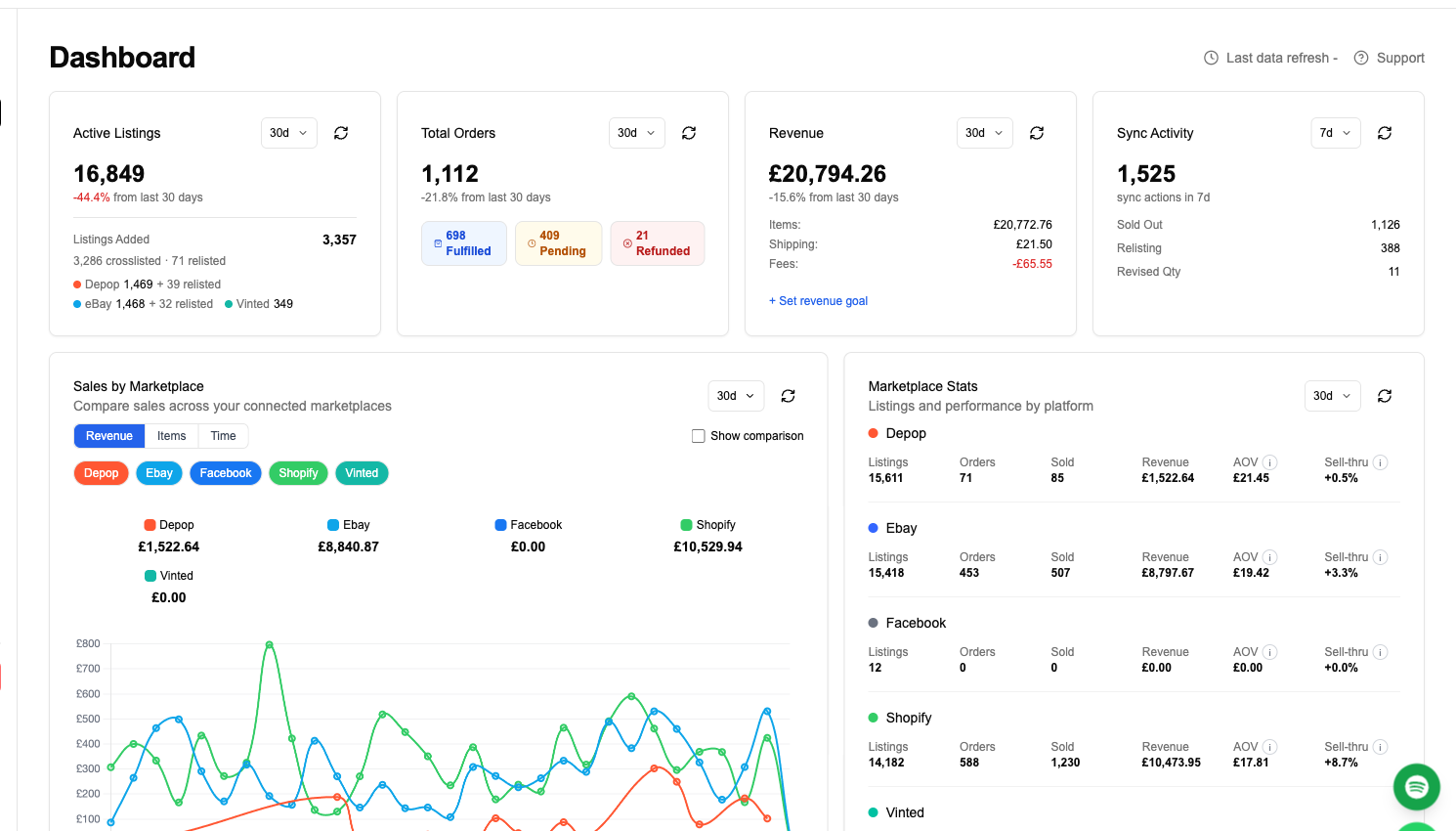
Automation like relisting, offers and bulk operations is included in every FLUF plan, not a paid add-on. Plans start at £9/month (Starter); There is no free plan, but every new account gets a 7-day trial for £1.
Shipping and payouts compared
Both marketplaces put shipping costs on the buyer and offer prepaid labels, so your out-of-pocket postage is effectively zero when you use the platform’s own label. The differences are in the details that catch sellers out.
On Grailed, Grailed Labels covers eligible US, Puerto Rico and Canada-to-US listings, but there’s a hard rule: you must upload tracking within 7 days or the order auto-cancels and you don’t get paid. International orders are seller-arranged, with strict customs and value-declaration requirements. Payouts run through Stripe to your bank roughly 3 days after delivery, with US bank clearing adding a couple more days and international payouts taking up to around ten business days.
On Depop, prepaid labels use USPS in the US and Evri in the UK, or you can self-arrange. US payouts arrive 2 working days after delivery, or 10 working days after the sale, whichever comes first, then a few days to reach your bank. New or unverified accounts are held longer, and US sellers crossing the $600 reporting threshold need to supply tax details. The key structural difference: Grailed authenticates and curates, while Depop is an open, social marketplace where trust is built through reviews rather than platform verification.
What sellers actually say
Seller communities are candid about both platforms, and the sentiment is worth weighing before you commit.
In the Grailed seller community, the recurring themes through 2026 are fee frustration (the 9% commission, and complaints about fees charged on shipping), worries that the platform’s traffic has softened, and friction with support over frozen funds or account actions. Lowballing is so normalised that offers around 60% of the asking price are routine, so experienced sellers price with negotiation room built in. Notably, Grailed’s most recent fee move was cutting seller fees on lower-value sales — a retention play, and the opposite of pushing costs onto buyers.
Among Depop sellers, the big 2026 talking point is the buyer marketplace fee: some feel “zero fees” is misleading once the buyer-side fee, payment processing, shipping and optional Boost are counted, and a handful report disputes resolving in the buyer’s favour. Sellers outside the US and UK regularly vent about the 10% fee that still applies to them. None of this makes either platform a bad choice — it makes the case for not depending on a single one.
A worked example: what you keep on a sale
Numbers make the difference concrete. Take a £100 item with £5 of postage that the buyer pays.
- On Grailed (a US-priced platform; figures shown in pounds for comparison), the seller pays roughly 9% commission (about £9) plus payment processing of around 3.49% + a fixed fee — call it ~£4 — leaving you with roughly £87 of the item price. Buyers pay no platform fee, so your sticker price is what they compare.
- On Depop in the UK, the seller pays 0% commission and only payment processing of 2.9% + £0.30 on the total — about £3.35 — leaving roughly £96–97. But the buyer is charged a marketplace fee on top of your price, so a buyer comparing two similar items will feel that cost even though it doesn’t come out of your payout.
- On Depop outside the US and UK, add the 10% selling fee back in, which puts your economics much closer to Grailed’s.
The takeaway isn’t “Depop is always cheaper” — it’s that the same item nets a different amount depending on the platform and your location, which is why blindly copying one price across both leaves money on the table.
Geography: where each is winning
Grailed’s centre of gravity is firmly the United States, which makes up roughly two-thirds of its traffic, followed by Canada, the UK, Australia and South Korea — and its buyers skew male and 25–34, shopping for menswear. Depop began in the UK and built a strong British base, but its fastest growth is now in the United States, where buyer activity has been climbing sharply, and its audience skews young and womenswear-leaning. If your buyers are US streetwear and designer collectors, Grailed concentrates them; if you’re chasing Gen-Z fashion demand on either side of the Atlantic, Depop’s reach is broader. For many sellers the honest conclusion is that the two audiences only partly overlap — another reason listing on both captures sales neither would alone.
How to price and sell across both
If you list the same item on Grailed and Depop, price for each platform’s economics rather than copying one number across:
- On Grailed, build in your ~12–13% all-in seller cost and a little negotiation headroom, since offers are expected.
- On Depop in the US or UK, you keep 100% of the item price minus processing — but remember your buyer sees an added marketplace fee, so an aggressively high sticker price can deter them.
- Match the channel to the item. Send menswear, streetwear, designer and archive to Grailed; send Y2K, vintage, womenswear and lower-value fashion to Depop. Cross-list the pieces that genuinely fit both.
- Avoid double-sales. The single biggest risk of listing everywhere is selling the same item twice. This is exactly what crosslisting software solves by marking an item sold across channels the moment it goes on one.
Grailed vs Depop: the verdict
There’s no universal winner — there’s a winner for your inventory. If you sell higher-value menswear, streetwear and designer to a US-leaning, predominantly male audience and value authentication, Grailed is the stronger home, and its seller-paid 9% buys you reach into a buyer base that expects to pay real money for grails. If you sell Gen-Z fashion, Y2K and vintage, lean womenswear, and want social discovery with 0% seller commission in the US and UK, Depop is the better fit. The most profitable answer for many resellers is simply both — matching each piece to the marketplace that pays best, and using FLUF Connect to do it without doubling your workload.
Related guides
- Sell on Grailed — the complete seller guide
- Sell on Depop — the complete seller guide
- Depop vs Vinted
- Crosslist from Grailed to Depop
- Crosslist from Depop to Grailed
- Poshmark vs Grailed comparison
Sources & Verification
Fees, ownership and audience figures in this comparison were verified against primary sources in June 2026, including:
- Grailed Help Centre — fees, authentication and payouts.
- Depop newsroom — US fee changes and UK fee changes.
- Etsy investor relations — eBay to acquire Depop (Feb 2026), with Depop’s 2025 active-buyer, seller and GMS figures.
- GOAT Group — acquisition of Grailed.
Frequently Asked Questions
It depends where you sell. Grailed charges the seller roughly 9% commission plus payment processing (about 12–13% all-in on a domestic sale), and buyers pay nothing. Depop charges 0% seller commission in the US and UK but adds a buyer-side marketplace fee, while sellers in the EU, Canada and Australia still pay 10%. For a US or UK seller, Depop's headline seller cost is lower; for high-value menswear, Grailed's reach can outweigh its fee.
Only outside the US and UK. Depop removed its seller commission in the UK in March 2024 and in the US in July 2024, so sellers there pay 0% commission (payment processing still applies, and buyers pay a marketplace fee). Sellers based in the EU, Canada and Australia still pay the 10% selling fee plus processing.
Yes. Grailed authenticates higher-risk items using a digital scan plus human expert review and shows an authentication badge. Depop is an open marketplace with no authentication; issues are handled reactively through Depop Protection and disputes.
Generally, yes. Grailed is menswear-first — streetwear, designer, archive and hyped sneakers — with a largely male, US audience that pays strong prices for those categories. Depop skews Gen-Z and womenswear, and is stronger for Y2K, vintage and lower-value fashion.
Yes. Both are FLUF Connect channels, so you can build a listing once and crosspost it to Grailed, Depop and other marketplaces, then keep stock in sync. When an item sells on one channel, FLUF marks it sold on the others to help you avoid a double-sale.
Grailed has been owned by GOAT Group since October 2022. Depop was bought by Etsy in 2021; in February 2026 eBay agreed to acquire Depop, with the deal expected to close around mid-2026.
They serve different audiences. Depop disclosed about 7 million active buyers and roughly $1 billion in sales for 2025. Grailed reports over 8 million users but, as a private company, does not publish active-buyer figures, so the numbers aren't directly comparable.