
Gumtree vs Depop — Fees, Audience & Which to Sell On (Plus How to Do Both)
Gumtree is best for bulky, any-category items sold locally for cash; Depop is best for fashion shipped to a young global audience — here's how to choose, and how to sell on both.



Gumtree vs Depop — Key Takeaways
- Choose Gumtree if you are shifting bulky, any-category items — a sofa, a car, a fridge, a pram, a box of household clutter — to a local buyer who collects and pays cash, fast, with no postage and no listing fee.
- Choose Depop if you sell fashion, vintage, Y2K or streetwear and want a young, national-and-international audience that expects everything shipped, browsed inside a social app used by 30M+ registered users across 150 countries.
- Fees: both are cheap to sell on. Gumtree charges no seller fee on basic private listings; Depop dropped its seller fee to 0% (UK 2024, US July 2024) and moved the cost to the buyer.
- Audience: Gumtree is a UK/Australia local-classifieds giant with ~16 million UK monthly users; Depop is a global Gen-Z fashion app with around 90% of users under 26.
- The real difference: Gumtree is local-pickup-and-cash by default; Depop is shipping-first and fashion-only. They serve different items and different buyers, so they rarely compete for the same sale.
- Best strategy = use both. FLUF Connect lists one inventory to Gumtree, Depop and 20+ more marketplaces from a single dashboard, so you reach the local bargain-hunter and the international vintage buyer without doubling your admin.
Gumtree vs Depop at a Glance
Gumtree is one of the UK’s oldest and largest online classifieds sites, with a sister platform in Australia. It is the digital equivalent of a small-ads noticeboard: you post a free advert for almost anything — a car, a wardrobe, a lawnmower, a cot, a bundle of clothes — and local buyers browse by location, message you directly and usually collect the item in person and pay cash. Gumtree is deliberately category-agnostic. Its busiest sections are cars and vehicles, furniture, home and garden, electronics, appliances and baby and kids gear, precisely the heavy, awkward, hard-to-post items that no shipping-first app handles well.
Depop is the opposite animal. It is a shipping-first, mobile-native fashion resale app built around a social feed of follows, likes and curated shops. It exists for one job: selling clothing, vintage, streetwear and one-of-a-kind pieces to a young, style-led audience that discovers items by scrolling. Where Gumtree keeps a sale local and physical, Depop assumes the buyer could be three towns away or three countries away, and it provides the payment rails and postage to make that frictionless. If Gumtree is where you clear the garage, Depop is where you build a vintage brand.
Their histories explain the difference. Gumtree launched in 2000 as a London noticeboard for expats needing flats, jobs and furniture, and it never stopped being a general-purpose classifieds board — breadth is its whole point. Depop arrived in 2011 as a fashion-first mobile app, was later acquired by Etsy, and doubled down on being the resale destination for a generation that shops on its phone and cares about individuality and sustainability. So when you weigh Gumtree against Depop, you are not really comparing two versions of the same thing — you are comparing a local marketplace for everything against a global marketplace for fashion. That framing makes the rest of the decision much simpler.
| Gumtree | Depop | |
|---|---|---|
| Type | Local classifieds, any category | Shipping-first fashion resale app |
| Founded | 2000 (UK) | 2011 (Italy/UK) |
| Active users | ~16M UK monthly; 10M+ monthly in Australia | 30M+ registered, 150 countries |
| Seller fees | None on basic private listings | 0% seller fee (buyer pays a fee) |
| Best for | Bulky, local, any-category, fast cash sales | Fashion, vintage, streetwear shipped nationally/globally |
| Geography | UK & Australia | Global; strongest in US & UK |
| Shipping | Local pickup / cash default; buyer-paid delivery optional | Shipping-first; prepaid labels & in-app payments |
Read the table row by row and a pattern emerges: almost every line points to the same underlying split. Gumtree is older, local, category-agnostic and pickup-first; Depop is newer, global, fashion-only and shipping-first. Even the user numbers tell that story — Gumtree’s are counted as monthly users in two countries, reflecting a habit-forming local utility, while Depop’s are registered users across 150 countries, reflecting a global app people join for a specific purpose. Keep that split in mind as we compare fees, audience and shipping in detail, because it is the thread that ties all three together.
Fees Compared: Gumtree vs Depop
On paper both platforms are unusually seller-friendly, but the mechanics are completely different. Gumtree makes its money from optional promotion and from business advertisers, not from private sellers listing everyday items. A standard private advert is free to post, and using Gumtree Payments is free for the seller too. The catch is that Gumtree Payments adds a Buyer Protection fee of £0.70 fixed plus a 5%–10% variable charge — but that is paid by the buyer at checkout, not deducted from your proceeds. There are also optional paid upgrades (Urgent, Featured, Spotlight) that push an advert up the results, though most private sellers never touch them.
Depop rebuilt its fee model in 2024 specifically to compete with the fee-free resale apps. It removed its 10% seller selling fee entirely — the UK earlier in 2024 and the US on 15 July 2024 — and in the US introduced a buyer-side marketplace fee of up to 5% plus up to $1 from 18 July 2024. Payment processing still applies on Depop sales, and there is an optional Boost promotion, but the headline for sellers is simple: your listing price is largely what you keep, minus processing.
| Cost | Gumtree | Depop |
|---|---|---|
| Listing fee | Free (basic private ad) | Free to list |
| Seller commission | None | 0% |
| Buyer-side fee | £0.70 + 5%–10% (via Gumtree Payments) | Up to 5% + up to $1 (US) |
| Payment processing | Included where Gumtree Payments used | Applies (treat exact % as approximate) |
| Optional promotion | Urgent / Featured / Spotlight | Boost (optional) |
Worked example — what you keep on a £40 sale. Say you list a jacket at £40. On Gumtree, if the buyer collects in person and pays cash, you keep the full £40 and never touch a fee. If they buy through Gumtree Payments, you still keep your £40 — the Buyer Protection fee is added on top for the buyer. On Depop, with a 0% seller fee, you keep £40 minus only payment processing, so roughly £38–£39 after the processor’s cut. The difference is small in cash terms; the meaningful gap is reach and effort. On Gumtree that £40 jacket is visible to local buyers who must travel to you; on Depop it is visible to a national and international fashion audience but you must package and post it. Neither is “cheaper” in a way that decides the sale — the platform you choose should follow the item and the buyer, not a fee spreadsheet.
Now scale it up — a £300 sofa. Here the platforms diverge sharply, not on fees but on feasibility. On Gumtree the sofa lists free, a local buyer collects it in a van and pays cash, and you keep the full £300 with no postage and no packaging. On Depop the same sofa is a non-starter: the app is built for items that fit in a mailer, the audience is not there to buy furniture, and there is no realistic way to ship a three-seater through an in-app postage label. This is the clearest illustration of why fee comparisons miss the point. For heavy, local, any-category goods, Gumtree is not merely cheaper — it is the only one of the two that works at all. For light, postable fashion, Depop’s 0% seller fee and built-in postage make it the natural home. The fee tables look similar; the practical fit could not be more different.
It is also worth noting where the hidden costs actually sit. On Gumtree the real “cost” is your time and travel: fielding time-wasters, arranging collection, and the occasional no-show. Its optional Urgent, Featured and Spotlight upgrades can buy visibility in a busy category, but most private sellers never pay for them. On Depop the real cost is effort of a different kind — photography, styling, description and the optional Boost promotion that some sellers use to surface items to more buyers. Budget for effort, not just percentages, and the two platforms feel much more evenly matched than a raw fee comparison suggests.
Audience & Traffic: Who Buys on Gumtree vs Depop?
Gumtree’s scale is local and broad. It reaches around 16 million monthly users in the UK — roughly one in three people — and adds more than 10 million monthly buyers and sellers in Australia. Crucially this audience is not filtered by taste or age in the way a fashion app is. It skews slightly older and more male — around 59% male and 41% female in the UK, with 25–34 the largest age bracket — and it turns up looking for practical, value-driven purchases: a used car, a dining table, a second-hand games console. These are buyers who want to save money and collect nearby, not build a wardrobe.
Depop’s audience is narrow but intense. It counts 30M+ registered users spread across 150 countries, with its strongest markets in the US and UK. The defining trait is age: roughly 90% of active users are under 26, making it one of the most Gen-Z-concentrated marketplaces anywhere. The base is female-skewed with men the fastest-growing segment, and it behaves like a social network as much as a shop: buyers follow sellers, like items, and discover pieces through a curated feed rather than a search box. That is why vintage, Y2K, 90s, streetwear and designer one-of-a-kind pieces sell so well there — the audience treats shopping as identity, not errand.
Buyer intent differs as much as demographics. Gumtree shoppers arrive with a specific, practical need — a washing machine because theirs broke, a desk because they are working from home, a car for the commute — and they filter by location and price. They want the transaction done quickly and nearby. Depop shoppers browse for pleasure and identity; many are not looking for anything in particular until the feed surfaces a piece that fits their aesthetic. That difference shapes how you should present items: a Gumtree advert wins on clear specs, honest condition and a fair price, while a Depop listing wins on mood, styling and the sense that the item belongs to a curated shop.
Geography compounds the point. Gumtree’s reach is deep but bounded — it is a UK and Australia proposition, and a listing’s value is largely determined by how many buyers live within collection distance. Depop’s reach is shallow-per-country but global; a niche piece that would find one buyer in your town might find its perfect buyer in another country entirely. If you sell rare or specific fashion, that international pool is a genuine advantage; if you sell general household goods, local density matters far more than global spread.
The practical upshot: these two audiences barely overlap. A person selling a corner sofa is not competing with a Depop seller, and a seller of 90s Levi’s is not competing with a Gumtree car listing. That is exactly why the smartest sellers do not treat this as a choice at all — they place the right item in front of the right crowd, and use both.
Shipping & Selling Experience: Gumtree vs Depop
Shipping is the single biggest structural difference between the two. Gumtree is, at heart, a local, cash-in-person, buyer-arranged classifieds service. The default transaction is: post the advert, a nearby buyer messages you, they come and collect, money changes hands, done. Gumtree Payments layers optional buyer-paid delivery and buyer protection on top for those who want a safer or remote transaction, but posting is not the assumption. This makes Gumtree unbeatable for the items nobody wants to ship — furniture, white goods, bikes, cars, garden equipment — where a courier would cost more than the item or simply can’t handle the size.
Depop assumes shipping from the first tap. It handles the payment in-app and provides postage — prepaid USPS labels in the US and integrated postage in the UK. The seller lists, photographs well, sets a price, and when it sells they print a label and drop it at the post office. That model is perfect for clothing and small, light, valuable items that travel cheaply, and it is what unlocks Depop’s national and international reach: a seller in Manchester can sell a jacket to a buyer in California without either party leaving home.
The experience of listing differs too. A Gumtree ad is quick, plain and functional — a few photos, a category, a location, a price. A Depop listing is closer to social-media content: strong photography, hashtags, a styled description and an eye on your shop’s overall feed all influence how well an item performs. Gumtree rewards speed and clarity; Depop rewards presentation and consistency. Sellers who list on both quickly notice they are effectively writing two different kinds of advert for two different kinds of buyer — which is where a tool that adapts one listing to each channel’s format earns its keep.
Trust and safety follow the same split. On Gumtree, meeting a stranger to hand over goods for cash puts the emphasis on personal caution — meeting in daylight, in public where practical, and checking cash — though Gumtree Payments now offers a protected, at-a-distance alternative for those who prefer it. On Depop, the transaction is mediated entirely through the app: payment is held and processed digitally, postage is tracked, and there is a structured process behind any dispute. Neither model is objectively safer; they simply move the risk to different places. In-person collection removes shipping fraud but requires meeting a stranger; app-mediated shipping removes the doorstep meeting but introduces postage and delivery disputes. Match the model to your comfort level and to the item’s value.
Speed of sale is the last practical difference. Gumtree can be extraordinarily fast for in-demand local items — a well-priced fridge or bike can sell the same day to someone who simply drives over. Depop sales can be quicker for hyped fashion but often take longer for everyday pieces, because discovery depends on the feed and on buyers browsing at their leisure. If you need cash today and the item is bulky and local, Gumtree usually wins on speed. If you can wait for the right buyer and the item is fashion, Depop’s reach usually wins on price.
How to Choose Between Gumtree and Depop
The decision is really about what you are selling and how you want to hand it over. Before the profiles, run each item through three quick questions. First, can it be posted affordably? If a courier costs more than a fraction of the item’s value, or the item simply won’t fit in a parcel, it belongs on Gumtree. Second, is it fashion? Clothing, vintage, streetwear and accessories have a ready, motivated audience on Depop that Gumtree cannot match. Third, how quickly do you need the money? A same-day local cash sale points to Gumtree; a patient wait for the best price on a niche piece points to Depop. Most items answer these three questions cleanly and sort themselves into one camp or the other. Use the two profiles below to confirm.
Choose Gumtree if…
- Your item is bulky, heavy or awkward to post — furniture, appliances, a car, a bike, garden or DIY gear.
- You want a fast, local sale with cash on collection and zero postage hassle.
- Your stock spans many categories, not just fashion — Gumtree’s classifieds breadth fits a house clearance or mixed garage sale.
- You are selling in the UK or Australia and value reaching a broad, practical, value-driven local audience.
- You want to list at no listing cost, with no seller fee and no need to package anything.
Choose Depop if…
- You sell fashion — vintage, Y2K, 90s, streetwear, designer or one-of-a-kind apparel.
- You want a young, style-led audience, with roughly 90% of users under 26.
- You are happy to ship and want national and international reach, not just local buyers.
- You want to build a following and a branded shop, using the social feed to drive repeat sales.
- You want a 0% seller fee and in-app payments and postage handled for you.
For most sellers the honest answer is “it depends on the item,” and that is the clue. A single seller clearing a flat might have a sofa that belongs on Gumtree and a rail of vintage jackets that belong on Depop. Forcing everything onto one platform leaves money on the table — post the jackets on Gumtree and they drown among car parts; post the sofa on Depop and it will not sell at all. The winning move is not to choose the platform, but to choose the platform per item, then reach both audiences at once.
Consider three common seller types. The declutterer is clearing a home and has a genuinely mixed pile: furniture, kitchenware, kids’ toys and a few nice coats. For them Gumtree carries the bulk and the coats can go to Depop for a better price. The fashion reseller sources vintage and streetwear specifically to resell; Depop is their shop window and Gumtree is, at most, a place to occasionally shift a bulk lot locally. The side-hustler sits between the two, selling whatever they find cheap — some clothing, some electronics, some homeware — and needs to spread stock across whichever platform fits each item. In all three cases the constraint is not which platform is “better,” but how much time it takes to list and manage across more than one. That admin burden is the real reason sellers stick to a single channel and under-sell — and it is exactly the problem a crosslisting tool removes.
Why Not Both? Sell on Gumtree and Depop at Once
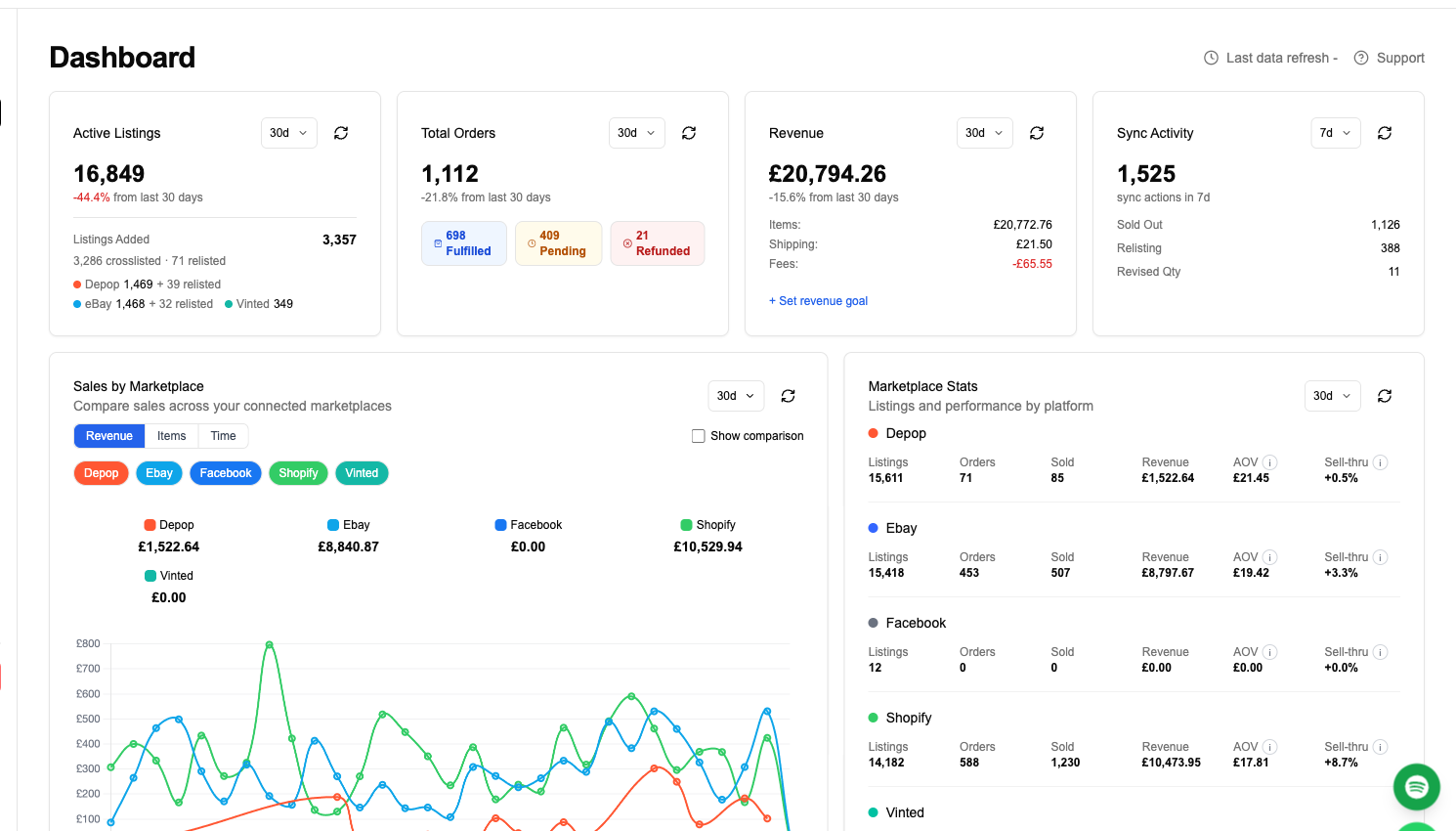
Gumtree and Depop do not talk to each other. List an item on one and nothing appears on the other; sell it on one and it stays live on the other until you manually take it down — the classic recipe for double-selling and awkward apologies. FLUF Connect exists to close that gap. It lets you manage one inventory and crosslist it across Gumtree, Depop and 20+ marketplaces — including eBay, Vinted, Etsy, Facebook Marketplace, Grailed, Vestiaire Collective and Poshmark — from a single dashboard, so the same jacket can face Depop’s Gen-Z fashion crowd and, alongside your bulkier stock, Gumtree’s local bargain-hunters.
Here is how selling on both with FLUF Connect works in practice:
- Connect your channels. Link your Gumtree and Depop accounts (plus any others you use) to one FLUF Connect dashboard.
- Import or build your catalogue once. Add each item a single time — photos, title, description, price, condition, category — and FLUF stores it as one master listing.
- Crosslist to each marketplace. FLUF adapts your listing to each channel’s format and category structure, so a Depop fashion listing and a Gumtree classified advert are both generated from the same source without you rewriting anything.
- Manage everything centrally. Edit a price or description once and push the change out; track your live listings across both platforms from one place instead of logging into each app.
- Keep inventory in sync. As items sell, cross-channel inventory sync helps you avoid the double-sale trap across your connected channels.
It is worth being precise about what FLUF automates on each side, because the two channels are not equal. On Depop, FLUF Connect does the full suite: relisting to keep items fresh in the feed, offer management, order sync and automatic mark-as-sold so a Depop sale delists the item elsewhere. On Gumtree, FLUF Connect provides crosslisting and central listing management — you list and manage Gumtree adverts alongside everything else from one dashboard, without relisting, offer, order-sync or mark-as-sold automation. In other words, Depop is a fully automated channel within FLUF; Gumtree is a managed crosslisting channel. Knowing the difference means you can lean on automation where it exists and keep a light manual eye on Gumtree where the platform’s local, cash-based nature makes automation less relevant anyway.
The payoff is reach without the workload. Instead of writing one advert for Gumtree and a completely different one for Depop, then manually reconciling what has sold, you maintain one catalogue and let FLUF handle the translation and distribution. Your furniture and mixed household stock find local buyers on Gumtree; your fashion and vintage pieces find a young, global audience on Depop; and you spend your time sourcing and packing rather than copy-pasting between apps.
The bigger picture is that Gumtree and Depop are only two of more than 20 marketplaces FLUF Connect supports. A vintage seller who does well on Depop often finds an overlapping but distinct audience on Vinted, eBay, Grailed or Vestiaire Collective; a general reseller shifting mixed stock on Gumtree may also want Facebook Marketplace for local reach and eBay for national demand. Because everything runs from one catalogue, adding a new channel is a switch you flip rather than a new inventory you rebuild. The item you already photographed and described for Depop can be placed in front of half a dozen more buyer pools with a few clicks — and every additional channel is another set of eyes on the same stock at effectively no extra listing effort.
None of this asks you to abandon the platform you know. If Gumtree already works for your bulky local sales, keep it and simply add Depop for the fashion you were under-pricing locally; if Depop is your shop, keep it and add Gumtree for the occasional bulky item you could never post. FLUF Connect is the layer that makes running both — and then more — sustainable, so the answer to “Gumtree or Depop?” stops being a compromise and becomes “both, from one place.”
Plans start at £19/month (Growth — 1,000 products). There is no free plan. Automation is included in every plan, not a paid add-on — see full pricing for details.
Sources & Verification
Gumtree fees and Gumtree Payments: source. Gumtree UK monthly users: source. Gumtree Australia users: source. Gumtree geography: source. Gumtree categories: source. Gumtree demographics: source. Depop fee changes and geography: source. Depop active users: source. Depop categories and shipping: source. Depop demographics: source. Last verified: July 2026.
Frequently Asked Questions
Both are very cheap for sellers. Gumtree charges no seller fee on basic private listings, and Gumtree Payments is free for sellers (the Buyer Protection fee of £0.70 plus 5%–10% is paid by the buyer). Depop dropped its seller fee to 0% in 2024, moving the cost to a buyer-side fee, though payment processing still applies. Neither platform's fees should decide the sale — the item and buyer matter more.
Gumtree is best for bulky, any-category items sold locally — furniture, cars, appliances, bikes, garden gear and mixed household goods that are awkward or costly to post. Depop is best for fashion: vintage, Y2K, 90s, streetwear, designer and one-of-a-kind apparel shipped to buyers nationally and internationally.
Gumtree reaches around 16 million monthly users in the UK — roughly one in three people — plus more than 10 million monthly buyers and sellers in Australia. Depop has 30M+ registered users across 150 countries, with the US and UK its strongest markets.
Depop's audience is overwhelmingly young, with roughly 90% of active users under 26, female-skewed with men the fastest-growing segment, and it behaves like a social app. Gumtree skews slightly older and more male (around 59% male, 41% female in the UK, with 25–34 the largest age bracket) and buys for practical, value-driven reasons.
No. Gumtree is local-classifieds by default — buyers usually collect in person and pay cash, with buyer-paid delivery only an optional add-on through Gumtree Payments. Depop is shipping-first: it handles in-app payments and provides prepaid postage labels, so items travel nationally and internationally by default.
Yes. The two platforms don't sync natively, so listing on both manually risks double-selling. FLUF Connect lets you manage one inventory and crosslist it to Gumtree, Depop and 20+ other marketplaces from a single dashboard, with cross-channel inventory sync to help avoid double sales.
On Depop, FLUF Connect does the full suite: relisting, offer management, order sync and automatic mark-as-sold. On Gumtree, FLUF Connect provides crosslisting and central listing management only — you list and manage Gumtree adverts alongside your other channels from one dashboard, without relisting, offers, order-sync or mark-as-sold automation.
Plans start at £19/month (Growth — 1,000 products). There is no free plan, and automation is included in every plan rather than being a paid add-on. See the pricing page for the full range of plans.