Crosslist from Wallapop to Yaga — Automatically
Move your Wallapop fashion to Yaga's Baltic and South African buyers in minutes. Brand, size, photos and price transfer automatically — and a Wallapop sale removes the item from Yaga for you.
7 days for £1, then from £9/month.



- Wallapop: ~19 million monthly users concentrated in Spain, Italy and Portugal — a male-skewed, utility-and-fashion C2C marketplace with low seller fees and its own “Envíos” prepaid shipping.
- Yaga: a secondhand-fashion-first marketplace strong in the Baltics (Estonia, Latvia, Lithuania) and South Africa — app-first, very low fees, with escrow-style buyer protection.
- Fields that transfer automatically: title, description, photos, price, brand, size, condition and category — mapped from Wallapop’s structure into Yaga’s fashion taxonomy.
- Inventory sync is honest and asymmetric: when an item sells on Wallapop, FLUF Connect removes it from Yaga automatically; when it sells on Yaga, you remove the Wallapop listing yourself (Wallapop has no programmatic delisting).
- Currency: Wallapop is EUR-led; Yaga lists in EUR (Baltics), ZAR (South Africa) or KES (Kenya) depending on your shop’s country — FLUF follows your Yaga site automatically.
- Cost: from £9/month on the FLUF Connect Starter plan (unlimited listings) — crosslisting, inventory sync, offers and bulk tools included, not a paid add-on.
Why Sell on Both Wallapop and Yaga?
Crosslisting from Wallapop to Yaga takes your secondhand fashion out of a single Iberian audience and puts it in front of dedicated pre-loved-clothing buyers in the Baltics and South Africa. Wallapop is broad and local; Yaga is fashion-deep and community-led. The two barely overlap geographically, so the same dress or pair of trainers can sell to whichever market values it most — without competing against itself.
Wallapop is Spain’s leading consumer-to-consumer marketplace, with roughly 19 million monthly active users and strong positions in Italy and Portugal. It is genuinely general-purpose — electronics, motors and household goods sit alongside clothing — and its audience skews male (around 66% male, with 25–34 the largest age group). That breadth is a strength for sourcing buyers, but it means a fashion seller’s clothing competes for attention against phones and furniture. In 2025 Wallapop was acquired by Korean tech group Naver, valuing it at around €600 million and signalling further international growth — but its buyer base is still concentrated in Southern Europe.
Yaga is the opposite shape: a secondhand-fashion-first platform where buyers arrive specifically to shop pre-loved clothing, shoes and accessories. Founded in Estonia in 2017, it is the leading second-hand fashion marketplace in the Baltics and has built a large community in South Africa, with growth into Kenya after a €4 million pre-Series A raise in October 2025. For a Wallapop seller whose inventory is clothing-led, Yaga is the channel that reaches a fashion-hungry audience Wallapop’s Spanish-centric base never surfaces.
Who this is for: a Wallapop seller — most likely in Spain — extending a secondhand fashion shop into Yaga’s Baltic and South African communities. Both platforms keep seller costs low, so your margins stay roughly consistent as you add reach. The catch is cross-border shipping reality (covered below) and Yaga’s app-first, fashion-only catalogue, which suits clothing far better than electronics or bulky goods.
The fee picture is reassuring on both sides. Wallapop takes nothing on an in-person sale and applies roughly a 10% handling charge on shipped (Envíos) sales, with the buyer paying the protection fee at checkout. Yaga charges sellers nothing at all — the buyer pays a protection fee instead — though the exact rate varies by market, so it is not a “no-fee” platform, just a very seller-friendly one. Crucially, neither platform charges to keep a listing live, so a piece can sit on both at the same time, waiting for whichever audience converts first, at no extra cost to you.
| Wallapop | Yaga | |
|---|---|---|
| Active users | ~19M monthly | 1M+ (Baltics + South Africa + Kenya) |
| Primary age range | 25–34 | Young to mid-adult, fashion-led |
| Top markets | Spain, Italy, Portugal | Estonia, Latvia, Lithuania, South Africa |
| Strongest categories | Electronics, fashion, motors, household | Pre-loved fashion, shoes, accessories |
| Gender skew | ~66% male | Fashion-led, broadly female-leaning |
| Seller fees | ~10% handling on shipped (Envíos) sales; 0% in person | 0% to sellers — buyer pays protection fee |
| Listing currency | EUR (ES/IT/PT) | EUR (Baltics) / ZAR (SA) / KES (Kenya) |
| Listing format | App + web, prepaid shipping | App-first, escrow + courier built in |
Audience figures: Statista, Similarweb; Yaga reach: ArcticStartup.
Wallapop gives you a large, general Southern-European audience that browses everything from electronics to clothing. Yaga adds a fashion-only community across the Baltics and South Africa that comes specifically to buy pre-loved clothing. Crosslisting puts each garment in front of both — broad Iberian demand plus high-intent fashion demand — without listing it twice by hand.
How to Crosslist from Wallapop to Yaga with FLUF Connect
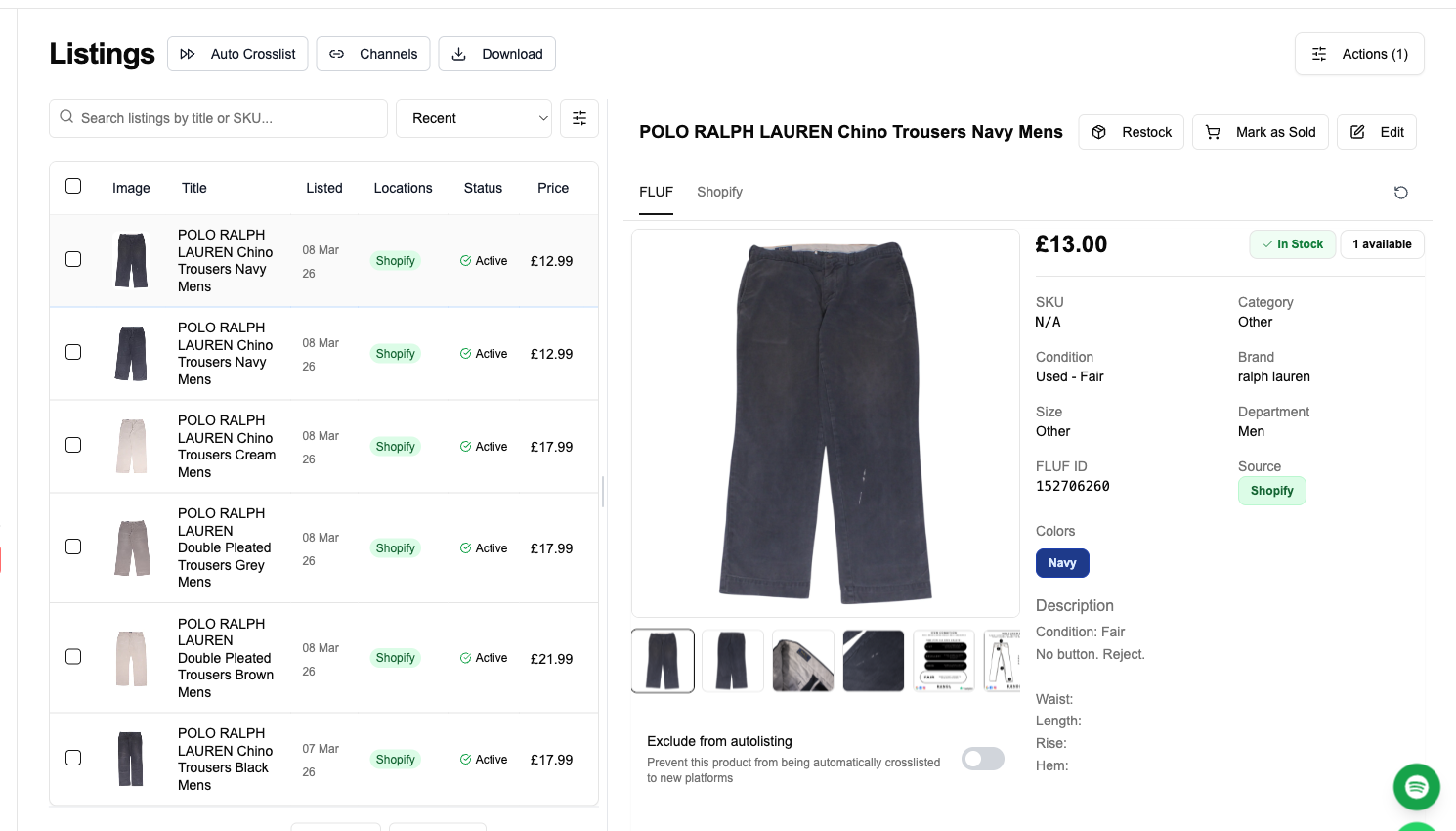
FLUF Connect reads your live Wallapop listings and republishes them on Yaga, reformatting each one into Yaga’s fashion catalogue as it goes. Both Wallapop and Yaga connect through the FLUF browser extension, so there are no API keys to paste — you select items and crosslist them in bulk.
- Create your FLUF Connect account and open the dashboard.
- Connect Wallapop via the FLUF browser extension — it reads your existing Wallapop listings, including title, description, price, photos and condition.
- Connect Yaga through the same extension; FLUF detects which Yaga country site your shop is on and sets the currency and courier options accordingly.
- Import your Wallapop catalogue — pull in everything, or filter by category, brand or price.
- Review the mapping — FLUF pre-fills Yaga’s brand, size, condition and category from your Wallapop data and flags anything fashion-specific that needs a value.
- Select and crosslist — publish to Yaga individually or hundreds at a time.
- Your listings go live on Yaga with images, price and details in place.
Behind the scenes, FLUF maps each Wallapop field to its Yaga equivalent, uploads the photos, translates Wallapop’s general condition language into Yaga’s fashion grading, and publishes the listing. You can set auto-crosslisting rules so any new Wallapop fashion listing is pushed to Yaga automatically, and crosslist your whole back-catalogue in a single bulk run.
How FLUF compares to manual crosslisting
Generic crosslisting tools rarely cover this specific pair — Wallapop and especially Yaga sit outside the US-centric channel rosters of Vendoo and List Perfectly. That leaves most Wallapop-to-Yaga sellers copying listings by hand across two apps in two languages and, often, two currencies. FLUF Connect bundles the crosslisting, the inventory sync and Yaga’s offer automation into one flat plan, so a Wallapop seller gets the listing and the post-listing automation in one place rather than a copy-paste workflow.
What Transfers When You Crosslist from Wallapop to Yaga?
The Wallapop-to-Yaga move is mostly a translation job. Wallapop is a general marketplace with loose, free-text categories; Yaga is a fashion catalogue that expects brand, size and a clothing-specific category on every listing. FLUF Connect does the restructuring so your general Wallapop entry becomes a proper Yaga fashion listing.
Field Mapping — Wallapop to Yaga
| Wallapop field | Yaga field | Transfer | Notes |
|---|---|---|---|
| Title | Title | ✅ Automatic | Carries over; brand and item type kept at the front for Yaga search |
| Description | Description | ✅ Automatic | Free-text transfers as written |
| Photos | Photos | ✅ Automatic | Wallapop allows up to 10; the first images transfer to Yaga |
| Price | Price | ✅ Automatic | EUR by default; converted to your Yaga shop’s currency (ZAR/KES) where the site differs |
| Brand | Brand | ✅ Automatic | Pulled from Wallapop where present |
| Category | Category | ⚡ Smart mapped | Wallapop’s broad tree maps to Yaga’s fashion taxonomy |
| Condition | Condition | ⚡ Mapped | Wallapop’s condition language maps to Yaga’s fashion grades |
| Size | Size | ⚡ Mapped | Yaga expects a clothing size; FLUF maps or flags it for input |
| Colour | Colour | ⚡ Mapped | Complete this detail if it is missing from the preview. |
| Shipping (Envíos) | Courier options | ⚠️ Set on Yaga | Yaga uses its own local couriers (e.g. Omniva/DPD in the Baltics, Paxi/PUDO in SA) |
| Non-fashion attributes | — | ❌ Not available | Yaga is fashion-only; electronics or motors don’t have a home there |
Field references: Wallapop shipping terms; Yaga fees & listing: Yaga Help Centre.
Category Mapping Examples
| Wallapop category | Yaga category | Notes |
|---|---|---|
| Moda y accesorios > Mujer > Vestidos | Women > Dresses | Brand and size become required on Yaga |
| Moda y accesorios > Hombre > Zapatillas | Men > Shoes > Sneakers | Shoe size mapped to Yaga’s size selector |
| Moda y accesorios > Bolsos | Accessories > Bags | Maps cleanly; condition grade applied |
Fields That Need Your Attention
Three friction points are worth knowing before crosslisting a large Wallapop catalogue to Yaga:
- Fashion-only catalogue. Yaga lists clothing, shoes and accessories. Any non-fashion Wallapop inventory — electronics, motors, household — has no place on Yaga, so FLUF crosslists the fashion subset only.
- Size and brand. Yaga’s fashion buyers filter by size and brand. Where a Wallapop listing left these loose, FLUF flags them so you can add a value before the item goes live.
- Currency and shipping. Wallapop is EUR. If your Yaga shop is South African (ZAR) or Kenyan (KES), FLUF converts the price and you choose Yaga’s local couriers — Wallapop’s Envíos labels do not carry across.
Inventory Sync Between Wallapop and Yaga — What Stays in Sync?
This is the most important part to get right, and we keep it honest: sync between Wallapop and Yaga is asymmetric because of what each platform allows a tool to do programmatically.
| Event | What happens | Timing |
|---|---|---|
| Item sells on Wallapop | Removed from Yaga automatically (Yaga supports programmatic mark-as-sold) | Within minutes |
| Item sells on Yaga | FLUF detects the order, but you remove the Wallapop listing manually — Wallapop has no programmatic delisting | Manual step on Wallapop |
| Price changed in FLUF | Pushed to both channels | On next sync |
| Item deleted in FLUF | Delisted from Yaga; Wallapop removed manually | Yaga within minutes |
| New Wallapop fashion listing (auto-rule on) | Crosslisted to Yaga | Automatically |
When an item sells on Wallapop, FLUF Connect’s order sync catches the sale and uses Yaga’s mark-as-sold to pull the item from Yaga automatically — no double-selling. When an item sells on Yaga, FLUF still records the order, but because Wallapop offers no programmatic way to delist, you take the Wallapop listing down yourself. It’s one manual step in one direction, and we’d rather tell you that up front than pretend otherwise.
What to keep in mind: both Wallapop and Yaga are extension-based channels, so availability syncs whenever the FLUF extension runs — minutes, not seconds. Order details flow into FLUF from both sides, which is how the Wallapop sale can trigger the automatic Yaga removal. Inventory sync keeps price and availability aligned across every connected channel, with the one honest Wallapop-side manual delist noted above.
Crosslisting from Wallapop to Yaga: Before and After FLUF Connect
Without FLUF Connect (manual)
- Open the Wallapop listing and copy the title and description.
- Download or screenshot every photo.
- Open the Yaga app and start a new listing.
- Re-type the title and description, translating where needed.
- Upload photos one by one.
- Pick the right Yaga fashion category from a different taxonomy.
- Fill in brand, size and condition to Yaga’s fashion grading.
- Convert the price into your Yaga shop’s currency.
- Choose Yaga’s local courier options.
- Publish — then note in a spreadsheet that it’s live on both.
- When it sells on either side, go to the other platform and pull it down.
Resellers consistently report manual cross-listing taking around 5–15 minutes per item — before you account for tracking what’s live where.
With FLUF Connect
- Select the Wallapop fashion items in your FLUF dashboard.
- Click crosslist to Yaga.
- Confirm the pre-filled brand, size and category.
- Done — a Wallapop sale auto-removes the item from Yaga; a Yaga sale just needs a quick Wallapop delist.
Manual: roughly 15–25 hours of copying, translating and tracking. With FLUF Connect: under an hour, plus the occasional manual Wallapop delist when something sells on Yaga. That’s most of a working week back to source and photograph.
Automation Features for Wallapop and Yaga Sellers
Crosslisting is the start. The automation that keeps both channels selling is where FLUF earns its keep — and the strongest lever on this pair sits on the Yaga side.
Offer management on Yaga
Yaga lets sellers nudge interested buyers with offers, and FLUF can automate this for you — so the shoppers who liked or saved a piece on Yaga get a timely offer without you doing it by hand. See offer management for how the engine works across channels. Wallapop does not expose an equivalent offer mechanic to tools, so this is a Yaga-side advantage you gain by crosslisting.
Auto-crosslisting rules
Set a rule once — for example, “every new Wallapop listing in Women’s clothing” — and FLUF crosslists qualifying fashion items to Yaga automatically as you add them.
Bulk operations
Bulk-crosslist your entire Wallapop fashion back-catalogue, bulk-adjust prices, and find-and-replace across listings on both channels at once.
| Feature | Wallapop | Yaga |
|---|---|---|
| Crosslisting | ✅ | ✅ |
| Inventory sync | ✅ | ✅ |
| Order sync | ✅ | ✅ |
| Auto-remove on sale | ❌ (manual delist) | ✅ (mark-as-sold) |
| Offer management | ❌ | ✅ |
| Auto-relisting | ❌ | ❌ |
| Bulk operations | ✅ | ✅ |
Note that neither Wallapop nor Yaga supports automated relisting through FLUF — relisting runs on channels like eBay, Depop and Vinted. On this pair, the value is reach, sync and Yaga’s offers.
Which Wallapop items tend to do well on Yaga
Yaga is a fashion community, so the Wallapop inventory that travels best is clothing, shoes and accessories — branded womenswear, trainers, bags and everyday wardrobe staples in good condition. High-street and recognisable labels filter well in Yaga’s brand-led search. Bulky, non-fashion or heavily local-pickup Wallapop items (furniture, electronics, motors) don’t have a place on Yaga and are best left on Wallapop. Keeping your fashion subset live on both is low-risk: there’s no seller fee on Yaga to keep an item listed while it waits for the right buyer.
How Much Does It Cost to Crosslist from Wallapop to Yaga?
FLUF Connect charges a flat monthly subscription — there is no per-sale commission on top of each marketplace’s own fees. There is no free plan, but every new account gets a 7-day trial for £1; the entry plan is Starter at £9/month, with no cap on how much you list.
| Plan | Monthly | Crosslisted products |
|---|---|---|
| Starter | £9/month | Unlimited |
| Pro | £29/month | Unlimited |
| Super Seller | Custom pricing — tell us what you need | Unlimited |
Every plan includes crosslisting, inventory sync, offers and bulk tools across all supported channels — not just Wallapop and Yaga — so you can add Vinted, Depop or eBay on the same plan. Automation is built into Seller and above, not a paid add-on. See the full pricing page.
Start crosslisting from Wallapop to Yaga
Take your Wallapop fashion to Yaga’s Baltic and South African buyers — and keep both in sync automatically.
Sources & Verification
- Wallapop monthly users (Spain): Statista
- Wallapop audience & geography: Similarweb
- Wallapop shipping (Envíos) & buyer protection fee: Wallapop shipping terms
- Naver acquisition of Wallapop (2025): The Korea Herald
- Yaga fees & buyer protection: Yaga Help Centre
- Yaga €4M raise & expansion (Oct 2025): EU-Startups; ArcticStartup
- Manual listing time: Vendoo
Frequently Asked Questions
FLUF Connect plans start at £9/month (Starter). There is no free plan, but every new account gets a 7-day trial for £1. Every plan includes crosslisting, inventory sync, bulk tools across all supported channels, so you can connect more marketplaces than just Wallapop and Yaga on the same plan, and Pro and above add offers. You still pay each marketplace's own fees — Wallapop's shipping handling on Envíos sales, and Yaga's buyer-paid protection fee.
Sync is asymmetric, and we keep it honest. When an item sells on Wallapop, FLUF detects the order and removes it from Yaga automatically because Yaga supports programmatic mark-as-sold. When an item sells on Yaga, FLUF records the order but cannot auto-remove it from Wallapop — Wallapop has no programmatic delisting — so you take the Wallapop listing down yourself. It's one manual step, in one direction only.
FLUF Connect detects the Yaga sale through order sync, but you remove the Wallapop listing manually. Wallapop does not expose a way for tools to delist on your behalf, so this is a quick manual step you do on Wallapop. In the other direction — a Wallapop sale — FLUF removes the item from Yaga automatically.
No. Yaga is a secondhand fashion marketplace for clothing, shoes and accessories. Electronics, motors, furniture and other general Wallapop categories have no home on Yaga, so FLUF crosslists only your fashion items and leaves the rest on Wallapop.
It follows your Yaga shop's country. Yaga lists in EUR in the Baltics (Estonia, Latvia, Lithuania), ZAR in South Africa, and KES in Kenya. Wallapop is EUR-led, so FLUF converts the price into your Yaga site's currency automatically where they differ.
Yes. Yaga lets sellers send offers to interested buyers, and FLUF can automate this so shoppers who liked or saved your item get a timely offer. Wallapop does not expose an equivalent offer mechanic to tools, so offer automation on this pair runs on the Yaga side.
Once both accounts are connected through the FLUF browser extension, selecting items and crosslisting takes seconds, and listings appear on Yaga shortly after. You can crosslist your whole Wallapop fashion back-catalogue in a single bulk run rather than one item at a time.
Yes. The same FLUF Connect plan lets you crosslist from Wallapop to Yaga, Vinted, Depop, eBay and other supported marketplaces simultaneously, with inventory kept in sync across all of them.
Yes. Both Wallapop and Yaga connect through the FLUF browser extension, which reads your existing listings on each. There are no API keys to copy or paste.