
Crosslist from Designer Wardrobe to Depop — Reach a Young Global Fashion Audience
List your Designer Wardrobe pre-loved fashion on Depop's 30M+ global Gen-Z buyers — from one dashboard, with stock kept in sync automatically.



Key Takeaways — Designer Wardrobe to Depop
- Designer Wardrobe is Australasia’s largest pre-loved fashion community — 350,000+ members across New Zealand and Australia, with more than 1M items sold and roughly NZD $1.6M in transactions each month, trading in women’s designer and contemporary labels via the escrow-style DW Wallet (source).
- Depop is a global social-commerce app with 30M+ registered users across 150 countries, of whom roughly 90% are under 26 — a Gen-Z, trend-led, shipping-first buyer base far beyond Australasia (source, source).
- Depop charges 0% seller fees in the UK and (from 15 July 2024) the US — the marketplace fee moved to the buyer side — so the platform economics reward listing wide and often (source).
- FLUF Connect copies each Designer Wardrobe listing’s title, description, photos, price (currency-converted), condition, brand and category to Depop, smart-mapping fields the two platforms don’t share.
- On Depop, FLUF runs the full automation set — relisting, offers, two-way order sync and automatic mark-as-sold — and when an item sells on either side, it comes down on the other so you never oversell.
- Plans start at £9/month (Starter). There is no free plan, but every new account gets a 7-day trial for £1. Automation is included in every plan, not a paid add-on.
If you sell women’s designer and contemporary pre-loved fashion on Designer Wardrobe, you already know its strengths: a trusted, women-led community across New Zealand and Australia, wallet-based payments that keep buyer details out of your hands, and buyers who understand labels. But that community, however large for the region, is bounded by the Tasman. The 30-something Kate Sylvander blazer or barely-worn Scanlan Theodore dress that a Christchurch or Melbourne buyer would love is invisible to the millions of trend-led shoppers browsing Depop in London, Los Angeles, Berlin and beyond.
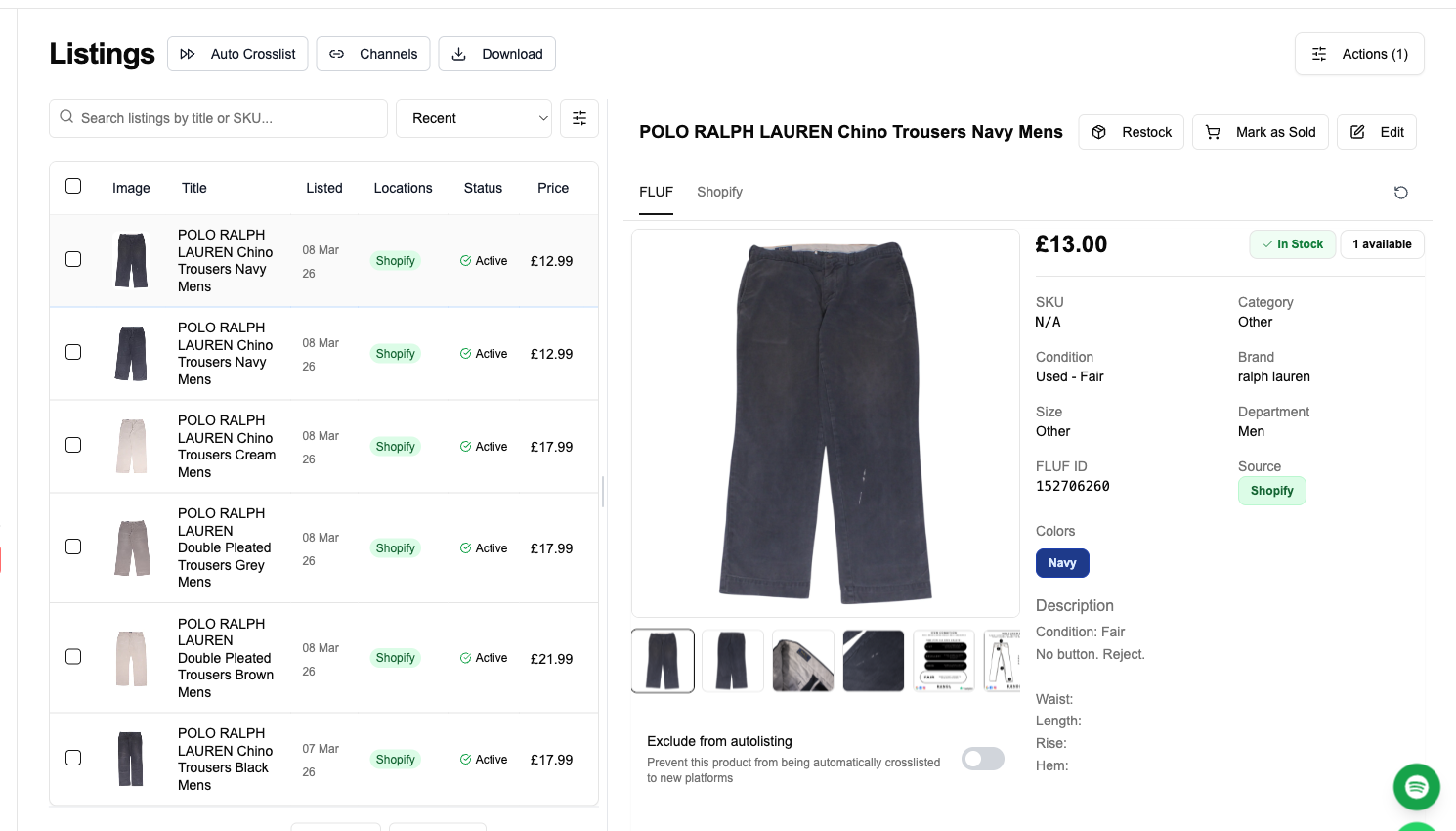
Designer Wardrobe and Depop don’t talk to each other. There is no native export, no shared catalogue, no way to keep stock levels aligned when the same jacket is listed in two places. FLUF Connect bridges that gap: you connect your Designer Wardrobe inventory once, import it, and crosslist to Depop — and then FLUF keeps the two in sync so a sale on one automatically pulls the item from the other. This page explains why the two platforms complement each other so well, exactly what transfers, and how the economics work.
Why Sell on Both Designer Wardrobe and Depop?
The case for adding Depop to a Designer Wardrobe operation is fundamentally about audience — reach, age and geography — and about which of your pieces travel well to a different kind of buyer.
Geography: escape the Tasman ceiling. Designer Wardrobe is deliberately regional. It is Australasia’s largest pre-loved fashion community with 350,000+ members, and it only expanded from New Zealand into Australia in October 2024 (source). That regional focus is a genuine strength for trust and shipping, but it caps your potential buyer pool at the size of two national markets. Depop operates in 150 countries with 30M+ registered users, and its strongest markets are the US (its largest) and the UK (source). Listing the same wardrobe on both means an item that stalls in a thin regional pool can find a buyer among tens of millions elsewhere.
Age and taste: reach a younger, trend-led shopper. Designer Wardrobe’s audience skews toward women buying designer and contemporary labels — a considered, brand-literate crowd. Depop is the opposite end of the resale spectrum: roughly 90% of its active users are under 26, a Gen-Z base that shops for vintage, Y2K and 90s pieces, streetwear and one-of-a-kind items as much as for names (source, source). For a Designer Wardrobe seller, that is a second demand curve entirely: pieces a 40-year-old NZ buyer passes over — a slightly loud contemporary print, a distinctly Y2K silhouette, a streetwear-adjacent label — are exactly what a 22-year-old on Depop is searching for.
Category fit: which DW items suit Depop. Not everything crosses equally. Depop is a fashion-resale app built around vintage, Y2K/90s, streetwear, designer and one-of-a-kind apparel. Your contemporary labels — the trend-forward, mid-tier and accessibly-priced end of a Designer Wardrobe closet — tend to perform best there, alongside any genuinely vintage or characterful pieces. Pure ultra-high-end couture is often better kept on a designer-specialist channel; the sweet spot for Depop is recognisable contemporary brands, interesting vintage and trend pieces that photograph well on a social feed. Crosslisting lets you place each item where it fits rather than betting your whole closet on one audience.
Fee economics reward breadth. Because Depop removed seller selling fees (UK earlier in 2024, US from 15 July 2024) and shifted the marketplace fee to the buyer, the marginal cost of having an extra listing live on Depop is effectively nil until it sells — and even then you keep the full agreed price minus payment processing (source). That structure specifically rewards sellers who list wide. The only real cost of breadth is the manual labour of duplicating listings and policing stock — which is exactly what FLUF Connect removes.
How to Crosslist from Designer Wardrobe to Depop with FLUF Connect
The workflow is designed so you keep managing one inventory, not two. Here is the end-to-end process:
- Connect your Designer Wardrobe as a source. Link your Designer Wardrobe account to FLUF Connect. FLUF imports your live catalogue — titles, descriptions, photos, prices and the item details it holds — so your existing DW listings become the master source, no re-keying required.
- Connect Depop as a destination. Authorise Depop in the same dashboard. FLUF supports full two-way integration with Depop, so this connection powers both crosslisting out and order/stock sync back in.
- Review and import your catalogue. Your Designer Wardrobe items appear in FLUF’s central inventory. You can bulk-edit, tidy titles, add Depop-friendly hashtags and styling notes, and set condition and brand before anything goes live.
- Crosslist to Depop — manually or by rule. Push selected items to Depop in bulk, or set auto-rules so that new Designer Wardrobe listings crosslist to Depop automatically as you add them. FLUF handles the currency conversion and category mapping in the process.
- Let sync run. Once items are live on both, FLUF keeps them aligned. A sale on Designer Wardrobe pulls the item from Depop; a sale on Depop marks it sold and delists it from Designer Wardrobe and any other connected channel — automatically.
The same dashboard manages every other channel FLUF supports too, so adding Vinted, eBay, Etsy or Vestiaire Collective later is the same three-click connection, not another spreadsheet.
What Transfers When You Crosslist from Designer Wardrobe to Depop?
FLUF Connect maps each field from your Designer Wardrobe listing to its Depop equivalent, smart-converting where the two platforms differ. Here is what moves and what to watch for:
| Field | Transfers? | Notes |
|---|---|---|
| Title | Yes | Depop titles are short and hashtag-driven; FLUF carries your title and you can add Depop-style keywords (brand, era, style) for the social feed’s search. |
| Description | Yes | Full description copies across. Add measurements and a Y2K/vintage/streetwear framing where the piece suits Depop’s audience. |
| Photos | Yes | All images transfer. Depop is intensely visual and social — styled, well-lit shots outperform flat-lays. FLUF’s photo tools help you crop and clean up before pushing. |
| Price | Yes (currency-converted) | Your NZD/AUD price is converted to the buyer’s market currency (Depop trades in USD/GBP/EUR/AUD by region). Review pricing per market — Depop’s 0% seller fee means you keep more of the sticker price. |
| Category | Yes (smart-mapped) | Designer Wardrobe’s women’s-fashion taxonomy is mapped to Depop’s category tree automatically. |
| Condition | Yes | Pre-loved condition grading carries across so buyers see an accurate state. |
| Brand | Yes | Brand/label transfers — important on Depop, where designer and contemporary names are searched directly. |
| Variants | Size-dependent | Fashion resale is typically single-item (one size, one unit); FLUF treats each piece as a unique listing and keeps its stock at one across channels. |
The practical upshot: a listing you built once on Designer Wardrobe becomes a Depop listing in seconds, with the fields Depop shoppers actually search — brand, size, condition, style era — carried over intact rather than retyped. One caveat worth naming: Depop and Designer Wardrobe describe items differently. Designer Wardrobe leans into label and formal condition grading for a designer-literate buyer; Depop rewards a looser, keyword-rich, style-led description with hashtags. FLUF carries your source text across so nothing is lost, and then lets you layer on the Depop-native framing rather than starting from a blank listing. That is the difference between a mechanical copy and a listing that actually converts on a social feed.
Inventory Sync Between Designer Wardrobe and Depop — What Stays in Sync?
Crosslisting is only safe if stock stays aligned. Listing the same jacket in two places is a liability the moment one sells and the other doesn’t come down — you risk selling an item you no longer have, disappointing a buyer, and taking a hit to your rating. FLUF Connect closes that gap in both directions.
When an item sells on Depop: FLUF supports full order sync and automatic mark-as-sold on Depop, so a Depop sale is detected, the item is marked sold, and it is delisted from Designer Wardrobe and every other connected channel automatically. You don’t touch a thing.
When an item sells on Designer Wardrobe: FLUF’s order sync and mark-as-sold also run on Designer Wardrobe, so a DW sale — settled through the DW Wallet — pulls the matching Depop listing down straight away.
Because both platforms are covered for order sync and mark-as-sold, the two stay genuinely two-way in step: sell on either, and the other reflects it without manual intervention. That is what makes it practical to keep the same pre-loved wardrobe live in front of both an Australasian designer audience and a global Gen-Z one at the same time.
Crosslisting from Designer Wardrobe to Depop: Before and After FLUF Connect
| Task | Manual (before) | With FLUF Connect (after) |
|---|---|---|
| Listing an item on both | Build it on Designer Wardrobe, then rebuild it from scratch on Depop — retype title and description, re-upload photos, reset price. | Build once; push to Depop in a click, fields mapped automatically. |
| Currency | Manually convert NZD/AUD to the Depop market and re-enter. | Price converted automatically per market. |
| Keeping stock aligned | Remember to delist manually the moment anything sells anywhere. | A sale on either side auto-delists the other. |
| Handling offers on Depop | Watch the app and negotiate each one by hand. | Automated offer management within your rules. |
| Relisting to stay visible | Manually re-post older items to refresh them in the feed. | Automatic relisting keeps items fresh on Depop. |
| Adding a third or fourth channel | Another platform, another full re-listing workflow. | Same central inventory; one more connection. |
Automation Features for Designer Wardrobe and Depop Sellers
Depop is one of the channels where FLUF Connect runs its full automation suite. That matters, because Depop’s economics reward activity — listing wide, refreshing often, negotiating offers — and doing that by hand across a large closet is punishing. FLUF automates it:
- Automatic relisting. Depop’s feed rewards freshness; older listings sink. FLUF can relist your Depop items on a schedule so they resurface in front of new browsers without you re-posting each one manually.
- Offer management. Depop buyers negotiate. FLUF handles offers within limits you set — including a minimum acceptable price — so you engage buyers and close sales without living in the app.
- Two-way order sync. Orders and sales flow back into your central FLUF dashboard, keeping one accurate picture of stock across Designer Wardrobe, Depop and everything else you connect.
- Automatic mark-as-sold and cross-channel delist. The moment a piece sells, it is marked sold and removed everywhere else — the single most important protection against overselling a one-of-a-kind item.
- Bulk operations and central editing. Edit a price, description or photo once in FLUF and push the change out; run bulk crosslists and bulk edits across your whole inventory.
On the Designer Wardrobe side, FLUF’s role is order sync and mark-as-sold — the sync backbone that keeps your DW listings accurate as sales happen on Depop and elsewhere. Relisting and offer automation are Depop-side features; FLUF only claims automations a channel actually supports, so you always know what is running where.
Styling and Photography: Making DW Pieces Work on a Social Feed
Depop is a social-commerce app before it is a marketplace — buyers follow sellers, like items and scroll a visual feed. A listing that reads as a considered resale entry on Designer Wardrobe can be re-framed to earn attention on Depop without rebuilding it from scratch. FLUF lets you tailor the crosslisted version: lead with your most styled, best-lit photograph; add the hashtags and era/style keywords Gen-Z buyers search (the label, “y2k”, “vintage”, “streetwear”, a decade); and keep the description scannable with measurements up top. The underlying item is the same pre-loved designer piece — you are simply presenting it to a younger, trend-led audience in the language of its own platform. Because the heavy lifting (fields, photos, price, sync) is automated, the only creative work left is the framing that makes a piece stand out in the feed.
How Much Does It Cost to Crosslist from Designer Wardrobe to Depop?
Three cost layers matter: what each marketplace charges, and what FLUF costs.
Designer Wardrobe fees. Designer Wardrobe is free to sign up and list — there are no listing fees, and it charges a success fee only when an item sells. Sales under NZD $40 carry a flat $4.95 fee; sales above $40 are charged 12.95% commission (capped at a maximum fee of $249), plus a small payment-processing fee, calculated on the final value including shipping (source). Earnings settle into your DW Wallet after the buyer receives the item and can be withdrawn free (source).
Depop fees. Depop charges 0% seller selling fees on new listings in the UK and, since 15 July 2024, the US — the marketplace fee (in the US, up to 5% plus up to $1) sits on the buyer instead (source). Payment processing still applies on your side, and an optional Boost promotion is available if you want to pay to surface a listing — both are best treated as variable rather than fixed. The headline, though, is that as a seller you keep the agreed price minus processing, which is why Depop is such an efficient second channel for a DW closet. Depop also handles shipping, providing prepaid postage labels and in-app payments, so fulfilment is streamlined (source).
FLUF Connect pricing. Plans start at £9/month (Starter). There is no free plan, but every new account gets a 7-day trial for £1. Automation — relisting, offers, order sync, mark-as-sold — is included in every plan, not a paid add-on. See pricing for the full tiers. Set against the labour of manually duplicating and policing a two-platform inventory — and the cost of a single oversold, one-of-a-kind designer piece — a flat monthly fee that keeps everything in sync pays for itself quickly.
Put together: you list on Designer Wardrobe and Depop from one dashboard, pay each marketplace only its own selling fees when items sell, and pay FLUF one predictable monthly fee to remove the duplication and prevent overselling. It is worth being clear about where the money actually goes on a sale. On a Designer Wardrobe sale, DW’s success fee and processing come out of your DW Wallet settlement. On a Depop sale, the seller fee is zero, so your take is the price minus payment processing — a materially cleaner split for the same item. Deciding which channel to push a given piece toward, and at what price, becomes a genuine lever once both are live and in sync, rather than a guess made in isolation on a single platform.
Who Should Crosslist Designer Wardrobe to Depop?
This pairing suits the Designer Wardrobe seller whose closet includes contemporary, trend-forward and vintage pieces — not only pure high-end couture — and who wants demand beyond New Zealand and Australia. If you are a reseller clearing volume, the reach of 30M+ international buyers and Depop’s 0% seller fee make it an obvious second front. If you are an individual with a wardrobe of characterful pieces, Depop’s Gen-Z audience will value the vintage and Y2K items your regional designer buyers overlook. In both cases, the barrier has always been the manual work of running two platforms at once — and that is precisely what FLUF Connect automates, from the first crosslist to every subsequent sale-and-delist.
Sources & Verification
Designer Wardrobe fees (source); Designer Wardrobe how it works and DW Wallet (source); Designer Wardrobe community size and transactions (source); Designer Wardrobe Australia launch (source); Depop fee changes and geography (source); Depop monthly active users (source); Depop audience demographics (source); Depop category skew and shipping (source). Last verified: July 2026.
Frequently Asked Questions
Yes. FLUF Connect imports your Designer Wardrobe catalogue and crosslists it to Depop in bulk, or automatically as you add new items via auto-rules. Titles, descriptions, photos, prices, condition, brand and category all transfer, with currency conversion and category mapping handled for you.
Designer Wardrobe is Australasia's largest pre-loved community with 350,000+ members across New Zealand and Australia, but that's a regional pool. Depop has 30M+ users across 150 countries, roughly 90% under 26 — a global Gen-Z audience for vintage, Y2K, streetwear and contemporary designer pieces that your regional buyers may overlook.
Contemporary, trend-forward and vintage pieces perform best. Depop's under-26 audience shops for vintage, Y2K/90s, streetwear and recognisable contemporary labels. Pure ultra-high-end couture is often better kept on a designer-specialist channel, while accessible contemporary and characterful pieces thrive on Depop's social feed.
Depop removed seller selling fees — 0% in the UK and, since 15 July 2024, the US — moving the marketplace fee to the buyer side (up to 5% plus up to $1 in the US). Payment processing still applies on your side, and Boost promotion is optional. As a seller you keep the agreed price minus processing.
Yes, in both directions. FLUF supports order sync and mark-as-sold on both platforms, so a sale on Depop delists the item from Designer Wardrobe (and any other connected channel) automatically, and a Designer Wardrobe sale pulls the Depop listing down — protecting you from overselling one-of-a-kind pieces.
The full suite: automatic relisting to keep items fresh in the feed, offer management within your rules including a minimum price, two-way order sync, and automatic mark-as-sold with cross-channel delisting. Bulk operations and central editing apply across every connected channel.
FLUF converts your Designer Wardrobe price (NZD on.co.nz, AUD on.com.au) to the buyer's market currency — Depop trades in USD, GBP, EUR and AUD by region. You can review and adjust pricing per market, and Depop's 0% seller fee means you keep more of the sticker price.
Plans start at £9/month (Starter). There is no free plan, but every new account gets a 7-day trial for £1. Automation, including relisting, offers, order sync and mark-as-sold, is included in every plan and is not a paid add-on.