Crosslist from Designer Wardrobe to Trade Me — After the March 2026 Fee Cut
Trade Me dropped its casual success fee on 10 March 2026, so the same $150 dress costs $3.29 there and about $24 on Designer Wardrobe. But Trade Me listings cannot be withdrawn in their final hour — which decides how you list.
7 days for £1, then from £9/month.



- Trade Me stopped charging casual sellers a success fee on 10 March 2026. A $150 dress sold casually now costs about $3.29 in Ping fees. The same dress on Designer Wardrobe costs roughly $24. That is the whole commercial case for this route.
- Designer Wardrobe charges 12.95% above $40, a flat $4.95 below it, capped at $249 — on the item price plus shipping — and then card processing of 3% + 49c or Afterpay at 4.95% on top.
- Not everything can be listed on Designer Wardrobe. It brand-gates: listings are held for review and rejected with “Unaccepted Brand”. Trade Me takes anything.
- Use Buy Now, never auctions, for crosslisted stock. A Trade Me listing cannot be withdrawn during its final hour, at all — and withdrawing an auction costs $3. Buy Now listings are free to withdraw.
- Trade Me has no condition attribute in clothing. Colour, Style, Size and Brand exist as structured fields; condition goes in your title and description.
- Photos are generous: 20 per listing, all free, against Designer Wardrobe’s curated single-item format.
- Trade Me does not report clothing sellers to IRD. New Zealand’s platform reporting rules cover “relevant services” — rentals, ride-share, food delivery — not the sale of goods. Your income-tax obligation is unchanged.
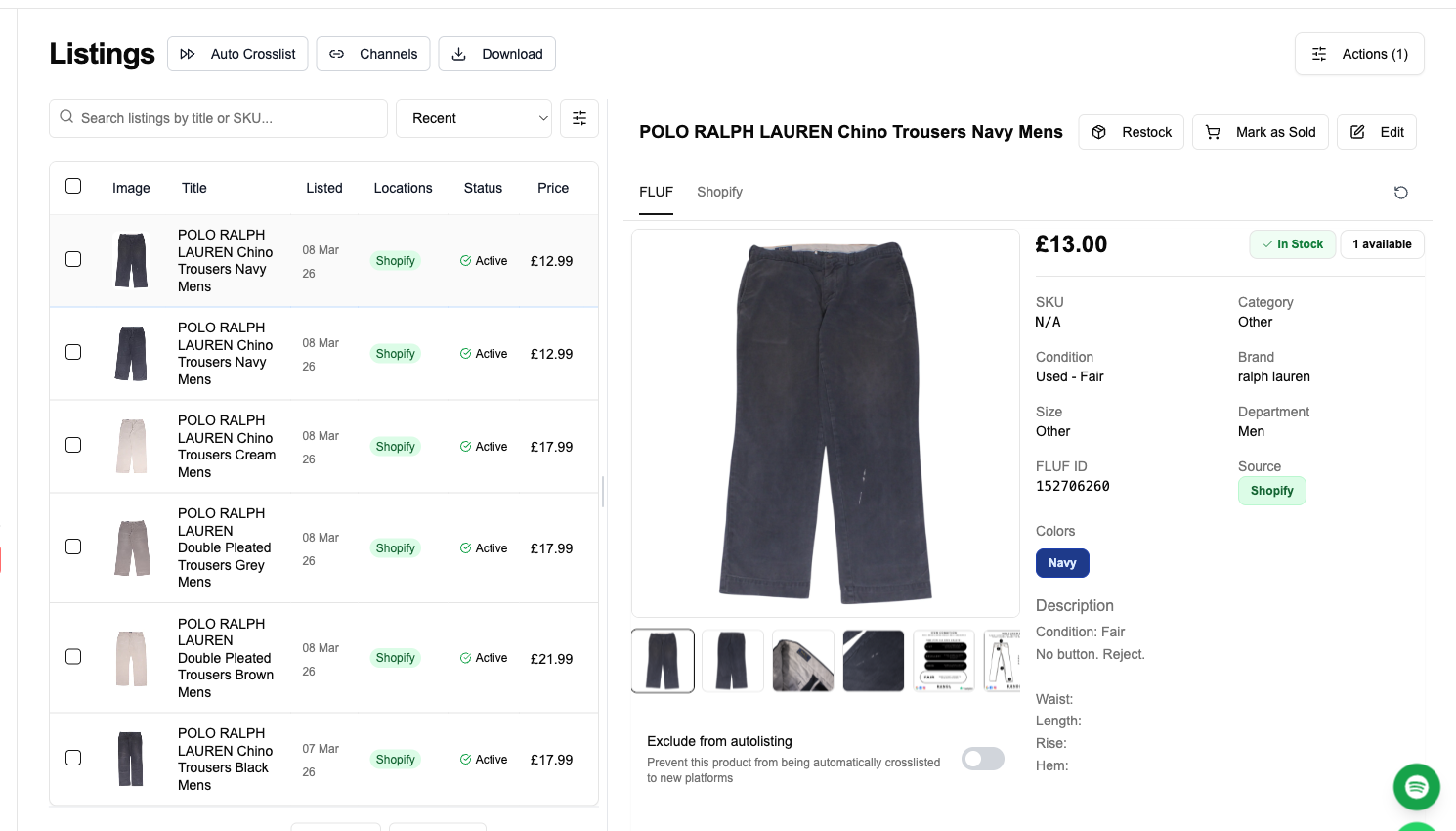
- Cost: FLUF Connect crosslists to 60+ marketplaces from one dashboard. £1 for 7 days, then plans from £9/month (Starter). There is no free plan.
What changed on 10 March 2026
If you last priced this comparison in 2025, redo it. Trade Me removed the 7.9% success fee for casual sellers on Marketplace, rolling out between 10 and 15 March 2026. Motors is excluded; general items are not.
What a casual seller pays now is close to nothing:
- Listing and relisting general items is free, within a free listing allowance of at least 50 — calculated as your highest weekly sales in the past six weeks multiplied by five. Beyond the allowance it is 10c a listing.
- Ping at 2.19% of item plus shipping, or 1.89% for Top Sellers. Afterpay is 4.95%. Cash is free.
- Bank transfer was removed as a payment option in the same change.
The money moved to the buyer, in the now-familiar pattern. Buyers on casual listings paid by Ping pay a Service Fee on the item price excluding shipping: free up to $20, then $0.99 to $100, $1.99 to $250, and $4.99 above that.
In-trade sellers are unaffected. If you are registered as a professional seller, success fees still apply at 5.9%, 7.9%, 9.9% or 11.9% by category, capped at $499, with a 15% discount for Top Sellers — and Clothing & Fashion sits at 11.9% across every subcategory. Your buyers pay no Service Fee. From 3 November new in-trade listings use Ping exclusively.
So this page has two audiences with genuinely different answers, and the split is worth being explicit about: for a casual seller Trade Me is now nearly free, and for an in-trade seller it costs 11.9% against Designer Wardrobe’s 12.95% — a difference of about one percentage point rather than an order of magnitude.
The fee gap, worked on a $150 dress
Designer Wardrobe is free to list. Its selling fee, as published, is a flat $4.95 on sales under $40 and 12.95% on sales over $40, capped at $249, applied to the final value — item price plus shipping — and deducted before funds reach your DW Wallet. Withdrawing to a bank account is free.
Payment fees sit on top of that. Online EFTPOS is free under $50 and 1.45% at $50 or more. Credit and debit cards cost 3% + 49c, minimum 50c. Afterpay and Klarna cost 4.95%, and buy-now-pay-later is enabled by default, though a seller can opt out.
| $150 dress | Designer Wardrobe | Trade Me, casual | Trade Me, in-trade |
|---|---|---|---|
| Listing | $0.00 | $0.00 within allowance | $0.00 within allowance |
| Selling fee | $19.43 (12.95%) | $0.00 | $17.85 (11.9%) |
| Payment fee | $4.99 (card, 3% + 49c) | $3.29 (Ping, 2.19%) | $3.29 (Ping) |
| Seller pays | ~$24.42 (16.3%) | $3.29 (2.2%) | ~$21.14 (14.1%) |
| Buyer pays extra | — | $1.99 Service Fee | — |
For a casual seller that is a seven-fold difference on the same garment. Even for an in-trade seller Trade Me is slightly cheaper, and considerably cheaper again if buyers pay by Afterpay on Designer Wardrobe, where 4.95% replaces 3% + 49c.
Two things the table does not capture. Designer Wardrobe holds your funds until delivery — released 24 hours after tracking marks the parcel delivered, or when the buyer confirms receipt, otherwise up to seven working days under the Purchase Protection window. And Designer Wardrobe’s fee applies to shipping as well as the item, so a $150 dress with $8 postage is charged on $158.
Optional Trade Me extras, if you want them: subtitle 55c, ten-day auction 25c, reserve 25c, scheduled end 25c, second category 99c, Gallery 55c, Feature $3.45, Feature Combo $3.95.
What Designer Wardrobe will not accept
This is the constraint that makes crosslisting necessary rather than optional, and it runs the opposite way to the fees.
Designer Wardrobe is a curated, premium marketplace, and it enforces that with brand gating. Listings are automatically flagged and held for review, typically for 12 to 24 hours, and can be rejected with the message “Unaccepted Brand — your listing contains a brand that we do not accept at this time”. There is also an image-recognition check that flags photographs which do not appear to be fashion.
Trade Me has no equivalent. Its Women’s Dresses category alone carries 571 brand options and it does not curate what you may sell.
So the two platforms cover different halves of a New Zealand reseller’s stock:
| Stock | Designer Wardrobe | Trade Me |
|---|---|---|
| Designer and premium labels | Accepted — its core market | Accepted, but competing with everything else |
| Mid-market and high-street brands | May be rejected as an unaccepted brand | Accepted |
| Unbranded or vintage without a label | Likely rejected | Accepted |
| Non-fashion items | Flagged by image recognition | Accepted — it is a general marketplace |
The obvious operating pattern falls out of that. List premium stock on both, list everything else on Trade Me, and let the review outcome tell you which is which rather than guessing at the brand list — which Designer Wardrobe does not publish in a readable form.
The auction trap, and why you should avoid it entirely
The sharpest practical risk on this route is not fees. It is the withdrawal rules.
Trade Me states that listings can be withdrawn at any time except during their final hour. Not “discouraged” — not possible. Withdrawing an auction also costs $3; Buy Now, multiple-quantity and classified listings are free to withdraw, and anything withdrawn within one hour of listing is free with fees refunded.
Now picture the failure mode. A one-of-one dress is live as a seven-day auction on Trade Me and listed on Designer Wardrobe. In the final hour, with bidding under way, it sells on Designer Wardrobe. You cannot withdraw. Somebody is going to win an auction for a garment you no longer have, and Trade Me is explicit that legitimate reasons to withdraw include an item “accidentally listed twice” — a description that fits, awkwardly, but only helps if you act before the last hour.
The mitigation is simple and free: use Buy Now only listings for anything crosslisted. They can be withdrawn at any time at no cost, there are no bidders to disappoint, and since the March change removed success fees for casual sellers there is no longer a fee argument for the auction format either. Trade Me auctions also auto-extend by two minutes if a bid lands in the final two minutes, which makes the closing time you planned around unreliable.
Worth noting what we could not confirm: several community threads claim Trade Me penalises accounts that withdraw listings with bids. The official help article does not say so. We are not repeating it as fact.
Field mapping: Designer Wardrobe listing to Trade Me listing
| Field | Trade Me equivalent | Transfer | Notes |
|---|---|---|---|
| Title | Title (80 characters) | ⚡ Rewritten | Trade Me has no condition field, so condition belongs here or in the description |
| Description | Description (2,048 characters) | ✅ Automatic | Generous, and worth filling — it carries condition, measurements and flaws |
| — | Subtitle (50 characters) | ⚠️ Optional, 55c | Rarely worth it for fashion |
| Photos | 20 photos, all free | ✅ Automatic | Minimum 500px on one side, maximum 5MB, PNG, JPG, BMP or GIF |
| Price | Buy Now price | ✅ Automatic | Use Buy Now, not an auction start price — see above |
| Brand | Brand attribute | ⚡ Mapped | 571 options in Women’s Dresses alone |
| Size | Size attribute | ⚡ Mapped | Trade Me runs 6 and under through to 34 and over |
| Colour | Colour attribute | ⚡ Mapped | 16 options |
| — | Style attribute | ⚠️ Manual | Casual, evening or other |
| Condition | No field exists | ❌ Prose only | Trade Me’s clothing categories have no condition attribute at all |
| Shipping | Shipping options | ⚡ Rebuilt | Designer Wardrobe’s Book a Courier starts at $7.92 domestically; Trade Me has its own arrangements |
Two structural notes. Trade Me listings default to seven days for general items, with 2 to 7 days allowed or 10 days for 25c, and there is no auto-relist — relisting is manual, free, and available within 45 days of closing, with watchlist members notified. So a slow-moving garment needs a hand every week, which is a real operational cost if you carry hundreds of pieces.
And Clothing categories cannot use classified listings, so the auction-versus-Buy-Now decision above is the only format choice you have. Variations with per-variant price and quantity do exist in Trade Me’s API for multiple-quantity listings, but treat that as a professional and API-level feature rather than something available in the casual seller interface.
Two different buyers
Designer Wardrobe was founded in 2014 and reported more than 350,000 members in a September 2025 release. Its buyer arrives expecting curated premium resale, which is why the brand gate exists and why a designer piece can hold its price there.
Trade Me is New Zealand’s general marketplace, owned by Apax since 2019. Its buyer arrives searching, from a base that spans everything from car parts to property. Third-party estimates put trademe.co.nz around 13.7 million visits in June 2026 and eleventh in New Zealand overall — a Semrush estimate rather than a Trade Me figure, and Trade Me itself publishes no current member count, so we are not quoting one.
We are also deliberately not giving you average-sale-price figures for either platform. Neither publishes them, and the numbers that circulate are invented. What can be said qualitatively, and is supported by each platform’s own behaviour, is that Designer Wardrobe’s brand gating exists precisely to protect a premium buyer expectation, and Trade Me’s category breadth exists precisely because it has none. That is the difference you are arbitraging: reach on one side, positioning on the other.
One company note for honesty: a Designer Wardrobe press release from September 2025 gives two figures that contradict each other — sales “exceeding $4 million in gross sales for both May and June 2025” and, in the same document, “around $1.6 million in transactions every month”. We are not quoting either.
What FLUF Connect syncs, and what it does not
What works. Designer Wardrobe supports relisting, order sync and sold-detection through FLUF Connect, so a Designer Wardrobe sale is picked up and can drop the item from your other channels automatically. That is the direction that matters most here, since Designer Wardrobe is where your premium stock is likeliest to sell first.
What does not. Trade Me is a create-and-publish channel in FLUF Connect. It does not report sales back, so there is no sold-detection, no order sync and no automatic delisting on the Trade Me side. If the dress sells on Trade Me, you must remove the Designer Wardrobe listing yourself.
Combine that with the withdrawal rule and the operating discipline writes itself. Buy Now listings only, so withdrawal is always possible and always free. Check Trade Me daily. And treat Designer Wardrobe as the automated side of the pair and Trade Me as the manual side, rather than assuming symmetry that does not exist.
GST, IRD and what Trade Me does not report
GST. Registration is required if your turnover was NZ$60,000 or more in the last 12 months, or is expected to be in the next 12. That is turnover, not profit, and it counts across both platforms together.
Income tax. Inland Revenue’s guidance on online trading is unusually direct, and worth quoting because it disposes of the most common misconception: “Any income you earn from a business (including online auctions or sales sites such as TradeMe) needs to be included in your income tax return. There is no minimum income level to be in business.” The tests it applies are whether you bought goods intending to resell them, whether you intended to profit, and whether you sell regularly. A reseller crosslisting across two marketplaces answers yes three times.
What Trade Me does not do. New Zealand’s platform information-reporting rules, in force since 1 January 2024, require New Zealand-resident platforms to report sellers of “relevant services” — property rental, ride-share, food delivery and personal services — filed by 7 February each year. Selling goods is out of scope. So Trade Me does not report your clothing sales to IRD, and neither does Designer Wardrobe. If a draft or a forum post tells you otherwise, it is wrong.
That is a statement about reporting, not about liability. Your obligation to declare the income is exactly the same either way; the difference is simply that IRD is not being handed the figures.
Sources and verification
- Trade Me Marketplace changes and Marketplace fees — the removal of the 7.9% casual success fee from 10 March 2026, Ping at 2.19%, Afterpay at 4.95%, the buyer Service Fee tiers, the in-trade success-fee bands including 11.9% for Clothing & Fashion, and the optional listing extras.
- Trade Me listing allowance — the minimum of 50 free listings and the 10c overage.
- Trade Me withdrawal rules — listings cannot be withdrawn in their final hour, the $3 auction withdrawal fee, and the legitimate reasons for withdrawal.
- Trade Me listing duration and relisting and photo specifications — the seven-day default, the manual 45-day relist window, auction auto-extension, and 20 free photos at 500px minimum.
- Trade Me listing API and the public category details endpoint — the 80-character title, 50-character subtitle, 2,048-character description, the Colour, Style, Size and Brand attributes in Women’s Dresses, the absence of a condition attribute, and the unavailability of classified listings in clothing.
- Designer Wardrobe fees and payment fees — the $4.95 flat fee under $40, 12.95% above it, the $249 cap, application to item plus shipping, and the EFTPOS, card and buy-now-pay-later rates.
- Designer Wardrobe payouts — funds held until delivery, released 24 hours after tracking marks delivered or within the seven-working-day Purchase Protection window.
- Designer Wardrobe listing review — the 12-to-24-hour hold, the “Unaccepted Brand” rejection and the image-recognition check.
- Designer Wardrobe couriers and international sales — domestic Book a Courier from $7.92, the 45×36cm bag limit, and NZ-to-Australia shipping.
- Inland Revenue on online trading — “there is no minimum income level to be in business” and the intention-to-resell tests; GST registration at NZ$60,000; and the platform reporting rules confirming that only relevant services, not goods, are reportable.
- Designer Wardrobe company release, September 2025 — founded 2014, 350,000+ members, and the two contradictory sales figures we have not quoted.
What we could not verify, and therefore left out. Designer Wardrobe’s photo limit per listing and its listing duration or expiry rules, which its help centre does not state. Its accepted-brand list, which is behind a bot wall, so we have not quoted a brand count. Whether a “DW Valet” consignment service is still offered — an agreement document exists but is not linked from the current help centre and may be retired. Any 2024 to 2026 acquisition or restructure of Designer Wardrobe, for which we found no evidence. Trade Me’s current member count, its Clothing & Fashion listing count, and average sale prices on either platform, none of which are published. NZ Post’s parcel rates, which sit behind a dynamic rate finder. And the community claim that Trade Me penalises accounts for withdrawing listings with bids, which the official help article does not support.
Related guides
Frequently Asked Questions
For a casual seller, dramatically. Trade Me removed the 7.9% success fee for casual sellers on Marketplace between 10 and 15 March 2026, so a $150 dress now costs about $3.29 in Ping fees at 2.19%. The same dress on Designer Wardrobe costs roughly $24 — 12.95% selling fee plus card processing at 3% + 49c. For an in-trade seller the gap is much narrower: Trade Me charges 11.9% across Clothing & Fashion, so about $21 on the same dress.
Listing is free. The selling fee is a flat $4.95 on sales under $40 and 12.95% on sales over $40, capped at $249, and it applies to the final value — item price plus shipping — deducted before funds reach your DW Wallet. Withdrawing to a bank account is free. Payment fees sit on top: online EFTPOS is free under $50 and 1.45% at $50 or more, credit and debit cards cost 3% + 49c with a 50c minimum, and Afterpay or Klarna cost 4.95%. Buy-now-pay-later is enabled by default but you can opt out.
Most likely brand gating. Designer Wardrobe automatically flags listings and holds them for review, usually 12 to 24 hours, and rejects some with "Unaccepted Brand — your listing contains a brand that we do not accept at this time". It also runs an image-recognition check that flags photographs which do not appear to be fashion. It is a curated premium marketplace and enforces that. Trade Me has no equivalent gate, which is precisely why the two work well as a pair: premium stock goes on both, everything else goes on Trade Me.
Buy Now, always. Trade Me states that listings can be withdrawn at any time except during their final hour — not discouraged, not possible — and withdrawing an auction costs $3, while Buy Now, multiple-quantity and classified listings are free to withdraw. The failure mode is concrete: a one-of-one dress sells on Designer Wardrobe during the final hour of its Trade Me auction and you cannot pull it, leaving a winning bidder with nothing. Since the March change removed casual success fees there is no longer any fee argument for auctions either.
No. The Women's Dresses category carries Colour with 16 options, Style, Size from 6-and-under to 34-and-over, and Brand with 571 options — but there is no condition attribute at all. Condition has to go in your 80-character title or your description, which has 2,048 characters to work with. If you are moving listings from a platform where condition is a structured field, that data has nowhere to land and will be silently dropped unless you write it into the prose.
Twenty, and all twenty are free. Images need to be at least 500 pixels on one side, no more than 5MB, in PNG, JPG, BMP or GIF format. That is generous by marketplace standards and worth using in full for secondhand clothing — full-length, detail, label, and honest photographs of any wear.
No, and this is a real operational cost at volume. General items default to seven days, with 2 to 7 days allowed or 10 days for 25c. There is no auto-relist: relisting is manual and free, available within 45 days of the listing closing, with watchlist members notified when you do it. If you carry hundreds of pieces, that is a weekly manual pass. Auctions also auto-extend by two minutes if a bid lands in the final two minutes, so the closing time you planned around is not fixed.
No. New Zealand's platform information-reporting rules, in force since 1 January 2024, require New Zealand-resident platforms to report sellers of "relevant services" — property rental, ride-share, food delivery and personal services — filed by 7 February each year. Selling goods is out of scope, so neither Trade Me nor Designer Wardrobe reports clothing sales. That is a statement about reporting only. Your obligation to declare the income is unchanged.
When your turnover was NZ$60,000 or more in the last 12 months, or you expect it to be in the next 12. That is turnover rather than profit, and it counts across both platforms together. Separately on income tax, Inland Revenue is blunt: "Any income you earn from a business (including online auctions or sales sites such as TradeMe) needs to be included in your income tax return. There is no minimum income level to be in business." The tests are whether you bought goods intending to resell, whether you intended to profit, and whether you sell regularly.
No — that direction is manual. Designer Wardrobe supports relisting, order sync and sold-detection through FLUF Connect, so a Designer Wardrobe sale is detected and can drop the item from your other channels automatically. Trade Me is a create-and-publish channel: it does not report sales back, so there is no sold-detection or automatic delisting on that side. Combined with the final-hour withdrawal rule, the working discipline is Buy Now listings only and a daily check of Trade Me.