
Crosslist from Trade Me to Depop — Automatically
Move your Trade Me fashion to Depop in minutes — photos, prices and details transfer automatically, and Depop relisting, offers and order sync run on autopilot.
7 days for £1, then from £9/month.



Selling fashion on Trade Me puts you in front of every clothing buyer in New Zealand — and only in New Zealand. Trade Me is the country’s biggest marketplace, with 6.1 million-plus active members, but it is a New Zealand-only site priced in NZD (Trade Me — Site stats). If you’re moving vintage, streetwear, Y2K or one-off pieces, the buyers who pay the most for them are often scrolling a different app entirely: Depop, the global fashion resale marketplace with more than 7 million active buyers and an audience that skews heavily under 34 (Depop — Facts and figures). Crosslisting your Trade Me wardrobe to Depop with FLUF Connect puts the same item in front of both audiences without you listing it twice.
This guide explains why Trade Me sellers with fashion and collectable clothing should be on Depop too, how FLUF Connect imports and crossposts your listings, what transfers, and exactly how the sync behaves between a New Zealand general marketplace and a global fashion app.
- Trade Me: New Zealand’s #1 marketplace — general goods, 6.1M+ members, NZ-only (source)
- Depop: global fashion resale — 7M+ active buyers, heavily under-34, strong in the US and UK (source)
- Fields that transfer automatically: title, description, photos, price, brand and condition
- What FLUF automates on Depop: crossposting, inventory sync, relisting, offers and order sync — Depop supports the full set
- Trade Me side: connects as a crossposting source; no two-way order sync or auto-relist on Trade Me itself
- Cost: From £9/month (Starter). There is no free plan, but every new account gets a 7-day trial for £1.
Why crosslist from Trade Me to Depop
The short answer: Trade Me gives you every fashion buyer in New Zealand; Depop gives you millions of style-led buyers around the world, most of them under 34. Crosslisting the fashion in your Trade Me shop to Depop puts each piece in front of both audiences from one catalogue — no second listing session, no doubled admin. For vintage, streetwear and designer resale in particular, the global Depop audience is often willing to pay more and buy faster than a domestic general-marketplace shopper.
Trade Me and Depop attract fundamentally different shoppers, and that difference is the whole opportunity. Trade Me is a general-goods marketplace where New Zealanders buy everything from whiteware to car parts to clothing (Trade Me — Most-viewed listings of 2025). Depop is a dedicated fashion community built around discovery, styling and resale culture, where buyers browse by aesthetic — vintage, grunge, cottagecore, designer — rather than by category tree.
The audiences barely overlap. Depop reports more than 7 million active buyers and tens of millions of registered users, with a base concentrated in the US and UK and skewing strongly toward Gen Z and younger millennials (Depop — Facts and figures). For a Trade Me seller sitting on vintage Levi’s, a rare band tee, a pair of hyped sneakers or a New Zealand designer piece, that global young-fashion audience will often pay more, and buy faster, than a domestic general-marketplace shopper ever would. Crosslisting means your one item is seen by both.
Depop sells through discovery, not search. Where a Trade Me buyer usually knows exactly what they want and types it into a search box, a Depop buyer scrolls a feed, follows sellers whose taste they like, and buys on impulse when a piece fits their aesthetic. That changes what a good listing looks like: styled photos, a clear vibe, relevant hashtags and a consistent shop identity matter more than a spec-sheet description. It also means the same denim jacket that reads as “used clothing” on Trade Me can read as “90s vintage Carhartt workwear” on Depop and command a premium — the item is identical, but the framing and the audience are not. Crosslisting lets you present it both ways at once.
Scarcity at home, demand abroad. New Zealand is a small market, so niche fashion — a specific era, a subcultural brand, a deadstock piece — may have only a handful of potential buyers domestically. On Depop’s global feed that same item competes for attention from millions of style-led shoppers actively hunting exactly that niche. This is why crosslisting fashion from a national marketplace to a global resale app is one of the highest-return moves a NZ reseller can make: you are not splitting your audience, you are adding a much larger, more motivated one on top of your local base.
| Trade Me | Depop | |
|---|---|---|
| Active buyers | 6.1M+ members (NZ) | 7M+ active buyers (global) |
| Primary age range | All ages, general population | Heavily under 34 (Gen Z / young millennial) |
| Top markets | New Zealand only | US, UK, and growing globally |
| Strongest categories | General goods, electronics, motors | Vintage, streetwear, Y2K, designer resale |
| Seller fees | Casual: buyer-paid service fee + 2.19% Ping | US/UK: $0 selling fee; 3.3% + $0.45 processing (10% selling fee outside US/UK) |
How the fees differ. Since March 2026 Trade Me removed the 7.9% success fee for casual sellers, moving the marketplace fee onto the buyer and leaving sellers with only the 2.19% Ping payment fee (RNZ — Trade Me drops success fee). Depop charges US and UK sellers no selling commission, only a payment-processing fee of 3.3% + $0.45 per order; sellers based outside the US and UK still pay a 10% selling fee on top of processing (Depop — Seller fees and charges). As a New Zealand-based seller you’ll fall into that 10%-plus-processing band on Depop, so price accordingly rather than copying your Trade Me figure across unchanged.
How to crosslist from Trade Me to Depop with FLUF Connect
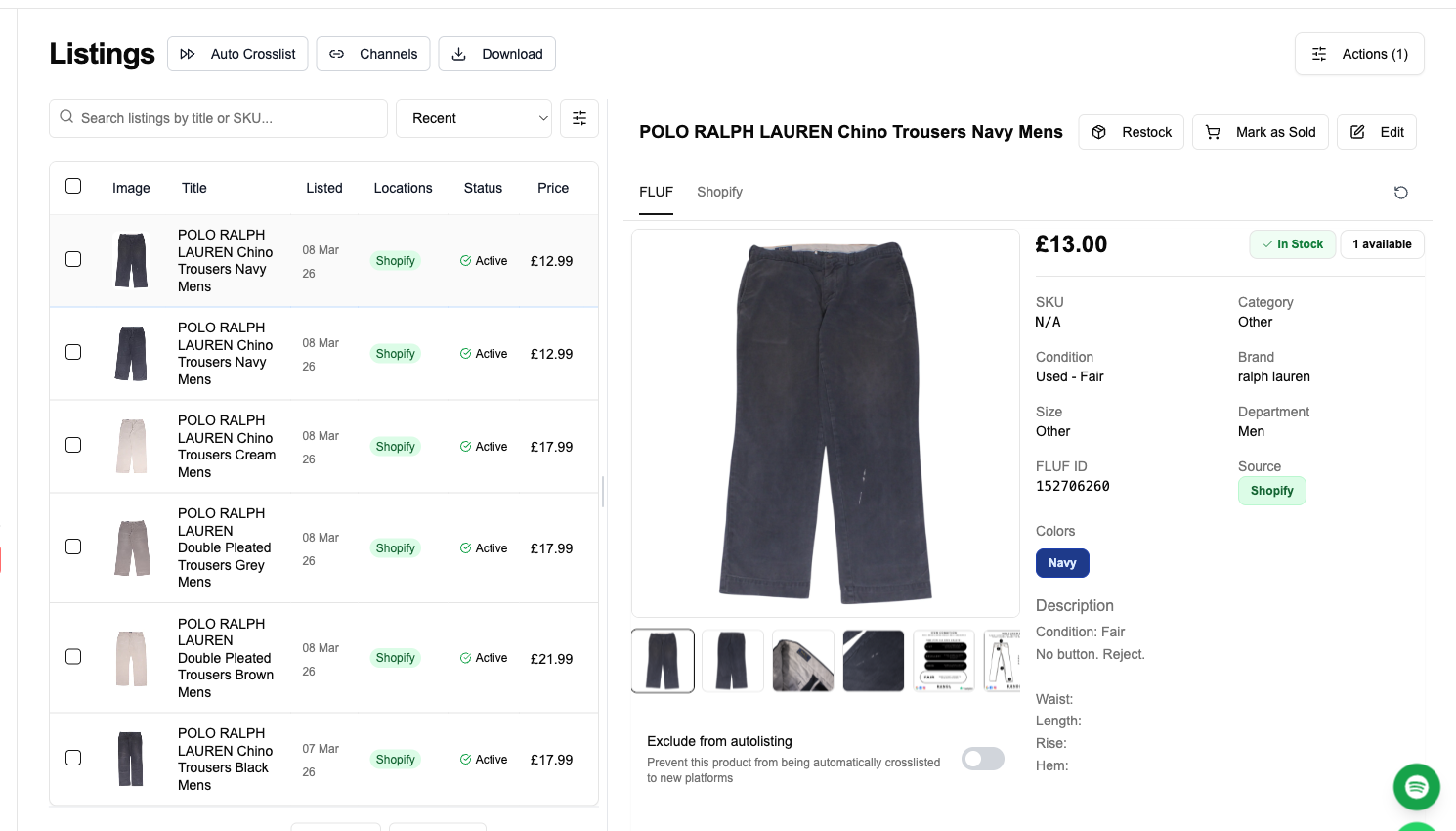
FLUF Connect holds your inventory once and crossposts it to 20+ marketplaces from one dashboard at /connect. For the Trade Me to Depop direction:
- Sign up for FLUF Connect and open /connect.
- Connect Trade Me through the FLUF browser extension, which reads your live Trade Me listings — titles, descriptions, photos, prices and conditions — into your catalogue.
- Connect Depop so FLUF can post to your real Depop shop.
- Style for Depop. FLUF pre-fills the Depop listing from your Trade Me data; you add the hashtags and aesthetic keywords Depop buyers search (brand, era, fit, vibe) and confirm price in the buyer’s currency.
- Crosspost a single item or a whole batch to Depop in a click.
- Automate. Depop relisting, offers, inventory sync and order sync then run inside FLUF for the Depop side.
Depop is a discovery platform, so the small amount of manual polish — good hashtags, a styled first photo, era and brand keywords — pays off more here than on a search-driven marketplace. FLUF gives you a per-channel description so you can write Depop’s copy in Depop’s voice without changing what appears on Trade Me.
If you already have a backlog of fashion on Trade Me, you don’t have to migrate it one item at a time. Select the clothing in your catalogue, apply a Depop-appropriate template, and bulk-crosspost the batch — FLUF pushes each one to Depop with its own photos, price and details, and you refine the highest-value pieces afterward. This is how sellers with hundreds of Trade Me listings get a Depop shop live in an afternoon instead of over weeks of manual re-entry.
Field & category mapping
- Title & description — carried across; you can rewrite the Depop copy to be more styling-led while your Trade Me listing stays as-is.
- Photos — your Trade Me images import and post to Depop, which is an image-first marketplace where the first photo does most of the selling.
- Price — imported in NZD and editable per channel; set your Depop price with Depop’s 10% (non-US/UK) selling fee and 3.3% + $0.45 processing in mind (Depop fees).
- Brand & condition — mapped to Depop’s fields, which matter a lot to fashion buyers filtering by label and quality.
- Category — Trade Me’s general-goods category is mapped to Depop’s fashion taxonomy (menswear, womenswear, accessories, and the sub-styles buyers browse).
Because Depop is fashion-only, the mapping works best for clothing, shoes, bags and accessories. Non-fashion Trade Me listings — electronics, homeware, tools — don’t belong on Depop and are better crosslisted to a general marketplace like eBay instead. FLUF lets you choose which items go to which channels, so your fashion goes to Depop and your general goods go where they fit.
Getting the Depop keywords right. Depop’s internal search and its recommendation feed both lean on the words in your title, description and hashtags. A Trade Me title like “Womens denim jacket size 12” is accurate but invisible on Depop; the same item wants “90s vintage oversized denim jacket grunge Y2K” plus brand and fit tags. FLUF keeps your Depop copy separate from your Trade Me copy, so you can optimise for Depop’s discovery mechanics — era, brand, silhouette, aesthetic — without rewriting your local listing. Spend the extra thirty seconds on tags for anything with a strong subcultural pull; it is the single biggest lever on how fast a Depop item sells.
Depop’s culture is its own. Owned by Etsy since 2021, Depop grew out of skate, streetwear and creative communities, and its buyers organise around aesthetics — grunge, cottagecore, gorpcore, coquette, avant basement — rather than departments. Sellers curate a shop identity, cultivate followers, and often style flat-lay or worn-on-model photography that reads more like a lookbook than a product catalogue. None of that maps onto how a general New Zealand marketplace works, which is exactly why the same garment can be reframed for a completely different, trend-literate buyer. Leaning into Depop’s subcultural vocabulary — naming the era, the movement, the silhouette — is how sellers plug into its recommendation feed and its community of tastemakers.
Sizing and measurements. Fashion resale buyers are cautious about fit, and Depop shoppers routinely ask for measurements. If your Trade Me listing already includes them, they carry across; if not, adding pit-to-pit, length and waist measurements to the Depop description reduces “will this fit me?” questions and returns. It’s a small edit that meaningfully improves conversion on a global audience who can’t try before they buy.
What syncs (and what doesn’t)
On the Depop side, FLUF runs the full automation set. Depop supports crossposting, real-time inventory sync, relisting, offer management and order sync (Depop channel overview). When an item sells on Depop, FLUF updates the quantity and can delist it from the other channels you manage in FLUF, which helps prevent you overselling a one-of-a-kind garment.
On the Trade Me side, sync is one-directional. Trade Me connects as a crossposting source through the browser extension; FLUF does not run two-way order sync, relisting or offers on Trade Me itself. So a sale on Trade Me won’t automatically pull the Depop listing. For one-off pieces, the safe habit is to close the Depop listing yourself if the item sells on Trade Me first. Everything flowing the other way — a Depop sale updating your catalogue — is fully automated.
Shipping to Depop buyers from New Zealand
Trade Me sales usually settle with domestic courier or local pickup, so the shift to Depop’s mostly-overseas buyers is the biggest practical change to plan for. Depop buyers are concentrated in the US and UK, and Depop is expanding its buyer base further, so most of your Depop sales will ship internationally from New Zealand. Weigh and measure each garment, quote realistic international postage, and build that cost into your Depop price — the same discipline you’d apply crosslisting to any global marketplace. Lightweight fashion travels well and cheaply relative to its value, which is part of why clothing is such a strong crosslisting category: a vintage tee costs little to post but can sell for many times its domestic price to the right overseas buyer. Set clear postage expectations in the listing and buyers rarely blink at international delivery for a piece they can’t find at home.
Before & after — a real workflow
Before FLUF. You list a vintage denim jacket on Trade Me. To reach Depop’s buyers you open the Depop app, re-shoot or re-upload the photos, rewrite the description in a styling voice, add hashtags, re-enter brand and size, and convert the price. Ten to fifteen minutes, and two listings to track.
After FLUF. The jacket is already in your catalogue from the Trade Me import. You open its card, add Depop hashtags and an aesthetic keyword or two, set the Depop price with fees factored in, and crosspost. Under a minute. Depop relisting and offers now run automatically, and a Depop sale updates the rest of your channels. Your only manual step is closing the Depop listing if it sells on Trade Me first.
Multiply that across a wardrobe and the time saving compounds. A reseller listing thirty pieces a week on Trade Me can crosspost the fashion among them to Depop in a few minutes rather than re-building thirty listings by hand — and with relisting on, those Depop listings keep resurfacing in the feed without any further work. The whole point is that reaching a second, larger audience should cost minutes, not a second full listing session.
Automation features for Trade Me + Depop
- Auto-relisting — Depop rewards fresh listings in its feed; FLUF can refresh yours on a schedule so they resurface without manual re-posting.
- Offer management — automatically handle offers on Depop with a minimum price floor you set.
- Inventory sync — keeps quantities aligned across the channels FLUF manages.
- Smart pricing — independent per-channel prices so your Depop figure carries its fees while Trade Me stays local.
Automation is included in every FLUF plan, not a paid add-on. For Trade Me + Depop the automation lives on the Depop side, while Trade Me remains your source channel. Relisting in particular is worth turning on: Depop’s feed favours recently-listed items, and scheduled refreshes keep your wardrobe visible to a fast-moving young audience without you touching the app. As you connect more channels, the same catalogue feeds them all and Depop’s order sync keeps stock aligned across everything.
Pricing
FLUF Connect plans start at £9/month (Starter). There is no free plan, but every new account gets a 7-day trial for £1. Every plan includes crosslisting plus the automation set — relisting, inventory sync, order sync — on the channels that support each feature and so automating Depop once your Trade Me fashion is crossposted costs nothing extra, and Seller and above add offers. Higher tiers lift the product cap for bigger closets, and every tier includes the same automation on the channels that support it. Setup is about ten minutes: connect Trade Me through the extension, connect Depop, crosspost your first pieces, and let relisting keep them fresh in the feed.
Sources & verification
- Trade Me — Site stats (6.1M+ active members)
- RNZ — Trade Me drops casual success fee (March 2026)
- Depop — Facts and figures (7M+ active buyers, under-34 skew)
- Depop — Seller fees and charges ($0 US/UK commission; 10% outside; 3.3% + $0.45 processing)
- Trade Me — Most-viewed Marketplace listings of 2025
Fees and buyer figures change — always confirm the latest on each marketplace’s official fees page before pricing.
Related guides
Frequently Asked Questions
Yes. FLUF Connect imports your Trade Me listings through its browser extension and crossposts them to your Depop shop. Titles, descriptions, photos, price, brand and condition are pre-filled, and you can add Depop hashtags and styling keywords before publishing — so you list once and reach Depop's global fashion buyers.
Not from the Trade Me side. Trade Me connects to FLUF as a crossposting source and does not run two-way order sync in FLUF. Depop supports full order sync and inventory sync, so a Depop sale can delist the item from your other connected channels — but if a one-of-a-kind item sells on Trade Me first, close the Depop listing manually to avoid a double sale.
Since March 2026 Trade Me removed the 7.9% success fee for casual sellers, leaving only the 2.19% Ping payment fee. Depop charges US and UK sellers no selling commission (only 3.3% + $0.45 processing per order), but sellers based outside the US and UK — including New Zealand — pay a 10% selling fee plus processing. Price your Depop listings with that in mind. Always check each platform's current fees page.
Fashion and collectable clothing — vintage, streetwear, Y2K, designer resale, rare sneakers and band tees. Depop is a fashion-only marketplace with an audience skewing heavily under 34, so clothing, shoes, bags and accessories perform best. Keep non-fashion Trade Me items (electronics, homeware, tools) on general marketplaces like eBay instead.
Yes. FLUF imports your Trade Me photos, title, description, price, brand and condition into your catalogue and maps them to Depop's fields. Depop is image-first, so your photos carry across and you can reorder them to lead with your strongest styled shot.
FLUF Connect plans start at £9/month on Starter, with Pro at £29/month and custom Super Seller plans above that; every plan is unlimited on listings and marketplaces, and the tiers differ by which automations they include and how often we check your channels for sales. There is no free plan, but every new account gets a 7-day trial for £1. Every plan includes crosslisting plus automation — relisting, inventory sync, order sync — on the channels that support each feature and which for this pair means the automation runs on the Depop side, and Pro and above add offers.