
Crosslist from Trade Me to Vinted — Automatically
Move your Trade Me fashion to Vinted in minutes — photos, prices and details transfer automatically, and Vinted relisting, offers and order sync run on autopilot.



On Trade Me you reach New Zealand’s biggest pool of buyers — 6.1 million-plus active members on the country’s dominant marketplace (Trade Me — Site stats). But Trade Me stops at the border: it’s a New Zealand-only site priced in NZD. For second-hand fashion, the largest audience in the world sits somewhere else entirely — on Vinted, the fee-free resale platform with more than 75 million members across Europe and, since January 2026, the United States (Vinted — Buyer Protection fee). Crosslisting your Trade Me wardrobe to Vinted with FLUF Connect puts every piece in front of both audiences from a single catalogue.
This guide explains why Trade Me sellers with pre-loved fashion should also be on Vinted, how FLUF Connect imports and crossposts your listings, what transfers automatically, and precisely how the sync behaves between a New Zealand general marketplace and Europe’s biggest second-hand app.
- Trade Me: New Zealand’s #1 marketplace — general goods, 6.1M+ members, NZ-only (source)
- Vinted: 75M+ members across Europe + the US; sellers pay 0% selling fees (source)
- Fields that transfer automatically: title, description, photos, price, brand and condition
- What FLUF automates on Vinted: crossposting, inventory sync, relisting, offers and order sync — Vinted supports the full set
- Trade Me side: connects as a crossposting source; no two-way order sync or auto-relist on Trade Me itself
- Cost: From £9/month (Starter). There is no free plan, but every new account gets a 7-day trial for £1.
Why crosslist from Trade Me to Vinted
The short answer: Trade Me gives you New Zealand’s buyers; Vinted gives you tens of millions of second-hand fashion buyers across Europe and the US, and it takes no selling fee from you at all. Crosslisting the fashion in your Trade Me shop to Vinted puts each piece in front of both markets from one catalogue, and the fee-free model means more of every Vinted sale stays in your pocket.
Vinted’s scale in second-hand fashion is hard to overstate. It reports more than 75 million members, is the category leader across sixteen European countries, and launched in the United States in January 2026 — extending that momentum into the world’s largest consumer market (Vinted — Buyer Protection fee). Its defining feature for sellers is the fee structure: Vinted charges sellers no listing fee, no final-value fee and no payment fee, so you keep 100% of your asking price. Instead, buyers pay a Buyer Protection fee of roughly 5% plus a small fixed amount at checkout (Vinted — Buyer Protection fee).
Compare that to Trade Me, where — even after the March 2026 removal of the casual success fee — sellers still pay the 2.19% Ping payment fee, and it becomes clear how different the two economics are (RNZ — Trade Me drops success fee). On Vinted a NZ seller keeps the full listed amount. The trade-off is logistics, which we cover below, but for everyday pre-loved clothing the combination of a vast audience and zero seller fees is exactly why Vinted has become the default resale channel across Europe.
| Trade Me | Vinted | |
|---|---|---|
| Members / buyers | 6.1M+ members (NZ) | 75M+ members (Europe + US) |
| Top markets | New Zealand only | 16 European countries + US |
| Strongest categories | General goods, electronics, motors | Everyday and vintage second-hand fashion |
| Seller fees | 2.19% Ping payment fee (casual) | 0% — sellers keep 100%; buyer pays protection fee |
| Listing format | Auctions & Buy Now | Fixed-price, image-led feed |
Two very different buyer bases. A Trade Me shopper is a New Zealander browsing a general marketplace. A Vinted shopper is one of tens of millions of Europeans or Americans hunting specifically for affordable second-hand fashion. There is almost no overlap, so listing on both does not split your demand — it stacks a huge new audience on top of your local one. For everyday brands, kidswear, and high-turnover pre-loved clothing especially, Vinted’s fee-free volume-driven model rewards a large, well-photographed catalogue.
Why the US launch matters. Vinted spent more than a decade becoming the default resale app across Europe before entering the United States in January 2026. For a Trade Me seller that timing is useful: the US market is still early, competition among established sellers is thinner than in mature European markets, and a well-stocked shop that lists consistently can build a following while the category is still forming. Getting your Trade Me fashion onto Vinted now, rather than in a year, means being present as that audience grows rather than arriving late to a crowded feed.
What sells best. Vinted is a volume marketplace, not a boutique. Its sweet spot is affordable, recognisable, everyday fashion — high-street brands, basics, kidswear, and the kind of pre-loved clothing a family clears out seasonally — sold quickly at fair prices with the seller keeping every cent. Rarer vintage and designer pieces sell there too, but the platform’s real engine is turnover: many items, priced to move, refreshed often. That maps neatly onto the tail of a Trade Me wardrobe — the everyday clothing that a New Zealand general marketplace prices thinly but Vinted’s specialised, fee-free audience will happily absorb.
How to crosslist from Trade Me to Vinted with FLUF Connect
FLUF Connect holds your inventory once and crossposts it to 20+ marketplaces from one dashboard at /connect. For the Trade Me to Vinted direction:
- Sign up for FLUF Connect and open /connect.
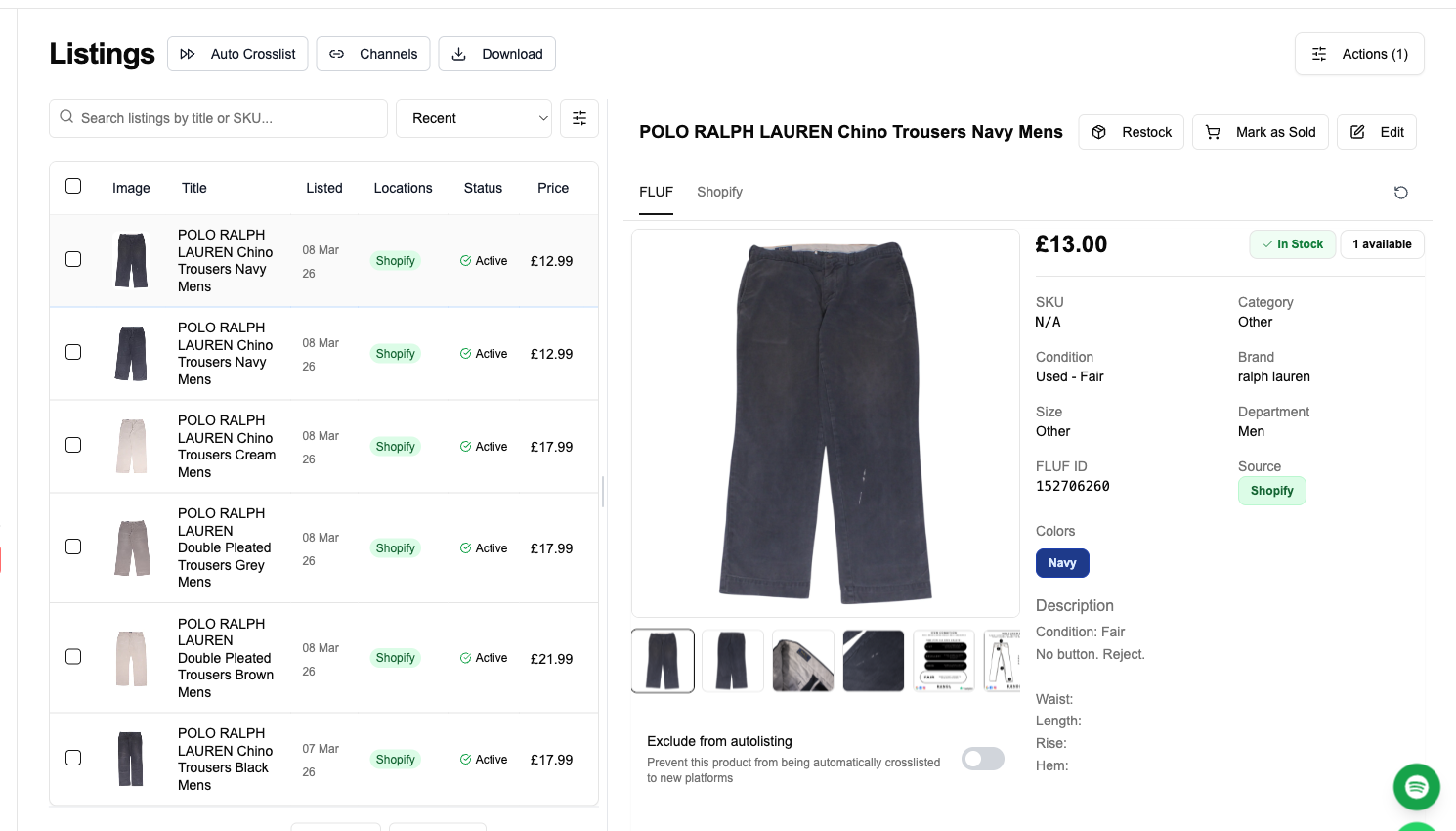
- Connect Trade Me through the FLUF browser extension, which reads your live Trade Me listings — titles, descriptions, photos, prices and conditions — into your catalogue.
- Connect Vinted so FLUF can post to your Vinted account.
- Prepare for Vinted. FLUF pre-fills the Vinted listing from your Trade Me data; you confirm brand, size, condition and category, and set the price knowing you keep 100% of it.
- Crosspost a single item or a batch to Vinted in a click.
- Automate. Vinted relisting, offers, inventory sync and order sync then run inside FLUF for the Vinted side.
Vinted’s buyers filter hard by brand, size and condition, so those structured fields matter more than long prose. FLUF maps them from your Trade Me listing where they exist and prompts you to fill any gaps, which keeps your Vinted listings complete and searchable.
Field & category mapping
- Title & description — carried across; Vinted descriptions are typically shorter and detail-led (brand, size, flaws, measurements).
- Photos — your Trade Me images import and post to Vinted, an image-first feed where clear, bright photos on a plain background convert best.
- Price — imported in NZD and editable per channel; because Vinted takes no seller fee, your listed price is close to what you receive, so you can often price competitively and still net more than on a fee-charging marketplace.
- Brand & size — mapped to Vinted’s structured catalogue, which buyers use as their primary filters; accurate brand and size tags are the difference between being found and being invisible.
- Condition — mapped to Vinted’s condition scale (New with tags, New without tags, Very good, Good, Satisfactory).
- Category — Trade Me’s general-goods category is matched to Vinted’s fashion taxonomy (women’s, men’s, kids’, and the item-type tree beneath).
Vinted is built around fashion and related categories — clothing, shoes, accessories, bags, and increasingly homeware and beauty — so the mapping is cleanest for wearables. General Trade Me goods that aren’t a fit for Vinted can be routed to eBay or Facebook Marketplace instead; FLUF lets you decide per item which channels each listing goes to, so nothing lands on a marketplace where it doesn’t belong.
How Vinted decides what buyers see. Vinted’s feed favours fresh and active listings, and its search leans heavily on the structured attributes — brand, size, colour, condition and category — rather than free text. That has two practical consequences for a crosslister. First, fill in every attribute FLUF surfaces; a listing missing its brand or size simply won’t appear in the filtered searches most buyers use. Second, keep listings active: bumping or relisting periodically resurfaces items that have sunk down the feed. FLUF’s relisting handles the second point automatically once your items are live, and its field mapping handles the first at crosspost time, so your Vinted shop stays both complete and visible without daily manual upkeep.
Bundles and follower-driven sales. A meaningful share of Vinted activity comes from buyers purchasing multiple items from the same seller and from repeat buyers who follow shops they like. A larger catalogue therefore compounds: every additional item you crosspost from Trade Me is another reason for a buyer to bundle, and another entry in the feed that can win you a follower. This is the opposite of a marketplace where each listing stands alone — on Vinted, breadth of stock is itself a growth lever, which is exactly what makes bulk-crossposting your existing Trade Me wardrobe so worthwhile.
What syncs (and what doesn’t)
On the Vinted side, FLUF runs the full automation set. Vinted supports crossposting, real-time inventory sync, relisting, offer management and order sync (Vinted channel overview). When an item sells on Vinted, FLUF updates the quantity and can delist it from the other channels you manage in FLUF, which helps prevent overselling a one-of-a-kind garment.
On the Trade Me side, sync is one-directional. Trade Me connects as a crossposting source through the browser extension; FLUF does not run two-way order sync, relisting or offers on Trade Me itself. A sale on Trade Me will not automatically pull the Vinted listing, so for one-off items close the Vinted listing yourself if it sells on Trade Me first. Sales flowing the other way — a Vinted sale updating your catalogue and delisting elsewhere — are fully automated.
Vinted’s European heartland and US expansion
Vinted’s footprint shapes who sees your listings. It is the category leader across sixteen European countries — its heartland spanning France, Germany, Lithuania, Poland, Spain, Italy, the Netherlands, Belgium, the Czech Republic and the Nordics among others — and it entered the United States in January 2026 (Vinted — Buyer Protection fee). Each market has its own local buyer base, its own popular high-street brands, and Vinted’s integrated shipping network within it. For a New Zealand seller the practical question is which of these markets you can serve, since Vinted’s prepaid-label logistics are built country-by-country rather than for cross-hemisphere posting. Many sellers focus on one or two markets where their stock resonates — recognisable European high-street labels for the continental markets, or broadly appealing basics for the newer US audience — and grow from there. The scale is the draw: even a single Vinted market dwarfs New Zealand’s population, and the fee-free seller model means the reach costs you nothing in commission.
Shipping and logistics
Vinted’s model is built around its own integrated, prepaid shipping labels within each market it operates in, which is part of why it feels frictionless for European buyers. As a New Zealand-based seller you’ll need to work out fulfilment to Vinted’s markets before you scale — whether that’s shipping internationally, using a forwarding arrangement, or focusing on the markets you can serve cost-effectively. This is the real trade-off against Vinted’s zero seller fees: you keep 100% of the sale, but you own the cross-border logistics. Start with lightweight, higher-value pieces where international postage is a small fraction of the price, prove the channel, then expand. FLUF handles the listing and sync; the shipping decision is yours, and it’s worth getting right before you crosspost hundreds of items.
A pragmatic approach many cross-border sellers take is to treat Vinted as a channel for a curated slice of the catalogue rather than the entire wardrobe on day one. Pick the pieces where the numbers clearly work — desirable brands, low weight, healthy margin — list those first, and refine your postage settings against real orders before opening the floodgates. Because FLUF keeps Vinted prices independent of Trade Me, you can bake shipping realities into the Vinted figure without disturbing your local listings, and expand the range you offer as your fulfilment gets more efficient.
Before & after — a real workflow
Before FLUF. You list a batch of pre-loved dresses on Trade Me. To reach Vinted’s audience you open Vinted, re-photograph or re-upload each one, re-enter brand, size and condition, pick a category, and set a price — for every single item. An hour of work to mirror a wardrobe, and two sets of listings to reconcile whenever something sells.
After FLUF. The dresses are already in your catalogue from the Trade Me import. You select them, confirm brand and size, and bulk-crosspost to Vinted. A few minutes for the batch. Vinted relisting and offers now run automatically; a Vinted sale updates your other channels. Your only manual task is closing a Vinted listing if the item sells on Trade Me first. The reach roughly multiplies while the workload barely moves.
The economics are worth restating. On the Trade Me sale you paid the Ping fee; on the equivalent Vinted sale you paid nothing as a seller. Across a season of everyday fashion, keeping 100% of every Vinted sale — while the listing effort was a few minutes of crossposting rather than a full re-entry — is precisely the kind of margin-and-time win that makes multi-channel selling worth setting up. The fee-free upside is real, provided you’ve planned the shipping side so it doesn’t eat the saving.
Automation features for Trade Me + Vinted
- Auto-relisting — Vinted’s feed rewards recent activity; FLUF can bump your listings on a schedule so they resurface to new buyers.
- Offer management — Vinted buyers love to negotiate; FLUF can handle offers automatically with a floor price you set.
- Inventory sync — quantities stay aligned across the channels FLUF manages.
- Smart pricing — per-channel prices so your Vinted figure (where you keep 100%) is set independently of your Trade Me price.
Automation is included in every FLUF plan, not a paid add-on. For Trade Me + Vinted the automation lives on the Vinted side, while Trade Me stays your source channel. Offer management is especially valuable on Vinted, where a large share of sales come through negotiation — letting FLUF auto-respond within your limits means you capture those sales without living in the app. As you connect further channels, the same catalogue feeds them and Vinted’s order sync keeps stock aligned across everything.
Pricing
FLUF Connect plans start at £9/month (Starter). There is no free plan, but every new account gets a 7-day trial for £1. Every plan includes crosslisting plus the automation set — relisting, inventory sync, order sync — on the channels that support each feature and so automating Vinted once your Trade Me fashion is crossposted costs nothing extra, and Seller and above add offers. Higher tiers raise the product cap for larger catalogues. Setup takes about ten minutes: connect Trade Me through the extension, connect Vinted, and crosspost your first pieces. From there, the practical rhythm is simple — keep adding stock to your catalogue, let it flow to both Trade Me and Vinted, and let relisting keep the Vinted listings surfacing while you concentrate on sourcing and shipping.
Sources & verification
- Trade Me — Site stats (6.1M+ active members)
- RNZ — Trade Me drops casual success fee (March 2026); Ping 2.19%
- Vinted — Buyer Protection fee (0% seller fees; buyer pays ~5% + fixed fee)
- Trade Me — Most-viewed Marketplace listings of 2025
Fees, member counts and market coverage change — always confirm the latest on each marketplace’s official pages before pricing and shipping.
Related guides
Frequently Asked Questions
Yes. FLUF Connect imports your Trade Me listings through its browser extension and crossposts them to Vinted. Title, description, photos, price, brand, size and condition are pre-filled and mapped to Vinted's structured catalogue, so you list once and reach Vinted's members across Europe and the US.
Yes. Vinted charges sellers no listing fee, no final-value fee and no payment fee — you keep 100% of your asking price. Instead, buyers pay a Buyer Protection fee of roughly 5% plus a small fixed amount at checkout. That fee-free seller model is a key reason to add Vinted alongside Trade Me. Always confirm current fees on Vinted's official page.
Not from the Trade Me side. Trade Me connects to FLUF as a crossposting source and does not run two-way order sync in FLUF. Vinted supports full order sync and inventory sync, so a Vinted sale can delist the item from your other connected channels — but if a one-of-a-kind item sells on Trade Me first, close the Vinted listing manually to avoid a double sale.
Vinted uses integrated prepaid shipping labels within each market it operates in. As a New Zealand-based seller you own the cross-border fulfilment to Vinted's markets, so plan your shipping approach before scaling — start with lightweight, higher-value pieces where international postage is a small share of the price. FLUF handles the listing and sync; the shipping method is your decision.
Pre-loved fashion — everyday clothing, kidswear, shoes, bags and accessories, plus vintage pieces. Vinted is built around second-hand fashion, so wearables map cleanest. Route non-fashion Trade Me goods to general marketplaces like eBay or Facebook Marketplace instead; FLUF lets you choose which channels each item goes to.
FLUF Connect plans start at £9/month on Starter, with Pro at £29/month and custom Super Seller plans above that; every plan is unlimited on listings and marketplaces, and the tiers differ by which automations they include and how often we check your channels for sales. There is no free plan, but every new account gets a 7-day trial for £1. Every plan includes crosslisting plus automation — relisting, inventory sync, order sync — on the channels that support each feature and which for this pair means the automation runs on the Vinted side, and Pro and above add offers.