Sell on GoTrendier — The Complete Guide for Mexico and Colombia
GoTrendier is the only fashion-native resale platform operating in both Mexico and Colombia. Fees, couriers, the human Style Team that moderates every listing, and exactly what FLUF Connect can and cannot automate on it.
7 days for £1, then from £9/month.



- GoTrendier is the only fashion-native resale marketplace that actually operates in Mexico and Colombia. Vinted does not trade in Latin America at all, Vestiaire Collective serves Brazil and nothing else in the region, and Poshmark withdrew from everywhere outside the US and Canada in 2023. If you want a structured secondhand fashion audience in MXN or COP, this is the platform.
- The commission is wildly different in the two countries it runs. Mexico charges 18% + $19 MXN per sale, IVA included. Colombia charges 9.99% + $3,999 COP. Same app, same brand, nearly double the rate on one side of the border.
- Every listing is reviewed by a human before it goes live. GoTrendier’s “Style Team” checks uploads daily and rejects photos with text or emojis on them, bundles, missing measurements, brand mismatches and unproven luxury items. Bulk-pushing a catalogue without reading the rules gets you a queue of rejections, not a shop.
- FLUF Connect creates and manages GoTrendier listings — and nothing else. No relisting, no offer management, no order sync, no automatic mark-as-sold. A sale on GoTrendier will not pull into FLUF as an order and will not delist that item on your other channels. You mark it sold in FLUF yourself, and FLUF then clears it everywhere that supports it. That is the honest position and this page states it early, not in the small print.
- The buyer pays shipping, not you. $79 MXN via Estafeta or $49 MXN via PuntoPost in Mexico, a flat $9,500 COP via Servientrega in Colombia. You print a label and drop the parcel within seven business days or the order is cancelled and refunded.
- Cost: FLUF Connect is £1 for 7 days, then plans from £9/month (Starter). There is no free plan. Local currency is charged at the local equivalent, so the trial lands as roughly 19 pesos in Mexico rather than a pound.
What GoTrendier is, and who is actually on it
GoTrendier is a mobile-first peer-to-peer marketplace for secondhand clothing, bags, shoes and accessories, operating in Mexico through gotrendier.mx and in Colombia through gotrendier.com.co. Sellers photograph items from their own wardrobe, list them at their own price, and the platform takes a commission when the item sells and is delivered.
The company was founded in 2016 in Mexico by Belén Cabido Aresti and David Garzón, and opened its Colombian operation in 2017 with co-founder Ana Jiménez as country manager. In March 2019 it merged with the Spanish resale app Chicfy, a deal the two companies presented at the time as creating the largest Spanish-language secondhand fashion platform, with a combined eight million users and a twelve-million-product catalogue (Contxto, 27 March 2019). Funding has been modest but steady: a €14m Series B in November 2022 led by IDB Invest, Creas Impacto and IDC Ventures (La República, 28 November 2022). In October 2024 the Spanish listed media group Squirrel Media bought 10.5% of the group for €4.4m and took a board seat (Bolsamanía/Europa Press, October 2024).
Scale, and how to read the numbers
GoTrendier’s own June 2026 announcement claims more than nine million registered users in Mexico, more than thirty-five million items published there over the platform’s lifetime, twelve million regional users and forty-seven million items across markets — and states that the business is profitable. Its consumer-facing page, meanwhile, advertises “más de 2 millones de prendas” live at any one time. Both figures can be true: one is cumulative uploads since 2016, the other is the live catalogue. When you are sizing the opportunity, the two-million live figure is the one that matters, because that is what you are competing against for a buyer’s attention.
In Colombia, co-founder Ana Jiménez told El Tiempo in July 2026 that the platform had around 300,000 active sellers in 2025 and had registered half a million new users in the previous year, with men’s-category purchases growing 8.8% in Mexico and 7.8% in Colombia. That last data point is worth holding on to: the platform’s public identity is overwhelmingly womenswear, but the growth is coming from the categories nobody associates with it.
| GoTrendier at a glance | Detail |
|---|---|
| Founded | 2016, Mexico; Colombia from 2017 |
| Operating entities | Trendier México, S.A. de C.V. and Trendier Colombia, S.A.S. |
| Markets | Mexico (MXN) and Colombia (COP). US sellers can supply the Mexican market cross-border since June 2026 |
| Registered users | 9m+ in Mexico, 12m+ regionally (company statement, June 2026) |
| Live catalogue | 2m+ items (gotrendier.mx) |
| Categories | Ropa, Bolsas, Zapatos, Accesorios — womenswear, menswear and kids. No home, electronics, beauty or toys |
| Seller commission | MX 18% + $19 MXN · CO 9.99% + $3,999 COP |
| Listing fee | None |
| App ratings | 4.61★ from 73,613 ratings (Mexican App Store); 4.4★ and 5m+ installs on Google Play |
| Business model | Sale commission plus logistics margin; no subscriptions, no paid boosts |
The absence that defines the opportunity
The single most useful fact about GoTrendier for an international seller is not about GoTrendier at all. It is that the platforms you would otherwise reach for do not exist in these markets. Vinted’s own market list covers Europe plus the United States and, since July 2026, Australia — no Latin American market has ever been announced. Vestiaire Collective’s country list runs to seventy countries and Brazil is the only one in the region. Poshmark closed its non-North-American operations in 2023. thredUP takes intake only from the contiguous United States. Etsy supports Mexico but not Colombia, because Colombia is on neither the Etsy Payments nor the Payoneer country list.
What FLUF does and does not do here
Take this before anything else, because it changes how you should use the channel. FLUF Connect supports listing creation and management on GoTrendier, and supports none of the automation features it offers on other channels. No auto-relisting. No offer management. No order sync. No automatic mark-as-sold. That is the complete list, and it is short on purpose.
Concretely, this is what it means day to day:
- You can push items from your central FLUF catalogue onto GoTrendier, with photos, title, description, brand, size, category, condition and price, and edit or withdraw them later from the same place. This is the part that works.
- A sale on GoTrendier will not appear in FLUF as an order. Your orders view will not show it, your revenue figures will not include it, and no fulfilment record is created. You handle the sale entirely inside GoTrendier’s app or website.
- A sale on GoTrendier will not delist that item anywhere else. If the same jacket is live on Depop and eBay, it stays live there until you act. This is the oversell risk and it is real.
- The workaround is one deliberate step. When something sells on GoTrendier, open FLUF and mark that product as sold. FLUF then delists it from every connected channel that supports mark-as-sold — Depop, eBay, Etsy, Shopify, Mercari, Whatnot, Vinted, Facebook Marketplace and the rest. One action in one place.
- Selling elsewhere does clear the GoTrendier listing. Withdrawal of a GoTrendier listing when the item goes on another channel is wired; it is the inbound direction, detecting a GoTrendier sale, that is not.
GoTrendier does not require an open browser or the FLUF mobile app to remain open while listings publish. Connect your account, then select the products you want to crosslist.
Why is the automation missing? Because the failure modes are worse than the inconvenience. Relisting on GoTrendier would mean deleting a listing and rebuilding it through a three-step wizard, and a failure between steps leaves you with nothing live rather than a stale listing. Sold-detection is unwired because the exact signal GoTrendier uses to mark an item sold has not been observed on a live account, and guessing at it would mass-delist good stock. A crosslisting tool that quietly guesses is worse than one that tells you to click a button.
What it costs to sell — Mexico and Colombia are not the same
Publishing costs nothing on GoTrendier in either market. You are charged only when an item sells and the sale completes. But the rate differs so sharply between the two countries that a seller working both needs two separate pricing models.
Mexico: 18% + $19 MXN
GoTrendier’s Mexican cost list is explicit: “Al vendedor se le cargará 18% de comisión + $19 (IVA incluido) del precio fijado” (Lista de costos, gotrendier.mx). The help centre confirms the figure applies “sin importar el valor de la prenda, a partir del 02 de Enero de 2026” (¿Debo pagar para vender?). The fixed component rose from $18 to $19 on 2 January 2026, so any guide quoting $18 is out of date — including, at the time of writing, GoTrendier’s own listing manual, which still says $18 and $24. Trust the cost list and the fee FAQ over the manual.
Colombia: 9.99% + $3,999 COP
Colombia’s cost list reads “Comisión 9.99% + $3.999 (Sujeto a IVA)”, in force since 4 April 2025 (Lista de costos, gotrendier.com.co). Withdrawals cost $1,800 COP and are charged once per week per account regardless of how many withdrawals you make, and $1,800 COP is also the minimum balance you can cash out.
| Fee | Mexico | Colombia |
|---|---|---|
| Listing | None | None |
| Sale commission | 18% + $19 MXN, IVA included | 9.99% + $3,999 COP, subject to IVA |
| Withdrawal fee | $10 MXN per transfer | $1,800 COP per week, per account |
| Minimum withdrawal | Not stated | $1,800 COP |
| Buyer-side charge | $12 MXN protection fee per order | Not published as a separate line |
| Shipping, paid by buyer | $79 Estafeta / $49 PuntoPost | $9,500 COP Servientrega |
| Optional seller-funded shipping promo | Seller absorbs $27 MXN | Seller absorbs $4,500 COP |
| Return logistics if a claim succeeds | $100 MXN, deducted from balance | $9,500 COP, deducted from balance |
| Subscriptions or paid boosts | None | None |
Worked examples: what you actually keep
The fixed component is the part that decides whether a listing is worth making. On a mid-priced item it barely registers; on a cheap one it dominates.
- Listing fee: $0
- Commission at 18%: $90.00
- Fixed component: $19.00
- Withdrawal fee: $10.00
- Total cost to you: $119.00 — 23.8% of the sale price
- You keep: $381.00. The buyer separately pays $79 shipping and a $12 protection fee, so the item costs them $591.
- Commission at 18%: $27.00
- Fixed component: $19.00
- Total commission: $46.00 — 30.7% of the sale price
- You keep: $104.00, before the $10 withdrawal fee, while the buyer pays $79 to have it delivered
- Commission at 9.99%: $7,992
- Fixed component: $3,999
- Weekly withdrawal fee: $1,800
- Total cost to you: $13,791 — 17.2% of the sale price
- You keep: $66,209. The buyer pays $9,500 shipping on top
The costs that are not on the fee page
- Return logistics. If a buyer’s claim succeeds, you pay $100 MXN or $9,500 COP for the return leg, deducted from your balance, and you pay it again if the item comes back a second time. This applies to authenticity failures, wrong sizes and undisclosed defects — in other words, to exactly the errors a rushed crosslist produces.
- The 48-hour hold. Not a fee, but a cash-flow cost. See below.
Getting paid: balance, holds and withdrawal runs
GoTrendier does not pay you per sale. Money lands in an in-app Balance, sits there until it clears, and then leaves on a fixed schedule that you should plan around.
When an item is delivered, the proceeds appear in your Balance marked “Pendiente” and are locked for 48 hours — the buyer’s dispute window. If the buyer confirms delivery in the app before that, the funds unlock early and the status changes to “Puedo Cobrar” (¿Cuándo recibo el dinero?, Mexico).
Then the calendar takes over. In Mexico there are two payment runs a week: request a cash-out between Monday and Wednesday and it is paid the following Friday; request it Thursday to Sunday and it is paid the following Tuesday. Bank posting can add another 48 hours on top. In Colombia there is one weekly run — cash out at any point Monday to Sunday and you are paid the following Tuesday (Colombian help centre).
Verification before you can withdraw anything
Both markets gate withdrawals behind identity checks, and both are worth completing before you list rather than after your first sale.
In Mexico, you must have an approved “Contrato”: a bank statement showing your 18-digit CLABE, the account-holder’s name and the bank, plus a matching official ID. Approval usually takes under 48 hours (Contrato article).
In Colombia, you upload a cédula de ciudadanía, cédula de extranjería or valid passport and are approved within 24 business hours. Payouts can go to a bank account, Nequi or Daviplata — a genuinely important detail in a market where low-value digital wallets have been adopted by around three-quarters of adults and are the everyday money rail for a large share of the population.
Shipping, labels and the seven-day clock
Shipping on GoTrendier is simple in a way that will surprise sellers coming from eBay or Shopify: the buyer pays it, the price is flat, and you never buy postage.
In Mexico the buyer chooses between Estafeta at $79 MXN and PuntoPost at $49 MXN, with a five-kilogram volumetric cap and a surcharge for designated long-distance “zonas especiales”. PuntoPost is the newer and cheaper of the two, added during 2026. In Colombia there is one carrier, Servientrega, at a flat $9,500 COP for parcels up to three kilograms and 90cm of combined length, width and height. Two remote zones carry substantial surcharges — $32,025 COP for Zone 1 and $47,395 COP for Zone 2, the latter covering Leticia, San Andrés, Providencia, Puerto Inírida and Puerto Carreño. The full municipality lists live on each country’s cost page.
Once an item sells, the label is generated automatically. You retrieve it from the confirmation email or from Perfil > Mis pedidos > Mis ventas, print it, attach it and take the parcel to an Estafeta, PuntoPost or Servientrega branch.
The seven-business-day clock is the rule that catches people out. You have seven business days from the sale to hand the parcel over. On business day eight the label is cancelled and the order is refunded in full, including the buyer’s shipping charge. Repeated non-shipment is one of the listed grounds for account blocking. If you are crosslisting into GoTrendier from a catalogue you keep in storage, or you take holidays, this constraint should shape how much stock you make live at once.
| Aspect | Mexico | Colombia |
|---|---|---|
| Carriers | Estafeta, PuntoPost | Servientrega |
| Buyer pays | $79 or $49 MXN | $9,500 COP flat |
| Weight or size cap | 5kg volumetric | 3kg, 90cm total dimensions |
| Remote-area surcharge | Yes, zonas especiales | Zone 1 +$22,525 · Zone 2 +$37,895 COP |
| Label | Auto-generated, emailed and in-app | Auto-generated, three-part print |
| Dispatch deadline | 7 business days, then automatic cancellation and refund | |
The Style Team: why listings get rejected
GoTrendier pre-moderates. A human team reviews uploads daily and removes those that fail the rules — the help centre puts it plainly: “Cada día nuestro Style Team revisa los productos que se suben en la app/web y eliminan aquellos que no cumplen”. If your listing is rejected you can edit and resubmit, re-review takes up to 24 business hours, and you get roughly three passes before the item is done.
The published rejection reasons
- Photos with text, numbers or emojis on them. Overlaid price stickers, “SOLD” badges, arrows pointing at flaws — all rejected. Many crosslisters and photo apps add exactly this kind of overlay by default.
- Bundles and lots sold as one listing. One item, one listing.
- Missing size, measurements or condition. All three are treated as mandatory in practice even where the form does not force them.
- Brand mismatch — the help centre’s own example is a SHEIN item listed as ZARA. Assume the reviewer knows the brands.
Authenticity evidence is specific, and it is per category
GoTrendier’s authenticity policy is more prescriptive than most resale platforms and it names what it wants to see (Política de autenticidad). Fine jewellery must show the hallmark legibly and disclose plating. Watches need photographs of the caseback, lug and crown codes. Luxury bags need the interior side label plus engraved or date codes and hardware logo shots — the policy names Louis Vuitton, Balenciaga, Miu Miu, Chloé, Gucci, Tous, Coach and Michael Kors. Footwear needs the internal size label. Smartwatches need a live shot showing the time and date and another showing the battery charging. Pandora specifically requires the original invoice photographed.
What you can and cannot sell
GoTrendier’s scope is narrow and strictly enforced: clothing, bags, shoes and accessories. Four top-level categories, nothing else. There is no home category, no electronics, no toys, no beauty. Both help centres list the exclusions, which include makeup and perfume, wigs and hair extensions, sports equipment other than bike and skate helmets, bathrobes and towels, used swim shoes, and underwear that is not new.
Womenswear, menswear and kidswear are all supported. This matters because GoTrendier’s own documentation has not entirely caught up — the Mexican returns article still tells buyers they can claim a refund because “compraste una prenda de hombre o del hogar”, listing menswear as prohibited, which it no longer is. If you sell menswear, expect the occasional confused buyer citing that page.
The brands with dedicated landing pages on the Mexican site are a reasonable proxy for what moves: Adidas, Bershka, Calvin Klein, Coach, Guess, H&M, Kate Spade, Mango, Massimo Dutti, Michael Kors, Nike, Nine West, Shein, Steve Madden, Stradivarius and Tommy Hilfiger. A £180 Ganni dress and a £12 H&M blouse are not competing in the same place here; the second one is much closer to the market’s centre of gravity.
Writing listings that pass review and sell
Two things are being satisfied at once here: a human reviewer who can reject the listing, and a Spanish-speaking buyer scrolling an app. Neither of them is served by a machine-translated eBay title.
Write in Spanish, and write it properly
This is a Spanish-language marketplace with Spanish-language search. An English title will be searched by nobody. If you are importing from a UK or US catalogue, budget time for translation — of titles, descriptions, and any condition notes you rely on. Machine translation gets you most of the way for garment nouns and much less of the way for condition vocabulary, which is where buyer trust is won and lost.
The condition ladder Spanish-speaking buyers actually use runs: nuevo con etiqueta (new with tags), como nuevo, seminuevo, poco uso, buen estado, con detalles. That last one — “with details” — is the polite regional way of saying there is a flaw, and using it correctly signals that you know the market. Search vocabulary buyers type includes ropa de segunda mano, ropa usada, de segunda, seminuevo and vintage. Note that ropa americana and paca are strongly Mexican terms referring to imported bales of US secondhand, and mean little in Colombia.
Sizing: the trap that will cost you returns
Mexican and Colombian numeric sizing are different systems, and they are not interchangeable. Colombian women’s numeric sizes run roughly three numbers above Mexican ones for the same body: Colombia 12 is about Mexico 9 is about US 7; Colombia 14 is about Mexico 11 is about US 9. Mexican women’s numeric sizing maps to US as roughly (US × 2) + 22, so MX 28 is US 3 to 4 territory and MX 32 is around US 5. Mexican menswear tags commonly use ECH / CH / M / G / EG / EEG rather than XS to XXL, and the letter-to-letter mapping is contested between sources.
The practical rule, and this is not a counsel of perfection: put measurements in centimetres in every description. Chest, length, waist, hips, shoulder, inseam, and the insole length for shoes. Measurements are also one of the fields the Style Team rejects listings for omitting, so this satisfies both audiences at once. Never let an automated size conversion carry an item between the Mexican and Colombian catalogues unchecked — the two markets even run independent size taxonomies internally, where the same numeric identifier means different things.
Titles
The pattern that works is brand, garment, colour or material, size, and one distinguishing detail. Keep it readable rather than keyword-stuffed; the reviewer is a person.
Weak: Blusa bonita
Better: Blusa Zara blanca de lino manga abullonada talla M — como nuevo
Weak: Nike shoes size 8
Better: Tenis Nike Air Force 1 blancos piel talla 25 MX (US 7) — poco uso
Descriptions
Keep a fixed structure and use it every time. Buyers on a phone scan; they do not read.
- One line on what the item is and why it is good
- Measurements in centimetres, labelled
- Material and care, if the label survives
- Condition, honestly, naming any flaw and where it is
- Fit note — runs small, oversized, cropped
Pricing
Price against the local market, not against your home one. Mexico’s minimum purchase ticket is $150 MXN, roughly £6.50. The Colombian ecommerce average ticket across all categories was $212,373 COP in 2025 and falling in real terms, according to the Cámara Colombiana de Comercio Electrónico‘s 2025 close-of-year report — transaction volume is growing much faster than value, which is a market trading down. Set prices in whole round numbers, factor the fixed commission component into anything cheap, and remember that the buyer is also paying $79 MXN or $9,500 COP in shipping on top, which weighs on cheap items far more heavily than expensive ones.
Photography for a moderated marketplace
Photography here has a hard constraint most platforms do not impose: no text, numbers or emojis anywhere on the image. No price overlays, no branded frames, no arrows annotating a flaw, no “reduced” stickers. If your existing workflow adds a watermark, turn it off for this channel — and check what your photo-editing app does by default, because several add subtle corner marks.
Beyond that, the rules are the familiar ones, applied strictly:
- The whole garment, in frame, in focus. Partial and blurry shots are named rejection reasons, not stylistic preferences.
- Your own photographs only. Catalogue and supplier images are rejected on sight. This is the specific reason a Shopify catalogue often cannot be pushed here as-is.
- Photograph the flaw. A visible small stain that is disclosed loses you a little money; an undisclosed one loses you the sale, the return-leg charge of $100 MXN or $9,500 COP, and your rating.
- Shoot the label — brand tag, size tag, composition tag. In the categories that require authenticity evidence these are mandatory, and in every other category they answer the question buyers ask most.
Around 95% of the platform’s transactions happen on mobile, and Mexico’s own internet statistics explain why: INEGI’s ENDUTIH survey found 97.3% of Mexican internet users connect via a smartphone against 36.2% via a computer. Compose for a thumbnail first.
Visibility, promotions and GoLive
There is no paid promotion on GoTrendier. You cannot buy a boost, there are no promoted listings and there is no seller subscription that grants placement. That is unusual and mostly good news: it means the levers available to you are the same as everyone else’s.
What is left is a small set of mechanics, all of them free to activate and some of which cost you margin rather than cash:
- Fresh uploads. As on every feed-driven resale app, newly published items get an initial surface. Listing in batches spread through the week beats dumping two hundred items on a Sunday night.
- Seller-funded shipping subsidies. Mexico’s Promo Envíos drops the buyer’s shipping to $52 while you absorb $27; Colombia’s equivalent takes the buyer to $5,000 COP while you absorb $4,500. Cheaper shipping visibly moves conversion in price-sensitive markets, so treat these as a marketing spend with a known unit cost rather than a fee.
- Descuento de Amigas. Automatic 20% markdown on items unsold after a month, floored at $250 MXN or $40,000 COP. Useful for stock you want gone; disruptive if you are trying to hold a consistent price across channels.
- Answer your comments. Item comments are the platform’s main buyer-seller channel, and two months of ignoring them is a listed reason for blocking an account. Responsiveness is not just courteous here, it is a compliance matter.
- GoLive. Live shopping launched around June 2026 — scheduled 30-minute slots where you can sell from your last 25 published items. It is app-only and there is no crosslisting equivalent, but if you have volume it is the newest surface on the platform and the least crowded.
Returns, disputes and what they cost you
GoTrendier does not offer change-of-mind returns. A buyer cannot send an item back because it did not suit them, and this is a real advantage over marketplaces where the seller absorbs remorse returns. The valid grounds are narrow: the item is damaged, it is not as described in size, colour or brand, it is the wrong item entirely, it is not authentic, or it is in a prohibited category.
The buyer has 48 natural hours from delivery to open a claim in-app, and must attach at least two photographs — weak evidence is rejected automatically. Your balance is frozen for exactly that window. Resolution takes up to seven business days; you get 24 hours to choose one of three offered options before the case auto-resolves against the clock, and GoTrendier describes its own verification verdict as “inapelable”. In Mexico, items under $200 MXN auto-resolve as a refund without return, so the item is simply gone.
The cost lands on you when a claim succeeds: $100 MXN or $9,500 COP for the return leg, deducted from your balance, and charged again if there is a second return on the same item. Refunds route back to the buyer’s original payment method — instantly for PayPal, five to seven business days for cards, and to the in-app balance for cash and CoDi payments.
Tax for online sellers in Mexico and Colombia
This is general guidance, not tax advice. Rules changed in Mexico for 2026 and thresholds in Colombia move every year with the UVT, so confirm your position with a qualified contador or contadora before acting on any of it.
Mexico
Digital platforms withhold tax at source from sellers of goods. From 1 January 2026 the ISR withholding rate on enajenación de bienes through a platform is 2.5%, up from 1% in 2025. If you have no RFC registered with the platform, the position is much worse: ISR is withheld at 20% and IVA at 100% of the 16% charged, rather than the 50% — eight points — withheld when you do have an RFC on file. Registering your RFC is therefore the single highest-value administrative act available to a Mexican seller.
One provision matters specifically to secondhand sellers and is widely overlooked: Article 9 fraction IV of the Ley del IVA exempts the sale of used movable goods from IVA except where the seller is an empresa. An individual clearing their own wardrobe is not obviously carrying on a commercial activity; a person buying stock in volume to resell probably is. That line is fact-specific and it is exactly the sort of thing to put in front of an accountant rather than resolve from a blog.
Colombia
Colombia works on thresholds expressed in UVT, and the UVT for 2026 is $52,374 COP (Resolución 000238 of 15 December 2025). To remain no responsable de IVA you must satisfy all of the conditions in Article 437 of the Estatuto Tributario, including gross income from the activity below 3,500 UVT — $183,309,000 COP at the 2026 value — a single commercial establishment, no franchise or royalty exploitation, no customs-user status, no individual contracts at or above 3,500 UVT and bank deposits below the same figure. Below those thresholds you still register in the RUT and keep records; you simply do not charge or file IVA.
Sellers based outside the region
If you are a UK or EU seller reaching Mexican buyers, note that GoTrendier’s cross-border route opened in June 2026 and it is narrow: US-based sellers only, new-with-tags clothing, bags and accessories only, no used items and no shoes, shipped via USPS with GoTrendier absorbing customs cost. There is no equivalent programme for UK or European sellers today, so selling here in practice means having a presence, a bank account and an identity document in Mexico or Colombia.
How to crosslist into GoTrendier with FLUF Connect
The realistic use of FLUF here is to take a catalogue you already maintain — on Depop, Vinted, Shopify, eBay or anywhere else — and get it onto GoTrendier without retyping it. That works well. What it will not do is run the channel for you afterwards.
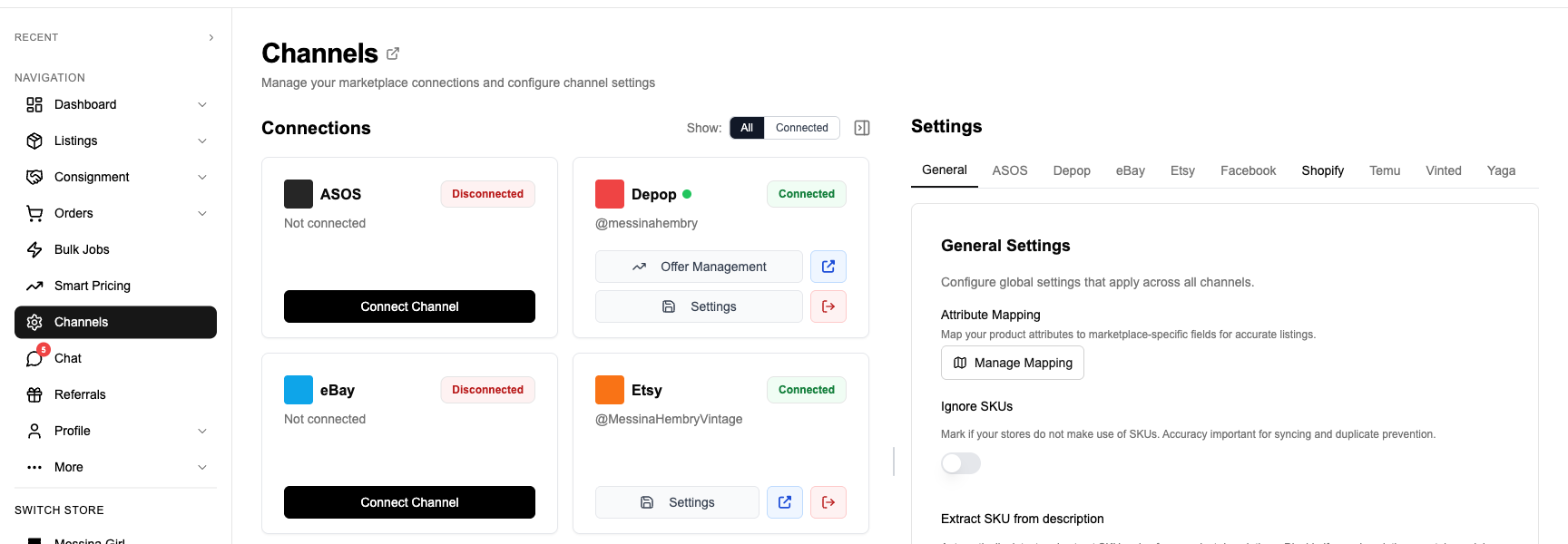
- Connect the channel. Add GoTrendier from the channels view and sign in to your Mexican or Colombian account. FLUF derives which of the two hosts you are on from your account itself, so there is nothing to configure — one channel, two countries.
- Get your catalogue into FLUF first. If your products already live on Depop, eBay, Etsy or Shopify, import them so that FLUF holds one master record per item with photos, price and description. This central record is what every channel is published from.
- Triage before you push. Filter out everything outside clothing, bags, shoes and accessories — GoTrendier will reject the rest. Then check your photos for watermarks, price overlays and supplier imagery, because those are rejections waiting to happen.
- Translate and localise. Titles and descriptions into Spanish, measurements into centimetres, sizes into the local convention with the international equivalent noted, prices into MXN or COP and then repriced against the local market rather than converted and left.
- Publish, in batches. Send a first batch of twenty or thirty items rather than the whole catalogue. You will learn what the Style Team objects to on your particular photography and phrasing, and you will learn it cheaply.
- Fix rejections and resubmit. Re-review takes up to 24 business hours and you have about three attempts per item, so read the rejection reason before changing anything.
- Then push the rest, with your first batch’s lessons baked into how you prepare items.
For a wider view of how the multi-channel workflow fits together, the crosslisting overview covers the catalogue model, and inventory sync explains what happens on the channels that do support automatic delisting.
What syncs, and what you have to do by hand
Here is the capability table, stated flatly. Compare it with the same table on our Depop or eBay guides and the difference is the point.
| Feature | GoTrendier via FLUF Connect |
|---|---|
| Create listings from your central catalogue | Yes |
| Edit and withdraw listings | Yes |
| Browser extension or mobile app required to publish | No — no browser or mobile app needs to remain open |
| Auto-relisting | No |
| Offer management | No |
| Order sync — GoTrendier sales appearing in FLUF | No |
| Automatic mark-as-sold when it sells on GoTrendier | No |
| Withdrawal from GoTrendier when it sells elsewhere | Yes, once you mark the item sold in FLUF |
| Refunds and fulfilment | No — handled entirely in GoTrendier |
The manual step, in full
When something sells on GoTrendier, you get the notification from GoTrendier — email and app. Do two things. Ship it within seven business days, and open FLUF and mark the product sold.
That second action is what makes the channel safe to run alongside others. Marking the item sold in FLUF delists it from every connected channel that supports mark-as-sold, so the jacket that just sold in Guadalajara stops being purchasable on Depop, eBay, Etsy, Shopify, Vinted, Facebook Marketplace and the rest. Without it, the first person to buy it elsewhere becomes a cancellation, and cancellations damage your standing on platforms that measure them far more aggressively than GoTrendier does.
GoTrendier against Mercado Libre and Facebook Marketplace
The comparison sellers actually make in these markets is a three-way one, and the answer is usually “all of them, for different stock”.
Mercado Libre is the giant, but it is not built for used fashion and its rules say so. In Colombia its published clothing commission is 18.50% on a Clásica listing and 21.50% on Premium — both above GoTrendier’s 9.99% headline — and its structural benefits are explicitly scoped to new products. The shipping subsidy applies from $60,000 COP on new items only. Used items get their own, worse shipping table in Mexico with no green-reputation discount. Payout is two days after delivery for a well-rated seller with new stock, and six days if the item is used or you have no reputation yet. Mexican fashion-category percentages are not publicly published; the fee page is behind a login, so treat any specific Mexican percentage you read elsewhere with suspicion.
Facebook Marketplace’s reach in these countries is genuinely enormous — a 2021 Rapyd survey of banked adults found 80% of Mexicans and 72% of Colombians buy through Facebook, the highest figures in the region. But there is no escrow, no shipping integration and no dispute process. Price and handoff are agreed in a chat thread. That makes it excellent for bulky, local, low-hassle sales and poor for shipping a $500 MXN blouse to a stranger in another state.
| GoTrendier | Mercado Libre | Facebook Marketplace | |
|---|---|---|---|
| Built for secondhand fashion | Yes, exclusively | No — general catalogue, new-first | No — general classifieds |
| Seller commission | 18% + $19 MXN · 9.99% + $3,999 COP | Category-based; CO clothing 18.5–21.5% | None on local sales |
| Who pays shipping | Buyer, flat rate | Seller-funded on cheap and used items | Not applicable — local handoff |
| Payment protection | Escrow with a 48-hour claim window | Yes, via Mercado Pago | None |
| Payout timing | 48-hour hold plus a weekly or twice-weekly run | 2 days new and well-rated; 6 days used | Immediate — cash in hand |
| Listing moderation | Human pre-moderation | Automated policy checks | Automated policy checks |
| FLUF automation available | Create and manage only | Not a FLUF channel | Mark-as-sold only |
Mistakes that cost new sellers money
- Listing your cheapest items individually. The fixed fee is $19 MXN or $3,999 COP whatever the price. At the Mexican $150 floor that is nearly a third of the sale before the percentage even lands. Sell your cheap stock in person or accept that the platform is not the right home for it.
- Leaving overlays on images. Price stickers, “SOLD” badges, arrows pointing at a flaw — all text on an image, all rejection reasons. Audit your photo workflow once, before the first batch.
- Converting sizes automatically between Mexico and Colombia. The numeric systems differ by about three sizes. Automated conversion produces a stream of not-as-described claims, each carrying a $100 MXN or $9,500 COP return charge.
- Selling without registering an RFC in Mexico. The difference between having one on file and not is 2.5% ISR versus 20%, and eight points of IVA versus sixteen. It is the most expensive piece of paperwork not to do.
What FLUF Connect costs
FLUF Connect is £1 for 7 days, then plans from £9/month (Starter). There is no free plan. The ladder runs Starter at £9, with no cap on how much you list. Every plan is unlimited on listings and marketplaces; the tiers differ by which automations they include and how often we check your channels for sales — every 90 minutes on Starter, down to every 15 on Super Seller. If you are billed in local currency you pay the local equivalent rather than a converted pound figure — in Mexico the seven-day trial is charged as 19 pesos.
Bulk operations are included in every plan, and relisting and offer management from Seller upwards rather than sold as add-ons. They are not available on GoTrendier, for the reasons given above, but they are available on the channels you are most likely to pair it with, and the price does not change based on which channels you use.
Related Guides
- Crosslist from GoTrendier to Depop — 18% Plus $19 Against 10% Plus PayPal
- Crosslist from GoTrendier to eBay — Automatically
- GoTrendier vs Facebook Marketplace in Mexico — Free and Local, or 18% and National
- Inventory Sync Across Depop, eBay, Vinted, Shopify, and Etsy
- How to Sell on Multiple Platforms at Once — The Complete Guide
Sources and verification
All figures were checked against primary sources in August 2026. GoTrendier’s own documentation is internally inconsistent in two known places: the Mexican listing manual still quotes the pre-January-2026 commission of 18% + $18, and the Mexican returns article still describes menswear as a prohibited category. Where documents conflict, this page follows the cost lists and the fee FAQs, which are the more recently maintained. Where a figure could not be traced to the party that sets it, it has been omitted — that includes GoTrendier’s GMV, which the company does not publish, and Mercado Libre Mexico’s fashion-category commission percentage, which sits behind a seller login.
- GoTrendier Mexico — Lista de costos: 18% + $19 MXN commission, shipping rates, buyer protection charge
- GoTrendier Colombia — Lista de costos: 9.99% + $3,999 COP commission, Servientrega rates and special zones
- GoTrendier Mexico help centre — ¿Debo pagar para vender?: commission effective 2 January 2026
- GoTrendier — ¿Cuándo recibo el dinero? (Mexico): 48-hour hold, twice-weekly payment runs, $10 withdrawal fee
- GoTrendier — ¿Cómo envío? (Mexico): Estafeta and PuntoPost, seven-business-day dispatch deadline
- GoTrendier — ¿Artículo rechazado?: rejection reasons and re-review window
- GoTrendier — Política de autenticidad: per-category authenticity evidence
- GoTrendier — ¿Qué puedo vender?: permitted and prohibited categories
- GoTrendier — Vendedora: Devoluciones: dispute grounds, seven-business-day resolution, return charges
- La República, 28 November 2022: Series B, 9.1m users, 30,000 daily uploads
- Bolsamanía / Europa Press, October 2024: Squirrel Media takes 10.5% for €4.4m
- El Tiempo, 29 July 2026: 300,000 Colombian sellers, menswear growth
- Mercado Libre Colombia — costos por categoría: clothing at 18.50% Clásica and 21.50% Premium
- SAT: platform withholding regime under LISR articles 113-A to 113-D and the Ley del IVA
- DIAN: UVT for 2026 and the no responsable de IVA conditions
Subscribe to the seller news brief
The marketplace news that changes how you list, in one short email.
- Fee, policy and algorithm changes across 60+ marketplaces
- Only the topics you pick — the marketplaces you actually sell on
- Short enough to read in a minute. Daily or weekly, unsubscribe in one click
No spam. We never share your address.
Pick your topics first ›Frequently Asked Questions
Publishing costs nothing in both Mexico and Colombia. You are charged only when an item sells: 18% + $19 MXN (IVA included) in Mexico, or 9.99% + $3,999 COP in Colombia. There is no listing fee, no subscription tier and no paid promotion product on the platform.
It depends which country you sell in. Mexico charges 18% of the sale price plus a fixed $19 MXN, IVA included, in force since 2 January 2026. Colombia charges 9.99% plus $3,999 COP, in force since 4 April 2025. On a $500 MXN sale in Mexico you keep $391 before the $10 withdrawal fee; on an $80,000 COP sale in Colombia you keep $68,009 before the $1,800 COP weekly withdrawal fee.
Money lands in your in-app Balance when the item is delivered and is locked for 48 hours, which is the buyer's claim window, unless the buyer confirms delivery sooner. After that you request a cash-out. Mexico runs two payment runs a week (requests Monday to Wednesday pay the following Friday, Thursday to Sunday pay the following Tuesday); Colombia runs one, paying every Tuesday. Bank posting can add up to another 48 hours.
The buyer does, at a flat rate on top of the item price. In Mexico that is $79 MXN via Estafeta or $49 MXN via PuntoPost, up to 5kg volumetric. In Colombia it is $9,500 COP via Servientrega, up to 3kg. You print the auto-generated label and must drop the parcel within seven business days, or the label is cancelled and the buyer refunded.
Yes. A human Style Team reviews uploads daily and removes anything that breaks the rules. Common rejection reasons include watermarked or catalogue photographs, images with text, numbers or emojis on them, bundles sold as one listing, missing size, measurements or condition, brand mismatches, and luxury items without the required authenticity evidence. Re-review after an edit takes up to 24 business hours.
Yes. FLUF Connect can create and manage GoTrendier listings from your central catalogue, so items already on Depop, Vinted, eBay or Shopify can be published to GoTrendier without retyping them. GoTrendier does not need the FLUF Chrome extension or the FLUF mobile app to stay in the loop once connected.
No, and this is important. FLUF supports no automation features on GoTrendier: no relisting, no offer management, no order sync and no automatic mark-as-sold. A GoTrendier sale will not appear as an order in FLUF and will not delist that item on your other channels. Mark the product sold in FLUF yourself and it is then withdrawn from every connected channel that supports mark-as-sold.
Clothing, bags, shoes and accessories only, for women, men and children. There is no home, electronics, toys or beauty category. Explicitly prohibited items include makeup and perfume, wigs and hair extensions, most sports equipment, bathrobes and towels, used swim shoes and underwear that is not new.
For used fashion, usually yes. Mercado Libre's published Colombian clothing commission is 18.50% on a Clasica listing and 21.50% on Premium, against GoTrendier's 9.99%, and Mercado Libre scopes its shipping subsidies and fastest payouts to new products, paying used-item sellers six days after delivery rather than two. Mercado Libre is still the better home for anything outside GoTrendier's four fashion categories.
Not in the general case. Withdrawals require a local bank account or wallet and a local identity document. GoTrendier opened a cross-border route in June 2026 that lets United States sellers supply Mexican buyers with new-with-tags clothing, bags and accessories only, shipped by USPS. There is no equivalent programme for UK or European sellers.