Crosslist from GoTrendier to Depop — 18% Plus $19 Against 10% Plus PayPal
A Mexican or Colombian wardrobe on a UK and US marketplace: the real fee gap, why you are paid through PayPal, the six states GoTrendier will not ship from, and what to rewrite. Or sell on both across 60+ channels.
7 days for £1, then from £9/month.



- The fee gap is the headline, and it is large. GoTrendier México takes 18% plus $19 MXN from every sale, IVA included, whatever the garment is worth. Depop charges a seller outside the UK, US and Australia 10%, plus PayPal’s own processing.
- Yes, a Mexican or Colombian seller can sell on Depop. Depop publishes no seller-country whitelist; it publishes a fee tier specifically for sellers outside the UK, US and Australia. Mexico and Colombia are not on its sanctions list.
- But you get the second-class version of Depop. No Depop Payments, so you are paid through PayPal. No Depop shipping label, so you post the parcel yourself, tracked, at your own cost. And your buyers pay no Marketplace fee, because that is a UK, US and Australia thing.
- GoTrendier will not let you sell at all from six states. Baja California, Sonora, Chihuahua, Coahuila, Nuevo León and Tamaulipas are blocked, because a second-hand item has no sales invoice and the courier will not take it across the border zone. Depop has no such rule.
- Language is a real cost, not a formality. A Spanish title dropped into Depop is not merely untranslated — Depop’s discovery is keyword-driven against English buyer searches, so an unconverted listing is effectively invisible.
- You keep the peso catalogue and add a pound-and-dollar one. GoTrendier is single-currency by market. Depop is not.
- Cost: £1 for 7 days, then plans from £9/month (Starter). There is no free plan.
Can you actually do this?
Start here, because the internet will tell you otherwise. Yes. A seller in Mexico or Colombia can sell on Depop.
Depop does not publish a list of countries its sellers may come from. What it publishes instead is a fee table, and that table has a row for you: “Sellers outside of the UK, US and AUS — Depop Selling fees — 10% on all sales.” A platform does not price a tier for sellers it refuses to accept. Depop’s sanctions policy, updated 9 June 2026, names Crimea, Cuba, Iran, North Korea and the occupied Ukrainian oblasts, with further restrictions on Syria, Russia and Belarus. Neither Mexico nor Colombia appears anywhere on it, and Depop’s terms of service contain no country-eligibility clause at all.
The honest caveat is smaller but real: Depop does not publish which currencies a seller can list in. Its help article on the subject says only to “choose your currency from the available options”. So before you build a pricing strategy around Mexican pesos, open the app and look at what the currency picker actually offers you. The fee wording is worth noting here, because it is conditional on both things at once — the 10% applies to sellers outside the UK, US or Australia and selling in a currency other than GBP, USD or AUD. Which is to say: if you can list in pounds or dollars, the fee position may look different. Check it in your own account rather than trusting anyone’s summary, including this one.
What each one takes
GoTrendier México publishes its costs plainly, and they changed at the start of this year.
18% commission plus $19 MXN, IVA included, from 2 January 2026, regardless of the value of the garment. In GoTrendier’s own words on its cost list: “Al vendedor se le cargará 18% de comisión + $19 (IVA incluido) del precio fijado” — the seller will be charged 18% commission plus $19, VAT included, on the set price. Listing itself is free. Note that GoTrendier’s older seller manual still says “18% + $18 MXN”; the $19 figure is the one on the more recently updated pages, and it is the one to work from.
Colombia is a different business on the same brand. There the commission is 9.99% plus $3.999 COP, subject to 19% IVA, in force since 4 April 2025. If you sell in both markets you are running two fee structures, not one.
| GoTrendier México | GoTrendier Colombia | Depop (seller outside UK/US/AU) | |
|---|---|---|---|
| Listing | Free | Free | Free |
| Seller commission | 18% + $19 MXN, IVA included | 9.99% + $3.999 COP, plus 19% IVA | 10% of the sale price, plus the postage if you did not use a Depop label |
| Payment processing | Included in the commission | Included in the commission | PayPal’s own fee, set by PayPal and varying by account |
| Who pays the postage | The buyer. Estafeta $79 MXN or PuntoPost $49 MXN, up to 5 kg volumetric | The buyer. Servientrega, flat $9.500 COP up to 3 kg | You, unless you price it into the item |
| Buyer-side fee | Protección GoTrendier, $12 MXN | Included in the flow | None — the Marketplace fee applies only to UK, US and Australian buyers |
| Withdrawal to a bank | $10 MXN per transfer | $1.800 COP, capped at one charge per week to the same account | PayPal’s own withdrawal terms |
| Promotion | Promo Envíos: you absorb $27 MXN of the buyer’s postage | Envíos a $5.000: you absorb $4.500 COP | Boost, 8% outside the UK and US, charged on top of the selling fee |
| Failed sale penalty | $100 MXN logistics charge if the item is damaged, inauthentic, the wrong size or has undisclosed flaws | $9.500 COP | Fees are reversed on refund — but see below |
The single comparison worth putting in front of a Mexican seller: 18% plus $19 against 10% plus PayPal. On a $500 MXN dress, GoTrendier’s cut is $109. That is not a marginal difference, and it is the reason this route exists.
Depop’s Boost deserves a warning. It only charges when a buyer interacts with the boosted listing — a view, a click, a like — and then buys within 28 days. But Depop is explicit that boost fees are “in addition to selling fees… and payment processing fees”. At 8% on top of 10% plus PayPal, a boosted sale from outside the core markets is an expensive sale. Use it deliberately.
How you get paid, and why it is PayPal
This is the part sellers are most often surprised by, and it is stated policy rather than an accident.
Depop Payments — the in-app system that handles cards, Apple Pay, Google Pay and Klarna, and pays into your bank — is described by Depop as “a requirement for sellers in the US, UK, and Australia”. Everyone else is on PayPal. Depop’s fee page confirms the mechanics: “If you sell via PayPal, sale proceeds are sent to your PayPal account. The Selling fee and PayPal’s payments processing fee are then deducted as separate charges from your PayPal account.”
Three consequences follow.
Your real cost is a stack, and PayPal sets most of the variable part. Depop takes 10%. PayPal takes its commercial receiving fee, which in Mexico is 3.95% plus a fixed amount domestically with a further 0.50% where the payment originates outside Mexico, and its currency conversion charge sits above the base exchange rate — 3.50% for payments received in another currency, 4.00% for other conversions. We are not going to reduce that to a single headline percentage, because Depop itself says PayPal’s fee “may vary depending on your location and PayPal account setup”. Work out yours from your own PayPal account, not from a blog.
Refunds are not automatic for you. When a sale is refunded, Depop reverses its selling fee — but for a PayPal seller that reversal has to be asked for. In Depop’s words: “If you’re outside the UK, US, or AUS and using PayPal, you can get a refund for the Depop selling fees by raising a ticket with our Support team and attaching a screenshot of your refund and confirmation of your @username.” Keep the screenshots. A seller who processes a few returns a month and never raises those tickets is quietly paying 10% on sales that did not happen.
Bundles are charged per item. Outside the UK and US, Depop’s selling fee applies to each item in a bundle, while the processing fee applies once to the bundle. Compare that with GoTrendier, where every sale is its own transaction with its own $19.
GoTrendier’s payout rhythm is a wallet, not a bank transfer. Money sits as “Pendiente” until 48 hours after delivery, or earlier if the buyer confirms, then becomes withdrawable. Mexico runs two cut-offs a week: request between Monday and Wednesday and you are paid the following Friday; Thursday to Sunday and you are paid the following Tuesday. Colombia runs one, on Tuesdays. Withdrawal requires an approved contract with an 18-digit CLABE, an ID that matches, and approval within 48 hours.
Posting the parcel yourself
On GoTrendier, logistics are somebody else’s problem. The label is generated for you, the buyer has already paid for it, and GoTrendier states plainly that sellers “no tendrán que pagar nada al proveedor del servicio de envío” — you pay the courier nothing. You have seven days to hand the parcel over, and if you miss that the buyer is refunded and GoTrendier does not guarantee your payment.
Depop, for a seller outside the US or UK, gives you none of that. Its shipping guidance is direct: “If you’re a seller located outside the US or UK, you can use your preferred method to ship the item to your buyer wherever they are… Ship ASAP using tracked shipping and make sure you keep proof of shipping.” And: “As a seller, it is always your responsibility to send items tracked and keep proof of postage.”
So you are choosing a courier, paying for it, and tracking it — internationally, to a buyer whose country you did not know when you set the price. Depop’s own advice is to estimate from the size of the item at listing time, which is a polite way of saying you carry the risk.
Practically, that means two things for pricing. Build the postage into the item price rather than hoping to recover it, and be realistic about which garments survive the journey economically. A $250 MXN top does not pay for a tracked international parcel. A jacket, a pair of boots, a designer piece — those do. The slice of a GoTrendier wardrobe that makes sense on Depop is the higher-value end of it, and that is a different selection than the one that sells fastest at home.
The six states GoTrendier will not ship from
Worth its own section, because it is invisible until it bites and it is a genuine argument for having a second channel.
GoTrendier’s own help centre says: “Si te encuentras en un estado fronterizo (Baja California, Sonora, Chihuahua, Coahuila, Nuevo León, Tamaulipas), tu venta no podrá realizarse. Recuerda que en GoTrendier vendes artículos de segunda mano, por lo cual al no tener factura de venta no es posible que sea aceptado por paquetería.” — if you are in a border state, your sale cannot go through, because a second-hand item has no sales invoice and the courier will not accept it.
If you live in Tijuana, Hermosillo, Ciudad Juárez, Saltillo, Monterrey or Matamoros, GoTrendier is closed to you as a seller. Depop imposes no equivalent restriction — you choose your own courier, so the constraint simply does not arise. For sellers in those six states this is not a crosslisting page at all; it is the only route.
What a GoTrendier listing has and what Depop wants
A GoTrendier listing is a compact record. Its own listing manual sets out the required fields: choose a category, set a name for the item, describe it as well as you can, put it in the right category, then select the brand, the size, the colour, set a price, and state the item’s current condition.
So the record you already have is roughly: section and category, title, description, brand, size, colour, price, condition, photos. Depop wants very nearly the same things, plus a few of its own.
| GoTrendier field | Depop | Transfer | Notes |
|---|---|---|---|
| Title (nombre) | Title | Needs rewriting | Not a translation job. Depop’s own advice is to “add relevant words that you would search for as a buyer” — in the buyer’s language. |
| Description (descripción) | Description | Needs rewriting | Depop recommends up to five hashtags plus up to two brand hashtags. Add measurements here. |
| Marca (brand) | Brand | Direct | Latin American high-street labels may not be recognised names to a UK or US buyer. Say what the garment is as well as who made it. |
| Talla (size) | Size | Needs judgement | See below. Do not machine-convert. |
| Color | Colour | Direct | Depop accepts up to two colours. |
| Categoría | Category and subcategory | Mapped | The Mexican and Colombian trees differ from each other, never mind from Depop’s. |
| Estado (condition) | Condition | Mapped | Depop’s listing form offers five values — Brand new, Like new, Used – excellent, Used – good, Used – fair. Depop does not document them in its help centre, so check them in the app rather than relying on any published list. |
| Precio | Price | Recalculate | Different currency, different fee stack, different postage. Do not convert the peso price. |
| Photos | Photos and video | Direct | Depop’s app guidance describes up to four photos and one video. |
| — | Style | New field | No GoTrendier equivalent. Worth setting; it feeds Depop’s discovery. |
One structural difference is easy to miss. GoTrendier’s Colombian taxonomy is not its Mexican one: Chaquetas rather than Chamarras, Camisetas rather than Playeras, Vestidos de baño rather than Trajes de baño, Bolsos rather than Bolsas, Baletas rather than Flats, plus Billeteras and Sombrillas that Mexico does not carry. If you sell in both, you already know that the same garment is filed under two different words. Depop adds a third.
Also worth checking before you push anything: GoTrendier’s prohibited list is narrower than Depop’s. Used underwear, bathrobes and towels, used beach shoes, sports equipment beyond helmets, wigs and extensions other than costume, cosmetics and perfume, electronics, toys, homeware and décor are all banned on GoTrendier. Depop’s rules differ. The overlap is fashion; anything outside it needs checking on the Depop side, not assumed.
Spanish listings on an English marketplace
GoTrendier is a Spanish-language business from end to end — the app, the help centre, the seller contract flow. Depop’s buyer mass is in the UK and the US.
The instinct is to translate. The better instinct is to rewrite, and the reason is mechanical rather than aesthetic. Depop tells sellers to build titles from “relevant words that you would search for as a buyer”, and says its ranking uses “the details you enter when listing your item, such as gender, description, product type, brand, and condition”. A Depop buyer searching “brown leather jacket vintage” will never surface “chamarra de piel café vintage”, however accurate that is. The listing is not merely harder to find; on that search it does not exist.
So: English title, English description, English hashtags. Keep the Spanish original on GoTrendier untouched — it is doing its job there.
Sizes, and why measurements beat conversion tables
We are not going to give you a Mexican-to-UK size table, and the reason is that we could not find one we would stand behind. Mexican womenswear runs several coexisting conventions — junior numeric sizing, a separate numeric run, and plain S/M/L — and the published conversion tables contradict each other. One says a Mexican 32 is a US 8; another puts the same 32 at an L. Neither is sourced to a standards body.
What we can tell you is sourced from both platforms. GoTrendier treats a size mismatch as a chargeable seller fault: a return caused by an item that “no es de la talla anunciada” costs the seller $100 MXN in Mexico or $9.500 COP in Colombia. And Depop’s own guidance solves the problem the same way a careful seller already does: “Add measurements and fit notes: sizes can vary between brands, so add the exact measurements of the item and let buyers know how it fits.”
Pick the closest size on Depop’s picker, then put chest, length, waist and inside leg in centimetres in the description. That is defensible against a buyer in any country, and it is the only thing that is.
How to crosslist with FLUF Connect
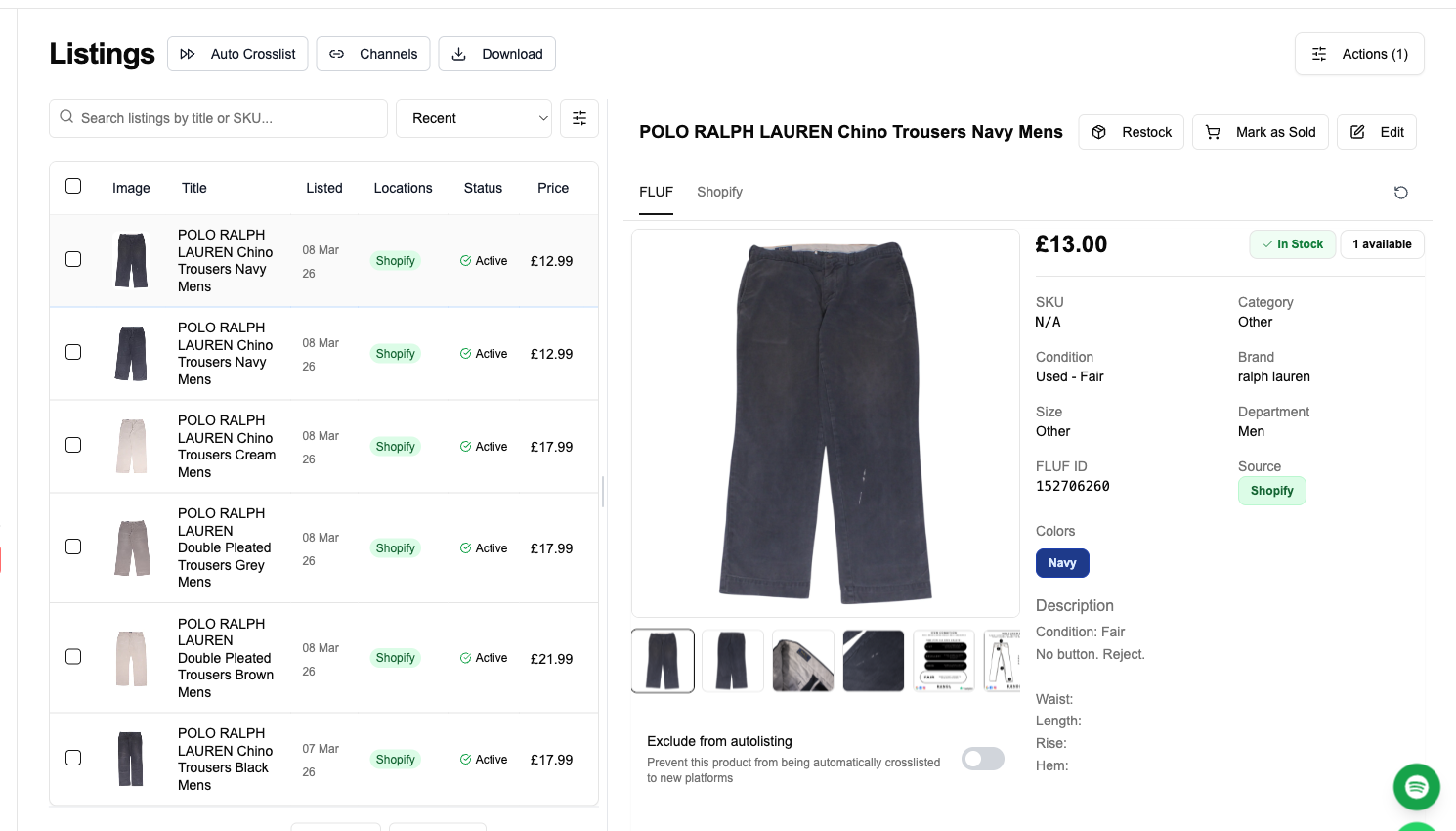
- Connect GoTrendier in FLUF Connect and import your wardrobe — photos, prices, sizes, brands and categories — into one catalogue.
- Connect Depop. If you are outside the UK, US and Australia you will be selling via PayPal, so have a PayPal account that can receive commercial payments in the currency you intend to list in.
- Choose the slice that travels. Higher-value pieces that can carry the cost of a tracked international parcel. Leave the fast-moving low-ticket stock where it is.
- Rewrite the copy in English — title, description, hashtags — and add measurements in centimetres.
- Reprice rather than convert. Your Depop price has to absorb a different commission, PayPal’s cut, currency conversion and the postage you are now paying yourself.
- Push, then run both from one dashboard. Depop itself acknowledges the category in its own help centre, noting that after the first listing you can list “using the Depop app, depop.com, or a crosslisting website”.
One route that will not help you: Depop Import, the tool that pulls a closet across from another marketplace, is US-only in Depop’s own words. It is not an alternative for a Mexican or Colombian seller.
What syncs between them
| Event | What happens |
|---|---|
| An item sells on Depop | Depop order sync brings the sale into FLUF Connect, and the item is marked sold so it stops being offered elsewhere. |
| An item sells on GoTrendier | GoTrendier does not report sales back automatically, so close the item in FLUF Connect when the sale lands in your wallet. |
| A Depop listing goes stale | Relisting is supported on Depop, and it is included in every FLUF Connect plan. |
| You get an offer on Depop | Offer management is supported on the Depop side. |
| You edit a price | Change it once. Remember the two prices are not a conversion of each other. |
The habit to build is closing the GoTrendier sale promptly on the Depop side. Everything in a second-hand wardrobe is one of one. An oversell on Depop is a cancellation, and cancellations land on the account of a seller who is already operating outside Depop’s core markets and has less margin for error.
What it costs
FLUF Connect is £1 for 7 days, then plans from £9/month on Starter, with no cap on how much you list. There is no free plan.
Bulk operations are included in every plan, and relisting and offers from Seller upwards rather than sold as add-ons. On this route the relevant one is relisting: Depop rewards freshness, and the pieces worth shipping internationally are usually the ones that sit longest.
Sources and verification
Checked against primary sources on 26 August 2026. GoTrendier’s Spanish-language help centre and cost lists were read directly and are quoted in the original with translations. Depop’s help centre was read directly.
- Depop — seller fees and charges — the 10% tier for sellers outside the UK, US and Australia, the PayPal processing arrangement, the per-item bundle rule, and the support-ticket route for fee refunds
- Depop — what is Depop Payments — “a requirement for sellers in the US, UK, and Australia”
- Depop — the Marketplace fee — buyer-side, UK and US in GBP or USD, from 15 April 2024 and 18 July 2024 respectively; Australia from 22 July 2026
- Depop — shipping worldwide — sellers outside the US or UK ship by their own method, tracked, keeping proof of postage
- Depop — sanctions policy (updated 9 June 2026) — the restricted-territory list, which does not include Mexico or Colombia
- Depop — boosted listings — 8% outside the UK and US, charged in addition to selling and processing fees, on interaction followed by a sale within 28 days
- Depop — tips for describing your item — search-led titles, up to two colours, and the advice to add exact measurements and fit notes
- Depop Import — “currently only available for US users”, and Depop’s own acknowledgement of listing via a crosslisting website
- GoTrendier México — lista de costes — free listing, buyer-paid Estafeta $79 MXN and PuntoPost $49 MXN up to 5 kg volumetric, Protección GoTrendier $12 MXN, the $100 MXN return charge, and Trendier México, S.A. de C.V. as the operator
- GoTrendier — comisiones — 18% + $19 MXN, IVA included, from 00:00 on 2 January 2026, regardless of item value
- GoTrendier — cómo cobrar — the wallet, the $10 MXN withdrawal charge, the 48-hour hold after delivery, and the two weekly payment cut-offs
- GoTrendier — envíos — the seven-day dispatch requirement and the six blocked border states, quoted above
- GoTrendier — cómo publicar — the required listing fields: category, name, description, brand, size, colour, price and condition
- GoTrendier — artículos no permitidos — the prohibited categories summarised above
- GoTrendier Colombia — lista de costes — 9.99% + $3.999 COP plus 19% IVA from 4 April 2025, Servientrega at a flat $9.500 COP up to 3 kg, and the $9.500 COP return charge
- GoTrendier Colombia — cómo cobrar — the $1.800 COP withdrawal charge capped weekly, Daviplata and Nequi, and the Tuesday cut-off
- PayPal México — comisiones — the 3.50% and 4.00% currency conversion charges above the base exchange rate, and the withdrawal terms
- GoTrendier — market selector — two live markets, Mexico and Colombia
Where a number could not be traced to the organisation that sets it, this page leaves it out. That includes any Mexican-to-UK size conversion table, GoTrendier’s photo and description limits, whether GoTrendier or Depop withhold Mexican tax on your behalf, and any claimed uplift from crosslisting or from translating a listing. Depop’s ownership changed in 2026 — eBay completed its acquisition from Etsy on 30 July 2026 — and some of Depop’s own policy pages have not caught up, so treat any “subsidiary of Etsy” wording you find there as stale rather than current.
Related guides
Frequently Asked Questions
Yes. Depop publishes no list of permitted seller countries; it publishes a fee tier specifically for sellers outside the UK, US and Australia, charged at 10% of the sale price. Mexico and Colombia do not appear on Depop's sanctions policy, and its terms of service contain no country-eligibility clause. What Depop does not publish is which currencies you may list in — check the currency picker in your own account before planning around pesos.
GoTrendier México takes 18% plus $19 MXN from every sale, IVA included, regardless of the item's value, in force since 2 January 2026. GoTrendier Colombia takes 9.99% plus $3.999 COP, subject to 19% IVA. Depop charges a seller outside the UK, US and Australia 10% of the sale price, plus PayPal's own processing fee, which PayPal sets and which varies by account.
Through PayPal. Depop Payments — the in-app system that pays into a bank account — is described by Depop as a requirement for sellers in the US, UK and Australia only. Everyone else is paid into a PayPal account, with Depop's selling fee and PayPal's processing fee deducted as separate charges from that account.
On GoTrendier the buyer pays and the label is generated for you — Estafeta at $79 MXN or PuntoPost at $49 MXN in Mexico, Servientrega at a flat $9.500 COP in Colombia — and you pay the courier nothing. On Depop, a seller outside the US or UK gets no Depop label at all. You choose your own carrier, pay for it, and Depop requires the parcel to be sent tracked with proof of postage kept.
GoTrendier blocks sellers in six border states — Baja California, Sonora, Chihuahua, Coahuila, Nuevo León and Tamaulipas — because a second-hand item has no sales invoice and the courier will not accept it in the border zone. Depop has no equivalent restriction, since you arrange your own shipping. For sellers in those states Depop is not a second channel, it is the only one.
Rewrite rather than translate. Depop's own guidance is to build titles from words a buyer would search for, and its ranking uses the gender, description, product type, brand and condition you enter. A buyer searching "brown leather jacket vintage" will never surface "chamarra de piel café vintage", however accurate that is. Leave the Spanish original in place on GoTrendier.
There is no conversion table we would stand behind — Mexican womenswear runs several coexisting conventions and the published tables contradict each other. Do what Depop itself advises: pick the nearest size on the picker, then put exact measurements in centimetres in the description. GoTrendier charges the seller a $100 MXN logistics cost when a return is caused by an item that is not the advertised size, so precision pays twice.
No, and the reason is postage. You are now paying for a tracked international parcel yourself, and a low-value garment cannot carry that cost. The slice that works on Depop is the higher-value end — jackets, boots, designer pieces — which is a different selection from the one that turns over fastest at home.
Depop reverses the selling fee on a refund, but if you are outside the UK, US and Australia and paid via PayPal it is not automatic. Depop's instruction is to raise a ticket with its support team attaching a screenshot of the refund and confirmation of your username. Keep those screenshots — a seller who processes returns and never raises the tickets is paying 10% on sales that did not happen.
FLUF Connect plans start at £9/month on Starter, with Pro at £29/month and custom Super Seller plans above that; every plan is unlimited on listings and marketplaces, and the tiers differ by which automations they include and how often we check your channels for sales. There is no free plan. Bulk operations are included in every plan, and relisting and offers from Pro upwards rather than sold as add-ons.