Crosslist from Shopify to GoTrendier — Variants, Pesos and a Second-Hand Audience
A Shopify product with fifteen variants is fifteen GoTrendier listings, or it is none. Here is the variant decision, the peso arithmetic, and the customer you give up when a sale happens on the marketplace instead of your own checkout.



- The hard part is not the export, it is the variants. A Shopify product carrying five sizes and three colours is one product with fifteen variants. GoTrendier has no variant model at all — one listing is one garment in one size, so that product is fifteen listings or it is nothing.
- GoTrendier is fashion, in Mexico and Colombia, in pesos. Its form takes integers only: a price of 899.00 is rejected and 899 is what has to be sent.
- Commission is 18% + $19 MXN, or 9.99% + $3.999 COP. The two countries are one channel with two rate cards, two carriers, two currencies and two entirely separate category trees.
- New stock is allowed — Nuevo con etiqueta is one of the five condition grades — but the audience is a second-hand one, and it prices accordingly.
- Shipping is the buyer’s problem, not yours. GoTrendier charges the buyer and issues the label, which is the opposite of the Shopify model where you own the rate table.
- You lose your checkout, and get an audience. A GoTrendier sale is GoTrendier’s customer: no email address, no order record in your store, no repeat-purchase flow.
- Cost: £1 for 7 days, then plans from £9/month (Starter). There is no free plan.
The variant problem, and why it decides everything
Every guide to moving a Shopify catalogue onto a marketplace starts with fields and finishes with categories. For this particular route that is the wrong order, because the thing that will stop you is structural rather than clerical.
Shopify’s data model is built around the variant. A product has a title, a description, images and a category, and then it has variants — each with its own price, SKU, stock quantity and image (Shopify, product details). A shirt in S, M, L, XL and XXL, in black, white and navy, is one product with fifteen variants. That is the correct model for a shop, because a shop sells the same thing repeatedly.
GoTrendier’s model is the opposite, and it is the correct model for what it does. A listing has one category, one brand, one size, one colour, one condition grade and one price. There is no variant array, no quantity field worth speaking of, and no notion of “the same product in another size”. The marketplace exists because someone is selling the one jacket they own.
So there are exactly two honest ways to run this route, and you should pick before you start:
- One listing per variant. Fifteen variants become fifteen GoTrendier listings, each with its own size and its own stock life. This is right when your Shopify store genuinely holds fifteen distinct garments — which is the normal case for a store built on second-hand or one-off stock.
- One listing per product, one representative variant. You publish the size you actually have depth in and leave the rest in your store. This is right when the Shopify catalogue is new stock in a size run, because listing fifteen sizes of the same shirt on a C2C wardrobe app reads as a shop, prices badly, and gives you fifteen things to withdraw when one sells.
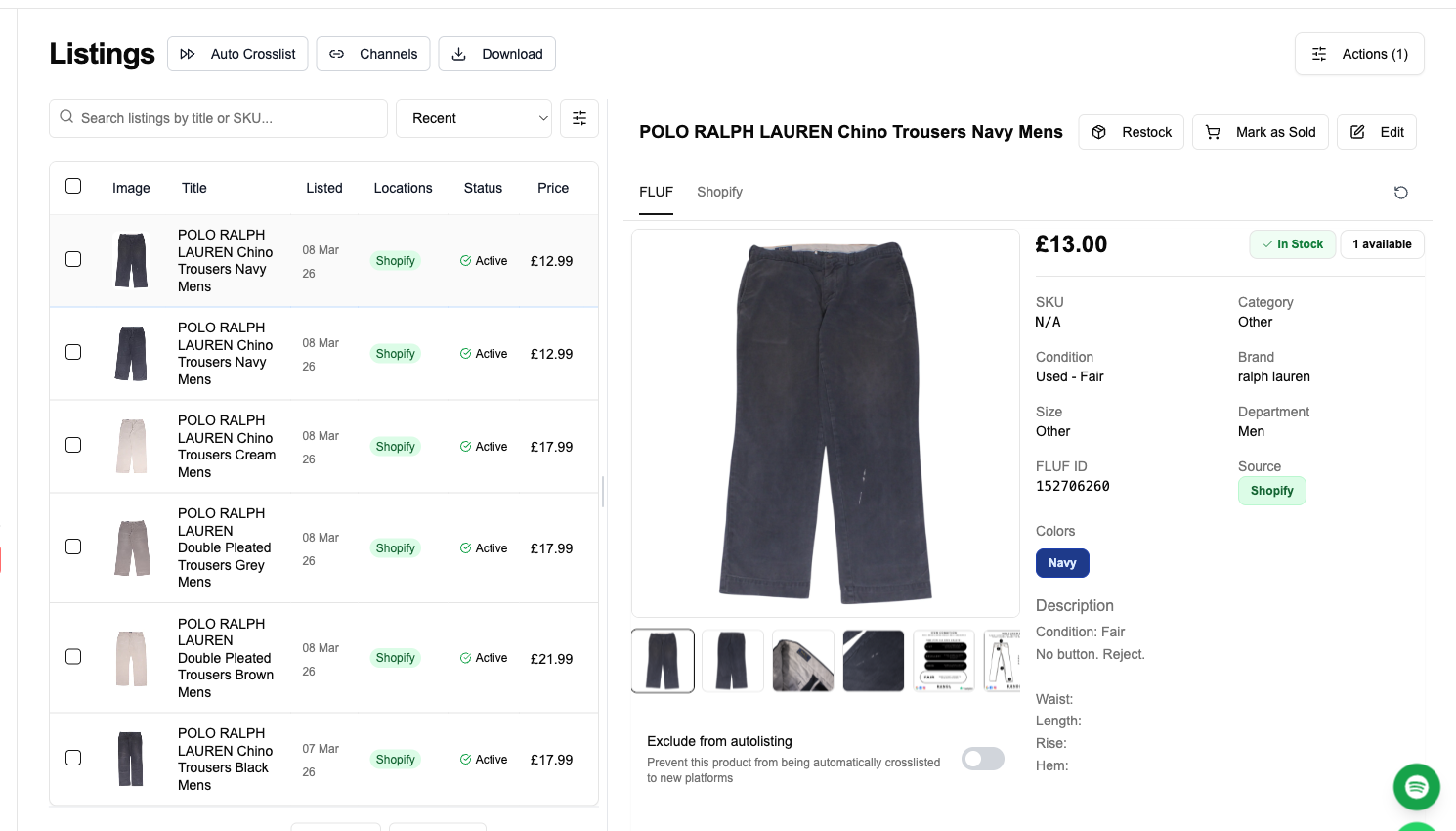
FLUF crosslists at the product level and lets you choose which variants become listings, so this is a decision you make once per product rather than a fight you have with an exporter. But it is a decision, and no tool can make it for you — it depends on what is actually in your stockroom.
Why put store stock on a resale marketplace at all
A Shopify store is a shop with no footfall. That is the whole difficulty of the model and the reason every store owner eventually looks at marketplaces: you have built something you own completely, and nobody is walking past it.
GoTrendier is footfall. It has passed eight million registered users in Mexico (El Financiero, June 2025), with sellers having earned more than MX$1.8 billion between them (El Publicista), around 5,000 garments published a day and sessions running past twenty minutes (La República). In Colombia it counts roughly three million women, with Bogotá alone at 35% of purchases (El Espectador).
That is a specific kind of footfall, though, and worth naming precisely. These are people who came to buy second-hand clothes. Your store’s brand, your product photography and your carefully written collection pages are invisible there — the listing is a photo, a brand tag, a size and a price, sitting next to somebody’s used Zara blouse. New stock is permitted; Nuevo con etiqueta is one of the five condition grades. But it will be judged against second-hand prices, which is the trade being made.
The stock this route suits, then, is not your hero product. It is end-of-line, single sizes left over from a run, returns you cannot sell as new, samples, and anything second-hand you already carry. Sold at a resale price to an audience that came looking for exactly that, while the store keeps doing what the store does.
The maths: Shopify’s fee model against GoTrendier’s
These are two different cost shapes and comparing the headline numbers is misleading. Shopify charges a fixed subscription and a card rate. GoTrendier charges nothing until something sells and then takes a percentage plus a flat fee.
On the Shopify side, in Mexico, plans are billed in US dollars while card rates are quoted in pesos: Basic at $19/month, Grow at $52 and Advanced at $399, with online card rates of 3.5%, 3.4% and 3.3% plus $3.00 MXN respectively, and a third-party gateway fee of 2%, 1% or 0.6% if you use a processor other than Shopify Payments (Shopify México, precios). Shopify Payments has been available in Mexico since 3 March 2025, settling in pesos, with meses sin intereses supported for MXN card payments (Shopify changelog, Shopify Help, Mexico payment methods).
On the GoTrendier side, the published Mexican rate is, verbatim, “Al vendedor se le cargará 18% de comisión + $19 (IVA incluido) del precio fijado” (GoTrendier México, Lista de costes). Because of the flat nineteen pesos, the rate you actually pay depends heavily on the price:
| Sale | Through your Shopify store (Basic, Shopify Payments) | Through GoTrendier |
|---|---|---|
| $300 MXN | $13.50 card fee → you keep $286.50 | $73 commission → you keep $227 |
| $800 MXN | $31.00 → you keep $769 | $163 → you keep $637 |
| $1,500 MXN | $55.50 → you keep $1,444.50 | $289 → you keep $1,211 |
| $3,000 MXN | $108.00 → you keep $2,892 | $559 → you keep $2,441 |
Shopify wins every row, and it will always win every row, because the store charges you for infrastructure and the marketplace charges you for demand. The subscription is not in the table because it is fixed — it is the price of having a store at all, and it does not change when you add a channel. The right way to read the table is: a GoTrendier sale nets roughly three-quarters of what the same sale nets through your own checkout, and the question is whether it is a sale you would otherwise have made. For stock sitting unsold in a store nobody has found, that answer is usually yes.
Two smaller charges belong in the arithmetic: withdrawing your balance to a bank account costs $10 MXN per transfer, and a successful buyer dispute over damage, authenticity, size or undisclosed defects deducts a $100 MXN logistics cost from your balance. GoTrendier has also raised its commission in each of the last three years, so read the live cost page rather than any figure quoted elsewhere, including an older version of this one.
What GoTrendier demands that Shopify never asked for
Shopify’s product form is deliberately permissive. Only a title and a price are genuinely required; everything else — SKU, weight, customs information, product category, tags — is optional and many stores leave large parts of it blank. Marketplaces are the opposite: they enforce structure because structure is how their search works.
| Shopify field | GoTrendier | Status |
|---|---|---|
| Title | Product title | Transfers, trimmed to 120 characters |
| Description (rich text) | Description (plain) | HTML stripped, trimmed to 2,000 characters |
| Media | Photos | First 10 transfer; GoTrendier’s own advice is that more than four photos sells better |
| Price | Price | Rounded to a whole peso — the form rejects decimals |
| Product category | GoTrendier category | Mapped to a node in the Mujer, Niños or Hombre tree |
| Vendor / brand | Brand | Resolved against GoTrendier’s own brand list; an unrecognised brand is no brand |
| Variant option: size | Size | Mapped per category and per country |
| Variant option: colour | Colour | Mapped to a fixed colour list |
| — | Condition | Required. One of five: Nuevo con etiqueta, Nuevo sin etiqueta, En perfecto estado, Puesto una vez, Usado |
| SKU, barcode, weight, customs info | — | Not used. GoTrendier issues the label itself, so weight never leaves your store |
| Compare-at price | — | No equivalent |
| Inventory quantity | — | No meaningful equivalent — a listing is one garment |
Condition is the one that catches store owners, because a Shopify catalogue usually has no condition field anywhere. It is not optional on GoTrendier and there is no free-text sixth option, so it has to come from somewhere in your product data — an attribute, a tag, or a default you set once for the whole catalogue.
The weight row is worth a second look for the opposite reason. A Shopify merchant thinks constantly about weight, because weight is what their shipping rates are calculated from. On GoTrendier it simply does not apply: the buyer pays $79 MXN for Estafeta or $49 MXN for PuntoPost, up to a volumetric weight of five kilos, and GoTrendier issues the prepaid label. You are not quoting a rate, not buying a label, and not absorbing a cost.
Pesos, integers, and the rounding decision
GoTrendier prices use whole currency units. Review your destination price and currency after conversion before publishing or updating listings.
There is a second, subtler pricing question that only arises on this route. Your Shopify prices were set for your own storefront, where the customer arrives having already decided to buy from you and pays your card rate. GoTrendier prices have to survive a commission of roughly a fifth and a side-by-side comparison with used stock. Pushing store prices across unchanged is the single most common way this channel produces no sales at all: the listings are live, correctly categorised, and simply too expensive for the room they are standing in.
FLUF’s price rules exist for exactly this. A per-channel rule — a percentage adjustment, a floor, or both — is applied when the listing is built rather than by editing your Shopify catalogue, so your storefront prices stay untouched while the marketplace sees a number that makes sense there. Set it once for the channel; it applies to everything you push afterwards.
The Colombian side of the channel runs on a different rate card again, with roughly half the Mexican commission, a different carrier, a different currency and separate category and size tables. FLUF reads which country your connection belongs to from the credential itself and uses the matching taxonomy; the Facebook Marketplace to GoTrendier page covers those differences in full, and they apply identically here.
How to crosslist with FLUF Connect
- Connect Shopify. A standard app authorisation, approved once. FLUF reads your products, variants, images and prices into a single catalogue.
- Connect GoTrendier. Use the FLUF browser extension for initial setup while signed in to your account. It does not need to remain open afterwards. Check your selling country and currency before publishing.
- Choose your variant policy. One listing per variant for genuinely distinct garments, or one representative variant per product for size-run stock. See the section above — this is the decision that shapes the whole channel.
- Filter to fashion. GoTrendier takes clothing, shoes, bags and accessories. Its community rules exclude replicas and counterfeits outright, along with used underwear, towels and bathrobes, cosmetics, perfume, toiletries, electronics and toys.
- Review the listing. Confirm the category, brand, size, colour and condition for each item before publishing.
- Publish. FLUF drives GoTrendier’s three-step wizard per item — photos and text, then attributes, then price, which is the step that actually publishes. If a later step fails, FLUF removes the half-built draft rather than leaving an invisible shell on your account.
What syncs, and what honestly does not
| Event | What happens |
|---|---|
| Order placed in your Shopify store | FLUF reads it. Shopify supports order sync, so the sale is visible without you doing anything. |
| Item sells on GoTrendier | You mark it sold in FLUF. GoTrendier sold-detection is deliberately not wired. |
| You change a title, description or price in FLUF | Pushed to GoTrendier as an edit. |
| Shopify stock hits zero | Handled through the same mark-sold path, so the GoTrendier listing comes down. |
| Automatic relisting | Not available on GoTrendier. A relist is a delete followed by a recreate, and a failure part-way through a three-step wizard would leave you with nothing live. |
| Offer management | Not available on GoTrendier through FLUF. Negotiation happens natively. |
GoTrendier sales are not currently detected automatically. When an item sells there, mark it sold in FLUF Connect yourself. See inventory sync for supported channels and directions.
Why not just add another Shopify sales channel?
A reasonable objection: Shopify already has sales channels, so why reach for a separate tool at all? It is worth answering properly, because for some destinations the objection is correct.
Shopify’s own channel integrations are genuinely good where they exist. TikTok Shop, for instance, explicitly supports Mexico — Shopify’s documentation lists Mexico among the countries a store may be located in to use that channel — and it syncs catalogue, inventory, fulfilment and orders in both directions (Shopify Help, TikTok setup). The Facebook and Instagram channel similarly syncs products for tagging (Shopify Help, social commerce). Where a first-party channel exists and covers your market, use it.
Connect GoTrendier using the FLUF browser extension for initial setup. Then review and publish your selected Shopify products from FLUF Connect.
It is also why no competing tool covers it. Checked on 25 August 2026 against each vendor’s own supported-marketplace page, none of Vendoo, List Perfectly, Crosslist or PrimeLister names GoTrendier, Mercado Libre or any Latin American marketplace at all, and several rule the region out by policy — Crosslist states plainly that it is available in the United States, the United Kingdom, Canada and Australia only.
The thing you give up: the customer
This deserves its own heading because it is the real cost of the route and it never appears in a fee table.
When something sells through your Shopify checkout you get an order record, an email address, a shipping address and a customer who can be marketed to again. That is the entire strategic argument for having a store: the second sale is nearly free. When something sells on GoTrendier you get a payout, and GoTrendier gets the customer. The buyer’s relationship is with the marketplace. There is no email address for you, no order in your admin, and no realistic route to a repeat purchase.
Set against that: GoTrendier holds funds for 48 hours after delivery before they become withdrawable, and Mexican payouts run on cut-offs on the 1st and 16th followed by up to five business days to reach the bank, so a sale can be roughly three weeks from cash. Your own checkout settles far faster. Those are the two prices — the customer, and the float — and they are what the eight million buyers cost.
What it costs
FLUF Connect is £1 for 7 days, then plans from £9/month — Starter. Every plan is unlimited on listings and marketplaces; the tiers differ by which automations they include and how often we check your channels for sales — every 90 minutes on Starter, down to every 15 on Super Seller. There is no free plan. Inventory sync and bulk operations are included in every plan, and relisting and offer management from Seller upwards on every channel that supports them, not sold as add-ons.
Shopify and GoTrendier charge separately. Your Shopify subscription and card rates are unchanged by adding a channel, and GoTrendier charges nothing to list — its commission falls only on a sale.
Sources and verification
- GoTrendier México — Lista de costes: commission, shipping, protection, withdrawal and return charges
- GoTrendier Colombia — Lista de costes: the Colombian rate card, for connections in that country
- GoTrendier — Acerca de: positioning and free listing
- Shopify México — precios: plan pricing in USD, card rates in MXN, third-party gateway fees
- Shopify changelog: Shopify Payments available in Mexico, 3 March 2025
- Shopify Help — Mexico payment methods: supported cards and meses sin intereses
- Shopify Help — Mexico payouts: MXN settlement and timing
- Shopify Help — product details: the product and variant model
- Shopify Help — variants: options, per-variant price, SKU and stock
- El Financiero: more than 8 million registered users in Mexico, June 2025
- El Publicista: MX$1.8 billion earned by sellers
- La República: publication rate and session length
- El Espectador: Colombian scale and the Bogotá share
- Trustpilot México and Apestan.com: seller sentiment on commission and returns
- Competitor coverage checked 25 August 2026 against Vendoo, List Perfectly, Crosslist and PrimeLister — none names GoTrendier or any Latin American marketplace
Where a figure could not be traced to the platform that sets it, this page omits it. GoTrendier’s monthly traffic and its best-selling brands both fall into that category. Payout timing is drawn from GoTrendier’s help centre, which is protected against automated access, so treat those particular figures as reported rather than directly verified.
Related guides
- Sell on GoTrendier — the complete seller guide
- Sell on Shopify
- Crosslist from Facebook Marketplace to GoTrendier
- Crosslist from Shopify to Wallapop
- Crosslist from Shopify to Vinted
- All crosslisting routes
- Inventory sync
- Crosslist from GoTrendier to Etsy — an export route for the vintage slice of a Mexican closet
- Crosslist from GoTrendier to Depop — 18% + $19 against 10% + PayPal
- Crosslist from GoTrendier to eBay
Frequently Asked Questions
They do not, directly — GoTrendier has no variant model. A listing there is one garment with one size, one colour, one condition and one price. So a Shopify product carrying five sizes and three colours becomes either fifteen separate GoTrendier listings or a single listing for the one variant you actually want to sell. FLUF crosslists at the product level and lets you choose which variants become listings, but the choice depends on whether your store really holds fifteen distinct garments or one shirt in a size run.
Yes. Nuevo con etiqueta and Nuevo sin etiqueta are two of the five condition grades, so new stock is explicitly allowed. The caveat is commercial rather than regulatory: the audience arrived to buy second-hand clothes and prices accordingly, so new stock competes against used prices. The stock this route suits best is end-of-line, orphaned sizes from a run, returns you cannot sell as new, samples, and anything genuinely second-hand you already carry.
Roughly a quarter of the sale, against a few per cent through your own store. GoTrendier's published Mexican rate is 18% commission plus $19 MXN, IVA included. Shopify Basic in Mexico charges 3.5% plus $3.00 MXN on an online card payment. On a $800 MXN sale that is about $163 to GoTrendier against about $31 through your store. Shopify wins every comparison, because a store charges you for infrastructure and a marketplace charges you for demand — the real question is whether it is a sale your store would have made at all.
No, and this is one of the few places the route is easier than expected. GoTrendier charges the buyer for shipping and issues the prepaid label itself — $79 MXN via Estafeta or $49 MXN via PuntoPost in Mexico, up to a volumetric weight of five kilos. You are not quoting a rate, buying a label or absorbing a cost, so the weight and customs fields your Shopify store cares about never leave it.
GoTrendier prices use whole currency units. Review the destination price and currency after conversion before publishing or updating a listing.
It is one channel and one application, but two very different businesses underneath. Colombia's published commission is 9.99% plus $3.999 COP, about half the Mexican rate, with Servientrega as the carrier and a flat $9.500 COP paid by the buyer for anything up to 3 kg. The category and size taxonomies are genuinely independent — Mexico lists Chamarras and Playeras where Colombia lists Chaquetas and Camisetas, and Colombia has categories Mexico lacks entirely — so FLUF keeps both trees separately and never substitutes one for the other.
One direction is automatic and the other is not. Shopify supports order sync, so FLUF sees a sale in your store without you doing anything. GoTrendier's supported feature set in FLUF is currently empty — no order sync, no automatic mark-as-sold, no relisting and no offer management — because its sold state has never been observed on a real seller account, and reading a listing's disappearance as a sale would withdraw live listings in bulk. So a GoTrendier sale is one you mark in FLUF, and the Shopify side comes down from that.
Later than by your own checkout. Funds sit pending for 48 hours after delivery before becoming withdrawable, Mexican payments run on cut-offs on the 1st and 16th of the month, and the bank transfer then takes up to five business days. A sale can therefore be around three weeks from cash. Withdrawing to a bank account costs $10 MXN per transfer. Your Shopify payouts settle considerably faster, and the difference in float is a genuine cost of the channel.
It is a fashion marketplace covering clothing, shoes, bags and accessories across its Mujer, Niños and Hombre verticals. Community rules exclude replicas and counterfeits, which are grounds for removal from the platform, along with used underwear, bathrobes and towels, cosmetics, perfume, toiletries, electronics and toys. A general Shopify catalogue will usually have a good deal in it that simply cannot go.
£1 for 7 days, then plans from £9/month — Starter. Every plan is unlimited on listings and marketplaces; the tiers differ by which automations they include and how often we check your channels for sales. There is no free plan. Inventory sync and bulk operations are included in every plan, and relisting and offer management from Pro upwards on every channel that supports them, rather than sold as add-ons.