
Sell on BigCommerce — Crosslist Your Store to Every Major Marketplace
Everything you need to know about BigCommerce fees, setup, and B2B strength — plus how to crosslist your store to Depop, eBay, Etsy, Vinted and more, automatically.



Key Takeaways
- BigCommerce is your own hosted online store, not a marketplace — like Shopify, it is a SaaS platform where you run a branded website at your own domain. Unlike eBay, Depop, or Vinted, it does not hand you buyers — you drive your own traffic.
- Plans from $39/month (Standard, billed monthly) or $29/month annually — rising through Plus ($105/mo) and Pro ($399/mo) to custom Enterprise pricing. From 1 June 2026 these are renamed Core, Growth, Scale and Performance.
- Historically zero transaction fees — BigCommerce’s signature advantage over Shopify. From 1 June 2026 it introduced an Open Payment Provider Fee (2.0% Core, 1.0% Growth, 0.6% Scale) only on orders settled through non-embedded gateways; merchants using an embedded provider still pay nothing extra (source).
- Powers 37,000+ active stores and 130,000+ cumulative merchants across 150+ countries, generating $34B+ in annual GMV, with a sharp focus on mid-market and B2B sellers (source).
- Best used as one channel in a multi-platform strategy — FLUF Connect reads your BigCommerce catalogue and crosslists it to Depop, eBay, Etsy, Vinted, Facebook Marketplace and more, syncing inventory and sold status back automatically.
- FLUF Connect plans from £9/month, with no cap on how much you list — inventory sync, order sync and mark-as-sold are included in every plan; relisting, offer management and smart pricing come with the plans above Starter. There is no free plan.
What Is BigCommerce?
BigCommerce is a hosted, software-as-a-service (SaaS) e-commerce platform that lets you build and run your own branded online store without managing servers, hosting, or security patches yourself. Like Shopify, it gives you a standalone website at your own domain — yourstore.com — where you control the design, pricing, customer experience and data. Unlike a marketplace such as eBay, Depop, or Vinted, BigCommerce does not put your products in front of a built-in pool of shoppers. You own the storefront, and you are responsible for bringing the traffic.
BigCommerce was founded in Sydney, Australia in 2009 by Eddie Machaalani and Mitchell Harper, two Australian developers who had met in an online chatroom in 2003 and launched an earlier company, Interspire, before building BigCommerce. The company opened its first US office in Austin, Texas in 2009 and relocated its headquarters there in 2011 following its Series A funding (source). It went public on the Nasdaq in 2020 and today positions itself as the e-commerce platform for mid-market and enterprise brands, with particular strength in business-to-business (B2B) commerce.
As of early 2026 BigCommerce powers roughly 37,000 active live stores, with 130,000+ cumulative merchants having used the platform across 150+ countries. Together those merchants generate more than $34 billion in annual gross merchandise volume (GMV). The platform holds around 3% of the US e-commerce software market and is consistently ranked among the top ten e-commerce platforms worldwide (source). Notably, BigCommerce has deliberately narrowed its store base in recent quarters — active store count fell around 8% in Q1 2026 — while growing enterprise annual recurring revenue, with enterprise accounts now representing roughly 75% of total ARR and around 12,000 active B2B accounts on the platform.
For resellers and brands already selling on marketplaces, BigCommerce serves a fundamentally different purpose. Marketplaces bring you eyeballs but take a large cut (often 10-15%) and own the customer relationship. A BigCommerce store charges no marketplace commission, lets you keep customer emails and purchase history, and gives you a branded shopfront — but every visitor has to be earned through SEO, paid ads, email and social. This is why so many successful sellers run a BigCommerce (or Shopify) store and a portfolio of marketplaces at the same time, using a crosslisting tool like FLUF Connect to keep them in sync.
BigCommerce at a Glance
| Metric | Detail |
|---|---|
| Founded | 2009, Sydney, Australia |
| Headquarters | Austin, Texas (since 2011) |
| Founders | Eddie Machaalani & Mitchell Harper |
| Type | Hosted SaaS e-commerce platform (own-store, not a marketplace) |
| Active stores | ~37,000 live (130,000+ cumulative merchants) |
| Countries | 150+ |
| Annual GMV | $34B+ |
| Focus | Mid-market & B2B brands; ~75% of ARR from enterprise |
| Entry price | $39/month (Standard, billed monthly) / $29/month annually |
| Revenue model | Monthly subscription tiers (no per-listing fees) |
Why Sell on BigCommerce in 2026?
BigCommerce is built for sellers who have outgrown — or want to operate alongside — marketplaces and need a powerful, scalable storefront with strong built-in features. Its appeal sits in four areas: rich functionality without dozens of paid apps, a no-transaction-fee heritage, genuine B2B and headless capability, and an API-first architecture that plays well with automation tools like FLUF Connect. Here are the main reasons merchants choose it.
Powerful built-in features, fewer apps to buy
The single most-cited advantage of BigCommerce is how much is included out of the box. Advanced SEO controls, multi-currency, real-time carrier shipping quotes, product variants, native faceted search, multi-warehouse inventory routing and gift cards all ship as standard, where competitors often push you toward paid third-party apps for the same functionality (source). For a growing catalogue this can mean a lower total cost of ownership than a Shopify store stacked with subscription apps.
Its no-transaction-fee heritage
For years BigCommerce’s headline pitch against Shopify was simple: it never charged a platform commission on your sales, no matter which payment gateway you used. That changed on 1 June 2026, when BigCommerce introduced an Open Payment Provider Fee on its self-serve plans — but only on orders that settle through a non-embedded gateway, and at modest rates (2.0% Core, 1.0% Growth, 0.6% Scale) (source). Merchants who use an embedded payment provider still pay no platform fee. Compared with the 10-15% take rate on most resale marketplaces, a BigCommerce store remains a far cheaper place to convert a sale you have driven yourself.
Genuine B2B and wholesale strength
BigCommerce has invested heavily in B2B. Customer-specific catalogues, wholesale price lists, bulk-order pricing tiers, purchase orders, quote management and customer groups are built into the core platform rather than bolted on (source). If you sell to other businesses as well as consumers — a common pattern for wholesalers, vintage suppliers and brand owners — BigCommerce handles both audiences from one store. This B2B depth is the clearest functional gap between BigCommerce and a vanilla Shopify or Depop setup.
API-first and headless-ready
BigCommerce is engineered as an API-first platform. Its modern REST and GraphQL APIs let you decouple the storefront from the backend and run a custom headless front end (React, Next.js, a content-management system, or a native app) while BigCommerce powers the catalogue, cart, checkout and orders behind the scenes (source). FLUF Connect lets you reuse your BigCommerce catalogue on other supported marketplaces.
Multi-channel selling from one catalogue
BigCommerce’s Channel Manager lets merchants connect external sales channels — Amazon, Walmart Marketplace, eBay, Facebook by Meta and Instagram — and push orders from those channels back into the BigCommerce control panel for unified fulfilment (source). For resale and fashion-focused marketplaces that BigCommerce’s native Channel Manager does not reach — Depop, Vinted, Etsy, Vestiaire Collective, Grailed, Poshmark, Whatnot — FLUF Connect fills the gap, treating your BigCommerce store as the source catalogue and crosslisting outward.
Fee comparison vs Shopify and WooCommerce
The table below compares the headline economics of running a hosted store on each of the three dominant platforms. WooCommerce is free open-source software but you pay for your own hosting, security and (typically) a stack of plugins.
| BigCommerce | Shopify | WooCommerce | |
|---|---|---|---|
| Monthly subscription (entry) | $39/mo ($29 annual) | $39/mo (≈£19 in UK) | $0 software (hosting from ~$10/mo) |
| Listing fees | None | None | None |
| Platform transaction fee | 0% with embedded gateway; 0.6-2.0% on non-embedded (from 1 Jun 2026) | 0% with Shopify Payments; up to ~2% on outside gateways | None (you choose your own gateway) |
| Built-in B2B/wholesale | Yes (native) | Plus tier / apps | Plugins |
| Hosting included | Yes | Yes | No (self-hosted) |
| Revenue-tiered pricing | Yes (GMV caps move you up) | No | No |
Sources: BigCommerce 2026 pricing update, BigCommerce vs Shopify 2026 fee analysis. Figures are headline list prices and processing fees are extra in all cases. See the full fees section below.
How Much Does It Cost to Sell on BigCommerce? — Fees and Pricing Explained
BigCommerce charges a flat monthly subscription rather than per-listing or per-sale marketplace fees. What you pay depends on your plan tier, which is partly driven by your trailing-twelve-month online sales volume (GMV). On top of the subscription you pay your payment processor’s card-processing fees, and — from 1 June 2026 — a possible Open Payment Provider Fee if you route orders through a non-embedded gateway. Here is every cost broken down.
Monthly subscription plans
BigCommerce has four tiers. On 1 June 2026 the names changed (Standard→Core, Plus→Growth, Pro→Scale, Enterprise→Performance) and lower GMV thresholds were introduced, meaning sellers cross into higher tiers earlier (source). Current list pricing:
| Plan (new name) | Monthly billed | Annual billed | Sales / GMV cap | Best for |
|---|---|---|---|---|
| Standard / Core | $39/mo | $29/mo | ~$30K trailing-12-month GMV | New and small stores |
| Plus / Growth | $105/mo | $79/mo | ~$100K TTM GMV | Scaling stores; adds customer groups, abandoned-cart saver |
| Pro / Scale | $399/mo | $299/mo | $33,333/month + 0.9% overage | High-volume stores; Google reviews, custom SSL, faceted search |
| Enterprise / Performance | Custom (commonly from ~$1,499/mo) | $250K/month + 0.6% overage | Large brands, B2B, headless, priced on GMV & features | |
A key thing to understand: BigCommerce’s pricing is revenue-tiered. As your annual sales cross a plan’s GMV cap, you are moved up to the next tier (and its higher monthly fee). This differs from Shopify, where the entry plan does not force you upward purely on sales volume, and from WooCommerce, which has no subscription at all. Plan for the next tier when modelling your costs at scale.
Open Payment Provider Fee (new, from 1 June 2026)
Historically BigCommerce charged no transaction fee on any plan — its biggest selling point against Shopify. From 1 June 2026 it introduced an Open Payment Provider Fee on the self-serve plans, charged on the GMV of orders that settle through a payment provider not on BigCommerce’s embedded list: 2.0% on Core, 1.0% on Growth, 0.6% on Scale, and none on Performance (contracted terms) (source). If you use an embedded provider, you still pay no BigCommerce platform fee. This is a meaningful change to the platform’s positioning, but for most sellers using a supported embedded gateway the effective platform fee remains zero.
Payment processing fees
Whatever platform you are on, your card processor takes a cut. BigCommerce does not run its own first-party processor the way Shopify Payments does; instead it integrates dozens of gateways (PayPal, Stripe, Adyen, Braintree, Authorize.Net and more). Typical online card-processing rates sit around 2.9% + $0.30 per transaction, varying by provider, card type and region. Because BigCommerce never marked up processing through a proprietary processor, you negotiate or shop these rates directly with the gateway.
What you do NOT pay
- No listing or insertion fees — list as many products as your catalogue limit allows at no per-item charge.
- No final-value/commission fee on the sale itself (unlike marketplaces’ 10-15%).
- No mandatory app subscriptions for core features like multi-currency, faceted search or B2B pricing — they are built in.
Worked example: what you keep on a $100 sale
- BigCommerce listing fee: $0.00
- BigCommerce platform/commission fee: $0.00 (embedded provider)
- Open Payment Provider Fee: $0.00 (embedded provider)
- Card processing (~2.9% + $0.30): ~$3.20
- Total transaction cost: ~$3.20 (3.2% of sale)
- You keep: ~$96.80 (before your fixed $39/mo subscription and shipping)
By contrast, the same $100 sale on a typical resale marketplace charging a 12% fee plus payment processing would cost roughly $12-15, leaving you ~$85-88. The trade-off: the marketplace brought you the buyer; on BigCommerce, you did.
Hidden costs to watch
- Theme and design — premium themes run a one-off ~$150-300; custom design costs more.
- Third-party apps — although core features are generous, niche needs (advanced loyalty, subscriptions, specialist tax) may still mean paid apps.
- Tier jumps — crossing a GMV cap raises your monthly fee, sometimes unexpectedly.
- Marketing spend — the real cost of an own-store model is traffic acquisition (ads, SEO, email). The platform fee is the small part.
For a full breakdown of FLUF Connect’s own pricing — which sits separately and adds crosslisting on top of your BigCommerce store — see our pricing page. FLUF plans start at £9/month, with no cap on how much you list with all automation included.
How to Set Up Your BigCommerce Store
Getting a BigCommerce store live is straightforward and does not require coding. BigCommerce offers a 15-day trial with no credit card required, giving full access to every standard feature so you can build your store before committing to a plan (source). Note: this trial is a BigCommerce offer for its own platform — it is unrelated to FLUF Connect, which has no free plan. Here is the typical setup flow.
- Start a trial and name your store — sign up with an email address; your trial is your actual store, and anything you build carries over when you pick a plan.
- Choose and customise a theme — pick from the free and premium theme library, then adjust colours, logo, fonts and homepage layout in the visual editor. No HTML/CSS required for the basics.
- Add your products — create products with titles, descriptions, images, prices, SKUs, variants (size/colour), weights and inventory counts. You can bulk-import via CSV for large catalogues.
- Set up payments — connect a payment gateway (PayPal, Stripe, Adyen and many others). Choosing an embedded provider keeps you clear of the new Open Payment Provider Fee.
- Configure shipping — define shipping zones, flat or carrier-calculated rates, and connect real-time quotes from carriers like UPS, USPS, FedEx, Royal Mail or DPD.
- Set up taxes — configure automatic tax calculation (BigCommerce integrates with Avalara and TaxJar) for the regions you sell into.
- Connect your domain — point your custom domain (yourstore.com) at BigCommerce, or buy one through them.
- Launch — pick a plan, remove the trial banner and go live.
For a fashion or resale catalogue you can be listing within an hour. If you already sell on marketplaces, the smarter sequence is to make BigCommerce your source catalogue and then crosslist outward — connect it to FLUF Connect once it is live (see the crosslisting section).
How to Create BigCommerce Product Listings That Sell
On a marketplace, the platform’s search engine decides who sees your listing. On BigCommerce — your own store — your product pages have to do two jobs at once: rank in Google search (your main free traffic source) and convert the visitors who land on them. That makes listing quality even more important than on a marketplace, because there is no built-in audience to forgive a weak page.
Title and product name optimisation
Your product name is both the page’s H1 and a major SEO signal. Write descriptive, keyword-rich names that a buyer would actually type into Google. Include brand, model, key attribute and (where relevant) condition.
❌ “Leather Jacket”
✅ “Schott Perfecto 618 Black Leather Biker Jacket — Men’s Medium”
Description writing
BigCommerce gives you a full rich-text and HTML editor for descriptions — far more room than a marketplace caption. Structure descriptions with a short benefit-led opening paragraph, then a bullet list of specifications (material, dimensions, fit, condition, what’s included), then any care or sizing notes. Weave in the keywords buyers search for, but write for humans first. Long, genuinely useful descriptions help both conversion and SEO.
Product variants and options
Use BigCommerce’s native variant system for size, colour and style rather than creating separate products. Each variant can carry its own SKU, price, weight and stock count, which keeps inventory accurate and is exactly what FLUF Connect reads when it crosslists. Clean, well-structured variants in BigCommerce translate into clean listings everywhere FLUF pushes them.
Pricing strategy
Because there is no marketplace commission, you have more pricing headroom on BigCommerce than on a 12%-take marketplace. Use that margin to fund free shipping (a strong conversion lever), bundle deals, or B2B/wholesale price tiers. Psychological pricing ($29.99 vs $30) still applies. If you crosslist the same item to marketplaces, factor each marketplace’s fees into its price so your net is consistent — FLUF’s pricing rules can handle per-channel mark-ups.
Categories, search and faceted navigation
Organise products into logical categories and, on Pro/Scale and above, enable faceted (filtered) search so buyers can narrow by size, brand, colour and price. Good category structure improves both on-site discovery and Google’s understanding of your catalogue.
SEO fields and structured data
BigCommerce exposes page titles, meta descriptions, URL slugs and microdata for every product. Fill them in deliberately — these are the fields Google reads. Unique, keyword-aware meta descriptions for each product are one of the highest-leverage SEO tasks on an own-store platform, since unlike on a marketplace, your store competes for its own organic rankings.
Photography and Product Presentation
On your own store there is no marketplace aesthetic to conform to — but there is a higher bar, because shoppers who arrive from Google or an ad have no marketplace trust signals to fall back on. Strong, consistent photography is what makes a standalone store feel credible.
- Use clean, consistent backgrounds — white or neutral for catalogue shots gives a professional, brand-owned look and keeps your product grid tidy.
- Shoot every angle — front, back, sides, and close-ups of fabric, hardware, labels and any flaws. BigCommerce supports multiple high-resolution images and zoom per product.
- Add lifestyle shots — at least one styled or in-context image helps conversion, especially for fashion and homeware.
- Light it well — natural diffused light or a softbox; avoid harsh shadows and colour casts that misrepresent the product.
- Keep dimensions consistent — upload square or consistently-proportioned images so the storefront grid looks uniform.
- Show flaws honestly — for second-hand and vintage items, transparent flaw photos reduce returns and disputes.
A useful efficiency point: photograph each item once to a high standard in BigCommerce, and FLUF Connect carries those images across to every marketplace you crosslist to — so you are not re-shooting for Depop, eBay or Vinted.
Shipping, Returns and Fulfilment
BigCommerce gives merchants flexible, built-in shipping tools and integrates real-time carrier quotes, so buyers see accurate postage at checkout. Because you control the store, you also control the returns experience — a powerful lever for a brand-owned model.
Shipping options
Configure flat-rate, free, weight-based or carrier-calculated shipping, and connect real-time quotes from UPS, USPS, FedEx, Royal Mail, DPD, Evri and others. Free shipping (funded by your healthier own-store margin) consistently lifts conversion, so many merchants build it into the price.
| Option | How it works | Best for |
|---|---|---|
| Free shipping | Postage built into the price | Conversion-focused stores; higher-margin items |
| Flat rate | Fixed fee per order or per item | Predictable, similarly-sized products |
| Carrier-calculated | Live rates from UPS/USPS/Royal Mail etc. | Varied weights/sizes; international |
| Free over threshold | Free above e.g. $50 | Lifting average order value |
Returns and fulfilment
BigCommerce includes a built-in returns (RMA) workflow so customers can request returns and you can manage them from the control panel. Set a clear, fair returns policy — on an own-store model a generous policy builds trust that a marketplace would otherwise provide. For fulfilment, you can ship yourself, use a third-party logistics (3PL) provider, or route marketplace orders into one place. With FLUF Connect, orders from the marketplaces you crosslist to can be centralised in Shopify for unified fulfilment, so a multi-channel operation ships from a single queue rather than logging into every platform.
How to Drive Traffic and Sales to Your BigCommerce Store
This is the defining challenge of any own-store platform: BigCommerce gives you a beautiful, low-fee shopfront, but no buyers. Every visitor has to be earned. The most successful BigCommerce merchants combine several traffic sources rather than relying on one.
Search engine optimisation (SEO)
BigCommerce’s strong built-in SEO controls — editable URLs, meta data, microdata, fast hosting, automatic sitemaps — make it well suited to organic search. Target the long-tail product and category keywords your buyers use, write genuinely useful product and blog content, and earn backlinks. SEO is slow but compounding and free.
Paid advertising
Google Shopping, Performance Max, Meta (Facebook/Instagram) and TikTok ads can drive immediate traffic. BigCommerce’s Channel Manager and product-feed integrations make it easy to push your catalogue into Google and Meta ad systems.
Marketplaces as a discovery engine
Here is the strategic insight most own-store guides miss: marketplaces are themselves a traffic source. Listing the same inventory on eBay, Depop, Etsy, Vinted and Facebook Marketplace puts your products in front of millions of active shoppers who would never have found your standalone BigCommerce store. Buyers discover your brand on a marketplace, then increasingly buy direct on your store next time. Crosslisting is therefore not just a sales channel — it is top-of-funnel discovery for your own-store brand. This is precisely the role FLUF Connect plays for BigCommerce merchants.
Email and social
Because you own your customer data on BigCommerce, you can build an email list and remarket — something impossible on a marketplace. Combine email flows (welcome, abandoned cart, win-back) with an active social presence to turn one-time buyers into repeat customers.
Getting Paid and Tax Obligations
BigCommerce does not hold your money — your chosen payment gateway does. Payouts land in your bank on the processor’s schedule (commonly within 1-3 business days for Stripe-style gateways), and you are not subject to marketplace-style new-seller holds because there is no marketplace intermediary. You are, however, fully responsible for your own tax compliance.
Sales tax and VAT
As the merchant of record, you must collect and remit the appropriate sales tax or VAT. BigCommerce integrates automatic tax calculation (via Avalara and TaxJar) to apply the right rate at checkout based on the customer’s location, but registering and filing remains your responsibility.
Income tax by country (general guidance)
- UK — profits from selling are taxable; there is a £1,000 trading allowance below which you generally need not declare, above which you register for Self Assessment with HMRC. VAT registration is required once turnover crosses the threshold.
- EU — income is taxable in your country of residence; cross-border B2C sales are subject to VAT rules (OSS/IOSS for distance selling). Platform reporting under DAC7 applies to marketplaces rather than your own store, but your income obligations stand.
- US — business income is reportable to the IRS; you must manage economic-nexus sales-tax obligations across states where you have nexus.
- Australia — business income is assessable; GST registration is required once turnover reaches the threshold.
This is general information, not tax advice. E-commerce tax — particularly multi-state US sales tax and cross-border VAT — is complex. Consult a qualified accountant for your specific situation.
Record keeping
Keep records of sales, fees, cost of goods, shipping and refunds. If you sell across BigCommerce and several marketplaces, centralising orders (FLUF Connect routes marketplace orders into Shopify) makes reconciliation and bookkeeping dramatically easier than logging into each platform separately.
What Sells Best on BigCommerce
Because BigCommerce skews toward mid-market and B2B, its strongest categories differ from a fashion-resale marketplace. The platform’s own merchant base over-indexes on higher-consideration, higher-margin and B2B-friendly products. Categories that perform well on BigCommerce stores include:
| Category | Why it works on BigCommerce | Tip |
|---|---|---|
| Apparel & accessories | Variant-heavy catalogues handled natively | Use rich variants; crosslist to Depop/Vinted for discovery |
| Health, beauty & supplements | Subscriptions and repeat purchase | Build email flows; own the repeat customer |
| Home, garden & furniture | Higher AOV suits own-store margins | Carrier-calculated shipping for bulky goods |
| Electronics & tech accessories | Detailed specs convert better with full descriptions | Use the rich editor and spec tables |
| B2B / wholesale & industrial | Native customer groups and price lists | BigCommerce’s clearest edge over rivals |
| Automotive parts | Fitment/variant complexity handled natively | Faceted search helps buyers find fit |
For sellers of second-hand, vintage and fashion items, the smart play is to use BigCommerce as the branded home base and lean on resale marketplaces — via crosslisting — for the discovery that BigCommerce alone cannot provide.
Pro Tips from Experienced BigCommerce Merchants
- Use an embedded payment gateway — from 1 June 2026, this is how you avoid the new Open Payment Provider Fee entirely and keep your effective platform fee at zero.
- Model the next tier before you hit it — BigCommerce’s revenue-based pricing pushes you up at GMV thresholds. Forecast when you will cross a cap so the jump in monthly fee never surprises you.
- Lean on built-in features before buying apps — much of what Shopify charges app subscriptions for (multi-currency, faceted search, B2B pricing) is native here. Audit the core platform first.
- Treat marketplaces as your traffic engine — your store won’t get discovered on its own. Crosslist to eBay, Depop, Vinted and Etsy to put inventory in front of buyers, then convert them to direct customers over time.
- Keep your catalogue clean and SKU-disciplined — accurate variants and SKUs in BigCommerce flow straight through to every channel FLUF crosslists to, and prevent overselling.
- Invest in product-page SEO — unique titles and meta descriptions per product are free traffic that compounds; on an own-store platform this is non-negotiable.
- Centralise your orders — running BigCommerce plus several marketplaces gets chaotic fast. Pull marketplace orders into one fulfilment queue so you ship from a single place.
- Use B2B features even as a B2C seller — customer groups and price lists let you run wholesale, VIP and trade tiers from the same store, a quiet revenue lever competitors charge extra for.
Common Mistakes New BigCommerce Sellers Make
- Expecting the platform to bring buyers — BigCommerce is a shopfront, not a marketplace. Budget time and money for traffic from day one, or list across marketplaces to seed demand.
- Routing payments through a non-embedded gateway by accident — post-June-2026 this can trigger the Open Payment Provider Fee. Check your gateway is on the embedded list.
- Ignoring the GMV caps — sellers are surprised when growing sales bump them to a pricier tier. Watch your trailing-12-month volume.
- Thin product descriptions — on an own store, weak pages neither rank nor convert. Use the rich editor fully.
- Skipping SEO fields — leaving meta titles and descriptions blank wastes your single biggest free traffic source.
- Selling on one channel only — relying solely on a brand-new BigCommerce store leaves the marketplace discovery audience untapped. Crosslist to reach buyers you’d never otherwise meet.
- Manual multi-channel listing — re-listing the same products by hand on eBay, Depop and Vinted wastes hours and causes oversells. Automate it.
Crosslist Your BigCommerce Catalogue to Every Marketplace
A BigCommerce store is an excellent home base — low fees, full branding, customer ownership — but on its own it relies entirely on traffic you generate. The fastest way to add sales is to put the same inventory in front of the millions of buyers who shop on marketplaces every day. That is exactly what FLUF Connect does for BigCommerce merchants.
Use your BigCommerce store as your source catalogue in FLUF Connect. Import your titles, descriptions, images, variants, prices and stock, then select the marketplaces where you want to crosslist.
How it works in three steps
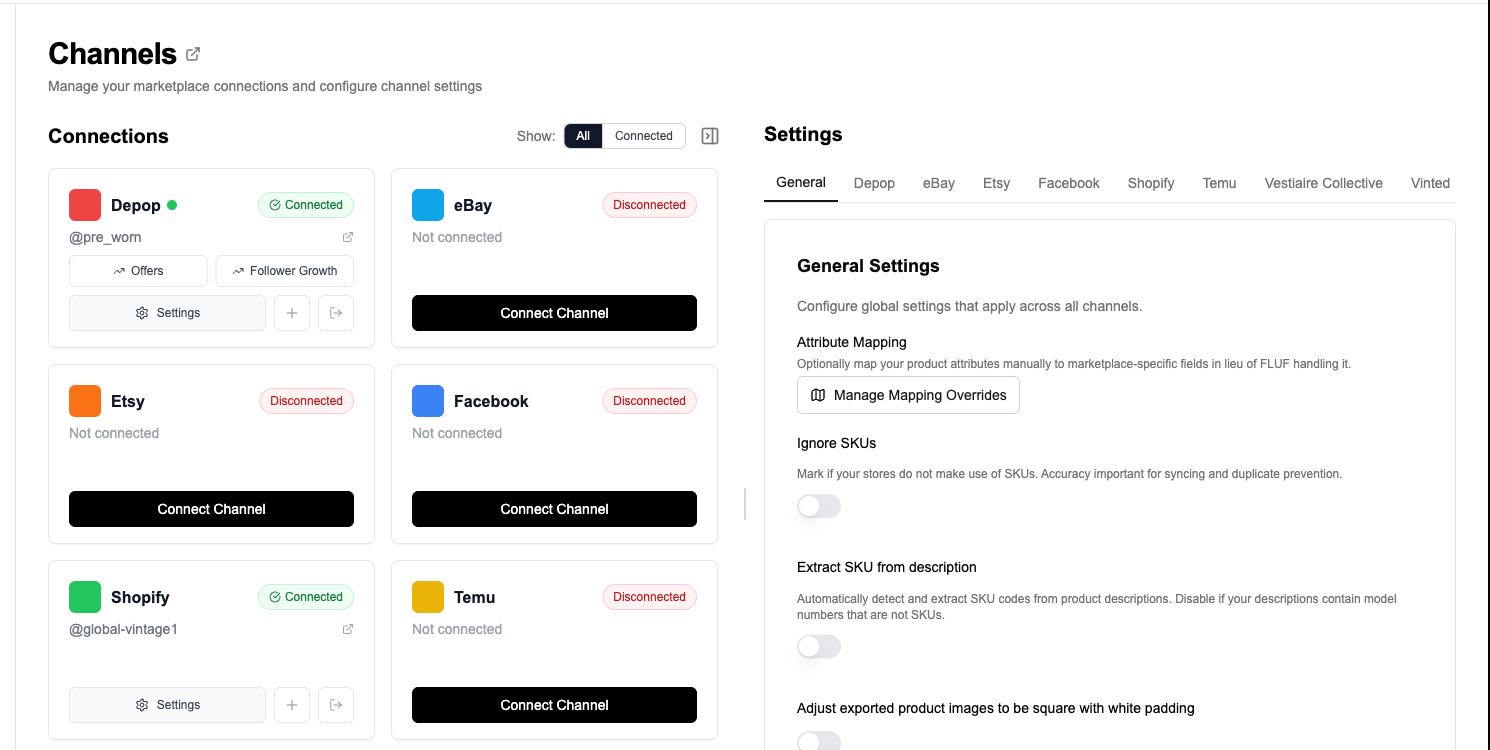
- Connect your store — follow the BigCommerce setup steps in FLUF Connect. No browser extension is required for this channel.
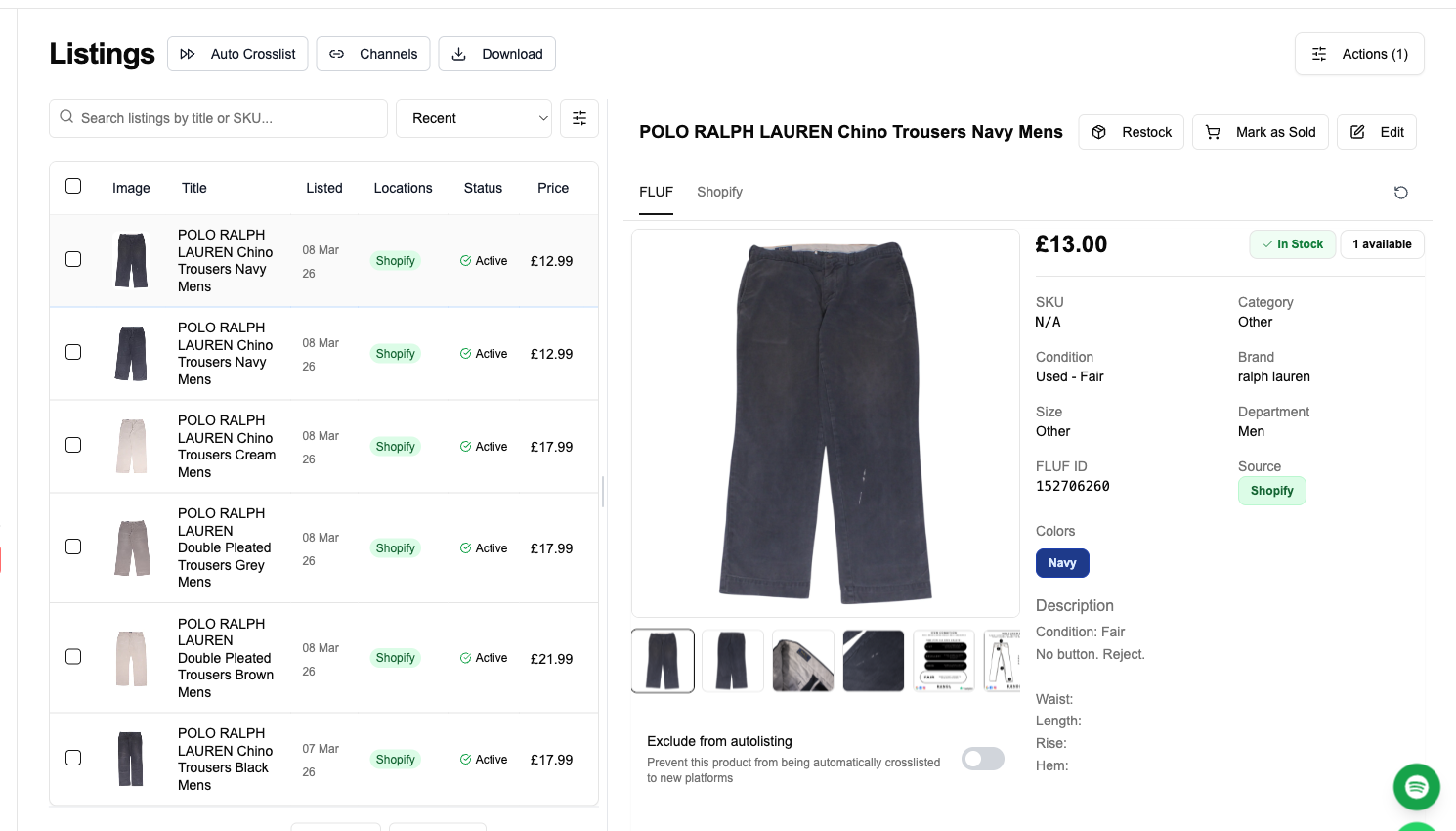
- FLUF reads your catalogue — your BigCommerce products appear in FLUF Connect, ready to push outward, with images and variants intact.
- Crosslist to your chosen marketplaces — select products (or set auto-crosslisting rules by category, brand or price) and FLUF lists them to Depop, eBay, Etsy, Vinted, Facebook and others. When something sells or stock changes, FLUF keeps inventory in sync.
What FLUF Connect supports for BigCommerce
The table below reflects FLUF’s registry-confirmed capabilities for the BigCommerce channel specifically. BigCommerce is a live, public FLUF channel.
| Feature | BigCommerce support in FLUF Connect |
|---|---|
| Crosslisting (as source) | Yes — read your BigCommerce catalogue and list to Depop, eBay, Etsy, Vinted, Facebook & more |
| Inventory sync | Yes — stock kept in step across channels |
| Order sync | Yes — orders tracked for BigCommerce |
| Mark as sold | Yes — sold status reflected back to prevent overselling |
| Auto-relisting | Not on BigCommerce (available on Depop, eBay, Etsy, Vinted, Vestiaire) |
| Offer management | Not on BigCommerce (available on Depop, eBay, Vinted, Yaga, Vestiaire) |
| Bulk operations | Yes — bulk crosslist, find & replace, bulk pricing |
| Connection method | No browser extension required |
Automation that FLUF does support — inventory sync, order sync and mark-as-sold — is included in every FLUF plan, not sold as a paid add-on. FLUF Connect plans start at £9/month on Starter, with Seller (£29/month) and Pro (£99/month) above it — every one of them uncapped. There is no free plan. See full pricing.
Which marketplaces pair best with a BigCommerce store?
- eBay — the broadest audience and FLUF order sync; ideal for almost any catalogue.
- Depop and Vinted — fashion and second-hand discovery, huge in the UK and Europe; a natural fit if you sell apparel.
- Etsy — handmade, vintage and craft buyers with strong purchase intent.
- Facebook Marketplace — vast local and casual-buyer reach.
Multi-channel sellers consistently report that the same inventory sells faster when it is visible in more places — and crosslisting from a single clean BigCommerce catalogue is the lowest-effort way to get there. Explore the full roster on the channels hub or read how the engine works on the crosslisting page.
Sources & Verification
Every non-trivial fact on this page is sourced from BigCommerce’s own documentation or reputable third-party data. FLUF Connect capability claims are confirmed against FLUF’s live channel registry (BigCommerce status: live; order sync and mark-as-sold supported; relisting and offer management not supported for BigCommerce).
- BigCommerce — 2026 Plan & Pricing Update (plan names, prices, GMV caps, Open Payment Provider Fee, 1 June 2026 effective date)
- BigCommerce — 15-Day Trial (15-day, no credit card)
- BigCommerce Developer Center — APIs (REST/GraphQL, headless, API-first)
- BigCommerce Developer Center — Channels & Channel Manager (Amazon, Walmart, eBay, Facebook, Instagram)
- BigCommerce — Headless & B2B features
- Wikipedia — BigCommerce (founding, founders, HQ, history)
- BigCommerce Statistics 2026 (active stores, merchants, GMV, B2B/mid-market focus)
- BigCommerce vs Shopify 2026 (transaction-fee positioning analysis)
- Shopify vs WooCommerce vs BigCommerce 2026 (built-in features comparison)
Crosslist From Your BigCommerce Store With FLUF Connect
Already running a BigCommerce store? FLUF Connect reads your catalogue and pushes it to every major marketplace in one click:
- BigCommerce to eBay
- BigCommerce to Etsy
- BigCommerce to Depop
- BigCommerce to Vinted
- BigCommerce to Facebook Marketplace
- BigCommerce to Shopify
- BigCommerce to Poshmark
- BigCommerce to Vestiaire Collective
Comparing platforms first? Read BigCommerce vs Shopify and BigCommerce vs WooCommerce.
Sources & Verification
Last verified: 2026-06-28. Please contact us if any figure is out of date.
- BigCommerce — 2026 Plan & Pricing Update — plan names (Core, Growth, Scale, Performance), list prices, GMV caps, Open Payment Provider Fee (2.0% Core / 1.0% Growth / 0.6% Scale), 1 June 2026 effective date
- BigCommerce — 15-Day Free Trial — 15-day trial, no credit card, access to standard features before committing to a plan
- BigCommerce Developer Center — APIs — REST/GraphQL, headless / API-first architecture
- BigCommerce Developer Center — Channels & Channel Manager — built-in sales channels (Amazon, Walmart, eBay, Facebook, Instagram) with orders returned to the control panel
- BigCommerce — Headless & B2B features — headless commerce, B2B/wholesale price-list and customer-group features built into the core platform
- BigCommerce — Wikipedia — founding (2009), founders, Austin, Texas HQ relocation (2011), Series A, 2020 Nasdaq IPO, company history
- Chargeflow — BigCommerce Statistics — ~37,000+ active stores, merchant count across 120+ countries, $34B+ annual GMV, mid-market / B2B focus, top-ten platform ranking
- Commerce-UI — BigCommerce vs Shopify 2026 — transaction-fee positioning and fee-analysis comparison
- Gurkha Tech — Shopify vs WooCommerce vs BigCommerce 2026 — built-in-features comparison (functionality included vs paid third-party apps)
For in-person retail alongside your store, see our Square guide. How to sell with Square.
FLUF data This week on BigCommerce via FLUF: 67 sales (-20% vs last week), average sale £180.23, 3,184 active listings (-1%).
Subscribe to the seller news brief
The marketplace news that changes how you list, in one short email.
- Fee, policy and algorithm changes across 60+ marketplaces
- Only the topics you pick — the marketplaces you actually sell on
- Short enough to read in a minute. Daily or weekly, unsubscribe in one click
No spam. We never share your address.
Pick your topics first ›Frequently Asked Questions
BigCommerce charges a flat monthly subscription rather than per-listing or commission fees. The Standard (Core) plan is $39/month billed monthly or $29/month annually, Plus (Growth) is $105/month, Pro (Scale) is $399/month, and Enterprise (Performance) is custom-priced, commonly from around $1,499/month. You also pay your payment processor's card fees (typically ~2.9% + $0.30), and from 1 June 2026 an Open Payment Provider Fee applies only on orders settled through a non-embedded gateway.
Historically BigCommerce charged zero platform transaction fees — its signature advantage over Shopify. From 1 June 2026 it introduced an Open Payment Provider Fee (2.0% on Core, 1.0% on Growth, 0.6% on Scale) that applies only to orders processed through a non-embedded payment gateway. If you use an embedded provider, your effective BigCommerce platform fee is still zero.
No. BigCommerce is a hosted SaaS platform for building your own branded online store, like Shopify. Unlike marketplaces such as eBay, Depop or Vinted, it does not bring you buyers — you drive your own traffic through SEO, ads, email and social. Many sellers run a BigCommerce store alongside marketplaces and crosslist between them.
All three let you run your own store. BigCommerce includes more features out of the box (native B2B/wholesale, multi-currency, faceted search) and historically had no transaction fees, but its pricing is revenue-tiered so growing sales push you to higher plans. Shopify is the easiest to launch and has the biggest app ecosystem; WooCommerce is free open-source software you self-host and control entirely. BigCommerce is the strongest pick for mid-market and B2B sellers.
Yes. Connect BigCommerce to FLUF Connect, import your product details and choose the marketplaces where you want to crosslist. Check each destination for supported inventory updates and sale-sync directions.
Yes. FLUF Connect supports inventory sync, order sync and mark-as-sold for the BigCommerce channel, which is a live, public FLUF channel. Auto-relisting and offer management are not available for BigCommerce specifically (they run on channels such as Depop, eBay, Vinted, Etsy and Vestiaire). Crosslisting, inventory sync and order sync are included in every FLUF plan; relisting, offer management and smart pricing come with the plans above Starter.
No browser extension is required. Follow the BigCommerce connection steps in FLUF Connect.
FLUF Connect plans start at £9/month on Starter, with Pro at £29/month and custom Super Seller plans above that; every plan is unlimited on listings and marketplaces, and the tiers differ by which automations they include and how often we check your channels for sales. Inventory sync, order sync and mark-as-sold are included in every plan.
Yes. As the merchant of record on your own store, you are responsible for collecting and remitting sales tax or VAT and for declaring income. In the UK there is a £1,000 trading allowance before Self Assessment is needed; the EU, US and Australia each have their own VAT/sales-tax and income rules. BigCommerce integrates automatic tax calculation via Avalara and TaxJar, but filing remains your responsibility. This is general guidance, not tax advice — consult a qualified accountant.
BigCommerce is a strong choice if you want a low-fee, feature-rich own-store with genuine B2B and headless capability, especially for mid-market sellers. Its main drawback is that it brings no buyers and its revenue-tiered pricing can move you up plans as you grow. The most effective approach is to use BigCommerce as your branded base and crosslist to marketplaces — via FLUF Connect — for the discovery a standalone store cannot provide on its own.